Awareness of Change

The following is an excerpt from a teaching by Jetsunma Ahkon Lhamo called “The Bodhisattva Ideal”

One of the main thoughts that one hears when one begins to turn the mind toward Dharma is the idea of impermanence.  Now when we hear that all things are impermanent, we take this just as it sounds.  We know from our own experience that all things are impermanent, or at least we know that roughly.  We know that if we buy ourselves a quart of milk that the quart of milk will either sour or be used up.  We know that if we buy a car or a color TV or something like that, that eventually the car or the color TV will break down. Then we’ll have to buy another one and go through the entire process again.  We also know that what is young becomes old, much to our dismay, and that no matter what we do, what we do only works temporarily—what was young becomes old.  We also learn that what is high will become low; what is low will become high.  What is brought together will separate; what is separate will be brought together again.  These aspects of the idea of impermanence we don’t really hold to; we don’t really understand very well.  We try to have a more superficial view of impermanence because the idea is painful.  It’s not our favorite concept.

When the Buddha taught us about impermanence, he taught us about impermanence as a way to understand the faults of samsara, and as a way to understand how suffering is all-pervasive.  Again, as human beings, we like to ignore the idea of suffering.  Of course, when we are suffering and we can feel it very deeply, it’s pretty hard to ignore, but when we are feeling pretty and feeling comfortable, the idea of suffering becomes sort of distant and cloudy.  When we feel up, in a way, we have mixed feelings.  We feel as though it’s always going to be this way and life is pretty good.  But then, by the same token, we’re afraid to feel too up, because we know if we feel too up we’re going to have too far to fall.  It’s odd.  We have this neurotic capacity for seeing the truth, and yet using it against ourselves or hiding it from ourselves. It’s like we know, but we close our eyes because we don’t want to know.

So this particular suffering of samsara becomes to us somewhat hidden; and actually the hiding of this particular truth leads us to many disappointments.  For instance, in the case let’s say, of meeting someone that you love very much, meeting a loved one and coming together with that loved one in some capacity.  Perhaps if it is a romantic relationship, and there is a coming together in marriage or something of that nature.  If it is the coming together of a parent and child such as in the birth of a child, then the parent sees the child and the child sees the parent. The parent, being the elder, has the capacity to perhaps recognize something very familiar about that child, or to feel that this isn’t a new acquaintance, that there is a deep and profound connectionwith this child.

Sometimes people will meet each other in a very casual way and will become instant allies and best friends.  I know that’s happened to each one of us at some point in our lives.  It certainly has happened to me. You meet someone and suddenly this person becomes your ally, your friend, someone who is really a helper to you and who understands; and it feels as though you have been friends for a very long time.

So in each of these cases, when we have these wonderful meetings that bring us so much joy, at that point we like very much to forget that that joy is impermanent. Yet, everything we know and everything we’ve seen teaches us and leads us to believe that everything is impermanent.  We have seen that even in the case of romantic relationships that result in marriage. Should that marriage go really well, then ultimately the bond will be separated through death.  And we know that in the case of parents and child, no matter how close the parent and child are when they are younger, the relationship will evolve and change. In some cases the relationship becomes very distant, unfortunately.  In other cases where that does not occur, then even when the relationship between parent and child stays loving and has mutual concern in it, still eventually one will leave the other.  There will be the separation of death.  The separation of death always happens. Even within that experience of togetherness, there is so much change that you can literally say that two people who married in their twenties are not the same people that are together in their sixties and seventies.  They look completely different. There are worlds of difference between a twenty-five year old and a sixty year old.  There is a vast amount of experiential living and maturity that has occurred. That person at twenty is quite different when they reach sixty, very different.

I remember being in my twenties, and where I was and where I wasn’t.  And I know that I am not the same as I was.  I know that many of my understandings, beliefs, habits, even values have matured and changed.  So it is impossible to think that we will remain in the same comfortable, stagnant condition for the rest of our lives, let alone the fact that we are all separated by death.

Copyright © Jetsunma Ahkon Lhamo.  All rights reserved
Extraordinary Relationship

The following is an excerpt from a teaching by Jetsunma Ahkon Lhamo called “Neurotic Interaction to Guru Yoga”

If we rely purely on an emotional level, not much will come of the path.  If we do not challenge ourselves to truly understand all of the thoughts that turn the mind (and you’ve been taught them many, many times.  You can go back and re-listen to the teachings if you aren’t sure what they are), if we do not require of ourselves to really recognize this precious opportunity, we won’t get very far.  And now the recognition has to go even deeper than that. Number one, understanding that the teacher is a spiritual ally, a spiritual friend—someone on whom you can depend as a spiritual guide or a spiritual friend—is a really important first realization.  Secondarily, you must understand that this reality that you are looking at when you see your teacher, when you see the Buddha, the Dharma and the Sangha, is to be considered separate from ordinary samsaric cause and effect conditions, or separate from the wheel of death and rebirth,  because this is all the result of the Buddha’s teaching which arises from the mind of enlightenment and, like a seed, it must always create a fruit that is appropriate to that seed.  So if this reality rises from the mind of enlightenment, it results in enlightenment as well.  The seed and the fruit are always consistent.

That being the case, this is understood as something different.  Now, if you wish you can, like that Tibetan man with His Holiness Penor Rinpoche regarding his opinion on my enthronement (this student did not agree with His Holiness Penor Rinpoche’s recognition of Jetsunma) waste the opportunity by just playing out your little intellectual ‘here’s my idea, what’s your idea.  I’ll see you as something equal to my common ordinary intellectual mind in the world.  You know, I’ll see you as that.’  Or you can play the game where “O.K., you’re the Guru, so I’m going to call you the real thing, but in my heart, in my mind, I’m pretty much just going to keep doing exactly what I’m doing, but I’ll have a teacher,”  rather than gathering oneself together in order to understand something about this primordial wisdom nature, rather than trying to move further on the path of accomplishing pure view, rather than utilizing the teacher as a way to untangle some of our neuroses and actually seeing the condition of our mind and how different that is from what the Buddha described when the Buddha said simply, “I am awake.”  The Buddha didn’t say, “I’m different from you.”  The Buddha didn’t say “I am better than you.”  The Buddha said “I am awake.”  Awake to that nature that is also your nature.

Now supposing that you could use the relationship with the teacher to puzzle that out, to work that out.  It’s such a fine line how to you give rise to or at least, shall I say not suppress, not give rise to, conflicting thoughts that you may have.  How can you not suppress them and still utilize the teacher faithfully in the best possible way? Not as something common and ordinary that is equal to your own conceptual proliferation because then you could do that with anything.  We do that with all of our relationships.  We do that with all of the areas in life that we work with.  We have preconceived ideas that we play out in our lives.  Why would the teacher be different then?  Why would it be precious?  What’s the value then of having a teacher?

So it becomes the student’s responsibility to harness their mind.  It isn’t about going brain dead.  It isn’t about suppressing your ideas and your thoughts and your feelings.  It’s about recognition between what is ordinary, habitual, definitely part of birth and death cyclic existence, that which arises from ordinary cyclic existence, and always therefore results in more ordinary cyclic existence, or that which arises from the precious primordial awakened state that is also your nature, and therefore always results in that precious primordial state that is also your nature—enlightenment.  You are the one that must make the distinction.

So the Buddha recommends this:  Take a long time determining your relationship with your teacher.  If at first you have an emotional reaction, that’s fine.  You don’t just suppress that either, but don’t stop there.  It’s a big mistake just to stop there, because otherwise you just stay in some kind of wacko bliss thing.  You could get that wacko over a cute little puppy or something, or a new car, or a new honey.  You gets lots more wacko about a new honey, don’t you?  Way more wacko about that!  So your responsibility then becomes the responsibility of recognition.  You have determined that this teacher has the necessary qualities to give you what you need.  You can travel on the path now.  You can understand very clearly.  The teacher has a way of explaining to you and you can understand.  You can hear it.  You mind is opening.  It is ripening.  It’s deepening.  Your compassion is increasing.  Something is happening here and you are able to determine that this is not ordinary because this didn’t come from ordinary experience.

You’re travelling the path of Dharma and this is precious.  This teacher has hooked you onto the path of Dharma, placed your feet there, deepened and ripened your mind, provided for you all of the necessary accoutrements. Therefore this is precious.  You then must determine that this is different for you.  You see, it’s not up to the teacher to provide proof for you.  It’s not up to the teacher to convince you.  It’s up to you to determine for yourself. Take your time, do it right, move through all the foundational teachings and decide for yourself: Is this precious to me?  Then if it is, treat it like it is.

Copyright © Jetsunma Ahkon Norbu Lhamo.  All rights reserved


Responsibility Begins With Recognition

The following is an excerpt from a teaching by Jetsunma Ahkon Lhamo called “Neurotic Interaction to Guru Yoga”

Responsibility begins with recognition.  Simply that.  Recognition.  There are some fundamental truths that must be recognized here in order to stop the game of projecting your own neuroses onto yet another external object.  Because that is not the practice of Dharma.  That is not going to lead you to liberation.  That will continue to lead you to more and more neuroses.  So you must play the game correctly.  The first thing that happens is recognition.  It begins with the recognition of the fundamental foundational truth that we call turning the mind toward Dharma—the faults of cyclic existence, cause and effect relationships, impermanence, these kinds of thoughts, and then the realization that in all the six realms of cyclic existence there is suffering.  Then the recognition that there is the appearance of the Buddha, which brings the element of enlightenment and supreme realization and the visage or face of our own primordial wisdom nature, and  puts that into the world.  That’s the Buddha, the Dharma, which is the Buddha’s method, inseparable from the Buddha like the rays are inseparable from the sun, and the result, which is enlightenment, also inseparable from the Buddha.  You begin to recognize that this has in fact happened.

In the world there is the Buddha.  There is the Dharma.  There is the Sangha, and there is the Lama as the condensed essence of all three.  That recognition alone puts you into position where you have to choose between continuing in samsara and neurotic redundancy which is what samsara really is.  Isn’t that a great term?  Neurotic redundancy.  Don’t you just love that?  Neurotic redundancy,.Or you can choose Buddha, and Dharma, and Sangha—this three-legged stool, or chariot we should say, by which we travel through the door of liberation into enlightenment, into realization, the precious awakened state that the Buddha named.

So we’re in a position now where we make that choice.  That choice is based on this recognition.  You can’t make that choice on an emotional level.  Big mistake!  And some people try to do that.  They come to the temple and they say, “I like this stuff!  It’s all weird.  I like the colors.  I like the shape.  I like the material over there.  Look how they built that up there.  Isn’t that cute?  Those books… You know, I like that they don’t turn this way.  I like that they turn this way.  It’s so exotic.  I think it’s really cool, don’t you?  And then all the statues and crystals!  Look at this!  This is really cool to be with the crystals!” Really I’m describing a silly mindstate, but many students, when they first begin, will come here and say, “Oh this stuff is so cool.  I really want to do this.  O.K., you’re my teacher.”  So on that emotional level, really not much has happened.  Or they might come in and have an emotional reaction.  I’ve seen that happen too.

In fact, this is another story that you’ll be amazed at.  This is an amazing story. A woman once walked into the bookstore.  I happened to be there, checking out the earrings as usual!  So I was in the bookstore and she turned around.  She got immediately who I was.  She had never been around Dharma before, knew nothing about Dharma, knew nothing about anything like that and she just was entranced.  She was transfixed.  She looked at me and then she did three perfect prostrations. Then when she got up she said “I don’t know what that is.  I don’t know what I just did.”  No idea what happened there, no idea.  And then I never saw her again.  And she was crying, crying, just like “My teacher.  My teacher at last!  My teacher!”  Crying.  Big emotional thing, and I never saw her again.

What happened there was unfortunate.  I would call that an obstacle to her practice.  She obviously had enough inner purity to remember a former relationship with her teacher.  Something bled through and yet the obstacle was that she could only, in that moment of meeting, relate on a purely emotional level.  She could not lay down the foundation.  She could not make any connecting thought.  Really, as beautiful as that story is, it broke my heart that she never came back.  It really did.  I love you all, but I have to tell you I have many stories about the ones that got away!  You see, she could have been very close to me and it broke my heart that she didn’t come back.  But what you’re seeing there is just purely an obstacle.  She was only able to relate on this emotional level, and really, it’s not that much different from what you see your dog do when your dog barks to go out or sits there looking at the door.  It is an immediate emotional hit that you’re just overwhelmed with.  It’s not that different from what animals do.  But animals can’t practice Dharma, because what’s needed here is to make these connecting thoughts, these cause and effect thoughts, by creating the kinds of awareness and thinking that causes you to move into a deeper level on the path, and causes you to get the lay of the land, to really get what’s going on here.

This is what’s necessary.  She was not able to, at that time, to think of the faults of cyclic existence, to think of impermanence and that this opportunity might not come again.  She was not able to think “Now that I’ve found my teacher, I have found a way to travel the path of Dharma and pass through the door of liberation.”  Just not able to think like that.  This is a big obstacle that arose in her path at the same time as the blessing of meeting with her teacher again.  So this is the difficulty that we all have, but now we are here and we are in a learning and teaching situation.  We’re in a situation where we have time to think.  We have the leisure to think.  We have the ability to put two and two together, and this is how we have to approach the path.  This is how we have to do this.

Copyright © Jetsunma Ahkon Norbu Lhamo.  All rights reserved

Navigating the Path with Guru Yoga

The following is an excerpt from a teaching by Jetsunma Ahkon Lhamo called “The Guru is Your Diamond”

Should it happen that we cannot meet with the Guru for some reason, or there is some difficult point in one’s path, some difficult moments, some difficult times, maybe even some difficult months or years, still, so long as the Guru remains in the world, we can turn our face towards the Guru and know.  It’s like falling off a horse.  You can always get back on.  But the problem is—and there is a problem with that—if you waste your time with that precious jewel and don’t collect its interest, the jewel somehow becomes more distant, less potent, less present, less precious, less everything.  And we think to ourselves, “Why is the Guru not in my life so much?”  And we tend to think, “Oh, it’s because the Guru’s over here or the Guru’s over there, or the Guru is not speaking right now, or the Guru is this, or the Guru is that.”  And you can think that way if you want to but it won’t help.  We must think, “Now I’ve come to this place.  I have chosen my Guru and I am steadfast.  I have seen the door of liberation.  Yet somehow things are a little mixed up here, I can’t quite get to it.  I don’t feel focused.  I don’t feel like I understand this blessing.  I feel outsourced.  I feel like I’m out to lunch somewhere on the Path here.”  And so we think, “Oh, what is the problem?”

Well, the first thing we have to do is correct our view and think, This is the door to liberation.  It is present in the world.”  Period.  End of story.  “What must I do?  What must I do?” Sometimes it takes traveling to see your Guru.  Sometimes it takes sitting down and doing Guru Yoga like you never did it before.  It can work out a myriad of ways according to one’s karma, according to one’s blessing.  I’ve had it both ways.  I’ve traveled to see my Guru and the blessing was immeasurable and phenomenal.  And then I’ve stayed home and practiced Guru Yoga and with amazing signs. The blessing was amazing and fundamentally life changing.  And one, I saw the Guru’s face; and one, I saw the Guru’s face.

That’s the nature of this blessing.  It doesn’t depend on time and space.  It doesn’t depend on ordinary things at all.  And unless you neglect it, it cannot lose its potency.  We must think, as pertaining to Guru Yoga, that everyday, even while now we sit in comfort and enjoy being together, that everyday, even this day, we should earn the blessing to see the Guru tomorrow.  How will I see the Guru?  Maybe I’ll see the Guru’s picture and it will jump out at me and touch my heart.  Maybe I’ll see Guru Rinpoche’s picture and it will jump out at me and touch my heart.  Or maybe I’ll say The Seven Line Prayer. And wow, that one really…, that one did it.  Or maybe I will do my practice and it feels deep and rewarding like an underground stream that has come suddenly to the surface and has given us something precious to drink.

Guru Yoga can always be depended on to reestablish and continue the blessing.  I promise you, if we call out to the Guru with a full heart, with determination and with fervent regard and recognition, the Guru will respond, whether it’s in the way that you would like which is “Hi I’m here for lunch.” Or whatever.  It may not be that way.  It may be something quite different.  And sometimes it’s not something that feels good right away.

I’ve seen one of my favorite students work herself to death and forget to practice sometimes and then periodically she does things like break her back or, you know, injure herself in some way.  And then she practices and amazing things happen.  I wish she wouldn’t do it that way, but she does.  You know who I’m talking about, out in Sedona.  I have other students that kind of orchestrate separation and return in order for that feeling of return.  But I wish they wouldn’t do that because that feeling of separation often comes with some cause and effect relationship.  Again if it were my diamond, I’d be shining it up all the time. I’d be collecting that interest all the time.

We use Guru Yoga that way to create the causes for continuation on the Path.  The teacher should never be frightening.  The teacher is your friend.  Your friend who will take your hand and walk you, lifetime after lifetime, even when you stumble and you fall.  Something will arise through the devotion that you practice in this lifetime, to protect you even in your next life.  So eventually we come to the place where we see everything as the blessing of the Guru.  Everything.  Sometimes we feel some confusion, and maybe even feel confusion for a long time; but you know that that Guru would not let you down.  You know that.  And so you count on that, even the confusion, to be a blessing.  Eventually because of that devotion, the confusion will clear and the Guru will appear, again like an underground spring coming once again to the surface.

Copyright © Jetsunma Ahkon Norbu Lhamo All rights reserved

Understanding the Nightmare – by His Holiness Penor Rinpoche

The following is an excerpt from a teaching by His Holiness Penor Rinpoche on “Meditation” reprinted with permission from Palyul Ling International:

And there are many, many beings that don’t know much about Buddha or Enlightenment or the Dharma teachings or liberation. They really don’t have any idea of such things. Even with all the explanations we could find in these Dharma teachings, and even though so many lamas and other qualified teachers give these teachings, still one might think that these teachings are just myths. And so you can’t truly accept them or believe in the absolute reality.

Everything is based on what is called the Law of Karma which is the actions that we do, the causes and conditions we create ourselves. Furthermore there is a Law of Karma which is known as the Collective Karma, the actions, causes and conditions we create together. There is no way we can change ourselves other than understanding Karma. Moreover, when one cannot understand all these deeper things, then one thinks that these things do not really exist.

When the lamas and the many other qualified teachers¹ teach on the sufferings of Samsara, of course it is not really nice to hear and then one feels like, “I don´t want to hear these kinds of teachings.” Certain people when lama gives these teachings on suffering even say, “I’m not interested to listen about the sufferings of Samsara. This lama doesn’t seem like he can give out good teachings!” These people prefer to just express their own ideas.

However, when taught by a qualified lama, it is indeed the Dharma, the truth. These teachings about the nature of Samsara and the reality of the faults of Samsara have been taught by all the Enlightened Beings such as Shakyamuni Buddha. The Enlightened Beings, the Buddhas, all gave these teachings because if we could just understand the nature of Samsara, we could then move on to the actual practices through which we could purify our obscurations. We could have the ultimate realization through which we achieve peace and happiness, and through that we could manifest ourselves to benefit all other sentient beings in Samsara. For that purpose Buddha gave all these teachings. It is not that Buddha wanted to be famous and so gave these teachings, nor was the Buddha showing off his skills in teaching, nor was he explaining things to us so that we would become frightened. These teachings are mainly about how all sentient beings can believe and act to attain complete Enlightenment, to liberate themselves from the sufferings of Samsara. So you see, Buddha gave these teachings with great compassion.

Take the example of a having a nightmare. Within such dreams, no matter what you do, you still cannot escape the scary feeling of a nightmare until you wake up. At the same moment, someone who is awake and watching beside the bed, can see that you are having a dream. We can understand something of the nature of Samsara from this dream example. While we are in Samsara experiencing all different kinds of sufferings, it is exactly like somebody who is having a nightmare.

The Beginning

images

The Beginning

I am Love,

I pour myself out

on the waters…

And the Earth.

Over time and space

I pour, I am,

never ending.

I encompass all

unto Myself.

I am pregnant with

Creation.

I penetrate all.

I am fulfilled…

Love.

I am Light.

The Light of the One…

Of the All.

Radiant, life-giving,

I am…

To BE.

I declare my Self

In all things

And it is so.

I find my Self

in Creation

and bear my Self

forth

triumphant!

And all is perfect

because I am.

Light.

I am Spirit.

I am the song and the

Breath

of the Infinite.

The sound and essence

of the most subtle

One.

I bring to you your birthright

on silent, soaring

wings.

Behold, I come quickly.

Look within.

I am here.

I speak to you,

from deep within you.

And now you hear me.

You let me heal you.

You let me radiate from you

You let me claim you as

My own.

Let us make a pact,

You, who I am.

To know our oneness.

To renounce duality.

To know only Truth.

For I speak to you

Even as you call

To Me.

“Awaken… Awaken…

This is the beginning.”


© Jetsunma Ahkön Lhamo

Putting Out the Fire: Turning the Mind Towards Dharma by HH Penor Rinpoche

The following is an excerpt from a teaching given by His Holiness Penor Rinpoche at Kunzang Palyul Choling on Bodhicitta:

We start first with the special method that will turn one’s mind towards the Dharma.  In that method, we have to understand that wherever we are born in the world, in this universe, there will not be much happiness.  There is hot and cold suffering in the hell realms, and the hungry ghosts have the suffering of hunger and thirst.  The animals have the suffering of killing each other.  The human beings have a short lifespan, and within that short life, there is a lot of suffering.  Even those god beings in the god realms have a very good life there, but because of their carelessness, they are just spending and wasting their lives with happiness.  The sentient beings in this world have their own sufferings.  It is important, the Buddha said, for you to understand that wherever you are born, there is no happiness.  There is suffering.

When you understand that, then in order to remove the suffering, you need to have diligence to remove the suffering, like the diligence you do when your hair is burning, when your dress is burning.  During that time, you will put all your efforts toward removing the fire.  Similarly, once we have understood the suffering of samsara, of the world, then we have to really put some kind of diligence toward removing the suffering of samsara. Then if our hair is on fire and our dress is on fire, then we will not really remain peaceful.  We will definitely do something.  So, similarly, once we understand the suffering nature of samsara, we will not waste our time.


A Variety of Stupas

An excerpt from a teaching called Cosmology of a Stupa by Tulku Sang-ngag Rinpoche

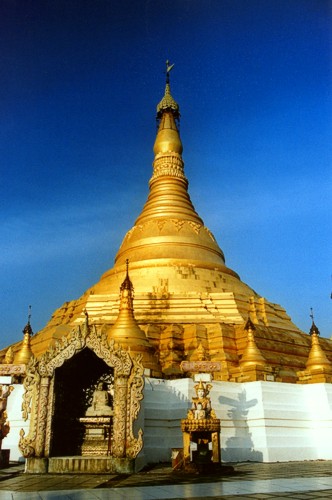
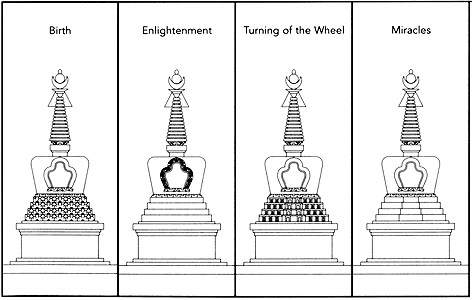
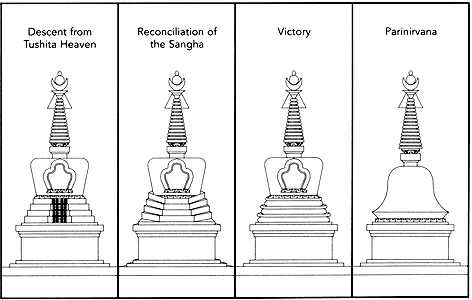
Stupas can be roughly divided into two categories – Theravada or Hinayana stupas, and stupas in the Mahayana tradition.  There are further subdivisions of those stupas, with different shapes and designs.

In the Hinayana tradition, there are stupas that are roughly in the shape of the Buddha’s body, some in the shape of his robes, some in the shape of his alms or begging bowl, and some in the shape of his throne or in the shape of a staff.  There are different renditions.

BurmeseStupa

In the Mahayana tradition, there are eight principle stupas.  At the time after the Buddha was cremated, his relics were divided into eight piles and given to eight different great kings who made stupas for those relics.  According to the great teacher, Nagarjuna, there are eight principle stupas that perform eight different functions.

These eight principle stupas in the Mahayana tradition commemorate the great deeds of the Buddha’s life, from the time when he was born till his passing into nirvana.  For example, there is a stupa that commemorates his birth, that moment just after his birth when he took seven steps in the four directions.  Each time he took a step, a lotus flower blossomed under his foot. And so, there is a stupa that commemorates the birth of the Buddha.

stupa-types-1stupa-types-2

There is a stupa that commemorates the fact that the Buddha studied a whole variety of topics in his youth and mastered them all.  There is another stupa called the auspicious many-gated stupa.  The Tashi Gomang stupa celebrates the fact that the Buddha descended back down from Tushita Pure Land, where he was teaching his mother.

In the Vajrayana tradition, the tantric vehicle, there are specific stupas that accomplish particular purposes.  For example, there are the four main types of stupas for pacification.  Some are to magnetize.  Some are to increase, increase prosperity and merit, and others are for more wrathful activities. There are different shapes that the stupa can adopt, but the fundamental meaning is the same – stupas represent the enlightened body, speech and mind of the Buddha.  The stupa primarily represents the enlightened mind of the Buddha.

The Benefits of the Awakening Mind

1000 Armed Chenrezig Mandala

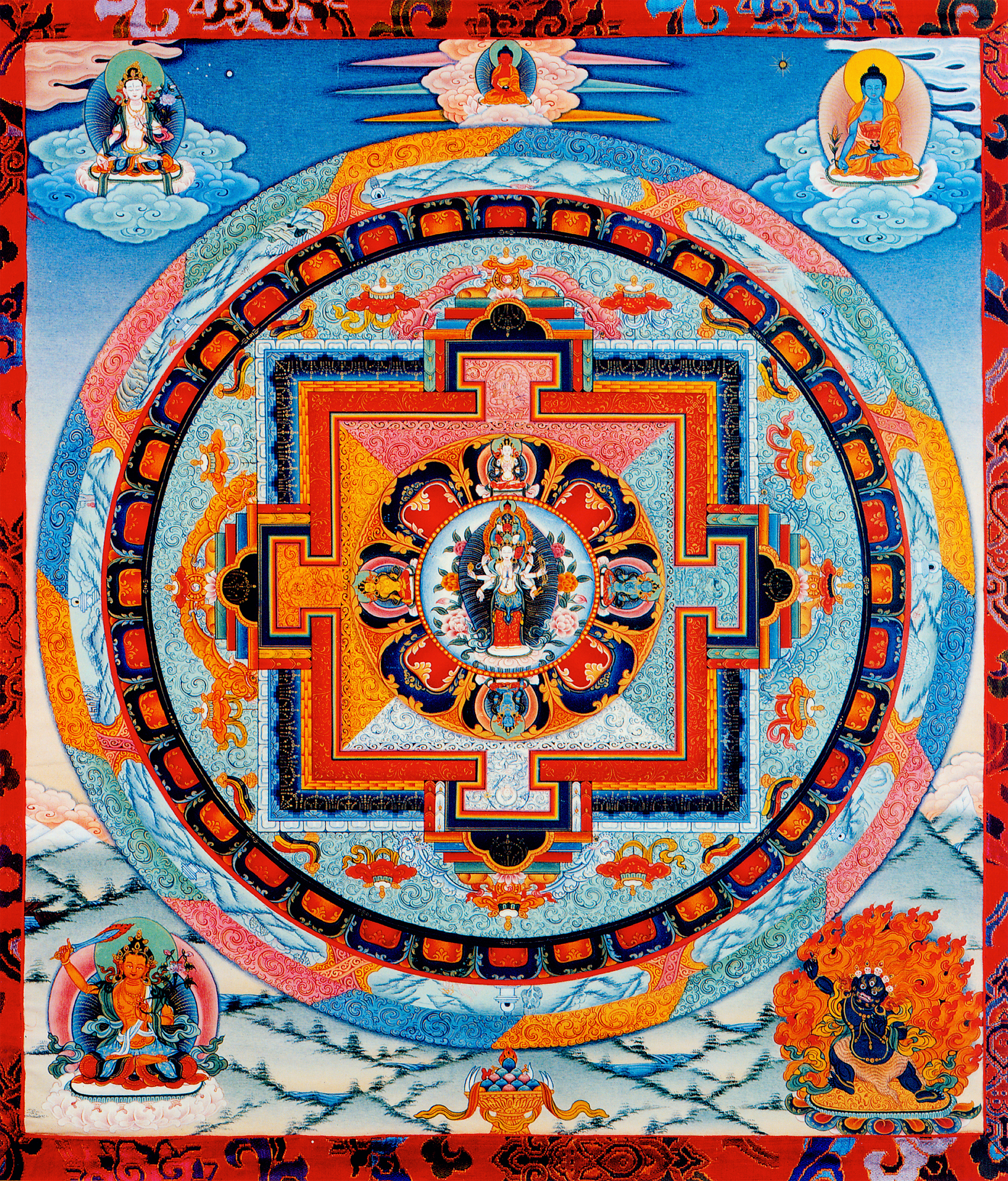
Here is another excerpt from the first chapter of A Guide to the Bodhisattva’s Way of Life called “The Benefits of the Awakening Mind.”  May these words written by Shantideva inspire all who encounter them.

#26

How can I fathom the depths

Of the goodness of this jewel of the mind,

The panacea that relieves the world of pain

And is the source of all its joy?

#31

If whoever repays a kind deed

Is worthy of some praise,

Then what need to mention the Bodhisattvas

Who do good without it being asked of them?

#32

The world honors as virtuous

One who sometimes gives a little, plain food

Disrespectfully to a few beings,

Which satisfies them for only a half a day.

#33

What need be said then of one

Who eternally bestows the peerless bliss of the Sugatas

Upon limitless numbers of beings,

Thereby fulfilling all their hopes?

#34

The Buddha has said that whoever bears a harmful thought

Against a benefactor such as a Bodhisattva

Will remain in hell for as many aeons

As there were harmful thoughts.

#35

However, if a virtuous attitude should arise (in that regard),

Its fruits will multiply far more than that.

When Bodhisattvas greatly suffer they generate no negativity,

Instead their virtues naturally increase.

#36

I bow down to the body of those

In whom the sacred precious mind is born.

I seek refuge in that source of joy

Who brings happiness even to those who bring harm.

WP2Social Auto Publish Powered By : XYZScripts.com