From Samuel Long:
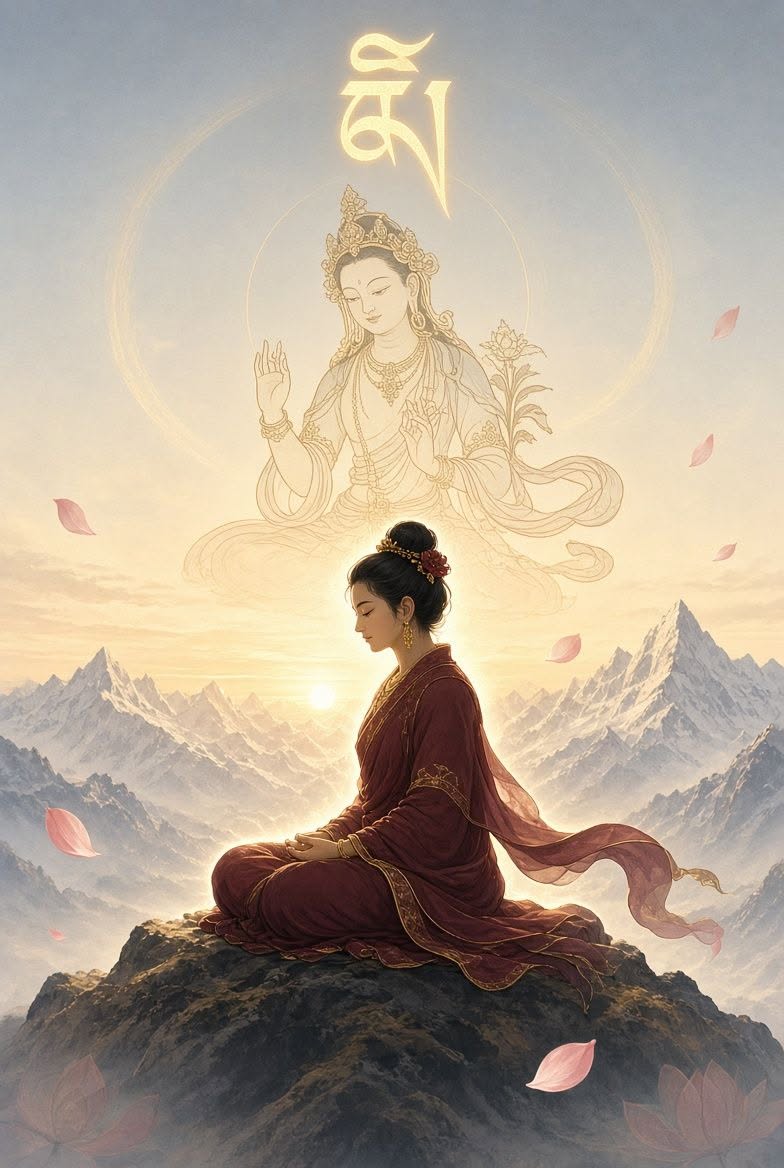
In the rugged highlands of eastern Tibet during the latter half of the seventeenth century, a luminous figure arose within the Nyingma Tradition whose life embodied the seamless union of profound realization and compassionate activity. Jetsunma Ahkön Lhamo—also known as Genyenma Ahkön Lhamo or Ah Kham Lhamo—was revered as a human emanation of Arya Tārā, the holy mother of all the Buddhas. As the youngest sister of Rigdzin Kunzang Sherab, the first throneholder of the Palyul lineage, her existence was interwoven with the founding and flourishing of one of the six great mother monasteries of the Nyingma school. Through unwavering practice, visionary insight, and the establishment of a thriving community of nuns, she left an indelible mark on the Dharma that continues to resonate across centuries.
She was born in the province of Do Kham (Dokham), in the Achok Drolhe (or Achog Dro Lhae) village within the Bubor Range of the Palyul region in what is now Garzê Tibetan Autonomous Prefecture. This land was said to possess all ten auspicious signs of a sacred place. Her father, Dorje (or Dorjee), belonged to the highly revered Mutsaga (Mutsa Ga) family lineage. Her mother, Gurutso (Guru Tsho or Gurutso), was recognized as a wisdom dakini. Born in the later part of the eleventh Rabjung cycle of the Tibetan calendar—corresponding roughly to the second half of the seventeenth century—she entered the world amid many amazing signs. As the younger sister of the great Vidyadhara Rigdzin Kunzang Sherab (1636–1699), her destiny was bound from the outset to the preservation and expansion of the Buddha’s teachings in Kham.
From earliest childhood she displayed extraordinary aptitude. She mastered reading and writing with effortless ease, requiring little formal instruction. Alongside her brother, she received profound teachings from some of the most luminous masters of the era. Principal among them were the treasure revealer (tertön) Namchö Mingyur Dorje (1645–1667), whose pure-vision “Sky Dharma” (Namchö) revelations would form a cornerstone of the Palyul tradition, and the great scholar-practitioner Khedrup Karma Chakmé (Karma Chagme, 1613–1678), regarded as an emanation of Chokro Lüi Gyaltsen. Under their guidance and that of other accomplished scholars and mahasiddhas, she attained flawless mastery of both Sūtra and Tantra, particularly the vast cycles of tantric practice. Through the wisdom of hearing and contemplation she dissolved all residual doubts.
Yet intellectual mastery was only the beginning. Jetsunma Ahkön Lhamo dedicated herself to intensive, single-pointed meditation in secluded and sacred places. In these retreats, meditational deities appeared to her in vision and granted direct instructions. Through rigorous practice she purified all illusory phenomena—the ordinary dualistic perceptions of self and world—into the expanse of non-conceptual, primordial pure awareness. She realized the highest states of awakening and became a ruler of the realm of Kuntuzangpo the Bodhisattva Samantabhadra), the primordial Buddha of the dharmakāya. Sources describe her as an accomplished yogini on outer, inner, and secret levels who spent her life in practice, attaining the complete fruition of the path.
Her realization found concrete expression in compassionate activity for others. On a mountain ridge east of the newly established Palyul Namgyal Jangchub Choling Monastery (founded in 1665 by her brother under the patronage of the King of Derge and in accordance with prophecies linked to Mingyur Dorje), she gathered a vast community of female disciples. There she unceasingly turned the wheel of Dharma, teaching and guiding them with tireless dedication. The settlement grew into a large nunnery known locally as Jogondong (or Jo Gon Dong / Jogon Dong)—“nunnery on the ridge.” Because of the sea of maroon robes worn by the great assembly of nuns, the surrounding region came to be called Drongmar Teng (or Dongmar Teng / Upper Red Village)—the “red knoll village.” Through her dual mastery of teaching and practice she ripened the minds of countless students, shaping generations of highly realized practitioners and scholars. She was instrumental in helping stabilize and expand the nascent Palyul lineage alongside her brother.
When she perceived that her activities to benefit the doctrine and her disciples had reached the limits of that lifetime, she passed into the peaceful state of dharmatā (or dharmadhātu). During the cremation of her holy body, an extraordinary sign of realization manifested: her skull (kapala) miraculously flew into the sky and landed directly upon the teaching throne of her brother, Rigdzin Kunzang Sherab, at the place where he customarily gave Dharma teachings—some accounts specify a distance of about three kilometers from the cremation site. This event permanently hallowed the ground, establishing it as a sacred cemetery (dur trö) where all subsequent revered lamas of the Palyul Monastery would be cremated. Her skull itself became one of the most treasured relics of the lineage. It was used as a skull cup (thöyab or kapala) to hold nectar (dutsi) during major accomplishment ceremonies (drubchen) to invoke her continuous blessings. Remarkably, the interior of the kapala displayed self-arisen images of Buddhas, dakinis, and mantras, including the sacred syllable “AH” at the crown—a sign of the highest realization of the empty nature of self and phenomena.
The relic’s history continued into the modern era. During the upheavals of the mid-twentieth century, most of the kapala was destroyed, yet one piece bearing the “AH” syllable was preserved by a local man who kept it for decades. In 1987, after His Holiness the Third Drubwang Padma Norbu (Penor Rinpoche) recognized an American woman, Alyce Louise Zeoli (born 1949 in Brooklyn), as the reincarnation of Genyenma Ahkön Lhamo, this remaining fragment was presented to him. The following year, during her formal enthronement as Jetsunma Ahkon Lhamo at what became Kunzang Palyul Choling – KPC Buddhist Temple in Poolesville, Maryland—the first time a Western woman was both recognized as a tulku and enthroned as a Palyul lineage holder—Penor Rinpoche bestowed the precious relic upon her. It remains enshrined there as a living link to her previous realization.
Thus the life of Jetsunma Ahkön Lhamo stands as a radiant example of the feminine principle of enlightened activity within Tibetan Buddhism: the inseparable union of transcendent wisdom and boundless compassion. From the remote ridges of seventeenth-century Kham to the continuing stream of the Palyul tradition, her blessings endure—invoking the swift, motherly protection of Tārā for all beings who encounter her story.
Buddhist Dedication
By the merit of recounting
the life and liberation of Jetsunma Ahkön Lhamo,
the emanation of Arya Tārā and founder
of the first Palyul nunnery,
may all beings swiftly attain the pure awareness
of non-conceptual primordial wisdom.
May the lineage of Palyul flourish without interruption,
and may every being, limited only
by the bounds of space,
be liberated from suffering
and attain complete enlightenment.
Om Tāre Tuttāre Ture Svāhā
References
Tibetan Buddhist Altar: “A Brief Biography of the First Ahkön Lhamo” (sourced from The Pure Land of Dharma, General History of the Namdroling Monastery’s Tsogyal Shedrub Dargyeling Nunnery). https://www.tibetanbuddhistaltar.org/a-brief-biography…/
Tibetan Buddhist Altar: “Jetsunma Ahkon Lhamo from Palyul History” (from the History of the Palyul Lineage by Tulku Thubten Palzang). https://www.tibetanbuddhistaltar.org/jetsunma-ahkon…/
Kunzang Palyul Choling: “A Treasured Relic in the KPC Maryland Prayer Room.” https://www.tara.org/…/a-treasured-relic-in-the-kpc…/
Wikipedia: “Jetsunma Ahkon Lhamo” (section on Genyenma Ahkon Lhamo). https://en.wikipedia.org/wiki/Jetsunma_Ahkon_Lhamo
Palyul.org: Lineage pages on Rigdzin Kunzang Sherab and the Palyul tradition. https://palyul.org/
Tibetan Buddhist Altar: “Vidyadhara Kunzang Sherab.” https://www.tibetanbuddhistaltar.org/vidyadhara-kunzang…/
Additional historical context drawn from accounts of Namchö Mingyur Dorje and Karma Chakmé in The Treasury of Lives and related Nyingma lineage sources.


