Life On The Merry-Go-Round

An excerpt from a teaching called Awakening from Non-Recognition by Jetsunma Ahkon Lhamo

According to the Buddha’s teachings and according to everything that we can surmise from the information we receive as we travel along the path, we as sentient beings, are in a state of non-recognition. When you hear a term like “non-recognition,” it’s hard to really understand what it means. When we think of the word “recognizing,” we think in superficial terms such as “I recognize you” or “you recognize me.” We recognize people with whom we are familiar.

That concept still holds true, but there needs to be a deeper, more able way to understand what non-recognition means. According to Buddhist philosophy, we contain within us the seed that is the Buddha nature. It is not smaller than the Buddha’s nature. It is not bigger than the Buddha’s nature. It is not different from the Buddha’s nature. It is the same. It is that nature inherent within us that is the primordial wisdom state or the natural ground-of-being that is our nature. As we move toward enlightenment, we don’t construct that nature. It doesn’t become complete. It doesn’t become bigger. It simply is what it is, but we move from a state of non-recognition into a state that the Buddha clearly described as being awake. And that’s the only difference.

In our culture we tend to think in a materialistic way even about things that are very subtle, very pure, very profound and very spiritual. We tend to think that perhaps the Buddha or a great Bodhisattva or even one’s teacher has a bigger Buddha nature than we do. Somehow their Buddha nature is bigger and maybe more muscle-bound, more fit or stronger than ours. At the risk of being crude, we wonder if the teacher’s isn’t bigger than ours. According to the Buddha’s teaching, that is not the case. The simple difference is recognition. One Buddha nature is not different from another.

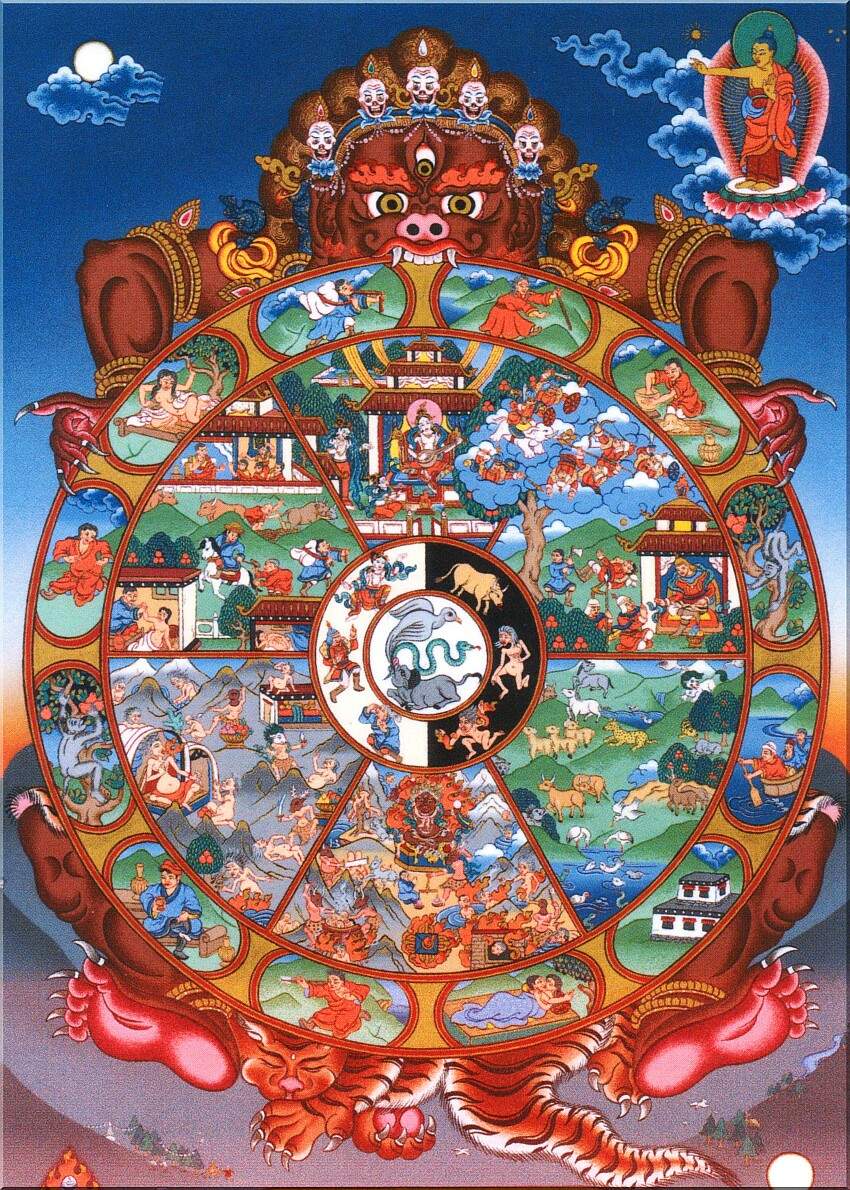
As ordinary sentient beings we are locked in the state of non-recognition, and that non-recognition is so all-pervasive that it becomes invisible. It’s like being born on a merry-go-round. If no one ever stops the merry-go-round and you spend your whole life on the merry-go-round, you will never know that you’re on it. You will never know anything other than that reality. Our condition of non-recognition is very much like that. It has always been this way. We project everything outward onto a screen. We know no other way to be aware. So that is the dilemma of sentient beings. We wish to awaken as the Buddha is awake. We wish to come to understand our true nature, our primordial wisdom nature, which is the ground-of-being, and yet we are locked in a state of non-recognition.

© Jetsunma Ahkon Lhamo

Wishing Prayers

An excerpt from a teaching by Jetsunma Ahkon Lhamo called Compassion is the Only Lasting Antidote to Suffering

In Vajrayana Buddhism (literally the Diamond Vehicle), which is the form of Buddhism preserved in Tibet and Mongolia and the one followed in my temple, one of the foundational teachings is the understanding and practice of compassion.  I personally find that a religious philosophy based on selfless compassion is deeply satisfying, and I believe that it strikes a chord with many Americans.

However, although there are many people who embrace the idea of compassion as love and a deep caring for others, they do not realize that to actualize the mind of Great Awakening requires a deliberate and disciplined path.  Human beings are not born with great compassion automatically realized.  Thus, the Diamond Path can be described as a technology for spiritual development.

From the Buddhist point of view, there are primarily two ways to approach compassion: aspirational compassion and practical compassion.  When one begins to practice on the Diamond Path, one begins straightaway to make wishing prayers, cultivating the idea of being of benefit to beings who are revolving helplessly through cycles of existence.   This is aspirational compassion.

Every practice in which we engage, every teaching we hear, every empowerment we receive, every prayer we chant, can all be dedicated to the liberation of all beings from all forms of suffering. Thus, aspirational compassion is practiced in the beginning by many repetitions of wishing prayers.  These prayers are meant to benefit beings through developing the sincere desire to utilize all one’s activities — from the mundane to the sublime — as a means of eliminating the causes of suffering in all its forms.  One prays for the cessation of war, poverty, sickness, death and rebirth, loneliness, hatred, greed and ignorance.  One adopts a posture of pure intention based on the idea that every portion of this life, as well as future incarnations yet to come, might somehow be useful to sentient beings.

As an example of this type of wishing prayer, I will paraphrase a famous practice:

If there is a need for nourishment, let me return as food.  If there is a need for shade, let me be a tree.  If there is a need for shelter, let me be a house.  If there is a need to cross over, let me be a bridge.  If there is sickness, may I manifest as the doctor, the medicine and the nurse who restore health.  May I be land for those requiring it, a lamp for those in darkness, a home for the homeless, and a servant to the world.

While this may sound very kind and loving, the intention here goes far deeper than the apparent words because one must strive to be of benefit not only to fulfill the immediate needs of beings, but also to bring future benefit.  Providing things such as food, housing, and medicine bring about benefit, of course, and this type of kindness is profoundly virtuous.  We should all strive to meet the needs of others in just these ways.  Yet, from a Buddhist perspective, being able to practice only this type of compassion does not bring ultimate benefit.  For instance, if it were possible to feed an entire nation or perhaps even the world and completely eliminate hunger and hopelessness, we still would not be solving the root of the problem.

According to the Buddha, there is no condition or circumstance without a cause.  Just as the fruit does not manifest without first appearing on a tree, which came from a seed, neither does any circumstance, good or bad, in which we find ourselves manifest without a cause.  These causes may not be found in this life only, but may come from previous lifetimes.

It is not possible for people to be born randomly into difficult circumstance or to suddenly experience the onset of tremendous suffering and upheaval.  These events are always the result of a tapestry of cause-and-effect relationships (karma) woven around the delusion involving the definition and maintenance of an ego.  Thus, to solve the immediate needs of beings may bring some relief, but it does not guarantee that they will not experience great difficulty in the future, because it does not break the continuum of cause and effect that ripens unexpectedly and constantly.  This continuum originates from the belief in an ego self and the desire that results from that belief.  It is through the pacification of desire that one can begin to transform one’s karma.  When the delusion of ego begins to dissolve, karma also begins to dissolve.  But if the mindstream is not purified of the karma of suffering, the potential for suffering remains.

© Jetsunma Ahkön Lhamo

Devotional Yoga

An excerpt from a the teaching, When the Teacher Calls, by Jetsunma Ahkon Lhamo

In Buddhist tradition and particularly in Vajrayana Buddhism, there is a kind of practice called devotional practice. One of its most meaningful and foundational aspects is developing a relationship of pure devotion with one’s lama or teacher. In Vajrayana, the teacher is considered to be the door to liberation because even though the Buddha was once on the earth and even though the Buddha’s teachings are written in books, it is just about impossible to enter onto the Path without the blessings of the teacher. The lama, who is necessary for empowerment, transmission and teaching, is considered to be the blessing that is inherent in the Path.

In the Vajrayana tradition there is a devotional aspect to every practice that is done,from the most preliminary to the most superior practice, and it is considered to be the means by which blessing is actually transmitted. In the Nam Chö Ngöndro, the preliminary practice accomplished at this temple, there is a beautiful song of invoking the lama’s blessing called “Calling the Lama from Afar.” It has haunting melody, and it is done from one’s heart in order to soften the ego and make the mind like a bowl ready to receive any blessing.

This type of practice functions like a cultivator. Think of planting a field of grain.  One has to plow the field and work the soil so that it’s capable of receiving the seed.  Otherwise, if the soil were not ready, when seed was thrown out it would just bounce, as on a hard surface. Likewise, devotional practice is considered to make one ready. Its benefit is immeasurable. Without it there is no possibility of the blessing being fully received.

Devotional yoga is meant to benefit the student. The teacher is not “pleased” by devotional yoga. Rather, the teacher is pleased by movement and the softening, the gentling and the change that occurs within the student.  In the  same way as the student calls the lama from afar in traditional practice by putting one’s heart in a position of surrender, we may talk about what the lama experiences when the lama calls the student from afar and the student responds to that call.

When a student calls the teacher, with his or her mind and heart like a bowl, many things are happening. First, there is fantastic auspicious karma ripening. In order for a student even to make that step, he or she must have accumulated a tremendous amount of merit or virtue in the past. A nonvirtuous mind cannot call the teacher with devotion.

When the student calls the lama, it’s because the student has realized certain things. First of all, they have looked around and have seen that cyclic existence or ordinary life is flawed or faulted. Sometimes it’s older students who, in some ways, are able to do this more readily because they’ve seen their lives pass, and they have looked around and said, “What have I done? I’ve worked so hard my entire life, and what have I really accomplished? What am I going to take with me?”

At any rate, the student that is prepared to call the teacher has been awakened, stimulated, has understood that much time has passed and that very little can be really accounted for. There has been some fun. It’s been up and down. We’ve all experienced getting older; we’ve all experienced sickness, and we will certainly experience death. At some point we look at all of this and ask ourselves, “Isn’t there something more? There must be something!”  We begin to think in this way, and then we see someone who can give us a path, not just thoughts about the path, not just ideas that are popular in the New Age, but a technology that is succinct and exacting, a method that has shown itself to give repeatable results. When students see this they become hopeful and joyous. Suddenly they’re excited, and they begin to want to come in closer to this experience. It’s a beautiful, precious moment, but that moment can only happen due to the virtue of the student’s previous practice.

Eventually students will come to the point, due to the virtue of their practice, where they will do anything because they know their time is short. They know that they’ve tried everything and nothing has worked. Nothing has produced permanent happiness, so they are looking at the door to liberation, and in part, that is how the teacher is considered. They want to walk through that door.

© Jetsunma Ahkon Lhamo

Understanding Death And Rebirth

The following is an excerpt from a teaching by Jetsunma Ahkon Lhamo called “Commitment to the Path”:

The Buddha wants us to understand that the only thing that has lasting value, that is actually truly and really good for us, that will lead us to the door of liberation, that will lead us into spiritual reality, are the Three Precious Jewels— the Buddha, the Dharma and the Sangha. And in Vajrayana the Lama is the condensed essence of all those three.

We are taught that everything is impermanent and nothing can be trusted, because nothing goes with you when you die. There is only one thing that you can gather and accumulate that has any value and that is virtuous habitual tendencies, the dissolution of the poisons.  One’s karmic propensities and habitual tendencies are the only thing that leave with us when we die, continue with us in the bardo and return with us and form our next life.  It is this package of habitual tendencies and karmic material that actually experiences death and rebirth.  The Buddha teaches that it isn’t even the fact that you reincarnate.  The Buddha teaches us that we experience rebirth and death.  There is a difference.  What is experiencing that birth and death is this package of habitual tendencies and karmic propensities. And that is how the experience happens.  But you, in your nature, are the primordial wisdom Buddha.  You cannot die and be reborn.  But if you are dead to that reality, asleep to that reality, you only experience death and rebirth.

If we really take the Buddha’s teachings on impermanence and carry them to a deeper level, we begin to understand this.  The Buddha teaches us that due to delusion we experience rebirth, death and rebirth.  That which you are does not reincarnate.  It’s like saying that what we are experiencing are the waves on top of an ocean.  You can’t keep anything still there—it’s all wavy. But the truth of our nature, the meaning of the path, is the sanctity and solidity of the ocean floor that never changes.  That is why the Buddha teaches us about impermanence. Not to scare us, not to make us unhappy.  To tell somebody a thing is a certain way doesn’t make them any unhappier if it is that way.  It makes them able to cope, to deal, to decide.

Copyright © Jetsunma Ahkon Lhamo.  All rights reserved


Turning On The Light

The following is an excerpt from a teaching by Jetsunma Ahkon Lhamo called “Commitment to the Path”

Lord Buddha teaches us that we are wandering in cyclic existence, and that cyclic existence is tricky.  We are taught that cyclic existence is like that room full of furniture, full of obstacles.  You have to get through it, but lots of things are going to happen.  You’re going to go through events; karmic ripenings will take place.  There will be sickness.  There will be old age, and there will be death.  The only way you get out of old age is if you die first.  These are the rules.  That’s how the house works.

So that being the case, the Buddha teaches us, as well, that everything in samsara has a beginning and therefore has an ending.  Literally every time you meet and come together with a loved one, at that moment, you have given rise to the parting from that loved one. These moments, these cause and effect relationships arise interdependently; and although they seem to us to be separated by time, that’s part of our delusion.  Cause and effect arise interdependently.

So when we meet the great love of our life that we have waited for oh these many years, then we are also at that moment entering into the experience of separating, because it will happen.  Should we attain fame, fortune, whatever it is that our society teaches us that we want, then we should understand that the moment we have achieved this very thing, we have also given rise to its end. There is nothing one can accomplish through and within samsara that has any real lasting value other than to cultivate the mind, other than to cultivate the practice.  Only that brings results that are carried forward because it creates a virtuous mind and pure habitual tendencies.  But not one penny of the money we make, not one bit of any relationship, other than memory, will survive death.  We’ll all come together again, but it will all be different.

Lord Buddha teaches us that this is a constant, spinning, spinning, spinning in samsara. While each of us has in common the wish to be happy, we do not understand how to create the causes of happiness.  We think that to have more will make us happy or to be with somebody will make us happy or to be cured of something will make us happy or to change our lives and sail around the world or whatever, that’s going to make us happy.  But we find that ultimately it does not.  You can travel all over the place, sail around the world, have all kinds of relationships, make all kinds of money and you will find that in the heart, you have not attained happiness. We do attain temporary happiness. I feel pretty happy right now. But having lived with yourself for lo these many years, surely you must know by now that this happiness is so, so temporary.  It’s like the dew vanishing on the leaves every morning.  It’s like that.  That easy to lose. And there is no amount of positive thinking that is going to change that.  All you can do is make yourself crazier, crazier, crazier and more neurotic. You know you are suffering.  You know you’re not happy and you’re going, yes, I am.  Everything is fine.

So Lord Buddha teaches us that what we have to do essentially in our path is to turn on the light. Some of the furniture we’re going to have to move, get it out of the way.  That’s called pacifying obstacles, and we do that through practice.  Some of the furniture we’re going to have to climb on top of.  It’s just there and it’s going to have to be something we move beyond.  Some of the furniture we’re going to have to get under, Maybe we could liken that to undoing some of our poisons, like the five poisons that we have within our mind stream.  But whatever it is, things have got to change.

So Dharma is like that.  Dharma provides us a way to turn on the light.  You get the picture.  You see what is in your way and you decide how to deal with it. There are methods for how to deal with it,  but the big thing is eyes opened.  To wish and hope that everything is going to turn out well because, you know, I’m a spiritual person, therefore, da da da, whatever, is just not going to cut it, because you are still whistling in the dark.  You are walking through that room and you’re whistling in the dark.  Buddhism says, “Turn on the light.”

Copyright © Jetsunma Ahkon Lhamo.  All rights reserved


The Path Is Love

The following is an excerpt from a teaching by Jetsunma Ahkon Lhamo called “The Bodhisattva Ideal”

Is the Bodhisattva unafraid?   Heck no!  The Bodhisattva is afraid just like anyone else.  Why not?  Nobody wants to be challenged.  Nobody wants to have difficulty or obstacles.  Nobody wants to suffer.  The Bodhisattva is not less afraid than anyone else. But what is fear in the face of the needs of the many?  What is fear, knowing that what I might collect out of my fearfulness will ultimately lead to my unhappiness and disappointment?

I’ve been practicing the Bodhisattva Path for some time.  I am afraid of everything.  Everything frightens me.  I’m a jellyfish by nature.  But I don’t stop, because it doesn’t make any sense to stop.  Does the Bodhisattva no longer want anything or need anything?  No!  I want and need everything!  Anything you want to give me would be much appreciated!  But I do not concern myself with gathering such things.  I concern myself with the liberation and salvation of all sentient beings.  That’s what I concern myself with.

I’m not a perfect Bodhisattva, but there have been perfect Bodhisattvas. And I can tell you that with the understanding that the Bodhisattva naturally obtains through this kind of conduct: There is a natural kind of internal ease or lightness of being, a kind of quiescence that is a natural byproduct of that lack of emphasis on self-concern and increased emphasis on the well-being of all sentient beings, and the reasonableness of accumulating only those virtuous characteristics which can benefit in all future times.  There is a reasonableness about that and, as we emphasize that reasonable method, and do not emphasize ego-cherishing and ego-clinging, there is a natural lightness of being that occurs that, even while if someone punches us we will be punched and we will roll over, it isn’t so heavy because, as a Bodhisattva, although you may experience phenomenal reality in the same way that others do, there is not the suffering of suffering, which only actually occurs when one is filled with desire, just like the Buddha taught—filled with self-cherishing and ego-clinging, filled with hatred, greed and ignorance. The deep neurosis of acting inappropriately according to what you actually are, the suffering of suffering, comes from that.  It comes from acting like something that is death-oriented, that is contracted, that is separate and limited as opposed to acting as though you understood that you are that primordial wisdom nature, that ground of being, that Buddha nature, that state of innate wakefulness, that quiescent light.  That is the great Bodhicitta that is your nature.

If we could act in accordance with that, that deep neurosis that is characteristic of samsara, that suffering of suffering, could not exist in such a life.  So then, for such a one who practices in that way, all efforts become a benefit to sentient beings, no matter what they appear like.  Ultimately they will result in benefit.  This is the life of the Bodhisattva and this is the practice of the Bodhisattva, and this is what each one of us must attain to because I will tell you, no matter how good you are at sitting in the lotus position or how good you are at looking like a meditator or how many of the rules of meditation you know or how many of the books on spiritual practice you have read and can memorize, if you do not have the Bodhicitta, if you are not alive in love, you have no path.  If you do not consider others before you, you have no path, because the path is love.

Copyright © Jetsunma Ahkon Lhamo.  All rights reserved

Disappointment

The following is an excerpt from a teaching by Jetsunma Ahkon Lhamo called “The Bodhisattva Ideal”

As children, we are only interested in taking care of ourselves.  We are only interested in getting what we want.  Well, we don’t actually understand taking care of ourselves, because really, if we understood taking care of ourselves, we would mature.  But as children, we just delight in everything and we want everything. It’s gimme this, gimme this, gimme this. I need this new piece of equipment. I need this new piece of clothing.  I need this new gizmo. I have to have this car. And I’m just gathering all of this, you see?  As spiritually mature people, we realize through experience (and it’s experience that teaches us), that after we’ve gathered a few of these things, we still aren’t happy.  We are still neurotic.  In fact, the more we gather to please ourselves without consideration for cause and effect relationships, or without considering whether or not this is of any true value within our lives, we find that we are disappointed and disappointed and disappointed. And it continues, and the level of disappointment never ends.  Every time we try to get something for ourselves that makes us feel better without any thoughts of cause and effect relationships… It’s just the oddest thing.  It’s like we have this little, I don’t know, kind of heartbreak, with this disappointment.  Every time we try to make ourselves happy and it doesn’t work, there’s this part of us, somewhere inside that sighs, “Wow, I really thought that was going to work!  How come that didn’t work?”  And we’re confused and lost.

But as spiritually mature people we begin to learn,, in the same way adults learn, that children’s toys aren’t much fun anymore.  And the spiritually mature people will begin to understand that what we have to do now is to live a life that has more meaning than that.  We have to live a life where we can plot out and plan and understand the results.

Copyright © Jetsunma Ahkon Lhamo.  All rights reserved

What Are You Gathering?

The following is an excerpt from a teaching by Jetsunma Ahkon Lhamo called “The Bodhisattva Ideal”

In the view of the Bodhisattva, we realize that everything in life is impermanent, that nothing we can gather has any meaning other than the collection of virtuous habitual tendencies within our mindstream. Having realized that, one travels a moderate path in which one’s own enlightenment and the enlightenment of others become the same weight, and nondual.

Further, we come to understand that we are one and others are many. Even in this room, let’s say, if I am practicing as a Bodhisattva, I think that yes, my happiness is equal to the happiness of any one of you. But there are so many more of you than there are of me that it only makes sense for me to do what is beneficial for you rather than what is beneficial for me.  This I try my best to live by. As a Bodhisattva, I consider this to be the most precious understanding that I have.  It’s my treasure and my wealth. It’s reasonable and logical that the needs of the many would outweigh the needs of the one.   Because we are the same, and because we all wish to be happy, and because in our nature we are absolutely inseparable and indistinguishable from one another, I find that I cannot be happy without you. So all of the different gatherings and collections that one can make during the course of one’s lifetime have to be understood in that way.  Are they really worth anything?  Or are they the gaudy childlike baubles that we play with until we have a better understanding of what the Buddha has taught.

Copyright © Jetsunma Ahkon Lhamo.  All rights reserved

WP2Social Auto Publish Powered By : XYZScripts.com