Boundless Treasury Of Blessings


Boundless Treasury of Blessings is now available on Amazon in paperback and kindle versions. This forward prepared by Khenpo Pem Sheri Sherpa:

NAMO GURU DEWA DAKI YE

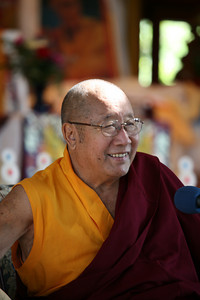
​​​​​​It is a great blessing and honor to have an opportunity to give a short introduction about Her Eminence Jetsunma Ahkön Lhamo and her noble activities. 

Her Eminence Jetsunma Ahkön Lhamo is a Western reincarnation of a Bodhisattva who practices Secret Mantrayana and is spreading the Buddha’s doctrine in the West in a way that is accessible to Westerners. I have known her since 1996, when His Holiness Pema Norbu Rinpoche enthroned her at Namdroling Monastery in Bylakuppe, India. She is the founder of Kunzang Odsal Palyul Changchub Chöling(KPC), which is located in Poolesville, MD, USA. In this Dharma center, there is 24/7 prayer, group practice, recitation, and other spiritual and community activities; and it is open for the public as well. 

In order to understand who Jetsunma is and what KPC is we must know a brief historical introduction to Buddhism and Tibetan Buddhism. The founder of Buddhism, Buddha Shakyamuni was born in Lumbini grove in Nepal, the son of King Sudhodana and Queen Maya Devi. His early life was spent in palatial luxury, and he excelled in all the pursuits of his time, both academic and athletic. Slowly he began to doubt the validity of his worldly life. At the age of 29, he renounced his worldly life, and left the palace. After six years of unwavering meditation, at the age 35, he attained enlightenment.

Through his infinite compassion, Buddha started to teach, but his teaching was so vast and profound that it was broadly divided into three categories or levels which are now known as the Hinayana School, Mahayana School, and the Vajrayana or Secret Mantrayana School, which uses a variety of skillful methods to bring about that same vast and profound realization in a relatively short time. These different traditions were gradually propagated all over India, Nepal, and many other Asiancountries. The  Buddha’s teachings are still unbroken today. The Hinayanateachings have been preserved in Sri Lanka, Thailand, Cambodia and other countries in Southeast Asia. The Mahayana teachings have been preserved in China, Japan, and Korea; and the Vajrayana teachings have been preserved mainly in Tibet, Bhutan, and the Himalayan part of Nepal. 

Tibet was doubly fortunate. Not only was it one of the few countries in which Vajrayana continued to be practiced, it was also the only one in which the full range of teaching, from all three traditions, was transmitted and preserved. 

Over the centuries these many strands of the Buddha’s teaching have been handed down from master to students, as demonstrated by the lineage holder. Today there are four main schools of Tibetan Buddhism. Of these four main schools, the Nyingma school was the very first Buddhist school in Tibet. It was establishedaround the eighth century and is known as the old-translation school. The Kagyu, Shakya, and Gelug schools came after the tenth century and are called new-translation schools. 

The first Nyingma school masters were mainly the Indian masters Shantarakshita, Vimalamitra and Padmasambhava, whom the Tibetans refer to as Guru Rinpoche, the precious Master. These masters handed the teachings down through fully realized Tibetan masters such as Longchen, Jigme Lingpa, Mipham Rinpoche and others. Within the Nyingma lineage, there are also six mother monasteries: Palyul,Kathog, Shechen, Dzogchen, Mindroling, and Dorje Drag. 

Palyul was founded by Rigdzin Kunzang Sherab, the elder brother of the previous Jetsunma Ahkön Lhamo. The lineage was passed down from Rigdzin KunzangSherab to Pema Lhundrup Gyatso and Drubwang Pema Norbu Rinpoche throughtwelve Palyul lineage holders to His Holiness Karma Kuchen Rinpoche and Her Eminence Jetsunma Ahkön Lhamo. All the teachings have been passed down unbroken from master to students until the present master. 

Her Eminence Jetsunma Ahkön Lhamo is none other than an emanation of the great yogini Mandarava who was the consort of Guru Padmasambhava. Jetsunma Ahkön Lhamo is a Bodhisattva who has boundless love and compassion toward all sentient beings. A Bodhisattva is one who has bodhichitta (the mind of enlightenment), one who has transcended samsara. To be a genuine Buddhist practitioner, you must go through a traditional system. First, you must take refuge in front of the Three Jewels, the Buddha, Dharma, and Sangha, and also, in Vajrayana, in front of the root master (the guru). After that we also need to arousethe Bodhichitta. Without Bodhichitta we cannot possibly attain the ultimate goal of complete enlightenment. Then in the path of Dzogchen, Bodhicitta must be aroused because it is the only doorway to Dzogchen. In essence, all Dzogchenpractice is guru yoga practice. It is a special, powerful, skillful means for accomplishing this path and attaining the siddhis, spiritual accomplishments. Just practicing only guru yoga will directly destroy dualistic thoughts.  Then one canrest in the unaltered natural state of awareness (rigpa) itself. 

I think Western people are very good at analyzing and researching the reason to practice, but in order to accomplish the practice itself, one must have a good master who can show the methods of skillful means and confer blessings. That could be the reason that the Bodhisattva, Jetsunma Ahkön Lhamo, came in Western form to teach Western people in their own language. 

I wish and pray that this book will bring immense benefit to all the Western people as well as whoever sees it, reads it, contemplates it, and meditates on it. May all sentient beings be free from the ocean of suffering. May all sentient beings attain complete enlightenment in this very life. 


May Bodhichitta, precious and sublime, 

Arise where it has not yet come to be;

And where it has arisen may it never fail 

But grow and flourish ever more and more. 


Khenpo Pem Tsheri Sherpa 

Namdroling Monastery
 

Five Demons Or Dakinis

From The Spiritual Path: A Compilation of Teachings by Jetsunma Ahkon Lhamo

How do phenomena express themselves as they do? Each sentient being, within its own nature and even within the form in which it arises, contains an essential seed or drop that is the nature of mind itself. Just as all things emanate from Nature and can be understood as the spontaneous arising of that Nature—all phenomena that you as an individual perceive, including your individuality, can be considered the emanation or activity arising from that same mind-drop or essential seed.

Correct view describes that natural drop as being neither small nor big but both and neither. Since this Nature is indivisible, the only difference must be in perception. Literally everything you see is a reflection of your karma as it formulates itself into the perceptions of the five senses. The more you try to contrive understanding with the five senses, the more you try to “nail down” your perceptions, the more confused your perception will be. Data that are based on a system of logic organized by the five senses—cannot give you true wisdom of the realization of the uncontrived Nature.

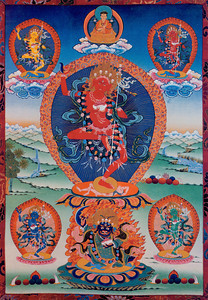
Since the five senses will always support the ego, they can be considered demonic in their influence. In their enlightened state, however, they can be considered the five celestial wisdoms: they are the components of the activities and qualities of the Buddha Nature itself. They are the five underlying blissful expanses, completely one with emptiness. They are the celestial opportunities, the celestial messengers by which miraculous activity can enter into the world of samsara in order to benefit beings. They are five goddesses or dakinis even though, used as they are, they are five whores.

Within each of us is blissful mind expanse. All spontaneous activity occurs directly and inseparably from that expanse. The dakinis are depicted as distributors, upholders of the fruit of one’s karma. Does this mean that there are dakinis who are separate from you, who are doing something to you? No. It is through the perceptions of the five senses in their unenlightened state that one’s punishments are meted out. There is no one outside of you who causes your suffering.

Karma is completely implemented through the perceptions of the five senses, which survive in some form from life to life. Even though your nose, ears, and brain are gone, the underlying karmic pattern remains to reactivate itself in other incarnations. However, you now feel a totally self-contained involvement with everything you experience. You honestly feel that you suffer because you are too tired, because you have insufficient food or money, because your body hurts. The five senses create these incorrect perceptions.

“How,” you may ask, “can I free myself of these demons, these witches who cause me suffering?” You must want to be free. Unfortunately, you do not. Oh yes, all sentient beings want to be happy, and you are trying to be happy. But you compulsively believe that you can be happy by resolving the scenarios presented by these five senses. These scenarios are not measured and apportioned. Their essential form is not something that can be balanced. The only recourse is to strive to perceive True Nature, renounce the affliction of these five witches, and take refuge in the five celestial wisdoms and the five-natured blissful expanse of emptiness.

© Jetsunma Ahkön Lhamo

Seven Part Supplication

The following prayer was taken from the Nam Cho Daily Practice from Palyul Ling International:

I pay homage to the continuously present and unmodified nature of pure presence (rigpa).
I offer the clear light, freedom from depths and limits.
I confess within the vast expanse, the equality of samsara and nirvana.
I rejoice in the great wearing out of reality, freedom from conception.
I ask you to always turn the Wheel of Dharma, the great perfection,
And to churn the depths of samsara,
Free from the limiting three conceptions, I dedicate this to reaching the far limit.

With Joyful Expectancy

From The Spiritual Path: A Compilation of Teachings by Jetsunma Ahkon Lhamo

It’s easy to hear Dharma, if you have the merit. It’s easy to keep a record of how many teachers we have sat in the presence of. It is much harder to change, to remain where we are and to deepen. It is harder still to rely on the advice of our Spiritual Master rather than on our own prideful, rigid, ordinary ideas.

The path of Dharma must renew for us a profound, living presence in our lives. It should never become stale or stiff, nor should we allow our minds to become hard, rigid or prideful. We should hold our hearts and minds in a confident posture of trembling, joyful expectancy. Then the path becomes our treasure, our food, our refuge. Then, gradually, we transform into that most precious jewel, the aspirant who actually gives rise to the Bodhicitta, who makes love and compassion a living presence in the world. This is the answer to all our longing.

May the power and potency of Dharma fill your lives. May virtue prevail. May compassion be born in our hearts and devotion nourish our minds, pouring forth to all sentient beings who remain in samsara. May they be liberated from the very causes of suffering. And may it be soon; may it be today. May samsara be emptied. Lord Guru, of the suffering of sentient beings, there has been enough. I dedicate all virtue I have accomplished, in this and every other lifetime, past, present and future, to this end.

Copyright © Jetsunma Ahkon Lhamo. All rights reserved

True Purity

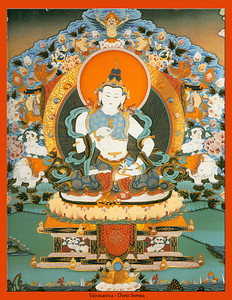
Vajrasattva

From The Spiritual Path: A Compilation of Teachings by Jetsunma Ahkon Lhamo


Let’s say you have become satisfied with an idea of what a practitioner should be. You are quiet, meek, gentle, and ever so passive. You attempt to be pure by never adorning your face, hair or body. You do what you think is right. Fine. But what if you stop there? What if you allow days, weeks, years, your whole life to pass by with no true sense of the need to eradicate hatred, greed and ignorance from your mindstream? What if you have no real understanding of the emptiness of phenomena? No true perception of the nature of mind? What have you really accomplished? What is yours to carry with you? How will you enter the afterlife state, the bardo? Will you not see as you have always seen? Will you not see the events within the bardo state as external phenomena? Will you not be excited, afraid? Will you not still be lost in the delusion of self and other?

On the Vajrayana path, true purity, true virtue is central and precious. Even one moment of true perception of the nature of mind is the only conceivable virtue. If you merely live according to the rules, you will definitely have merit. But in terms of the value of your own nature, your own mind, you will not have the purification that leads to true perception. The Vajrayana path is unique in its perspective on this. It adopts the morality and rules of the Hinayana path, as well as the Mahayana perspective of compassion and purity, yet it goes further into the understanding that true perception is the thing of value—the diamond.

The goal of the Vajrayana path is to realize the nature of mind. The nature of mind is absolute compassion. At that primordial-wisdom level, there is no good or bad. There is clear, uncontrived, pure, self-luminous nature. Primordial mind is unborn, yet perfectly complete. It is unmarked, un-measured by time or space. It is self-arising. True virtue is not a way of acting. Nor is it a way of thinking—as most people understand thought. There is only one real virtue: the realization of primordial mind. Naturally arising within that realization is a deep and abiding compassion—a compassion that is capable of manifesting in any form necessary in order to bring true benefit to beings.

Please understand that primordial mind itself is not filled with hatred, greed and ignorance. This is simply not possible. The mind is forever pure. It is unchanging. It cannot be defiled in any way. What then is the problem? Where is the defilement? Not in mind itself, but in perception. The real value of practicing on the Vajrayana path is that you are involved in a system by means of which your mind can arise with all the pure qualities of the Buddha. Think, for instance, of Buddha Vajrasattva. This is the practice of a Buddha who is the perfect union of wisdom and compassion. He represents that phase of mind as it first moves into manifestation from the primordial level. The pristine connection between the primordial nature of mind and its transition into an activity phase is not separate from that basic nature.

© Jetsunma Ahkön Lhamo

End Desire

An excerpt from a teaching by Jetsunma Ahkon Lhamo from the Vow of Love series

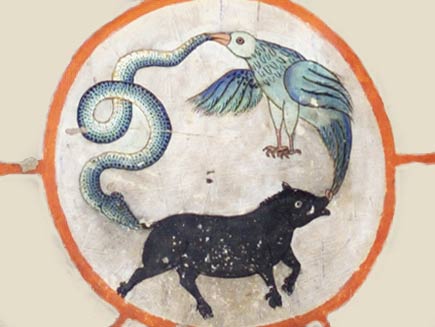
Where does desire come from? It comes from the belief that self-nature is real. According to the Buddha, if you believe that you are a self, if you believe in self-nature as being real, as being truly existent, then there has to be desire, because in order to be a self or to have a self, you have to define a self. That’s how it is. If you believe in the nature of self, you have to have an underlying belief that self ends here and other begins there. You have to have some conceptualization in your mind about what the self is, because the idea of self cannot exist without some definition. Conceptual proliferation develops, and with that, desire.

Desires are not always fulfilled. There is always the contest between self and other, and from those contests the three root poisons of hatred, greed and ignorance occur. It is the presence of hatred, greed and ignorance in the mind that causes phenomena to appear as they do. If there were no hatred, greed and ignorance in the mind, there would be no cause for suffering and therefore we would not see the phenomena of war, hunger, old age, sickness and death in the world. There would be no cause. This is the understanding and commitment that you should think about and work with in your mind.

© Jetsunma Ahkön Lhamo

The One Unfailing Source

From The Spiritual Path:  A Compilation of Teachings by Jetsunma Ahkon Lhamo

Every great lama has yearned with sincere intensity for the Precious Teacher. How is it that some people have that yearning and others do not? Some people seem shallow and prideful. Others seem blessed with spontaneous devotion and love. What accounts for the difference? You may not believe it, but the key is discipline. The person who holds to the goal of realizing the Guru’s mind has the discipline to renounce the perceptions of the five senses and to see only with the heart of hope. Not ordinary, dualistic hope, but hope born of trust and faith in the Root Teacher. That takes discipline.

You may think you know the nature of the Root Guru, whose job is somehow to teach you. You may think that the person sitting before you, the one you call “Teacher,” will give you great teachings. Yet you fail to realize that you must cultivate that knowledge with your own effort. You think that somehow, if you try to practice—even though you continually go through your mood swings, your battles in life, and so on—it will all work out in the end. That is a foolish assumption.

This path takes tremendous, relentless, sincere effort. But it’s not just how many prostrations you do or how many hours you put into practice. You must cultivate in yourself a profound yearning. You must think: “If these five senses, pleasantly seductive though they may be, can convince me that I am a separate human being who has a right to hate and who wants to live in such a way that I will be born in terrible places—if these five senses can lie to me so that I am tricked into planting seeds in my own mind for endless future suffering—then I must with all my heart cultivate a yearning to be free of them and to take refuge in the one unfailing source.”

What is that source? Is it a thing? A person? A substance? The one unfailing source is the Root Guru, who embodies freedom from all sensory data and from all beliefs that relate to a separate ego-self. When all considerations of self are gone—when you rely not on the false guru of your five senses, but on the absence of hatred, greed and ignorance—that is the one unfailing hope. It is not within the potential of that nature to hurt you. In the relative world, the world of duality, there is nothing but the potential to hurt you. Everything you touch, see, or feel is impermanent, seductive, and illusory. It contains all the potential for creating the causes of suffering and death. It contains the justification for hate, for saying cruel and unkind things, for being crass, gross, or stupid, for caring only about yourself.

There is only one source of unfailing refuge—the Root Guru, the true face. The Root Guru is the Dharmakaya itself. Why then must we view the flesh and blood teacher as the Root Guru, as the undefiled, unchanging nature? Through the vehicle of that Teacher, you are offered the Dharma, the unfailing method to attain realization of your true nature—the ultimate source of refuge. Thus, the Teacher must be understood as a cornucopia, a feast of all things that will bring about salvation from suffering.

There is another level of understanding. Suppose we say: “I am the same as my Root Teacher. To find that out, I only need to go on a magical journey of discovery.” No matter how we disguise it with beautiful words, the very pridefulness which causes that declaration keeps us from genuinely prostrating. It makes our hearts rigid and stiff. That pridefulness keeps us from bothering to feel deeply, from having true devotion. That pridefulness and ignorance can allow you to come into the presence of your Root Teacher and not even think of Guru Rinpoche, not even think of true nature at all. That very pridefulness is what keeps you believing in self. Actually, you believe in self as well as hope for the truth of its reality. This keeps you clinging to self as a source of refuge, believing that if you could be strong enough, or smart enough, or just discover something wonderful about yourself, it would suffice.

The antidote is to recognize, from the depth of your heart, your own nature as inseparable from the Root Guru and as the true source of refuge. Without that realization, you will always suffer. You will desperately attempt to inflate your ego, thinking that the bigger and more powerful you are, the more easily you can overcome suffering by strength alone. One day, however, you will discover that you have not understood the causes of suffering. Look around you. Look at the most beautiful people in the world. Look at the most lovable people, the strongest and smartest people, even the most virtuous. They will all experience death. There is no hope until you take sincere refuge in True Nature, until you are willing to confront your own five senses, saying: “You have lied to me again and again and again.”

© Jetsunma Ahkön Lhamo

The Stream Of Bodhicitta

The following is from a series of tweets by Jetsunma Ahkon Lhamo

AH – May all beings be free of suffering.
May they recognize what to accept and what to reject, and pacify the root causes of suffering.
May we joyfully and lovingly accomplish compassionate activity for the sake of all sentient beings in all realms.
May the stream of Bodhicitta flow deep, strong and sweet, to quench the thirst of all beings.
May the fruit of merit ripen in our mind streams, nourishing all who are hungry.
May all who are homeless be sheltered, who are cold be warmed, who are sick be healed.
May all who are lonely be comforted, the helpless be raised up, the poor be satisfied in every way.
May our land be purified of hate and greed.
And may a song of freedom be heard throughout this and all nations.
May we join as one life, which is our nature – and be unbound by hatred, greed and ignorance.
May there be peace and joy throughout the 3,000 myriads of universes!
And may I myself bear in love, the suffering of all. Now and in the time to come.

Copyright © Jetsunma Ahkon Norbu Lhamo. All rights reserved

The Eight Auspicious Symbols

The Eight Auspicious Symbols represent the Eight Qualities of the Buddha. Here is a brief explanation of how each quality is symbolized.

Taje4Metog

Excellent Lotus Flower:

The purity of the Buddha’s mind


Taje8KhorloGolden Wheel of the Dharma

The Buddha’s unending activity of training beings in the path of liberation


Taje7Gyaltsen victory bannerGreat Victory Banner

The Buddha having conquered all negativity and limitations


Taje3BumpaInexhaustible Treasure Vase

The inconceivable blessing of the Buddha’s presence


Taje1Dug - parasolPrecious Parasol/Umbrella

The universal respect, which beings feel for the Buddha


Taje5Dungkar conchPrecious Right-turning Conch

The all-pervading call of the Buddha’s teachings


Taje2SerNya goldfishTwo Goldfish

The Buddha’s eyes and, therefore, his perfect wisdom and also a symbol of royalty


Taje6Patra KnotGlorious Knot

The tremendous love and compassion of the Buddha and the never-ending continuity of the teachings, also longevity, the eternal nature of things and the interrelatedness of wisdom and compassion

WP2Social Auto Publish Powered By : XYZScripts.com