The Four Immeasurables

In Tibetan Buddhism the idea of compassion is talked about by using the idea of “Bodhicitta.” Bodhicitta actually means compassion, but for Westerners, the idea of compassion is often that the “haves” give to the “have-nots.” There is a sense of one person having or being in a position to give, and another one being needy. In Buddhism it is different. When one displays Bodhicitta, one understands that all sentient beings are suffering. One looks at cyclic existence and sees that it is impermanent; that all sentient beings, no matter how happy they are, temporarily, ultimately lose that happiness by experiencing old age, sickness, and death; that in the six realms of cyclic existence, there are many different forms of suffering due to impermanence and the mind of duality.

If you have no awareness of the impermanence of your situation, then you have no awareness of the fact that even though you may be happy at the moment, you are likely to suffer at some point in your life. If you tend to avoid that knowledge, you really cannot accomplish stability in your path because the motivation isn’t right. When you are suffering and you realize that you are suffering, your experience is intensified in such a way that you know that enlightenment is important. You know that this suffering that is happening to you is not good. Even if you are experiencing some temporary happiness like watching TV or feeling great when you’ve accomplished something, you notice that you feel not so great when that temporary satisfaction is absent.

According to the Buddha’s teaching, compassion and the determined cultivation of Bodhicitta is absolutely necessary in stabilizing and deepening one’s experience in meditation. Why is that so? First of all, we should look at the teaching that is called the Four Immeasurables.

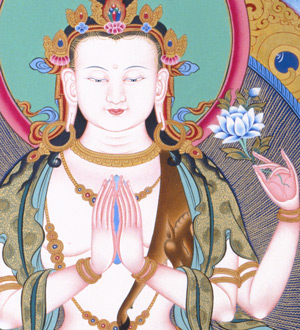
The Four Immeasurables are loving kindness, compassion, joy, and boundless equanimity. Of these, the most foundational is boundless equanimity. This means the realization that all things are essentially equal. You learn to treasure your most loved one the same as those that you don’t know, including your worst enemy. How is this possible? If you look at why you care for your loved one more than you love your enemy or someone that you’ve never met, you can understand that the motivation for loving one more than another is desire. The desire that is felt here is the desire for approval, the desire for being recognized as an entity, the desire for the continuation of one’s awareness of self as being inherently real and stable. Believing in self- nature needs to continue once it is assumed, otherwise one will feel chaos or as though things are falling apart. Desire is inherent in all of this. There is another thing that you can learn from realizing the difference you feel between the friend and the enemy, and that is the belief in the separation of self and other.

Buddha teaches us that we are actually empty of self-nature. This means that although we exist in a primordial wisdom state, what we experience when we experience self-nature as inherently real, is actually a series of conceptualizations that are contrived. They are inconsistent with the pure primordial natural state which is free of all contrivance.

Boundless equanimity is the opposite of this self/other contrivance because it is the realization of the loved one and the hated one as essentially equal. To realize this, one must rid the mind of attraction and repulsion, which according to the Buddha are the very causes of suffering. They are the children of desire; they actually begin the cycle of karmic cause and effect, and they occur every time you have a thought. If there is attraction and repulsion, there is always wanting or not wanting, there is always grasping or pushing away. When attraction arises, to the same degree repulsion will also occur because the ordinary mind exists in a state of duality. If you do not experience it at that very moment it will be experienced at some future time, perhaps next year or next lifetime. Once a cause and effect relationship is set up it always realizes itself.

Equanimity becomes necessary, then, in order to have a profound and continuously stable experience in one’s meditation or practice, not floating on the ups and downs of attraction and repulsion. Through equanimity one understands the equality of all phenomena. The way that the Buddha teaches us to establish equanimity in the mind is to realize true nature, which is the underlying reality of all phenomena, including self-nature. The Buddha teaches us that the primordial wisdom state, or the ground from which phenomena spontaneously arise is clear — it has the quality of innate wakefulness. Yet the moment that you describe it you lose it, because to wrap concepts around it makes it a contrived, unnatural experience. Realizing the natural state comes through realizing equanimity, through learning how that natural state might appear or how it might be viewed, how it might arise. Then by eliminating desire from the mind stream one has the potential to experience the natural state in meditation.

How do you begin to attain this pure view of equanimity? First of all you should look at yourself in the mirror and ask, “Which part is self? Where exactly is self?” Maybe you think it’s in your brain. Imagine that you can open up your head. Can you find self there? Where’s your identity? Look at every little piece under a microscope. Where is self? Then look at something else you identify with. Do you have great legs? Look at your legs, take them apart. Look at the bones, the muscle, the cellulite. Can you find self in there? Or look in your liver, or heart, or your chakras. Maybe self is in one of your chakras. You look inside, but you can’t find it. You take yourself apart and examine every single molecule under the microscope and you still haven’t found self. So you understand then that self-nature is a concept or a contrivance that is born of a certain type of consciousness which is actually an idea of separation — the separation between self and other. The whole thing is a conceptual proliferation. In examining the nature of self we understand that self-nature is inherently empty, that it doesn’t exist the way we thought.

If self is not real, maybe I should look and see if I can find “other.” Do the same thing with all the “others” in the world. Take everybody apart, examine everything. And after you do all of this you will find that many of the things by which you have structured your life are not as they appear. From that you can begin in a courageous way to determine what true nature really is. It is through meditation that you may come to sense or understand this primordial wisdom state that is free of all conceptualizations, free of any religious idea, free of any perception of self and other yet experienced and felt as luminous and awake.

How is it then that one’s loved one and one’s enemy become essentially the same? It is because they are understood to be the same nature, the same taste. Buddha teaches that all phenomena, when understood through pure view and the stabilization of one’s mind, are the same taste. It is only desire and the attraction to other that makes loved ones and enemies seem inherently real and separate in the way we always consistently experience them.

The equality of all sentient beings allows the arising of the purely loving viewpoint found in the other three Immeasurables. One of these three is loving kindness. This kindness is not about acting kind, or adopting a set of rules to be a nice person. Instead, the Buddha’s view understands that profound nature as having one taste, realizing that all beings are equal. Their happiness has exactly the same weight as mine, exactly the same importance. From this viewpoint, one naturally develops loving kindness. There is no progress without it: This exceptional quality of desiring the happiness of all sentient beings is what the Buddha means by loving kindness.

The next of the Four Immeasurables is compassion. Here one realizes the needs of others by realizing the intense suffering of others. One realizes the fragile nature of impermanence, the needs of sentient beings and how they suffer. The wisdom, stability and intensity of determination that comes through a solid realization of these things, the compassion that arises naturally from this is the second of the Four Immeasurables.

The third is joy. Ordinarily we grow up thinking that if we just develop a good attitude and if we are positive we’re going to look happy and therefore be happy. We’re taught, “I want mine and when I get mine then I’ll be joyful because I’ll be able to act joyful then.” But the Buddha talks about joy in the well-being of others. An example would be: if I hear that you have a new car I am happy for you because you have attained even a moment of temporary happiness. I don’t make a judgment like, “Well, you’ve already got three cars, or hey, there are lots of people starving and you have a new car.”

Instead, the practice is this: the happier you are, the happier I am. If even for one moment you have achieved some level of happiness I should bless that happiness and think, “May that happiness bring you to such a point of stability and regard, may it afford you the generosity to think about others and wish for their well-being to the extent that you attain realization. May that car be the cause for your realization, may you be free of suffering in all its forms.” Or, “I wish you could have six hundred cars; I wish you could have everything that makes you happy.” It’s the joy that naturally occurs from sincerely wishing for the happiness and well-being of all sentient beings, to the extent that whatever they are capable of in terms of achieving some degree of relaxation, peace, time out from suffering, or whatever they are able to achieve that is of any benefit or any use to them at all, I am sincerely happy for them because they are the same as me and inseparable from me.

Without the Four Immeasurables and the pure view that’s implied by them, there is no enlightenment. They can be developed in the same way that you have cultivated any of the talents or abilities you have developed during your life — through determination, through taking the time to really examine the emptiness of self-nature and the emptiness of phenomena, through meditation and stabilizing the mind through pure perception of the natural primordial wisdom state, through the determination to attain compassion. It does not happen effortlessly. So it does no good to throw your hands up and say, “I can’t do this, I just can’t think that way.” Neither can anyone else.

All the great Buddhas and Bodhisattvas began as sentient beings, in a state of confusion. Through the same kind of practice that you are embarking on now, they stabilized their minds and developed not only loving kindness and compassion, but the extraordinary pristine Bodhicitta that is the basis and the method for the attainment of enlightenment.

The ground from which you arise thinking that you are self and thinking that self and other are inherently real and separate, that ground is the same ground that gives rise to the most pristine compassion, the most glorious of spontaneous celestial awareness when realized with pure view. That ground is your nature, and in potential you are the same as all the Buddhas and Bodhisattvas. Holding that in your mind, continue with determination, knowing that all things are possible.

© Jetsunma Ahkon Lhamo
Astrology for 05/03/2018

05/03/2018 Thursday by Jampal & Wangmo

Theme: Exciting change

There is energy for change today. Take the opportunity when it presents. Barriers are breaking down as people soften their positions. For the next few days explore different ways of seeing and doing things. Putting energy into your spiritual practice will be fruitful. For the next week  a mystical aspect enters into relationships which can be difficult to initially integrate. ‘God, make me so uncomfortable that I will do the very thing I fear.’~Ruby Dee

Today the Moon is Void of Course from 8.51 pm EST USA until 10.07 pm. If you’re in another country check what that means for you time-wise. It’s best to avoid making major decisions or signing contracts during this time.

Vajrayana is for This Time

An excerpt from a teaching called Vajrayana’s Final Hour by Jetsunma Ahkon Lhamo

The tradition we practice here is called Vajrayana. This particular kind of teaching most greatly benefits people who are born in this degenerate aeon. There is something about Vajrayana that seems to burn the candle at both ends. When one practices generation stage practice for example, one does not suppress the compulsion to consider oneself a “self” or ego but rather uses that inclination. There is an energy associated with clinging to oneself as an ego that is a lot like a rubber band. You can try to think of something else, but however much you stretch it, it will always come back to its original shape. That compulsion to consider self-nature as being inherently real is similar to the energy-that causes a rubber band to reform; we have that energy instinctively within our minds.

Vajrayana actually uses that inclination in generation stage practice. There we meditate on Emptiness, on the natural uncontrived primordial state of Emptiness. We consider that all elements of perceptual phenomena are broken into their natural component: sheer luminosity. Meditating on emptiness or shunyata, we then generate the deity using that same energy that causes us to consider self-nature. Generating ourselves as the deity, we generate the pure display having all the pure qualities of the deity. Arising from emptiness, we generate the pristine Nature in such a way as to be a phenomenal thing, a display. It is visible to our eyes and our consciousness. We use the very energy that causes us to cling to self-nature to accomplish realization. Vajrayana has that unique quality. Can you see how it burns the candle at both ends? We use what we have — that fire, that passion, even desire, to accomplish the Primordial Wisdom Nature.

In this time of degeneration, I am taught that there will come a time when there is no teaching in the world that can bring us to enlightenment. There will be no path, no Bodhisattvas that incarnate, and the Buddha will not be present in the world. It will be a time of great darkness and wars. And finally there will be a time of night, of darkness. Immediately after that the next Buddha will appear again.

Now while things are becoming darker and more condensed, one still has a shot. Things are lining up so that if one were to sincerely practice a technology that can lead to enlightenment and that has brought others repeatedly to enlightenment, if one were to practice that with fervent regard, devotion, and faith in a pristine way, then one could achieve the auspicious result — realization during the course of this lifetime, or in the Bardo, or an auspicious rebirth in order to practice purely and perfectly.

© Jetsunma Ahkon Lhamo

Astrology for 05/02/2018

05/02/2018 Wednesday by Jampal & Wangmo

Theme: What’s real?

Communication flows easily today but with the Moon square the planet of other realities, Neptune, there is room for confusion, especially in emotional expression. Generally speaking things may not be what they appear. Subtle conflicts between conscious and unconscious feelings arise. However, tensions are beginning to loosen after an extended period and it’s becoming easier to express or acknowledge uncomfortable feelings. ‘I dream of painting and then I paint my dream.’ ~Vincent Van Gogh


What is Enlightenment?

An excerpt from a teaching called The Seed of Your Buddha Nature Within by Jetsunma Ahkon Lhamo

One understands that Enlightenment is actually the awakening to the Primordial Wisdom Nature, the awakening to the Buddha nature. The Buddha never said that he was different from anyone else. He said simply, “I am awake.” He is indicating that he has awakened to the fullness of his own Nature and is able to abide spontaneously in that awakened state without any interruption or impediment. So, from that perspective, the basis of practice, the basis of the path itself is exactly the same as the goal. They are indistinguishable from one another. The path that one uses in order to achieve the goal is also indistinguishable from the basis, which is the Buddha Nature, and is also indistinguishable from the goal, which is the Buddha Nature. So, these three things, the basis, the method and the goal are indistinguishable from one another.

For us, however, it does not appear to be so, simply because of the way our minds work, involved in discursive thought as they are. We distinguish between what is potential and movement. We distinguish between movement and the goal. But in truth, you cannot distinguish between these three. If the basis for practice is the same as the goal, then anything in which you engage in order to achieve that awakening to your own Nature, must also be indistinguishable from your own Nature. The path, then, or the method, is not separate from the Buddha Nature.

Now, where we run into trouble is when we make our Dharma practice an outward movement that goes somewhere. When we do our practice, we project that there is going to be a certain result. That very subtle concept prevents the practice from doing all that it can do to remove obstacles from our own perception, because we cling to the idea of here-ness and there-ness, of such-ness and thus-ness, and in doing so, we cling to the idea of self. It’s very hard to understand that subtle difference, but that subtle difference is very important. If we did not view our Dharma practice as a subject, object, thing or as a linear movement in some way, we would more easily understand that the goal is the un-moveable, unchangeable, fully complete and spontaneously realized Nature itself, which is already present. The potential for the realization of that Nature would be much stronger in our practice, in terms of taking responsibility for our situation and utilizing our practice to its fullest capacity.

In order for us to consider our Dharma practice, or even the ability to listen to teachings, as a movement that ‘goes somewhere’– we have to be considering it in a very superficial way. But if the practice is understood as a natural and spontaneous manifestation, arising from the Buddha Nature that is our Nature, then the practice becomes less materialistic and more meaningful in a very profound way. In the same way, if we are in an ordinary environment and an ordinary teacher comes before us, we don’t respond as we would if the Buddha himself, with all the signs and marks, were sitting in front of us. If the Buddha appeared, we would respond with, “Whoa! Whoa! This is important! Something is happening here. The Buddha is here!” In truth, we should respond that same way to our own simple practice because that practice is indistinguishable from the Buddha Nature itself. The Buddha is here. But the impact is different in the way that we consider and understand what we are doing.

© Jetsunma Ahkon Lhamo

Astrology for 05/01/2018

05/01/2018 Tuesday by Jampal & Wangmo

Theme: Seeking love in difficult places

A theme for the next few days is the need for connection, and yet feeling distant and apart from others. However, this is balanced by the harmonious planetary energies between the principles of communication and connecting,  making it easier to share and relate. With the Moon entering Sagittarius today the spirit of adventure is highlighted for the next two and a half days. Religion, philosophy and long-distance travel are emphasized. ‘In a sense everything is dreamlike and illusory, but even so, humorously you go on doing things. For example, if you are walking, without unnecessary solemnity or self-consciousness, lightheartedly walk toward the open space of truth.’ HH Dudjom Rinpoche.

Today the Moon is Void of Course from 10.57 pm on the 30th of April EST USA until 1.21 am on the 1st of May. If you’re in another country check what that means for you time-wise. It’s best to avoid making major decisions or signing contracts during this time.


The Big Picture

An excerpt from a teaching called True Motivation for Kindness by Jetsunma Ahkon Lhamo

The Buddha teaches us that everything a sentient being does has a little hook on the end of it. And the hook is: I…me…always about me. So you have to watch when you’re being kind that you’re not being kind just to be a certain way. What you really want to do is to alleviate the suffering of sentient beings. It’s about them, not about you. Get the big picture. All sentient beings are suffering. Get that they, like you, don’t wish to suffer.

You can help others understand the value of kindness. You can demonstrate it. You can begin to show people the value of being of benefit to others. You can help people to understand in some simple way that there is something better than the superficiality that they are revolving in. You can pray for their enlightenment. Make prayers for the end of hunger, prayers for the end of war, prayers for the end of suffering in all its forms. You can do that, and in doing that, you have actually entered onto the Path. It’s just a baby step, but a good one. It is one thing that you can do quietly in your heart. No one ever sees it. You can do it without expecting anyone to pay you back.

The upshot of all of this then is to consider compassion in a new way, in a sense to consider it in an ordinary way, in that you can truly practice it within the context of your life. But more than that, know yourself! See what your motivation is. On this path your motivation is everything. Examine the faults of cyclic existence so that when you accept the hard work of this path, even if it’s just simply acting in a compassionate way, accomplish it for the right reasons.

Take into yourself the fundamental truth that cyclic existence is faulted, but that the Buddha said there is an end to suffering, and it is attainable to you if you open your eyes and act appropriately. Don’t waste your time gathering unto yourself things that you cannot take with you. Don’t waste your time. Practice the Path.

© Jetsunma Ahkon Lhamo

Astrology for 04/30/2018

04/30/2018 Monday by Jampal & Wangmo

Theme: Joyful generosity

With the Moon conjunct Jupiter today feelings are more joyful and enthusiasm is more apparent. Tolerance is highlighted and relationships with women, and those with feminine energy are emphasized. There is more interest about the deeper aspects of life. Another theme is deepening spiritual awakening. Take advantage of the energy that is available for this today. Communications can bring good tidings. ‘Ever since happiness heard your name, it has been running through the streets trying to find you’~Hafez.

Je Lama

Je Lama

Why don’t you tell me

What to do

I been thinking it over

And this I know:

That there is suffering

Everywhere I go.

And so I’m ready

Nothing else to do

Now is my time

I give it all to you

So I offer my

Body, Speech and Mind

And all I have

In the three times

Cause I know it’s holy

What we are inside

In that nature

Liberation resides.

© Jetsunma Ahkon Lhamo, March 1992

Astrology for 04/29/2018

04/29/2018 Sunday by Jampal & Wangmo

Theme: Learning from experience

With the Moon opposite the Sun feelings are heightened, and there are conflicts between personal needs and professional or public duties.  However, with Saturn in good aspect to the Moon and the Sun today it’s an opportunity to take what you’ve learned and apply it to your life. This includes self-discipline even though you might have thought you didn’t have it! You may want to be alone with your thoughts and feelings today. ‘The scientific theory I like best is that the rings of Saturn are composed entirely of lost airline luggage.’~Mark Russell

Today the Moon is Void of Course from 1.33 am EST USA until 3.13 am. If you’re in another country check what that means for you time-wise. It’s best to avoid making major decisions or signing contracts during this time.

WP2Social Auto Publish Powered By : XYZScripts.com