The Feast


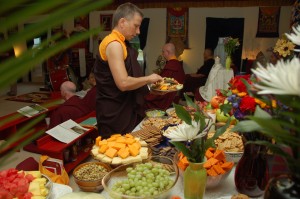
Tsog - A Spiritual Feast

The banquet is ready
The feast is set
And never will I forget
The taste, the sweetness.

The Bodhichitta, sublime display
Of all the Buddhas. Sweetness
Without measure. Peerless pleasure
The dazzling play of light
And essence.

Oh! For the day still coming
When virtue prevails
The ship to Liberation sails
For you. Come aboard!
Know the Lotus Lord.

In this day, in this time,
Taste the bliss- love sublime awaits.
Where are you? Will you obey
The call within, or turn away?
Will the treasure be yours, today?

Oh, Beloved, will you stay?

By Jetsunma Ahkon Lhamo on October 23, 2009

Limitless Kindness

An excerpt from a teaching by Jetsunma Ahkon Lhamo from the Vow of Love series available on Amazon

One of the most important and central thoughts in Buddhist philosophy is the idea of compassion. The Buddha taught that we must cultivate our lives as a vehicle to be of benefit to all sentient beings.  It’s good that you’re a good mother, and it’s good that you’re a good friend, but we can’t limit ourselves to a small, familiar circle. We have to go on and on increasing our compassionate activity, our influence and our determination until we attain a level of kindness or compassion that supersedes what we believe is reasonable. We can’t stop even with our nation. We can’t think that we only want to help Americans. Nor can we stop with our world. We can’t think that we only want to help humans and animals, which are the ones that we can see. We have to think, according to the Buddha, that we wish to be of benefit to all sentient beings.

A sentient being is one who has sensory feeling or the development of that kind of discriminating consciousness. According to the Buddha’s teachings, there are six realms of cyclic existence, and there are sentient beings in all of these realms. The human realm and the animal realm are visible to us. This is living proof that at least some of the Buddha’s teaching is right. We see human beings and we see animals; therefore, we know that they exist. But according to the Buddha’s teaching, there are also non-physical beings and different kinds of beings that must be considered if we are to truly develop the mind of compassion.

Limiting ourselves to an identity such as,”I am a woman,” or “I am a man,” or “I am an American,” or “I am a Russian,” or even “I am a citizen of planet earth,” is not the way of the Buddha. Instead, we should think that on every particle we can see, and all those that we cannot see, and in every inch of space, there are millions and millions of sentient beings. And space goes on forever. If we intend to develop the mind of kindness, it must extend to all sentient beings equal to the limits of space.  Space has no limits and there are limitless beings, seen and unseen.  Therefore, we must extend the mind of compassion to beings far beyond those we can conceive of with our brains. That is an awesome thought. How can we really do that? We think that must be impossible. How can we be directly concerned with somebody we can’t see? How can we really care about something that might be infinitesimally small, like bacteria? Or a sentient being that may be as large as a galaxy? How can we seriously consider we must be kind to all sentient beings in that way?

When you develop the mind of compassion, you have to be careful how you develop that mind. If you examine yourself profoundly and honestly – and you have to be willing to be very honest with yourself – you may find that your goal is not really to benefit all sentient beings, but to be a kind person. There are worlds and universes of difference between these two goals. One is selfless: you truly wish to be of benefit to all sentient beings. The other is heading in the right direction, but ultimately it is not selfless because you wish that you could be a kind person. I hope that you can hear the difference between these two ideas. There are worlds of difference between them.

© Jetsunma Ahkön Lhamo

The Power Of Speech

From a series of tweets by Jetsunma Ahkon Lhamo:

What is “Right Speech” in Buddha Dharma? Mostly as with the Eight Fold Path, we must do no harm. To understand right speech one must first understand what non virtuous speech is. That is where one speaks in a way as to be hurtful, offensive to another. Like name- calling and bullying others. Hate speech, in other words. Any speech that elevates oneself at the expense of others. Mean speech, speech without foundation, especially, which is gossip. Divisive speech. Speech that is not factual – lying. Telling tales to hurt a person’s livelihood. Lying speech causing one to prosper while others cannot as a result. Some think brutal honesty is right speech. Not so. Take the brutality out. Some think they are always right so brutality is necessary. Never the case!

We can always use right speech if we try. And to try we must be warm hearted and caring. Willing to take a back seat and applaud another’s efforts. At that point we can develop right speech, that is helpful. We can nurture, build confidence, benefit others with right speech. It is teaching, helpful and loving. When right speech is accomplished, in a future life one’s voice will be gifted and empowered. One will bring happiness and good result from teaching. One will be born with a beautiful voice, that is well loved and can transmit many blessings. That is the power of right speech, and one can see if they have spoken kindly in a previous life. The voice will be a beautiful thing, like a golden magical flute. All will benefit and Dharma will be spoken.

Copyright © Jetsunma Ahkon Lhamo. All rights reserved

The Logic Of The Buddha’s Teaching

The following is an excerpt from a teaching by Jetsunma Ahkon Lhamo called “Keeping Heart Samaya”

The Buddha has taught us some main points. These main points necessarily pervade all other levels of Buddhist doctrine or Buddhist philosophy or Buddhist teaching. They are the foundational thoughts that you have to use to think through the logic of the Buddhadharma. Without these fundamental thoughts, nothing that we accomplish in Dharma will make any sense or have any real weight. We are encouraged as Dharma students not to have some kind of blind faith based on no recognition of cause and effect relationships, but instead to have a faith that is based, yes, on heart, but also on logic, on reasonableness.

Lord Buddha himself taught that you should examine the teachings. If, having learned these foundational thoughts, they do not seem reasonable to you, if it doesn’t seem thoughtful and reasonable and intelligent to continue on in the way the Buddha has prescribed, then you shouldn’t do it.

The Buddha has taught that the Dharma should be logical and reasonable. And the way that the Buddha laid it out, it is. It is. For myself (some of you know my story), I was not born in the Tibetan monastery. I was found here, in America. I was born in Brooklyn of half-Jewish, half-Italian heritage, a little Catholic, a little lox and bagels. When my teacher found me, I was 38 years old, so I was already established in whatever habits I had, probably most of them bad. We have a lot of bad habits by the time we are 38, don’t we? By the time I found my teacher, I was quite established in a certain way, but I have found that in that meeting with my teacher a certain communication about the Buddha’s teaching has come to me that is logical and reasonable. There is a certain way to follow through the teaching that even appeals to a hard-headed, Brooklyn-born, half-Jewish, half-Italian gal like me. Now, I am a very practical person, a very practical person. So when I view the Buddha’s teachings, I want to know that they make sense to me. I want to know that they are reasonable. I, myself, would have difficulty following something that did not seem reasonable to me in some way.

Taking into account that sentient beings cannot actually gather all the necessary data by which to evaluate this logical Buddhist teaching, we have to rely to some degree – to a large degree actually – on the Buddha’s perception. For instance, all sentient beings do not have the capacity to actually evaluate samsara or the wheel of death and rebirth, conditioned life, realistically. In the same way, if we had no TV cameras and no satellite communication, none of our modern tools, we wouldn’t know for sure, let’s say, that there are people in China. We could hear about it. We could even hear Chinese people in America tell us that it exists, but for ourselves, unless we had gone there, we would never know. Not really, not for sure. But today we have TV and news reporters and newspaper pictures and satellites that broadcast information, and we can see China with our own eyes, even though it is on the other side of the world. So in a way, the Buddha acts like that for us.

Copyright © Jetsunma Ahkon Lhamo. All rights reserved

[google72e18ae637cd3487.html]

What Makes Buddhism Different?

An excerpt from a teaching called “The Importance of Shakyamuni”

Without the teachings of Lord Buddha, there would be no perfect path by which to achieve supreme enlightenment. There have been and still are paths on this planet by which one can move forward spiritually. There are many ways in which one can accumulate merit. There are many ways in which it is possible to make some kind of spiritual progress. But the kind of spiritual progress that produces supreme enlightenment is quite different.

Lord Buddha said that all beings are suffering, and he didn’t say that to be negative. He said that because he looked around and saw that even those beings that were most happy, most beautiful, and most productive would still get old, sicken, and ultimately die. Each being of the six realms of cyclic existence ultimately gets old, gets sick, and dies.

That is why Lord Buddha said that there is no comfort and no happiness in cyclic existence. He wasn’t denying the possibility of achieving some sort of momentary happiness or fleeting joy. Everyone knows we feel really good when we can eat a piece of chocolate cake or watch our favorite TV program or go swimming or have some friendly conversation or something like that. But the kind of joy that Buddha wished for all sentient beings was long lasting, one that ultimately did not betray us. The kind of joy that is available in cyclic existence has a beginning and therefore an end.

When Lord Buddha saw that, he wished in his great kindness and great compassion to present a way by which we could overcome cyclic existence, not merely make progress. That really is the difference between the teachings of Lord Buddha and other spiritual teachings. The teachings of Lord Buddha have one goal and one goal only: supreme realization – ultimate liberation from samsaric existence and the final overcoming of the mind of duality that produces the conditions of samsara. This is the path that Lord Buddha created.

Copyright © Jetsunma Ahkon Lhamo. All rights reserved

Our Guide In Difficult Times

From a series of tweets by Jetsunma Ahkon Lhamo:

Ngundro, or preliminary practice consists of several parts:

  • Refuge, or entering the gate of protection of the “three precious ones” – the Buddha, Dharma and Sangha.
  • Bodhicitta, the practice of the six perfections and the generation of the aspiration to realize Enlightenment.
  • The offering of the Mandala, the accumulation of merit through skill.
  • Vajrasattva, the purification of obscurations through wisdom.
  • And Guru Yoga, receiving the blessings through which one can attain enlightenment in a single lifetime.

Nothing is more precious than this. Even a cache of jewels, a palatial home, a beautiful and healthy body, nothing is more precious than Guru Yoga, the means to awaken. I have always been taught this: that in these deteriorating times Guru Yoga is the swiftest and most powerful method as it is so easy to be distracted, make mistakes, forget to be mindful. Our Spiritual Guide is the method to keep our path as straight as an arrow and as powerful as the mightiest sword. One should always keep samaya with the Tsawei Lama, even at the cost of one’s very life. If one cannot do even that, even after the precious Dharma has been offered, there is absolutely no way to accomplish the path.

One should remain within their Lineage as well, as there is the certainty of receiving pure unstained empowerment. If we cannot do even that, we are in delusion and ignorance. The fruit of Enlightenment will not come to your mouth. Body, speech and mind, the three doors will be corrupted. Speech will be ordinary, and without any benefit or virtue.

This teaching is a combination of Kyabje His His Penor Rinpoche and my humble self. Forgive me, Guru Padma for any mistakes, and for my presumption. Lama Kyen No! To the lotus feet of the Guru I make extensive offerings! Happy Losar to all! Kye HO!

Copyright © Jetsunma Ahkon Lhamo. All rights reserved

Break Free

An excerpt from a teaching called Bodhicitta by Jetsunma Ahkon Lhamo

One thing I like about all of you is your great compassion. You really want to help people. I’ve always loved that about you. There are some of you that are less interested than others, but everyone here really wants to help all sentient beings. But you know what? You can’t help anyone until you yourself are free of cyclic existence, because what you have there is the blind leading the blind. While you have hatred, greed and ignorance in your mind stream, you cannot help anyone. You can generate the deity all day long. You can help little old ladies cross the street all you want. You can make them bliss out and have a beautiful experience and sing songs and play music, and rub their backs and wiggle their toes and everything, but you can’t help them, because you may give them a short experience of happiness, and sometimes that’s worse because you can give them hope where there is no hope. The only hope is to break the cycle of cyclic existence and to be free of it. Sometimes the worst thing you can do for people is to give them a lot of blissful experiences, because sometimes it causes them to be satisfied and complacent and they don’t try to grow spiritually. Sometimes it can inspire them. But very often it can do the opposite.

The most profoundly beautiful thing about you is that you really want to help people. You really do. Then doesn’t it seem logical, that you would therefore take complete responsibility for your realization? If you can help somebody by achieving liberation in such a way that you can consciously reincarnate and come back in a form to teach others to achieve liberation, wouldn’t it seem rational that you would take profound responsibility for that and say, “I will do anything. So I am going to eradicate this grasping from my mind. I’m going to practice so hard and so sincerely.” And still I see people mouthing prayers. How do you do that? Still I see you trying to have a powerful experience. How can you do that? So what if you have a powerful experience? If you are going to be reborn as a cow, what’s the big deal? Is that what you want?

You have to have courage. You have to say, “I’m finished. I’m finished with all this junk that betrays me, with all of this stuff that ends up to be a bauble and nothing more with all this distraction that I’m wasting my life on. I’ve got 20 or 30 or 40 years to live. Am I going to waste it on this kind of distraction?” Just think about that. Then what will you do? You’ll have to realize the faults of cyclic existence. You’ll have to realize how impermanent it is. You’ll have to realize how fraught with pitfalls it is. You’ll have to realize how completely unconscious you are. You are tossed about. You have no control over where you are going to be born in the next incarnation. You have no control over any of that stuff until you seriously practice Dharma in such a way that you are able to break free of dualistic mind and therefore break free of the prison of samara. That’s what it takes. It’s the only thing you can do.

Copyright © Jetsunma Ahkon Lhamo. All rights reserved

Prisoner of Mind

An excerpt from a teaching called Bodhicitta by Jetsunma Ahkon Lhamo

Some of you here are not young anymore. I’m not young anymore and some of you are older than me. I don’t know where you are going to be, because you have not renounced samsaric existence. I cannot guarantee that in your next incarnation you won’t be reborn as a cow because you are so ignorant. And believe me, cows in India and Nepal do not have a good life. I cannot guarantee you that you won’t be reborn as a hungry ghost because even in the presence of the Lama, even in the presence of the Buddha, the Dharma and the Sangha, even with this absolutely precious human rebirth, you are still grasping, having not renounced samsaric existence thoroughly. I cannot guarantee that you will not be reborn a hungry ghost.

Sometimes I think about those of you that are not getting any younger. That’s all of us, of course. I tend to think of the older members of the group with great love. Sometimes I lose sleep thinking about you all. That’s the truth. And I wonder, “What can we do? Maybe I’ll get them to practice Phowa really consistently, so even if they really screw up in this lifetime, at least in the bardo state there is a chance for liberation.” I think about this. Well, why aren’t you thinking about this?

You people that have the leisure to practice, where the heck are you? It doesn’t make any sense. Here is a beautiful and comfortable place to practice. You can make time to practice, and you have your teacher with you, and you have the direct empowerment of the Nam Cho lineage. Why in the world haven’t you renounced cyclic existence? Why haven’t you taken the teachings that you have now to purify your mind of grasping? You have everything. In the Ngondro practice, you have everything you need to purify your mind of grasping and need.

Now the shallowness that I hear is people doing their practice and saying, “OK, I’m going to visualize this milk coming down. Oh I feel so good that this milk is coming down.” They’re having a wonderful experience. But are they saying, “I know that my life is impermanent and I’m going to die soon. When? Ten years, 20 years, 30 years? That’s soon. And in the meantime I still have this greed in my mind. I am going to visualize that non-dual nature of Vajrasattva completely purifying me of that greed, of that grasping so that I can fully renounce cyclic existence, so that I will be safe and not imprisoned in my own dualistic mind.”

You are imprisoned in your own dualistic mind. You are not safe. I can take a running guess at how many of you will achieve liberation, if not in this lifetime, then soon, but I don’t know, because you can change that. You can break samaya with me or with any of your Vajra teachers tomorrow and that’s it. You’re a goner. Unless you fix it somehow, there’s nothing I can do for you. Then you are in the same position as everybody else. You surfaced here in this beautiful place, but where are you going to be the next time?

Death is not a beautiful experience and a release like some of the New Age metaphysicians like to pretend it is. You enter into the bardo and all the demons of your mind are there with you and unless you have enough wisdom to understand what is in front of you, you’ll throw yourself into a rebirth that’s horrible out of fear and compulsion. And you don’t know where, I don’t know where you will be next incarnation.

Now we have this wonderful manduk. Manduk is precious stuff because it absolutely ensures that you will not take a lower rebirth. Of course if you don’t have faith in it, maybe it won’t work. Your faith is everything. Do you know what makes people not have faith? Bad karma. And do you know what makes bad karma? Broken samaya. Do you see what I am saying? You’re not safe until you’re safe. A deep practitioner is one that looks at the situation and says, “Holy cow. I’ve got to do something about this and I am going to ensure that in this lifetime I am removed from cyclic existence and I am safe so that I can benefit beings and myself.”

Copyright © Jetsunma Ahkon Lhamo. All rights reserved

WP2Social Auto Publish Powered By : XYZScripts.com