Seeing The Guru’s Face in All Things

An excerpt from the Mindfulness workshop given by Jetsunma Ahkon Lhamo in 1999

We have to find a way to live in a constant state of recognition.  The greatest power that any of us can have is that practice of recognition.  To give rise to the bodhicitta in our ordinary lives, to give rise to an awakening state in our ordinary lives, to give rise to compassion, which is the very display of the Buddha’s miraculous intention in our lives, this is the way that we change our lives meaningfully.  It won’t change our lives permanently because even our lives aren’t permanent.  But this the way we deeply and meaningfully change our lives, through applying the antidote.

Running around like a chicken without a head trying to make everything work makes you a chicken without a head.  It does not make you successful.  It will not help.  I don’t know how better to put this to you, but consciousness creates form. There is no getting around that. There is no other way.  It is through the mindfulness of our practice, it is through spiritual discrimination that we can make an actual change in the flavor, the condition and the results of our lives, and that’s really the only way.  Anything else that we do is like putting a bandaid on an ulcer.  It’s just festering underneath there, and pretty soon it’s just going to open under the bandaid.  Do you see what I’m saying?  The disease is still there, and I’m using a disgusting analogy because it should be disgusting.

But when you practice the antidote, you’re talking about healing something from the inside out, from the root cause, which is your mindstream, your consciousness.  It’s so real, and we’ve never had the opportunity to see how real it is: how this spiritual mindfulness, this lifting up of what is sacred, this practicing of bodhicitta in every aspect of our lives, this looking for the Guru’s face in all things — we have not had the opportunity to see what a tremendous life changer this is, what a tremendous empowerment, what a tremendous power to live it gives us.  And so we’re asleep, sleeping peacefully, thinking all we have to do is do the things, the busywork, that keeps us afloat, and we don’t know why life happens to us the way that it does.

Your life is not happening to you.  You are caught in a feedback loop, if you will.  Let me use some electronics: caught in a feedback loop, a bubble, a reflection.  You look outward, and you see your own mind moving back and forth.  That’s kind of a feedback loop, a constant, circular kind of motion, and the qualities of your mind display themselves in the world, and they have the same taste as the quality of your mindstream.  The external conditions that you have and the quality of your mindstream:  same taste.

© Jetsunma Ahkön Lhamo

Baby Steps to Recognition

An excerpt from the Mindfulness workshop given by Jetsunma Ahkon Lhamo in 1999

Sometimes when we begin to make offerings of what we experience to the Buddhas and Bodhisattvas, we may think it’s not a good idea to offer something that’s not ours, but that’s only because we’re materialists and have this idea of ownership.  We really don’t understand how things are.  We’re kind of sick and deluded with this idea of the self being the center of all experience.  So that being the case, when we offer a tree or a field of flowers that isn’t ours or even offer an experience that you have with someone else that’s wonderful and pleasurable to you or to see a friend of yours that has not one, not two, but three cars — for you to offer any of those things to the Buddhas and the bodhisattvas in your mind, is that illegal because you don’t own them?  Of course not.  The idea isn’t about ownership.  It isn’t about defining that, yet again.  It’s about allowing these five senses to participate in Recognition in some way, even if it’s only in a small way.  To offer anything that one sees, any image that is formulated in the eyes, any sound – the sound of the beloved’s voice, maybe your beloved friend, your beloved spouse or child – the sound of that voice that is so comforting and so wonderful to us, that very sound can be offered when it meets your ears.  Rather than owning it and saying this is about me and my children or me and my spouse or me and my stuff, instead make that kind of ongoing process of offering.

In a very real sense, you’re not so much offering the object as you are offering your response to the object.  You’re allowing your senses, your thoughts, and your sensibilities to work in a different way than they have worked before, so then you can feel free.  You can offer someone else’s money.  You can do anything you want to in that way as long as you are truly sincere and it’s done in a profound way.  Remember, we’re keeping in mind the faults of cyclic existence, and practicing that kind of renunciation because we have seen the faults of cyclic existence.

Perhaps you meet somebody really rich, and you may notice, because of the contemplations you’ve been doing on the faults of cyclic existence, that those people are so connected to their money that there is some real clinging going on there. Maybe you notice that that person is all about their money and maybe, because you’ve practiced Recognition, you can see that this is a non-virtue.  You can see that this is not making that person happy, that literally the money has no power to make that person happy.  So knowing that, in your practice you can visualize that money and offer it to the Buddhas and the bodhisattvas.  What good does that do?  Does the money disappear out of the banks?  No.  Perhaps there is some small blessing.  Perhaps more importantly, you, by making such an offering and by thinking that way, can begin to differentiate, to distinguish between clinging and some form of Recognition that there is something more precious than our egos. Maybe it’s a baby step, but many of those baby steps make for big movements.

Cultivate the habit of constantly offering everything that you see, all pleasure, and even hardship.  When we come into a place in our life where it’s very uncomfortable, where there’s some hardship and we survive and perhaps overcome that hardship, that very event can also be offered.  That event can be considered practice, a manifestation of an opportunity to have made offerings, to have been more mindful, and to have been in a better state of Recognition.  Then, that very difficulty that you just survived becomes a form of practice.  It becomes sacred.

For Westerners, our biggest problem is that lack of a deeper understanding of how to practice.  We still think that you go to church on Sunday, and so you practice on Sunday.  You do your religious thing on Sunday and maybe on the other holidays.  We still have that division in our mind.  We are deeply materialistic people, and that is the worst, most horrible delusion that we’re stuck in: that inability to recognize any distinction because of our material outlook.  Practicing in the way I’ve described gives us the opportunity to develop constant mindfulness, purification of the mind, and constantly creating new habitual tendencies.  It’s perfect for Westerners to practice in this way in addition to their sit-down practice because we have such limited time to sit down.  In addition, in this culture we’re taught that when you’re sitting down, you’re being lazy, and our whole commitment, therefore, is to be busy all the time.  So one way to begin to counteract that is to practice in this way of constantly making offerings.

© Jetsunma Ahkön Lhamo

The Point of Practice

An excerpt from the Mindfulness workshop given by Jetsunma Ahkon Lhamo in 1999

Training the mind is a very personal, very intimate, and very private thing because there is nobody that can train our minds better than we can.  No one can know the ins and outs of how we think better than we can, and so that responsibility, as well as that power, lies in our hands.  Therefore, the most important aspect of one’s practice is to practice recognition of the nature of phenomena, of the emptiness of all that is; to practice recognition of cause and effect relationships; to practice recognition of the faults of samsara; to practice recognition of the difference between what is ordinary and what is the miraculous activity of the Buddhas.  To practice this kind of recognition is the point, and it’s included in the book practices that we do.  That is as much our practice as reading these prayers is — more so, because if you were to practice this state of recognition without having a book – let’s say you were a prisoner, and you couldn’t get your books – you could still practice a state of recognition.  You could still learn to practice the View.  You could still examine your habitual tendencies.  You could still reorient your intentions and your understanding.  There’s so much that you can do.

© Jetsunma Ahkön Lhamo

Challenge the Appearances

An excerpt from the Mindfulness workshop given by Jetsunma Ahkon Lhamo in 1999

Since you were young and you figured out that it was very bad to get caught, that idea has never changed. Literally, once that idea is there, it’s in you.  You have that idea.  Why go back and challenge it?  Because it isn’t true.  We have to overcome that childish, immature part of us that we have preserved. You’re not only in trouble when you get caught; you’re in trouble when you’re in a state of non-recognition.  You’re in trouble when you’re asleep, spiritually speaking.  So why are we thinking in that same childish way?  Because it is also human nature, and we have to observe this about ourselves, that in certain ways, we’re incredibly lazy.

We like to keep really busy to reach a goal because we want that, but when it comes to backtracking and reevaluating an old conceptual scenario, like “it’s only trouble when you get caught,” we’re not going to do that unless we are pushed to do it.  We’re not going to do that because we already did it.  Why do it again?

In order to practice effectively, you must go back and challenge all things samsaric, all conceptual proliferation.  Instead of going through the rest of our lives in a childlike way, we have to go back and reevaluate, and you know how childlike we are about this.  We don’t want to get caught.  We don’t want to get in trouble.  We don’t want people to think badly of us, so we work very hard at this.  Instead of staying in that childish place, which only reinforces the idea of self-nature as inherently real, ego-cherishing, ego-clinging and the division between self and other, why not go back and challenge appearances?  Why not go back and reevaluate and ask yourself: what is the nature of suffering?  Where does the suffering come from?  Does it come from getting caught?

If you are gifted with the ability to impress people with how cool and attractive and wonderful you are, and yet within your mind, you’re basically a schmuck, constantly in judgment of others, constantly uncaring about others, constantly in a state of non-recognition, constantly fearful, angry, not compassionate, just your average, ordinary, mid-grade schmuckness on the inside but on the outside it’s not visible, then you have the greatest obstacle of all.  I am so sorry for you.  I’ll do anything I can to help you work through that, but it’s not going to work unless you work through it with me.  It’s much easier to be a student if you’re somebody like a recovering alcoholic and know that people have seen you vomit.  You have gotten to the bottom and it was nasty and dirty and there was no way you could avoid it.  I have more hope for the practitioner that one day decided to practice because they woke up in a pool of their own vomit than I do the practitioner that wants to practice because they want to be a Buddhist.  You think about that.  To come to the point where you really deal with yourself, with the appearances that you are putting forth, and discriminate between that, and just faking your way through.  This is really quite a different level of depth, isn’t it?

You have to ask yourself: remaining in a state of non-recognition, acting outwardly as though you have some answers, what do you think the result will be?  Why wait for me to tell you?  What do you think the result will be?  Assuming that the seed and the fruit are the same, that the seed produces the appropriate fruit and not a different kind of fruit, what do you think is going to happen?  Do you think your life will have less suffering in it, or more?  So much more.  But to be in a state where you’ve seen that there is some flaw here, that there’s something wrong here, then there is a kind of self-honesty that you have attained.  In the case of the recovering alcoholic, maybe you come to the point where you say, “Well, anywhere I go from here is up,” that is a very valuable point because at that point you’re not faking it.  You’re not in a place where you’re saying, “Oh, if I act this way, then I’ll be this way.”  Having fallen so far to where you’ve bottomed out and really recognize the faults of samsara, when you begin to engage mindfulness, it won’t be an external acting.  It will be more of an internal engagement, or an internal awareness.

It’s that kind of thoughtfulness, mindfulness, and recognition that must be part of our practice.  If we had been born in a culture where spiritual progression and realization were not only valued but eventually expected, we wouldn’t have to be told this, just as in a materialistic society we don’t have to be told that you have to train for your profession.  We would automatically, by reading these texts, understand that it is pointless to read the prayers, even if you read them so well and you are so cool when you read them.  If you have no understanding of their meaning or if you are insincere about this recitation, there’s just no point.  To realize that the point is to actually awaken, to move into a state of recognition, one would practice differently than if one’s understanding was that you had to do a certain amount of practice in order to be a really cool guy, or in order to be successful at Buddhism.  Do you see the difference?  One is about mind training, and the other is about samsara.

© Jetsunma Ahkön Lhamo

Bring the Sacred Into Your Life

An excerpt from the Mindfulness workshop given by Jetsunma Ahkon Lhamo in 1999

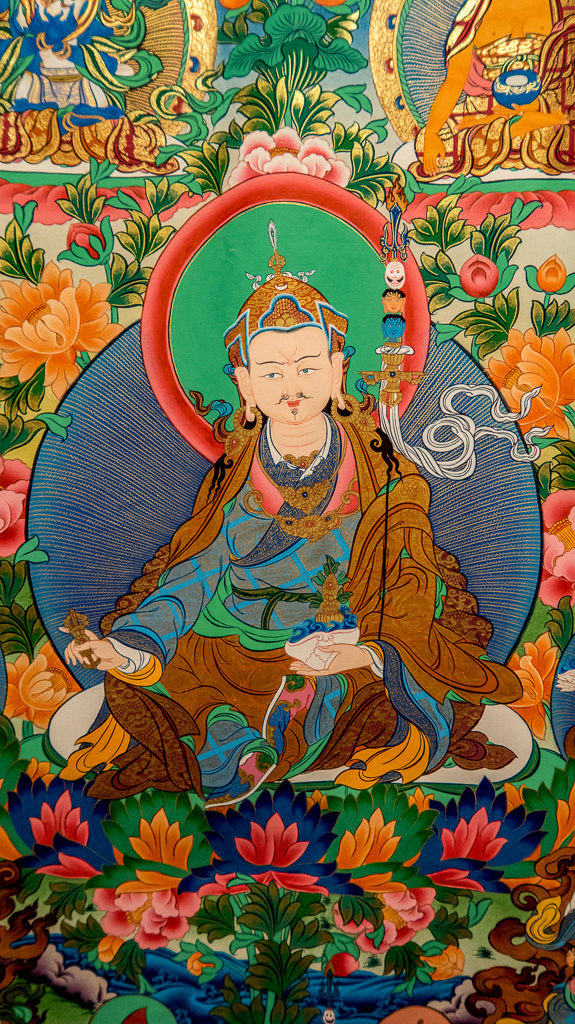
Oftentimes we run into this terrible, terrible, tragic separation in our lives, don’t we?  Where this is this thing, and that’s the sacred.  This is the life, and that’s the sacred.  The way that we practice is by saying, “Okay, here’s how I’m doing on my path.  I’ve got this practice and that practice and this practice, and I’ve accumulated 30,000 prostrations, so that’s how I’m doing on my path.” Then we have our lives, and we say, “Oh, am I  making lots of money?  Do I have a good family situation?  Do I have good relationships, good friends?  Do I have a good social life?  Am I cool?”  Mostly,  “Am I cool?  Am I in?  Am I happening?  Am I loved by everybody?  Do I get enough approval?  Do you all care for me enough?”  We’ll say,  “Okay, I’ll go practice Guru Rinpoche over here.”  You visualize Guru Rinpoche in the sky with diamonds, right?   You’re visualizing Guru Rinpoche in the sky like a cartoon, and you do that for 20 minutes or a half an hour, two hours, and that’s your practice.  Then you walk out of that, and you forget everything.  You forget everything.  And then, in the rest of your life you think, “I’m not making enough money. How am I going to do this?  How am I going to pay this bill?”   And you get all tense and wound up and  think, “I’ve got to run over here, I’ve got to run over there. I’ve got to have this relationship or that relationship.”  So you’re okay with your practice, but stuff’s not going too well for you out here.  Why do you think that is?

Here’s why it is: because Guru Rinpoche is not in your life because there is non-recognition.  You are just floundering in a state of non-recognition.  There can be no blessing if you’re not looking for it.  There can be no recognition if you do not establish it.  No one can shove it down your throat, and it’s not going to magically appear in front of you.  If you do have a vision of some deity or something like that, that’s probably because you did well in your practice, but that doesn’t mean that you wait for the next time for the deity to show up before you think of the deity again. It’s up to us to make our life sacred.

As we are thinking, “Why don’t I have enough money, gotta get more money, gotta get a better job, gotta do this, that and the other thing, why isn’t this happening?”  The Buddha taught you why this isn’t happening: you’re not practicing generosity.  You’re not practicing bodhicitta, or at least in the past you did not practice generosity and bodhicitta, and so the seed that creates the fruit of prosperity was not there.  Your opportunity, then, is to begin to practice generosity, to begin to practice bodhicitta in your ordinary life.

Start small.  It’s best that way.  Start small and work your way big because when we start small, we learn.  It’s kind of like when you’re exercising, if you do a great, big, giant, heavyweight workout the first time, you’ll never do it again because the pain will kill you. You think, “I’ll never do this again.” and then you wait three weeks and by that time it’s all gone.

My suggestion is that you start to practice things like mindfulness and generosity in a small way.  If you have two dollars, buy somebody a cup of coffee or something with one of them.  If you have three dollars, give one of them to somebody that needs it more than you do, like the temple, or put it aside for a donation or something like that.  Start in that small way, making that kind of generosity and offering part of your life to bring the sacred into your life. It also changes the actual conditions of your life, because really, according to the teachings, if we find that we are poor and then somehow we get a better job and maybe the money situation works out, that cure is not permanent.  The poverty will return, either in this life, by you losing that job, or in a future life by the condition simply returning, and we may not understand why.  That mindfulness, that spiritual distinction, has to be embedded in our lives.

© Jetsunma Ahkön Lhamo

Upholding the Extraordinary


An excerpt from the Mindfulness workshop given by Jetsunma Ahkon Lhamo in 1999

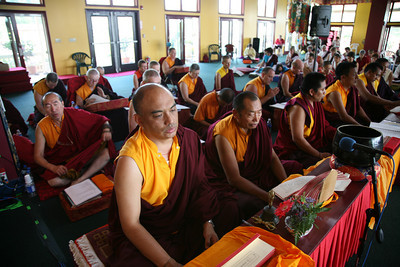
When we view one another, if we have taken teachings together or empowerments under the same teacher, we are Vajra brothers and sisters.  We are family.  When we see each other, we should be willing to lay down our lives for each other because there is nothing more precious than someone who is holding empowerment, holding the blessings of the Buddha in the world.  That doesn’t mean you have to make a big display about it.  You still have that one vertebra bow trick you could do.  We hold our Vajra family as being most precious.  We should think very, very carefully how we deal with our Vajra brothers and sisters.  If we’re ill-tempered, hateful, scornful towards them; if we are not holding them in pure View, holding them as gods and goddesses, as deities and consorts, if we are not looking at them in that way, we are committing a non-virtue.  If we speak with hatred or ugliness to a monk or nun, we are committing a heinous non-virtue.  I don’t think it’s written “heinous” in the book, but I’m telling you, it is.  It is a serious non-virtue because monks and nuns are the providers, the holders, of the doctrine that make it possible for us to practice.  So if we were to speak with disrespect to a monk or nun, the one who suffers from that is us.  The monk or nun, they’re going to react or not react.  That’s their business.  Whatever they do, that’s their practice.  You’re only responsible for your own practice.  And whether that’s a good monk or a good nun, that’s also not your problem.  That they are holding the Buddha’s teachings invites you to accomplish pure View regarding them.  So we should not think of monks and nuns as being equal to us.  I think of monks and nuns as being higher.  They hold the Doctrine, and I hold the view about them.  So even though I am required, to sit higher than the monks and nuns, if I didn’t have this job, I would never willingly do it, never.  I would never willingly do it.  I know you guys on chairs, you’re thinking, “Oh God!”  But in general, I will tell you that when you have the opportunity to sit lower than a monk or nun, you should try to do so, always.  If you have the opportunity to receive a cup of tea from a monk or nun,  receive it properly.  This is from a monk or a nun!  This is really important to hold the View.  These nuns are goddesses.  They are Tara, none other.  These monks are the appearance of Avalokiteshvara in the world, Chenrezig.  Their compassion establishes the Lineage on this Earth.  It’s because of their efforts that we are able to keep ourselves together.  It’s about raising up what is extraordinary, raising the Dharma up higher.

For monks and nuns, there is a particular hierarchy that we think of when we honor one another. For instance, the younger – I don’t mean younger in terms of age but younger in terms of ordination – the more recently ordained monks and nuns are supposed to hold the elders in higher respect, and you should because they have held the robes longer.  Even if you’re better at your practice, if there is a monk or a nun that has held their robes longer than you, you hold them up.  You practice that View.  You monks and nuns that have had your robes for a long time, however, you don’t hold yourselves up.  You don’t think, “Well, you know, I’m an older monk, I’m an older nun.” In fact, your job should be a little bit like the tactic I take.  Perhaps you can allow younger monks and nuns to show some respect if that is their practice and they are willing to do so, but in your mind, you should be thinking, “These are the most precious ones, the babies, the newly ordained, fresh, moist with longing.”  You should think that they are still fresh from that devotion, from that opening, from that pouring out and the gathering of merit that it took for them to become monks and nuns.  You should think, “These are the jewels.  I, as an older monk or nun, am responsible for bringing these along because they are so precious.” not because they are younger in their ordination.  Do you understand that?

In a way, each of us is looking for ways to not have our own ego in the center of our own mandala.  We are looking for a way to practice View so that we really begin to awaken to the sense of all phenomena, all appearance, as being none other than the celestial palace mandala, and that doesn’t mean thinking it.  It means practicing like I said, not just saying, “Oh, everything is love and light, everything is celestial palace mandala.” That’s not how it’s done.  That will produce absolutely zero result.  Positive thinking is not the same thing as practicing View.  Positive thinking is nice, it’s lovely, I hope you do it, but that ain’t what the Buddha taught.  Practicing View is much firmer than that, and yet more subtle.

Practicing View is instituting the habit in your mind to see things differently than you did before.  Practicing View is using every opportunity to get yourself, your ego, off that throne, and using every opportunity to flush out that obsessive-compulsive desire syndrome.  You know that syndrome: the one that says if you have something sweet, now you have to balance it with something salty and then you have to have something sour and then you have to something wet and then you’re thirsty and then you’re hungry.  That is never ending.  Those are the attributes of your ego.  That is what your ego does, that obsessive-compulsive nature, that constantly going around in circles with what we want.  That is absolutely the nature of the ego.  That is all it does.  That’s all it does, and your five senses help you do it.  You smell what you want, you see what you want, you touch what you want, you grab what you want.  The five senses help us to do that.  Any opportunity that we have to move away from that is an excellent opportunity.

When we have those opportunities, and we search them out, you will find those opportunities everywhere, because there is no place where it’s impossible to practice the sacred.  So that being the case, once you move into that posture of really practicing View and beginning to give rise to that recognition and beginning to see all extraordinary, compassionate, sacred objects as being something different — once you begin to see opportunities in every part of your life, you will begin as well to recognize Guru Rinpoche’s blessing.  Once you recognize those opportunities and practice like that, Guru Rinpoche’s blessing will be everywhere.

© Jetsunma Ahkön Lhamo

Wisdom Merit

[Adapted from an oral commentary given by His Holiness Penor Rinpoche in conjunction with a ceremony wherein he bestowed the bodhisattva vow upon a gathering of disciples at Namdroling in Bozeman, Montana, November 1999. —Ed.]

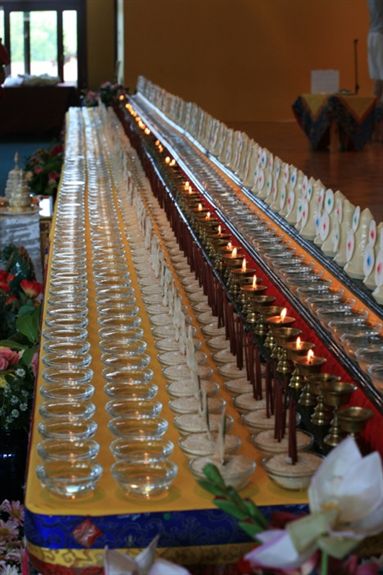
General offerings please the senses. Imagine those offerings to be vast and inconceivable. However, if you were to [attempt to] compare the outer offerings with a single particle of the realms of buddhas and the quality of offerings made in the minds of enlightened ones, [you would find that comparison] to be beyond the scope of your imagination. That is why it is so important while presenting offerings to try to connect with the ultimate nature of offering, which is mental and not just material. Material offerings you make are supports for your mental or imagined offerings, which should be as inconceivably vast and wondrous as you are capable of manifesting. The actual offerings you use as a support should also be the best substances you are able to offer. At least they must not be old, dirty, or leftover substances; they must be suitable supports for the basis of virtue. The pure material offerings you make will be the support for the continual manifestation of inexhaustible offerings that will remain until samsara is emptied.

There is a well-known story of an accomplished practitioner named Jowo Ben. One day Jowo Ben made a very beautiful, clean, and pure offering on his altar. As he sat and looked at his offering, he thought, “What is it that makes this offering I’ve made here today excellent?” Then he remembered his sponsor was coming to visit that day, and he realized he had made the beautiful offering in order to impress his sponsor. He jumped up, picked up a handful of dirt, and threw it on the altar, saying he should give up all attachment and fixation on worldly concerns. Other lamas, on hearing what Jowo Ben had done, proclaimed his offering of throwing dirt on his altar to have been the purest of offerings, because Jowo Ben had finally cleared his mind of attachment and aversion.

When offerings are made, they are rendered pure and excellent by a mind free from attachment and aversion to the ordinary, material aspect of the offerings—and they must be made with a mind that is also free from avarice. Don’t think you can throw dirt on your altar and think that will benefit you. You must adjust your mind. If your mind is free from attachment or fixation and aversion, then whatever you do will be right. If your mind is not adjusted and your intentions are impure, then no matter how beautiful and magnificent the offering is, it will be insignificant. If you present all offerings, whether abundant or meager, with fervent devotion from the core of your heart, that will produce profoundly amazing results.

In order to be free from the suffering of existence, the mind must be free from dualistic fixation. In freedom from duality, everything is inherently pure. Just imagine all the wonderful offerings that are made that are free from duality: pure water possessing the eight qualities, garlands of flowers, incense, light, superior perfume, celestial food, musical instruments, fine garments, beautiful umbrellas, canopies, victory banners, the sun, the moon—the finest and best of everything is offered. Consider those as offerings arranged in a magnificent array equal in size to Mt. Meru. Furthermore, know that those offerings are pure and free from duality. For example, if you were to pick a flower and think, “Oh, this is such a beautiful flower; I want to offer it,” but then you also think, “My flower is more beautiful than the others,” and you offer it with that dualistic thought, then that offering would be defiled by your dualistic fixation. On the other hand, if you focus on the pure nature of the offerings and present them with pure devotion, you will make offerings that are pure or free from dualistic fixation. Recite the verses of the branch for offering, and make the most excellent, immeasurable offering you are capable of with the enlightened attitude [bodhicitta], faith, and pure devotion.

It is important to understand that presenting offerings is the antidote for [having] desire. Offerings are not made to the Three Jewels because they are considered to be poverty-stricken and in need of receiving from their disciples; offerings are made to accumulate merit. By making offerings with actual material substances, we accumulate ordinary conceptual merit; by using the mind to manifest immeasurable offerings, we accumulate nonconceptual wisdom merit.

From “THE PATH of the Bodhisattva: A Collection of the Thirty-Seven Practices of a Bodhisattva and Related Prayers” with a commentary by Kyabje Pema Norbu Rinpoche on the Prayer for Excellent Conduct

Compiled under the direction of Venerable Gyatrul Rinpoche Vimala Publishing 2008

Karmic Ripenings

From The Spiritual Path:  A Compilation of Teachings by Jetsunma Ahkon Lhamo

We tend to externalize our experiences: everything happens “to us.” We externalize all cause-and-effect relationships as somehow separate and distinct from our own minds. To some degree, we even externalize our thoughts and feelings as if they were solid things that can overpower us. If we base our happiness on a new car or a personal relationship, we are powerless when they break down. We may even warily watch for signs of the next unhappiness.

In our practice, if we are unable to concentrate, we have no real understanding of why that would be. Perhaps someone in the next room has a TV playing; that is why we can’t concentrate. Or it’s because we’re here in the West, where everything is materialistic and fast-moving. Or perhaps our parents brought us up wrong. There are causes aplenty, and they’re all out there. Similarly, if we manage to practice properly, the environment is somehow responsible for our happiness. “I like to pray in my own little room.” Or: “I like to practice sitting on a cliff somewhere.” Sometimes we feel dull, lethargic, helpless, lonely, or all of those wrapped into one. Yet we don’t know why. Insidiously, we become resigned to it. “That’s just the way I am,” we say—and we take this as a validation, or permission to feel disabled emotionally. That is how crippled we become when we fail to understand the causes of our own unhappiness. So we concentrate still more on our suffering. Since we believe in the reality of self-nature, we create in our minds a separation between self and other. Then we react with attraction, repulsion, or neutrality. This is where desire enters. Also hope and fear. And karma.

How does karma function? Please picture a black vertical line on a white marking board. This line is the present, where you are right now. To the left is the past; on the right, the future. If all of this can be seen to represent your own mindstream, if that could be done, your self-nature is located on the line in this time and space grid. In the here-and-now. To the left, in your mindstream’s past, karmic seeds are ripening and coming forward like light and dark bubbles. As they come forward, they are experienced in the present. As they pass the present line, they actually work as catalysts or causes for future events—depending on how you react in the present moment.

You have a vast number of bubbles surfacing from countless lives. The dark bubbles are negative seeds, negative causes: you were selfish or you killed someone; you were greedy or hateful. But you also have light bubbles, meritorious seeds: you helped feed starving children, you practiced Dharma, you were kind; you did many wonderful things. In everyone’s mindstream there are mixed causes (like partly overlapping light and dark bubbles) that are ripening and coming to the surface, to the present moment. How they ripen depends on what events and attitudes are at the surface, interacting with these ripenings.

© Jetsunma Ahkön Lhamo

WP2Social Auto Publish Powered By : XYZScripts.com