The Heart of Experience is the Guru

An excerpt from the Mindfulness workshop given by Jetsunma Ahkon Lhamo in 1999

For many of you, I know that when we first started this temple it was family style, and you thought of yourselves as children, and I thought of myself as your mother in many ways, and there was a spiritual family dynamic.  We started small, and we got big.  So for many of the people who have always been around, who have been practicing with me for about 15 years now, (or 15 aeons it seems like), for many of you, my going away, my physical movement, if you will, from Poolesville, Maryland, to Sedona, Arizona, has been an extremely painful thing.  It’s not that I don’t have compassion for you, but if that is the case, I’m telling you, you are not practicing correctly.

There is nothing on this earth, including me, that can take your guru away from you.  There is nothing that can take that Recognition away from you, that relationship. There is nothing that can take Guru Rinpoche’s blessing away from you, that marvelous connection. Nothing has that power.  If you think that your teacher is absent, then you are absent.  It’s like the sun and the earth.

When we were younger as a species, we thought that when nighttime came, the sun disappeared; it fell off the edge, and it wasn’t there anymore.  Then later on it came back, and we liked it better when the sun was there because we could see better and it felt warm on our skin and it was safer.  But really what was happening, we later found out, is that the sun is staying right where it is constantly shining.  It’s the earth that cyclically turns away.   It’s the same way with the relationship with our teachers.  To the degree that we keep mindfulness, that we practice Recognition, that we are willing to see the guru in all things, in every opportunity, and utilize that opportunity, to that degree we experience oneness, non-duality, with our teachers.  We also experience some kind of awakening to our own primordial wisdom nature to the degree that we practice that Recognition.

If you think that your teacher is not with you most of the time, then you are not with your practice most of the time.  We have to get past making our egos and the appearances that go with the phenomena of ego-clinging the center of the mandala of our activity.  We have to stop doing that, and move past appearances into a deeper Recognition through constant mindfulness. To practice that as an extension to our sit-down practice, is the way, and to the degree that we awaken our capacity to Recognize, we are held inseparable from the heart of Guru Rinpoche.

Don’t waste your time as a practitioner thinking, “Oh, now my teacher moved away, so now I am lonely.  Now she’s there and I’m here, or he’s there and I’m here.” You’re accumulating the mantra of samsara if you do that.  You are accumulating appearances.  You are just thickening the delusion. Instead practice the recognition of one’s own nature being totally inseparable from the guru.  Practice the recognition of that to such an extent that you feel, in every moment, the king of that moment is Guru Rinpoche; in every breath, the queen of that breath is Guru Rinpoche – yes, the queen – everything.   Whatever ideas that we have, think that every movement, every experience, through our practice, through our determination to practice Recognition, the essence of that experience is the guru.  The more we practice like this, more and more we become awake.

It is possible to practice in that way with such fervent regard that in every future lifetime that presence will not be denied you.  In this and every future lifetime that presence will never be denied you.  There is no way that, as we accomplish Recognition, the primordial wisdom nature can be kept from you.  Again and again it will be Recognized as the seed and the fruit of every moment, every bit of experience.  But it only works if you work it.  So this tendency that we have to keep our minds satisfied with simply fulfilling the form and then going out to be lazy and slothful, reacting to appearances, simply accepting things at the most superficial, apparent level — this is a mistake.

© Jetsunma Ahkön Lhamo

Approaching the Dharma Like Children

An Excerpt from a teaching called Our Motivation Is For Those Who Have Hopes of Us by Jetsunma Ahkon Lhamo

I often make prayers that all of us will approach the Dharma like children.  Because when we hold onto our own minds, our own self image, our intellectual prowess, we lose something.   Our minds become hard.  It’s especially important for long-time Dharma practitioners to approach the Dharma like children, because we get the idea that we don’t have to check on ourselves.  We don’t have to examine our minds anymore.  We don’t have to really look inside and see what’s happening.  Then we dry up.  We lose it.

If we approach the Dharma like children, we can remember the first moment we met Dharma, how it came to be important to us, how it answered our questions, and how it led us to make certain decisions.  On what did we base our turning toward Dharma?  What were the realizations that we had?  Our answers to these basic questions are still important; they should still motivate us.

We always have mixed motivation for approaching the Dharma.  What we forget is that our motivation absolutely sets the pace.  It plows the ground in which the seed will be laid.  Those who have the most trouble keeping their motivation pure and practicing accordingly seem to be those who have been practicing the longest.  Because we’ve been practicing for a long time, we think surely we’ve got it by now.  We can just jump right in and do it.  We tend to forget that every day of our lives, as practitioners, we need to go back through the same process we experienced in the beginning when we tried to turn our minds completely toward the Dharma.  The decisions that we made, the view that we had, the understandings that we came to, those have to be realized again and again and again.  We have to examine anew every day the faults of cyclic existence.  We have to examine what we’re up against.

In terms of self-examination, new practitioners have an advantage.  They are already looking at their motivation.  They have to, because they don’t know why they should become practitioners.  They don’t really understand the faults of cyclic existence.  They’re going through a process that’s very raw, very new.  It’s right on the surface.  It’s achingly important to them.  They know they’ve got to establish themselves firmly, and so they think about these matters continually.  They examine cyclic existence, even having thoughts like, “Isn’t it true that everyone you know and everyone you love will die?  Isn’t it true that everyone so far has died?  Therefore, the life that we know is utterly impermanent.  Isn’t it true that every material object that has ever made you happy has been impermanent?  Isn’t it true that you cannot count on relationships — that they, too, are impermanent?  Isn’t it true that you cannot count on any single condition, including your own appearance, your own health, your own psychological state?”

Even when you feel on top of it, even when you feel you’ve aced it, when you feel you’ve got the world right in the palm of your hand, you know that little pancake is surely going to flip right over!  We have to think like this constantly.  In the beginning we thought like that.  But Dharma practitioners who are somewhat experienced, who have some teaching under their belt, who feel they have continued on the path for some time, who feel a certain degree of confidence (if not false bravado) — these Dharma practitioners forget.  We don’t notice that we are not practicing from the depth of our being, that we are not practicing from our heart.  “Now we’re experienced in Dharma,” we say.  “We can dress like Dharma people, look like Dharma people, and we can write down Dharma words.”

But how important are these things if the mind remains hard as horn?  How important are these things if the content of the mindstream remains unchanging?  Do you think that wearing Dharma clothes and doing the Dharma dance can be important for you if the heart doesn’t change?  Absolutely not.

Unfortunately, when we approach Dharma teachings, we tend to collect them.  Like pretty things.  Like treasures.  And then not understanding the treasures, we put them on a shelf and we admire them and say, “Oh, I’ve got a hundred treasures, and that means something about me.”  But if you are not changing to the depth of your being, and if your motivation is not right, you can have a million treasures and it won’t mean anything about you except that you have missed the point.

What is the motivation you should have when you approach the teachings?  The lamas tell us again and again.  It’s Bodhicitta.  You should think, “Thus for the benefit of sentient beings, I will practice accordingly.”  And only for the benefit of sentient beings, because the value of the Dharma is that it can produce the end of suffering — a promise that Lord Buddha himself made.  If we practice sincerely we ourselves can be of some benefit to those that suffer.  And eventually we can return in a Nirmanakaya form to urge others toward enlightenment or to directly give them the teachings.

You might as well not be a practitioner if you have not yourself looked at the world and seen the suffering there and said ENOUGH IS ENOUGH!  There is too much hunger, too much war, too much suffering, too much ignorance, too much hatred, and too many people who do not understand the infallible law of cause and effect.  It doesn’t matter if you are a long-time practitioner or even a monk or a nun.  If Bodhicitta is not your primary motivation every time you hear a word of Dharma, read a word of Dharma, or even see an image associated with the Dharma, you have missed the point, and the blessing will not ripen in your mindstream.

© Jetsunma Ahkön Lhamo

A Nontraditional Chod Practice to Establish a Sacred View

An excerpt from the Mindfulness workshop given by Jetsunma Ahkon Lhamo in 1999

Before I ever learned about the Buddha dharma, I actually used to do a practice that my teachers have told me was a natural kind of Chöd.  What I would do is contemplate on different body parts and it took me months and months and months to do this. I practiced it for months because I felt like the deeper I went into it, the more involved it became.  I would think about a certain body part, like my feet, and I would say, “Thinking of these feet in one way, here are their limitations,” and it’s easy to see what the limitations of feet are.  You can’t walk on fire with them.  Well, not most of us.  You can’t walk on water with them – not most of us either.  There are so many things you can’t do with your feet, but there are also many things that you can do with your feet.  So thinking of feet in those ways, I would see all of the limitations of feet, being used as they are presently being used, and then I would think about all the possible ways that feet could be of benefit to beings.  How could my feet be of use?  That’s what I want.  I want my feet to be of use.  So I would think, “How can my feet be of use?  Well, I can go to people that need me with my feet.  I can go to do some meditation.  I can make my body go and comfort someone that’s sick or feed someone that’s hungry through moving my feet.”

After I had examined both the down side and the opportunity associated with feet, I would then practice this kind of deep offering, and I would make many prayers.  I would say, “I offer my feet to (back then I didn’t say Buddhas and bodhisattvas), Absolute Nature. I offer my feet to the Buddhas and bodhisattvas in order that they might be used to benefit sentient beings.  Other than that, they have no meaning for me.”  I would practice that until I felt like I had given up my feet and they were no longer mine; they were offerings.  I went through my entire body.  Then I found that that wasn’t enough, so I went through all my emotions.  And then I found that wasn’t enough, so I went through all the different ways of thinking and attributes of mind.  I would see the potential of each and I would see the downfall of each and I would contemplate on that very, very carefully.  Then I would spend a great deal of time offering that particular quality or attribute or body part to be used for the benefit of sentient beings, to be used to accomplish some good.

It seemed to me that, generally speaking, the body is a marvelous thing, but if it’s not accomplishing any good, it’s kind of limited, so it seemed logical and reasonable to me to want to offer all of my limitations, all of my ordinary perceptions, all of my attachments in the hope that every part of me would be used to benefit sentient beings.

Think about your speech.  Speech is a wonderful thing; it’s an amazing thing.  It’s one of those human attributes that make it possible for us to teach and learn, so it makes it possible for us to practice Dharma.  So although speech is an amazing thing, what do we use our speech for?  For the most part, we use our speech to help us suffer.  For the most part, our speech is like vomit coming out of our mouths.  What I mean by that is, the stuff that comes out of our mouth often is not connected to any thought anywhere.  We use our speech for blah-blah-blah-blah-blah, and yet this precious thing could be used to teach Dharma.  This precious capability could be used to receive teachings of Dharma.  How amazing!

Practicing this kind of nontraditional Chöd was when I really learned about speech.  That was really important.  When I learned about speech, I found out that if I were really to offer my speech and be constantly mindful of its power, constantly mindful of this blessing, and if I really, ultimately offered my speech to the Buddhas and the bodhisattvas, that instead their holy speech might be here.  That makes the speech worth something.  That makes it powerful.

I used to spend a lot of time considering the pros and cons, the limitations and the attributes of different aspects of what I considered ‘myself,’ and eventually, after offering all my parts and all my qualities and all my different attributes, at that point I felt that something was changed.  I had done this so deeply that I got into the habit of thinking like this, to the point where, when it comes to benefiting sentient beings, I don’t have to make that choice because it’s already been made.  I don’t own this stuff.  It’s already given away.  I developed this habit of constantly offering, and I’m telling you about the way that I did this is not so that you can say, “Ooh, aah, wasn’t she a great practitioner!” I’m not a great practitioner by any means.  What I’m telling you is that as a Westerner, even if we don’t have perfect translations, even if we haven’t accumulated all the teachings, even if it seems to us strange to practice Chöd in a way where we boil stuff and offer it and all those things, even if we’ve never heard of that teaching, it is still possible for us to practice the same principles and to establish a sacred view. It’s still possible.

I feel like my main job is to speak to Westerners because Westerners have a particular outlook, a particular take on things, and I think one of the greatest blessings that I have is that I’m a Westerner and I think like you.  I really do think exactly like you, so maybe I can help you, not just to follow the books by rote, not just to repeat everything like a magpie, but maybe instead to practice more deeply.  Maybe I can help you practice in such a way that the practice becomes married with your life, with your body, with your speech, with your mind, with your consciousness, until they are so one that it’s like mixing milk with water.  That is how practice becomes potent.

© Jetsunma Ahkön Lhamo

The Comfort Zone – Is It Real?

An excerpt from the Mindfulness workshop given by Jetsunma Ahkon Lhamo in 1999

Let’s say we were living in a terribly traumatic situation where there was all kinds of danger and all kinds of suffering, but something came on TV, a sitcom, the one that starts with an event and ends up with happily ever after in 30 minutes.  Don’t you love that about sitcoms?  I wish life were like that.  In the midst of all your travail and suffering you watch this sitcom, and for that short period of time, you’re comfortable, sort of happy.  You can laugh at things, but like the sitcom playing, does it change anything?  When the sitcom is finished, what happens?  You’ve still got your life, right?  So it’s like that with the kind of escaping that we try to do.  We try to put ourselves in a comfort zone.  We are so addicted to the narcotic quality of samsara that we try to bring that narcotic state onto ourselves again and again.   We want to watch TV.  We want to do different kinds of activities that make us feel safe.  We like to do activities that we can control.  We like to experience little adventures that are completely within our control, where there are no surprises, and we call that amusement.  We like to experience psychological, emotional events that are totally safe and totally controlled, and we call that relationships.  We don’t want to leave that comfort zone.

What is that comfort zone?  That comfort zone is the blind, dumb acceptance of the appearance of phenomena as being real without any discrimination, without any recognition.  We prefer to bring this narcotic cloak onto ourselves.  When we feel that things are getting too naked, too real, pull up the covers!  That’s what we do.  And we all have different ways of doing that, don’t we?  You know some people like to do the domestic goddess routine; some people like to be workaholics; some people like to do the fertility mambo.

No matter what area you’re practicing, you have to require of yourself a mental exercise – to rethink things, to reassess.  You have to practice recognition.  Do not wait for recognition to come.  The mistake that most practitioners make is magical thinking.  They say, “If I do this practice for two hours a day for the rest of my life, and maybe I’ll take a three year retreat, then I will be enlightened.”  It’s like a magical charm.  It doesn’t matter how you do those things or what you do after those things or before those things, but so long as you do those things, you will be enlightened.  This is the kind of thinking we have about our practice.  What I’m suggesting is that it’s not true.  We achieve enlightenment when we awaken.  There’s a difference.  You can’t really say you achieve your enlightenment after you finish your practice.  You achieve your enlightenment when you awaken.  The state of recognition is the key here.  How you hone your mind, how you choose to use your senses, how you redefine, how you study Samsara in order to recognize, how you study and learn to discriminate is necessary in order to achieve realization.  It is part of the process of awakening.

© Jetsunma Ahkön Lhamo

Reactiveness Is The Enemy

An excerpt from the Mindfulness workshop given by Jetsunma Ahkon Lhamo in 1999

How does one practice the recognition of the empty nature of all phenomena?  One of the ways that we can do that is by pacifying reactiveness through a deeper understanding and discrimination.  Reactiveness is an inner enemy.  In a very profound way, it’s probably your worst enemy.  It is the seat, the throne, the source of all suffering.  It is really our reaction to samsara and the resulting activity that that brings our suffering; that is our suffering.  Like the Buddha said, our suffering is all based on our clinging to self-nature as being inherently real and the desire that arises from that.  This reactiveness is truly the enemy.  I can’t say that often enough.

Since time out of mind we have believed in self-nature as being inherently real.  Since that first idea of self-nature as being inherently real, we have spent every moment from that point on securing ourselves, establishing ourselves, making ourselves safe and defining – most of all defining – ourselves.  In order to define myself, I have to see you as separate.  All of the ideas we have that come from that are truly samsaric in nature, even, as a practitioner, the idea that I should walk around looking very noble and very holy and very renounced.  Even that idea, although it may seem to be about practicing on the path, is actually about the samsaric clinging to self-nature as inherently real.

So this discrimination that we practice has to antidote that very thing.  How are we going to antidote that very thing?  That’s not so easy.  Reactiveness, if you think about it, is a perception about self-nature being real, the perception of other, and the reaction is based on hope, fear or neutrality.  As a human being, if I see you, I hope that you will make me happy.  I hope that you will make me safe.  Or, if I see you, maybe I fear that you’re going to be prettier than me or richer than me, or I fear that you’re going to be unkind to me or that you’re a danger to me.  Neutrality comes after you go through both hope and fear and you’ve decided it’s pretty well balanced, so you’re neutral about this.  Neutrality is not wisdom.  When we have that kind of a reactive mentality, it is such a knee-jerk reaction that it is automatic.  There is never a thought that says, “Oh boy, now I’m going to react to this.”  When somebody walks in the room, you don’t think, “Now, watch me react.”  When something happens to you, you don’t think, “Watch this.”  I have the image of these old-time paddleballs with an elastic string and a ball on the end, you know?  The only thing that you can do with it is bam-bam-bam-bam-bam-bam, you know, like that?  Our minds are like that.  We are like that, bam-bam-bam-bam-bam.  The thing that’s happening is that we perceive ourselves as being real and solid; we perceive stuff as being “out there,” and the only thing it can do is hit us, and the only thing we can do is bounce at it, and it’s bam-bam-bam-bam-bam, reaction, reaction, reaction, reaction, reaction, because we cannot have a second where we don’t reinforce the idea that self-nature is inherently real.  Maybe we would disappear.  So bam-bam-bam-bam-bam-bam-bam!  That’s what we have to do, and it has to be constant or maybe time won’t pass or things won’t be solid.

To apply the antidote to that, we are told to sit and practice and do the visualization.  That is an antidote.  The reason why it’s an antidote is because you’re not reacting to something that affects self-nature, but you are engaging in a visualization, giving rise to a deeper awareness of what your nature actually is.  So it’s a great antidote for that.  But if you really look at the phenomenon of bam-bam-bam and what it’s based on, you can see that there is no spaciousness between the idea of self-nature as being inherently real and BAM, the reaction.  There’s no space.  The mind can’t NOT snap back.  Do you understand why I’m saying that?

To apply the antidote, you can’t just decide consciously not to react.  That would only make you neurotic.  That is the nature of the beast as we are now.  You cannot pretend that you’re not reacting.  You’d look holy, I guess, but it would make you a little weird.  The way to practice is to try to get a little bit of space somewhere in the equation; to try to take a breath, give it a moment.  How can you do that?  I just said you can’t control that, so how are you supposed to do that?  The way to do that is to begin to recognize the nature of the phenomena that you’re experiencing.  When you go through this mental stuff and your mind is so tight and you’re bam-bam-bamming and you’re in that deeply reactive mode, you have the power to do this.  Animals can’t do this, other kinds of beings can’t do this, but humans can do this.  This is what’s unique about us.  We can stand back, and we can say, “Oh yeah, that’s just like me.  I do that.”  Just that stepping back to observe phenomena without going crashing into it headlong in total ignorance and drunkenness and denial is an incredible practice.  To be an observer just for a moment, to watch the equation – self-nature is inherently real, therefore…to watch the reactiveness, to watch the play that goes on there, begins to create some space in the mind. This is an incredible practice, and it should be done at times when you’re not deeply reactive.

To practice like that, you have to start very simply, when the mind is relatively quiet.  Watch yourself looking at a tree.  Watch how, when you look at the tree, the tree is only relevant if it makes you feel good.  Otherwise, what do you care about trees?  You couldn’t care less. But the tree is beautiful.  It affects us.  It’s very healing, pretty in the spring, shady in the summer, fruitful in the fall.  Instead of being king or queen baby on your own little stage, perhaps you can observe yourself looking at a tree and watching how the tree is relevant as to how it affects you.  Watch what happens when you watch the tree.  When you look at the tree, just kind of watch that whole equation right then.  At first, maybe it’ll happen too fast and you won’t be able to see it, but if you persist, you will get a wedge in there.  Watch your mind.

© Jetsunma Ahkön Lhamo

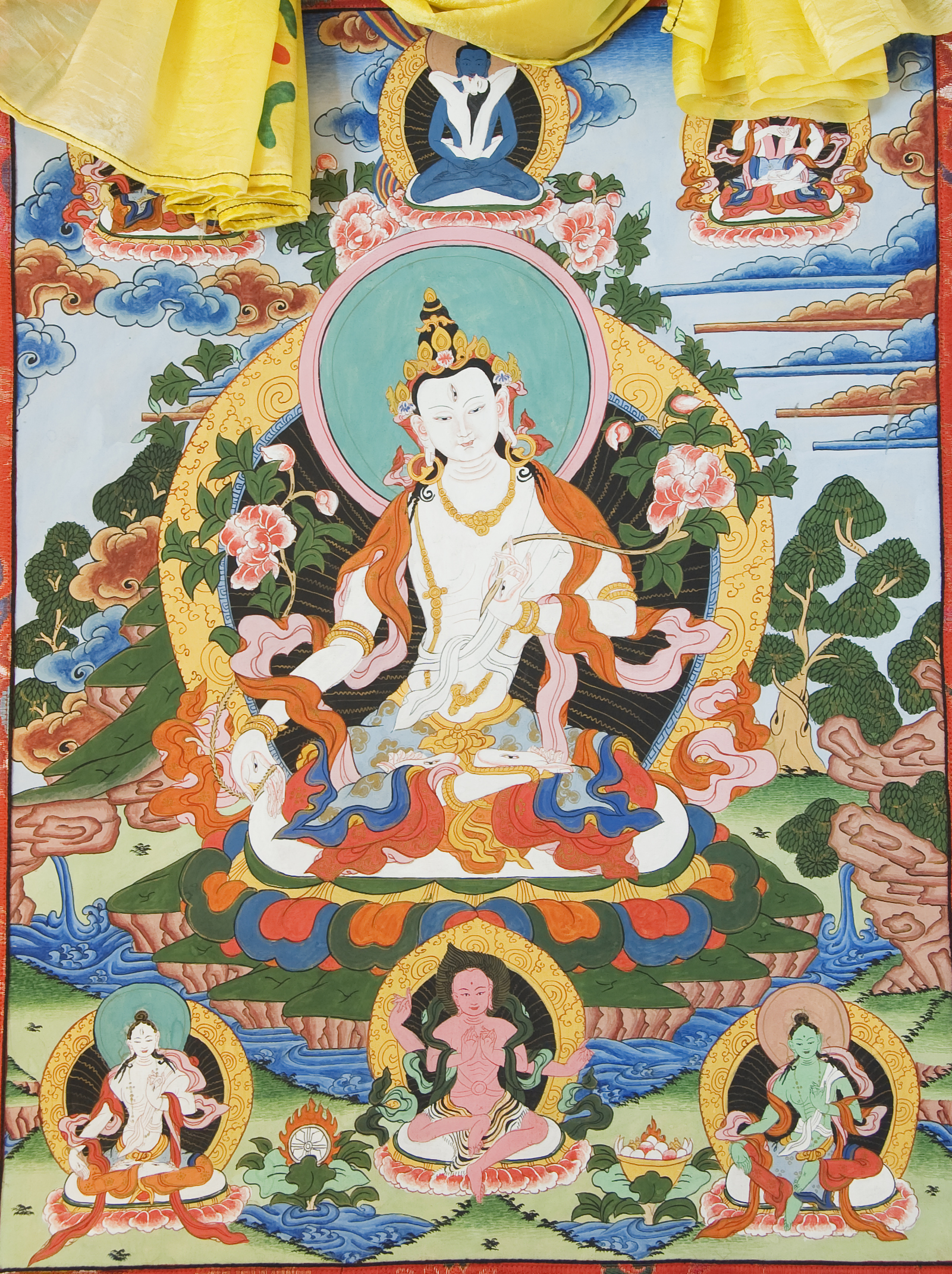
21 Homages to Tara

The Twenty‐One Homages to Tara
OM JETSÜMA PHAGMA DROLMA LA CHAG TSAL LO
OM To Jetsunma Arya Tara, I bow down.
CHAG TSAL DROLMA NYUR MA PAL MO
CHEN NI KE CHIG LOG DANG DRA MA
JIG TEN SUM GÖN CHU KYE SHAL GYI
GE SER JE WA LEI NI JUNG MA
Homage, Tara, quick and brave, with eyes that flash like lightning, born from the open corolla of
the lotus face of the protector of the three worlds.
CHAG TSAL TÖN KI DA WA KÜN TU
GANG WA GYA NEI TSEG PAI SHAL MA
KAR MA TONG TRAG TSOG PA NAM KYI
RAB TU CHE WAI ÖD RAB BAR MA
Homage, the lady whose face is filled with a hundred autumn full moons, blazing with the free
light of thousands of stars
CHAG TSAL SER NGO CHU NEI KYE KYI
PEDME CHAG NI NAM PAR GYEN MA
JIN PA TSÖN DRÜ KA THUB SHI WA
SÖD PA SAM TEN CHÖD YUL NYID MA
Homage, Lady whose hand is adorned with a golden‐blue, water‐born lotus whose realms of
practice is generosity, effort, austerity, peace, patience and meditation.
CHAG TSAL DE SHIN SHEG PAI TSUG TOR
THA WEI NAM PAR GYAL WAR CHÖD MA
MA LÜ PHA ROL CHIN PA THOB PAI
GYAL WAI SEI KYI SHIN TU TEN MA
Homage, Lady with Tathagata crown, enjoying infinite victory, attained all perfections, served by
the sons of the Buddha.
CHAG TSAL TUTARA HUNG YI GE
DÖD DANG CHOG DANG NAM KHA GANG MA
JIG TEN DÜN PO SHAB KYI NEN TE
LÜ PA MED PAR GUG PAR NÜ MA
Homage, Lady filling the desire realm, the directions and space with TUTTARE and HUM,
trampling the seven worlds with her feet, able to summon all
CHAG TSAL GYA JIN ME LHA TSANG PA
LUNG LHA NA TSOG WANG CHUG CHÖD MA
JUNG PO RO LANG DRI ZA NAM DANG
NÖD JIN TSOG KYI DÜN NEI TÖD MA
Homage,Lady worshiped by Indra, Agni, Brahma, Pavana and Vishveshvara, praised by hosts of
spirits, ghosts, gandharvas and yakshas.
CHAG TSAL TRAG CHE JA DANG PHET KYI
PHO ROL TRUL KHOR RAB TU JOM MA
WEI KUM YÖN KYANG SHAB KYI NEN TE
ME BAR TRUG PA SHIN TU BAR MA
Homage, Lady who destroys others’ magic devices with TRAD and PHAT, trampling with left
foot up and right extended, blazing with a mass of blazing fire.
CHAT TSAL TU RE JIG PA CHEN PÖ
DÜD KYI PA WO NAM PAR JOM MA
CHU KYEI SHAL NI TRO NYER DEN DZED
DRA WO THAM CHED MA LÜ SÖD MA
Homage, Lady who destroys the heroes of Mara with fearful TURE, with the angry lotus face,
slayer of all enemies
CHAG TSAL KÖN CHOG SUM TSÖN CHAG GYAI
SOR MÖ THUG KAR NAM PAR GYEN MA
MA LÜ CHOG KYI KHOR LÖ GYEN PAI
RANG GI ÖD KYI TSOG NAM TRUG MA
Homage, Lady adorned with fingers over the heat in the mudra inducating the three Jewels,
adorned with the universal wheel, swirling with masses of its light.
CHAT TSAL RAB TU GA WA JID PAI
U GYEN ÖD KYI TRENG WA PEL MA
SHED PA RAB SHED TUTTARA YI
DÜD DANG JIG TEN WANG TU DZED MA
Homage, Lady diffusing garlands of light from her joyous, shining crown, subjugating the world
with laughing, mocking TUTTARE.
CHAG TSAL SA SHI KYONG WAI TSOG NAM
THAM CHED GUG PAR NÜ PA NYID MA
TRO NYER WO WAI YI GE HUNG GI
PHONG PA THAM CHED NAM PAR DROL MA
Homage, Lady able to summon all the hosts of the earthʹs protectors, saving from all poverty by
the movement of her angry brows and the letter HUM.
CHAG TRAL DA WAI DUM BUI U GYEN
GYEN PA THAM CHED SHIN TU BAR MA
RAL PAI TRÖD NEI ÖD PAG MED LEI
TAG PAR SHIN TU ÖD RAB DZED MA
Homage, Lady blazing with all jewels, head ornament a crescent moon, continually blazing with
light from Amitabha on her mass of piled hair.
CHAG TSAL KAL PA THA MAI ME TAR
BAR WAI TRENG WAI Ü NA NEI MA
YE KYANG YÖN KUM KÜN NEI KOR GAI
DRA YI PUNG NI NAM PAR JONG MA
Homage, Lady located in the center of a blazing garland like the fire at the end of the aeon, in a
joyous posture, right leg extended, left up, conquering the army of the enemy.
CHAG TSAL SA SHI Ö LA CHAG GI
THIL GYI LÜN CHING SHAB KYI DUNG MA
TRO NYER CHEN DZED YI GE HUNG GI
RIM PA DÜN PO NAM NI GEM MA
Homage, Lady touching the earth with her palm, pounding it with her feet, frowning angrily, the
letter HUM subduing the seven stages
CHAG TSAL DE MA GE MA SHI MA
NYANG NGEN DEI SHI CHÖ YUL NYID MA
SO HA OM DANG YANG DAG DEN MEI
DIG PA CHEN PO JOM PA NYID MA
Homage, Lady blissful, virtuous, peaceful, whose realms of practice is peaceful Nirvana, with
SOHA and OM conquering great negative actions.
CHAG TSAL KÜN NEI KOR RAB GA WAI
DRA YI LÜ NI RAB TU GEM MA
YI GE CHU PAI NGA NI KÖD PAI
RIG PA HUNG LEI DROL MA NYID MA
Homage, Lady by total joy destroying the bodies of enemies, saviouress arisen from HUM in the
mantra composed of ten letters.
CHAG TSAL TU REI SHAB NEI DAB PEI
HUNG GI NAM PAI SA BÖN NYID MA
RI RAB MEN TA RA DANG BIG JED
JIG TEN SUM NAM YO WA NYID MA
Homage, Lady, the seed of the form of HUM, striking with feet of TURE, shaking Mountain
Meru, Mandara, Kailasha and the three worlds.
CHAG TSAL LHA YI TSO YI NAM PAI
RI DAG TAG CHEN CHAG NA NAM MA
TA RA NYI JÖD PHET KYI YI GEI
DUG NAM MA LÜ PAR NI SEL MA
Homage, Lady holding the ʺdeer‐markedʺ, in the form of a sea of gods, with twice spoken TARA
and the letter PHAT cleansing all poisons.
CHAG TSAL LHA YI TSOG NAM GYAL PO
LHA DANG MI‐AM CHI YI TEN MA
KÜN NEI GO CHA GA WAI JID KYI
TSÖD DANG MI LAM NGEN PA SEL MA
Homage, Lady served by the king of the hosts of gods, by gods and spirits with the brilliance of
her joyous total armour dispelling disputes and bad dreams.
CHAG TSAL NYI MA DA WA GYEI PAI
CHEN NYI PO LA ÖD RAB SAL MA
HA RA NYI JÖD TUTTARA YI
SHIN TU DRAG POI RIM NED SEL MA
Homage, Lady shining with the light of two eyes, the sun and full moon, with twice spoken
HARA, and TUTTARE, curing terrible fevers and illnesses.
CHAG TSAL DE NYID SUM NAM KÖD PEI
SHI WAI THU DANG YANG DAG DEN MA
DÖN DANG RO LANG NÖD JIN TSOG NAM
JOM PA TU RE RAB CHOG NYID MA
Homage, Lady truly possessing the strength of peace by the array of the three essences,
conquering the hosts of demons, ghosts and yakshas, supreme Lady TURE.
TSA WAI NGAG KYI TÖD PA DI DANG
CHAG TSAL WA NI NYI SHU TSA CHIG
This is the praise of the root mantra, and the Twenty‐one Homages.
Benefit Verses
LHA MO LA GÜ YANG DAG DEN PAI
LO DEN GANG GI RAB DANG JÖD TE
Recited by an intelligent man, with true devotion to the goddess,
SÖD DANG THO RANG LANG PAR JE NEI
DREN PEI MI JIG THAM CHED RAB TER
Arising at evening or dawn and remembering them, they grant all fearlessnesses,
DIG PA THAM CHED RAB TU SHI WA
NGEN DRO THAM CHED JOM PA NYID DO
Pacify all negative actions and conquer all evil existences.
GYAL WA JE WA TRAG DÜN NAM KYI
NYUR DU W ANG NI KUR WAR GYUR LA
Quickly being initiated by seventy million Buddhas, thereby achieving greatness,
DI LEI CHE WA NYID NI THOB CHING
SANG GYE GO PHANG THAR THUG DER DRO
He will pass to the ultimate of Buddhahood.
DE YI DUG NI DRAG PO CHEN PO
TEN NEI PA‐AM SHEN YANG DRO WA
Even if he has eaten or drunk terrible poison, either inanimate or animate,
ZÖ PA DANG NI THUNG PA NYID KYANG
DREN PEI RAB TU SEL WA NYID THOB
By remembering them one will obtain purification.
DÖN DANG RIM DANG DUG GI ZIR WAI
DUG NGAL TSOG NI NAM PAR PANG TE
All the sufferings of demons, fevers and poisons are gone.
SEM CHEN SHEN PA NAM LA YANG NGO
NYI SUM DÜN DU NGÖN PAR JÖD NA
Even for other beings, if they are clearly recited two,
three and seven times,
BU DÖD PEI NI BU THOB GYUR SHING
NOR DÖD PEI NI NOR NAM NYID THOB
If one wishes a son, one will obtain a son. If one wishes wealth, one will obtain wealth.
DÖD PA THAM CHED THOB PAR GYUR LA
GEG NAM MED CHING SO SOR JOM GYUR CHIG
All wishes will be obtained, without hindrance, all will be conquered.
OM TARE TUTTARE TURE SO HA
GYAL YUM DROLMA KYED KU CHI DRA DANG
KHOR DANG KU TSE TSED DANG SHING KHAM DANG
Oh, Dolma, Mother of all the Buddhas, all forms are yours, all containers contained, and all realms are
yours. May their duration and ling life endure,
KYED KYI TSEN CHOG ZANG PO CHI DRA WA
DE DRA KHO NAR DAG SOG GYUR WAR SHOG
And in the excellence of all your goodness and sacred marks,
may we become identical with you in every way.
KYED LA TÖD CHING SOL WA TAB PEI THÜ
DAG SOG GANG NA NEI PAI SA CHOG SU
By the power of this prayer and hymn of praise,
may I and all others, wherever they may be, in every direction,
NED DÖN WUL PHONG THAB TSÖ SHI WA DANG
CHÖ DANG DRA SHI PHEL WAR DZE DU SOL
Have all our poverty, illnesses, obsessions and wars pacified.
Any may the hold Dharma and good fortune increase without end.

For a PDF download: https://www.tibetanbuddhistaltar.org/2010/06/21-homages-to-tara-pdf-download/

Mindfulness Brings Awakening

An excerpt from the Mindfulness workshop given by Jetsunma Ahkon Lhamo in 1999

For all students, when they see the sacred, whether it’s a text or a holy image, it is an opportunity to practice and it’s an opportunity for recognition.  It’s an opportunity to practice the View – to get that coarseness and dullness out of our minds.

As practitioners, we should never, even for a moment, point our feet at a sacred image.  You might think, “Ah, that’s for another culture,” but no, it’s not.  There is a thing that happens in your mind when you’re kicking back and you’ve got your feet up and you’re pointing it at something holy.  The mind goes to sleep.  Inwardly, subtly, you simply go to sleep.  Believe me when I tell you, you leave yourself wide open for real negativity to come out at that very time, because there was an opportunity for recognition, and there was a choice of non-recognition.  That puts more weight in the shit pile, not the Dharma pile.  See, we have two piles – shit and Dharma.  Those are the choices.  Just trying to be real clear about this.

When we practice this non-recognition, we are going deeper and deeper into suffering.  The mind becomes more inflamed, thicker, looser as in sloppy.  In actuality, in some ways it’s much tighter.  The mind is very reactive.  When we practice viewing the sacred and taking that little moment to practice the humility of lifting up that sacred image in our minds and really recognizing that, at that moment the mind is not concentrating on ego-clinging; it is not concentrating on desire; it is not concentrating on how you feel or what you want or what you don’t have; it is not concentrating on what you have to do next to make yourself happy.  It is practicing something different, and every opportunity to recognize the sacred in one’s life is a good one, particularly when you’re walking around not visibly practicing.  So, we never point our feet at a sacred object or at the Lama.

I remember for a long time I had a problem with my leg.  It was very swollen, and I had a hard time.  I had to keep it elevated, for a couple of years actually. Now it’s a lot better, but it used to be that I had to, even in puja, taking empowerment from my teachers, put my foot up, and it was the worst time in my life.  There were times I wished that I could cut my damn leg off.  I felt that strongly about it.  I’d just look down at that leg and think, “What the hell use are you, sitting there like that?”  So I really felt very bad about that.  What I would do is cover my leg with a blanket so no one could see it, and I was prayed that somehow that made it go away.  That was something I had to deal with, and I didn’t like that at all.  It felt wrong to me.  However, for the most part we are healthy, and we are able to practice in such a way that we do not point our feet at any sacred object.  This teaches us not to be slovenly in our minds, not to be forgetful, not to be mindless, but rather to be more mindful, and that is an antidote to suffering of all kinds.

Furthermore, Dharma texts should never be treated like regular texts.  They should always be lifted up.  They should never be on the floor.  They should never be under you.  Dharma is always held up because it is the path that the Buddha has given us.  Not doing so brings a lot of obstacles because of the state of non-recognition, which is the root of the suffering.  It’s the root of the problem.  You don’t think that you’re disrespecting the Dharma.  Let’s say  I have a Dharma book over here and I’m in a really tight seat and somehow I just kind of lean over like that with my elbows on top of the Dharma book – not good.  The Dharma book doesn’t care.  And it’s not about what a good girl you are, or what a good boy you are.  Nobody cares about that either.  It is that non-recognition, that dullness, that sleeping state that is the problem.  Every opportunity that we have that is taken to establish recognition is fruitful and very beneficial to us.  Try to remember that you’re not doing anyone a favor if you practice this way.  This is for you.  This is about you.  The book doesn’t need it, the teacher doesn’t need it, the bodhisattvas and the Buddhas, don’t need it; but you need it.  It is your opportunity to practice recognition.

We are very careful about how we treat the books.  When you finish reading a regular book, you just close it without thinking.  That thickness of mind, that non-recognition should never happen with a Dharma book.  When you close a Dharma book, do it mindfully.  Even if you don’t do it physically, such as touching it to the top of your head, at least in some way internally, you should be doing something like that.   Put it above the top of the head in some symbolic way in your own mind so that you’re gentle with it and mindful.  Think, “These precious pages, what would we do if we didn’t have the Prayer to the Three Bodies of the Lama?  What would we do if we didn’t have the Orgyen prayer?  What would we do if we didn’t have the Seven-line Prayer?”  We wouldn’t do anything because we wouldn’t have any practices.  So this is so precious to us, and this mindfulness really is important.  It really makes a difference.

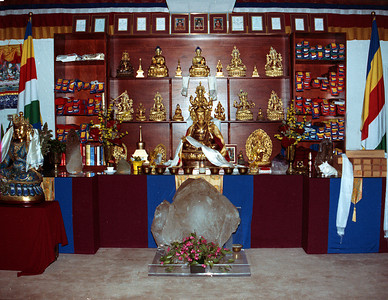
Likewise, when you have an altar, whether it’s at the temple or at home, it should always be clean and free of dust.  The bowls should always be clean, with no nasty ring around them because you didn’t wipe them.  The offerings should be made every day.  Of course, in opening one’s altar, automatically one is making offerings.  That has to be done mindfully, and if you don’t have a regulation type altar yet, if you just have an image of the Buddha and offer one flower, a few grains of rice, a cup of water, something like that every day, that mindfulness brings an awakening to the sacred.  Once again, it’s not for the picture; it’s for us.  Conversely, not doing that, not having a sacred image, not having a way to establish the sacredness of any given day, hour, moment, life,  produces obstacles.  It can produce tremendous obstacles because, once again, we are floundering around, and maybe even willingly so, in a state of non-recognition.  These things are very important.

© Jetsunma Ahkön Lhamo

The Value of Human Existence

The following is respectfully quoted from “Treasury of Precious Qualities” by Jigme Lingpa, with commentary by Longchen Yeshe Dorje and Kangyur Rinpoche, as translated by Padmakara Translation Group:

The Value of Human Existence:

1. So long enchanted in samsara’s wilderness,
Tormented by the cutting of their heads and limbs,
With seeds of future sorrow hidden in their minds,
Beings long so foolishly for bliss of higher realms.
2. From there they fall again, their states of mind destroying them,
To wander in three evil realms, or as insensate gods,
Or else in barbarous lands, with false views, handicapped,
In places where the Buddhas have not come.

3. On blazing iron grounds without reprieve,
With dreadful weapons wounded time and time again,
The denizens of hell are slain but cannot die–
Still tangled in the webs of hatred’s evil deeds.

4. What need is there to say that hungry ghosts are racked by want?
For food they find not even pus or blood or filth,
And streams and orchards dry before their eyes.
Their vitals burn in endless pain,
Their length of life uncertain,
Measured by the strength of obscuration.

5. Beasts prey on one another, are each other’s food.
And, hunter’s quarry, they are slain by cruel means;
Or caught and tamed, they are reduced to bondage.
Born to such great misery, what can they do?

6. The insensate gods, whose life-supporting karma is immense,
Live long in formlessness; no sorrow do they know.
But lacking support for learning and reflection,
At death they have false views and so lack freedom to progress.

7. Supported on the palaquin of legs and feet,
But yet with minds untouched by virtue,
Barbarous men live sunk and skilled in evil ways,
And wander in the jungles of false morality.

8. Some have senses that belie their promise.
Though they meet with teachers, holy and sublime,
They hear their words like echoes sounding from a cliff,
And suffer in the wasteland of no understanding.

9. Some achieve the great ship [of human life]
With wits like sails wherewith to cross the ocean of rebirth.
But overwhelmed by demons, the espouse false views,
Wherein the Buddha who has come takes no delight.

10. Some fall in blind and lightless chasms:
Ages where no Buddhas manifest.
And though they try to rise, they find no path
And in despair sink down from low to lower destinies.

11. Eight states therefore where beings are not free to practice Dharma,
Where world-destroying gales of sin and suffering rage,
Where merit is defiled in wariness and fear–
O think of this and profit from your freedom!

12. To be a human being in a pure and central land,
With limbs and senses whole, with faith in Buddha’s teaching,
With karmic fortune blossoming, unmarred by evil deeds–
And this is like the wishing-tree, extremely rare.

13. But rarer still, the Buddha, like an udumbara, has appeared within our world.
The flower of Dharma is in bloom. The garden of the doctrine,
Undiminished, still exists, and perfectly do holy beings enter it,
Within whose cooling shade we may find rest.

14. Such fortune in ourselves is rarer than the wishing tree;
Such outer circumstances are like udumbara flowers,
These ten together joined with eight-fold leisure–
Such coincidence will scarce be found again!

15. Examples make it clear–the turtle’s head, the floating yoke,
And numbers also, whereby humans in comparison with beasts
Are like stars that shine by day compared with those by night,
With, in a like proportion, hungry ghosts and denizens of hell.

16. If once aboard this great ship of our freedom,
We now fail to reach the far shore of this sea of pain,
This meeting with the helmsman will indeed have been in vain
For us who strive and fare upon the Dharma’s path.

Paying Homage

An excerpt from a teaching called The Seven Limb Puja:  Viewing the Guru by Jetsunma Ahkon Norbu Lhamo on October 18, 1995

Since we find that we are, in fact, in the presence of the primordial Guru at every single moment, what is the posture that we should take?  You should refer to the practice called the Seven Limb Puja.  The Seven Limb Puja appears in many different practices in slightly different variations, but it has certain common denominators, and these should be studied and looked at as a guide of how one should practice now that one is coming to understand that the eyes of the Guru are our eyes; that the heart of the Guru is our heart; that in our nature, that is the nature.  That is the nature, and we are indistinguishable in our nature from that.


Practicing in that way we should think like this.  First of all, in the face of the Guru, knowing that the face of the Guru is always with us, we should practice paying homage constantly.  Constantly paying homage to the Guru, this will antidote our pride, our ego, that habit that says, “Oh, well, look at that!  The Guru has faults.  He or she must be human.” And, of course, that is the statement that keeps you from practicing pure devotion and pure surrender, and the same statement that prevents you from achieving realization.  So this is the antidote that helps you to give rise to that spiritual posture that makes it possible for you recognize the nature of the Guruas the absolute non-dual display of emptiness and luminosity; and to give rise to profound devotion at last, rather than the superficial stuff that we’ve been passing out as devotion.

We practice paying homage.  We pay homage to the Buddhas and the Bodhisattvas; the Lamas are in that number.  The Buddhas and Bodhisattvas are all represented in the Lama.  We should think that we pay homage to the Buddhas because they have crossed the ocean of suffering.  Therefore, they are capable of captaining us across the ocean of suffering.  So we pay homage with that kind of regard, as though we needed to cross an ocean of suffering and the trip is scary and long and hazardous and difficult and so a qualified captain is required.  Otherwise, we can’t make it.  So that is the kind of recognition of the superior quality of the Buddhas and Bodhisattvas, of the Lama.  Recognize every moment, this is a vajra command, that when we think of ourselves in our samsaric state and then we think of the Guru, we should think that the Guru is like a precious diamond, beyond compare, because the Guru is capable of helping us cross the ocean of suffering. We cannot do that ourselves.  That will antidote the kind of pride that we have when we try to put ourselves above everything, in subtle or gross ways, whatever it happens to be.

© Jetsunma Ahkön Lhamo

Two Eyes of Practice

An excerpt from the Mindfulness workshop given by Jetsunma Ahkon Lhamo in 1999

Guru Rinpoche himself said, “I will appear as your Root Guru,” and that appearance is to be recognized.  It demands to be recognized.  One of the reasons why I harp so much on reciting the Seven line Prayer is because the Seven line Prayer is a prayer, the blessing of which creates the capability of seeing the Guru in all things, and of following the Guru and of practicing in such a way as to discriminate that absolute nature.  The nature of that prayer is to begin to awaken our inner psychic channels and to bless our psychic channels and winds and fluids in such a way that everything within us that is the Buddhanature begins to awaken.  That’s the power of that prayer, and it is done through the practice of recognizing and discriminating what is extraordinary.  In order to provide for that kind of recognition, we have to put a lot more effort into that aspect of our practice than we have up until now.

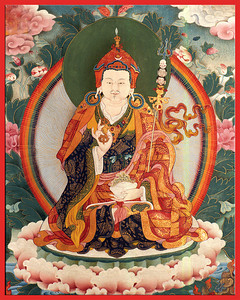
Maybe I am giving you the impression that it’s all about Guru Rinpoche.  For me it is, but maybe that’s because I’m lucky enough to have had enough teachings to have an understanding of Guru Rinpoche’s nature.  When we talk about the nature of the Guru, we are talking about the perfect mating of wisdom and compassion, of emptiness and appearance.  When you see the image of Guru Rinpoche, you always see that staff crooked in his arm, and that is the symbol of his consort.  It indicates that the Lama is never separate from his consort, and the meaning of that is the non-duality and union of emptiness and appearance, of wisdom and compassion, or bodhicitta.  That is the meaning of that union of Lama and consort.  So Guru Rinpoche is always seen that way.  We are to understand from that, then, that His nature is the perfect union of wisdom and bodhicitta, of the view of emptiness and the understanding of the display of appearances.  That is Guru Rinpoche’s nature.

That being the case, we have to find a way to not only recognize the physical form of the Guru, the picture that looks like Guru Rinpoche or the picture that looks like your teacher.  We really have to get past that and go into a deeper sense of trying to awaken and potentiate our own meditation, our own understanding, of the nature of emptiness and of the nature of appearances.  We have to begin to potentiate and practice and meditate in such a way that we see wisdom and compassion as being like the two eyes of our practice.

Click here for a teaching on the Seven Line Prayer and audio files of Jetsunma chanting the Seven Line Prayer.

© Jetsunma Ahkön Lhamo

WP2Social Auto Publish Powered By : XYZScripts.com