The Faint

20125251534_darkness

The following is an excerpt from a teaching offered by Jetsunma Ahkon Lhamo during a Phowa retreat:

Now I want to refer back to this book [Death and the Art of Dying by Bokar Rinpoche] to give you a couple of statements that I think may be helpful. When we last were together we spoke about the white path or the white bindu that dropped from the top of the head to the heart, and we spoke about the white light that is shown. The white method would be to move toward and expect and recognize that white light; that would be the white method. According to this book, the white method or the white path results in the body of emanation or the nirmanakaya form. It is considered that when a tulku appears in the world that a tulku is a nirmanakaya form of the Buddha. So recognition of the white path results in the body of emanation and the nirmanakaya form. Recognition of the red path results in the body of perfect experience or the sambogakaya, also called the bliss form. And recognition of the black path, which is also the clear light that we spoke about, results in the absolute body or the dharmakaya. Now it is considered, actually, that of these, the black path or the clear path, the one that we spoke of last, the recognition of the dharmata, the recognition of the clear light is the most difficult of all of the recognitions. It’s considered that the black path or the clear path is usually available only to those who have practiced mahamudra, which you are learning to practice even as we speak.

I wanted to read to you exactly how this lama put it, but I’m not seeing it. Well, then I’ll explain it to you in my own words, which may not be quite as dramatic but the meaning will be there. It is considered that the great vast majority—that is to say, 99.999 percent—of sentient beings who experience death, and remember, they all do, will not be able to recognize either the white, or the red, or the clear, or black, method. They will not be able to recognize any of those three stages. This is really, really interesting. During each of the times that the lights appear—first the white light, the red light, and the clear light—after those events are finished and you have not recognized any of those lights (and it is very likely that that will happen), it is at that time that you continue on into the bardo. It is then that you actually slip into the bardo of becoming.

If you do not recognize the white light, if you do not recognize the red light, and then if at the end the fundamental clear light is not recognized, then the lama says here, “The mind slips into a deep state of unconsciousness of variable duration, which is generally said to last three and a half days.” Now I have had the experience and the good fortune to have the opportunity to do phowa for a number of other beings. The clear or dark light is, in fact, the appearance of one’s true buddha nature, appearing just so. Just as it is. It is the true face of the primordial Buddha, but those of us who have no training to be able to witness the face of the primordial Buddha literally will not see it. It will be much like going to some sort of desert tribe that has never seen a picture of a boat or large body of water. If you show them a picture of a boat and a large body of water, they won’t be able to recognize it. They do not have the brain pathways or something that will help them to recognize that. And in our case, even though the very face of our true nature, which to a practitioner would be as recognizable as the mother is to the infant or to the child, for a non-practitioner it would be, again, like the child who was adopted out right at birth and never saw the face of their mother. They would not be able to recognize their mother; they would not be able to connect. They would not be able to have the force of surety in conviction to be able to move toward and direct themselves with their own inner force to be able to move toward that reality. They will not be able to slip into meditation on that nature. They will not be able to slip into that non-dual state, even though all of their distracting elements will be dissolved at that point. Literally, if you were a meditator and had that experience, that would be the time, ironically, during the course of your whole life and death experience, where you would be able to meditate the best. If you had experience. But 99.999 percent of the people go to sleep at that time. They have a faint, or sleep, because it looks like darkness to them, rather than light clarity. Their mind is not awake in their meditation. Not awake. When that happens there is no choice and nothing for it, but that we have to go on into the bardo of becoming.

Copyright © Jetsunma Ahkon Norbu Lhamo All rights reserved

The Choice


The following is an excerpt from a teaching by Jetsunma Ahkon Lhamo offered during a Phowa retreat:

What makes this practice of Phowa different from all of that slip sliding and unpredictability, and unclear cause and effect connections, and lack of understanding as to where things come from and why things are a certain way? And what makes this practice of Phowa different from—forgive my French—the bullshit we feed ourselves? Literally the lies that we feed ourselves when we tell ourselves how we’re doing and how long we’re going to last, and all of the ideas we have about how we should leave ourselves alone and not try ourselves too hard. These kinds of ideas are separate from the bardo idea because in life, situations are so confused that you can play that game. It’s not clear. There are so many different ways that you can go. It’s just not clear. There’s plenty of space and time and ability to fool yourself. And we do fool ourselves. We fool ourselves every day. For instance, we pretend to believe that virtuous conduct will lead us closer to enlightenment. We pretend to believe that, but in our lives most of our conduct is in fact non-virtuous. We are slothful. We are lacking in commitment. We are unkind to others. We are not aggressive in our desire to benefit sentient beings. We are self-absorbed. We allow ourselves to wallow in our neuroses, rather than pulling ourselves up, kicking ourselves in the butt, and causing ourselves to just get ourselves together. And we do have that capacity, you know.

So what is the difference between that kind of thing and bardo, and the eventuality of bardo and the idea of Phowa? The difference is that no matter how you slice it or how you bullshit yourself or how you are in denial, no matter how many of Cleopatra’s outfits you try on every day, no matter what you do or what you think, you cannot deny that you will die. This is one eventuality that we all share; and without exception, to the man and woman, we must prepare for this event, because we’re going to go through it. And we’re going to go through it one of two ways: blindly, driven by the forces of karma, and helpless; or we’re going to go through it safe, prepared, aware, and able. Those are the only two choices. Whether we will go through this event, there is literally no choice. Think about that. You have to think about that. I know you have the capacity to think about this, although you say, “Well, I just can’t think about that, can’t think about that. It scares me too much, scares me too much.” But I know you have the capacity to think about that. I know that you do. And you have the capacity to experience the fear. Do not suppress it. Acknowledge that you have that fear. Let it be; and then explain to yourself that we will overcome this fear together through training. Through accomplishing method. The only way to overcome fear is to accomplish method. It’s the only possible way. But remember—about going through this, we have no choice.

We have incredible degrees of choice about how to go through. Just as we have a choice as to how to live, we also have a choice of how to die. And the thing that I would encourage is that, even if you are the rascal of rascals in this lifetime, even if you are so naughty that if I knew I would spank your bottoms! Even if you were just that naughty! Even if you are so naughty that you are childish and you let yourself get away with everything,…  You don’t practice even though you have the method, you just haven’t had the time, you won’t make the time, and blah, blah, blah, all these other things, and then you come up to me and you say, “Oh, it’s because my mind is so unstable, that’s why I can’t practice [hic] practice [hic] practice [hic] practice.” And of course, the answer is the reason why your mind is so unstable is because you haven’t practiced practiced practiced. That is the antidote. That’s what you do when your mind is unstable. But people come and tell me, literally, that they cannot practice because their minds are too unstable. Well, well, well, whatever. So, even if you are that kind of person, remember, you don’t have to practice. I can’t make you practice, I can’t force you to do it. Guru Rinpoche can’t force you to do it. Lord Buddha can’t force you to do it. Neither can Lord Buddha force you to walk through the door of enlightenment. Neither can Guru Rinpoche force you to walk through the door of enlightenment. Certainly neither can I. But the one thing that you will have to do, once again, is to die. You have no escape from that. It is written in stone.

And so what you have to think about is this: Will you die nobly and well? You do have to die, and for the person who is not a good practitioner or who is born with the kinds of mental or physical afflictions that truly prevent them from practicing in a deep and profound way, this is the method. Phowa is what you have left. I don’t see many of you packing your bags to go stay in a cave in Nepal and practice until you achieve supreme enlightenment. I don’t see any of you heading for a seat under the Bodhi tree, planning to sit there and practice austerities, or whatever, just to see how that goes. I don’t see any of you rushing off in some other direction. I see you in your lives, deeply enmeshed in your lives, dealing with the choices and opportunities of your lives. You have many choices.  And you’re right—some of you have less time than others. Definitely you will not have the time that it takes to practice to the degree that you will end up achieving liberation or the rainbow body before your death. Because that takes a commitment that none of us have made yet, that none of us has made within the context of our lives here. We literally cannot do it; we’re not ‘going there’ now. It isn’t the karma of the situation.

So what do you have left? Definitely you have two methods that will help you to die well. Because if liberation is not possible during the course of this lifetime—even though theoretically it is—if for you it is not, then definitely you should understand liberation is possible in the bardo. Even for you, even if you have not practiced well during the course of your life. And that’s truly the biggest piece of candy that I know on this path. It is a big piece of candy, because I know of no other method that can allow for this.

Copyright © Jetsunma Ahkon Norbu Lhamo All rights reserved

Generation Stage Practice and the Bardo

oah

The following is an excerpt from a teaching by Jetsunma Ahkon Lhamo offered during a Phowa retreat:

There is one way that you can help yourself to prepare for the bardo state. As I begin to explain the bardo of becoming now, which is the next stage in the bardo, and a very important one, you will see how important it will be to you if you can successfully practice generating yourself as the deity. That’s called generation stage practice. That is a practice that is available for you to learn right now, even before practicing your Ngöndro. It is permissible, acceptable and desirable for each of you to practice, first of all, the Shower of Blessings, which is the generation of Guru Rinpoche—not oneself as Guru Rinpoche, but a generation of Guru Rinpoche in front of oneself giving blessings. That brings about a definite firming and developing of one’s relationship with Guru Rinpoche—one’s relationship with the appearance—the nirmanakaya form of all the Buddhas, in fact, because it gives us a relationship with the appearance form of that which is actually enlightenment itself. So there is that. There is also, even before Ngöndro, the opportunity to practice generating oneself as Chenrezig. Chenrezig is considered to be one of the main bodhisattvas who can block rebirth in the lower realms.

Phenomena is not solid and concrete the way we think it is. So we find that in generation stage practice we have the wonderful opportunity to be able to meditate on our true nature, allowing ourselves to dissolve into emptiness. Subtly we dissolve into emptiness and remain meditating on emptiness just momentarily, meditating on the emptiness or illusory quality of our own nature. Then we give rise to our self as the deity, and that takes different forms. Generally, it starts with a seed syllable which is symbolic of the qualities and mind state of the deity. Then after that, we begin to actually give rise to our self as the deity. But the deity is understood to be only as solid as, say, a bubble, or as gossamer thin, if you will, as a whisper. It has all of the solidity of dew, just before the sun dries it up. We generate ourselves as that deity and we are subtly meditating on a dis-attachment to the heaviness of our own consideration of what we are.  We’re also seeing ourselves in a completely different way.

Now why does generation stage practice prepare us for the bardo? First of all, it gives us enough spaciousness in our mind to have another idea besides ‘I am, and I want,’ which is probably the only idea we ever have, if you boil it all down—‘I am, I want, I think.’ So here we are in the bardo able to take a step back from that, and perhaps that will give us the spaciousness, the moment of space, that we need. Somewhere inside that knee jerk reaction tendency, we need to have a moment of space where we can consider where we are and what to do about it. And the lightening up that we have in generation stage practice will help with that. Furthermore, and most importantly, we will begin to recognize these displays, these many displays of the Buddha nature that appear as the meditational deities. These are forms, these are display forms which are actually pictures of, or movements that express, or dances that show, or colors that display or indicate, the qualities of enlightenment. That’s actually what the meditational deities are, if you think about it. They are enlightenment in display or emanation form. What they are holding in their hands, what they’re doing, indicates to us those particular qualities that are being isolated and demonstrated at that time. So we become familiar with the many different ways in which our Buddha nature is demonstrated, is displayed, and that prepares us for the bardo of becoming, because it is in the bardo of becoming that the BBuddhas actually come to meet us.  We will see them, and we can have liberation through recognition. It is actually the easiest form of liberation in the bardo. That is liberation through recognition. For most of us, that will be the easiest form.

Copyright © Jetsunma Ahkon Norbu Lhamo All rights reserved

Denial

Men-growing-older-001

The following is an excerpt from a teaching by Jetsunma Ahkon Lhamo offered during a Phowa retreat:

Those people who accuse Buddhists of creating a kind of depression or melancholy through these ideas, are, what I would call, in denial. They’re simply in denial. They’re not at that stage of maturity, either in their physical lives or in their spiritual lives, where they can come to grips with this idea [preparing for death]. Some of it has to do with their age. Look around you. Look at the age of the people in this room. There are very few of us who are in our twenties. There are a few of us who are in our thirties. Most of us are at least kicking down the door of forty, if not on the other side. And it’s not because forty-year-olds are so much more spiritually developed than twenty-year-olds. Even the forty-year-olds that are spiritually developed have to be twenty at some point, so that can’t be it. But there are certain changes that happen psychologically within the context of our lives.

Many of you have already noticed this. This is not a news flash, is it? One of them is that we meet a stage in our life where we have a recognition, and the recognition is keyed off by, first of all, physical changes within our body. It is obvious that things are changing. We look in a mirror. Then we look at a picture of us a decade ago. And even a twenty-year-old could see this. You have changed. Maybe a twenty-year-old could see it even more dramatically. If you are twenty-five now and ten years ago you were fifteen, you’re much different now than you were back then. But how much more so for the forty- or fifty-year-old who looks at their twenty-year-old pictures. I’ve got a couple of them sitting on one of the shelves in my room. One of my sons was thoughtful enough to give me these pictures framed—framed, mind you—so I can look at them every day! They’re sitting on my shelf, and I look at myself when I was in my twenties every day. What a great technique for a Buddhist! And I’ll tell you, things have definitely changed.

So those of us who are going through those sorts of changes and we’re seeing ourselves on the downside of that midlife experience, we’re also having another kind of expansion or understanding that is coming to us for the first time, not because we weren’t capable of seeing it for the first time, but because we are suddenly keyed in by certain kinds of visual stimuli and also we’re keyed in by what’s happening inside of us. Somewhere in that first five years of our forties we come up with a realization that is a little hard to take, and that realization is that it is not likely that we have a full half of our lives left. It is not likely. It is more likely that I am more than half done with my life. That’s what I’m thinking about, and that’s what you’re reminded of when you look at those pictures of yourself when you were younger. And I’m thinking of how none of us has ever gotten used to that.

Do you remember, let’s say, when you were going to school, especially if you hated school like many people did, or perhaps going to a job that you didn’t like when you were literally owned by somebody else from, say, nine to five, or eight to three, or whatever it was, during five days of your week? You look forward to the weekend as though it were manna from heaven, or nirvana. Or perhaps equally as important as enlightenment. In fact, at a certain age and a certain stage, right about oh, Thursday afternoon, if someone asked you if you wanted your weekend or nirvana, you might have taken your weekend. Weekend becomes out of proportion in terms of its importance, because we have a hard time dealing with the stress of an entire period of time when we look forward to the rest. Do you remember how it felt on Friday night when you were really young? Party time! Friday night is happy time, and no matter what you did it was really fun. You made sure you went out. Friday night was definitely the night that you did something, because you had some steam to work off and it was the first day of the weekend and you were really excited. And then you go all the way through your weekend, and of course there’s the Saturday morning recovery for some of us. And then later on there’s the Saturday evening. And towards the end of the evening, you remember that kind of sinking feeling in your stomach when you realize that tomorrow was Sunday and there was only one day left? Not only that, but Saturday night was the last night that you had before the night before you had to wake up early again. You know, that kind of thinking.

So that’s the kind of minds that we are preparing for our death with. You think about that: It’s the same mind that we deal with our life situation with. We get away with it as long as we can get away with it. So long as it is Friday night and Saturday morning and Saturday afternoon and just starting Saturday night, we’re getting away with it. We are in denial about everything else. We’ve pushed aside anything that is uncomfortable or frightening to us, or anything that is stressful. And the way that we’re dealing with stress at that particular moment is to be who my son calls ‘Cleopatra, Queen of Denial.’ That’s his joke. So we’re Cleopatra throughout most of our lives. And then suddenly you hit forty-five and it’s Saturday night again. It is. Forty-five, it’s Saturday night. Because at forty-five you start to want to go to bed a little earlier, and you can’t help but get up earlier, because you wake up at that time.  You’re not like you used to be and you can’t go back to sleep. And all sorts of things change. But suddenly at that time, as well, you realize that your weekend is more than half over. Or your lifespan, in this case, is more than half over. And it begins to wake you up and causes you to relate to necessity. Reality is hitting us, and that’s what’s happening. And for some us that is a very sad part of our lives, and there are many different reasons for that.

This isn’t really a part of our Phowa retreat but I would like to mention it anyway.

There are many people who literally cannot get themselves together at this point in their lives because they are too scared, too much in denial about the passage that is overtaking them right now. There are many people who have spent their whole lives seeing their own self worth and their own value according to their looks, their youthfulness, their beauty, their sexuality, their youthful vim and vigor, their kind of youthful energies, determination. There are so many people who strongly take all of their ideas about self worth in accordance with their ideas about desirability. And, of course, here in America we have a cult associated with youth going on. A youth cult. Women are only attractive in their twenties; they’re barely attractive in their thirties if they can make up well; and in their forties they’re going over the hill. That is the popular Madison Avenue approach.

Of course, nowadays we are finding our self worth in a different way, and fortunately women are seeing themselves as something other than a desirable object. Men are seeing themselves as other than a warrior that has to prove his prowess at every turn. So fortunately we’re not viewing ourselves in the same way, but we still seem to maintain this denial about our lifespan. We do have this denial about our lifespans.  And even those people who are in their fifties and going on to their sixties… Once again, when we move into our sixties there are no guarantees. There are plenty of people who die in their sixties. Plenty of people. Even though we feel well, even though we feel fairly youthful in our sixties—and I hope you do, I hope I do when I reach my sixties—still there is no guarantee. But we don’t think like that. We think, “I’m feeling well now.  Everything’s fine.” And there are many people who don’t plan for their death, even in terms of making out a will. They don’t plan at all for these events during the course of their lives, except when they get to the very, very end and it’s literally impossible to be in denial about this thing.

So you wonder, are these the sensible people, the people who are in denial like that, that are not preparing themselves for their eventual continuation though samsara? Are they wise? Are they free of the obscuration of ignorance? Not for my money. I think they are the most ignorant; they are not preparing. It’s like knowing that you’re going to have an extraordinarily challenging and difficult tomorrow, where if you knew that if you spent the afternoon and the evening preparing for tomorrow, maybe reading this book or studying a bit or getting your props together that you need for a certain presentation, it could easily be that while tomorrow would be stringent and challenging and you would definitely be tired afterwards, it could be the kind of thing where you feel like a job well done. Good for me. I worked really hard but I was prepared and I got the job well done. You could handle it that way. Or about your difficult tomorrow, you can of course think, “Tomorrow is tomorrow, today is today and I don’t have to worry about it until tomorrow, do II don’t have to think about it this afternoon because it’s not tomorrow yet.” See, you’re doing this kind of ‘dzogchen-esque’ double talk. When it’s dzogchen-esque double talk from a sentient being rather than true dzogchen teaching from a lama, it’s not going to be quite sensible, is it? It’s not going to be the same at all. So the idea that ‘today is today and tomorrow is tomorrow and never the twain shall meet’, and the idea that ‘well, we should just kind of go with the flow, have another avocado, think about tomorrow when tomorrow comes’, is not the kind of thinking that is going to help you feel strong and powerful the next day. And probably what will happen the next day is that you may fail, or the chances are that you won’t do such a good job, and you definitely will not have the result that you expected or desired from your efforts during that day. And it’s because of a lack of preparation.

Now the very people who would advise you to simply let it be and think positive thoughts and have a good time and ‘don’t worry about it ‘til tomorrow,’ have the same kind of mentality that says that Buddhism is a depressing and melancholy sort of idea. These are the people that are in the state, within their own minds, of ignorance and delusion and denial, where they aren’t considering things from the intelligent, common sensical, wisdom point of view. They’re not facing the fact that tomorrow will come. There is no way to get out of dying. Absolutely none. You can’t even die to get out of dying. There’s just no way to get out of it. And we will face this, and how much better is it to be prepared. Because I tell you that while death is something that is extremely difficult to do well, and requires intelligence, forethought, and of course practice, it can be done well, in the same way that you can prepare well for something that you have to do; and you can ace it.

Now you have to ask yourself what is your habit about such things. Are you accustomed to failure? Some people are, you know. Some people fail habitually. There is a strong element of neuroses in the way that their minds work. They are, according to other people who are close to them and seeing them, sometimes called ‘programmed for failure.’ They’re sometimes called extremely neurotic. They put obstacles in front of themselves and cause themselves to fail. And they mostly do this with their attitudes. Sometimes I’m teaching class and I look around. I watch your faces and I perceive the energy that is coming from you and I think, “Problem. You’re going to fail.” Not that I’m predicting your demise and not that I’m wanting you to fail. It’s not that. But it’s obvious, from the attitude, from the way that you are listening, from the barriers that you are throwing up, within your own mind, in front of yourself, that you are not going to let yourself do well.

Copyright © Jetsunma Ahkon Norbu Lhamo All rights reserved

Migyur Dorje Passes Away

“The following is an excerpt from a teaching offered by Tulku Dawa Gyalpo at Kunzang Palyul Choling in Maryland. Future posts will continue with the teaching on the Life of Migyur Dorje.

Now I think it’s time to tell why he passed away so fast. Karma Chagmed explains one reason very clearly in Tulku Migyur Dorje’s life story. He said that it is very obvious. I think there is also one other reason that is not so obvious, but it isn’t described as another reason. One reason he gave I also heard very clearly from our late Holiness. There is a pure realm called Metok Tram [Tram means distributed all over], Metok Trampa. Metok Dronpi. Karma Chagme wrote that in the Buddha field of Metok Tram, which literally means June flower, the Buddha Metok passed away. They needed somebody to take care of that pure land. They said that Tulku Migyur Dorje had to go there and take his place. Tulku Migyur Dorje didn’t want to go there, but he had no choice. He had to go there. That’s why he changed his life. This reason is very clear. His Holiness also mentioned it.

This, I think, is another reason. In our refuge field there are the five Gonpos. One of them is Gonpo Ma-Ning. During his second retreat, Tulku Migyur Dorje revealed a treasure to Karma Chagme in which he experienced that Gonpo Ma-Ning was kind of eating Tulku Migyur Dorje’s body.  Through that sound, he received one of the sadhanas of Gonpo Ma-Ning. Tulku Migyur Dorje asked Karma Chagme, “Do you want to write this down?” Karma Chagme replied to him, “No!” He was kind of scared. He said, “Alas. I don’t want to write the sadhana which comes from eating your body!” And he didn’t write that. Tulku Migyur Dorje said, “OK. If you don’t write it down, then I have to give it back.” Tulku Migyur Dorje said, “Take it back.” And they did. During that night, Tulku Migyur Dorje was a little bit upset and he looked at Karma Chagme and he said, “This is how these samsaric people act. They get unnecessarily scared.” He said also, “This is the sadhana that will get rid of my big obstacles, but you don’t want to write this.” In his story, it is not mentioned clearly that this is one reason, but I think that it is.

However, the first reason which I gave you is obvious. His life changed like that when he was very young. Later, Karma Chagme started investigating what would happen next: where Tulku Migyur Dorje was going to be. Maybe some of you heard that he went down to the hell realm and liberated many beings from there. After sometime, he got tired because there are so many living beings there. He took some fine sand. After reciting a lot of mantra, he blew on the sand and threw it in those fires. By just throwing the sand, it cleaned all those fires. Still in the intermediate state time, he was there for others.

Karma Chagme wanted to know where Tulku Migyur Dorje was going. In his own experience, he heard very clearly that Tulku Migyur Dorje would take another 21 lives. Within those 21 lives, during two of them he would not do anything, would not benefit others, would not reveal treasures. It seems like he would be resting. That’s what Karma Chagme heard. During the other 19, he would complete whatever treasures were not revealed.

That’s the life of Tulku Migyur Dorje. Right now we have the same profound, precious teaching; and right now we have great masters like Holiness Karma Kuchen that we can rejoice in, and likewise so many other great masters. Mugsang Kuchen Rinpoche is also considered his reincarnation. We Palyul have great masters like Tulku Thubsang and Gyangkhang Rinpoche, all three heart sons as we know. Not only do we have them, we have so many others as well. All of them keep this profound teaching, unconditionally, but not with blind faith. We are trying to keeping this with wisdom. Understanding like this.

Now I think I have completed. Thank you so much once again to everybody for giving me this opportunity to talk about it. And also to Jetsunma Akhon Lhamo. I enjoyed it so much. Yes, I will stop here.

Dedication now.

Today we are specially related with this topic, so I want you to dedicate and make an aspiration. After dedication, making an aspiration is important. Dedication is just giving up. You are just letting go of whatever merit you accumulated from 7:30 to now. You are just offering. Offering is kind of like giving up. Let it go. From there, it’s not yours. Right? Once you offer it means tit does not belong to you. You already offered it. After we offer, then we have to make aspirations. “Through this merit then may I get” that-that-that whatsoever. So specially today I want all of us to make aspiration. After understanding this history, may I have confidence in it and put into practice the generation and completion stages. May I also achieve the same as Tulku Migyur Dorje. Make that aspiration. And after that, make aspiration for whatever circumstances you would like. “May I be healthy. May I get a good job. “May I get” whatsoever. Yes, I’m serious. You can make these aspirations. They work. If you look in history, they made aspiration that way; they achieved that way.

Sometimes we don’t know how to make aspirations. That spoils our merit. We make aspirations for the first purpose, which is to become enlightened. But we also need circumstances. So this is the second purpose for aspiration. So please, dedicate and make aspirations together.

Why Recite Mantra?

From HHDilgo Khyentse Rinpopche:

Why is it so important to recite Mantras and what are they? Just as we visualize ourselves as a deity and the surroundings as a buddha-field in order to purify our impure perception of form, we recite mantras to purify our impure perception of sound. Mantra is a Sanskrit word that means “to protect the mind” since, while reciting mantras the mind is protected from its ordinary deluded thoughts. – HH Dilgo Khyentse Rinpoche.

Tulku Migyur Dorje Blessings for Palyul

“The following is an excerpt from a teaching offered by Tulku Dawa Gyalpo at Kunzang Palyul Choling in Maryland. Future posts will continue with the teaching on the Life of Migyur Dorje.

Tulku Migyur Dorje organized many of these great sadhanas, and retreats. He made great sadhanas for doing Vajra Guru mantra, BENZAR GURU PEDMA SIDDHI HUNG mantra and OM MANI PEDME HUNG mantra. He made a 1.3 billion BENZAR GURU mantra retreat.

Whatever money he got from the teachings he gave while traveling, he spent for that purpose. Like now here also Jetsunma is doing. It’s a good thing. We appreciate that. I know this from two years ago, but sometimes appreciation is not coming so openly. That shows that whatever Tulku Migyur Dorje does, he does only for others. Even whatever wealth he received, he spent for others, giving teaching, empowerment, instruction. He didn’t need it. He had already accomplished by doing retreat.

Then he turned twenty-three which was the end of his life. Let me tell it briefly. When he was about to die, he got very bad diseases. Bad diseases. He was very ill. At that time, he wrote a letter to Karma Chagme, and he sent some Dzambhala statues made in Nepal, not from India. India doesn’t make the kind of metal [lima?]that these statues were made from. In Tibet, lima is considered very precious because they don’t have it there. However, when Tulku Migyur Dorje was very ill, he sent a Dzambhala statue made from li, this kind of metal, and also some other things to Karma Chagme. In a letter, he wrote, “I’m really very ill and struggling far away from you. I have nobody taking care of me like you.” He did have somebody taking care of him, but he was saying that when he was with Karma Chagme, he was very comfortable. When he left Karma Chagme, even though he had somebody serving him, it seemed that he didn’t feel so confident as he did when he was with Karma Chagme. He wrote this letter to Karma Chagme that he was very ill and in a difficult situation. Karma Chagme got very sad and from his retreat, he did lots of prayer for him, long life prayer and so forth.

Now I will go to the end. When he was about to pass away, about to change his life, then he became more weak. During the fourteenth and fifteenth days of the lunar calendar, he was feeling very strange. He had someone who was taking care of him at that time. His name was Khyentse, but not Dilgo Khyentse. Khyentse became his very close assistant at that time. Tulku Migyur Dorje asked him to read some prayers so he could meditate even in that very painful situation. He asked Khyentse to read what we are reading right now, the Nam Cho lineage masters invocation. He asked him to read that while he was meditating. While he was meditating, Tulku Migyur Dorje spoke out to him that,… “some kind of white things are coming to me and taking me toward the eastern direction. At the same time, many monks are flying with me, and Khyentse, you are also flying with me.” He said that. Right after, he said, “But don’t worry. Don’t think anything.” He was saying you are not going to die. It seems that you are coming later. He’s saying, “Don’t worry, but don’t worry. Don’t think anything. Just let it be.” The hundred deities mandala appeared. During that very painful time, still that kind of experience happened to him. On the night of the sixteenth day, the last day of his life on this earth, he sat up and crossed his legs in meditation posture. Khyentse and many other lamas surrounded him. All of them expected that he would get better. They requested him to live long, but he just sat in Vajra posture and meditated.

A little bit later, there was a very strong thunderstorm. It felt like the whole earth was shaking. The ground and the mountains were trembling, shaking. Khyentse, his assistant, said that. Karma Chagme wrote in accordance with what Khyentse said. Right before Tulku Migyur Dorje also wrote a letter. It seems that he didn’t give it to anybody, but nobody knows what happened to it. Some people said that he himself hid the letter for the future. Somebody else said that during that time there were so many lamas, maybe someone took the letter from him. Karma Chagme said, “We know that he wrote a letter, but we don’t know right now what happened after that.” This is lost information. At the end this very strong thunder happened. Everybody felt like everything was shaking. Then Tulku Migyur Dorje asked Khyentse to give him two cups of nectar. After consuming the two cups of nectar, he straightened up his body. In his left hand, he was counting with the rosary, but his voice could not be heard.  He couldn’t talk anymore. Then he was just silent, totally silent in meditation. At that time, Khyentse and the other lamas asked him to please come back again for them. Khyentse said he shook his head three times then he went.

Everything seems very important in this history, particularly how Rigdzin Kunzang Sherab received all the teachings that we are practicing right now from him; also whether those treasures are authentic or not. We can understand from his history and we can also understand by looking back to our Palyul lineage history too. People like our late Holiness become that kind of person because the teachings are authentic. These teachings are the one idea, the method, that make that kind of person. Likewise if you go all the way back [to the beginning of the] lineage, back, back, back, we are only talking about lineage masters, because obviously these are important persons; but there are so many other great practitioners, whose history we don’t keep because they did not become important persons. Our late Holiness also used to tell us about these histories of the time of Palchen Dupa, before Palchen Dupa, and all of Karma Kuchen’s incarnations, the previous Karma Kuchens, taking care of the Palyul lineage: How Palyul retreat was famous in the Kham region. Even Paltrul Rinpoche came to Palyul retreat center and took the siddhis from the Palyul retreat center. Do you know how he took the siddhis from Palyul retreat center? He took siddhis from the retreat center sewage. He took the siddhis from the sewage. That’s how they showed this retreat was profound. He actually drank the sewage because it came from those practitioners inside. Patrul Rinpoche is considered a very great master, a dzogchen practitioner, and he’s appreciated that retreat. Likewise Mipham Rinpoche praised the Palyul retreat center and the previous Dodrupchen Rinpoche, and the previous Situ Rinpoche. Those great masters also recommended that people go there and practice. So many lamas achieved siddhis from their retreat. Therefore others came and took the siddhis. Otherwise they would not come. They are not fools. They are very wise.

During their own time, those persons, like Paltrul Rinpoche and Mipham Rinpoche, are kind of like one person in Tibet. They are like that. One piece, scholar. These histories also show that what we have right now is authentic and profound. Precious. Our late Holiness said there is a prophesy that through this practice that Tulku Migyur Dorje revealed, there will be ten million great masters. Through these teachings, this practice. Now among the ten million, some have already come. It has been over three hundred years. Still there are many chances. We, I, also could be one of them. There are prophesies. That’s what our late Holiness used to tell us. During Tulku MIgyur Dorje’s short time, what he achieved was so immeasurable. Still today his blessing remains here for us.

The life story of Migyur Dorje will continue in future posts.

If you are inspired by these stories and wish to engage in the profound practices revealed by Tulku Migyur Dorje, there is an opportunity to receive these teachings and empowerments directly from Palyul Masters in New York each summer. To register for Palyul Retreat in New York in July 2017 please click here: http://retreat.palyul.org/registration

Migyur Dorje and the Beginning of the Palyul Lineage

Vidyadhara Kunzang Sherab

The following is an excerpt from a teaching offered by Tulku Dawa Gyalpo at Kunzang Palyul Choling in Maryland. Future posts will continue with the teaching on the Life of Migyur Dorje.

Some other prophesies happened to Tulku Migyur Dorje, saying he must go to Kham and open some sacred place, a holy place. He can’t go in [to Karma Chagme’s retreat], but he wrote a letter, asking can I go or not? Karma Chagme gave back the letter telling him, “said everything to you. Now this is your time to make decision. Please make sure that you write down whatever kind of special things happen to you and send it to me.” That’s what he said. “Please this is very important. Write down everything that happens to you during those times and bring those letters to me” is how he collected all the letters even after Tulku Migyur Dorje was not with him.

After that, Tulku Migyur Dorje started to teach again, giving empowerment and giving those instructions again. Many different monasteries invited him and requested him to teach, give empowerment, instructions. He went to so many different monasteries. I have the name of one monastery, [Tibetan name]. He went back to Kathog monastery. Also he went to some Kagyu monasteries; Kagyu monks, Sakya monks, even the Bon practitioners were inspired by him. They also requested teaching from him. He all gave empowerment, teaching, instruction, and everything to whoever requested it. Then, especially in that monastery, [Tibetan name], he did the one sadhana that we do in Namdroling, the eight day Drupchen, the great sadhana, that all the monks together continuously recite mantras day and night. He did it in accordance with Sky Treasure [Tibetan]: the collection of one hundred thousand MANI mantra and also [Tibetan] the sadhana of reciting one hundred thousand MANI and another sadhana called Do Drup, kind of like mendrup. We make this medicine. Medicines are actually made this way. It is a blessing, not just collecting all the herbs. After collecting all the herbs, then we make sure everything is balanced. After that, we do sadhana. Also during the sadhana, there has to be some sign of accomplishment. Otherwise, we won’t use this mendrup. Our late Holiness also used to do that in Namdroling. After Tulku Migyur Dorje was nineteen, he did that in that monastery particularly. In those eight days, so many signs appeared as the success of this mendrup. They made pills and they had the signs of kind of flying up. This was not something just seen by him, but by everybody in the mandala.  There were other signs like very sweet scent pervading all around the mandala, and also some sounds came up, and those small pills increased. There were common signs like rainbows and flowers raining down. The signs continuously happened until the sadhana was finished.

After that, he gave all these special teachings that we are practicing during our summer retreat. He started giving those teachings then. At that time, our first lineage holder, Kunzang Sherab was there, and also many others. I think it is important that we know he was there because that was when our lineage started. There were many other disciples as well, not just him. Then Tulku Migyur Dorje started to give the Ngondro, and the togyal and the threkchod teachings that we practice every summer. Also the tummo. He gave all these dzogchen teachings from Ngondro to the threkchod togyal two times. During those two times, Kunzang Sherab was there; and he gave the tummo teaching which we practice many times. During that time also, Kunzang Sherab was there, receiving all this teaching from him. Likewise he gave the P’howa which we do to many people. If somebody asked him to do P’howa for their dead person, he did it for them. He gave teaching so people could practice P’howa as we continue to do today. These same practices that we are doing today started then. He traveled and gave these teachings.

At that same time, he opened some important sacred places as well. He gave the introduction. The sacred palace opening already existed there, but people like Tulku Migyur Dorje introduced the place, told who came there before, what blessing they gave, and what retreat to do there. These are the places where if you do retreat, there is more potential. He opened that kind of sacred place. Through that and by giving teaching, he got so much wealth and money and so forth. All of the things that were given to Tulku Migyur Dorje, he just gave or used for the purpose of the Dharma. He didn’t keep anything for himself. What it says literally here is whatever he got he used right away. He purely used everything for the sake of Dharma.

Our late Holiness was also like that. Whatever he got, he spent for the Dharma. He didn’t waste any money. Therefore it becomes worthwhile to offer. Your offering is not going to be misused.

Migyur Dorje Leaves Retreat

Rigdzin Dudul Dorje asked him to go back into three year retreat again because if he didn’t go, there would be obstacles when he was seventeen and eighteen. That was why he went back into retreat again. When he turned nineteen during the time of his second retreat, Karma Chagme was getting a little bit tired of teaching and serving him. Karma Chagme said to Rigdzin Dudul Dorje, his master, the treasure revealer, “I want to do my own personal retreat. You two are actually like a father and son, you two have a long karmic connection, so please take this from me, I am tired now.” Rigdzin Dudul Dorje said, “Well, you are old and you have done so many retreats already. Now it seems you don’t need to do retreat anymore. Treat this kid well, serve this kid well. Just by doing that,” he said, “you are also doing a great service to the teachings of Shakyamuni Buddha as well as to the teachings of Guru Padsambhava. Just serving that kid, you are spending all your time and energy to practice the Buddhadharma. This is itself called Buddhadharma or you can call this itself following the path of Guru Padsambhava.” He was encouraging him, but at the same time he was telling the truth.

After that Karma Chagme took him back to retreat again. They both started retreat again when Tulku Migyur Dorje was seventeen. Karma Chagme took care of him again. Then when Tulku Migyur Dorje turned nineteen, Karma Chagme said to him directly, “Now you are already an adult. Now you know what you have to do, and also you know what to think, what to avoid and everything.” Let me just say it exactly. He said it very beautifully. When Tulku Migyur Dorje turned nineteen, Karma Chagme said, “Although you are the mind of the Buddha, you are also a child. I have tried to teach you the Dharma as well as the mundane life so far.” Both kinds of education he provided: the mundane education and the Dharma education. “In both ways, I am taking care of you so far. Now you have to make your own decisions. Whenever you have difficulties, just invoke Guru Padmasambhava. I know that you have this clairvoyance and I know that you can see all these deities. Now you are able to make decisions by yourself. Don’t ask me anymore what you have to do or not.” From then, Tulku Migyur Dorje becomes free. After that, Karma Chagme went to his personal retreat. Tulku Migyur Dorje was not with him after that.

The life of Migyur Dorje will continue in future posts.


Migyur Dorje Accomplishes Siddhis

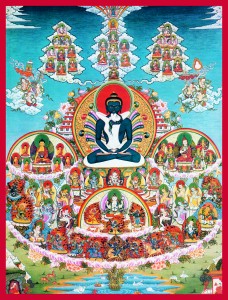
Palyul Nam Chö Refuge Visualization

The following is an excerpt from a teaching offered by Tulku Dawa Gyalpo at Kunzang Palyul Choling in Maryland. Future posts will continue with the teaching on the Life of Migyur Dorje.

Actually when we look to the Tantric teachings, you will see so many references to this kind of treasure revealer. It’s possible. More or less, Buddhists ask, “Does Buddha say that or not?” Actually, yes. This was already told when Nagarjuna clarified in Mahayana teachings. Also there is argument: This is not what Buddha taught when Buddha was alive. The Hinayana practitioners agree that it didn’t happen. I will tell here exactly what Buddha Shakyamuni said in the sutra, The Collection of Pure Dharmas. In that sutra, it says that some bodhisattvas who have pure motivation, pure bodhicitta, even though Buddha is not alive, Buddha is not there, will still hear the Dharma from the space, from the sky, or from the wall, or from other things. You can also receive the teachings from the trees. I know some of them they took from the wall. The history is there. Actually there were treasure revealers like this before Shakyamuni, but they are not called treasure revealers. This kind of name is not there. They would just take it and practice it. If it made sense, they kept it. If it didn’t make sense, they let it go.

During this three years, Tulku Migyur Dorje revealed all the treasures that we have right now. He started revealing all these different things. Then they completed three year retreat. From fourteen, fifteen, sixteen, and half of seventeen, he was out of retreat. Then he started to teach. He traveled. During those years, he also revealed some of the Earth Treasures, and also opened some of the sacred places. Also within those three, almost four years, he taught many people the Sky or Space Treasure Dharma. Especially there are 13 karmically connected people. Although in his lifetime, he taught many people, these thirteen are the main disciples. They’re called the 13 main karmically connected, or fortunate, people.

There are so many people’s names in that history. Let me give you one, Nyemba Tulku. Nyemba Tulku is one among the 13. There are so many people. It seems that during that time, Rigdzin Kunzang Sherab was not there. Tulku Migyur Dorje was giving teachings to all these other karmically connected great persons. When he was seventeen, again he went back to retreat with Karma Chagme. When they did retreat, there were so many signs of siddhis. I will tell you about one when they were practicing in accordance with Sky Treasure, doing the Heart Sadhana of the Bishuddhi, Yangdak, one of the eight Herukas.

During that time, this was a sign of the achieved siddhis during this sadhana that occurred. In the front, there was a red and yellowish lotus flower and upon that was a golden wheel with a thousand spokes. That wheel was turning toward the right, clockwise, for a long time, adorned with the wish fulfilling jewel, which is mostly benduria, blue in color. That wish fulfilling jewel had a wooden handle. Tulku Migyur Dorje had the experience of being given these kinds of things in his hand. This was one sign when they were doing this sadhana in their retreat time. It continuously happened all during these three years. Whenever he started some new sadhana, some sign like this appeared.

WP2Social Auto Publish Powered By : XYZScripts.com