The Basis Of Vajrayana

The following is an excerpt from a teaching by Jetsunma Ahkon Lhamo called “Tools to Deepen Your Practice”

Today I would like to discuss the depth at which one practices. That is to say, how to avoid practicing in a superficial way where there is no mental or emotional investment. That’s really not the ideal kind of practice.  It’s a little bit like watching TV, or listening to the radio, or something like that where you do it with half-a-mind, you know, and the rest of the time, of course, the mind is involved with other things.  And so, we’ve all heard that we don’t want that to happen, that we want the mind to be gentled and stilled but yet we have a hard time understanding that really the key to that is the depth, the level, and the absorption with which we practice.  That depth or that absorption is called the Dakini’s breath.  That is actually what makes one’s practice relevant, delicious and sweet, meaningful and nourishing. Without that depth and that level of absorption, it’s very difficult to practice in any way that is more profound than say, recitation by rote.  So that’s the effort that we want to make. In order to do that, I would like to explain things a little differently, perhaps a little more deeply than you may be used to.

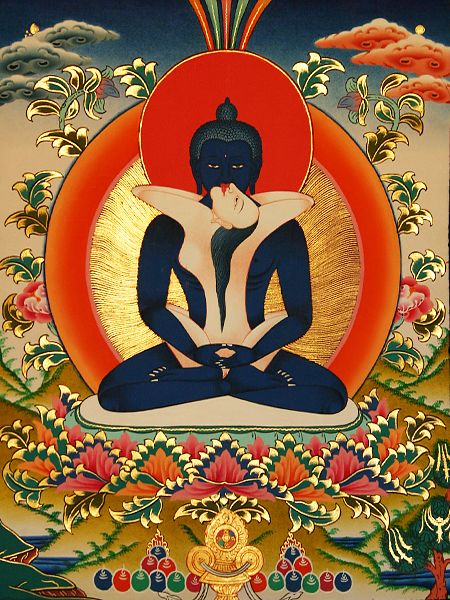
One of the things that I would like to mention is that in Tantrayana,  or the path of Vajrayana (which is the same thing), which is where we are now, you could say that the Path has two eyes or two legs, two supports.  Another way to say it would be that the Path can be distilled to its essential nature in two words: wisdom and compassion.  In fact one sees in many of the thangkas, the traditional paintings that are all around, pictures of a female and male in union, two lamas as consorts in union.  And of course having ordinary minds and being used to billboards and stuff like that, we think “Oh, what is this?” But we shouldn’t look at those pictures with an ordinary mind because they have a profound meaning.  The meaning of the union between lama and consort is the union of wisdom and compassion, the union of emptiness and method. The union of emptiness and method is the perfect balance, the perfect ship by which to cross the ocean of suffering.  It’s the perfect vehicle.  And of course, first we should understand what it means.  Wisdom and compassion or emptiness and method. . .  What does it really mean?

Well the meaning is this.  First of all, wisdom is something that you cannot arrive at by accumulating facts, because facts are phenomenal. They are believed to be self-existing. They are part of samsara, even if they are very smart facts.  Even if they are PhD-style facts!  Even if they’re MD-style!  No matter how many facts you know, you can never accumulate wisdom through the accumulation of facts, or what we would call the accumulation of knowledge.  It’s not to say that the accumulation of knowledge is not necessary.  If that were the case, then none of us would need training.  We would simply sit and do our best at meditating.

Of course facts are necessary.  It is necessary for us in our practice to understand how it is that the preceding lamas and excellent practitioners  accumulated merit and how they accumulated tremendous achievement.  It’s tremendously helpful to know facts, for instance, about the great lamas and the great saints and the Buddhas that have come in this time, and in other times, in order to understand with our ordinary minds what it is about them, how they come to be.  In fact, to some degree, our ordinary minds do require satisfaction.  And that’s where Vajrayana is ideal, because Vajrayana gives us ‘mental food.’  We have visualization. We have mantra recitation. We have the absorption in emptiness and then the springing from emptiness as the deity; and then the vajra confidence and the vajra pride.  It’s busy work!  Sometimes when people who are used to just sitting quietly and doing whatever it is they do, you know, when they have that habit of just sitting quietly, and there is a part of Vajrayana Buddhism in which you do sitting meditation; but if students only have that experience, they come here and they say, “Well, my mind is not calm.  I’m reciting all this stuff and I’m really stressed because I can hardly pronounce it.  And the tunes—forget about it.  And so there!”  And of course the response to that is, “Well really in Vajrayana the task is not to calm the mind.  The task is to awaken to the emptiness of all nature,to awaken to emptiness, that is, to perceive emptiness.”

Copyright © Jetsunma Ahkon Norbu Lhamo All rights reserved
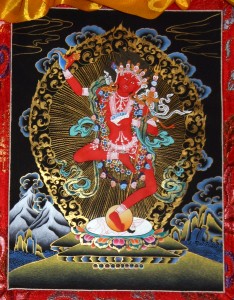
 

The Dakini

kw-752-0021-dorje-phagmo-ed-234x300

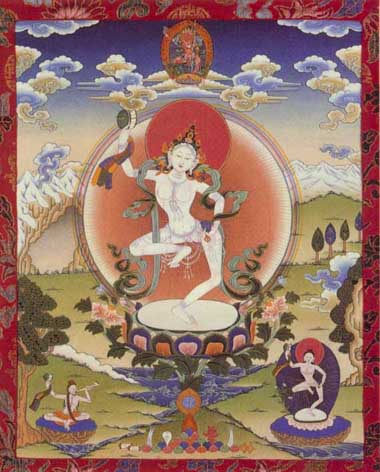
The female plays an important role in Tibetan Buddhism.In this video, Khenpo Tenzin Norgey teaches about the female manifestation of enlightenment – the Dakini or Khandro (Kha = Sky and Dro = Dro).“Khandro” is frequently translated as “Sky Dancer.”In an ultimate sense, “Space” or “sky” can be translated as emptiness, that which is beyond conditional phenomena.Empty but still dynamic.The Khandro is the root of enlightened activity.

The full length teaching is available at Palyul Productions

Viewing The Spiritual Master

The following is respectfully quoted from “Treasury of Precious Qualities” by Longchen Yeshe Dorje and Jigme Lingpa as translated by Padmakara Translation Group:

Spiritual masters have already accomplished their own aim. It is now their task to labor for the sake of others. It is important to understand that their various activities are displayed as appropriate to the inclinations and feelings of different beings and are the inconceivable operation of enlightened activities. Bearing this in mind, one should refrain from misinterpreting them. The siddhas of India like Saraha appeared for the most part as social outcasts. They adopted the way of life that was conventionally disreputable and lived without concern for purity or impurity, getting their livelihood as menials of the lowest caste or as “sinful” hunters and fishermen–living in the humblest way possible. But since their minds were undeluded, their actions were never wrong. We, by contrast, are as deluded as if we were under the power of hallucinogenic drugs. If we have not gained freedom through the three doors of perfect liberation, and have not realized the infinite purity of all phenomena, ascribe defects to our teacher, we commit an immeasurable fault. Bhikshu Sunakshatra committed to memory the entire twelve collections of the teachings, but, overpowered by his wrong views, he regarded as perfidious and underhand the actions of Buddha Shakyamuni himself, who was utterly without fault and possessed of every excellence. We should take all this to mind and confess and repair the slightest fluctuation in our faith.


A Great Opportunity

The following is an excerpt from a teaching by Jetsunma Ahkon Lhamo offered at Palyul Ling Retreat in New York 2012:

We have a great opportunity here.  When I come here, I don’t take advantage because I am shy and I don’t like to come out, but I still practice and I still do what I can to benefit sentient beings. For instance, I think about ordinary things, and I think about how I can bring benefit to people who have ordinary lives and ordinary situations. One thing that I did was to start a food bank, so that we can feed the people in our neighborhood and in our community who have nothing. It is not a rich area. Those who have nothing can have food. They can come and get food for their families. There is no expense or anything like that. We do ask that if you take something, then bring something. If you take some beans and bread and that sort of thing, bring something, even if it is just a tiny something to make that exchange, to make that connection. There are a lot of people in my community that are eating very well because of our efforts. And I don’t feel like that is separate from Dharma. There’s practical Dharma and there is ultimate Dharma, and I feel that both are essential. And all are supported by the great bodhicitta.

Another thing that we have done is to create an animal sanctuary for rare and exotic parrots. Before these parrots came to us, they were abused. Many of them lived all their lives in cages that were too small for them to spread their wings. Many of them had never seen the sky. Many of them were fed graham crackers, and stupid things like that, that they should never eat. There was so much cruelty in the exotic bird community, so we decided to see if we could do anything. And we did. And now my son runs that exotic bird sanctuary, and all the birds get to go outside. We have a huge area for them, and they can actually fly, which they never could do before. It’s beautiful to see.

As you remember, His Holiness loved animals; he especially loved birds. In India he used to keep birds. When His Holiness saw the birds in the aviary, he was so happy about that. His Holiness saw them and loved them. He felt that that was Dharma in action. Activity Dharma.

Copyright © Jetsunma Ahkon Lhamo.  All rights reserved

What Is Chod?

The following is respectfully quoted from “Compassionate Action” by Chatral Rinpoche:

Chöd means “cut” and is a practice for destroying ego-clinging by offering your body, cut into pieces and converted into pure nectar, as sustenance for the enlightened ones, the hungry ghosts, demons, and other sentient beings. It is traditionally practiced at charnel grounds and cemeteries.


No Short Cuts

The following is an excerpt from a teaching by Jetsunma Ahkon Lhamo called “Antidoting the Mantra of Samsara”

As a part of Ngondro, we have to accomplish 100,000 repetitions of a short version of the Bodhisattva Vow,  the Bodhicitta mantra. Do you think to yourself, “Well what’s the goal here?  See, I’m trying to be compassionate. O.k. so from now on I’m just going to be nice.”  Have you ever tried to make that decision?  From now on you’re going to be nice?  Have you ever tried to do that?  How long did it last?  Maybe five minutes if you’re lucky!  I think the all-time world record for a woman is 28 days!  And that goes for her husband also!  So it really can’t be done. You can’t just decide you’re going to be compassionate. And why is that?  Because you still have the weight of these ancient habitual tendencies and deluded perceptions.

The Buddha teaches us that what’s needed here is to recite the Bodhicitta mantra at least 100,000 times with the correct absorption, correct mental concentration, mental imaging, and mental visualization, just as you are taught by the Buddha. Don’t make up your own religion now. Don’t do that!  Practice what the Buddha has taught you just like the Buddha says, and that will change that. Rather than thinking “Oh, let me see if I can rewrite this religion to make it a little easier,” which you guys have all tried to do, haven’t you?  Yes, we know that. So, instead of rewriting the religion, we actually practice it the way that it was given. But we’re thinking, “Wouldn’t it be nice, instead of this 100,000 business, why don’t we sort of do it the new way?  This is a new age isn’t it?  We’ll just think positive all of the time.” Anybody ever tried to think positive all the time?  That’s another fun one. The world record for that is also 28 days.

So we have to understand that what’s recommended here is not arbitrary. Some Buddhist person didn’t show up a long time ago and say “Let’s see, when it gets to be about 1996, how are we going to torture these people?”  It wasn’t like that at all. These practices are meant to antidote your particular situation. You must understand that these were not given to us by ordinary sentient beings. These were not authored by someone who felt that they had an answer the way many of our New Age wisdoms are. You know, nowadays we hear people coming up with wisdom all the time, all kinds of wisdom.They came up with it two years ago, five years ago—how to dream, how to vision. Everybody’s got some wisdom.

But this stuff that comes from the Buddha is different. What actually occurred here is that the very mind of enlightenment appeared in the world as the perfected Buddha. This was not an ordinary sentient being. This is the Buddha nature appearing in the world in a form that we can see with our eyes. And from the mind of that nature, from the mind of that one, from that, directly from the Buddha nature itself, this antidotal process was given. It’s not the same as some mom and pop wisdom somebody cooked up nowadays. So it’s not going to sound like, “Let’s put a bandaid on an ulcer.” It’s not going to sound like “O.k. you’ve been alive since time out of mind creating lots of nonvirtue. Just think positive. Everything will be fine.”  It’s not going to sound like that.

It’s going to sound like what it is. The necessary solution for what ails you according to what you actually are, not according to your over-simplified understanding of yourself. So the Buddha has given a very deep, very extensive, very profound method for a very deep, extensive and profound problem. And there are no shortcuts.

Copyright © Jetsunma Ahkon Norbu Lhamo.  All rights reserved


WP2Social Auto Publish Powered By : XYZScripts.com