The Bodhisattva Vow – A Commentary

[Adapted from an oral commentary given by His Holiness Penor Rinpoche in conjunction with a ceremony wherein he bestowed the bodhisattva vow upon a gathering of disciples at Namdroling in Bozeman, Montana, November 1999. —Ed.]

In general, dharma consists of many divisions and distinctions of spiritual teachings, while at the same time the nature of all dharma is that it has the potential to liberate beings, both temporarily and ultimately, from the suffering of cyclic existence. The main cause or seed for that [liberation] is the cultivation of bodhicitta. Various traditions exist for the bodhisattva vow ritual and training. The lineage for these particular teachings, which was passed from Nagarjuna to Shantideva, is known as the tradition of the Middle Way as well as the lineage of the bodhisattvas.

There are four aspects related to receiving the bodhisattva vow: receiving the vow itself, ensuring that the vow does not degenerate, repairing the vow if it is damaged, and methods for continuing to cultivate and maintain the vow.

The first aspect of receiving the vow itself has three aspects: the individual from whom one receives the vow, oneself as a qualified recipient, and the ritual for receiving the vow.

First, the individual from whom one receives the vow must have strong faith in the Mahayana vehicle and must be a true upholder of the vow. He or she must be someone within whom the vow abides and should also be someone who is very learned concerning the vehicles, particularly concerning bodhisattva training. Such a person must never abandon bodhicitta and must always keep the vows pure, even at the cost of his or her own life. That individual must also be a practitioner of the six paramitas of generosity, morality, patience, diligence, meditation, and prajna, and must never engage in any activity that contradicts them.

According to the tradition of Nagarjuna, the way to receive the vow for the first time is from a spiritual guide. Later, if an individual’s vows[1] degenerate, and if a spiritual guide is then absent, that person can restore the vows in the presence of an image of the Buddha. It is not necessary that they be restored in the presence of a spiritual guide.

The second aspect for receiving the vow itself concerns the individual who qualifies to receive it. According to the tradition of Nagarjuna, all sentient beings who desire to receive the bodhisattva vow qualify to receive it. The only exception is types of gods in the formless realm, called gods devoid of recognition, which are gods that lack cognitive abilities. With this one exception, basically all sentient beings qualify to receive the vow. But those who qualify in particular are those who have supreme knowledge, which refers to those who know what the bodhisattva vow is and what the benefits of receiving and maintaining it are. Such individuals are particularly worthy recipients because they have profound compassion and are able to use that compassion to bring both temporal and ultimate benefit to other beings. In short, any individual who has an altruistic attitude and wishes to take the bodhisattva vow qualifies to receive it.

The ritual [which is the third aspect of receiving the vow itself] also has three parts: the preliminaries, the actual ritual, and the concluding dedication. The preliminaries have four parts: adjusting one’s own intention, supplicating the objects that confer the vow, taking the support of refuge, and practicing the method of accumulating merit.

First [during the preliminaries] one adjusts one’s intention [in order] to be in harmony with the special feature of this instruction. There are three ways to do so: by developing repulsion or weariness toward the suffering of samsara, by developing an attraction to enlightenment, and by transcending the two extremes of samsara and enlightenment through vowing to maintain the middle way.

When considering the first step to adjust the mind, one cultivates repulsion and weariness toward samsara as antidotes for strong attraction to worldliness, to ordinary phenomena, to one’s own life, wealth and endowments, and to one’s friends and loved ones. Through cultivating weariness toward the suffering of samsara, we learn about impermanence and come to understand the impermanence of all worldly phenomena.

[The second way to adjust one’s intention in order to be in harmony with the special feature of this instruction is through] developing attraction to enlightenment. According to this tradition, what leads one to develop an attraction to enlightenment is the cultivation of love for all beings, which one begins by contemplating the suffering of cyclic existence and then cultivating repulsion and weariness [toward that existence].

This leads to the third stage concerning the aspect of adjusting one’s intention [which is the first of four aspects of the preliminaries to the ritual for receiving the vow]; transcending the two extremes of samsara and enlightenment by vowing to maintain the middle way. The practice of the enlightened mind, bodhicitta, involves two levels, the aspirational and the practical. Maybe now you’re thinking, “If we reject the suffering of the three realms of existence and avoid attraction to the quiescence of the hearers and solitary realizers, what is there for us to obtain? What we are to obtain is the state of bodhisattvahood, which is dependent on bodhicitta cultivated for the sake of self and others. It is only bodhicitta that leads beings from the suffering of existence to the state of fully enlightened buddhahood. We must avoid the two extremes: the quiescence of ordinary nirvana and the endless cycle of samsara. It is only through cultivating bodhicitta that we can truly follow the middle way.

Through cultivating bodhicitta you will purify all nonvirtue accumulated in the past, present, and future, and compassion and all noble qualities, including the ability to meditate in Samadhi, will blossom in your mind. As you dedicate yourself to the welfare of others, the [strength of your] vow will increase to the point where you are truly able to help sentient beings as limitless as space. You will be able to bring limitless beings to enlightenment, until the ocean of existence is emptied. The Buddha taught that without the cultivation of the precious bodhicitta, there is no chance to achieve the state of fully enlightened buddhahood. Therefore, for the purpose of all other living beings, with great enthusiastic joy you should give rise to the precious bodhicitta and engage in the actual practice.

Having adjusted your intention [in order] to begin the actual practice, supplicate the objects from which you will receive the vow. Recognizing the spiritual teacher to be the Buddha, first offer the mandala to receive the bodhisattva vow. Then repeat the supplication to the spiritual teacher and request to be a recipient suited to receive the vow and to accomplish the training for the benefit and welfare of all living beings.

Next, go for refuge in the sublime supports: the Buddha as the embodiment of the three kayas, the dharma as the representation of all scriptural transmissions and realization, and the Sangha as those who have attained the irreversible path of the sublime ones. From this moment until enlightenment, in order to liberate all parent sentient beings from their suffering, develop compassion. Realize that [in order] to accomplish your goal, aside from reliance on the Three Jewels of Refuge, there is no other support for refuge. It would be impossible for you to bring all beings to liberation without the buddha, dharma, and sangha. With irreversible faith and devotion, repeat the vows of refuge.

According to the Mahayana path, we take refuge in the teacher who shows us the path to liberation: that is the buddha. We engage on the path of Mahayana practice by cultivating the precious bodhicitta until we realize buddhahood: that is the dharma. The sangha is the spiritual community that is on the same path as we are on, assisting in the accomplishment of our mutual goals.

Next is the method for accumulating merit. Visualize in the space in front a magnificent throne supported by eight lions, where your teacher sits, indivisible with Lord Buddha Shakyamuni. The eight arhats and a vast assembly of buddhas and bodhisattvas surround him like masses of clouds that fill the ten directions. Imagine countless emanations of yourself filling the entire pure realm of your environment, which includes the entire universe. You and countless emanations of yourself and all parent sentient beings join together to fill [all of] space. With humility, reverence, and faith, you and they all bow down and pay homage to the objects of refuge in the space in front. [Here you] prostrate by touching the five places of your body to the ground. This is the branch of prostration, a powerful antidote for pride. Having pride means having the attitude of cherishing yourself by thinking you are so great and special. Performing prostrations purifies that egotistic attitude.

Now visualize that you and innumerable emanations of yourself present boundless offerings. Offer all of your wealth and endowments, including the root of all virtue in this lifetime, in all your past lifetimes, and in future lifetimes. Offer objects that are of this world and those that are transcendent. Imagine them to be inconceivable vast clouds of outer, inner, and secret offerings that completely fill space. In addition, offer the essential nature of reality.

The next branch involves [making] confession.

The next branch concerns rejoicing.

The next branch is that of requesting the buddhas to turn the dharma wheel.

Next is the branch of requesting the buddhas and bodhisattvas not to pass into nirvana.

The final branch of the seven entails the dedicating of merit. Amass all merit, especially the merit of reciting these seven, as well as all virtue and merit of the three times, and offer it for the welfare and liberation of all parent sentient beings. [The practice of] dedicating merit is the antidote for having many degrees or levels of doubt.

The second aspect related to the ritual is that of bestowing the vow, which has two parts: training the mind and receiving the vow. To train the mind, one begins by thinking of all parent sentient beings that have remained in cyclic existence from time immemorial until now and that have been extremely kind as one’s own parents in the past. Consider how they suffer unceasingly. Then think, “In order to alleviate the suffering of all these beings, I will give myself, my life, my wealth, and my endowments, and without ever giving up, I will work unceasingly to free sentient beings from suffering. I will happily take upon myself whatever suffering they are enduring.”

The actual bestowal of the vow follows.

Begin the stages of training by establishing the three moralities. The first morality, which is the basic morality of bodhisattva training, is to abstain from harming others. The second morality is to practice to amass great virtue, which means constantly practicing the six paramitas of generosity, morality, patience, diligence, meditation, and the wisdom of knowing the nature of emptiness. The third morality is to accomplish the purpose of others, which means directing all effort and actions toward the sole purpose of repaying the kindness of parent sentient beings and establishing them in the state of fully perfected buddhahood. Keeping all this in mind, you take the vow.

When you recite the verses of the vow, you should be in the state of the three recognitions. The first recognition is to have strong faith and devotion in the gurus, buddhas, and bodhisattvas because of knowing their noble qualities. The buddhas and bodhisattvas possess omniscient knowledge concerning the details of the relative lives of all sentient beings. Not an instant goes by where they do not simultaneously know the nature of all phenomena. The second recognition is to have tremendous compassion for all parent sentient beings, to feel completely responsible for repaying their kindness, based on all the reasons explained earlier. The third recognition is to work unceasingly and tirelessly to establish all parent sentient beings in the state of fully perfected buddhahood.

To take the vow, kneel, press your palms together, and feel certain that the buddhas and bodhisattvas of the ten directions abide in the space in front of you. Give rise to the three recognitions. With strong, fervent regard and the aspiration to accomplish your vow, recite the verses of the vow. When you complete the third recitation, feel certain that you have received the bodhisattva vow.

Upon receiving the vow, you should rejoice. Consider that you have taken countless rebirths with innumerable bodies, and that not until now, in this present rebirth, have you had the opportunity to really cultivate the enlightened mind with the vow to guide all beings to liberation. With that in mind, rejoice in taking this vow, and feel you have finally extracted the purpose of your human life.

The following are the concluding stages of dedication [the third and final aspect of the ritual itself]: To begin, consider the benefits of taking the bodhisattva vow. Although the benefits are so vast they cannot be enumerated, a few of them will be mentioned here. When cultivating bodhicitta and taking the bodhisattva vow, you are elevated from the rank of an ordinary individual to become a son or a daughter of the bodhisattvas. Now you are an object of homage for gods and ordinary human beings.

Even though you [may] lose mindfulness, if you never lose the bodhisattva vow, the force of bodhicitta will always bring you back to your original vow. The more you become accustomed to the bodhisattva vow, [the more] your negative tendencies and habits will be transformed and absorbed into the continuum of bodhisattva training.

The four stages involved in receiving the bodhisattva vow include receiving the vow, maintaining the vow, practicing the six paramitas, and achieving equanimity, which means purifying the mind from partiality or attachment and aversion. With these four stages [complete], the noble qualities and benefits are ineffable.

These few points provide a very brief, highly synthesized enumeration of the benefits of the bodhisattva vow, benefits that are otherwise inconceivable and inexpressible. If we tried to express any form these benefits could be likened to, even the sky would be unable to contain that.

Keeping all that in mind, recite the verses of rejoicing in your personal good fortune, followed by the verses of others rejoicing with you. Invite all beings to be present, including all the buddhas and bodhisattvas, and ask them to bear witness as your guests on this occasion of receiving the bodhisattva vow. As you recite the verses, think that all beings rejoice along with you.

Once you receive the vow, you must know how to guard it from deteriorating. This brings us to the teaching on how to ensure that the vow does not degenerate, which involves the three things to know—namely, how to keep the vow, how to train, and how to stop external forces and circumstances that may hinder you in your ability to keep the vow.

First, the instruction on how to keep the vow concerns the cultivation of aspirational bodhicitta and the training in practical bodhicitta.

The second part concerning how to keep the vow involves the training in practical bodhicitta. Here you must reject the two categories of downfalls, which are the root and branch downfalls. Those are downfalls that can occur within the context of the various categories of vows one takes. For example, there are five root downfalls that pertain to rulers, five to ministers, and five to beginners. There are also vows for those who practice on a common level. Any individual who has taken the bodhisattva vow is capable of committing a downfall. However, these instructions do not pertain to any individuals who had a mental impairment or deficiency or were unconscious and therefore didn’t know what they were doing when they took the vow.

Next is the discussion on how to repair the vow if it degenerates and how to continuously cultivate and maintain the vow. [This is the third of the four main aspects related to receiving the vow.] The three ways that a vow deteriorates are by losing the foundation for the aspirational mind, through rejecting the vows by returning them, and by allowing a root downfall to occur. In the first and second cases, the vow is completely lost and must be taken again in order to be restored. In the third case, if you commit a root downfall, you must confess it immediately. If you postpone [your] confession of a downfall, that downfall will become more and more difficult to purify. Apply the four powers, and in the presence of the Three Jewels of refuge, confess your downfall. Pray to purify any negativity accumulated through the downfall, and then perform purification practices.

Once you have received the bodhisattva vow, you may take it again either if you have lost it or [in order] to ensure that it does not diminish. To retake the vow on your own, consider that you are in the presence of the buddhas and bodhisattvas. With strong faith and devotion, feeling they are present, take the bodhisattva vow directly from them. Otherwise, you can use a support of the Buddha, such as a statue for enlightened form, a scripture for enlightened speech, or a stupa for enlightened mind. If you do not have any of these supports, you can use the power of your own mind in order to take the vow.

The reason we retake the bodhisattva vow is because we are habituated with the five passions. We always do the opposite of what should be done. We always turn things into negativity. The little bud of our buddha nature, which is just beginning to open, should blossom when exposed to the blessings of the sun and the refreshing showers of dharma. Instead, it dries and closes due to [our] negative habits that obscure the circumstantial blessings that come through the dharma. If we encourage ourselves by continuously reaffirming pure intentions and by taking the bodhisattva vow over and over again, that will give us the power and strength to rise up despite all the difficulties imposed by the influence of our passions. Then, by focusing on the vow and training, we will obtain the confidence to abandon self-concerned fixations. Emphasis shifts from the self to the needs of others. Once our bodhisattva vows become strong, accomplishing whatever prayers or aspirations we hold in our hearts will be very easy.

The three dharmas to adopt are to rely on a spiritual teacher, to make offerings to the Three Jewels, and to never abandon compassion for any sentient being. The first of the four recognitions to accept is to examine yourself to see whether you have the potential to uphold the vow and to maintain the training. The second is to examine to see whether an action is virtuous or not. If you determine it to be virtuous and fail to accomplish it, or if you contradict it or remain indifferent, then in all three of these cases there will be a downfall.

[Third,] in order to constantly guard the vow, you must be learned in the teachings on bodhisattva practice as found in the scriptures, particularly those [teachings] that discuss the subject of cultivating bodhicitta. [Fourth,] you must know how to be conscientious and mindful, so that [your] bodhisattva training will not deteriorate. If your training is free from deterioration, that indicates you are practicing mindfulness.

Although there are countless ways of knowing how to guard the vow to ensure that it will not be lost, they can be synthesized into three. First, the bodhisattva training must be internalized as much as possible. Second, the internal training must be expressed externally to meet the needs of beings by bringing them the gift of dharma. Finally, there must be the pure view of the pure lands of the buddhas. From now on, at all times and in all situations, with loving-kindness and compassion, you must do your best to always be of benefit to all sentient beings equally. No matter what, you must never abandon any living being for any reason. In addition, you must never be biased towards some and against others. From this time forward you must consider all beings impartially and with loving-kindness and compassion, and you must do your best to always increase your virtuous deeds, which you dedicate to the service and benefit of others. This is how you will be able to keep your bodhisattva vow.

It is especially important to always cultivate mindfulness. Once you have taken the bodhisattva vow, if you are mindful of it, then you won’t forget to direct your every effort toward the practice of dharma. It is also important to cultivate conscientiousness, which will stabilize your ability to be mindful. Finally, it is important to be careful in all the different circumstances of life. Mindfulness, conscientiousness, and care are extremely important.

[Once you have taken it] you will have the bodhisattva vow in your mind. You will no longer be an ordinary world individual, as you will have entered the path of the bodhisattvas to become a son or daughter of the buddhas. If you keep your bodhisattva vow, without allowing it to degenerate, then you are truly a bodhisattva. If you drink a cup of water from the ocean, you can say that you drank the ocean; likewise, if you enter the path of the bodhisattvas, you can say that you are a bodhisattva. With faith and devotion, please do your best to keep this vow.

The Bodhisattva Vow

Dedication Prayers


[1] [While the word in the term bodhisattva vow is commonly used in its singular form, it is also often used in its plural form, bodhisattva vows. Both the singular and plural forms of the term in fact represent a series of vows. Readers will find both forms used throughout the commentary.—Ed.]

From “THE PATH of the Bodhisattva: A Collection of the Thirty-Seven Practices of a Bodhisattva and Related Prayers” with a commentary by Kyabje Pema Norbu Rinpoche on the Prayer for Excellent Conduct

Compiled under the direction of Venerable Gyatrul Rinpoche Vimala Publishing 2008

Astrology for 03/24/2018

03/24/2018 Saturday by Jampal & Wangmo

Theme: Cross-purposes

Today your emotional self and your active self may be at cross-purposes. The challenge will be to let go of your wishes for yourself and make a wish to be of benefit. Sometimes larger forces are at work and we don’t always have a choice. And yet with discipline, right action and careful restraint one can accomplish a great deal. ‘Happiness is not something that is ready made. It comes from your own actions.’~HH Dalai Lama

Root Downfalls

[Adapted from an oral commentary given by His Holiness Penor Rinpoche in conjunction with a ceremony wherein he bestowed the bodhisattva vow upon a gathering of disciples at Namdroling in Bozeman, Montana, November 1999. —Ed.]

As the ancient literature states, there are five vows that pertain to rulers or kings, and those vows concern the ways a ruler, or really anyone in a position of authority, exercises power. Rulers who take the vow to train in bodhisattva conduct take the five special vows to ensure that they will not misuse power. The first of the root downfalls [associated with kings or rulers] is to embezzle or steal the wealth of the Three Jewels of refuge for personal gain. The second root downfall is to not allow others to practice or study the dharma. The third is to take the possessions of the ordained. The fourth is to cause harm to dharma practitioners in general. The fifth root downfall is to engage in any of the heinous nonvirtues, such as killing one’s own father or mother, killing a buddha, shedding the blood of a bodhisattva or an arhat (or engaging anyone else to perform this deed on one’s own behalf), or with deceitful intentions trying to influence others to engage in nonvirtue through body, speech, or mind. Those are the five root downfalls that pertain to kings or rulers. There are also five vows that pertain to ministers. The first four are the same as those for rulers, and the fifth concerns destroying villages or towns and harming lay people.

For beginners, there are usually eight root downfalls. The first of those root downfalls is to teach the dharma to people without being aware of the level of their spiritual development or capacity to receive teachings. For instance, if one teaches about the nature of emptiness to individuals who do not have the capacity to understand that level of teaching, those individuals may misinterpret and develop an incorrect view. Because [teaching in] that [context] is inappropriate, it is [considered] a root downfall. The second root downfall is to discourage someone from entering the path of bodhisattva training. The third is to disparage the path of the lesser vehicle of Hinayana and the followers who are the hearers and solitary realizers. That would involve, for example, saying to someone, “Your tradition is not really the true lineage of the Buddha.” The fourth is to claim that the Hinayana path is inadequate—for example, to make statements such as, “The dharma practice of the hearers and solitary realizers will not eliminate the passions.” The fifth is to put down others through slander or to speak ill of others out of jealousy in order to build up or boast about oneself. The sixth is to claim to have realization about the nature of emptiness when that is not true; that would be to speak an unsurpassed lie. The seventh is to embezzle or [otherwise] take the wealth of the upholders of virtue (those who dedicate their lives to the path of virtue). The eighth is to steal the wealth or possessions of ordained sangha (renunciants) and give that to ordinary, worldly individuals.

All those [eight root] downfalls pertain to beginners. As a beginner, if you commit any of those root downfalls, you will fall to the lower realms.

From a common point of view, a downfall involves giving up aspirational bodhicitta and abandoning the intent to work for the welfare of others because of being motivated by personal concern.

The first branch downfall is to act in a nonvirtuous manner [to be] crude and disrespectful, with wild and erratic behavior, which is exactly the opposite of how a bodhisattva should behave: a bodhisattva should always be peaceful and subdued. The second downfall is to be impolite, to behave inappropriately in the presence of others. As a practitioner in training, you must be concerned about others, which means that your conduct should reflect your mental training: your conduct, speech, demeanor, and so forth should always be in harmony with love and compassion. Those who have not rejected and have not even considered eliminating their attachment and aversion are always engaged in endless conversation and gossip based on attachment and aversion. If you are cultivating bodhicitta, you should not be like that. Instead, you should always think about love and compassion for all beings and speak in a way that reflects your training.

If you commit a root downfall, you must confess it immediately. If you postpone [your] confession of a downfall, that downfall will become more and more difficult to purify. Apply the four powers, and in the presence of the Three Jewels of refuge, confess your downfall. Pray to purify any negativity accumulated through the downfall, and then perform purification practices.

From “THE PATH of the Bodhisattva: A Collection of the Thirty-Seven Practices of a Bodhisattva and Related Prayers” with a commentary by Kyabje Pema Norbu Rinpoche on the Prayer for Excellent Conduct

Compiled under the direction of Venerable Gyatrul Rinpoche Vimala Publishing 2008
Astrology for 03/23/3018

03/23/3018 Friday by Jampal & Wangmo

Theme: Overcoming the past

There is an opportunity to let go of the past and to experience a new emotional freedom. Coming to terms with your shadow self will lead to philosophical breakthroughs. There continues to be a lot of start-up energy today. However, with Mercury Retrograde for the next three weeks communication is slower and misunderstandings are increased. It’s an opportunity to finish past projects but beware of starting something new as it is likely to change. ‘To free yourself from the past you must break the rules of silence and compliance.’~ Claudia Black

Today the Moon is Void of Course from 11.53 pm EST USA until 4.54 am the next day. If you’re in another country check what that means for you time-wise. It’s best to avoid making major decisions or signing contracts during this time.

Wisdom Merit

[Adapted from an oral commentary given by His Holiness Penor Rinpoche in conjunction with a ceremony wherein he bestowed the bodhisattva vow upon a gathering of disciples at Namdroling in Bozeman, Montana, November 1999. —Ed.]

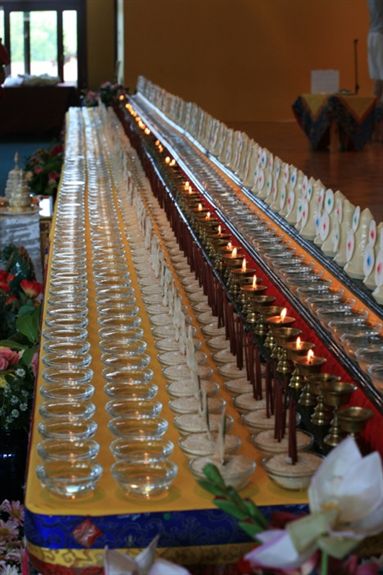
General offerings please the senses. Imagine those offerings to be vast and inconceivable. However, if you were to [attempt to] compare the outer offerings with a single particle of the realms of buddhas and the quality of offerings made in the minds of enlightened ones, [you would find that comparison] to be beyond the scope of your imagination. That is why it is so important while presenting offerings to try to connect with the ultimate nature of offering, which is mental and not just material. Material offerings you make are supports for your mental or imagined offerings, which should be as inconceivably vast and wondrous as you are capable of manifesting. The actual offerings you use as a support should also be the best substances you are able to offer. At least they must not be old, dirty, or leftover substances; they must be suitable supports for the basis of virtue. The pure material offerings you make will be the support for the continual manifestation of inexhaustible offerings that will remain until samsara is emptied.

There is a well-known story of an accomplished practitioner named Jowo Ben. One day Jowo Ben made a very beautiful, clean, and pure offering on his altar. As he sat and looked at his offering, he thought, “What is it that makes this offering I’ve made here today excellent?” Then he remembered his sponsor was coming to visit that day, and he realized he had made the beautiful offering in order to impress his sponsor. He jumped up, picked up a handful of dirt, and threw it on the altar, saying he should give up all attachment and fixation on worldly concerns. Other lamas, on hearing what Jowo Ben had done, proclaimed his offering of throwing dirt on his altar to have been the purest of offerings, because Jowo Ben had finally cleared his mind of attachment and aversion.

When offerings are made, they are rendered pure and excellent by a mind free from attachment and aversion to the ordinary, material aspect of the offerings—and they must be made with a mind that is also free from avarice. Don’t think you can throw dirt on your altar and think that will benefit you. You must adjust your mind. If your mind is free from attachment or fixation and aversion, then whatever you do will be right. If your mind is not adjusted and your intentions are impure, then no matter how beautiful and magnificent the offering is, it will be insignificant. If you present all offerings, whether abundant or meager, with fervent devotion from the core of your heart, that will produce profoundly amazing results.

In order to be free from the suffering of existence, the mind must be free from dualistic fixation. In freedom from duality, everything is inherently pure. Just imagine all the wonderful offerings that are made that are free from duality: pure water possessing the eight qualities, garlands of flowers, incense, light, superior perfume, celestial food, musical instruments, fine garments, beautiful umbrellas, canopies, victory banners, the sun, the moon—the finest and best of everything is offered. Consider those as offerings arranged in a magnificent array equal in size to Mt. Meru. Furthermore, know that those offerings are pure and free from duality. For example, if you were to pick a flower and think, “Oh, this is such a beautiful flower; I want to offer it,” but then you also think, “My flower is more beautiful than the others,” and you offer it with that dualistic thought, then that offering would be defiled by your dualistic fixation. On the other hand, if you focus on the pure nature of the offerings and present them with pure devotion, you will make offerings that are pure or free from dualistic fixation. Recite the verses of the branch for offering, and make the most excellent, immeasurable offering you are capable of with the enlightened attitude [bodhicitta], faith, and pure devotion.

It is important to understand that presenting offerings is the antidote for [having] desire. Offerings are not made to the Three Jewels because they are considered to be poverty-stricken and in need of receiving from their disciples; offerings are made to accumulate merit. By making offerings with actual material substances, we accumulate ordinary conceptual merit; by using the mind to manifest immeasurable offerings, we accumulate nonconceptual wisdom merit.

From “THE PATH of the Bodhisattva: A Collection of the Thirty-Seven Practices of a Bodhisattva and Related Prayers” with a commentary by Kyabje Pema Norbu Rinpoche on the Prayer for Excellent Conduct

Compiled under the direction of Venerable Gyatrul Rinpoche Vimala Publishing 2008

Karmic Ripenings

From The Spiritual Path:  A Compilation of Teachings by Jetsunma Ahkon Lhamo

We tend to externalize our experiences: everything happens “to us.” We externalize all cause-and-effect relationships as somehow separate and distinct from our own minds. To some degree, we even externalize our thoughts and feelings as if they were solid things that can overpower us. If we base our happiness on a new car or a personal relationship, we are powerless when they break down. We may even warily watch for signs of the next unhappiness.

In our practice, if we are unable to concentrate, we have no real understanding of why that would be. Perhaps someone in the next room has a TV playing; that is why we can’t concentrate. Or it’s because we’re here in the West, where everything is materialistic and fast-moving. Or perhaps our parents brought us up wrong. There are causes aplenty, and they’re all out there. Similarly, if we manage to practice properly, the environment is somehow responsible for our happiness. “I like to pray in my own little room.” Or: “I like to practice sitting on a cliff somewhere.” Sometimes we feel dull, lethargic, helpless, lonely, or all of those wrapped into one. Yet we don’t know why. Insidiously, we become resigned to it. “That’s just the way I am,” we say—and we take this as a validation, or permission to feel disabled emotionally. That is how crippled we become when we fail to understand the causes of our own unhappiness. So we concentrate still more on our suffering. Since we believe in the reality of self-nature, we create in our minds a separation between self and other. Then we react with attraction, repulsion, or neutrality. This is where desire enters. Also hope and fear. And karma.

How does karma function? Please picture a black vertical line on a white marking board. This line is the present, where you are right now. To the left is the past; on the right, the future. If all of this can be seen to represent your own mindstream, if that could be done, your self-nature is located on the line in this time and space grid. In the here-and-now. To the left, in your mindstream’s past, karmic seeds are ripening and coming forward like light and dark bubbles. As they come forward, they are experienced in the present. As they pass the present line, they actually work as catalysts or causes for future events—depending on how you react in the present moment.

You have a vast number of bubbles surfacing from countless lives. The dark bubbles are negative seeds, negative causes: you were selfish or you killed someone; you were greedy or hateful. But you also have light bubbles, meritorious seeds: you helped feed starving children, you practiced Dharma, you were kind; you did many wonderful things. In everyone’s mindstream there are mixed causes (like partly overlapping light and dark bubbles) that are ripening and coming to the surface, to the present moment. How they ripen depends on what events and attitudes are at the surface, interacting with these ripenings.

© Jetsunma Ahkön Lhamo

Astrology for 03/22/2018

03/22/2018 Thursday by Jampal & Wangmo

Theme: Innovation

There are opportunities to think outside the box for the next few days. Expect spontaneity in your relations with others through to the end of the month. This could also manifest as abruptness and unpredictability in relationships. It’s also a day of communication and conversation. ‘I’ll be more enthusiastic about encouraging thinking outside the box when there’s evidence of any thinking going on inside it.’~ Terry Pratchett

Astrology for 03/21/2018

03/21/2018 Wednesday by Jampal & Wangmo

Theme: Relationships and Love

The Sun has moved into Aries. Happy Birthday Aries! It’s a great day to shine. It’s a good day also for spiritual inquiry. The issue of freedom will come up in relationships so give people space today and then they’ll come through for you. There is an element of unpredictability in relationships coupled with emotional intensity. It’s a good opportunity to examine ones own mind and motivation. ‘Let there be no self — only compassion. Where I am let Love live.’ Jetsunma Ahkon Norbu Lhamo

Your Life: A Vehicle of Blessings

An excerpt from a teaching by Jetsunma Ahkon Lhamo called Turning Adversity Into Felicity

There is happiness in watching one’s mind change from that which was tightly constricted, self-absorbed and contracted into that which is spacious, lifted, calm, receptive, generous, and has a strong degree of clarity!  Watching oneself grow in that way, haven’t you ever noticed that there are so many things that bring us joy?  Like I said, we can have love, we can have money, we can have good food, we can have a great car, there are so many things that make us happy for a little while.  But my experience has been—and maybe this is the same for you as well—that nothing makes me feel more joy and more happiness than watching my own practice mature, watching my mind transform into something it wasn’t before, watching the mind grow into something which is relaxed, which has a kind of sophistication to it.  A sophistication that’s based not on closing the eyes, but engaging in a purposeful way, to watch myself develop new habits, to watch myself grow through things that I could not grow through before and suddenly I have mastered.

These are the real joys in my life.  These are the things that sustain me, and I think if you think about it, you’ll notice that every time you’ve gone through a period of spiritual development and growth, you will find that you have become much more satisfied with yourself than anything else could have made you.  Happier.  Oh, it may not be the jump-up-and-down kind of happy we get when we get that new car, but it’s a quiet, supportive, dignified, noble kind of happiness.

And what else brings us the motivation to practice that way, brings us the necessary components that unfortunately do what we need, gives us that old kick in the butt, other than adversity?  It’s adversity that ultimately comes to be the greatest blessing in our lives.  Not that you want it.  You don’t go, “Hey!  Bring on the adversity!  Bring it on!”  That’s not what you want to do.  Of course, we’re not going to think like that.  Nobody wants adversity, but the trick here–and the point of this teaching–is that we can transform adversity into extraordinary benefit through utilizing the gifts that were given to us by the Guru, through using all the objects of refuge as our ultimate support and our true refuge, through not relying on the unpredictable, temporary, mixed events of samsara and grasping at them as though they were our object of refuge, but instead relying on the Guru as the supreme object of refuge, and engaging in the Guru’s teachings, following in the Guru’s example, using that method that was given.  If we do that and transform adversity into great benefit, the benefit is extraordinary.

It’s extraordinary.  It has a depth to it that can’t be gotten any other way.  That’s all I can say about it.  If, let’s say, in Never-Never Land—we’re back to our Peter Pan thinking—it is possible to experience poverty, to wish upon a star and suddenly a million dollar check is in our hand, the superficiality of that kind of happiness would be evident from that point on through the rest of your life because all you have there is a million dollars, and a million dollars in a mind that is completely dissatisfied, untrained, unhappy, not relaxed, and does not make happiness.  And the first people who will tell you that are people with a million dollars who are not happy.

But if, on the other hand, you experience impoverishment and begin to create through your practice, in a disciplined, compassionate and honest way, the causes for prosperity, the causes for riches of all kinds to enter into your life through the practice of generosity, through the practice of offering, through the practice of the discipline of engaging in Dharma practice, through all of the many means that have been prescribed by the teacher, then not only will the impoverishment cease, but there are layers and layers and dimensions and dimensions of supportive change that intertwine and are part of and are inseparable from the feeling of opulence and wealth.  And they all become a part of you.  You develop new habits that are a part of your awareness, a part of your perception, a part of the cause and effect relationships that are the karma of your experience of continuum.  And these are the blessings that when you actually die and enter into the bardo remain with you, not the million dollar check.  You can’t take that with you.  But the practice that you have engaged in, that has created the cause for happiness and prosperity, the habit of that, the merit of that, the virtue of that, the karma of that, the causes, these seeds go with you into the bardo experience and ripen there.  They go with you into your next incarnation and ripen there.  This is the method.

And I’ll tell you that if you, with faith and confidence and patience, engage in that kind of practice, not making up your own religion, not having bliss-ninny thinking or being forever Peter Pan,  if with faith and confidence and fervent regard you actually engage in what the Guru has taught you, then it’s as though you have accomplished the most extraordinary spiritual practice.  You are actually at that point a Dharma practitioner, an intelligent one, creating cause and effect relationships that are beneficial.  When you have accomplished in that way and you have done so with the idea that with faith and fervent regard you are entering that door of liberation, out of that burning room and into happiness, then at that point it’s as though you have the very thumbprint of the guru on the fabric of your mind and on the fabric of your heart.  You have become like one of the Buddha’s sons and daughters.  You have become disciples of the Lamas who have accomplished, who have achieved all of the necessary components of enlightenment and have returned for the sake of sentient beings.  You have accomplished what the Guru has come to the world to invest in you, and it’s the only way to do it.

Simply repeating phrases, simply blinding yourself to reality, simply warping your own mind and denying what you see, simply skating through life on the surface as though there were no cause and effect relationships, as though you were basically a complete idiot, this is not receiving the blessing of the Guru.  This is not transforming adversity into felicity.

To open the eyes, to open the heart with confidence and patience, to accomplish the teachings that were actually given to us with courage, the courage of accepting responsibility, the responsibility of your own life, of your own reality, and holding that responsibility like a treasure, because once it is in your hand, it is yours.  No one can take that away from you.  Guru Rinpoche himself, if he was inclined to do so, could not take away from you the potency of how you can transform your life through practice.  No one can take that away from you.  It is the one thing that you have now in your hand that you will never be parted from unless you yourself give it up, and even then, although you’ve denied it, it’s still there.  In that way you are practicing this teaching that is so often spoken of, “turning and transforming adversity into felicity”.  Having practiced in that way, you come out of the experience of lack (or whatever it was that you had), deeper, more relaxed, more spacious, more sophisticated, more developed and happier.

You know in your heart when you have achieved that kind of success, when you have practiced in that way, and you also know when you’re faking.  My advice to you, therefore, is to look within with honesty and clarity and practice what you have been taught, and in this way your life will be transformed into a vehicle of blessings.  And it will always be that way.  And it is the one wealth that you have that you can actually take with you.

© Jetsunma Ahkön Lhamo

WP2Social Auto Publish Powered By : XYZScripts.com