Astrology for 12/30/2016

12/30/2016 Friday by Norma

An early morning upset occurs, which you’ll probably sleep through: a storm, earthquake or explosion is possible. If you’re in the epicenter, clean up and clear out, otherwise hear about it on the news. Pay special attention to your hunches and intuition; if you sense something is about to happen, believe it and take prompt action. A sensitive reaction saves the day. The weather, cold and storms are highlighted. Physicians and medical treatments are outstanding. You can truly help someone or something today, so take action! Debbie Fields said, “You do not have to be superhuman to do what you believe in.” Compassion, empathy and friends are highlighted today.

The astrology post affects everyone differently, depending on individual horoscopes. Look to see how this message reflects your life today!

Giving Hope and Finding Forgiveness: From “The Tibetan Book of Living and Dying”

The following is respectfully quoted from “The Tibetan Book of Living and Dying” Sogyal Rinpoche:

GIVING HOPE AND FINDING FORGIVENESS

I would like to single out two points in giving spiritual help to the dying: giving hope, and finding forgiveness.

Always when you are with a dying person, dwell on what they have accomplished and done well. Help them to feel as constructive and as happy as possible about their lives. Concentrate on their virtues and not their failings. People who are dying are frequently extremely vulnerable to guilt, regret, and depression; allow the person to express these freely, listen to the person and acknowledge what he or she says. At the same time, where appropriate, be sure to remind the person of his or her buddha nature, and encourage the person to try to rest in the nature of mind through the practice of meditation. Especially remind the person that pain and suffering are not all that he or she is. Find the most skillful and sensitive way possible to inspire the person and give him or her hope. So rather than dwelling on his or her mistakes, the person can die in a more peaceful frame of mind.

To the man who cried out: “Do you think God will ever forgive me for my sins?” I would say, “Forgiveness already exists in the nature of God; it is already there. God has already forgiven you, for God is forgiveness itself. ‘To err is human, and to forgive divine.’ But can you truly forgive yourself? That’s the real question.

“Your feeling of being unforgiven and unforgivable is what makes you suffer so. But it only exists in your heart or mind. Haven’t you read how in some of the near-death experiences a great golden presence of light arrives that is all forgiving? And it is very often said that it is finally we who judge ourselves.

“In order to clear your guilt, ask for purification from the depths of your heart. If you really ask for purification, and go through it, forgiveness will be there. God will forgive you, just as the father in Christ’s beautiful parable forgives the prodigal son. To help yourself to forgive yourself, remember the good things you have done, forgive everyone else in your life, and ask for forgiveness from anyone you may have harmed.”

Not everyone believes in a formal religion, but I think nearly everyone believes in forgiveness. You can be of immeasurable help to the dying by enabling them to see the approach of death as the time for reconciliation and reckoning.

Encourage them to make up with friends or relatives, and to clear their heart, so as not to keep even a trace of hatred or the slightest grudge. If they cannot meet the person from whom they feel estranged, suggest they phone them or leave a taped message or letter and ask for forgiveness. If they are suspect that the person they want to pardon them cannot do so, it is not wise to encourage them to confront the person directly; a negative response would only add to their already great distress. And sometimes people need time to forgive. Let them leave a message of some kind asking for forgiveness, and they will at least die knowing that they have done their best. They will have cleared the difficulty or anger from their heart. Time and time again, I have seen people whose hearts have been hardened by self-hatred and guilt find, through a simple act of asking pardon, unsuspected strength and peace.

All religions stress the power of forgiveness, and this power is never more necessary, nor more deeply felt, than when someone is dying. Through forgiving and being forgiven, we purify ourselves of the darkness of what we have done, and prepare ourselves most completely for the journey through death.

FINDING A SPIRITUAL PRACTICE

If your dying friend or relative is familiar with some kind of meditation practice, encourage him or her to rest in meditation as much as possible, and meditate with the person as death approaches. If the dying person is at all open to the idea of spiritual practice, help the person find a suitable, simple practice, do it with him or her as often as possible, and keep reminding the person gently of it as death nears.

Be resourceful and inventive in how you help at this crucial moment, for a great deal depends on it: The whole atmosphere of dying can be transformed if people can find a practice they can do wholeheartedly before and as they die. There are so many aspects of spiritual practice; use your acumen and sensitivity to find the one they might be most connected with: it could be forgiveness, purification, dedication, or feeling the presence of light or love. And as you help them begin, pray for the success of their practice with all your heart and mind, pray for them to be given every energy and faith to follow the path they choose. I have known people even at the latest stages of dying make the most startling spiritual progress by using one prayer or mantra or one simple visualization with which they really made a connection in their heart.

Stephen Levine tells the story of a woman he was counseling who was dying of cancer. She felt lost because, although she had a natural devotion to Jesus Christ, she had left the church. Together they explored what she might do to strengthen that faith and devotion. She came to the realization that what would help her renew her connection with Christ, and to find some trust and confidence while dying, would be to repeat continuously the prayer, “Lord Jesus Christ, have mercy on me.” Saying this prayer opened her heart, and she began to feel Christ’s presence with her at all times.

THE ESSENTIAL PHOWA PRACTICE

The most valuable and powerful of all practices I have found in caring for the dying, one which I have seen an astonishing number of people take with enthusiasm, is a practice of the Tibetan tradition called phowa (pronounced “po-wa”), which means the transference of consciousness.

Phowa for dying people has been performed by friends, relatives, or masters, quite simply and naturally, all over the modern world–in Australia, America, and Europe. Thousands of people have been given the chance to die serenely because of its power. It gives me joy to make the heart of phowa practice now available to anyone who wishes to use it.

Practice One

First make sure you are comfortable, and assume the meditative posture. If you are doing this practice as you are coming close to death, just sit as comfortably as you are able, or practice lying down.

Then bring your mind home, release and relax completely.

1. In the sky in front of you, invoke the embodiment of whatever truth you believe in, in the form of radiant light. Choose whichever divine being or saint you feel close to. If you are a Buddhist, invoke a buddha with whom you feel and intimate connection. If you are a practicing Christian, feel with all your heart the vivid, immediate presence of God, the Holy Spirit, Jesus, or the Virgin Mary. If you don’t feel linked with any particular spiritual figure, simply imagine a form of pure golden light in the sky before you. The important point is that you consider the being you are visualizing or whose presence you feel is the embodiment of truth, wisdom, and compassion of all the buddhas, saints, masters, and enlightened beings. Don’t worry if you cannot visualize them very clearly, just fill your heart with their presence and trust that they are there.

2. Then focus your mind, heart, and soul on the presence you have invoked and pray:

Through your blessing, grace, and guidance, through the power of the light that streams from you:
May all my negative karma, destructive emotions, obscurations, and blockages be purified and removed.
May I know myself forgiven for all the harm I may have thought and done,
May I accomplish this profound practice of phowa, and die
a good and peaceful death,
And through the triumph of my death, may I be able to benefit all
other beings, living or dead.

3. Now imagine that the presence of light you have invoked is so moved by your sincere and heartfelt prayer that he or she responds with a loving smile and sends out love and compassion in a stream of rays of light from his or her heart. As these touch and penetrate you, they cleans and purify all your negative karma, destructive emotions, and obscurations, which are the cause of suffering. You see and feel you are totally immersed in light.

4. You are now completely purified and completely healed by the light streaming from the presence. Consider that your very body, itself created by karma, now dissolves completely into light.

5. The body of light you are now soars up into the sky and merges, inseparably, with the blissful presence of light.

6. Remain in that state of oneness with the presence for as long as possible.


Astrology for 12/29/2016

12/29/2016 Thursday by Norma

The new moon kicks off a whole new mode for the month, and Capricorn urges everyone to get back to work. Dig in to the projects you set aside during the holiday season and re-commit to your goals. Capricorn rules tiredness so move slowly but steadily through your tasks. Two distinct attitudes are clear: first, an earth emphasis that relates to organization, work and structure; next, a fire emphasis that generates happiness and heat. You can do your job with a smile on your face and joy in your heart. George R. Gissing said, “I have the happiness of the passing moment, and what more can mortal ask?” Friends, partners and work are great today.

The astrology post affects everyone differently, depending on individual horoscopes. Look to see how this message reflects your life today!

Listen to Your Life

The following is an excerpt from a teaching by Jetsunma Ahkon Lhamo called “Longing for the Guru”

One of the great difficulties we have as practitioners and people involved in a materialistic culture is that we have very little understanding of the longing we feel for the Guru.  In a culture that has a spiritual foundation, in a culture that recognizes the role of the Guru, that recognizes the role of the Teacher or that recognizes and approves of a tendency to long for spiritual fulfillment, it is much easier to put a name and a label on that longing.

But in our culture, in order for us to survive that kind of longing, we have to make believe that it’s something else.  We have to pretend that it has to do with human relationships.  We have to pretend that it has to do with prosperity.  We have to pretend that it has to do with a certain lifestyle.  We have to pretend that it has to do with intelligence or that it has to do with mental health.  We have to pretend all sorts of different things in order to put the longing into some slot that our society recognizes, because if not, as we grow up in the formative years, it’s crushing to know in your heart of hearts that you are very different from others.  No one seems to have quite the same feeling that you do.

And so, because it is so crushing, because it is such a lonely thing, often, the very people that longed the most are the ones that diverted that longing into, perhaps, promiscuity, or perhaps becoming almost fanatical about this thought or that thought or this idea or that idea.  They could have diverted that longing into drugs or alcohol.  They could have diverted that longing into making themselves into a way that they are not, such as a superficial way or a hard way or a tough way or a dull way or a dead way.  They might have pretended that they had no feelings in order to deal with the ones that they did have.

Now, it’s true that lots of people have these same feelings and lots of people have these same ways of dealing with feelings.  For instance, it’s very possible that someone whose mother or father didn’t love them could become promiscuous simply for that reason.  Yet, that does not preclude what I’m saying.  You should listen to your life.  You should listen to what you did and what was underneath it and you should come to understand that perhaps there was something a little different in your heart and in your mind. It was there and it was with you always.

Copyright © Jetsunma Ahkon Lhamo.  All rights reserved

Astrology for 12/28/2016

12/28/2016 Wednesday by Norma

Organizational thinking is outstanding today. Intelligence merges with power to the point where brilliant ideas solve crucial issues. Strong leaders are hard at work behind the scenes; be aware
that someone who seems to be doing nothing is very busy indeed. Medical treatments are effective
and detectives, sailors and spies operate with success. Everything associated with water is beneficial. Make use of the power of imagination today. Fulton Sheen said, “Each of us makes his own weather, determines the color of the skies in the emotional universe which he inhabits.” Romance, friends and groups are favorable today, and it’s time to start thinking about your New Year’s Resolutions!

The astrology post affects everyone differently, depending on individual horoscopes. Look to see how this message reflects your life today!

The Perfection of Generosity: From “The Jewel Ornament of Liberation”

The following is respectfully quoted from “The Jewel Ornament of Liberation” by Gampopa, as translated by Khenpo Konchog Gyaltsen Rinpoche:

Six subjects describe the details of action bodhicitta. The summary:

Reflection on the faults and virtues
Definition, classification,
Increase, perfection, and
Result —
These seven comprise the perfection of generosity.

I. Reflection on the Faults and Virtues. Those who have not practiced generosity will always suffer from poverty and usually will be reborn as a hungry ghost. Even if reborn as a human and so forth, they will suffer from poverty and a lack of necessities. The Condensed Perfection of Wisdom Sutra says:

The miserly will be born in the hungry ghost realm.
In case they are born human, at that time they will suffer from poverty.

The Discourse on Discipline says:

The hungry ghost replied to Nawa Chewari,
“By the power of stinginess.
We did not practice any generosity.
So, we are here in the world of hungry ghosts.”

Without the practice of generosity, we cannot benefit others and, so, cannot achieve enlightenment. it is said:

Without the practice of generosity, one will have no wealth.
So, without wealth one cannot gather sentient beings,
To say nothing of achieving enlightenment.

On the other hand, one who practices generosity will have happiness through wealth in all different lifetimes. The Condensed Perfection of Wisdom Sutra says:

The generosity of bodhisattvas cuts off rebirth as a hungry ghost.
Likewise, poverty and all the afflicting emotions are cut off.
By acting well, one will achieve infinite wealth while in the bodhisattva’s life.

Also, the Letter to a Friend says:

One should practice generosity properly.
There is no better relative than generosity.

Again, one who practices generosity can benefit others. With generosity, one can gather trainees and then establish them in the precious Dharma. It is said:

By the practice of generosity, one can fully mature sentient
beings who are suffering.

Again, it is easier for one who has practiced generosity to achieve unsurpassable enlightenment. The Bodhisattva Basket says:

For those who practice generosity, achievement of enlightenment
is not difficult.

The Cloud of Noble Jewels Sutra says:

Generosity is the enlightenment of the bodhisattva.

The Householder Drakshulchen-Requested Sutra alternatively explains the virtues of generosity and the faults of not giving:

A thing which is given is yours; things left in the house are not. A thing which is given has essence; things left in the house have no essence. A thing which has been given need not be protected; things kept in the house must be protected. A thing which is given is free from fear; things kept in the house are with fear. A thing which is given is closer to enlightenment; things left in the house go in the direction of the maras. The practice of generosity will lead to vast wealth; things left in the house do not bring much wealth. A thing which is given will bring inexhaustible wealth; things left in the house are exhaustible. And so forth.

II. Definition. The definition of generosity is the practice of giving fully without attachment. The Bodhisattva Bhumis says:

A mind co-emergent with non attachment —
With that motivation, fully giving things.

III. Classification. Generosity has three classifications:

A. giving wealth
B. giving fearlessness, and
C. giving Dharma.

The practice of giving wealth will stabilize others’ bodies, giving fearlessness will stabilize others’ lives, and giving Dharma stabilizes others’ minds. Furthermore, the first two generosity practices establish others’ happiness in this life. Giving Dharma establishes their happiness hereafter.

IV. Characteristics of Each Classification.

A. Giving Wealth. Two topics describe the practice of giving wealth:

1. Impure giving, and
2. pure giving.

The first should be avoided, and the second should be practiced.

1. Impure Giving. Furthermore, there are four subtopics under impure giving:

a) impure motivation
b) impure materials
c) impure recipient
d) impure method.

a) Impure Motivation. There are wrong and inferior motivations. First, generosity with the wrong motivation is giving in order to harm others, giving with a desire for fame in this life, and giving in competition with another. Bodhisattvas should avoid these three. The Bodhisattva Bhumis says:

Bodhisattvas should avoid giving in order to kill, fetter, punish, imprison, or banish others. And bodhisattvas should not exercise generosity for fame and praise. And bodhisattvas should not exercise generosity to compete with others.

Inferior motivation is generosity motivated by a fear of poverty in the next life or a desire to have the body and wealth of gods or humans. Both should be avoided by bodhisattvas. It is said:

Bodhisattvas should not give with fear of poverty.

And:

Bodhisattvas should not give to attain the state of Indra, a universal monarch, or Ishwara.

b) Impure Materials. Other impure generosity practices to be avoided are explained in the Bodhisattva Bhumis. In an abbreviated way, the meaning is: to avoid impure material substances, a bodhisattva should not give poison, fire, weapons, and so forth, even if someone begs for them in order to harm oneself or others. The Precious Jewel Garland says:

If that which helps is poison,
Then poison should be given.
But even if a delicacy will not help,
Then it should not be given.
As when one is bitten by a snake
Cutting the finger can be of benefit,
Buddha said that even if it makes one uncomfortable,
Helpful things should be done.

You should not give traps or skills for hunting wild animals and so forth to those who ask — briefly, anything which can harm or cause suffering. You should not give your parents nor pawn your parents. Your children, wife, and so forth should not be given without their consent. You should not give a small quantity while you have great wealth. You should not accumulate wealth for giving.

c) Impure Recipient. To avoid impure recipients, do not give your body or pieces of your body to the marakuladevata demons, because they ask for this with a harmful motivation. You should not give your body to beings who are influenced by the maras, insane, or who have disturbed minds, because they don’t need it and don’t have freedom of thought. Also, a bodhisattva should not give food or drink to those who are gluttons.

d) Impure Method. To avoid impure methods, you should not give with unhappiness, anger, or a disturbed mind. You should not give with disdain or disrespect for an inferior person. You should not give while threatening or scolding beggars.

2. Pure Giving. There are three subtopics under pure giving:

a) pure material,
b) pure recipient, and
c) pure method.

a) Pure Material. The first has two divisions: inside wealth and outside wealth.

Inside Material. Inside materials are those related to your body. The Narayana-Requested Sutra says:

You should give your hand to those who desire hands, should give your leg to those who desire legs, should give your eye to those who desire eyes, should give your flesh to those who desire flesh, should give your blood to those who desire blood, and so forth.

Those bodhisattvas who have not fully actualized the equality of oneself and others should only give their whole body, not pieces. Engaging in the Conduct of Bodhisattvas says:

Those who lack the pure intention of compassion
Should not give their body away.
Instead, both in this and future lives.
They should give it to the cause of fulfilling the great purpose.

Outside Material. Outside materials are food, drink, clothes, conveyances, child, wife, and so forth according to Dharma practice. The Narayana-Requested Sutra says:

These are outside wealth: wealth, grain, silver, gold, jewels, ornaments, horses, elephants, son, daughter, and so forth.

Householder bodhisattvas are permitted to give all the outer and inner wealth. The Ornament of Mahayana Sutra says:

There is nothing that bodhisattvas cannot give to others–
Body, wealth, and so forth.

A monk or nun bodhisattva should give everything except the three Dharma robes, which are not allowed to be given. Engaging in the Conduct of a Bodhisattva says:

Give all except the Dharma robes.

If you give your Dharma robes, it may cause your benefit for others to decline.

b) Pure Recipient. There are four recipients: recipients with special qualities, like spiritual masters, the Triple Gem, and so forth, recipients who are especially helpful to you, like your father, mother, and so forth; recipients who are special due to their suffering, like those who are patients, unprotected, and so forth; and recipients who are special because of their harmfulness, like enemies and so forth. Engaging in the Conduct of a Bodhisattva  says:

I work in the fields of excellence, benefit and so forth.

c) Pure Method. The methods of generosity are giving with excellent motivation and giving with excellent action. The first is practicing giving for enlightenment and sentient beings’ benefit, motivated by compassion. Regarding giving with excellent action, the Bodhisattva Bhumis says:

Bodhisattvas exercise giving with devotion, respect, by their own hand, in time, without harming others.

“With devotion” means that a bodhisattva should be happy in all the three times. He is happy before he gives, has a clear mind while giving, and is without regret after giving. “Respect” means giving respectfully. “By their own hand” means that when you have wealth, that is the time to give. “Without harming others” means not harming your entourage. Even though it is your own wealth, if the people around you come with tears in their eyes when you give something away, then do not do it. Do not give wealth that has been robbed, stolen, or cheated–that which belongs to others.

The Collection of [the] Abhidharma says:

Give repeatedly, give without bias, and fulfill all desires.
Astrology for 12/27/2016

12/27/2016 Tuesday by Norma

This is a serious/happy day. Previous plans for the future move ahead with crisp regularity. The Uranus/Jupiter opposition is mediated by Saturn, The Lord of Rules, who keeps everything running on an even keel. You can rely on institutional forces to maintain order now. A serious moment comes when the reality of a situation is made clear, but this turns into happiness! Mercury is still retrograde, preventing brand new schemes from flourishing, so stick to your previous plans. I Ching says, “When
clouds form in the skies we know that rain will follow but we must not wait for it. Nothing will be achieved by attempting to interfere with the future before the time is ripe. Patience is needed.” What’s good today? Friends, partnerships and stability.

The astrology post affects everyone differently, depending on individual horoscopes. Look to see how this message reflects your life today!

Light of Recognition

An excerpt from a teaching by Jetsunma Ahkon Norbu Lhamo on October 18, 1995

What would it be like for you if Guru Rinpoche himself, appearing in a way that you could understand, were to actually walk through every day with you?  In your mind, in your heart, seeing what’s in there?  Walk through all your efforts, and watch you when you turn away and say, AO.K. that’s enough of that.  I’m going to go and do what I want to do.  Enough of that high thinking.  Let me feel the way that I naturally feel, the hell with all of you.   You know, that kind of thing?

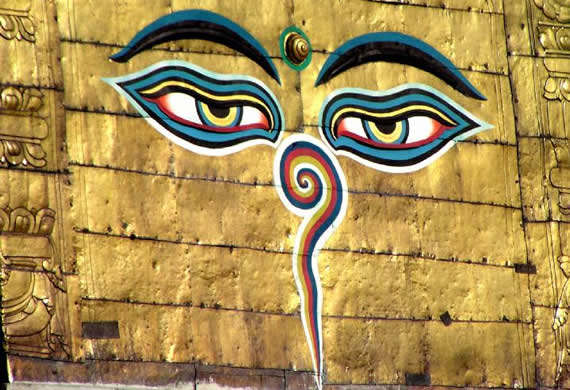
If we actually had the eyes of the Guru, if they could be felt watching us, you know what you would feel like if you had seen that happen.  If you had felt that even for one day.  There would never be an end to your grief.  There would never be an end to the sorrow that you would feel knowing that in the face of the Guru you had made such a stinking offering.

We remain content with our self-cherishing, content with our pride, content with our ego and our hatred and our bigotry and our bad qualities.  We remain content with these while the eyes of the Guru watch.  Because there is no moment that you exist, that you can have a thought, that you are alive in samsara that the eyes of the Guru are not watching. And I don’t mean this like you should think of yourself as a little kid thinking, “Oh no, Mommy’s watching.” It’s not like that.  The Guru doesn’t get mad at you. It isn’t an approval thing. It isn’t like your mother or your father.  It’s that these eyes are like a radiant connection through which we can see directly the primordial nature, which is free of any kind of contrivance and separation and ugliness and superficiality and any of the possibilities that make it likely that we are going to practice any kind of non-virtue.  This nature is so pure that it’s like having the eyes of supreme, unnamable, unspeakable sweetness looking at us always, looking at us with love and compassion.  And we are taking shit and throwing it against the wall and wiping it all over ourselves: scratching and burping and farting and hitting and killing and carrying on.  And yet, these eyes that hold us up, watch us always, even while we, like apes in a zoo, fling shit on them.

And yet, we wonder why it is that we cannot awaken to the Buddha nature.  “When is ‘it’ going to happen? When is ‘it’ going to come from ‘out there?’  How old am I going to be when ‘it’ happens to me?” —  as though it were going to be visited upon you like something air-dropped;  as though it were going to come to you from another city, or another state or another world.  And all the time, we are turning away from those eyes, those loving, perfect pure eyes, that are actually like guiding beams of light, if you can imagine such a thing.

When we turn our face away from the Guru, we are only creating more suffering.  There is no other result that can come from that, no matter what it looks like.  You might say that there are extenuating circumstances.  All right, name them!  I’d like to see an extenuating circumstance that’s going to change what I’ve just said,  because it doesn’t exist.  You might say, “Well, I did my practice from this time to this time and I really tried very hard with my Guru Yoga.  I worked very hard at that and I kept it mindful as much as I could and then, well, you know, you have other things to do.  You have to go work, and you have to go do this, and you have to go do that.” This is the kind of thinking that we have.  Basically, what we have done is, while we were in the state of devotional practice, while we were aware of being in the presence of the Guru, while we were practicing that kind of view, we have only created causes of future bliss and happiness.  The moment we turned away, that act of saying, “Okay, that’s that.  Now on to this” — the moment we said that, we have practiced that non-virtue which has caused us unthinkable suffering in this and every life that we have experienced up until this point. The moment we turn away from the face of the Guru and find “something else”: in that moment we have turned away from the primordial nature that is our nature, and found suffering. The moment that we go on to the next thing, is the moment that we go on to our suffering.  The moment that we move away from our practice into another state, at that moment we have moved away from what causes bliss and moved into what will only bring about more suffering.  This is true even if our activity is just as pure and clean as apple pie.  Let’s say we ended our practice to go feed the baby.  You can’t argue with that.  You got to feed babies, right?  Of course, you’ve got to go feed the baby, but the problem is that you had to turn away from the Guru in order to do it.

Now you haven’t actually figured all of this out yet, but now it’s time to practice so deeply that you understand that it is possible not to turn away ever.  It is possible to be in that space, to be with that face and of that face, to be inseparable, to be constantly in union with that which is union itself, to be inseparable with the Guru. This is the goal!

Why wouldn’t it be the goal?  Is it samsara that you wish to be inseparable from?  Is it suffering?  Is it non-virtue?  Do you like to turn away?  Maybe you like the result, the suffering that comes after!  Of course, now that I say it this way, it seems ridiculous!  Of course, you don’t want that!  Yet, in our practice, in our lives, what do we do?  We offer the five cups of poison.  This is our standard offering, every day. And then we read the text and the text says if we could just offer one butter lamp, we would remain in unmovable samadhi.  And we wonder, “I’ve offered lots of butter lamps!  What is the hold up? What’s the problem?”  I’ll tell you what the problem is.  It’s those five other cups that you offer so much more of than that butter lamp.

Maybe the butter lamp needs to be understood as a symbol, not only as a literal butter lamp on an altar, but like a light in the window, a constant reminder.  When you know that a loved one is nearby and you’re trying to create the connection whereby the loved one would be guided home. In this case, we’re trying to create the connection.  You would keep a lamp in the window, wouldn’t you?  Keep a light on?  Maybe that’s what we need to do. Maybe the butter lamp we need to offer, the one that brings us to immovable samadhi is the light that never extinguishes: the light of recognition.

© Jetsunma Ahkön Lhamo

Astrology for 12/26/2016

12/26/2016 Monday by Norma

Feel like you got up on the wrong side of the bed today? So does everyone. Irritability is paramount and all pervasive, so be on your best behavior. It’s important to follow rules in this Capricornian time; rules are will definitely increase your sense of security, whereas freelance behavior will get you into trouble. Determine who is in charge in every situation, report to that person, follow instructions, and you’ll do just fine. Abraham Lincoln said, “I claim not to have controlled events, but confess plainly that events have controlled me.” What’s good today? Stability in leaders, relaxation, good relationships with those who mean the most to you, and taking it easy.

The astrology post affects everyone differently, depending on individual horoscopes. Look to see how this message reflects your life today!

Practicing Deeply

The following is an excerpt from a teaching by Jetsunma Ahkon Lhamo called “Western Chod”

Westerners, in particular, have this habit. I think it may be somewhat unique to us because our experience is so multiple. We could go into the spiritual supermarket and buy ten different kinds of baloney. That’s the truth. We can go anywhere and get anything. We have so much to look at, so much that we can have, that oftentimes when we’re given a practice and the teacher says to us,. “Turn to page such and such. Read this practice and visualize like this. Then you say the mantra. Then you do the closing prayers. Do some dedication.”  Done. The practice is done. On Wednesday I make out my shopping list, and it’s with that kind of fervent regard, unfortunately, that westerners tend to practice, like we’re writing out laundry lists.  We need this. We gotta have this. We’re going for this. Let’s do it. It’s very much by rote.

I felt that my good fortune was that this practice had to be brought up from the very depth of me. I had to feel it or it wouldn’t work, and so that was my task. To the depth of my being I had to find a way to renounce. I had to face the part of me that was attached and addicted to whatever parts or things about my life that I had that feeling for. I had to face the ramifications if I didn’t accomplish this practice. That meant we all get to die and everything just goes on the way it is. That seemed to me unbearable being as there is so much suffering in the world.

It’s as though I had to reach down in the depth of my gut and pull this up everyday. It was so hard and so rewarding at the same time.  I have to say there are very few practices that I do at this time that match the intensity and the depth and the regard and the beauty that I felt at that time. In some ways it was so natural and so innocent and so total, because I couldn’t stop and go on to the next thing until I had really really accomplished the previous phase. That was the important thing. Unfortunately, we don’t practice, we don’t think like that at this time. That was my practice every single day.

Over the years that practice has made my life much easier.  In a way it was kind of like putting money in the bank for the future. My teachers have instructed me that that practice is called chöd . There is no text to go with it so you couldn’t say it was the practice of chöd as it is written in the text. It has been called by my teachers the essence or essential nectar of chöd. So I have been given permission to continue to practice that way and also to teach others to practice in that way.  My experience has been that it has made my life a lot easier.

 Copyright © Jetsunma Ahkon Norbu Lhamo All rights reserved

WP2Social Auto Publish Powered By : XYZScripts.com