Practicing Recognition

An excerpt from the Mindfulness workshop given by Jetsunma Ahkon Lhamo in 1999

As a teacher, sometimes I’ve had the opportunity to bring a student to task, to say, “Look, you’re all spaced out.  You’re working hard, you’re going through the motions, but you’re not practicing.  There’s no inner practice happening here.”  The first thing that the student will do is get defensive, and the reason why they’ll get defensive is because they’re dancing as fast as they can.  A student will look at me and say, “Well, what the hell do you want?  I’m dancing as fast as I can.  In the way that I understand, I’m working real hard.” I won’t argue that with you, not for a minute.  You’re right. You’re dancing as fast as you can; you’re working really hard; but the difference is you are not practicing recognition.  Even if you spend two hours a day practicing and then you leave it to go live the rest of your life, that is still a state of non-recognition, and you are not truly practicing.

What is required here is a deeper understanding, a deeper awareness, and a more profound grasp of the realities that we are facing.  Once again, our habitual pattern is to say, “Oh, this person is doing this and that person is doing that and that makes this person like this and that person like that.” but the way to practice is to understand that these things we see are the all-pervasive faults of cyclic existence; this person that you’re seeing is like a bee in a jar, just hitting the glass, boom-boom-boom-boom-boom.  Does the bee know what’s going on?  The bee is trying to fly.  The bee is trying to do what bees know how to do, but being in a glass jar, like samsara, all it can do is bash its head against the glass.  There’s no way for that bee to figure its way out.  That is the condition of samsaric beings, and awakening to that recognition is really the only way that we can give rise to the bodhicitta, give rise to compassion.  Otherwise we are simply acting compassionate, which means, “I am the star of the show.”  We are still in that deeply deluded state.  We’re just acting differently, but acting is still acting.

© Jetsunma Ahkön Lhamo

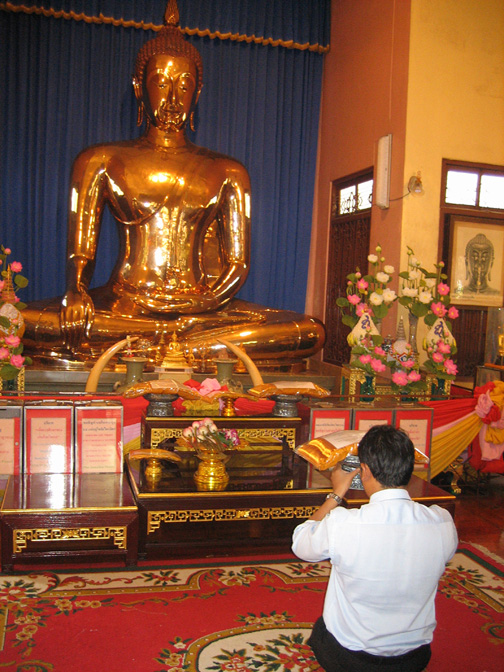
Paying Homage

An excerpt from a teaching called The Seven Limb Puja:  Viewing the Guru by Jetsunma Ahkon Norbu Lhamo on October 18, 1995

Since we find that we are, in fact, in the presence of the primordial Guru at every single moment, what is the posture that we should take?  You should refer to the practice called the Seven Limb Puja.  The Seven Limb Puja appears in many different practices in slightly different variations, but it has certain common denominators, and these should be studied and looked at as a guide of how one should practice now that one is coming to understand that the eyes of the Guru are our eyes; that the heart of the Guru is our heart; that in our nature, that is the nature.  That is the nature, and we are indistinguishable in our nature from that.


Practicing in that way we should think like this.  First of all, in the face of the Guru, knowing that the face of the Guru is always with us, we should practice paying homage constantly.  Constantly paying homage to the Guru, this will antidote our pride, our ego, that habit that says, “Oh, well, look at that!  The Guru has faults.  He or she must be human.” And, of course, that is the statement that keeps you from practicing pure devotion and pure surrender, and the same statement that prevents you from achieving realization.  So this is the antidote that helps you to give rise to that spiritual posture that makes it possible for you recognize the nature of the Guruas the absolute non-dual display of emptiness and luminosity; and to give rise to profound devotion at last, rather than the superficial stuff that we’ve been passing out as devotion.

We practice paying homage.  We pay homage to the Buddhas and the Bodhisattvas; the Lamas are in that number.  The Buddhas and Bodhisattvas are all represented in the Lama.  We should think that we pay homage to the Buddhas because they have crossed the ocean of suffering.  Therefore, they are capable of captaining us across the ocean of suffering.  So we pay homage with that kind of regard, as though we needed to cross an ocean of suffering and the trip is scary and long and hazardous and difficult and so a qualified captain is required.  Otherwise, we can’t make it.  So that is the kind of recognition of the superior quality of the Buddhas and Bodhisattvas, of the Lama.  Recognize every moment, this is a vajra command, that when we think of ourselves in our samsaric state and then we think of the Guru, we should think that the Guru is like a precious diamond, beyond compare, because the Guru is capable of helping us cross the ocean of suffering. We cannot do that ourselves.  That will antidote the kind of pride that we have when we try to put ourselves above everything, in subtle or gross ways, whatever it happens to be.

© Jetsunma Ahkön Lhamo

The Two Eyes of Your Practice

An excerpt from the Mindfulness workshop given by Jetsunma Ahkon Lhamo in 1999

Guru Rinpoche himself said, “I will appear as your Root Guru,” and that appearance is to be recognized.  It demands to be recognized.  One of the reasons why I harp so much on reciting the Seven line Prayer is because the Seven line Prayer is a prayer, the blessing of which creates the capability of seeing the Guru in all things, and of following the Guru and of practicing in such a way as to discriminate that absolute nature.  The nature of that prayer is to begin to awaken our inner psychic channels and to bless our psychic channels and winds and fluids in such a way that everything within us that is the Buddhanature begins to awaken.  That’s the power of that prayer, and it is done through the practice of recognizing and discriminating what is extraordinary.  In order to provide for that kind of recognition, we have to put a lot more effort into that aspect of our practice than we have up until now.

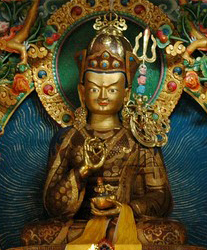
Maybe I am giving you the impression that it’s all about Guru Rinpoche.  For me it is, but maybe that’s because I’m lucky enough to have had enough teachings to have an understanding of Guru Rinpoche’s nature.  When we talk about the nature of the Guru, we are talking about the perfect mating of wisdom and compassion, of emptiness and appearance.  When you see the image of Guru Rinpoche, you always see that staff crooked in his arm, and that is the symbol of his consort.  It indicates that the Lama is never separate from his consort, and the meaning of that is the non-duality and union of emptiness and appearance, of wisdom and compassion, or bodhicitta.  That is the meaning of that union of Lama and consort.  So Guru Rinpoche is always seen that way.  We are to understand from that, then, that His nature is the perfect union of wisdom and bodhicitta, of the view of emptiness and the understanding of the display of appearances.  That is Guru Rinpoche’s nature.

That being the case, we have to find a way to not only recognize the physical form of the Guru, the picture that looks like Guru Rinpoche or the picture that looks like your teacher.  We really have to get past that and go into a deeper sense of trying to awaken and potentiate our own meditation, our own understanding, of the nature of emptiness and of the nature of appearances.  We have to begin to potentiate and practice and meditate in such a way that we see wisdom and compassion as being like the two eyes of our practice.

Click here for a teaching on the Seven Line Prayer and audio files of Jetsunma chanting the Seven Line Prayer.

© Jetsunma Ahkön Lhamo

The Silent Chant

An excerpt from a teaching by Jetsunma Ahkon Norbu Lhamo on October 18, 1995

We are talking about the Lama as being our own precious nature.  Someday when we die and all the elements fall away, what will arise naturally is the natural state, free of contrivance.  And they say for the practitioner there is realization, simply because, the practitioner that has meditated properly will recognize that natural uncontrived state as the very primordial mother from which they have sprung.  And like a child who has been separated from his mother for a while runs to the mother with happiness and joy, and practically rips open his heart, and sits on the mother’s lap and doesn’t wish to separate from the mother at all —  like that, if we are meditators, we will run to that nature.  We will recognize with fervent regard, but so much more than that.  I don’t even have the words.

Here in our lives, due to the force of our fortunate meritorious karma that we have accumulated in the past, when here in this life, that same uncontrived nature, that same pristine quality appears in samsara to speak to us, to see us with its eyes, to hold our hand, to teach us how to practice, and how to recognize in our practice, we’re drunk, light in the head, stupid.  We can’t care, we can’t get it together.  Our minds are just weak that way.  And yet, even with all of that, even with all of our terrible practice, we are still hoping that when we die and those elements that make up our samsaric existence begin to disintegrate and fall away that somehow, magically, we will recognize the primordial wisdom nature.  Boy, are you thinking like Peter Pan!  That’s what I call magical thinking.  The only way it is going to happen is if we can begin to recognize that nature now.  And the only proper way to recognize the nature of the Guru is to simultaneously recognize our own nature as well, and to know that they are indistinguishable.

It is not possible for us to look at the Guru and find fault, because that would mean that we are acting with samsaric intention, with samsaric mind, and the result is samsara.  There is no practice there.  That is nothing.  You do that all the time.  You do that every moment.  That’s not practice.  But if we think and practice in the way that I’ve just discussed with you, then instead, when we see the Guru we see literally the face of salvation.  We see literally:  “I am that.  That I am.”  Even though, of course you can’t say “I.”  “I” separates us, but in the beginning, we have the intention of understanding: that is the nature that is my nature also.

And so inside — instead of judgment, hatred, greed, ignorance, jealousy, pride — there is a soundless chant that says, “Holy holy holy.” and that is the practice.

© Jetsunma Ahkön Lhamo

The Nature of the Teacher


An excerpt from the Mindfulness workshop given by Jetsunma Ahkon Lhamo in 1999

The most important thing you can do to develop spiritual discrimination is to elevate the Root Guru. The Root Guru is the source of how you have come to the path, is the root teacher who gives you the preliminary teachings, is the one who hooks you onto the path.  For these reasons you elevate your teacher in such a way that you begin to awaken.  You are not awakening to the appearance of the teacher, but to the nature of the teacher.  Again, eventually, you will be able to see, not your own appearance, but your nature, and that’s the goal here.  That is the point of practicing Guru Yoga.  Otherwise no one else would care, because certainly the Buddhas and the bodhisattvas don’t need it.  They’re happy the way they are. The Lamas offer themselves to be used in that way. We have this extraordinary opportunity.  So it behooves you to accept that offer and use the Lama.  It behooves you to take the opportunity to see that this is the appearance of Dharma in your mind, of Dharma in your life, and to lift it up within you in your mind. Lift it up and see it differently from the other ordinary things that are in your life and be able to distinguish that.  You want to be able to get past the point where you say, “Well now, I like this about the Lama; I don’t like that about the Lama; I do like this about the Lama, I don’t like this about the Lama, blah, blah, blah.”  That’s what you’re doing about everything.  That’s what we do about each other and, most of all, about ourselves.  This mind training is meant to wean us away from that kind of conceptual proliferation.  It is meant to allow us to begin to taste the nourishment of pure View.

Those who have known me for any length of time know that my practice is all about Guru Rinpoche.  There are many reasons for that.  One is that I have a strong connection with Guru Rinpoche. That’s my great fortune and my great blessing.  In my mind and in my heart, there’s nothing else.  I don’t see anything else.  I’m not saying that I’m a great practitioner, but I’m giving an indication as to how this could work and what kind of formula we can develop in our own practice and in our own quest for mindfulness.  When I think about my practice with Guru Rinpoche, I look for him everywhere.  I look for the speech, for the method, for the intention of the Guru everywhere.  My experience has been that when I ask Guru Rinpoche for help, for receiving strength, receiving health, receiving whatever it is that I need in order to be strong enough to be of benefit to others, it is always there.  Even though I haven’t had the training from childhood that many other Lamas have had, when I ask Guru Rinpoche for help, it is always there.  There have literally been times when I have not known what my class was going to be about until I got there to teach, and sometimes those are the best classes, because I know that I am nothing but a vessel that Guru Rinpoche’s blessing simply pours through.

We are not talking about being falsely humble.  Remember that when you do prostrations, you always get up.  We don’t lie on the floor for hours!  We get up, and the reason why we get up is because that’s what’s supposed to happen.  Through prostrating the body, through practicing this with body, speech and mind, it is our nature that rises up.  The ego gets laid down.  We lay that down, and the nature is what rises up.  Symbolically that’s what’s happening with prostrations.  It’s all about learning to have View in a different way.

© Jetsunma Ahkön Lhamo

The Challenges of the Contemporary Disciple

The following is respectfully excerpted from “How to Follow a Spiritual Master” edited by the Ngagyur Nyingma Institute:

We have tried above to show the deeper meaning and role of a Spiritual Master, as well as the way in which he should be sought and followed, by first looking at what dharma means, how it came into this world and further in Tibet; we also looked at a summary of the extensive teachings given in both sutras and tantras about the Master and disciple relationship.

We saw that we do not only have to carefully examine a prospective Master, but we also have to fundamentally alter our outer and inner behavior to be able to benefit from his presence, Teachings and Blessings.

Today, moreover, we are living in what is known as the degenerate times, presenting us with additional challenges, as well as making the rare opportunities to meet and be guided by an authentic Teacher even more exceptional and precious.

Why is this period we live in called degenerate times? Prophecies abound about the particularity of our times and its struggles, yet it is very difficult for us to recognize or acknowledge this, because this degeneration of times is rooted in the thickening of our own obscuration and deepening of ignorance with the inevitably correlated narrowing of our mind’s horizon.

How can it be so, we may ask, when most people are talking about a general progress and improvement? Well, if we examine the nature of the so-called progress and the apparent increase in personal freedom, we will soon realize that these, indeed, only relate to the pursuit of external goals. By this we count on an increase of material wealth, improvement of facilities- albiet for some part of the world only; people are becoming more eager to speak their mind, believe in their own ability and strive for the betterment of their physical surroundings. This however does not occur without a cost, that we are not prepared to examine.

Improving material wealth happens at the cost of the environment both physical and social, whereby those in pursuit of this goal will sacrifice anything to achieve success, family, values and traditions which are reminding us of the impermanence of people and things,  the need to remind ourselves of the cycle of suffering and death. Instead they put these considerations to the side and engage in a frenzied chase without ever seeing a satisfaction to their desires and perceived needs.

Young people are demanding more freedom and responsibility, refusing to listen to older generations experiences, believing they know better than their parents or teachers and thereby unleashing an unrestrained flow of conflict, suffering and quarrels among families and social groups. As such generations succeed each other, less moral values, understanding and compassion are to be found, since they are systematically uprooted from the children both at home and in school.

It is therefore very difficult for us these days, even if we have the fortunate karma to meet with an authentic Spiritual Master, to be able to follow him according to the advice we are hearing. The values of respect and service are alien to our western society and appear old fashioned and obsolete. The habits we have acquired from our social surroundings are so strong yet subtle that they reflect the narrowing of our ability to reflect on the benefit of such advice and form layers of obstacles we have to work hard to recognize and eliminate.

Furthermore, we have the innate tendency to want to see results there and then, even before understanding what the situation really is and what is needed to remedy to it. We listen superficially to a little bit of advice, may be, if we have time try to apply it over breakfast, and by lunch time complain that we have seen no improvement; by evening time we are demoralized and go to the pictures to console ourselves.

This certainly cannot work and does not reflect any understanding of how long habits have taken to form. Like ruts, we now unconsciously follow them and Masters warn us over again that overturning them is not an easy matter, which can be accomplished overnight. Methods to do so exist, but what we lack is the sustained determination to apply them at any cost and the real concentration to do so. This sustained determination, this unfailing courage we are exhorted to develop are the fruits of both inner reflections on the Teachings we receive from our Masters as well as the unshakable confidence in their validity, born out of faith and devotion.

So although the texts describe in great details the preciousness of our human life, the only form of existence, which allows us to free ourselves from the cycle of Samsara, through meeting with the dharma and authentic Masters, we act as if we could waste this life in trivial pursuits with impunity. Although we do not know when the moment of death will occur, we act as if eons are in front of us to enjoy, and when death strikes, we are just as helpless and lost as any other, wandering without realization in the bardo and rushing indiscriminately into the next samsaric rebirth.

To benefit from having sought, found and to follow an authentic Master correctly, we must therefore unfold vigilance and courage as never before.


A Mind of Compassion

An excerpt from a teaching by Jetsunma Ahkon Lhamo from the Vow of Love series

If you’ve never practiced the Buddhadharma before, or if you’re interested in practicing, or if you have practiced some general meditation and you feel it’s time to move on to a path that is more stable or well known, then you’re in a perfect place for this teaching. You can start practicing one of the most important teachings of the Buddha right now. You can begin to cultivate the mind of compassion. How might you do this? First of all, you might look around and examine physical existence.

In America, we hide our suffering. We have very little knowledge of real suffering, and I think that’s one reason why it’s very difficult for Westerners to practice a pure and disciplined path. We think we understand suffering because we have experienced loneliness, or because when we were kids we had the measles, or because we have gone through marriages and divorces. Or maybe we’ve seen some sickness or poverty. For these reasons, we think we understand suffering, and we do to some extent. These are valid sufferings.

But there’s a funny thing about our culture that we must understand. We are actually hidden from the sufferings of our culture. When people are deformed, handicapped, mentally or terminally ill, they are taken away from the mainstream of society and they are hidden. Or if we are considered unpresentable to most people, we have plastic surgery or we have some kind of therapy that makes us like everyone else. In fact, if we examine the healing process in American medicine, part of that process is to become like other people.  We are made to look like other people.

In other countries around the world suffering is more evident, for many different reasons: those countries may not be as technologically advanced as our country, or their culture may be an older society in which suffering has become more the norm and it is not such a shock to see it. Or perhaps poverty is a factor.

I will describe how I felt when I first went to India. I couldn’t bear it. I don’t claim to be so compassionate; I too have to cultivate the idea of compassion every day. But I remember seeing people walking the streets with arms and legs missing, eaten up by leprosy. I saw mothers and fathers maim their children, not because they hated them or because they were cruel to them, but because that would give them a deformity they could use for begging. That would be the only way they could ensure their survival. There was no other way for them to get food. What do we do for our children? We might send ours to school. In the streets of India, they have to prepare them in a different way.

Suffering is a part of the fabric of the society in India, and it’s very evident. I remember walking down the street in Delhi. There was a young boy who must have been twelve; it was hard to tell, he was so small. He was lying on a rag, a tattered blanket, and he was dying. He was so thin that he looked like the pictures of starvation we see from Ethiopia. He was beyond thin. His bones were sticking out, his belly swollen, his tongue hanging out. And next to him were a few coins and a candy bar. Someone had thrown them down for him.

We don’t see that in our culture. We don’t understand it. We think that the things we’ve gone through – the divorces, not being able to pay the light bill, the heartbreak of psoriasis, the things we consider so awesome – are the real sufferings of the world. But they are not all the world has to endure.

Look at the animal realm. We know what our animals are like. They get fed everyday and they have it pretty good. But not all animals are like them. If we go to different countries, we see beasts of burden that are treated in horrible ways. We see animals that are denied their natural environment.

Humans and animals are only two life forms. According to the Buddha’s teachings, there are many different life forms, many of which are non-physical. How we appear, how we manifest, what form we take has to do with the qualities of our mind. If we are filled with hate, we are reborn in a hell realm. Why is that so hard to understand? When you are filled with hate now, even as a human being, aren’t you in your own private hell? Have you ever gone through a period where you were so filled with anger that everything you saw became ugly and you managed to distort it somehow? Each of us has lived in a private hell. Why is it so hard to believe that we are capable of living in or creating a situation like that? If your mind is capable of having a nightmare, then rebirth in a hell realm is a possibility.

Have you ever been needy? Have you ever gone through a period in your life when you needed approval, or love, or some kind of nourishment so badly, that you were in a state of despair? When people did reach out to you, they couldn’t get through? Each of us, for at least one moment in our lives, has experienced this. Why then is it so hard to understand that these kinds of existences really do exist?

Having understood that this is logical, having examined your own mind truthfully – and truthfully is the key – and found the residue of these experiences in your mind, you can allow yourself to go more deeply into the recognition that the Buddha was right. There is suffering in cyclic existence.

We have to think also of our own suffering. We must think that even if we have a TV, a car, a house, and all of the things that we are taught to desire, there will be a point at which we cannot take them with us. There will be a point at which they will do us no good. That point, of course, is death. All of the efforts that we’ve gone through to get those things will have been wasted.

Long-time Dharma practitioners may think, “I really wish she’d get on with it. I know this.” I have to tell you, if you really knew the truth of suffering, there would not be one moment that you did not practice with the utmost compassion. There would not be one moment when you thought only of yourself and your needs, and of the temporary gratifications you think you must have. Yet you still have many of those moments.

© Jetsunma Ahkön Lhamo

Seeing As The Buddha Sees

Palyul Refuge Tree

From The Spiritual Path:  A Compilation of Teachings by Jetsunma Ahkon Lhamo

You do not see as the Buddha sees, with a mind that is natural, uncontrived, and relaxed. You do not know the natural state—your own Nature that is beneath the conceptualizations you force upon it. In essence you are the same as the Buddha. Why does He see Buddhas and Bodhisattvas without number, and you do not? Why is the Buddha’s mind free of action and reaction? The difference is one thing only: the concept of self to which you cling.

The concept of self is the effortful contrivance that results in all forms of suffering. Once your “self” is established, it is vulnerable to termination. It now has a beginning; therefore it will die. A tension arises. As a baby, you cried when you were hungry, and your mother probably responded. If she did not do so immediately, you sensed a threat to your survival. If you smiled and cooed, perhaps your mother paid more attention. You tried to protect the fabric of self. You began the long process of learning to attract, to have power over, other people. You developed tendencies to dominate, to be submissive, or to survive in other ways.

These habitual tendencies take time and effort to perfect. They become part of the fabric of our being. We call them our individuality and take pride in them. These subtle, habitual tendencies will stay with us over many lifetimes—unless they are somehow purified from the mindstream. In fact, the longer we accumulate assumptions about the self, the more deep-seated and complicated these subtle tendencies become. Ironically, those who pride themselves on their uniqueness and individuality are often in the most trouble. For even though the brain and the personality end at death, the karma remains. In fact, every moment of the perception of self has within it enough seeds for eons of cyclic existence. And these seeds have only to be watered by certain kinds of activity to ripen.

The original tightness or tension that accompanies the concept of “I-ness” is desire. This is why the Buddha taught that the basic cause for all suffering is desire. Some think that because they have learned not to desire a mate or a car or money or beauty, they have become true renunciates. They think they have overcome desire. They could not be further from the truth. Desire is simply too pervasive. It is what holds the concept of “I-ness” together. This concept becomes as invisible and familiar as the air we breathe. Everything we do supports and maintains our ego. It is only in the enlightened, realized state, with natural, uncontrived view, that activity is spontaneous, free of conceptualization, and therefore free of tension.

You, however, cling to your contrived thoughts, and the odd thing is—you love them. You are fascinated with the activity of your brain. You enjoy being opinionated. You love the excitement—so you think—of the tension that surrounds conceptualization. Every perception you have is made of tension born of desire.

Why is it so difficult to annihilate desire from your mindstream? You desire desire. Otherwise, you could snap your fingers and say, “I am through with it.” Why do you desire? Because you have so much investment, such a strong belief in your “I-ness” that your primary religion is not Buddhism but the preservation of your ego. That is your gut-level religion. You make offerings to it every moment. You take refuge in it every moment. The preservation of your ego and all the assumptions that go with it have been the love of your life, your soul mate.

How then can you even conceive of being free of desire, much less manage it? You may hear the teachings of the Buddha and want to be free, but another part of you is absolutely in love with yourself. And you love to be in love, so you are helpless. This is why the powerful Vajrayana path is so necessary and efficient. It would take extremely long to purify your mindstream by progressively renouncing every thought, every activity that increases desire, until you are basically doing nothing but watching your breath and annihilating every assumption and tension as it comes up in your mind. The Vajrayana path will do that, but it has another dimension: you purify your entire view. The five senses are purified through generation-stage practice. In it, you are not imagining a deity; you are not pretending it is there; you are not even visualizing. Certainly that may be where you start, but when it is done correctly and the skill of concentration is fully developed, you are actually disassembling and re-manufacturing the incorrect perceptions that permeate your every thought, word, and deed.

© Jetsunma Ahkön Lhamo

Examining Cause and Effect in Real Life

The following is an excerpt from a teaching by Jetsunma Ahkon Lhamo called “Bringing Virtue Into Life”

You may have been born rich, or perhaps during the course of your life it has been relatively easy for you to make money, gain riches. Or perhaps during the course of your life, at some point you have inherited riches. And you wonder to yourself, “How is it that I hear about the starving poor and yet I, who wasn’t even hungry in the first place, have inherited this money, or I have this money? How is it?  It would seem as though I am completely undeserving.  How has that happened?”  You wonder about that.  “Why is it easy for me to make money?”  Well, the reason why it is easy for you to inherit that money or to make that money is because some time in the past you have earned it; and the way that you have earned it is by engaging in virtuous activity concerned with generosity toward others.   If you have given food to others, in this life you always have enough to eat, and more.  In fact, the problem is not eating too much.

So then, if you have a lot of money and things have been pretty comfortable for you, then sometime in the past you must have been very generous toward others, and your big problem in this lifetime is not how to make money but how to spend it, or not spend it.  In that case, you deserve everything that you get.  You deserve all of it.

Now, in this lifetime, if you just take that money and express through it no acts of generosity,… Let’s say maybe you keep it in your family to make sure that your children are provided for.  Well, that’s a kind of generosity.  You did give some to your children, but that isn’t real generosity, because children are kind of like an extension of our own ego.  We think of them as part of us.  We don’t think of them as being separate from us. We like our children to be rich because it’s a good reflection on us and it makes us die happy.

But let’s say in this lifetime, although you have lots of money, you haven’t really given any to benefit others.  You haven’t helped others not to be hungry.  You haven’t given it to children that don’t get any toys as Christmas.  You haven’t made any offerings to the temple where you receive all your spiritual benefit.  You haven’t done anything with your money.  If you think then that you’re going to somehow be able to legally make it happen that they’ll find you in your next incarnation and give you back that money,… Au contraire, monsieur.  You can’t take it with you.  It’s not going to appear again in your next life.  Forget it!  It’s not going to happen.  But in your next life you will probably be born much poorer because, even though you had the money before, you were not very generous.

So it’s very, very clear that cause and effect are interconnected.  In fact, the Buddha teaches us that they arise interdependently: When the cause arises, the effect arises at the same time, but in seed form.  Think about that.  Think about that the next time you have non-virtuous behavior.  One of the reasons why it’s so easy to be non-virtuous is because you think, “Well, O.K., I’m being non-virtuous now, but I don’t see the effect rising yet.  So maybe they…(Who are they anyway? We don’t know.) they’ll forget about it. “ You know, the guys with the x’s and the checks. They’re up there.  They’re sitting on the throne. You know, the guy with long beard.  Maybe he’ll forget about it by then.  But in fact the Buddha teaches that, number one, there is nobody with a book up there, or a beard. And number two, when you give rise to the cause, the effect is already born, and you will experience it.  You will experience it.

Copyright © Jetsunma Ahkon Norbu Lhamo.  All rights reserved

A Teaching on the Four Immeasurables

The following is respectfully taken from “How to Follow a Spiritual Master” edited by Ngagyur Nyingma Institute.

The following story of King Tsangpa Lha (Brahma Deva) and his son Gyaltshab Dhampa provides insights into the way bygone great practitioners have followed and practiced with their own Masters. The Prince was seeking dharma teachings but could not find any, feeling very saddened. Indra, the King of Gods knew clairvoyantly the mind of the Prince and assumed the guise of a Brahmin. He came to sit near the gate of the palace announcing he could give teachings. The Prince came to hear about it and requested them. The Brahmin answered that he would give teachings if the Prince were to jump into a deep fire pit and then make offerings.

The Prince accepted without hesitation and set about digging the fire pit at the dismay of the The King, Queen, Ministers and courtiers. Yet the Brahmin maintained his condition and the Prince his resolve so all was set for the Prince to jump. All his subjects requested him to abandon the idea to which the Prince replied, “I have been born in Samsara countless times and taken rebirth in higher realm of God and humans. There I have suffered under desire, in the lower realm I had undergone immense suffering. All to no avail and further I have never sacrificed my life in order to receive Teachings. Now I am going to offer this impure body. Please do not hold me back and alter this pure motivation in order to achieve enlightenment. I will give you the Teachings as soon as I have gained enlightenment. The subjects saw that the Prince was very determined and they could not press the matter further.

The Prince was ready to jump staying close to the pit as he spoke to Brahmin. O great Teacher! Please give me the teachings now as I may die and not be able to receive them from you. Then the Brahmin gave the following teachings on the Four Immeasurable,

Practice loving kindness,
Abandon anger
Protect the beings through great compassion
Shed tears of Compassion
With all sentient beings never to be separated from happiness
and the causes of happiness
By protecting all the beings through great compassion
You will become a genuine Bodhisattva

As soon as he finished these teachings, the Prince jumped into the fire pit. Both Indra and Brahma held him back holding him on both sides from falling into the pit. They said, “You are the Protector of beings who is very kind and compassionate. What will happen to your subjects if you jump now? It will be like the death of our parent.” The Prince replied, “Don’t hold me back from entering the path to Buddhahood, and all became silent as the Prince jumped into the firepit.

The earth shook and the Gods in the sky lamented shedding a shower of tears like rainfall transforming the firepit into a lake at the center of which the Prince stood on a lotus and the Gods showered flowers to praise him.

WP2Social Auto Publish Powered By : XYZScripts.com