Revealing the Hidden Faults: by Longchen Rabjam

The following is respectfully quoted from “Drops of Nectar” compiled by Ngagyur Nyingma Institute:

Vajra Song:

Instructions for Rousing Myself: Longchen Rabjam

Namo Guru Bhaya! Feeling truly wearied by the worldly experiences of myself and others, at Orgyen Dzong, I, “The Yogi of Various Kinds of Self-Liberation”, Longchen Rabjam (1308-1363), roused myself with this song of advice.

Chapter 1
Revealing the Hidden Faults

The great ship of the primordial wisdom of vast compassion
Liberates all beings without exception from the ocean of cyclic
existence.
I bow to the feet of the glorious protector, the sacred guru
Who has gone to the precious continent, peaceful and
immaculate.

The ocean of samsara is extremely difficult to cross;
With its raging waves of birth, old age, sickness and death.
It is hard to escape from the boundlessly deep.
To you confused ones who are floundering here I offer these
suggestions from my heart!

Without applying these suggestions to dig out hidden faults,
There will be no time to cast off all your unwholesome
behavior.
Without looking back into your inner mind,
There will be no time to see your negative faults.
Therefore, today I offer these suggestions from my heart!
Keep this in mind. It is beneficial spiritual advice.

Even if you live in solitude, you can become more accustomed
to depending on others;
If you are not free from the eight worldly concerns and the
distractions of this life,
You can become someone who appears to benefit others while
pervertedly benefiting himself.
Consider whether you can get by with such conduct!

By abiding in solitude, the Victorious Ones of the past attained enlightenment
And even former practitioners of the dharma achieved
accomplishment,
But you are completely distracted.
Consider whether you can get by with such conduct!

Not recognizing all material wealth, fame, glory, and valuable
possessions as magical illusions
And deceptive obstacles to accomplishment,
It’s like you are receiving something from one person and
giving it to another.
Consider whether you can get by with such conduct!

Not recognizing as manifold demons of distraction and illusion
All kinds of business with many different people,
you think that babbling platitudes about the dharma will
benefit others.
Consider whether you can get by with such conduct!

Being uncertain about exactly where you are heading,
You gather material wealth, build castles on dung heaps and so on.
Reckoning that you will live there forever, you take illusory
appearances to be real.
Do you think such conduct will suffice?

Failing to tame and stabilize your own mind,
But hoping to tame and stabilize the minds of others,
You will experience incessant suffering and torment.
Do you think such conduct is good enough?

Never applying yourself to the actual essence,
While day and night making great efforts for this life is a great mistake.
Such childish and imprudent ones are objects of the noble
beings’ smiles and laughter.
Consider whether you can get by with such conduct!

When a group of many aimless ones have gathered,
Distracted teachers and students fetter one another.
This is like making an aimless search for a guesthouse.
Clinging to never-ending appearances of magical illusion
As happiness and bliss, you lose the enlightened path to liberation
And feel no weariness toward cyclic existence.
Do you think such conduct is good enough?

This year is the dwelling ground of the Female Fire-Hog,
And twelve years from now will be the ground of the Male Iron-Dog, when
Foreign invasion is prophesied. Yet you make no effort to escape.
Do you think such conduct will suffice?

From all directions, war and strife will increase,
People will become intolerant and there will be many types of destruction,
But you are not trying to find the precious hidden land.
Consider whether you can get by with such conduct!

Even if you always perform good deeds without deceit,
Since there won’t be time to complete this, both inside and out,
The foundation of purposeless suffering will be uninterrupted.
Do you think such conduct is good enough?

Remaining in solitude in the mountains, but acting like you
were on the edge of a city,
Accustomed to countless meetings and gatherings,
You become completely careless and your occupations never end.
Consider whether you can get by with such conduct!

Although you mentally renounce this life, you cannot let it go;
Although you dismantle deluded ego clinging, it doesn’t fall apart;
Even remaining alone in the mountains, you’ll find no occasion for solitude
Do you think you can get by with that kind of conduct!

Although with words you talk about needing nothing, you
pursue food and clothing;
Although you speak of the impermanence of life, you’re still
not mindful of death;
Even remaining in solitude to practice, you’re still distracted by
entertainment.
Consider whether you can get by with such conduct!

Despite talking about the delusion of ordinary life, you chase
the eight worldly concerns;
Despite talking about the pointlessness of illusory appearances,
you still find a lot to do;
Although you say all things are equal, you maintain your partiality.
Do you think that kind of conduct will suffice?

Even if you sit down to accomplish the natural state, present
worldly concerns deceive you;
Even practicing the Dharma of your own free will, external
influences mislead you;
Whatever you do, day and night you are beguiled by illusion.
Consider whether you can get by with such conduct!

Although you ponder everything, this is not the essence.
Whatever you do lacks meaning and is a cause for suffering.
Abandon everything in an empty place without people.
If you could go today itself, this would be best!

Since there is nothing nearer than oneself,
I give this useful advice out of pity,
Listen, you virtuous-minded one who desires liberation!
If you heed these suggestions it will always be virtuous!

At the outset, the virtue is to abandon your present worldly activities.
In the middle, the virtue is to discard entertainment in solitary retreat.
In the end, the virtue is to achieve exhaustion in the natural state.
Ease in this present life and happiness in the future is the
intention of this advice!

I compose this advice by myself and for myself
To encourage others as well I offer this instruction.
It will be excellent if both others and I listen carefully!
Please pursue this excellent permanent aim from today!

From the Vajra Song of Instructions for Rousing Myself, this completes the first chapter of exposing one’s hidden faults.

Wonderful News! KPC is Open 24/7

TK-254_Saga Dawa_6-9-09-11-M

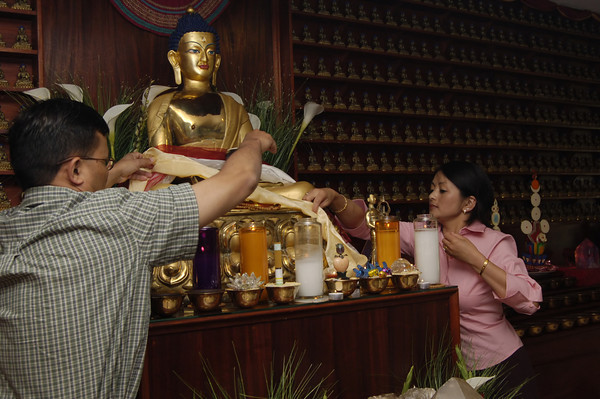
KPC has wonderful news! In a meeting with the Interfaith Advocate from Montgomery County, we were informed that we can open our doors, that visitors can come and go, taking advantage of the many blessings the temple has come to offer. The Prayer Room will be open 24 hours a day, 7 days a week once again for ANYONE seeking a place of spiritual refuge. You will be welcome to meditate quietly or pray, and take in the wealth of blessings offered by the statues, thangkas and crystals.

Not all functions of the temple will be able to continue until we are able to navigate the permitting process of Use and Occupancy and make the necessary renovations to ensure public safety and accessibility, but for those who have come to count on KPC as a place of peace, refuge and blessings the doors will once again be open to all regardless of faith.
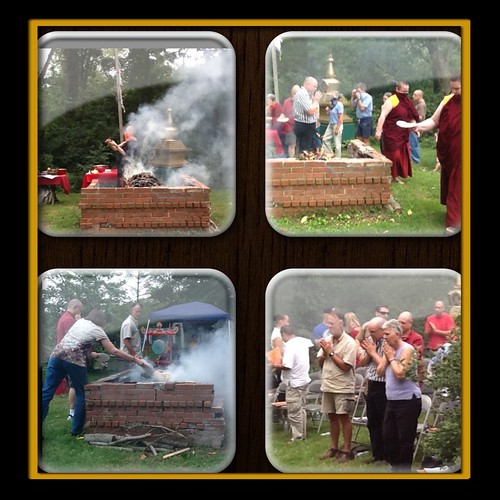
We cannot hold events inside the temple, but will continue to offer events outdoors in order to continue with KPC’s mission of offering the Dharma. In just a few weeks KPC will host Khenpo Norgay who will be offering teachings and empowerments associated with Phowa, a powerful Buddhist practice to prepare for the time of death. Though this event will be held outdoors, KPC will do it’s best to ensure you are comfortable while enjoying this precious opportunity.

Please continue to support us in our effort to come into compliance with the county. The renovations required to ensure the safety of all will require everyone’s ongoing support, as they will be very expensive. Please donate. Meanwhile, all are invited to come and partake of the many blessings of KPC.
To learn more please visit: www.tara.org

Fully Awakened Glorious Dharma Continent of Absolute Clear Light

The following is respectfully quoted from “Reborn in the West” by Vickie Mackenzie:

The journey to Poolesville, Maryland from New York had taken almost four hours. First one of those silver cigar-shaped trains from Penn Station in downtown Manhattan to Washington, D.C. Then a modern automatic train to Poolesville, green and lush, in the wealthy outskirts of the nation’s capital. I had had much time to ponder.

I recalled how, several years previously, I had read in a newspaper about a woman who had been recognized as a Tibetan tulku and who had run prayer vigils for world peace. That was the sum total of all I knew. Somehow, this small snippet of information had lodged in the outskirts of my brain, to be called up when the notion of this book appeared. Now, on the train rattling down the eastern seaboard of the United States, the idea of meeting a woman Western tulku beckoned alluringly. This, after all, was a rare commodity indeed: a female who had been granted the highest spiritual accolade and authority within the overly masculine world of Tibetan Buddhism. And a Westerner at that. Tracking her down, however, had not been easy. I had not been able to remember her name, and since her official enthronement in 1988 she had kept a very low profile. Through various Tibetan contacts in the USA I finally found her. Her name was Jetsunma Ahkön Norbu Lhamo, and she had a centre just outside Washington.

Over the seventeen years I had been visiting Tibetan Buddhist centres I can honestly say I had seen nothing like the one that was about to greet my eyes. It glistened in the sunlight, a grand, two-story white house fronted by six vast white pillars, looking for all the world like an exclusive country club. I reached this imposing edifice by means of a winding drive flanked with rows of tall flagpoles, immaculately manicured lawns and flower beds. Glancing up to the roof, I saw the first sign of the place’s true identity–two golden deer supporting a golden Dharma wheel, the national emblem of Tibet. And there, written large on a sign near the entrance, was the equally foreign name: Kunzang Odsal Palyul Changchub Chöling. Since its English translation was even more of a mouthful–the Fully Awakened Glorious Dharma Continent of Absolute Clear Light–it was called by its inmates simply ‘KPC’.

If the exterior was impressive, the inside was breathtaking. A large central staircase swept up from the central hall to the upstairs rooms, and the whole place was carpeted wall-to-wall in beige. But this paled into ordinariness when I entered the two gompas, without doubt the most beautiful shrine rooms I had ever seen. They were crystal palaces–around the walls was an extraordinary array of huge crystals, strategically placed on plinths and individually lit, like museum pieces. It was, I was told later, the biggest crystal collection outside the Smithsonian Institution in Washington.

The first gompa, where the teachings and ceremonies take place, was hung with royal blue and gold curtains and furnished with fine chairs for those who could not sit cross-legged on the floor. The throne for the teacher stood under a canopy of red, gold and royal blue. In the middle of the room was a huge mandala, surrounded by golden stupas at the base. Against one wall was a statue of Padma Sambhava, the founder of Buddhism in Tibet, and in front of it was the biggest solid round crystal of all. The effect was extraordinary–a cross between sumptuously exotic Western drawing room and a magic Eastern temple. It occurred to me that no man in Tibetan Buddhism would ever have had the courage to produce such a place of worship, let alone envisage the concept. It managed to break all bounds of convention, and yet remain unmistakably a gompa of Tibetan Buddhism.

The second gompa was even more fabulous. This was the prayer room, lit by candles, where the twenty-four-hour vigil for world peace still goes on. In the semi-light I picked out yet more gigantic crystals, individually glowing, and the impressive sight of a wall lined with 1,002 small Buddha statues standing neatly row upon row, like sentinels watching over the holy activity taking place before them. I had seen such sights in Tibet, where entire walls are painted with thousands of Buddhas turning black with accumulated grease of millions of burning butter lamps–but nothing could match the pristine splendor that Jetsunma had created in here in the Poolesville countryside. Turning round to view another wall, I saw an equally amazing spectacle–a display of of twenty-one golden statues of Tara, the female aspect of the enlightened mind which represents fast, effective action; they stood in tiers, like some beautiful female spiritual court. It seemed an accolade particularly appropriate here. With a solitary monk sitting on his cushion sending out prayers for universal harmony and compassion, and the taped voice of Jetsunma herself crying out her haunting invocation for the Buddha to be present, the room vibrated with spiritual power.

Who was the woman who had created all this? Jetsunma Ahkön Norbu Lhamo walked into the upstairs sitting room emanating warmth, a discernible kindliness, a bubbling vivacity and, it has to be said, in appearance at least, a middle-of-the-road American ordinariness. She was dressed in a straight-cut beige skirt and top and was wearing make-up and fashionable dangly earrings. Her fingernails were long and painted, her dark brown curly hair was shoulder-length and wild. She was tall, rounded and in her early forties. Nothing gave away her unique status except for the mall–a string of prayer beads–which she played with constantly in her hands; that and the fact that, with her dark, slightly almond-shaped eyes, her slightly down-turned mouth and the general shape of her face, she had a distinctly Tibetan look about her.

I learned that she was, in fact, a walking example of curious contradictions. In the modern Western way she had been married and divorced, more than once. She was the mother of three children–two sons, now in their twenties, and an adopted girl aged five. She lived in a house behind the centre where she cooked, scoured mail order catalogues for clothes (one of her passions), and looked after her husband and family just like millions of American women all over the country.

And yet in the ancient Eastern way, she carried the name ‘Jetsunma’–a title more honorific even than ‘Rinpoche’, the recognition bestowed on male reincarnates. Here before me, in her make-up and high heels, was a woman who had been hailed as a ‘Sublime Incarnation’, no less. Here was a woman who, it was said, had achieved the spiritual mastery from which she could be reborn in any form she chose and teach directly from her own memory, without any formal training. It was a rare accomplishment indeed. Unlike the other tulkus I had met, Tibetan and Western alike, Jetsunma Ahkön Norbu Lhamo had not been discovered at an early age, nor taken into any Tibetan monastery to bring forth her potential. She had developed it entirely by herself, secretly and alone in the middle of America without help from anyone. The testimony of what she had achieved was there for all to see: the magnificent centre with its beautiful grounds, its exquisite meditation rooms, and the thriving community of followers she had gathered around her. This was clearly one very special lady indeed.


The Law of Karma: From “Treasury of Precious Qualities” by Jigme Lingpa

The following is respectfully quoted from “Treasury of Precious Qualities” by Jigme Lingpa translated by the Padmakara Translation Group:

The Karmic Process in General

There is absolutely no doubt that when we die, we must go where we are propelled. Like fish caught on a hook, we are entangled in the strings of our karma and pulled into one or other of the six realms, high or low. This is nothing but the effect of actions, positive or negative. It is true that, ultimately speaking there is no such thing as origination, but on the level of relative truth, the karmic principle of cause and effect as inescapable. It is like a gardener planting two kinds of seed, the bitter aloe or sweet grape. The resulting crops will have a corresponding taste. In the same way, the existential quality of our present lives, whether fortunate or otherwise, is but the product of positive or negative actions to which we have become accustomed in our previous existences.

Actions never fail to produce an effect

The shadow of a bird soaring in the sky may be temporarily invisible, but it is still there and will always appear when the bird comes to earth. In the same way, when attendant causes coincide with the factors of Craving and Grasping, karma comes to fruition and results in a life situation that is either favorable or unfavorable. As the sutra says, “The karma that living beings gather is never worn away even after a hundred kalpas. When the moment comes and the appropriate conditions gather, the fruit of the action will come to maturity.”

For as long as phenomena are apprehended as truly existent, even small negative actions are liable to have immense consequences.  They are likened in the root verse to a monstrous fire-vomiting mare–a reference to the volcanoes that encircle and ocean of brine on the rim of the world. The fire of those volcanoes is able to dry up the countless waves of the sea that here symbolize happy incarnations, the fruit of positive action. It is important to study the sutras such as the Saddharmasmrityupasthana, Karmashataka, Lalitavistara, and Karmavibbanga, for they describe how our human condition, which is like a ship in which we can sail to the precious isle of Omniscience, may be wrecked and brought to utter ruin.

The results of evil deeds, namely, the lower realms so full of dreadful and inescapable misery, are said in the root text to have been unable, for the moment, to overwhelm our strength, our army of ten “virtues tending to happiness”–in other words, our fortunate existence in higher states. These virtues are like heroes whose land is not yet overrun by the legions of suffering. And yet if our determination weakens, we shall fall into the ten evil actions and thence into lower existences. There are many ways in which this might happen. Some people, aspiring to liberation, receive the vows of pure discipline from their abbots or preceptors. But tempted by  desire or other evil thoughts, they break their commitments and fall, defeated in their monastic resolve. Again, some people kill animals for the sake of gain, thereby shortening their own lives. Some, out of aggression, go off to war only to be killed themselves. Some, inspired by virtue, embrace an ascetic discipline, becoming indifferent even to food and clothing. But later, victims of their desire, they settle down to married life. Some devote themselves with great effort to study and reflection, but they are unable to free themselves of the eight worldly concerns and are carried away by mundane preoccupations. Some, instead of offering their wealth to the Three Jewels, lavish it on their relatives and squander it.

On the whole, a moral conscience with regard to oneself and one’s religious values, and a sense of shame in respect of the opinions of others, are two factors that work in tandem to put a brake on evil behavior. Some people, however, abandon both their conscience and their sense of shame. They disregard virtuous conduct and in one way or other indulge in evil, succumbing to the habits they have grown accustomed  to from time without beginning. This is how people fall into the lower realms and stay there.


Direct Perception: Jamgön Kongtrul

jamgon_kongtrul_by_ctr_295

The following is respectfully quoted from “The Treasury of Knowledge: Book Six, Part One by Jamgön Kongtrul:

Direct Perception of the Sense Organs [1″]

The defining characteristic of the first of these is [bare] consciousness consisting of extraneous awareness, which arises without conceptuality and without bewilderment, directly from the physical sense organs that constitute an individual’s own predominant condition. It has five aspects, corresponding to the direct perception of the [five] sense organs [the eye and so forth] which apprehend their respective sense objects.

Direct Perception of Mental Consciousness [2″]

The defining characteristic of the second is [bare] consciousness consisting of extraneous awareness, which arises without conceptuality and without bewilderment, directly from the sense faculty of the mind that constitutes an individual’s own predominant condition. It too has five aspects, corresponding to the direct perception of the [five aspects of] mind, which apprehend their respective sense objects.

Direct Perception of Intrinsic Awareness [3″]

The defining characteristic of the third is [bare] consciousness transcending all the other aspects of consciousness, which is exclusively introverted (kha nang kho nar ‘phyogs pa’i shes pa).

Direct Perception of Yoga [4″]

The defining characteristic of the fourth is the [bare] consciousness of a sublime being (ārya, ‘phags pa), free from conceptuality and without bewilderment, which derives from the power of genuine meditation (bhāvanā, sgom). When the last of these is analyzed, there are in fact three modes of the direct perception of yoga, corresponding to the [meditations of] the pious attendants, the hermit buddhas (pratyekabuddha, rang rgyal), and the [bodhisattva] followers of the Greater Vehicle–these are exemplified respectively by the path of insight (darśanamārga, mthong lam) attained by the pious attendants, the path of insight attained by the hermit buddhas, [and so forth].

The Nature of Perception: His Holiness Dudjom Rinpoche

His Holiness Dudjom Rinpoche

The following is respectfully quoted from “The Nyingma School of Tibetan Buddhism” by His Holiness Dudjom Rinpoche:

Although all these phenomena are compounded internally by the mind, their apparitional aspect and supporting foundation are the five gross elements of which external objects are compounded, and which are caused, conditioned, supported and substantiated by the fourfold process of creation, duration, destruction and dissolution. As the number of mental propensities through which they appear as objects expands, the world realm of desire containing the four continents, Mount Sumeru and perimeter appears like a dream, along with the realm of form, which originates from the contemplation of the summit of existence, and so on. In brief, the entire array of the inanimate container and animate creatures, mobile and motionless, subsumed by the three world realms, does not appear in the ultimate vision of sublime beings. Rather, it is an apparitional mode of the bewildered intellect of sentient beings, which appears by the power of the subject-object dichotomy lapsing into delusion, like water in a mirage, and into erroneous perception, like seeing a mulicoloured rope as a snake. As it is said in the Pearl Necklace (mu-tig phreng-ba, NGB Vol.9):

In this way, the diverse appearances
Resemble a rope when seen as a snake.
Though not so, by clinging to them as such
The outer container and inner essence
Are established as duality.
The rope itself, on further investigation,
Is primordially empty of container and essence.
The ultimate takes form as relative.
That perception of the snake is visually true,
The perception of the rope is genuinely true.
Enduring, for example, as a bird relates to a scarecrow,
The independent existence of the two truths
Refers only to the relative world.
It has no relation to genuine reality.
Because of the expanse of emptiness
The essence of that [reality] is that all is free.

Prayer to Guru Rinpoche

The following prayer is from “Buddha in the Palm of the Hand” Nam Cho Ngondro:

HUNG HRI: NGON GYI KAL PAI DONG PO LA
HUNG HRI: In the past, at the beginning of this aeon,

ORGYEN YUL GYI NUB JANG TSAM
In the Northwest country of Uddiyana,

DANA KO SHAI TSO LING DU
On an island at lake Danakosha,

PADMA GESAR DONG PO LA
Born in the pollen heart of a lotus

YA TSEN CHOG GI NGUDRUB NYEI
Possessing astonishingly supreme spiritual attainments,

PADMA JUNG NEI SHEI SU DRAG
You are well known as Padma Jungney (the Lotus Born),

KHOR DU KHANDRO MANG PO KHOR
Surrounded by a retinue of many Dakinis,

KHYED KYI JEY SU DAG DRUB KYI
Following you, I practice

JIN GYI LAB CHIR SHEG SU SOL
Please come forth to bestow blessings,

NAI CHOG DI RU CHIN PHOB LA
Bestow blessings upon this supreme place of practice.

DRUB CHOG DAG LA WANG SHI KUR
Confer the Four Empowerments upon me, an excellent practitioner,

GEG DANG LUG DREN BAR CHED SOL
Dispel the obstructions of harmful and misleading spirits.

CHOG DANG THUN MONG NGUDRUB TSOL
Please grant me the common and supreme spiritual attainments.

OM AH HUNG BENZAR GURU PEDMA THOD TRENG TSAL BENZAR SAMAYA DZA SIDDHI PHA LA HUNG AH

The Eight Great Chariots

Marpa

The following is respectfully quoted from “Treasury of Knowledge” by Jamgön Kongtrul:

As was said by the great learned adept Prajńāraśmi:

Prophesied by the Victor, the lord of beings in the snowy land,
[Who taught] exclusively the single doctrine of the full intention
For his Royal Highness the ruler,
Is the second Teacher in these snowy ranges.
The great editor-translator Bagor Vairocana,
The heir of the victors, Upāsaka Dromtön,
The great scholar-adept Khyungpo Naljor,
The great bilingual Lama Drokmi,
The mighty yogin, honorable lord Marpa,
The Indian Dampa who dwells on levels of attainment,
The translator Gyijo, and the scholar-adept Orgyenpa
Are the eight great pillars that upheld the practice lineages in the North.
Coming perfectly from the glorious Buddha Vajradhara,
Eight great pillars of practice lineages in the snowy region
Are the legacy of former adepts.
Those who desire freedom should follow their paths.

The Celestial Sphere and Time-Conjunctions

images

The following is respectfully quoted from “Treasury of Knowledge” by Jamgön Kongtrul:

The celestial sphere pervades space between Mount Meru and the mountain of fire.
It is a belt of wind, within which the twelve houses
And the twenty-eight constellations formed first.

The celestial sphere pervades the space between the outer circumference at which the [outermost impenetrable] enclosure of Mount Meru meets Cool Mountain Range and the inner circumference of the mountains [ring] of fire [i.e., Horse-faced Fire]. The celestial sphere is a circular belt possessing the nature of wind that supports [all] the celestial palaces of the gods. Since it is slightly higher near Mount Meru, it has the bent shape of a bow. Near the mountainous [ring] of fire, it is slightly lower, resembling a lotus petal. It forms a complete circle [around Mount Meru].

Concerning the meaning of the word,

The [Sanskrit] term gola (celestial sphere) may be translated
As hollow, concave and convex, circular, heavy and light, and so forth.
Translated precisely, it denotes “that which holds up the heavens.”

The form [of the celestial sphere] is described differently by different scholars–as resembling the spokes of a wheel; rising up or spreading out; as resembling a stack of helmets, a chain or shield. [These descriptions] are based on reason and scriptural reference. The view that the celestial sphere is shaped like a cluster of boats eventually became the most prevalent. The eight lord [Karmapa] Mikyö Dorjé, with some amusement, provided a clear description of this in the Ocean of Mind.

The term “house,” from the [Sanskrit} raśi, denotes a gathering or cluster. The Fundamental Tantra of Manjuśri states that there are thirty-six houses; other sources present different enumerations. Regardless of how many houses have formed on the celestial sphere, twelve houses exert the most pronounced influence–both positive and negative–on [the affairs of] this world. They are:

Aries, Taurus, Gemini, Cancer, Leo, Virgo, Libra, Scorpio, Sagittarius, Capricorn, Aquarius, Pisces.

Infinite numbers of stars are contained within the houses, which are the area of their rotation. The sage Delight in Stars (Jyotiráma) has stated:

Know that the number of stars
Is two hundered and eighty-five million.

Further,

In some discussions related to phenomenology, it is said
That in the sky of six empty spheres,
Ngāga eyes see the number of stars.

Thus, there are [many viewpoints] such as [this one that asserts] there are 28,000,000 [stars]. In the center of all stars is the pole-star and Canopus, which are shaped like a top ornament and its surrounding canopy. In addition, twenty-seven constellations are considered in astrological calculations to predict the outcomes of specific actions:

  1. Beta Arietis
  2. Thirty-five Arietis
  3. Eta Tauri
  4. Aldebaran
  5. Lambda Orionis
  6. Alpha Orionis
  7. Beta Geminorum
  8. Delta Cancri
  9. Alpha Hydroe
  10. Regulus
  11. Delta Leonis
  12. Beta Leonis
  13. Delta Corvi
  14. Spica Virgis
  15. Arcturus
  16. Alpha Libroe
  17. Delta Scorpio
  18. Antares
  19. Lambda Scorpi
  20. Delta Sagittari
  21. Sigma Sagittari
  22. Alpha Aquiloe
  23. Beta Delphinum
  24. Lambda Aquarius
  25. Alpha Pegasi
  26. Gama Pegasi
  27. Zeta Piscum

The constellations called Lyra and Alpha Aquiloe are both situated in one star cluster; however, they may be counted separately to make twenty-eight. Concisely expressed, the houses, the twenty-eight constellations, and so on formed [before the planets].

[The houses] are situated in a clockwise arrangement.
Planets such as the sun and moon rise above them.
[Eight] move counter-clockwise; Eclipser [moves] clockwise.

Each constellation is divided into four quarters nine such quarters situated in each house. Thus, Beta Arietis, Thirty-five Arietis, and one quarter of Eta Tauri are situated in Aries House and so on. [The houses and constellations] are situated in a clockwise arrangement. The first of these houses is Aries, and the first constellation is Beta Aries, since this is where the movement of the sun begins [at the beginning of the year].

The planets rise above the stars that are positioned within their respective houses. These include the Sun in the last quarter of Beta Geminorum and the moon in the first [quarter] of Beta Arietis, and so forth. These planets govern the houses and constellations like lords.

The ten planets are Sun, Moon, Mars, Mercury, Jupiter, Venus, Saturn, Long Tail of [Smoke], Eclipser, and Fire of Time.

The eight from the Sun to Long Tail begin their natural movement counterclockwise around Mount Meru, and Eclipser and Fire of Time clockwise. Four of these–Sun, Mars, Jupiter, and Saturn–are called malelfic planets because they are right branches; and the four–Moon, Mercury, Venus, and Long Tail–are called benefic planets because they are left branches.

Heart Teaching by His Holiness Penor Rinpoche

MG-86-18 HHPR

The following is an excerpt from a Heart Teaching by His Holiness Penor Rinpoche given at Palyul Ling:

Without any kind of doubts and with complete determination, carry through the supplication prayer.  Until we attain complete enlightenment, we have to rely on and depend on the lama.  Through gratefulness to the lama we can enter the actual path. With our afflictive, emotional mind, it is possible for us to give rise to all sorts of conceptual thoughts.  Our mind has so much afflictive emotion, which constantly arises with all sorts of doubts.  This will always obscure the path of liberation.  In the past, all the great masters and highly accomplished beings, without caring about the eight worldly concerns, completely dedicated themselves through the practice to abandoning all the afflictive emotions.  Then with single-pointed mind, they spent their whole lives continuously doing the practice.  Of course we all really like the idea of getting into those high bhumis, high realizations or high paths.  But still somehow from beginningless lifetimes, we have gotten so habituated to all sorts of defilements and afflictive emotions that are constantly arising and from which we cannot liberate ourselves.  For instance, from the moment that a child is born, he or she spontaneously has all the afflictive emotions.  Nobody has to give any teaching or training on afflictive emotion.  It is naturally there.  However to turn one’s mind towards the Dharma, one must work hard and train.  It seems so difficult.

As for samsaric or worldly activity, we work our whole lives, but still we can’t get rid of our attachment or clinging to it.  No matter how much difficulty and hardship we go through, still we have a great deal of patience.  No matter what material wealth or belongings we try to get, we are never content.  We never have satisfaction thinking, “Oh now I have enough.  This much is ok.”  We are never satisfied.  We collect all these material belongings.  Even if we collected so much stuff that we filled up an empty house, we would still want more.

Our mind is also emptiness and that is why no matter how much wealth we may have, we never feel satisfied, and still want more.  We should have less attachment to material or worldly activity, and try to be content.  We should always try to give rise to devotion, inclination, and faith in relation to Dharma practice.  Within samsara no matter what sorts of sufferings we are experiencing, we should realize that there is even more suffering, and through that we should turn our mind towards the Dharma and concentrate on the real practice.  With one’s mind, body, and speech all together, concentrate on the supplication prayer with single-pointed devotion and faith, and inclination in relation with one’s root teacher until one attains complete enlightenment.  Until enlightenment one takes refuge and supplicates to continue with these practices.

You also need to generate compassion and loving kindness towards all sentient beings who, in one lifetime or another, have all been your parents and very kind to you.  Because of obscurations and not recognizing their true nature, they wander in samsara experiencing all sorts of suffering, even in the unbearable hell realms.  Understanding that, one needs to generate compassion and loving kindness.  To obtain the ultimate happiness, complete enlightenment – Buddhahood, we have to concentrate on the bodhicitta through which we can get onto the right path.  All the countless past Buddhas and Bodhisattvas concentrated on the thought of bodhicitta and benefitting other sentient beings, and completely abandoned self-cherishing.  In that way they attained the ultimate happiness.

Somehow from beginningless time, we have been constantly concentrating on self-benefit and self-cherishing, always working to accomplish that.  That is why we still are not liberated, and are wandering in samsara.  What we need to abandon and what we need to apply into practice has been completely and clearly taught by the Buddhas and all the masters.  For a moment, when we hear all the teachings, we have some sense or feeling, but we cannot retain it in our mind, and then again we forget everything.  The most important part of this practice is to obtain the ultimate happiness or Buddhahood.

With full devotion, inclination, and single-pointed faith, do these prayers.  With one’s single-pointed mind, completely relying upon the Guru, do these supplication prayers.  Have a stabilized mind with the inclination to receive the vase empowerment, the secret empowerment, and then the wisdom empowerment or word empowerment from the body, speech, and mind of the root teacher.  One’s root teacher in the form of Guru Padmasambhava is inseparable with the enlightened mind of all the past, present, and future Buddhas.  Having that sense of understanding and belief, as we do the meditation on the Guru dissolving into oneself, mingle one’s body, speech, and mind with the Guru’s enlightened body, speech, and mind.  Try to rest in that nature.  Breathe very softly and in a relaxed way with the exhalation a bit longer than the inhalation, not breathing in right away.

WP2Social Auto Publish Powered By : XYZScripts.com