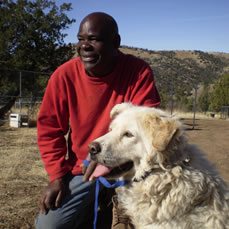
The Story of Tibet: Compassion in Action

The following is a story contributed by Ani Kunzang Drolma, former director of Tara’s Babies Animal Rescue and student of Jetsunma Ahkon Lhamo:

A dog called Tibet 

One of the 130 or so animals rescued by Tara’s Babies Animal Welfare following Hurricane Katrina was a mature, majestic cuddly-looking dog; with a white, long fluffy coat, and big chocolate eyes, much like a golden retriever, he seemed the sort of dog you wanted to cuddle up with on the couch How deceptive appearances can be.
Not long after arrival, while the all-volunteer staff was still working out routines and getting to know each dog, Tibet attacked a woman as she went to remove his food bowl. Until that moment he had seemed friendly, and of course his looks had fooled us, so this attack was totally unexpected. But it was vicious, and the wounds needed medical treatment.
Naturally, we wanted to ensure that no-one else was injured, so Tibet was moved to an area slightly apart from the other dogs, in a large yard on his own. Only trained volunteers were allowed to work with him. Unfortunately, a new volunteer ignored this, being charmed by his wagging tail and sweet looks, and tried to walk him on her own. Again he attacked, and the volunteer spent several days in hospital.
The challenge with Tibet was the unpredictable and sudden change in his behavior. He could for the most part be walked and cared for with no problems; he was happy, and wagged his tail and could be petted – yet the uncertainty always remained as to what may trigger another vicious attack. In addition, the local County has a ‘three strikes and you’re out’ law, meaning that if Tibet bit another person he would be euthanized. No-one at Tara’s Babies wanted that to happen.

As with many of the Katrina rescues, Tibet had never been neutered. The decision was made to perform that surgery and also remove his canine teeth. One of the cabin rooms was transformed into a surgery so that Dr Pema Mallu, Tara’s Babies excellent vet, could operate. Jetsunma Ahkon Lhamo, whose compassionate response to the suffering of animals following Katrina led to the foundation of Tara’s Babies, was on retreat at Dakini Valley at this time. As with every single animal we rescued, Jetsunma was personally concerned about Tibet’s welfare and the suffering he had been through. Jetsunma wishes every dog to know they are loved and safe, and so she wanted to be with Tibet at this time. She was present in the room as the surgery occurred, saying prayers for him.
We had created a post-op recovery space by setting up an old donated camper trailer with a small yard for him. While still sedated, Tibet was carried out and placed on a comfortable bed in his new trailer home. Jetsunma asked to remain alone with Tibet, to be there with him as he awoke.. I was privileged to sit outside, close enough to be able to help if something went wrong. Hearing Jetsunma gently repeat the Tara mantra, “Om Tare Tutare Ture SoHa” over and over again was a blessing not only for Tibet, but for all of us privileged to be part of this process of transformation. As he came to, Jetsunma continued to softly and tenderly speak to him, encouraging him, offering him love. She gently fed him by hand with bits of her own sandwich, and lightly dribbled water in his mouth, which he then drank thirstily. As is always the case, Jetsunma was willing to do whatever she could to help Tibet learn a new way of being in the world.

Jetsunma was alone with Tibet in that small, old trailer for several hours, introducing him to his new life, where people offer love deeply from the heart, and there is no reason for fear or aggression. Following this miracle of love, Jetsunma requested that only a few people, with calm stable energy, work with him. She suggested that I be one of those people. I was admittedly very nervous the first time I took Tibet out post-op. At that time I was scared of being bitten, something that over the years at Tara’s Babies diminished as I better understood the nature of fear in myself and others, and how best to respond to dogs. But on that first walk, what kept me going, was the knowledge that Jetsunma had worked with Tibet in ways I did not understand, and that if she had confidence that I could do this, I too should have that confidence to follow in her footsteps.

Tibet did indeed change, although from then on only a couple of us worked with him and we were always mindful of his past. A few years later, when he passed away peacefully in his igloo one night, from congestive heart failure, having come to us with severe heart worm and an already damaged body, our tears were genuine. We loved Tibet deeply, for he was a dog who deserved love and affection, like every being, despite his instability and fear. His absence brought much sorrow to us all; he had been a vibrant fixture in our lives, and a great teacher of being mindful. Tibet taught us many things – about appearances and assumptions, about our own and others’ fears, but mostly, through Jetsnma’s blessings, never to give up on anyone, for the potential to change, the seed of compassion and love, is within us all.

Ani Kunzang Drolma
Former Director TBAW
7 May 2012
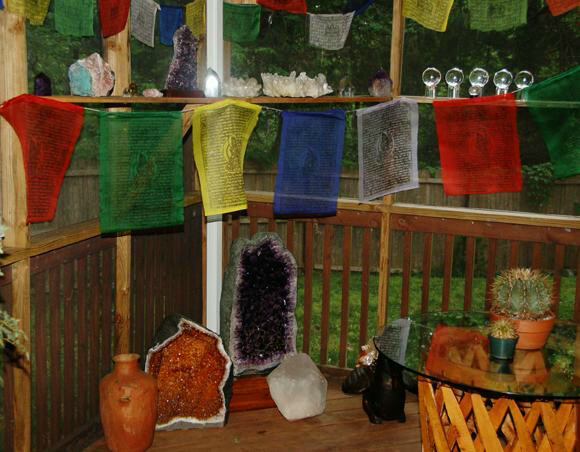
Prayers and Healing

The following is from a series of tweets by Jetsunma Ahkon Lhamo:

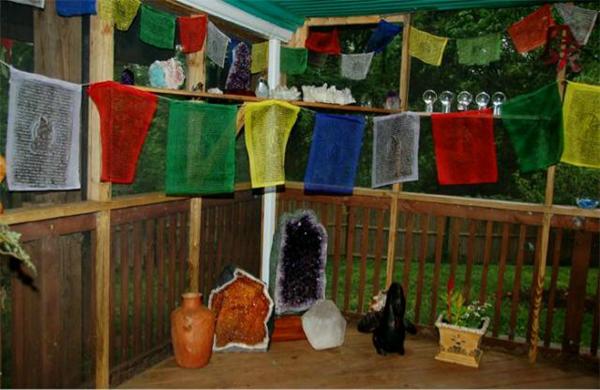
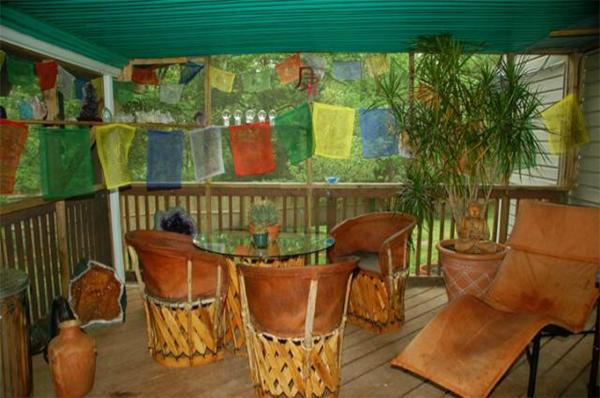
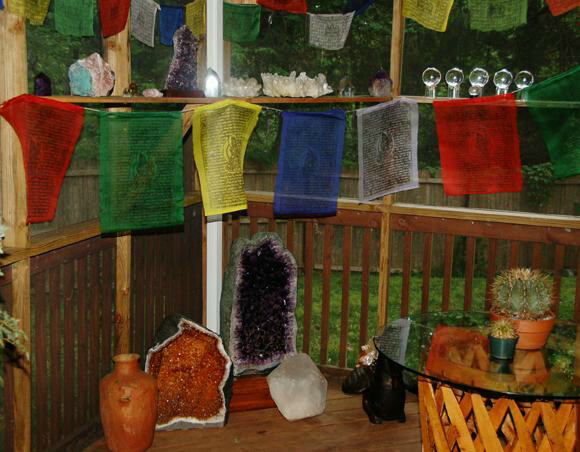
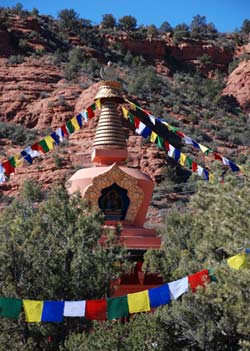
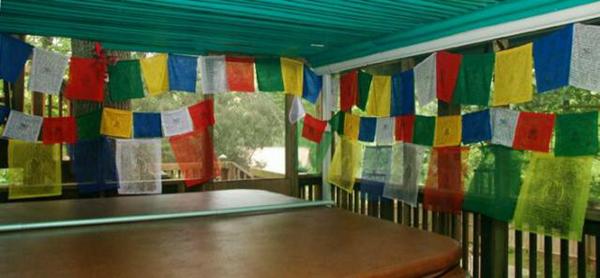
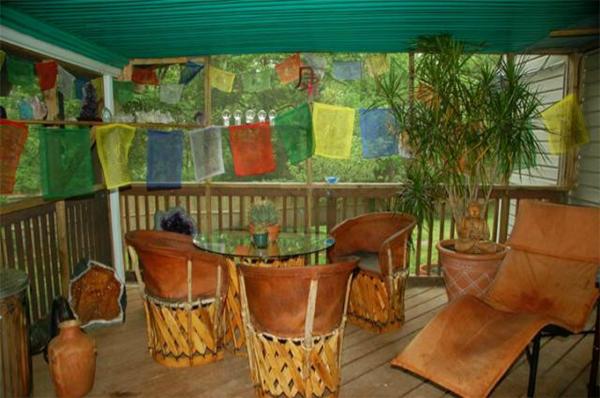
More of my healing lanai, and it feels like heaven! Prayer flags are so inspiring.

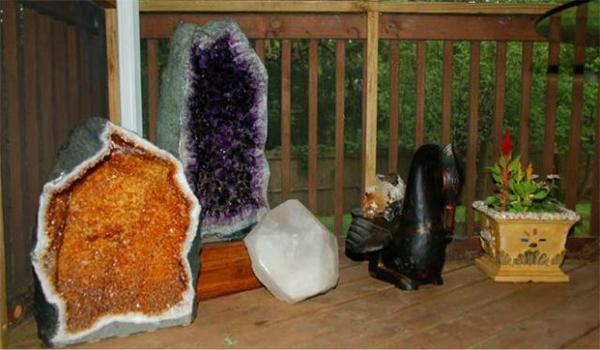
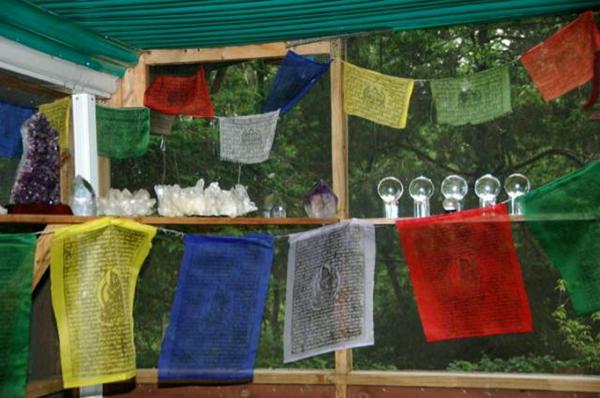
Here is the beginning of a crystal garden.


The crystals and flags are wonderful. When wind blows prayers are whispered.

This time of evening the birds sing loudly

The Amethyst and citrine are powerful:

© copyright Jetsunma Ahkon Lhamo All rights reserved.

Living the Sacred Life

An excerpt from a teaching called Intimacy with the Path by Jetsunma Ahkon Lhamo

What if it were possible to live in such a sacred way that instead of thinking of ourselves as separate human beings who want to go there and get that, we were able to see everything in the world around us as the same as us, a display of an underlying primordial natural state.  What if we could see that all things are the display of a fundamentally empty and yet full primordial nature, not separate from Buddhahood?   Supposing that, instead of clinging to what we see and putting ourselves in the posture of acceptance or rejection, like or dislike, or hope and fear—the hope that it will work out well and someone will love you, or the fear that it won’t and no one will.  Instead of approaching life with that kind of idea, which wears us out and does us in, supposing we could live a truly sacred life?

Supposing when we see a tree, a person, something beautiful or not so beautiful, supposing we were in a quiet way simply to know that this too is a display of the Buddha nature.  Supposing that when we see something that delights our eyes, we would think of it in a more sacred way as something that can be offered to the Buddhas and Bodhisattvas for the sake of sentient beings, rather than clinging and grasping.

Supposing everything could be offered.  Supposing that every experience that happened to us could be offered, whether we liked it or didn’t like it.  Supposing we could develop a sense of everything being sacred, precious, having its own weight and depth and taste, and that each experience on its essential level can be offered.

Supposing that we grew in the awareness that every single thing that occurs, and every single thing that we see, feel, touch and taste within the context of our life is inseparable from this fundamental spiritual reality that is both our beginning, our ground or basis, our ultimate goal and result.  Supposing we could really practice deeply in that way.

Once you get past the point of being an effort, once you really begin to awaken to the interconnectedness and sacredness of everything, then within the mind there becomes a kind of simplicity that is the result of such thoughts.  When you’re really in the posture of making offerings for the sake of sentient beings, there is no sense planning on how you’re going to get everything.  Once the joy of that begins to catch hold, of seeing everything not as a materialistic, external, or attainable thing, but more as a display of everything you long for, then you begin to move into the understanding that it’s not the display itself that you want, but the underlying joyful, spiritual reality that is in fact the essence we all long for.

In every major religion in the world, there is something about approaching it with the eyes of a child.  Every religion has a different way of explaining that, but there is a simplicity and naturalness that if one can engage in that on their spiritual path, it is sustaining, joyful, and natural.  It gives us the means by which we will not separate ourselves from the path – having times when we feel that we are very spiritual, and times when we feel that we have other things to do.

If we begin to practice the path in that way, it is much simpler.  It is simply our life.  It is so inseparable that, in the same way that you cannot stop breathing and continue to move and have your being, neither could you even consider not having one’s spiritual path be the most integral, most core, most central, nourishing and profound element within your life.  And so you become empowered.

© Jetsunma Ahkon Lhamo

Living in Prayer

The following is from a series of tweets by Jetsunma Ahkon Lhamo:

Last night we made a special room, a healing prayer room with tons of prayer flags:

The room will be finished but able to open completely in good weather- it’s called a Lanai. So peaceful!

It’s like living in a prayer…

Or floating in a dream with every pore awake and laughing, yet at peace.

Surround yourself with prayer flags someday and see for yourself. When the prayer flags blow you are blessed and happy.

© copyright Jetsunma Ahkon Lhamo All rights reserved.

The Students Call

The following is from a series of tweets by Jetsunma Ahkon Lhamo:

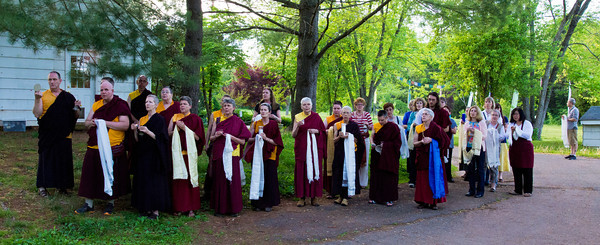
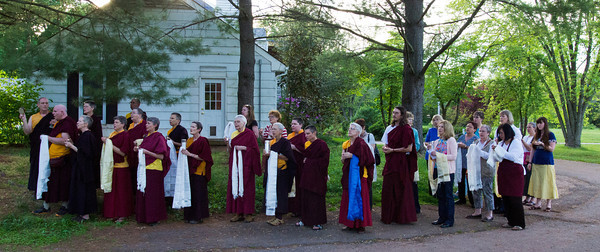
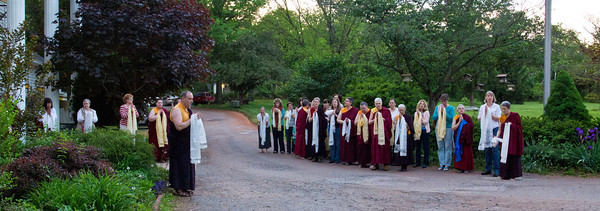
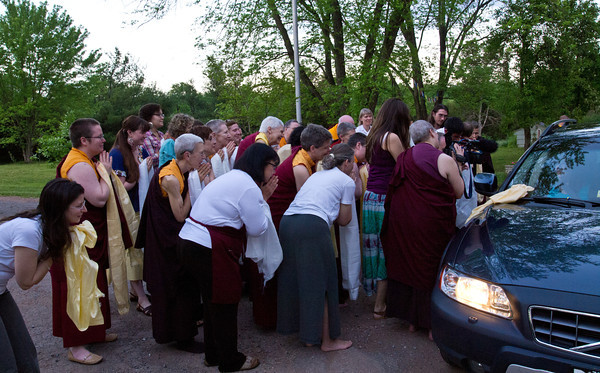
Wasn’t feeling well last evening, so students lined the driveway reciting 7-Line Prayer:

Here’s another photo of students calling:

Despite the pain in my back, couldn’t resist the student’s call. Here they are lining the driveway waiting:

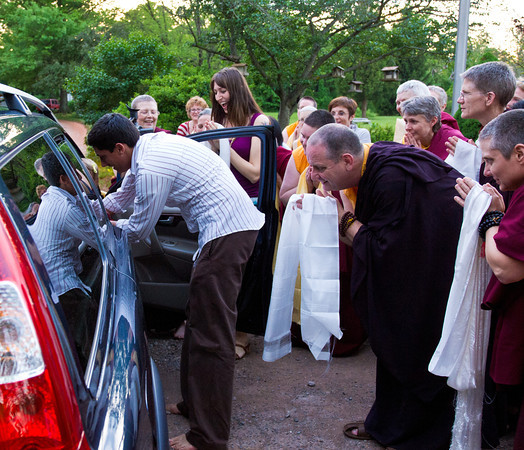
Though I couldn’t get out of the car, was able to offer blessings. Here offered blessings to one of the youngest sangha members:

Here are students receiving the Blessings:

Photos courtesy of Ted Kurkowski.

© copyright Jetsunma Ahkon Lhamo All rights reserved.

Free of Limitations: an Excerpt from “Buddhahood Without Meditation” by Dudjom Lingpa

The following is respectfully quoted from “Buddhahood Without Meditation” by Dudjom Lingpa:

On yet another occasion, when I met the great holder of intrinsic awareness, Hungchenkara, in a vision, I asked him, “What is this array of apparent phenomena like?”

He bestowed the following reply: “Ah, great spiritual being, the consciousness of the five avenues of the senses are like space in which anything is capable of emerging. Discursive thought is like the substances and mantras employed by a magician. The array of apparent phenomena that manifests from the synchronicity of these two comes about like a magical illusion. Consciousness that perpetuates this is like a spectator.

“This being the case, all substances offered or given are like substances used in magic. The approach of the illusion-like yoga involves using purificatory mantras to refine these substances into emptiness and mantras for increase to cause the unfolding of immeasurable appearances of sensory pleasures, which become objects of the six senses to delight all who are recipients of these offerings and gifts. Further, for the sake of sentient beings, who are like phantom emanations, through the illusion-like yoga one arranges the objective environment like a city of the gandharvas. One performs the acts of liberating and guiding beings as though changing the contents of a dream, thus gaining mastery over the supreme yoga of illusion.

“Consider the fact that no matter how many planets and stars are reflected in a lake, these reflections are encompassed within the water itself; no matter how many worlds there are as containers and their contents, they are encompassed within a single space; no matter how vast and how numerous the apparent phenomena of samsara and nirvana may be, they are encompassed within the single true nature of mind itself (sem-nyid).

“The nature of mind itself, referred to as ‘buddha nature,’ is a uniform pervasiveness unsullied by flaws. For example, even though there might be buddhas filling space, there is a uniform pervasiveness in that no object exists that benefits from their pristine awareness and positive qualities. Even though there might be sentient beings equal to the limits of space, each with an autonomous mindstream, there is a uniform pervasiveness in that no object exists that can be harmed by this.

“The ground aspect of dharmakaya as buddha nature is free of all locations, objects or agents of origination, and so is free of the limitation of origination. It is beyond there being any time at which it ceases or any agent that ceases to be, and so it is free of the limitation of cessation. Because it does not fall into the extreme of existence as some substantial entity, since even the eyes of a victorious one cannot see it, it is free of the limitation of permanence. Since it is nonexistent without being absolutely nothing and constitutes the common ground of samsara and nirvana, it is free of the limitation of nihilistic negation. Since it is beyond all locations, objects or agents of going, it is free of the limitation of going. Because no location, object or agent of coming can be established to exist, it is free of the limitation of coming. Because all phenomena of samsara and nirvana arise distinctly and individually within the vast expanse of the ground of being, or buddha nature, like the planets and stars reflected in a lake, it is free of the limitation of identity. Because the modes of samsara and nirvana, however they arise, are of one taste with the same ground of being, or buddha nature, just as the planets and stars reflected in the ocean are none other than the ocean, it is free of the limitation of separateness. Because it does not fall into any of these  eight limitations of conceptual elaboration, there is a uniform pervasiveness unsullied by flaws.”

Why Criticize Others?

The following is from a series of tweets by Jetsunma Ahkon Lhamo:

If one disagrees with another tweeter, why be ugly and bitter? Just stop reading their stream. Problem solved.

To obsess about people you don’t know and couldn’t care less about your stuff shows mental illness. Such bitterness shows jealousy and a dark heart.

Better to become a more advanced being. Warm- hearted. Generous.

© copyright Jetsunma Ahkon Lhamo All rights reserved


WP2Social Auto Publish Powered By : XYZScripts.com