Blessings and Opportunities

The following is from a series of tweets by Jetsunma Ahkon Lhamo:

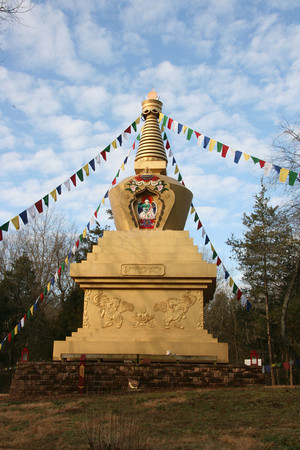
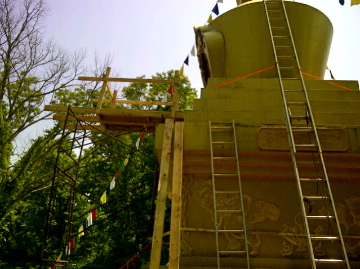
I made it to the Stupa today, difficult for me, and was happy to see repair continues. Joy to my heart! Weeding and gardening too. Gratitude.

It’s hard to express how important the Stupa is. So many blessings, opportunity to gather merit, a righteous life.

We need clearing too. All invited to come help, please, help is needed. We are aging fast here, and some are too old to do outdoor labor. But there are buyers needed to gather supplies, painters, mowers, etc. Who wants to change their life doing good works? It works when you work it.

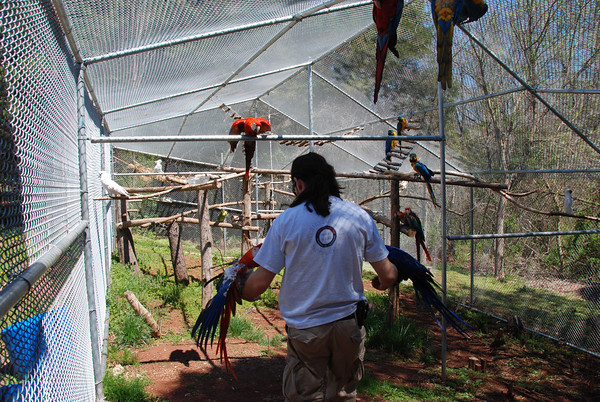
I went to the aviary too. Such joy watching macaws and other wild beauties fly! Riggs gives them a good life. We always need help there too.

Now my back feels pretty sore.

I kinda hoped I’d see workers there to thank them. Maybe next time. Maybe I’ll bring pizza and fruit and nuts next time. I always bring offerings. And happily.

I love you all but especially those who help others. Don’t forget the Occupy folks and the homeless. The system is hurting us all.

Copyright © Jetsunma Ahkon Norbu Lhamo.  All rights reserved

Fire and Gentleness

An excerpt from a teaching called Dharma and the Western Mind by Jetsunma Ahkon Lhamo given on January 29, 1989

Adapting Dharma for Westerners is not difficult if you understand what our needs are.  The first thing that a Westerner has to do is to become stable in this path.  You have to remain stable and you have to remain stable for the right reasons.  I have seen old time practitioners that have seen the best Lamas and had the best opportunities and the most glorious teachings, but I am not impressed with the stability of their path and I feel that the reason for that is that they have not come to the point where they have really cultivated a gentleness of mind.  They haven’t really cultivated the necessary fire in the heart that keeps everything going.  They haven’t lit that dynamo that makes them remain passionate about loving.

Sometimes I am disappointed in when I see old time practitioners doing the Dharma talk and walking the Dharma walk and spouting this name and knowing that term but their hearts are unchanged.  There is a hardness there. The most tragic thing about that is that even though they are hot and heavy on the path now they may not remain firm on the path.  And time has born that out.   There are many Western Dharma practitioners who were really on and now they are really off.  I think that the reason why this happens is because they did not take the time to build a foundation based on compassion. We cannot consider that it is a baby teaching.  I talk about bodhicitta and compassion all the time.  If bodhicitta, which is the term for compassion, were ice cream you would come here and you would get a different flavor every week.  That is how I teach.  And I teach it as many different ways as I can. I try to be creative and sometimes I pull rabbits out of hats and sometimes I whisper it and sometimes I shout it and sometimes I give it to you to read, but it is always about Bodhicitta.  It is always about compassion, it is always about love in some form or another.

I really have had old time Dharma students say, “Hey I have had Bodhicitta already, and I am tired of Bodhicitta.” I am so sad when I hear that because if you can get tired of that subject then you don’t know it at all. You think that it is a baby subject yet it is the very union of the wisdom of realizing the emptiness of self-nature and the compassionate self that is truly the awakened mind.  There is no time when you are finished learning about compassion.  There is no time when you are finished learning about love.

Westerners who have been to college, to university and have papers are the worst problem we have in this country when it comes to practice, because we think that having got papers we don’t need to be learning about this simple stuff.  We say, “I need the real teachings.  Give me some Dzogchen.  Give me some heavy stuff.  I want the real stuff, because I am an American and I can deal with it.”  The problem is that as Westerners, no matter who we are, if the mind is not prepared, it is like the ground not being cultivated.  You drop the seed and it goes plunk on the top and if our minds are not gentled and deepened we go plink.  We may be able to memorize a wonderful Dzogchen teaching, we may be able to read the text but we are still plinking merrily away.  We have to have these foundational teachings and they have to be with us always.  There is never a time, no matter how advanced you are that you should forget that the greatest Dzogchen teaching, the most pure and pristine understanding of the Nature of Mind is an understanding of the nature of compassion. The most pristine, achingly beautiful understanding of the Primordial Wisdom State is the awakening to love.  There is no difference: the two of them are inseparable.  You can’t have one without the other.  And you may think to yourself, “What comes first the chicken or the egg? Can’t I learn to love after I am wise already?”  I don’t think so because really the mind has to be prepared for these precious deeper teachings.  It has to be gentled.

There is a confession that His Holiness Dudjom Rinpoche gave to us and the translation that I have says, “That my mind is as hard as horn.” And I think about that all the time because at any stage it is possible for the mind to become hard as horn, to become so impressed with its prowess in playing with Dharma terms, to become so impressed with how we can sit straight when we meditate, to become so impressed with how good we live and how sorry we are for every one else, to become so impressed that we are hard. It is important for us as Westerners and as part of the human family to cultivate gentleness so that we can truly accomplish Dharma.

©Jetsunma Ahkön Lhamo

Stupas and Healing

The following is from a series of tweets by Jetsunma Ahkon Lhamo:

Greetings all from Poolesville Md where it is steamy and humid. All is well at KPC we are getting ready to make repairs and maintain Stupas. We will of course go to Palyul Retreat but there is fund raising and prep to do. And land clearing, taming the beast across the Temple.

Seems we are happiest working together as a family. Anyone wishing to give or help should watch here for how to get together.

We are busy these days and there is plenty to do. Members need to keep informed and responsible, and helping new people. Any Buddhist wanna dance?

Many miracles happen by the Stupa, healing, help with prosperity, we have many stories and testimonials as well.

To live long and well one must have merit. A good way to make some is by giving and helping with building and repair, and practicing near the Stupa.

I went to the Stupa yesterday and saw the need for repair and upkeep. I made offerings, and today I feel better than I have. My body craves rest and my Gurus demand it, so I’m working on resting. (Joke, haha) and saw “Avatar” again, and remembered that we are doing the same to this planet (see director’s cut) and we need Stupas more than ever. Worldwide.

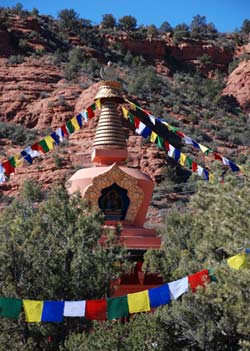
We need help with our Sedona Stupa too. Always.

Stupas are curative for the land and balancing as well. They will help.

Stand up!

See also: The Benefits of Building and Sponsoring a Stupa

 Incalculable Benefit of Stupas by Lama Zopa

 Blessings of a Stupa by Tulku Sang Ngag Rinpoche

Copyright © Jetsunma Ahkon Norbu Lhamo All rights reserved.

For the Benefit of Beings

During my Enthronement, I was in meditation the whole time. I was really annoyed at the flashes and the sounds from the news reporters. Any flashes like that, I felt wrath, “This is so sacred, there shouldn’t be any modern shit here.” And yet His Holiness was kind enough to let that happen so that modern people could see it.

The ceremony itself went off perfectly, but it hit like a bomb. When it was over, there were certain things I had to do, but all I wanted to do was just go be quiet. I didn’t want to go out to dinner, I just wanted to go be quiet. But His Holiness leaned over and said, “You don’t get to do that.” You never get to do what you want again! “You’re in jail” Gyaltrul Rinpoche said. That’s how it turned out.

Copyright © Jetsunma Ahkon Norbu Lhamo.  All rights reserved

Truth and Healing

The following is from a series of tweets by Jetsunma Ahkon Lhamo:

Please forgive me. This is my twitter space and yours too, as I offer it as a teaching vehicle. I’ve not been on and I am sorry. My body is breaking down. My mind too. So beat up. Now it seems I must divulge more of my story. I will as I must. And I can’t tell why. But it is the truth. They he/she must print tonight. Why? I don’t know bit I will cooperate. No choice. Tonight a post will come out on a multiple “user groups”(?) and will be seen by all.

The horror KPC has been through, and myself as well. So much must be disclosed. And must be told well. I can’t do it and I don’t know who will. I just know it will happen and I give permission. So I trust. And will do what I can.

Copyright © Jetsunma Ahkon Norbu Lhamo.  All rights reserved

The First Object of Refuge

The following is an excerpt from a teaching by Jetsunma Ahkon Lhamo called “Essence of Devotion”

Although the Buddha that we remember as Siddhartha, Gautama Buddha, Shakyamuni is not present in his physical body as we understand it right now, we look at the Lama as the embodiment of the qualities, intentions, compassion and activity of the Buddha in the world.  Our Lamas, those reincarnate Lamas who are recognized as reincarnate Lamas, are considered to be the Nirmanakaya form of the Buddha.  They are the Buddha in the world. So we look at the Lama as being the embodiment of the Buddha.  We look at the Lama as being the embodiment of the Dharma because, if we were to try to study Dharma on our own, even though all the books in our bookstore are written with the commentary of a qualified Lama, when you read those books you must also have first of all the teachings from the guru that deepen and ripen the mind ..Empowerment, lung, commentary teaching, the taking of vows, those teachings that deepen and ripen the mind, can only be given by the Lama, only be given by the Lama, and you must have them.  You must have your mind ripened.  A mind that is not ripe may delude itself into feeling spiritual and may even be able to speak spiritually.  However, if it is not ripe, it cannot fulfill itself.  So we should consider like that.

The Lama is considered to be the path.  The Dharma is given to us by the Lama.  The Lama connects us with the Dharma.  The Lama ripens us in the Dharma.  The Lama is the Dharma in that sense.  The Lama is also the Sangha because without the Lama there would be no Sangha.  It is the Lama’s qualities and compassionate activities that sound the note that eventually calls the Sangha.  When one of the Sangha has come to practice in some way, there is a personal and private circumstance that has called them, has pulled them in some secret inner way, particular and unique only to them, and their response is like a bell tolling somewhere deep in their minds—very unique, very individual, very present.  That is the gathering of the Sangha and it is done through the influence and compassionate activity of the Lama.  So the Lama is the first object of refuge, and the supreme object of refuge on the Vajrayana path.  That is our view.

Copyright © Jetsunma Ahkon Norbu Lhamo.  All rights reserved

What It Means to Be Sectarian: by Tsem Tulku Rinpoche

The following is respectfully quoted from “Gurus for Hire Enlightenment for Sale” by Tsem Tulku Rinpoche:

If you are a member of the royalty of one country and you criticize your own royalty, its okay because inadvertently, you include yourself. For example, if I were in the royal family of a certain country and I criticized the royalty of my country, some people in our country or i the royal house may be a little unhappy, but it is generally acceptable because I have included myself in the criticism. I am showing humility and not pointing fingers at other people.

However, it would not be acceptable if I started saying that our royalty was very good, but the royalty of another country was excessive, stupid, not educated, spoiled and did not do anything for their country. Some people who are fanatical in our country might agree but the people who can think will see that it is not a very good policy and not very diplomatic. They will say that we do not have the full information, that we are just looking at things in the media and that we do not know the inside story. They will question our right to criticize another royal family of another country that people respect. Once we start saying those kinds of things, we invite criticism of our own royal family and we open the doors for other people to criticize us also.

Similarly, we have four sects of Buddhism in Tibet. Each sect has its own head but the four sects have the same goal, priorities and requirements for Enlightenment. All their teachings are textually and scripturally sound, based on reliable sources that come from India, stemming back to Lord Buddha himself.

I have not studied other lineages. I have read a little here and there but I can never claim to know anything about other lineages. However, i can tell you from observing the other lineages and erudite Gurus that I do not see a difference between them and the erudite masters of my lineage. They are compassionate, just as the ones in my lineage are. If a master of another lineage becomes a Buddha or becomes highly attained, I do not see them as different from a master of my lineage. Once he attains Enlightenment, a Buddha is a Buddha, without any lineage. Once we climb to the top of the mountain, it is what flag we put on the top of that mountain that identifies who we are. Actually, the person who climbs to the top is just a mountain climber who go to the top!

I can only say that the other lineages (besides Gelugpa) are definitely valid because I have checked out their masters, their students and disciples. I can say they are good because I look at the results. Just as in my own lineage (Gelugpa), they also have great practitioners and practitioners who do not really practice. It is the same. (I do not say this politically. If I say this politically, I can see through my motive and so can you.)

His Holiness the 14th Dalai Lama has mentioned this during teachings. What His Holiness says is correct. I believe it, but I am a critical person and will still check it out and think about it.

When one sect criticizes another sect, it is very, very serious. One sect has no right to criticize another sect. One sect has not fully studied another sect’s or another school’s tenets in order to have the knowledge to criticize or to say anything. That is why I would not ever criticize, even if I had studied it; and dare not since I have never studied it. I would not even go in that direction.

Prejudice and bias toward another sect or another form of Buddhism is dangerous, as explained in the Lamrim Chenmo. The karmic effect of saying negative things about other lineages is very damaging.

Let’s consider how dangerous it is to kill an animal; how bad the karma is to kill a person or a monk. We cannot kill a Buddha because a Buddha does not have the karma to be killed, but if we could kill a Buddha, imagine the incredible amount of negative karma that would arise from that action. The Lamrim says that if we spread sectarian views, it is understood, the other person accepts and we rejoice, the four completing actions or the four factors of intention are complete: the demerit of spreading sectarian views is equivalent to killing 1,000 Buddhas. That is what His Holiness Pabongkha Rinpoche explained in the Lamrim Chenmo.

If other people dare spread sectarian views, we should have great compassion for them, never listen and just cut their talk off. We should not entertain or listen to them. Remember, we are trying to gain merit! If the demerit of spreading sectarian views is equivalent to killing 1,000 Buddhas, then all the merit we create from doing prostrations, making offerings and meditating will down the drain! Symbolically, the amount of practice we do can fill up one bathtub. If we were to put that bathtub into the ocean, it becomes nothing. The karma of killing 1,000 Buddhas is like the ocean. When we engage in sectarian talk, it is like putting our little bathtub of merit into the ocean and wondering what happened!

If we were to judge another school or sect of Buddhism and say they are not as good as ours, then we are also presupposing that no attainments can be gained from their practice. It is saying that in their lineage, there are no enlightened Gurus, no high-level, attained teachers or practitioners. It is impossible. It cannot be!

Every lineage and every school of Buddhism in every country, everywhere, has elite, erudite, practiced masters who prove to us that if we practice each school individually and correctly, we will get the results. The techniques and the way the different schools are formed may differ a bit due to time, place, geography and culture but that does not mean they are not complete paths in themselves.

It is sectarianism to have biased views against another lineage, another school or another form, based on prejudice, ego, self-centeredness, insecurity, fear and ignorance; or to think that it might not be good if someone is not practicing what we are practicing.

You will never see, feel, hear or sense one bit of sectarianism in a real practitioner of Buddhism who wishes to become a fully enlightened Buddha for the benefit of others. Why would a real Dharma practitioner speak about something that was never on their mind? Why would they dwell on or express things that are not true? Real Buddhist practitioners do not lie or have baseless bias.

We cannot even be biased against other religions, as spoken by the perfect Buddha and as taught by the perfect Dalai Lama. If we cannot be biased against other religions, how can we be biased against different sects within our own religion?

The Story of Tibet: Compassion in Action

The following is a story contributed by Ani Kunzang Drolma, former director of Tara’s Babies Animal Rescue and student of Jetsunma Ahkon Lhamo:

A dog called Tibet 

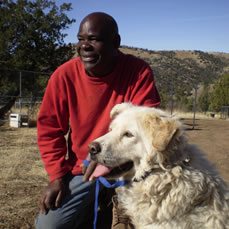
One of the 130 or so animals rescued by Tara’s Babies Animal Welfare following Hurricane Katrina was a mature, majestic cuddly-looking dog; with a white, long fluffy coat, and big chocolate eyes, much like a golden retriever, he seemed the sort of dog you wanted to cuddle up with on the couch How deceptive appearances can be.
Not long after arrival, while the all-volunteer staff was still working out routines and getting to know each dog, Tibet attacked a woman as she went to remove his food bowl. Until that moment he had seemed friendly, and of course his looks had fooled us, so this attack was totally unexpected. But it was vicious, and the wounds needed medical treatment.
Naturally, we wanted to ensure that no-one else was injured, so Tibet was moved to an area slightly apart from the other dogs, in a large yard on his own. Only trained volunteers were allowed to work with him. Unfortunately, a new volunteer ignored this, being charmed by his wagging tail and sweet looks, and tried to walk him on her own. Again he attacked, and the volunteer spent several days in hospital.
The challenge with Tibet was the unpredictable and sudden change in his behavior. He could for the most part be walked and cared for with no problems; he was happy, and wagged his tail and could be petted – yet the uncertainty always remained as to what may trigger another vicious attack. In addition, the local County has a ‘three strikes and you’re out’ law, meaning that if Tibet bit another person he would be euthanized. No-one at Tara’s Babies wanted that to happen.

As with many of the Katrina rescues, Tibet had never been neutered. The decision was made to perform that surgery and also remove his canine teeth. One of the cabin rooms was transformed into a surgery so that Dr Pema Mallu, Tara’s Babies excellent vet, could operate. Jetsunma Ahkon Lhamo, whose compassionate response to the suffering of animals following Katrina led to the foundation of Tara’s Babies, was on retreat at Dakini Valley at this time. As with every single animal we rescued, Jetsunma was personally concerned about Tibet’s welfare and the suffering he had been through. Jetsunma wishes every dog to know they are loved and safe, and so she wanted to be with Tibet at this time. She was present in the room as the surgery occurred, saying prayers for him.
We had created a post-op recovery space by setting up an old donated camper trailer with a small yard for him. While still sedated, Tibet was carried out and placed on a comfortable bed in his new trailer home. Jetsunma asked to remain alone with Tibet, to be there with him as he awoke.. I was privileged to sit outside, close enough to be able to help if something went wrong. Hearing Jetsunma gently repeat the Tara mantra, “Om Tare Tutare Ture SoHa” over and over again was a blessing not only for Tibet, but for all of us privileged to be part of this process of transformation. As he came to, Jetsunma continued to softly and tenderly speak to him, encouraging him, offering him love. She gently fed him by hand with bits of her own sandwich, and lightly dribbled water in his mouth, which he then drank thirstily. As is always the case, Jetsunma was willing to do whatever she could to help Tibet learn a new way of being in the world.

Jetsunma was alone with Tibet in that small, old trailer for several hours, introducing him to his new life, where people offer love deeply from the heart, and there is no reason for fear or aggression. Following this miracle of love, Jetsunma requested that only a few people, with calm stable energy, work with him. She suggested that I be one of those people. I was admittedly very nervous the first time I took Tibet out post-op. At that time I was scared of being bitten, something that over the years at Tara’s Babies diminished as I better understood the nature of fear in myself and others, and how best to respond to dogs. But on that first walk, what kept me going, was the knowledge that Jetsunma had worked with Tibet in ways I did not understand, and that if she had confidence that I could do this, I too should have that confidence to follow in her footsteps.

Tibet did indeed change, although from then on only a couple of us worked with him and we were always mindful of his past. A few years later, when he passed away peacefully in his igloo one night, from congestive heart failure, having come to us with severe heart worm and an already damaged body, our tears were genuine. We loved Tibet deeply, for he was a dog who deserved love and affection, like every being, despite his instability and fear. His absence brought much sorrow to us all; he had been a vibrant fixture in our lives, and a great teacher of being mindful. Tibet taught us many things – about appearances and assumptions, about our own and others’ fears, but mostly, through Jetsnma’s blessings, never to give up on anyone, for the potential to change, the seed of compassion and love, is within us all.

Ani Kunzang Drolma
Former Director TBAW
7 May 2012

Prayers and Healing

The following is from a series of tweets by Jetsunma Ahkon Lhamo:

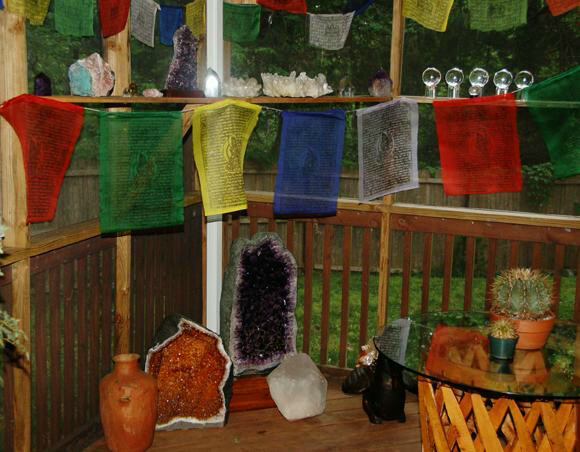
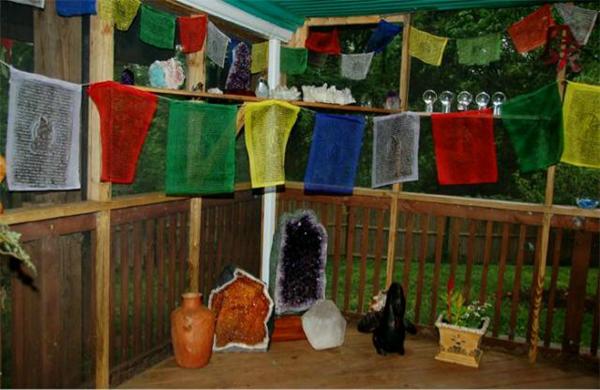
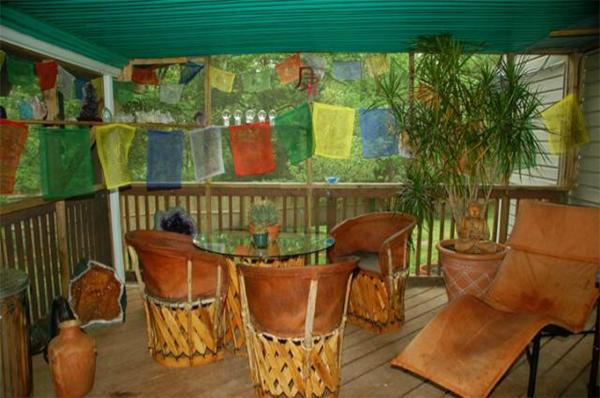
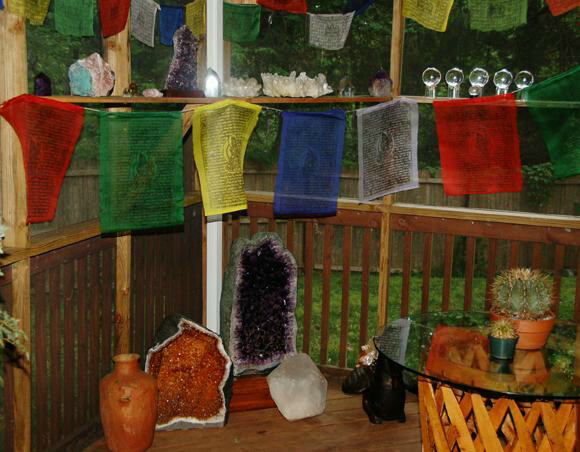
More of my healing lanai, and it feels like heaven! Prayer flags are so inspiring.

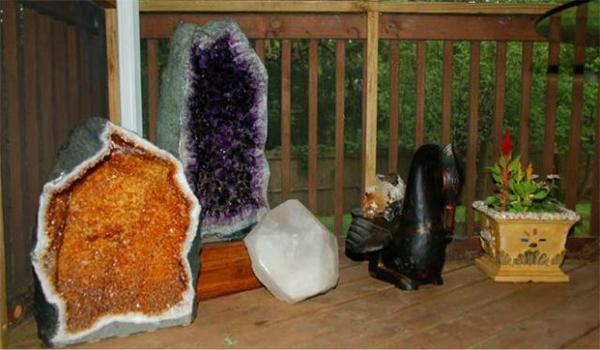
Here is the beginning of a crystal garden.


The crystals and flags are wonderful. When wind blows prayers are whispered.

This time of evening the birds sing loudly

The Amethyst and citrine are powerful:

© copyright Jetsunma Ahkon Lhamo All rights reserved.

Living the Sacred Life

An excerpt from a teaching called Intimacy with the Path by Jetsunma Ahkon Lhamo

What if it were possible to live in such a sacred way that instead of thinking of ourselves as separate human beings who want to go there and get that, we were able to see everything in the world around us as the same as us, a display of an underlying primordial natural state.  What if we could see that all things are the display of a fundamentally empty and yet full primordial nature, not separate from Buddhahood?   Supposing that, instead of clinging to what we see and putting ourselves in the posture of acceptance or rejection, like or dislike, or hope and fear—the hope that it will work out well and someone will love you, or the fear that it won’t and no one will.  Instead of approaching life with that kind of idea, which wears us out and does us in, supposing we could live a truly sacred life?

Supposing when we see a tree, a person, something beautiful or not so beautiful, supposing we were in a quiet way simply to know that this too is a display of the Buddha nature.  Supposing that when we see something that delights our eyes, we would think of it in a more sacred way as something that can be offered to the Buddhas and Bodhisattvas for the sake of sentient beings, rather than clinging and grasping.

Supposing everything could be offered.  Supposing that every experience that happened to us could be offered, whether we liked it or didn’t like it.  Supposing we could develop a sense of everything being sacred, precious, having its own weight and depth and taste, and that each experience on its essential level can be offered.

Supposing that we grew in the awareness that every single thing that occurs, and every single thing that we see, feel, touch and taste within the context of our life is inseparable from this fundamental spiritual reality that is both our beginning, our ground or basis, our ultimate goal and result.  Supposing we could really practice deeply in that way.

Once you get past the point of being an effort, once you really begin to awaken to the interconnectedness and sacredness of everything, then within the mind there becomes a kind of simplicity that is the result of such thoughts.  When you’re really in the posture of making offerings for the sake of sentient beings, there is no sense planning on how you’re going to get everything.  Once the joy of that begins to catch hold, of seeing everything not as a materialistic, external, or attainable thing, but more as a display of everything you long for, then you begin to move into the understanding that it’s not the display itself that you want, but the underlying joyful, spiritual reality that is in fact the essence we all long for.

In every major religion in the world, there is something about approaching it with the eyes of a child.  Every religion has a different way of explaining that, but there is a simplicity and naturalness that if one can engage in that on their spiritual path, it is sustaining, joyful, and natural.  It gives us the means by which we will not separate ourselves from the path – having times when we feel that we are very spiritual, and times when we feel that we have other things to do.

If we begin to practice the path in that way, it is much simpler.  It is simply our life.  It is so inseparable that, in the same way that you cannot stop breathing and continue to move and have your being, neither could you even consider not having one’s spiritual path be the most integral, most core, most central, nourishing and profound element within your life.  And so you become empowered.

© Jetsunma Ahkon Lhamo

WP2Social Auto Publish Powered By : XYZScripts.com