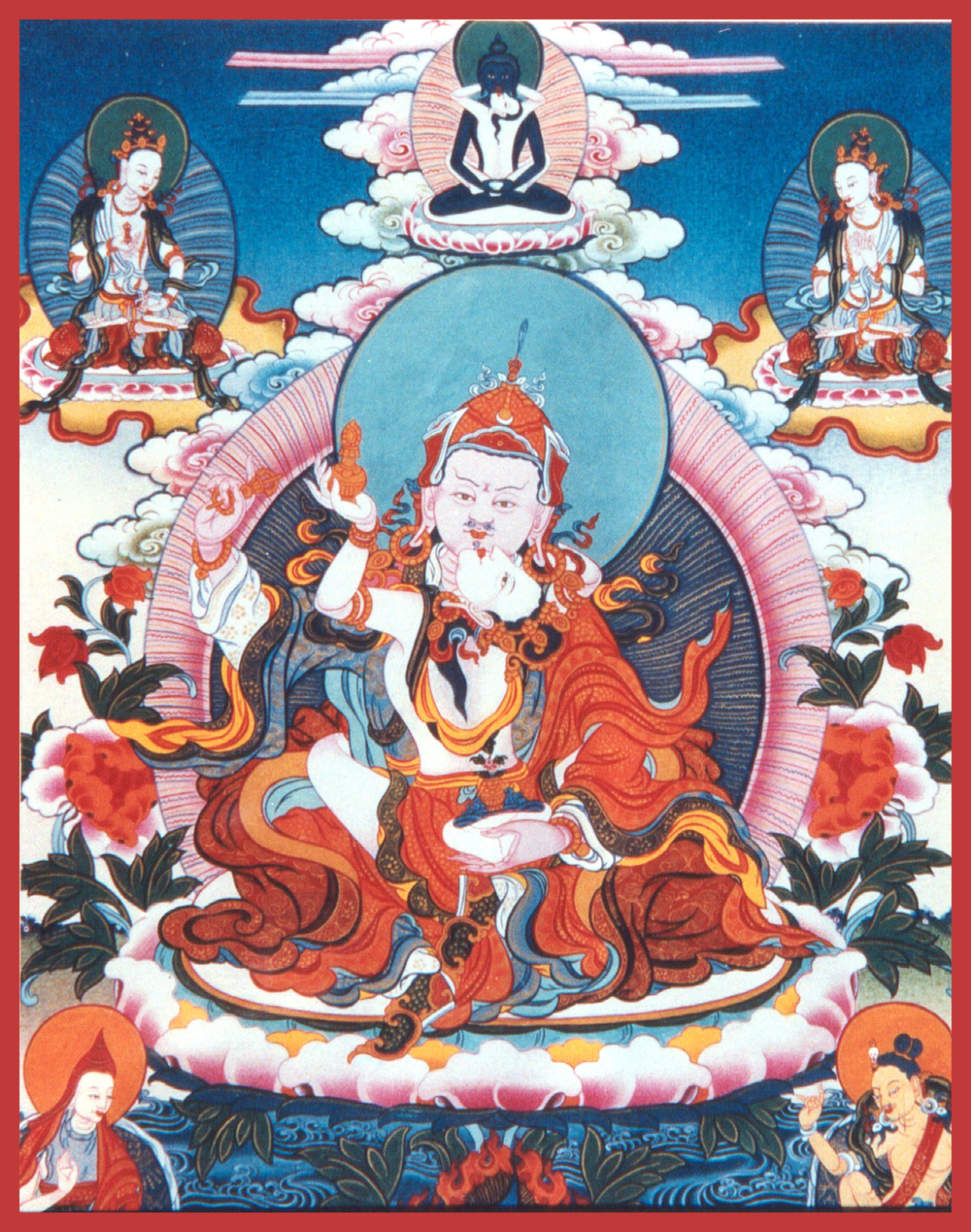
Homage to the Three Jewels: From “Treasury of Precious Qualities”

The following is respectfully quoted from “Treasury of Precious Qualities” by Jigme Lingpa, translated by the Padmakara Translation Group:

Homage to the Three Jewels

The Three Jewels of Buddha, Dharma, and Sangha are the rarest and most sublime objects in the universe. Therefore, from now until he attains enlightenment, the author of the treatise pays heartfelt respect to them in thought, word, and deed, his aim being to protect beings who wander in samsara, afflicted by many evils.

The Three Jewels may be explained according to their essential characteristics, the etymology of the Tibetan term, their various subsidiary aspects, and an explanation of the Sanskrit term. Essentially, buddhahood is the perfection of all the qualities of “elimination” and “realization.” According to the Tibetan expression sangs rgyas, a Buddha is one who has awoken (rgyas) like a lotus flower with the knowledge of all things. Buddhahood in turn has three aspects: (a) the kayas, which are like containers for (b) the wisdoms contained therein, together with (c) the enlightened activities that flow from these. Finally, the Sanskrit word Buddha means “one who perfectly comprehends,” one whose mind encompasses all objects of cognition and thoroughly understands them.

Essentially, the Dharma is characterized by the elimination of one or both the twin veils of defiled emotion and cognitive obscuration, or the means to this elimination. The Tibetan word chos is so used because the Dharma purges (‘chos) the mind of negative emotion, in the same way that medicine cures someone who is sick. As to its aspects, the Dharma may be classified in two ways: on the one hand, as the Dharma of transmission and the Dharma of realization, and on the other, as the third and fourth of the four noble truths, the truth of cessation and the truth of the path. In Sanskrit, the word dharma means “to hold.” In other words, the Dharma is what holds beings to the perfect path and keeps them from the ways of samsara and the lower realms.

Essentially, the Jewel of the Sangha is characterized by the possession of two qualities: knowledge of the truth and freedom from defilements. The Tibetan term dge ‘dun refers to those who have a keen interest (‘dun) in the path of perfect virtue (dge). Such practitioners may be divided into those belonging to the Hinayana Sangha of Shravakas and Pratyekabuddhas, and those belonging to the Mahayana Sangha of Bodhisattvas. The Sanskrit word has the meaning of “assembly” and refers to the community of those who are not distracted from the path by anyone, even gods.

The words “I prostrate” express a perfect salutation to the Three Jewels. This may be made on three levels: first, by realizing the view; then, by proficiency in meditation; and finally, by an act of devout veneration.

The “Precious Three” of the root verse is a reference to the Three Jewels and indicates that the Body, Speech, Mind, Qualities, and Activities of the Buddha are renowned throughout the three worlds. Jigme Lingpa gives the elegant illustration of this by referring to the story of how the Buddha once sent a message to the princess Vine-of-Pearls in form of a picture of himself together with some verses, printed on a piece of white cloth. When the girl saw the image, the joy she experienced was so intense that it was like a samadhi devoid of even the subtlest kind of discursive though. And as she reflected on the meaning of the message, the one hundred and twelve obscurations that are hindrances to liberation, and which are discarded on the path of seeing , fell away. The root text compares these obscurations to the deceitful faces of Mara’s daughters, which are like the lilies of the night, opening in darkness and blasted by the sun of wisdom cultivated on the path of seeing. As a result, Vine-of-Pearls was prepared for the dissipation of what is to be eliminated on the path of meditation. And all this came about through the power of the Buddha’s compassion. All such religious stories that tell of the effect of the Three Jewels are worthy of universal consideration, for they powerfully counteract the mental distraction and defiled emotion that are the very nature of samsaric existence.

Commitment to Compose the Text

The boundless collections of sutra and tantra teachings were propounded by the Buddha, master of the supreme wisdom of omniscience, who set them forth by means of the five excellences. His followers, the noble Bodhisattvas, composed commentaries beautiful in word and meaning, on the basis of the system of five major elements, compiling them according to the “fourfold interrelated purpose.” These scriptures and commentaries are as vast and profound as a great ocean; they are a veritable treasure of purifying waters. Thanks to them the Doctrine of the Conqueror has remained for a long time. Maitreya has said:

All Dharma is contained in Word and Commentary,
The perfectly expressed and its interpretation.
These two ensure that Shakyamuni’s Doctrine
Will remain for long within the world.

The Buddha’s teaching, so profound and hard to fathom, and the commentaries upon it, have not yet faded from the world, and are here condensed into a single treatise. But Jigme Lingpa says that he lacks the three qualifications for composition and that his treatise is a rough work of an ignorant gossip. He says that his book is destitute of the two qualities of healing defilements and protecting from sufferings of samsara. It lacks the three characteristics of a Buddhist composition and is quite possibly tainted with the six faults of non-Buddhist writings. It is, he says, a cacophonous din, like a “wave-garlanded torrent” cascading into a deep ravine in a dense jungle. But even though he considers his treatise to be an ugly and inelegant thing, he says nevertheless that it is based on the perfect utterances of the Sacred Teaching and is therefore worthy of attention. Of course, this verse is just an expression of the author’s modesty.

The Immaculate Mandala: From “The Practice of Dzogchen” by Longchen Rabjam

The following is respectfully quoted from “The Practice of Dzogchen” by Longchen Rabjam, translated by Tulku Thondup and edited by Harold Talbott:

In the Ghanavyuha sutra it is said:

The immaculate disc (mandala) of the moon
Always is unstained and completely full
But in relation to the days of the world
It is perceived as waxing and waning.
Likewise, the ultimate universal ground also
Has always been with the Buddha-essence (Tathagatagarbha),
And this essence in terms of universal ground
Has been taught by the Thus-Gone (Thatagata, i.e., Buddha).
The fools who do not know it,
Because of their habits, see even the universal ground
As (having) various happiness and suffering
And actions and emotional defilements,
Its nature is pure and immaculate,
Its qualities are as wishing-jewels;
There are neither changes nor cessations.
Whoever realizes it attains liberation…

Love and Hugs to All

The following is from a series of tweets by Jetsunma Ahkon Lhamo:

It is raining cats, dogs and Easter bunnies today. We needed it for spring flowers, too. Glad to see it pull pollen out of the air.

Shoutout to the OWS and Occupy D.C. and all Occupy friends who came to my teaching last night. Come back again! We love you!

Also happy to see old and new friends. Now today after last night’s teaching and yesterday’s Phowa I am exhausted, and sore as hell. But I’ll live and it was worth it! I was happy to see so many there on a Friday night. A good crowd and good feelings. And a shoutout to the PCD students, sooo good to see you! You guys are Palyul family. Pls come back! We should have a tea or something to catch up, no? Love and hugs from KPC to all! 

OM MANI PEDME HUNG!


© copyright Jetsunma Ahkön Lhamo all rights reserved

Intervention: From “To Have or To Harm” by Linden Gross

The following is respectfully quoted from “To Have or To Harm” by Linden Gross:

In Los Angeles, that solution includes mandating counseling as a condition of probation or parole, and diverting some criminal cases to psychiatric treatment programs such as the one John Key cofounded along with psychiatrist E. Eugene Kunzman. The Center Against Abusive Behavior is an outpatient mental health clinic that combines biological, psychological, and sociological approach to treating perpetrators of domestic violence and stalking. The nonprofit organization is staffed by treatment providers with expertise in the area of physical, emotional, psychological, and sexual abuse. Kunzman provides whatever psychiatric care or medications might be required based on a mental status examination and subsequent testing for any contributing biological factors.

Key bases his therapy on cognitive behavior model and focuses on controlling each new client’s abusive behavior as his initial priority. A movement contract requires stalkers to call in as often as twice a day to report their whereabouts and activities. To help keep track of them every moment, Key also demands a daily itinerary. Spot-checks, he finds, help to keep stalkers honest.

After reviewing police and court records, Key has stalkers tell their side of the story from beginning to end. Then he confronts them with any discrepancies between the two versions. “Because somewhere between the two lies the truth,” he says. A determination about what kind of counseling is required follows.

Whether the perpetrators wind up in individual or group therapy or both, the ultimate goal of such counseling is to get them to acknowledge their actions, in part through monitoring their own behavior, and then to recognize the errors in their thinking that make their actions seem logical to them. Call it a reality check. “These people indulge in fantasy and the suppression of thought. Everyone comes in here saying, ‘I didn’t do it. I just want to put this behind me and move on,’ says Dr. Key, whose background includes working as a hostage negotiator, a suicidologist, and a master trainer for the management of assaultive behavior. “Until they take responsibility for some of what they did and see themselves not as the victim [who’s been inappropriately hounded by the criminal justice system], they won’t make any progress. They’ll just step into the same river twice.”

During this process of cognitive reframing, patients are repeatedly asked to consider and talk about the mental process behind their actions. What prompted their decision to stalk or act out violently? Psychological imbalances, seemingly unrelated traumatic experiences in their pasts, and social conditioning that have contributed to the problem are explored. “My contention is that you can’t move until you understand what has created the path to violence,” says Dr. Key. “So my task is to bring it up in as many different ways as I can to get them to think about it.”

His approach allows perpetrators to deal with deep-seated issues that have provoked their conduct and to challenge ingrained responses and behaviors that have become well-worn paths. Take the work he did with a dark-skinned Hispanic woman who became obsessed with– and ultimately stalked — her former Anglo boyfriend. During the first three months of counseling, she gradually grew aware of her self esteem problems, many of which were tied to negative feelings about her dark skin. Eventually, she was able to recognize that her obsession with her blond girlfriend stemmed from her need for the affirmation she habitually denied herself. In short, by helping her navigate through his cognitive emotional problems, and by monitoring his movements, Key was able to start him on a path to recovery that would include impulse control and techniques to redirect destructive feelings.

The Los Angeles system, however, is not without its glitches. While warehousing disturbed stalkers in overcrowded prisons is certainly not the answer, mental health can’t always help. Alian Petroy, for example, mailed the target a bullet while in counseling, and fully resumed his stalking behavior once his parole (along with her court-mandated counseling) had come to an end. Even when psychiatric treatment does make a difference, there are no guarantees that psychotic stalkers who have biochemically stabilized will continue to take their medication once they’re on their own, especially if the drugs either induce unpleasant side effects or make the individual feel so good that he deems the medication superfluous.

An ideal approach for those recalcitrant stalkers, according to Key, would be to initially work with perpetrators in a locked psychiatric facility. Once the stalker is ready for outpatient treatment, electronic monitoring would supplement restrictions on his movements for as long as necessary. Probation or parole would aggressively monitor the quality of treatment and progress being made. Adjustments to the surveillance, the restrictions, and the counseling sessions would follow accordingly, until finally the rehabilitated stalker would be weaned off the counseling program altogether.

As indicated in chapter 16, procedural disagreements also exist on the Los Angeles law enforcement front. Although the TMU recommends that most of its victims obtain restraining–or protective–orders, a number of experts in the field strongly believe that these only worsen a case. Indeed, because the orders essentially constitute a response from the victim, they can actually encourage a stalker and reinforce his behavior.

“A restraining order can be a valuable tool if it’s used very early on in a case. But later on, it can be the worst thing you can possibly do,” asserts Gaven de Becker, who cited case after case where a restraining order provoked a stalker and led to homicide. Consider Laura Black, Kristin Lardner, Maria Navarro, along with so many others in his book.

An intervention can put an end to certain unwanted behaviors when the stalker never intended harm. But in cases that have escalated and carry the definite possibility of danger, interventions of any kind can aggravate the situation. “It amounts to a form of Russian roulette,” says de Becker. “Even though the odds are good, five to one in your favor, no reasonable person would want to play.”

The alternative? Radical nonintervention, where the goal is safety rather than prosecution. “That doesn’t mean you don’t do anything,” Dr. Park Elliott Dietz explained in a lecture about threat management. “It means that the subject is not aware of the actions you’re taking.”

With this approach, preventing encounters between the stalker and his target becomes the primary objective, rather than trying to control or discourage the pursuer’s behavior. “We need to change the only person we can change,” says de Becker. “The stalker may be crazy. He’s unreasonable. He’s culturally ill. There’s no button that can be pushed to reliably improve his mental state or control his conduct indefinitely. But the victim’s behavior can change in ways that will put him or her out of reach. Eventually, the majority of stalkers transfer their attention to someone else.”

The first step in this strategy involves having the victim cut off all response to what the stalker does (including asking police to warn him off), and then watching and waiting to see what happens next.

That means not even responding to a threat. “Threats are not guarantees of action. They’re not a contract,” says de Becker. “They’re like promises.” Indeed, whether those promises are kept depends largely on how the target reacts. It’s that reaction that gives the threat its value, and the stalker his or her power. “Engage and enrage” is how de Becker describes the dynamic of many cases gone bad.

This doesn’t mean that you do nothing. They key is to protect yourself by taking precautions that the stalker never becomes aware of, and then to try and outlast him. A far-ranging plan can help you live with the situation for as long as it takes the stalker to go elsewhere, which the vast majority will do.

An important step at this stage is to avoid dealing with the stalker alone. Informing your neighbors–as well as your supervisors and co-workers–of the problem can facilitate that, especially if you enlist their assistance. Some victims have set up a pool of neighbors to meet them when they arrive home from work each day. Others summon help by sounding an alarm each time the stalker is sighted. By prearrangement, the neighbors respond at the sound of the siren or bell. These kinds of deterrents frequently discourage a stalker and persuade him to transfer his focus to someone more accessible.

Victims can always opt for direct intervention should their case become extremely dangerous. However, once intervention has been attempted, the victim can never go back to a watch-and-wait policy. It’s like opting to deal with a lesion on your kidney by surgically removing the entire organ. Once that decision has been acted upon, a less aggressive course of action is no longer possible.

Should intervention become necessary, a trespass arrest can bring the same results as a restraining order violation, but with less risk. The city, rather than the victim, becomes the prosecutor, which helps to depersonalize the situation. The stalker is convicted of a crime rather than just the violation of a civil order. And the conviction term is essentially the same.

Los Angeles has also drawn fire because of some of its legal tactics. The ACLU deems the practice of bail enhancements (raising the bail to an amount the defendant can’t pay in order to keep him in jail) an infringement on the Constitution’s Eight Amendment, as well as on state constitutional mandates that dictate that the court consider only the seriousness of the offense, the defendant’s criminal record, and the probability of his or her appearing in court for trial when determining the amount of bail. (Whether the perpetrator poses a danger to his or her victim is often not a consideration.)

In 1993, deputy City Attorney John Wilson was brought up on charges after he grew concerned over a particular case and ordered a psychiatric evaluation of a stalker. “The obligation of a prosecutor who is specially trained is to prevent future dangerous conduct, even when it may have nothing to do with the current case,” says Wilson. So when the evaluation judged the alleged perpetrator to present a clear danger to others, he was placed on a seventy-two-hour psychiatric hold.

Wilson, however, neglected to consult with the public defender who had already been assigned to the case. The public defender’s office errupted. By ordering these psychiatric exams, they argued, the city attorney’s office had attempted to deprive people of their right to have counsel present (guaranteed by the Constitution’s Fifth and Sixth Amendments), and force them into involuntary mental health treatment. Further, they took issue with the reliability of the tests. “Psychological research has shown that the least predictive way to gauge dangerousness is through interviews,” says Los Angeles criminal defense attorney Neal Osherow. He points to studies showing that psychiatrists trying to assess an individual’s dangerousness fail more than 50 percent of the time.

The accurate prediction of physical violence is impossible, agrees forensic psychiatrist Kaushal Sharma, M.D. For though most people–including many in the field of psychiatry–incorrectly equate it with dangerousness, there’s no guarantee that a dangerous individual will act out or that a nondangerous one one won’t. “Nobody can predict the future. If we could, we’d all be playing the stock market instead of working,” he says. “But increased risk or the likelihood of violence can be assessed.”

Maureen Siegel, chief of the city attorney’s criminal division, sees nothing illegal, unethical, or immoral about her office’s attempts to determine either a defendant’s potential for violence or his mental health needs, and then filing a case with the goal of diverting him into appropriate treatment. To the contrary. “A lot of these defendants pose a danger to the victim and themselves, and are in desperate need of mental health care,” she says, adding that drug addicts and batterers are routinely diverted into treatment. “But the role of the public defendant is not therapeutic in nature–it’s to protect the defendant’s criminal justice rights. By focusing solely on those rights, the defendant can often beat the judge home for lunch.”

Returning

The following is from a series of tweets by Jetsunma Ahkon Lhamo:

Tomorrow will be a happy day, I will teach. And I’m looking forward to it. It’s been a while, and I feel stronger again. I hope to meet Some of the people I connect with online every day.

Must warn you, my hair is graying and I’m getting old. But face it. It happens to all. It isnt the package that matters at this age, it’s the message. Mine is kindness and love, Bodhicitta, Palyul.

In getting stronger I can Teach often. I am grateful for that. I am happy to say we are being remodeled, Temple and Stupas are looking great. I am proud of the work my Sangha is doing. Today we had about 50 volunteers and tons of visitors, including college classes. Busses. Wow. The feeling is full steam ahead, joyfully. A joyful heart is part of the way. And we are feeling it. I miss my students and can’t wait to touch hearts.

One Disappointment is I cannot climb into my throne as my lower back and hip still hurt constantly. Oh well. We’ll put a chair in front of the throne. But I have my Zen and Chuba and I’m ready to rock! Will you be there? Hugs from Palyul, Buddhism and KPC!

Copyright © Jetsunma Ahkon Norbu Lhamo.  All rights reserved

From “Buddhahood Without Meditation” by Dudjom Rinpoche: Illusory Phenomena

The following is respectfully quoted from “Buddhahood Without Meditation” by Dudjom Rinpoche:

On another occasion, when I encountered Orgyan Tsokyey Dorje–the embodiment of the magical illusion of timeless awareness–he bestowed advice for refining my perception of things so that I could see that they are illusory (gyu-ma). He said, “For me to introduce you directly to the interdependence of causes and conditions coming together, consider this: The cause is the ground of being as basic space (zhi-ying), which is pristinely lucid (dang-sal) and endowed with capacity for anything whatsoever to arise. The condition is a consciousness that conceives of an ‘I.’ From the coming together of these two, all sensory appearances (nang-wa) manifest like illusions.

“In this way, the ground of being as basic space, ordinary mind (sem) that arises from the dynamic energy (tzal) of that ground, and the external and internal phenomena that constitute the manifest aspect of that mind are all interlinked (lu-gu-gyud), like the sun and its rays. Thus, we use the expression ‘occurring in interdependent connection.’

“Here are some metaphors for this process: It is like the appearance of a magical illusion, which depends on the pristine clarity of space as the cause and manifestations through the interdependent connection created by the synchronicity of the conditions–that is, magical substances, mantras, and the mind that creates the illusion.

“All phenomena, which manifest as they do, are ineffable, yet appear due to the influence of conceiving of an ‘I.’ This process is like a mirage appearing from the synchronicity of vividly clear space and the presence of warmth and moisture.

“All sensory appearances of the waking consciousness, dream states, the bardo, and future lifetimes are apparent yet ineffable. Confusion comes about due to fixation on their seeming truth. This is like a dream that one does not consider false–thinking, ‘This is a dream’–but instead reifies and fixates on as some enduring objective environment.

“Due to the predominant condition of the perception of an inner ‘I,’ the realm of phenomena manifests as something ‘other.’ This is like the appearance of a reflection through the interdependent connection of a face and a mirror coming together.

“Because one is thoroughly ensnared by concepts of identity (dag-dzin), the realms of the six states manifest one after the other. This is like the cities of gandarvas appearing in one’s environment–for example, one a plain at sunset–as visionary experiences reified by the ordinary mind.

“While sensory appearances are primordially such that they have never existed, the myriad appearances that are seen, heard, smelled and tasted, or felt are like echoes–subjective appearances manifesting as though they were something else.

“All sensory appearances are not other than the ground of being, but are of one taste with that ground itself, like the reflections of all the planets and stars in the ocean that are not other than the ocean, but are of one taste with the water itself.

“Due to the concept of an ‘I,’ self and other manifest as though they truly existed within the panoramic sky of the ground of being, expansive basic space. This is analogous to bubbles forming on water.

“The pristine lucidity of the ground of being as empty basic space is forced into the narrow confines of the subjective perception of consciousness based on conceptual mind (yid-shey). The influence of this entrenched habit causes sensory appearances perceived in confusion to manifest in all their variety. This is like the appearance of a hallucination when pressure is applied to the optic nerve or when one’s nervous system is disturbed by an imbalance of subtle energy (lung).

“Sensory appearances manifest from the ground of being in all their variety in view of a consciousness that conceives of an ‘I,’ yet they do not diverge from or occur outside of that ground. This is like the case of an adept who has gained mastery (wang gyur-wa) over states of meditative absorption (ting-nge-dzin) that permit the emanation and control of phantoms. Although a variety of phantoms manifest when such an individual is engaged in this process of emanation and control, in actuality these phantoms are free of any basis and have never existed as real objects.

“Ah, my incredible little child, meditate progressively in this way and, having realized that all sensory appearances are illusory, you will become a yogin of illusion.”

Saying this, he vanished.

Emptiness

The following is an excerpt from a teaching by Jetsunma Ahkon Lhamo called “Nature of Mind” given in 1988, one month after her enthronement by His Holiness Penor Rinpoche:

Do you remember when you first started to seek the spiritual path?  The innocent sense of longing that you felt.  You must have felt in at one point of another, or you could not be here.  You could not, you must have longed to purify suffering.  You must have longed to be of benefit to someone, sometime.  You must have longed to attain the end of suffering.  And there must have been somewhere in there, the desire to do that in order to help others.  There has to be.  So that innocence, beautiful longing.  Remember how happy you were at that time.  There was a time when you were really happy, when you thought that.  Now, of course we’re too sophisticated.  We’re on the path and we’re already practitioners.  So we tend not to continue that thought in our minds, but we should.  We should constantly, with great longing.  And we should make prayers in that direction.  And that’s how you begin aspiration Bodhicitta.  You begin to make prayers of longing.  I long to benefit beings.  I pray with all my heart than I can take whatever form necessary in order to bring peace to the world.  In order to benefit beings.  In order to end the suffering of beings.  You should cultivate that, really and truly, you should do that until there are tears in your eyes.  And you will find that when you begin to develop that ability, those tears are not sad tears.  They are the happiest tears you’ll ever cry and they are heck of a lot more happy than going to the shopping mall and buying something new.  I mean, really, that sounds like a superficial comparison, and it is.  But, we spend much more time at the shopping mall than we do longing.  And we should long constantly to end suffering.

So you begin in that way.  And then you begin to think of the emptiness of self nature.  Begin to, even if you don’t know how to meditate, if you haven’t the technique, then you might begin, or contemplate at least, think of the emptiness of self nature.  And it goes hand in hand with that living the extraordinary life with that idea of compassion.  They are inseparable.  Because along with the emptiness of self nature, is the understanding that all suffering is born of delusion.  And the antidote to that is the annihilation of that delusion.  It’s the same as the meditation on emptiness.  For instance, let’s see what do I need, we used to have a crystal ball up here, do we not have it anymore?  How can I make a demonstration that I really want to.  Well maybe I can come over here if my little wire goes far enough.

Look here, if you see this crystal, it looks really really clear and you may not, this may not be a good example.  Oh here, can you see my hand coming through this crystal, can you see that?  Okay, then can you see the blue.  okay.  Okay look at this crystal.  This crystal is exactly like your mind.  It is exactly like the nature of your own mind in this way.  It is clear.  It is in its natural state, it is free of any form.  There is no form in there.  It is said that the nature of mind is clear, self-luminous.  That it exists in such a form that once any distinction is made, it is not understood.  It is free of any contrivance.  In the same way that this crystal is free.  You look in there, and you see only clarity.  A better example, of course is a crystal that is perfectly clear without any flaw.  Because that is the crystal that is exactly like your mind.  Perfectly clear, without any flaw.  You in the natural state are that.  You are pure suchness.  And the moment you began to appear as you do now, was the moment you began to make distinction.  But, in the natural state it is not so.  The mind is clear, self-luminous, free of contrivance.  Completely relaxed.  It is not gathered around itself, because it has no conceptualization of self.  It’s completely relaxed.  It is suchness.

Now you look at the crystal and you think that the crystal is like that also, and that the crystal might be understood as a symbol of that suchness in this way.  Now you put your hand behind it, and look, you see blue.  Has the crystal become blue.  Well, you have to look at it on two levels.  Your looking right now, this crystal looks blue.  So, in that sense, the crystal appears to have become blue.  But, if I take it away, does the Crystal change?  Is it blue now?  So what is blue?  Who perceives blue?  Look at that, you can see this hand.  See the flesh tone in there.  It’s very, when you look at it, do you see flesh tone?  Do you see it?  So the crystal has become like that, hasn’t it.  But, then you take it away, and the flesh tone is gone.  The crystal is the same.  It is the same, it is completely unaltered.  Who perceives the flesh tone?  What is the flesh tone?  This appearance of blue.  This appearance of this tone.  This appearance of phenomena in general.  This appearance of phenomena in general is merely conceptualization.  Who is it perceived by?  Think for instance about this.

Here is a very crude example, but then I told you I was born in Brooklyn, I’m not making any apologies, that’s it.  Okay, let’s take two objects, we have two objects here, we have chocolate, and we have shit, yes shit, you heard it right.  We have chocolate and we have shit, okay, there both brown, I mean, I’m sorry but we have to do this, there both brown right?  They both have a creamy consistency.  So sorry.  They both have a strong aroma.  What make one chocolate, and the other one shit?  Who determines the difference.  Who is the taster?  Who sees this?  Who sees that?  What is happening here?  All conceptualization, all phenomena arises from the belief in self nature and from the compulsion at that point to make self appear separate from other and to make a reactive relationship necessary.  All of your mind consists of the phenomena of hope and fear.  Of discrimination in a subtle and dense way.  But, the nature of mind itself remains steadfast, clear, uncontrived and when there is no concept of self it is just like that, pure, perfect, it is only suchness.  Only that.  And it cannot be altered, it remains unchanged.  And the weird thing about is the minute you that start talking about it, you’ve removed yourself from the potential to understand it.

How do you get free then of distinction between shit and chocolate.  How do you stop seeing the hand?  How do you stop seeing the blue?  How do you perceive that true nature?  Little by little you have to dis-engage the idea of self and you have to meditate on that.  And you can begin in this way, and I recommend that you do this.  Whether you are a dyed in the wool, or dyed in the cotton, I don’t know which fabric is, dyed in the cotton Buddhist, or whether you are person that has never even heard of any of this before.  You can begin to do in this way.  I don’t recommend that you taste both shit and chocolate, but you can try, let’s say, honey and lemon juice.  And you can look for yourself, who is the taster?  You say, I taste.  Where am “I”?  Well I’m right here.  Okay, where here?  Okay, let’s take you apart.  Let’s take you apart.  Let’s find out where “I” is.  We’ll look first in the feet, we’ll start low and work high.  Did you find “I” in there?  Take it apart.  Really, you have to make slides of everything.  You have to buy yourself a microscope and make slides and see if you can find “I”, okay?  Go all the way up, look everywhere that you can, examine every single molecule.  Go all the way up to the heart.  Everybody thinks hearts are big these days.  Let’s look in the heart, see if we can find “I”.  Then we’ll look in the throat.  What part do you identify with the most.  You have great legs?  We’ll look at your legs.  You have beautiful figure, we’ll look at every part of it.  Look at everything.  Let’s look in the brain.  Everybody thinks they come from their head right?  So we’ll look in the brain.  Where is “I”?  You can even look in your eye, eyeball.  See if you can find “I” there.  No matter how hard you look, if you make microscopic slides of every single part of it, you will not find “I” in this body.  You will not find it.  Well you say, there must exist an “I”, because how can I go from lifetime to lifetime?  And, I’m telling you that the idea of “I” is only that.  It is a conceptualization that has built around it so much karmic flagellants that the profundity of it has managed to exists for lo these many eons.  And at that point you can begin to understand that essentially, nothing has happened.  In truth, nothing has happened.  You can begin to mediate on the emptiness of all phenomena.

You want to look at cup, look at cup.  Find cup in there.  Take it apart.  Grind it up, find cup.  Cup is the idea of cup.  And you can continue with everything, your house, family.  You can’t practice Dharma because you have a family.  Ok, let’s take your house.  We’re going to take your house.  We’re going to examine your house.  Let’s take it apart, we’ll put it all under the microscope.  Find family.  Then we’ll examine the people that you are calling family.  Which one of them is family.  We’re going take them all apart, just the way we took you apart.  Where are we going to find family.  Family is a concept.  Who made it up?  You did.  Where are you?  I haven’t found me yet.

It’s crazy, but it’s a good way to start practicing.  It’s a good way to start practicing because your going to find that everything you live by, the things that make you suffer, the things that you bust your tail trying to do, everything that you do is based around an idea that you made up.  You did, you made it up.  And it has effected you for all this time.  So you can begin there.  It’s true that it would take sometime to achieve realization by meditating in that way.  But, it’s a really good place to start.  And meditating on the emptiness of self and on the emptiness of phenomena as well can give you the foundation and the strength to live the extraordinary life of compassion that I’m talking about.  And it’s that kind of extraordinary life of compassion and with the profound prayers that you will return in whatever form necessary in order to benefit beings and that even now you will able to benefit beings if you consider that that is the utmost important thing in your entire life and you yearn for that.

You actually have a little side benefit there that I’d like to tell you about.  And the side benefit is that you are purifying your mind of the garbage that we have gathered around it associated with self and desire in such a way that you will be able to actually move closer meditating on successfully and knowing that profound nature of mind.  That uncontrived natural state.  Just through the virtue of considering things in this way.  Considering yourself to be only important in as much as you can benefit beings.  And to begin to function in that way.  But, I tell you, the more that you get on an ego trip about this, or anything else.  I’ve done this, and I was ? in my last life, you know that kind of thing, the kind of thing.  The kind of thing that we do, and your ? is doing it.  The more that you do that kind of thing, the more you are creating the causes of suffering and the further and further away you get from perceiving the natural state.  Because the natural state, is as it is.  Remains unpolluted.  Untarnished.  Untainted.  And the only thing that makes us perceive something else, is that we have stuck the blue in the back of the crystal basically and that blue symbolically is conceptualization.  The way to liberate the mind from the belief in that phenomena of blueness as being inherently real is to meditate on the emptiness of phenomena.  The emptiness of self nature and to live a life that causes the purification of the mind.  And actually cleanses of discursive thought.  That is the ticket.  And no matter who your teacher is, if you really could talk heart to heart with any profound, profoundly realized teacher of any religion.  I believe and I’m willing to say this publicly, any teacher, any time if they are profoundly realized, no matter what religion they started, if they are profoundly realized, will tell you that the answer is the end of ego and all of it’s desire.  And the conceptual proliferation’s that come with it.  That the realization of the natural state is the answer, and that that state is uncontrived, unchanging, unborn and infinite.

So, that’s your Kellogg’s cereal boxtop nature of mind teaching for today.  Complete with Brooklynese language and I’m afraid that that happens to be on a regular basis.  I sort of slip back into Brooklyn, Jewish, Italian mode.  But, anyway, I hope that you enjoyed that.

Copyright © Jetsunma Ahkon Norbu Lhamo.  All rights reserved

Nang-jang from “Buddhahood Without Meditation” by His Holiness Dudjom Rinpoche

The following is respectfully quoted from “Buddhahood Without Meditation” by Dudjom Lingpa:

First, to reach a definitive conclusion (tan la wab-pa) regarding view, the sacred key point is to come to a definitive understanding through four topics — ineffability (med-pa), oneness (chig-pu), openness (khyal-wa), and spontaneous presence (lhun-drub) — and realize these just as they are.

In the first of these topics, the process of reaching a definitive conclusion regarding ineffability has two divisions: coming to a definitive conclusion about personal identity (gang zag gi dag) and a definitive conclusion about the identity of phenomena (chho kyi dag).

Let us begin by defining “personal identity.” The impression that an identity (dag) exists, whether in waking experience, dream states, the bardo–the intermediate state of conditioned existence between death and rebirth–or the next lifetime, is termed “personal identity.” Immediately following this first impression, there is an underlying consciousness that takes this impression to be an “I” and that is termed “subsequent consciousness” or “conceptualization.” As attention is given to this, it comes to seem stable and solid. For these reasons, by trying to locate the source from which this so-called I first occurs, you will arrive at the conclusion that it has no authentic source.

In searching for a place where this identity might dwell between its origination and its cessation, you should examine in the following way to determine whether, for this so-called I, a location and something located there exist as anything that can be individually identified and characterized.

The head is called “head”; it is not called I. Similarly, the skin of the head is called “skin”; it is not I. Likewise the eyes, in being only eyes, are not I. The ears, in being only ears, are not I. The nose, in being only the nose, is not I. The tongue, in being only the tongue, is not I. The teeth, in being only the teeth, are not I. The brains are also not I. As for the muscles, blood, lymph, nerves. blood vessels, and tendons, in being referred to only by their own names, they are not labeled “I.” From this you will gain understanding.

Furthermore, the arms, in being only arms, are not I. The shoulders are likewise not I, nor are the upper arms, the forearms, or the fingers. Moreover, the spine, in being only the spine, is not I. The ribs are not I, the chest is not I, the liver and spleen are not I, the intestines and kidneys are not I, and urine and feces are not I.

As well, this label “I” is not applied to the legs. The label “thighs,” is applied to the thighs. Similarly, the hips are not I. The shins are not I, nor are the insteps of the feet or toes.

To summarize, the outer skin is not labeled “I”; the intermediate layers of muscle and fat, in being referred to as “muscle” and “fat,” are not labeled “I”; the bones within, in being referred to as “bones,” are not labeled “I”; the innermost marrow, in being referred to as “marrow,” is not labeled “I.” Therefore, you can be certain of emptiness in the absence of any location or something located between origination and cessation.

Similarly, you should come to the decision that all final destinations and anything going there are transcended. In actuality, as with impaired vision, there is the appearance that things are what they are not. Moreover, using all these labels is like speaking of the horns of a rabbit.

Second, to reach a definitive conclusion that phenomena lack any identity, you must search for some basis on which labels can be applied, abolish your concepts of the seeming permanence of things, confront the hidden flaws of benefit and harm, and collapse the false cave of hope and fear.

To begin with, if you search for something with ultimate meaning that underlies the application of all names, you will find that this amounts to nothing more than labels being applied to what, in being ineffable, is simply the natural glow (rang-dang) that underlies thought. This is because it is impossible for any phenomenon whatsoever to have ever existed as self-sustaining in terms of being a basis for labeling. For example, what does “head” refer to and why? Is the label applied because the head constitutes the first stage in the growth of the body, because it is round, or because it appears uppermost? In fact, the head is not the first stage in growth of the body, the label “head” is not applied to everything that is round, and when you examine the concepts of “upper” and “lower” there are no absolutes of upper or lower in space. Similarly, the hair of the head is not the head. The skin, in being skin, is not labeled “head.” The bones, in being called “bones,” are not labeled head, and the nose and tongue are not the head.

You might suggest that, if we isolate these parts individually, they do not constitute the head but that their collective mass is called “head.” But if you were to cut off a creature’s head, pulverize it into molecules and subatomic particles, and then show it to anyone in the world, no one would say that it was a “head.” Even if the particles were reconstituted with water, this mass would not be labeled “head.” So you should understand the situation–that there is no object that is the basis for the expression “head,” which is merely a figure of speech.

Let us take a similar case, that of the eyes. The label “eyes” does not apply to spheres that exist in pairs. The sclera is not the eyes. The fluids, nerves, vessels, and blood are likewise not the eyes. If you analyze these components individually, you will see that none of them is the eyes. Nor are the particles of their collective mass or the mass that would be obtained by reconstituting these particles with water. That which sees forms, in being a state of consciousness, is not the eyeballs, as is evidenced by the fact that it causes seeing to take place during dreams and the bardo.

Likewise in the case of the ears, the auditory canals are not the ears. The skin is not the ears. The cartilage, nerves, vessels, blood, lymph, in being referred to by their own names, are not the ears. The powder that would result from pulverizing them would not be the ears. The mass that would be obtained by reconstituting them would not be the ears. If you think that label “ears” applies to that which hears sounds, just observe what hears sounds during dreams, the waking state, and the bardo. It is ordinary mind as timelessly present consciousness, not the ears.

Similarly, all the component parts of the nose–nostrils, skin, cartilage, nerves and blood vessels–in being referred to by their own names, are not labeled “nose.” Since that which smells odors is a state of consciousness, you should examine what smells odors during dreams and the bardo.

In the same way, if you analyze the tongue’s individual components–the muscle, skin, blood, nerves, and vessels–in being referred to by their own names, they are not called “tongue.” The powder that would result from pulverizing them would not be called “tongue.” Even the mass obtained by reconstituting them with water would not be labeled “tongue.”

The same reasoning applies in all of the following cases: In the case of arms, the shoulders are not arms, the upper arms are not arms, nor are the forearms, the fingers and knuckles, the flesh, skin, bones or marrow. Likewise regarding the shoulders, the skin is not the shoulders, nor are the flesh and bones. Neither is the collective mass of molecules or the mass that would be obtained by reconstituting them water. Any basis on which the label “shoulder” could be applied is empty in that it does not exist as an object. When you likewise examine the upper arms and forearms, in being referred to by their respective names–“muscle” for muscle, “bone” for bone, “skin” for skin, and “marrow” for marrow–none of these has ever existed as a basis on which labels could be applied.

By examining the fundamental basis of the expressions “body” and “physical mass,” you can see that the spine and ribs are not called “body.” The heart, lungs, liver, diaphragm, spleen, kidneys, and intestines, in being described by their own names, nevertheless constitute emptiness, in that any basis on which the labels “body” and “physical mass” could be applied is empty since it does not exist as an object.

When you examine the legs in a similar way, you will find that the hips are not the legs, nor are the thighs, shins, or feet. The muscles are not called “hips,” nor are the skin, bones, nerves, vessels, or tendons. Moreover, the skin, muscle, bones, nerves, vessels, or tendons are not called “thighs.” The same is true for shins. Such terms cannot be found to apply to the powder that would result from pulverizing these tissues, nor are they used to refer to the mass that would be obtained by reconstituting the particles with water.

If you search for some basis on which the label “mountain” could be applied in the outer world, you will see that earth is not a mountain, nor are the grasses or trees, the rocks, cliff faces, or water. If you search for some basis on which the labels “building” or “house” could be applied, just as the earth-works are not the house, neither is the stone or the wood. Moreover, as for the walls, in being called “walls,” they are not labeled as “house.” Thus, “house” has never existed anywhere, externally or internally.

You might search for some basis on which such labels as “human being,” “horse,” “dog,” and so forth could be applied. Eyes, ears, nose, tongue, flesh, blood, bones, marrow, nerves, vessels, tendons, and attendant consciousnesses are referred to by their own names, but no object exists as a basis on which the label “human being,” “horse,” or “dog” could be applied.

To take another example, among material objects “drum” does not refer to the wood, the leather, the outside, or the inside. Similarly, “knife” does not refer to the steel. None of the component parts–the blade, the back of the blade, the point, or the haft–has ever existed as an object that could be so labeled. Moreover, names and functions change, as when a knife is used as an awl and its designation changes, or when an awl is used as a needle, and these previous labels all turn out to refer to what have no existence as sense objects.

Relying on what my guru, the noble and sublime Supremely Compassionate One [Avalokiteshvara], said to me in a dream, I came to a thorough realization concerning two points–that which is called “personal identity” and the search for some basis on which labels could be applied.


Sacred Home Coming

The following is from a series of tweets by Jetsunma Ahkon Lhamo:

Since I’ve come back to KPC I see the dramatic changes and hope they continue. The Stupas look terrific! And the feel of the place- Wow!  It feels like one is constantly in meditation and prayer. And that is the point, isn’t it? To awaken!

I’m glad I came home. Yes, my stalkers know where I am. It would be dishonest to say that doesn’t scare me; but I’m doing better with PTSD. I can see what is dangerous and what is not.

The blessing of being in my appointed place is healing. I’m stronger here. Also I’ve found that my life is less important than the temple, monastics, Stupas, pechas, images, relics. These are treasures that will last longer than I will, so – I’m home. Come what may.

Copyright © Jetsunma Ahkon Lhamo.  All rights reserved


WP2Social Auto Publish Powered By : XYZScripts.com