OMG! My Kid is a Mystic!

An excerpt from Marrying Spiritual Life with Western Cultureby Jetsunma Ahkon Lhamo

As many of you know, I like to climb the same mountain that you like to climb – the mountain of wisdom or understanding – so that we can get to the top and really have the full vista of understanding.  I find its best to climb the mountain not in a linear way, but in a way that opens up to us true meaning on a conceptual level.   It’s a good thing to climb that mountain from every possible angle you can think of because on each side there will be a different experience of going up the mountain.  One can truly understand the mountain by moving in those various ways as opposed to having only one narrow means of approach.

In order to broaden and to deepen, then, one has to have the intention to really know and understand more deeply, so that Dharma will be real and focused and meaningful and will carry weight in one’s life.  That’s what I’d like to talk about today.  In order to do so, I’d like to talk about where we’re coming from and how our culture is different from a culture in which the Buddha naturally appeared and naturally emanated and naturally gave rise to certain teachings.  The Buddha did not appear in Missouri – not in the way we understand.  Although in truth the Buddha is everywhere in Missouri, the historical Buddha did not appear in Missouri or Indiana or Brooklyn, not in the same way.  The original teachings, the path of Dharma that we practice, was brought to us by Lord Buddha himself.

The Dharma began in India, in a culture that is very different from ours.  It’s where Lord Buddha appeared.  Even if it is not the most potent religion in India now, it still has had some effect on shaping and forming that culture.  Here in America there are religious factors that have shaped our culture, but they are different.

So I would like to examine some of the ways in which the cultures are different, just briefly enough to have a certain idea that we can examine for ourselves.  The best thing to do is to look at these cultures today, with just an idea of where they came from and how they progressed.  Culture in America today is materialistically oriented.  We are a culture of attainers.  We accumulate things.  We are given a definition of success that is handed down from generation to generation and, oddly enough, it has more to do with substance than it has to do with spirit; more to do with material gain or loss than it ever has to do with joy.  (Joy—what a concept!) When we are coming up, we are prepared and schooled to accomplish things that have to do with getting stuff – even if we study to become something that seems to be non-materialistically oriented, such as, for instance, a social worker.

You would think that a social worker would be looking at our culture with different eyes.  You would think that a social worker would be asking, “Well, what are these social factors? How can we organize them into something that is meaningful and deep for us?  How can we express within our culture the gamut of human expressions? How can we integrate it?  How can we make it work for us?  How can we discard those things that do not work for society?”  Yes, that is some of the training of a social worker.  But why does somebody become a social worker?  And how do we approach that kind of thing?  Well, we always think about how the job market is doing:  “When I get out of school after I learn all of this, will I really be able to get a job?”  And we think of ourselves as having an office, and we think of ourselves as having that little square on the office door that says, “You are somebody.”  Then we think about whether that would be a really profitable occupation.  So even if we were to approach something that could by its nature, be fundamentally non-materialistic, we approach it from a materialistic point of view.  That’s something that is interesting and unique about our culture.  It is so all-pervasive that it’s invisible, and you don’t really notice it until you go to other places.

If you really want to learn something about your culture, leave it and come back.  If mainstream America does not have that kind of experience, they cannot really see very well what the factors are.  It’s more difficult.  So to leave one’s culture and have another taste or another experience gives one a sense of comparison.

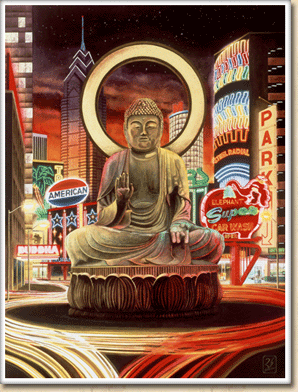
We approach everything in a collecting or accumulating way, in a materialistic way.  We measure success by material substance.  Nobody’s parents tried to raise a great mystic because you wouldn’t do that to your kid in our society.  You see what I’m saying?  You want to prevent your kid from the dark night of the soul.  You want to prevent your kid from the ambiguous, vague, cloudy, uncharted waters of mysticism.  You want your kid to be on the straight and narrow:  They know where to get a loaf of bread.  They know how to put some butter on it.  They know how to eat it.  They know how to feed it to their kids.  They know how to buy a car – that kind of thing.  You want your kid to be prepared for that.  You do not raise a mystic.  A mystic is something you have to contend with in our society.  It is an avocation that is fraught with suffering.

Now why is that?  Well, partially because a mystic goes into a very deep sense of connection.  In order to do that, the mystic has to plow through issues or plow through whatever it is that one plows through.  The other reason why being a mystic is so darn painful is because no one has any respect for that kind of thing.  A mystic in our society probably is a dreamer or a ne’er-do-well who can’t dress, who has no sense of self whatsoever, is socially inappropriate, and can’t figure out how to catch a cab.  Or maybe a mystic is someone who is depressed, possibly should be on Prozac.  These are the kind of things that we associate with a mystic’s life and that is why nobody has ever been encouraged to be like that.  The idea of really profound deep mysticism scares the pattooties out of us.

But in another culture where that kind of ideal is held up as being something pure, something wonderful, something significant, one’s experience regarding mysticism is entirely different.  There is a dignity and nobility about it.  There is a sense that this is a worthwhile occupation.  There is definitely less fear of having the freedom to utilize one’s life as a vehicle for true deep mysticism and spirituality.  One of the reasons why it’s more comfortable and easier to get connected to it is because one isn’t socially ostracized.

Now the great thing about being a mystic in America is that, once you get to the point where you’re really good at it and somebody finds you and you can market it – – maybe write a book or two, maybe sell something that you’ve given rise to – then you can be a success.  Mystics in our society can also be successful after they’re dead.  I really don’t know why.  If any of you know why, tell me.  But while we’re alive, we don’t have too much hope.

So how does this affect our sense of personal practice, our sense of taking refuge?  How does that connect with all of that?  We find ourselves in a difficult situation.  We are really limited, and we can’t see where the limitation is coming from.  We don’t know how deep we can quest or search and how profoundly we can make the connection between the external environment – between the ordinary view – and our deepest most intimate spiritual nature.  We feel somewhat limited in knowing how we can make that connection.

Let’s look again at some very important factors.  Think of how we follow religion in our country.  For the most part, here in the West, we believe religion is one of the many things that you should have in order to live a moral life.  It’s part of the palette of a moral life.  (This is kind of interesting, isn’t it?)  Many of the people who are deeply religious according to our society’s capacity have adapted their religion from their upbringing.  Somehow they got the message that in order to be part of that big, successful, materialistic picture you have to maintain a certain status quo concerning moral, ethical and spiritual issues.  It isn’t your heart.  No, you wouldn’t want that, because that’s that flaky stuff.  It’s really hard to have all that you’re supposed to have if this religious thing is so in your heart that it is your heart, that it speaks to you every minute, that all of your decisions are based on what you know to be true spiritually.  There’s not much chance that you’re going to be the big accumulator your parents hoped you would be if you go like that.  So religion is tamed.  It becomes insipid.  It becomes a thing that we do as part of the whole picture of who we are, but it does not really nourish us in the way that we want it to.  And we end up blaming the religion or the minister or the teacher or the prayers or something.  In America, our religious spiritual picture is not empowered.  It is not deepened – not in the way that would set us on fire.  I don’t mean this in a fanatical way.  I mean this in a way where we are never very far from what feels like spiritual truth, from what we know to be good, from what we know to be deep and meaningful.  It is very difficult for us in this culture to maintain that kind of spirituality.

Copyright © 1996 Jetsunma Ahkon Lhamo.  All rights reserved
Rest, Retreat and Compassion

The following is from a series of tweets by Jetsunma Ahkon Lhamo:
 

Hello all! I’ve now got my blackberry replaced. It died from a coffee spill. RIP li’l feller. 
 

Now at my destination I am resting and will soon begin retreat in earnest. All has been travel, stay overs, re-connecting with the people of Palyul — so good. 
 

Now resting, study, practice.I will be back eventually, when it is safe, I’m healthier, and justice is finally done. I look forward to returning home. Grateful for the love and care I have been shown. 
 

Photos newly dug up are now available. At last the splendor of Palyul is here for all!I have so much to share with you! Ancient stories, teachings, modern from the heart teachings too. Slowly, one step at a time.
 

I’ve asked my students to keep up with the Occupy DC movement, and to help them. For now, hearty Tibetan soup, called tukpa with barley dough balls. Best food there is. Can we get more support to feed vegetarians please? And boiled eggs always help. Plus fresh fruit and coffee! 
 

Here I am treated like a queen. And want to be sure all are treated so well. 
 

My back is pretty messed up so I have to stay off my feet some, and walk with sticks some. I must conquor this pain! 
 

But in every other way it’s all good. I’m so much less stressed not having to look over my shoulder to see if I’m being followed. This is pure bliss and peace here. And inspiring too. It feels like a whole new chapter of life, at least my life is about to begin. I just need the opportunity that comes with safety and Bodhicitta, and will do all I can for sentient beings. That is all that matters to me. To postulate about Dharma is useless. To bring the love is without question the way to awakening and peace! 
 

OM MANI PEDME HUNG!

Guide Your Life With Right Though Part 1: Full Length Video Teaching

The following is a full length video teaching by Jetsunma Ahkon Lhamo offered at Kunzang Palyul Choling:


Right thought is part of the 8-fold Path first taught by the Buddha as he described the method for exiting suffering. Jetsunma explores the concept of right thought and how i weaves with your karma to affect your experiences now and in the future.

© Jetsunma Ahkön Lhamo All Rights Reserved

Prayer to the Guru

The following prayer is from the Nam Cho Daily Practice from Palyul Ling International:

Glorious, precious Root Guru,
Upon the pollen heart of the lotus in my heart,
Without ever separating, always remaining,
Hold me fast with your great kindness.

Pray, bestow the spiritual attainments of body, speech and mind.

To the activities of the glorious Guru,
Not generating any wrong view even for a single instant,
With the faith and inclination of seeing every action in accordance with Dharma,
May the blessing of the Guru flow down to my mind stream.
In this birth and all future births,
May I attain a high birth, a clear mind without any ego,
A compassionate heart and devotion to the Guru,
And may I abide within the commitment of the glorious Guru.

In all lifetimes, may I never be separated from the perfectly pure Guru.
Utilizing the glorious Dharma to its utmost,
And by excellently pefecting all pure qualities on the stages and paths,
May I swiftly achieve the state of Vajradharahood!

The Verses of Prayer to the Eight Noble Auspicious Ones

The following translation of this prayer is from the Nam Cho Daily Practice from Palyul Ling International:

OM To all who dwell in natural, spontaneously present, perfectly pure phenomenal existence,
To all who dwell in the auspicious realms of the ten direcitons,
To the Buddhas, Dharma and assemblies of Noble Sangha,
I prostrate and pray that all may be auspicious for myself and others.
To Drönmè Gyalpo, Tsalten Dondrup Gong,
Jampè Gyenpal, Gedrak Paldampa,
Kunla Gongpa, Gyacher Drakpa-Chen,
Lynpo Tar Pak, and Tsal Drak Pal,
Noble Ones, known for your consideration of all sentient beings,
Noble Ones, known for your superior display of enlightened activities that grant mental satisfaction,
Merely hearing your names increases all glory and auspiciousness.
I prostrate to the eight Sugatas,
The youthful Manjushri, the glorious Vajrapani,
The powerful Avalokiteshvara, the noble protector Maitreya,
Sayi Nyingpo, Dribpa Namparsel,
Namkhè Nyingpo, the supreme Noble Samantabhadra,
Utpala flower, vajra, white lotus, naga tree,
Wish-fulfilling jewel, moon, sword, and sun,
Holders of the excellent hand emblems of supreme noble good fortune,
I prostrate to the eight Bodhisattvas,
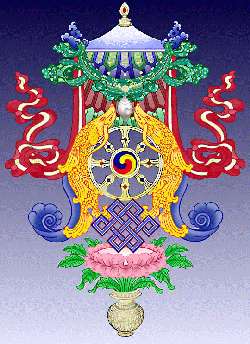
The supreme jeweled umbrella, the auspicious golden fishes,
The wish-fulfilling vase, the exquisite kamala flower,
The conch of fame and glory, the fully endowed endless knot,
The eternal victory banner, the all-powerful wheel,
You who hold these eight supreme precious signs,
Offered to the Conquerers of all directions and times,
Attractive maidens of pleasure, to recall your nature increases all that is noble,
I prostrate to the eight goddesses of good fortune.
Maha Brama, Maheswara, Visnu,
Thousand-eyed Indra, and guardian king Dhritarastra,
Virudhaka, Virupaksa and
Vaishravana, the holders of celestial articles,
Wheel, trident, short spear, vajra,
Vina, sword, stupa and victory banner,
Who make auspiciousness and positivity grow in the three realms,
I prostrate to the eight guardians of the world.
Through the activity that myself and others are about to begin,
By pacifying all obstructions and harms,
May the glory and endowments increase and all wishes be accomplished!
May good fortune, happiness and prosperity be fully endowed!

Guide Your Life With Right Thought: Part 1

The following is a full length video teaching offered by Jetsunma Ahkon Lhamo at Kunzang Palyul Choling:


Right thought is part of the 8-fold Path first taught by the Buddha as he described the method for exiting suffering. Jetsunma explores the concept of right thought and how it weaves with your karma to affect your experiences now and in the future.

© Jetsunma Ahkön Lhamo All Rights Reserved


Seeking Safety and Peace

The following is from a series of tweets by Jetsunma Ahkon Lhamo 


Finally, some coverage here, I can check in with my twitter buddies. I miss connecting. Seems we’ve been moving forever. Unsettling. If you aren’t used to it. And to be safe we’ve been learning to be hyper-alert, stay packed, be willing to eat from McDonalds (AAAAK!) 
 

I feel like I’m in China with the constant minders minding me. Or North Korea. Ah, I guess it could be worse. My stalker could have found and killed me already. I’m still alive so far. Just running. And staying safe. 
 

If and when I reach a safe place to stay I want to go into deep practice and stay there. My mind is affected by the trauma and danger, so I need to heal. Deeply. I’ve no strength at all, and must get my strength back. 
 

I have an RV which would have made all this so much easier! But it is a big target. 
 

As you know by now I’m not safe as the judge dismissed the case, US vs Cassidy. Even though he has a felony record and is known to be violent, especially with women. He’s an arsonist too.Therefore I have turned to victim’s advocates and others for help. There is help for women. But it is hard to find. 
 

I pray for a successful appeal and outcome. What a beautiful day for women. One more step toward respect and safety, toward being heard. Successful women should not be punished for what we do. We should be commended for our contributions, and be allowed the safe passage through our lives in peace!I want to say as well, that I believe in a Woman’s power to change the world. We can do it.


His Holiness Kyabje Dungsey Thinley Norbu Rinpoche


With the passing of Thinley Norbu Rinpoche, the world has lost another great Lama. Thinley Norbu Rinpoche was considered one of the greatest mahasiddhas of our time.  Rinpoche was very close to my own root teacher, His Holiness Kyabje Drubwang Penor Rinpoche.  In fact, His Holiness Penor Rinpoche respected Thinley Norbu Rinpoche so much that he was one of the very few Lamas for whom His Holiness would stand up to greet when Rinpoche entered the room. 

I had the tremendous blessing to visit Rinpoche a number of times, and each time he had very beautiful advice for me.   Thinley Norbu Rinpoche  told me that I could always come and practice with him, particularly if my life force was weak.  I had always intended to go, and wish I had.  But in 1991 Rinpoche came to pay a surprise visit to my center, Kunzang Palyul Choling in Maryland, and gave a spontaneous teaching to the students that were there, and we were able to meet again. Rinpoche was a sublime  writer.  Every book he has written is pure nectar.  

Yesterday morning, I woke thinking of Rinpoche, and then learned of his passing. I am full of grief on behalf of sentient beings for the loss of Rinpoche.  

 
                                                                                                           Ahkon Lhamo
 
Thinley Norbu Rinpoche wrote a number of books, all of which are sublime. They include:
 
The Small Golden Key –  To the Treasure of the Various Essential Necessities of General and Extraordinary Buddhist Dharma
Magic Dance – the Display of the Self-nature of the Five Wisdom Dakinis
White Sail – Crossing the Waves of Ocean Mind to the Serene Continent of the Triple Gems
Practice of the Essence of the Sublime Heart Jewel, the Propitious Speech from the Beginning, Middle and End by Patrul Rinpoche (Translation)
Welcoming Flowers From Across The Cleansed Threshold Of Hope
A Cascading Waterfall of Nectar
The Great Image – The Life Story of Vairochana the Translator
Gypsy GossiP
A Brief History of a Himalayan
Echoes
Sunlight Speech that Dispels the Darkness of Doubt
To read more about Thinley Norbu Rinpoche, please visit Thinley Norbu – Wikipedia, the free encyclopedia
 

Bring the Love

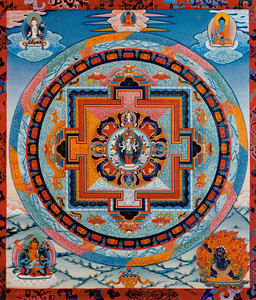
Thousand Arm Avalokiteshvara Mandala

From The Spiritual Path:  A Compilation of Teachings by Jetsunma Ahkon Lhamo

All Dharma, your practice, your teachers, and everything you have ever encountered that has brought you closer to enlightenment—is only one thing: a manifestation or an emanation of the enlightened, compassionate intention of the Buddha. That is why this path appears and why we are able to practice Dharma. If you wish to follow this path, abandon your drunken, compulsive need to be right, approved of, admired. You must rely on the Buddha’s great intention. And after you finally arise in the awareness of your own primordial-wisdom nature, you will of necessity appear again and again to benefit beings. For it is the nature of that state to do so. That pristine state appears in an emanation phase—a spontaneous, natural movement that we may call love.

Who stops the love? You do. Every moment you believe that you are inherently real, you stop loving. Every moment you focus on your “self” and its needs, you stop loving. As your churning desire compulsively creates a deluge of thoughts, you stop loving. As long as you hold on to a “self” and the idea of its eternal existence, you will never be anything but a cheap imitation of the supremely awakened mind. I asked a wonderful yogini in Nepal, “What would you say to women in America who are practicing?” She said, “Well, this applies to everyone, but especially to women. Have courage.” Your practice is meaningless—it amounts to nothing—unless you have courage. You must be strong. You must not let anything stop you. With that fearlessness, you can break through the lethargy in your life; you can break through the barriers that keep you from practicing sincerely; you can even break through the old ideas that keep you mired in garbage. You can understand that by believing in a surviving, eternal ego, you are following a fool off a cliff.

© Jetsunma Ahkön Lhamo

WP2Social Auto Publish Powered By : XYZScripts.com