Commentary on the Bodhisattva Vow: HH Penor Rinpoche – Our Kind Parents

mother and child

The following is adapted from an oral commentary given by His Holiness in conjunction with a ceremony wherein he bestowed the bodhisattva vow upon a gathering of disciples at Namdroling in Bozeman, Montana, November 1999:

[The second way to adjust one’s intention in order to be in harmony with the special feature of this instruction is through] developing attraction to enlightenment. According to this tradition, what leads one to develop an attraction to enlightenment is the cultivation of love for all beings, which begins by contemplating the suffering of cyclic existence and then cultivating repulsion and weariness [toward that existence].

Think about all living beings that at some time or another, throughout the course of innumerable past lifetimes, have been your own kind father or mother. Consider how a mother will anything for her child–even give her own life, without hesitation. Consider how all living beings have been that kind to you at some time in the past–not just once, but countless times, in countless different circumstances and situations over the course of countless lifetimes since beginningless time. Consider also that to not think carefully about repaying this kindness, and thereby to go through your life without the intention to truly benefit parent sentient beings, and so to actually ignore them, is truly shameless.

Many people in the West may think, “Wait a minute! My parents were not very kind to me. In fact, we are not even close, and I don’t even like them, so why should I feel that I need to repay their kindness now?” If that is what you think, then take a moment to think about how you acquired your body. Is it not due to the kindness of your parents that you have your precious human body? From the time your consciousness entered the union of your father’s seed and your mother’s egg, your mother carried you in her own body. Her body nurtured you as you grew within it. Then with pain and difficulty she gave birth to you. Her kindness did not just stop there: for many years she cared for you and lovingly fed, cleaned, clothed, and wiped you; she provided shelter and cared for you when you were sick, and thus she protected you and looked out for you constantly. If you think you don’t need to repay the kindness of your parents, just remind yourself of those events, which you were the recipient of time and time again.

If that still does not change your attitude, so that you still do not understand the kindness your parents showed you, then think about your body, the gift of your body, which is who you are; your parents gave you that. Because your parents showed you the great kindness of giving you your body, your precious life, here you are. Sure you had the causes for your precious human rebirth, but without parents you wouldn’t have your body. And if you didn’t have your body, you wouldn’t be able to receive these vows.

In our present state of ignorance, we have an inability to recognize that all beings have been our parents in the past, and we certainly don’t know what the particular situations and circumstances of those lifetimes were. Nonetheless, it is certain that we have had countless sentient beings as our parents over and over again in countless past lives. The truth is, at the present time we just do not recognize that.

Imagine you are on the bank of a river with your mother and suddenly she falls in and is being carried away by the rushing water. There you stand on the bank, watching that happen. What would you do? Would you do something to try to save her, such as throw out a rope? Or would your turn your back and walk away rather than risk your own life? Would you be concerned for her, or would your concern be only for yourself? The intention of hearers and solitary realizers can be likened to the later case, while the intention of Mahayana practitioners can be likened to the former. While it is important to develop attraction toward peace, you should never, for any reason, be attracted to the quiescence of the hearers and solitary realizers.
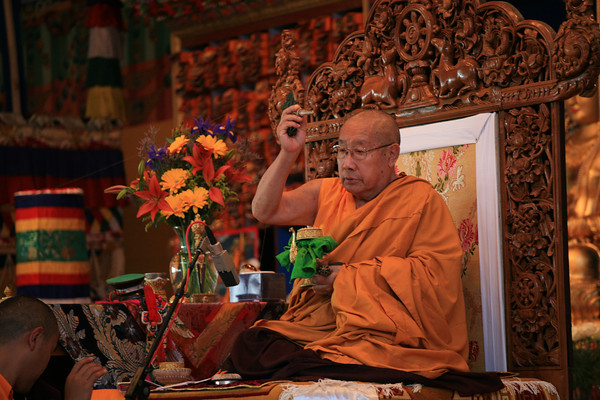
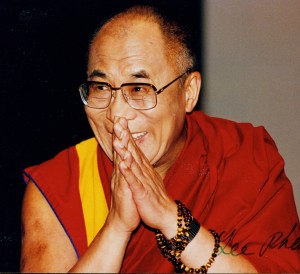
His Holiness Penor Rinpoche Heart Teaching from Palyul Ling

HH Penor Rinpoche Bumpa

His Holiness Penor Rinpoche offered this teaching prior to doing a Ganachakra Puja for Jetsunma’s long life at New York Palyul Retreat Center in 2005.

Today is the 15th day of the sixth month of the lunar calendar.  Jetsunma has some sickness or obstacle, so we are doing this Rigdzin Dupa Ganachakra Puja for her.  Some of Jetsunma’s students here requested this puja.

I met Jetsunma a long time ago.  I examined her for a while, and then recognized her as the incarnation of Rigdzin Kunzang Sherab’s sister known as Ahkön Lhamo.  Ahkön Lhamo, the sister of Rigdzin Kunzang Sherab lived near the Palyul monastery in a nunnery, which is in front of the monastery, and then in a place called Trong Mar, which means Red Valley.  It is called Red Valley because there were lots of nuns.  Ahkön Lhamo used to give teachings there to the nuns who wore red robes, filling the small valley, so that is why the place is called Trong Mar, the Red Valley.  Since then there has always been a nunnery there.  Even these days there are still about 200 nuns there.

I recognized her and then at KPC a long time back we did an enthronement ceremony.  Before I met her, she was giving the teaching on generating bodhicitta. Just among her disciples, there are 2-3 at all hours of the day and night trying to meditate on bodhicitta.  And she carries on Dharma activity in accordance with the other activities.

Since I named her in that way, there are lots of people in America who are jealous and have all sorts of problems with it.  That kind of jealousy doesn’t harm her; it harms the person who is jealous.  Many people also try to complain and say things to me.  Although people ask me many questions about that, I don’t have to humiliate myself, because I am a Palyul Throneholder, and I have my own rights regarding what I need to recognize.  Of course I cannot tell lies, but what I need to do, I’ll do.

Most of the other Nyingma schools just believe whatever I say, and especially all the Palyul traditions or Palyul monasteries.   Of course they believe me 100%.  There isn’t just one Palyul Monastery.  There are hundreds and thousands, and in all those monasteries there are a hundred monks or a thousand monks, and all of them respect whatever I command.  There is nobody who says, “This is right or this is not.”  But in America because of jealousy, some people say certain things, but there is no meaning.  In general America is a strange country.  Sometimes it is said that, “In your tradition there are mostly male teachers, and there aren’t any female teachers.”  And then Jetsunma is appointed and then again they are jealous and say something else.

Since we are human beings of course it is possible to make mistakes.  There is no one who just sits there like an enlightened Buddha.  Just because one doesn’t understand or makes a little mistake or does something, then you start complaining.

Jetsunma is a good and perfect teacher.  I don’t think she is deceiving anybody.  And among Jetsunma’s students, there are a whole bunch of monks and nuns, and she disciplines them all.  There is nobody else among women in America who could do that.  She is good and special. It is good for everybody to know that she is also one of the Palyul tulkus.  These days she is getting older and she has all sorts of sickness.  So for her longevity of life, we are doing this Ganachakra Puja.

It’s not just Jetsunma.  In America there are many other females and males who are incarnated ones.  But the problem is that the nature of Americans is to have so much pride.  With the recognition, the pride and ego develop so much that in the end it is difficult to benefit. As a practitioner and as a bodhisattva family, then naturally one should be humble and peaceful and loyal to the practice.  Developing pride doesn’t really help anybody.  When it is said that you are good or something special, then their pride or ego develops.  If that happens, then it is more harmful than beneficial.  For those who are noble beings, receiving all these teachings and doing the Dharma practice can benefit other beings.  Otherwise thinking that, “Oh, I’m something very special,” is like having a horn on your head and walking around.  It doesn’t help anything.

Anyhow, today we are doing this Ganachakra Puja for the longevity of her life.  Thank you.


India 1996: HH Penor Rinpoche on His Recognition of Jetsunma Ahkon Lhamo

The following is a transcript from Jetsunma Ahkon Lhamo’s visit to see her teacher, His Holiness Penor Rinpoche in India in 1996. Two YouTube Videos below show the ceremony from which the transcript was taken:

Kata ceremony in India 1996

His Holiness Penor Rinpoche:

This evening we are gathered here today in our monastery, also together with our Washington sangha.  On this occasion, I would like to reiterate some information that maybe some of you are not aware of and that is initially, of course, the founder of the great Palyul tradition and the individual who is responsible for the establishing of the original monastery together are the great Vidyadhara Kunzang Sherab, his sister, Genyan Ahkon Lhamo, lived her life at that time.  Initially, when I first traveled to the United States and I met Jetsunma, I noticed that she had developed in her mind stream a very great development of the bodhicitta, the awakened mind and that she had taken the vow to work for the welfare of all parent sentient beings according to the meaning of the awakened mind.  Dependent upon that she had certain students who were following her example in that the bodhisattva vow was being taken by them and they were making prayers that were ongoing as a vigil for 24 hours throughout the day and night.  This was something that was going on for some years without ever stopping.  And so, this is what I first came to notice, such a remarkable thing.

At this time, in the Western country, in her situation, it wasn’t really a circumstance whereby she was depending upon a teacher to be trained and that she had been trained and was doing this kind of practice from that point of view of having trained and having learned it from another.  But in fact, it was natural.  It was a natural practice and a natural development of the bodhicitta, and it seemed to be something very pure and great.

And so to me, I felt quite amazed.  And then I thought about it on many occasions after that.  I’m not someone who claims to have much experience or any kind of clairvoyant insight at all, but I do have thoughts which come to mind from time to mind and in examining the reoccurrence of my thoughts, I came to realize that she was an individual who was blessed and carrying the same mind stream and prayer as the sister of Kunzang Sherab, Ahkon Lhamo.  And so, I recognized her to be the reincarnation of Ahkon Lhamo.

However, because in the West, the concept of tulku, which is “intentional manifestation embodiment” is not something that people are necessarily accustomed to or something that they necessarily would understand.  So, realizing that if I sort of suddenly laid out this fact, that it might be something that would be too potent or it would happen too quickly for what people could really understand.  I didn’t speak about it for some time.

Generally speaking, the Buddhas and bodhisattvas, for the purpose of sentient beings, they manifest in whatever way can bring benefit to others.  This is due to the force of their prayers and their compassion.  Dependent on that, they will take rebirths that are undetermined and uncertain time and manifest in various ways anywhere and at any time and anyplace.  And so, it’s not to say that they don’t manifest in the Western countries.  Certainly, they do.  But because the tradition of discovering a tulku is not something that is common to the West, then I was not inclined to make a recognition just right away like that, bearing these facts in mind.

And also to make a recognition of a tulku in the West I also came to know is not something that would be disagreeable to the students that was entirely wanted and very agreeable.  So, knowing that and finding the right time, upon my return, I did make a formal recognition and I was overseeing the formal enthronement of Kunzang Sherab’s sister, Ahkon Lhamo, as she is.  Now, this is not something that you don’t all already know about, but I am reiterating it here on this occasion just to make it very clear.

And now in Washington, D.C. under the guidance of Jetsunma, we have a very strong and well established Palyul dharma center that is a seat for the Palyul lineage and it is being upheld accordingly and this is something that has been established and has been maintained for many years now and so, this is the type of activity that she is conducting for the purpose of the doctrine along with the help of her sangha and the honor of the morality that is maintained by the greater sangha community that surrounds her.

In Washington, Jetsunma teaches to her students and the students maintain the confession practices and other requirements and she also maintains regular teachings to several hundred students who are practicing now under her guidance.

And also, in the countries in the West, right now our center in Washington has the largest ordained community of disciples who have taken the formal vows of lay and novice and full ordination.  Of course, there are Western students who have embraced these vows in other centers and in other places, but the largest community is the Palyul Center in Washington under Jetsunma.

Therefore at this time, Jetsunma and several of her students have come here to our monastery, Namdroling, to take a look around and to join us for these few days, so I would like to thank you very much for coming here and taking the time out.  And also, of course, I would like to thank you for your effort in establishing the Palyul doctrine, the Nyingma doctrine in general and the greater doctrine of the Buddha in its entirety.  I would like to thank Jetsunma and all of her students and also for their efforts they have shown towards attempts to help us achieve a free Tibet.  So, thank you very much.

And as it has gone well until now, I also have an expectation that on into the future, that the entire sangha and our sanghas together will maintain this auspicious connection for the benefit of the doctrine and sentient beings and that year by year, this will only increase and that also all of your studies of the Buddhadharma will be most excellent, very stable and always improving.

Today, although I don’t have too much too offer, very humbly, to indicate the special occasion and also with prayers for Jetsunma’s longevity and the longevity of the doctrine, I offer her the white scarf of auspiciousness.  And in support for her longevity, I offer her the image of Buddha Amitayus; as a support for her enlightened speech to be ever increasing, I offer her the vajra and bell; and as a support for the enlightened mind the stupa, I offer her the collected works of terton Jetsun Nyingpo; and I offer her the crossed vajra as a seat for her to remain upon to indicate her longevity in this world, and the white conch shell, another brocade, a bolt of brocade.  Otherwise, I don’t have too much to offer.

And now, go on about the rest of your journey.  Please know that we are always one family, so you must come again and again.  The door is always open in that way and that Jetsunma and all of her sangha, I will offer the prayer that you will always be well and that your practice and everything that you wish for will always continue to increase and bear fruit.

JETSUNMA:   Please tell His Holiness that his kindness is immeasurable, and tell him and that in this and every future lifetime, I will follow him. I will always do as he has taught me.

Part 1

Part 2

Copyright © Jetsunma Ahkon Norbu Lhamo All rights reserved

How Buddhists Think

671623700_lp-hhdl-1-300x274

By Jetsunma Ahkon Lhamo

An excerpt from a teaching called “How Buddhists Think”

Some years ago, His Holiness the Dalai Lama took part in an interfaith discussion at a cathedral in Washington, D.C.  The Episcopalian ministers and Catholic priests repeatedly stressed the sameness at the core of all religions.  His Holiness stood up and said that in some respects we are all the same: we all wish for peace on Earth, we wish for the benefit of beings, we wish for the end of suffering, we wish to attain a level of consciousness in which we are unified with our optimum goal, whatever that might be.  “But,” he said, “between your religion and my religion there are fundamental differences.  And that has to be okay.  There has to be unity in diversity.”

Although I would certainly never speak for the Dalai Lama, I assume that the “fundamental differences” to which he referred have to do with Buddhism’s lack of an external God.  This is generally not understood by Westerners.  The Buddha’s teachings do not advocate the attainment of oneness with a God, with anything external.  Instead, the Buddha teaches the essential sameness of all phenomena, pointing out that in the beginning there was no distinction.  The Buddha tells us that such a distinction exists only in our mind, which is fixated on self-nature as being inherently real.

In truth, our Nature is all-pervasive.  There is no separation.  There is no distinction.  When Realization is achieved, it is a non-specific awareness, a luminosity, an innate wakefulness.  The process of fixation, of contrivance and distinction, is pacified.  That is not the same as attaining oneness with anything external.  The Buddha leads us to pacify the delusion that causes fixation on duality.

There is no optimum state one has to create, no supreme being towards whom to move.  For a Buddhist, the goal is awakening.  It is an awakening to the Nature that cannot be nearer, or stronger, or better than it is now.  It can never be tainted, pushed away, destroyed.  It remains stable and unchanging.  It is simply “Suchness.”

Copyright ©  Jetsunma Ahkon Lhamo.  All rights reserved

The Feast


Tsog - A Spiritual Feast

The banquet is ready
The feast is set
And never will I forget
The taste, the sweetness.

The Bodhichitta, sublime display
Of all the Buddhas. Sweetness
Without measure. Peerless pleasure
The dazzling play of light
And essence.

Oh! For the day still coming
When virtue prevails
The ship to Liberation sails
For you. Come aboard!
Know the Lotus Lord.

In this day, in this time,
Taste the bliss- love sublime awaits.
Where are you? Will you obey
The call within, or turn away?
Will the treasure be yours, today?

Oh, Beloved, will you stay?

By Jetsunma Ahkon Lhamo on October 23, 2009

Limitless Kindness

An excerpt from a teaching by Jetsunma Ahkon Lhamo from the Vow of Love series available on Amazon

One of the most important and central thoughts in Buddhist philosophy is the idea of compassion. The Buddha taught that we must cultivate our lives as a vehicle to be of benefit to all sentient beings.  It’s good that you’re a good mother, and it’s good that you’re a good friend, but we can’t limit ourselves to a small, familiar circle. We have to go on and on increasing our compassionate activity, our influence and our determination until we attain a level of kindness or compassion that supersedes what we believe is reasonable. We can’t stop even with our nation. We can’t think that we only want to help Americans. Nor can we stop with our world. We can’t think that we only want to help humans and animals, which are the ones that we can see. We have to think, according to the Buddha, that we wish to be of benefit to all sentient beings.

A sentient being is one who has sensory feeling or the development of that kind of discriminating consciousness. According to the Buddha’s teachings, there are six realms of cyclic existence, and there are sentient beings in all of these realms. The human realm and the animal realm are visible to us. This is living proof that at least some of the Buddha’s teaching is right. We see human beings and we see animals; therefore, we know that they exist. But according to the Buddha’s teaching, there are also non-physical beings and different kinds of beings that must be considered if we are to truly develop the mind of compassion.

Limiting ourselves to an identity such as,”I am a woman,” or “I am a man,” or “I am an American,” or “I am a Russian,” or even “I am a citizen of planet earth,” is not the way of the Buddha. Instead, we should think that on every particle we can see, and all those that we cannot see, and in every inch of space, there are millions and millions of sentient beings. And space goes on forever. If we intend to develop the mind of kindness, it must extend to all sentient beings equal to the limits of space.  Space has no limits and there are limitless beings, seen and unseen.  Therefore, we must extend the mind of compassion to beings far beyond those we can conceive of with our brains. That is an awesome thought. How can we really do that? We think that must be impossible. How can we be directly concerned with somebody we can’t see? How can we really care about something that might be infinitesimally small, like bacteria? Or a sentient being that may be as large as a galaxy? How can we seriously consider we must be kind to all sentient beings in that way?

When you develop the mind of compassion, you have to be careful how you develop that mind. If you examine yourself profoundly and honestly – and you have to be willing to be very honest with yourself – you may find that your goal is not really to benefit all sentient beings, but to be a kind person. There are worlds and universes of difference between these two goals. One is selfless: you truly wish to be of benefit to all sentient beings. The other is heading in the right direction, but ultimately it is not selfless because you wish that you could be a kind person. I hope that you can hear the difference between these two ideas. There are worlds of difference between them.

© Jetsunma Ahkön Lhamo

Love Like the Sun

Most people love with a “hook” at the end, better to love like the sun, radiating in all directions.

Why remain angry and disturbed? Watch a tree and it’s attendant breezes. And know that you are loved!

Why argue with the moon? The moon only reflects it’s Master’s lighr. Better to gaze in peaceful contemplation!

Why grasp at the love of a lover? Better to gaze with wonder at the face of the beloved!

Why fight with one’s friend? Better to sit at the stream and talk of gentle things!

From a series of tweets by Jetsunma Ahkon Lhamo

WP2Social Auto Publish Powered By : XYZScripts.com