The Time to Practice Phowa is Now

AS-x-21 Charlie Grant-M

The following is an excerpt from a teaching by Jetsunma Ahkon Lhamo offered during a Phowa retreat:

I would like to explain one question that I think is necessary to clear up at this point, because if it isn’t cleared up, you will assume you know more than your spiritual mentor. You will assume that you know how things will go at the time of your death, and you will not follow through with your practice. Many people look at their books and they think, “Well, here’s a pretty thick book and here’s a kind of thin book. I have no idea whether, at the time of my death, I will have time to open my practice.” Well, you’re right, you don’t have any idea whether at the time of your death you will have time to open your practice. Now do you really think that wasn’t thought of? I mean, c’mon guys, lighten up. Remedial Dharma 101. This has been thought of. Really. Lots of people have died. We pretty much got it down. So worry not. Now here’s what actually has to happen. This book [thick] and this book [thin] are not for the time of your death; they are for now. They must be practiced now. There’s a really good chance that at the time of your death you will not be able to pick the books up in time. And you may drop them. And you may not have enough breath to finish. Really. This has all been thought of. Don’t worry. These books are for now.

Copyright © Jetsunma Ahkon Norbu Lhamo All rights reserved

The Peaceful Deities

bardo_mandala

The following is an excerpt from a teaching offered by Jetsunma Ahkon Lhamo during a Phowa retreat:

On the third day Ratnasambhava Buddha appears with yellow light. Again, same scenario: too brilliant, scary. At the same time, the blue light of the world of humankind is also manifested, and you will feel very familiar with the blue light of the world of humankind. Although being reborn as a human is considered a very auspicious rebirth, if you have a chance to either go to Ratnasambhava’s pureland or experience that nature that is Ratnasambhava, or be reborn as a human, take Ratnasambhava.

Amitabha Buddha appears on the fourth day with red light. The red is so brilliant and so luminous and so pulsatingly brilliant that we can hardly bear it. And at the same time the yellow light of the world of hungry ghosts will appear. We’re used to yellow light because we’re used to desire. It is vibrationally familiar to us, and it will seem, therefore, like a softer and more welcoming light. Do not follow the yellow light of the hungry ghost realm.

Amogasiddhi Buddha appears on the fifth day with green light. At the same time, the red light of the worlds of animals and demigods are manifested. Again, do not follow the red light. In this case, it is softer, easier to live with, and yet it is Amogasiddha that you want to follow, with the brilliant green light. Always choose that brilliant light.

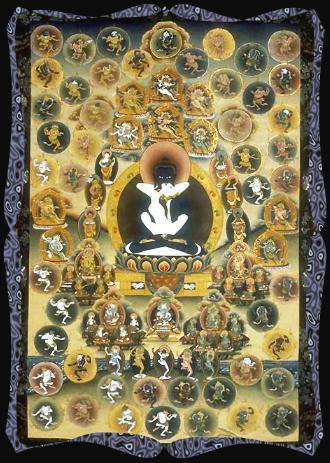
On the next day, the sixth day, all five Buddhas appear at the same time, with the lights of the six classes of beings. All of the forty-two manifestations of the Buddha that are considered the peaceful deities will then appear. They will be manifested because they are all representative and they are displays of the very elements that are intrinsically within our own nature, so therefore they must appear. It is the nature of the bardo that what appears subjective then becomes objective. What appears to be our own intrinsic nature is seen in an external form. So all of the forty-two peaceful deities will be manifested in our mind, and then they are followed by the fifty-eight wrathful ones. These manifestation scenarios last for about three weeks, unless you take one of the doors. One of the doors would either be, again, recognizing and going toward the Buddha nature in whatever form it appears, or it will be taking one of the doors of the six realms that constantly appear as a more seductive and more familiar light. This goes on for about three weeks.

Now you say to yourself, “When the peaceful deities show up, sounds to me like a good day at the park. I can live with that, being surrounded by all the deities.” But again, it will be unfamiliar; remember that—for a non-practitioner, and even for a practitioner who has not really accomplished their practice very well, or not yet. How are you going to deal when the wrathful deities come in, and what is their nature? What are they? Are the peaceful deities the pleasant and friendly ones and the wrathful deities the punishing ones? Who are the wrathful deities and how should they be understood? How can we avoid being frightened of them? Because they are terrifying. This is what we are going to learn in our next session.

Copyright © Jetsunma Ahkon Norbu Lhamo All rights reserved

Vajrasattva in the Bardo

Vajrasattva-single

The following is an excerpt from a teaching by Jetsunma Ahkon Lhamo offered during a Phowa retreat:

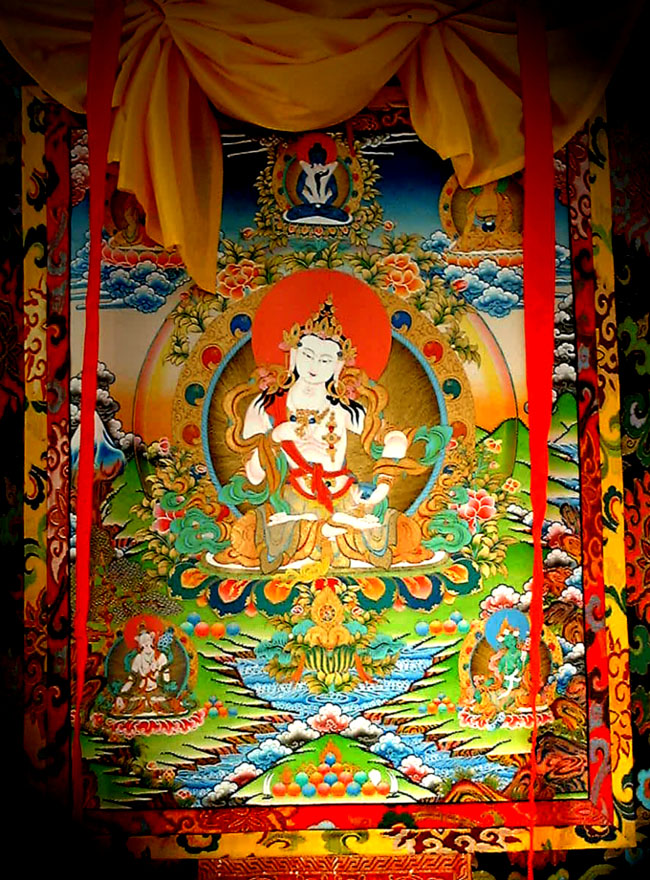
On the second day, here they’re saying Vajrasattva Buddha appears. This is Vajrasattva, the very same one that you are practicing in your Ngöndro. Think how ready you will be for him! The minute he shows up you’re going to go, “Yes! I know who you are!” In this case, Vajrasattva Buddha is also associated with Akshobya Buddha, but he will appear as Vajrasattva Buddha on the second day with white light. And again, the white light will be unnaturally brilliant, according to what we have understood, dazzling, frightening in its dazzling light; and at the same time a softer, easier on the eyes (even though there are no eyes, we have that kind of perception in the bardo at that point), black light, the softer black light of the hell world, will manifest. Now listen to how tricky this is. We are faced with an unnaturally white, unnaturally bright, scary light, or a softer, black light that, because we have felt hatred more than we have felt Vajrasattva, we are more familiar with. It will not be so frightening to us. It will be softer, and it will seem to be seductive, more so than the white light. So what we have to do is to be sure and avoid that black light, because that black light results in rebirth in one of the hell realms.

Copyright © Jetsunma Ahkon Norbu Lhamo All rights reserved

The Bardo of Dharmata

five-buddhas-2

The following is an excerpt from a teaching by Jetsunma Ahkon Lhamo offered during a Phowa retreat:

After the three and a half days of unconsciousness occur, another period begins which is called the bardo of dharmata. It’s also called the bardo of becoming. It looks or feels as though a person is emerging from a deep sleep. It is at that time that a person actually fully realizes that they are dead. If they have no training, then they have no capacity to realize beforehand. This is, again, three days after, and in some cases the body has been handled, or the body has been cremated. The person, although they are unconscious at that time, still has enough of a connection that when they wake up they are aware (and they are even residually aware in their sleep) of what the body is experiencing. Do not cremate the body before three days. Do not do that. Giving body organs? It depends on how you feel about it. There’s a lot of virtue in that. The timing? Well, you have to do that immediately; there’s no choice. But in that case you would be doing something compassionate, and even though it wouldn’t be the best for your own death situation, you would wait until the inner death ceased. The wise thing to do would be to have a lama come and practice Phowa with you. The inner wind would have ceased. If the lama is worth their salt and you have any devotion, you should be all right by that time, and you can then donate the organ within a reasonable amount of time. But for myself, my decision is that even though I would love to just keep manufacturing organs for lots of people to have, I would love to just keep giving them out, my decision is that I feel I can help people better during the course of my life; and I also want to achieve for myself, again and again, the most auspicious birth so that I can return again and again in a form to benefit sentient beings. I feel that that is ultimate benefit for sentient beings, rather than what my eyes could give, or something like that. So it’s a question of how you want to benefit sentient beings.

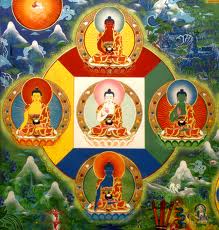
It is during this period, in the bardo of dharmata, that the Buddhas of the five families begin to manifest themselves. Now when you think of the Buddhas of the five families manifesting themselves, what do you think happens? Do you think that they have some sort of warning bell that tells them when you die, and they sort of know,“Oh, she’s dead. Better hurry up,” so they run from the five different directions and they come over and visit you, and they just sort of hang out, wave at you? No, it’s not like that. Actually, the Buddhas of the five families are seen as separate displays and separate emanations, but they are intrinsically present in our minds as our own nature, our own five wisdoms. So you can say that the Buddha families each represent our own subtle intrinsic wisdoms. Whether we have them developed or not, that’s another story. For instance, we think about Amitabha Buddha. That family, the Lotus family, is associated with discriminating wisdom. Ratnasambhava Buddha, associated with the Ratna family, is the wisdom of equanimity. Amoghasiddhi Buddha, associated with the Karma family, is accomplishing plain wisdom, and Vairochana Buddha accomplishes the wisdom of the dharmadhatu. That’s the awareness of what is and what is not, as one. Akshobya Buddha is considered the Buddha of mirror-like wisdom. So each one of these is our own intrinsic awareness, our own intrinsic wisdom. As to whether or not we have them developed, that is another thing.

Copyright © Jetsunma Ahkon Norbu Lhamo All rights reserved


The Power of Karma

indra

The following is respectfully quoted from “Naked Awareness: Practical Instructions on the Union of Mahamudra and Dzogchen” by Karma Chagmé with commentary by Gyaltrul Rinpoche

You can’t give someone else either good karma or bad karma, any more than you can give them virtue or non virtue. These are things that we accumulate and commit for ourselves. Whether we die in the womb, have a short life or a long life, these are the result of our karma.

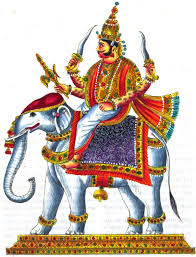
Even great gods, such as Indra and Brahmā, with their extraordinary powers, are powerless when the karma that propelled them into their present existence is exhausted. The reason for the precept not to take refuge in mundane gods such as these is that they, like ourselves, are still entrapped in this cycle of existence. Since they have not liberated themselves, it would be difficult for them to liberate anyone else, so they are not suitable objects of ultimate refuge. Moreover, if you take refuge in, or absolutely entrust yourself to, other beings who are subject to the five poisons, you really have a problem, because they can’t release you from something they are not free of themselves. So this precept is truly for your own sake.

Some mundane gods may actually be great bodhisattvas, or even emanations of the buddhas appearing in the form of Indra, Brahma, and so forth. Nevertheless, it is generally good counsel not to take ultimate refuge in any of them, for it is difficult to discern which ones are actually bodhisattvas or emanations of buddhas. In a way, we don’t really need to worry about this. We don’t have much, if any, direct contact with such gods anyway.

Cycle of Existence of Birth and Death States

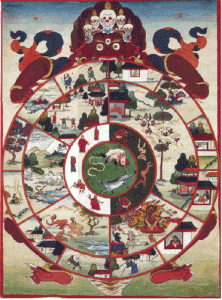
wheel7_500

The following is respectfully quoted from “Naked Awareness: Practical Instructions on the Union of Mahamudra and Dzogchen” by Karma Chagmé with commentary by Gyaltrul Rinpoche

The Chapter on the Cycle of Existence of Birth and Death States [583]

Wherever one is born in the three realms,
That birth is dominated by karma.
Death as well is dominated by karma.
When the time comes for birth and death,
The gods gradually fall from the heavens.
Despite their great miraculous powers, they are powerless to remain.


Preparing for the Journey

20130123142638advance-directive

The following is an excerpt from a teaching by Jetsunma Ahkon Lhamo offered during a Phowa retreat:

When they are unreachable during this three and a half [days] period time, according to traditional teachings, it says, “Care should be exercised not to touch the body for at least three days. That is the optimum. But certainly not while the event of death is occurring.” Remember what I told you about that yesterday. Certainly you must not do that. The best case scenario—and this is what the lamas all ask for—is that the body should not be touched at all, other than perhaps up here [crown] while they are dying, for three days. Many lamas arrange for that to happen. You have the right to arrange for that to happen as well, but you have to write it down legally. You have to have it notarized; it has to be legal. You have to register that with someone. You have to give that to someone who is interested in protecting you and who will fight for you at that time, because the relatives that do not understand, the friends that do not understand, will want things differently, you see. They will not accept. So you have to make your wishes known; and your wishes will be respected if they are legally written down. You should prepare for your death in that way.

It is considered that actual death starts when the external breathing ceases, but it’s only final at the moment of the black path. It is during the event of the black path that the internal wind ceases. That’s when the white tigle and the red tigle have joined and the black path ensues. At the moment when the mind falls into unconsciousness, the cessation of the internal winds then occurs. And in the case of accidental death, all of these things that happen very gradually must happen very much more quickly. So although some people pray to be hit by a truck and have it over and done with quickly, do not pray for that, do not ask for that. If you want to pray for anything, pray for a slow and knowledgeable death—one that you know and understand, and can track and relate to, and be the captain of. That’s what you should ask for. It’s so different from the way we think ordinarily. We think, ‘get out of here quick,’ you know, make it easy. But again, that’s like trying to go through your life with all the lights off, trying to go through your death with all the lights off. It isn’t wise. It will not bring a good result, and you will be afraid.

Copyright © Jetsunma Ahkon Norbu Lhamo All rights reserved


Devotion in the Bardo

MG-0002-JAl Rigzin Pema-L

The following is an excerpt from a teaching by Jetsunma Ahkon Lhamo offered during a Phowa retreat:

Now we’ll speak about the bardo of becoming. I forgot to mention to you that I’ve had many opportunities to practice Phowa on other people, and I’ve noticed that in every case, even if the person had been something of a practitioner or had tried to meditate, or had minimal experience, in every case, if you were not there exactly at the moment of death to facilitate the person at that time, there would always be a period of about three, three and a half days where the person was unreachable. Where you could literally practice Phowa for them and it would do no good whatsoever. You cannot rouse them out of the deep slumber or death-like sleep that they have once they do not recognize that clear light. You cannot rouse them at that time. You have to wait until they come to the bardo of becoming. Then the lama will appear to them or try to reach them and guide them out of the bardo.

How well is that done? There are two situations upon which how well that works out are dependent. One of them is, of course, the qualities of the lama—whether the lama has awakened, whether the lama is capable, whether the lama has realization in their practice. That is, of course, one of the conditions. The other one is, of course, the degree to which the student or the person who has died has any connection, even if it’s only a residual connection, with devotion. If the person has no connection with the practice of devotion, if the person has never practiced devotion or has no capacity for devotion, the best of lamas will not be able to reach them in the bardo. It is not possible. They may be able to afford some blessing for them, but they will not be able to rescue them. They may be able to guide them in a better rather than less good direction, but they cannot prevent them from going through the bardo of becoming.

Generally, you have to rely on the student’s connection with devotion.If the student has a great deal of devotion, the lama will be able to appear clearly as their spiritual guide during the bardo of becoming. The lama will be recognizable. The student will have faith in the lama; they will go toward the lama without fear. The force of their devotion will propel them toward the lama. They will enter into the lama’s heart, and they will experience the wisdom that the lama has to afford them. They will be rescued from the bardo and liberated in the state of becoming. So sharpen up that devotion, you guys.

Copyright © Jetsunma Ahkon Norbu Lhamo All rights reserved

The Faint

20125251534_darkness

The following is an excerpt from a teaching offered by Jetsunma Ahkon Lhamo during a Phowa retreat:

Now I want to refer back to this book [Death and the Art of Dying by Bokar Rinpoche] to give you a couple of statements that I think may be helpful. When we last were together we spoke about the white path or the white bindu that dropped from the top of the head to the heart, and we spoke about the white light that is shown. The white method would be to move toward and expect and recognize that white light; that would be the white method. According to this book, the white method or the white path results in the body of emanation or the nirmanakaya form. It is considered that when a tulku appears in the world that a tulku is a nirmanakaya form of the Buddha. So recognition of the white path results in the body of emanation and the nirmanakaya form. Recognition of the red path results in the body of perfect experience or the sambogakaya, also called the bliss form. And recognition of the black path, which is also the clear light that we spoke about, results in the absolute body or the dharmakaya. Now it is considered, actually, that of these, the black path or the clear path, the one that we spoke of last, the recognition of the dharmata, the recognition of the clear light is the most difficult of all of the recognitions. It’s considered that the black path or the clear path is usually available only to those who have practiced mahamudra, which you are learning to practice even as we speak.

I wanted to read to you exactly how this lama put it, but I’m not seeing it. Well, then I’ll explain it to you in my own words, which may not be quite as dramatic but the meaning will be there. It is considered that the great vast majority—that is to say, 99.999 percent—of sentient beings who experience death, and remember, they all do, will not be able to recognize either the white, or the red, or the clear, or black, method. They will not be able to recognize any of those three stages. This is really, really interesting. During each of the times that the lights appear—first the white light, the red light, and the clear light—after those events are finished and you have not recognized any of those lights (and it is very likely that that will happen), it is at that time that you continue on into the bardo. It is then that you actually slip into the bardo of becoming.

If you do not recognize the white light, if you do not recognize the red light, and then if at the end the fundamental clear light is not recognized, then the lama says here, “The mind slips into a deep state of unconsciousness of variable duration, which is generally said to last three and a half days.” Now I have had the experience and the good fortune to have the opportunity to do phowa for a number of other beings. The clear or dark light is, in fact, the appearance of one’s true buddha nature, appearing just so. Just as it is. It is the true face of the primordial Buddha, but those of us who have no training to be able to witness the face of the primordial Buddha literally will not see it. It will be much like going to some sort of desert tribe that has never seen a picture of a boat or large body of water. If you show them a picture of a boat and a large body of water, they won’t be able to recognize it. They do not have the brain pathways or something that will help them to recognize that. And in our case, even though the very face of our true nature, which to a practitioner would be as recognizable as the mother is to the infant or to the child, for a non-practitioner it would be, again, like the child who was adopted out right at birth and never saw the face of their mother. They would not be able to recognize their mother; they would not be able to connect. They would not be able to have the force of surety in conviction to be able to move toward and direct themselves with their own inner force to be able to move toward that reality. They will not be able to slip into meditation on that nature. They will not be able to slip into that non-dual state, even though all of their distracting elements will be dissolved at that point. Literally, if you were a meditator and had that experience, that would be the time, ironically, during the course of your whole life and death experience, where you would be able to meditate the best. If you had experience. But 99.999 percent of the people go to sleep at that time. They have a faint, or sleep, because it looks like darkness to them, rather than light clarity. Their mind is not awake in their meditation. Not awake. When that happens there is no choice and nothing for it, but that we have to go on into the bardo of becoming.

Copyright © Jetsunma Ahkon Norbu Lhamo All rights reserved

The Choice


The following is an excerpt from a teaching by Jetsunma Ahkon Lhamo offered during a Phowa retreat:

What makes this practice of Phowa different from all of that slip sliding and unpredictability, and unclear cause and effect connections, and lack of understanding as to where things come from and why things are a certain way? And what makes this practice of Phowa different from—forgive my French—the bullshit we feed ourselves? Literally the lies that we feed ourselves when we tell ourselves how we’re doing and how long we’re going to last, and all of the ideas we have about how we should leave ourselves alone and not try ourselves too hard. These kinds of ideas are separate from the bardo idea because in life, situations are so confused that you can play that game. It’s not clear. There are so many different ways that you can go. It’s just not clear. There’s plenty of space and time and ability to fool yourself. And we do fool ourselves. We fool ourselves every day. For instance, we pretend to believe that virtuous conduct will lead us closer to enlightenment. We pretend to believe that, but in our lives most of our conduct is in fact non-virtuous. We are slothful. We are lacking in commitment. We are unkind to others. We are not aggressive in our desire to benefit sentient beings. We are self-absorbed. We allow ourselves to wallow in our neuroses, rather than pulling ourselves up, kicking ourselves in the butt, and causing ourselves to just get ourselves together. And we do have that capacity, you know.

So what is the difference between that kind of thing and bardo, and the eventuality of bardo and the idea of Phowa? The difference is that no matter how you slice it or how you bullshit yourself or how you are in denial, no matter how many of Cleopatra’s outfits you try on every day, no matter what you do or what you think, you cannot deny that you will die. This is one eventuality that we all share; and without exception, to the man and woman, we must prepare for this event, because we’re going to go through it. And we’re going to go through it one of two ways: blindly, driven by the forces of karma, and helpless; or we’re going to go through it safe, prepared, aware, and able. Those are the only two choices. Whether we will go through this event, there is literally no choice. Think about that. You have to think about that. I know you have the capacity to think about this, although you say, “Well, I just can’t think about that, can’t think about that. It scares me too much, scares me too much.” But I know you have the capacity to think about that. I know that you do. And you have the capacity to experience the fear. Do not suppress it. Acknowledge that you have that fear. Let it be; and then explain to yourself that we will overcome this fear together through training. Through accomplishing method. The only way to overcome fear is to accomplish method. It’s the only possible way. But remember—about going through this, we have no choice.

We have incredible degrees of choice about how to go through. Just as we have a choice as to how to live, we also have a choice of how to die. And the thing that I would encourage is that, even if you are the rascal of rascals in this lifetime, even if you are so naughty that if I knew I would spank your bottoms! Even if you were just that naughty! Even if you are so naughty that you are childish and you let yourself get away with everything,…  You don’t practice even though you have the method, you just haven’t had the time, you won’t make the time, and blah, blah, blah, all these other things, and then you come up to me and you say, “Oh, it’s because my mind is so unstable, that’s why I can’t practice [hic] practice [hic] practice [hic] practice.” And of course, the answer is the reason why your mind is so unstable is because you haven’t practiced practiced practiced. That is the antidote. That’s what you do when your mind is unstable. But people come and tell me, literally, that they cannot practice because their minds are too unstable. Well, well, well, whatever. So, even if you are that kind of person, remember, you don’t have to practice. I can’t make you practice, I can’t force you to do it. Guru Rinpoche can’t force you to do it. Lord Buddha can’t force you to do it. Neither can Lord Buddha force you to walk through the door of enlightenment. Neither can Guru Rinpoche force you to walk through the door of enlightenment. Certainly neither can I. But the one thing that you will have to do, once again, is to die. You have no escape from that. It is written in stone.

And so what you have to think about is this: Will you die nobly and well? You do have to die, and for the person who is not a good practitioner or who is born with the kinds of mental or physical afflictions that truly prevent them from practicing in a deep and profound way, this is the method. Phowa is what you have left. I don’t see many of you packing your bags to go stay in a cave in Nepal and practice until you achieve supreme enlightenment. I don’t see any of you heading for a seat under the Bodhi tree, planning to sit there and practice austerities, or whatever, just to see how that goes. I don’t see any of you rushing off in some other direction. I see you in your lives, deeply enmeshed in your lives, dealing with the choices and opportunities of your lives. You have many choices.  And you’re right—some of you have less time than others. Definitely you will not have the time that it takes to practice to the degree that you will end up achieving liberation or the rainbow body before your death. Because that takes a commitment that none of us have made yet, that none of us has made within the context of our lives here. We literally cannot do it; we’re not ‘going there’ now. It isn’t the karma of the situation.

So what do you have left? Definitely you have two methods that will help you to die well. Because if liberation is not possible during the course of this lifetime—even though theoretically it is—if for you it is not, then definitely you should understand liberation is possible in the bardo. Even for you, even if you have not practiced well during the course of your life. And that’s truly the biggest piece of candy that I know on this path. It is a big piece of candy, because I know of no other method that can allow for this.

Copyright © Jetsunma Ahkon Norbu Lhamo All rights reserved
WP2Social Auto Publish Powered By : XYZScripts.com