A True Path

An excerpt from a teaching called How Buddhists Think by Jetsunma Ahkon Lhamo

In America, as in few other countries, you can find a multitude of ways to be “a spiritual person.”  When Tibetan Lamas first came to this country, they were appalled.  They were saddened to see there are so many ways to think that you are being spiritual, that you are adopting a spiritual path.  The Lamas saw this as the unfortunate, unbearable, bad karma of the American people.

Doesn’t that sound odd?  Many of us might say: “No! It’s just the opposite!  We can do anything we want, we can be spiritual in this place or that.  We can choose to be traditionally spiritual or non-traditionally spiritual.  This is the land of opportunity.”

But as the Lamas understand it, much of what is assumed to be spirituality was started less than 50 years ago.  Essentially this means we don’t know if it can produce Enlightenment.  Many Americans are diligently trying to cross the ocean of suffering in a boat that has never made it across a lake.

Even in the older religions in America, you can be confused about what goals to pursue.  Some leaders of Christan churches admit that the original teachings Jesus gave are not found in the Bible.  Many teachings have been lost, portions may have been deleted, and the true meaning may have been clouded over by layers of translations.  Many of today’s Christian practitioners have no idea that they could become immersed in a mysticism that will actually change their perception.  Very few understand that they could practice in a way that leads to Realization.

Lamas who came to this country understood that it would be difficult for Americans to be open to the Buddha’s teachings.  So many things in America seem more flashy, seem to promise a great deal more.  New Age ideas include promises of instant healing and even opportunities to talk to Masters from the Great Beyond.  But has anything like that produced Enlightenment yet?  Have we seen the signs?

Buddhist Lamas who came to America had seen miraculous signs.  For instance, both my root gurus had seen Lamas fly through the air.  A close student of one of my root gurus had seen him lift off the ground and hover for some time.  Many of the Lamas had seen the miraculous appearance of the rainbow body after a Dharma practitioner died.

Not long ago, when a Buddhist Lama died, his body was cremated in a fire so hot that his very bones turned into a crispy substance, with a texture somewhere between ashes and potato chips.  Yet his heart remained uncooked, raw!

Many Lamas, I among them, have relics of Lamas who died, relics that are “pearls” produced automatically by their bodies.  When kept in a dark, quiet place, these pearls continue to reproduce themselves.  Lamas I know have told of stupas with empowerments so strong that on one side would come a sweet nectar; on the other, a sour nectar.  The flow was continual, and would never dry up.  This has been happening for hundreds of years. There has been no explanation for it.

When a Buddhist speaks of “a True Path,” this is not meant as: “My religion is better than yours.”  It is not intended to be haughty or prideful.  Rather, we want to be on a path that has repeatedly produced results, and can be expected to do so in the future.

That is how I view the Buddha’s teachings.  They did not come from any ordinary intellectual process or experience, or from a compilation of other people’s views.  They arose from the mind of Enlightenment.

Some people call themselves “enlightened,” and when I hear this, I cease to believe them.  The Buddha simply said, “I am awake.”  He never made himself out to be a god; he never said he was different from anyone else.  He simply said, “I’ve given you the Path.  Now work out your own salvation.”

© Jetsunma Ahkön Lhamo

To download the complete teaching, click here and scroll down to How Buddhists Think


Blinded to Our Own Nature

An excerpt from a teaching called How Buddhists Think by Jetsunma Ahkon Lhamo


Until we attain Enlightment, we are blinded to our own Nature, fixated on the belief in self-nature as inherently real.  We walk through an experiential field that is based on this false supposition, and all desire and compulsion arise from it.  We experience death and rebirth in an endless cycle.  We may feel relatively stable now, but soon we will die and be reborn.  You may think, “Great!  It’s an endless adventure.  It goes on and on.”  Well, here’s the problem: you don’t know where you’re going next.

When you die, you go through what we call the Bardo or intermediate state, in which you experience the content of your mind in an externalized form––almost as if flashed on a screen in front of you.  If you have much hatred and anger in your mind, you will see what looks like demons.  If you have much virtue and loving kindness in your mind, you will have what seems to you a very beautiful and seductive experience.

Hidden beneath that kind of event is the truer experience which occurs to everyone as the elements that bind us dissolve and the consciouness becomes more fluid.  What we experience at that time is our own Nature; however, if we are deluded and fixated, we won’t experience it as such.  We won’t recognize the Buddhas and Bodhisattvas, though we are in their presence.

But if, in the Bardo, your mindstream is free enough to experience the vision of these Buddhas and Bodhisattvas as inseparable from your own mind, it will be overwhelming.  The intense connection will be as strong as that of a child and its mother.  You will run into the arms of Enlightenment!  If you have accomplished the causes I’ve just described, that very experience is possible in the after-death state.

© Jetsunma Ahkön Lhamo

To download the complete teaching, click here and scroll down to How Buddhists Think

Bodhicitta in the World

The following is an excerpt from a teaching by Jetsunma Ahkon Lhamo given at Palyul Ling Retreat 2012:

They say that I am a Dakini.  I’m not so sure but they say I am.  The Dakini has to do with the activity of the Buddhas.  And so that being the case, I feel it is my responsibility to try to bring some benefit in the activity way.  So I try to feed everybody – animals, people, and the birds outside my house.  Everybody knows that we spend a lot of money on feeding people and feeding beings.  And it is a happy thing to do.  It makes us all happy.  So many beings are fed.  And they are having what they need because of the kindness of His Holiness Penor Rinpoche, and what he taught me.  The precious bodhicitta, the nectar of kindness that is inherent in the dharma.  This is what I was taught, what I learned, and its what I practice.

We have a prison program also.  We like to forget people who have done something wrong and just throw them away, but we have a program where we can go and teach prisoners some dharma, because these men will die in prison.  And they will have no way to get any kind of help or straighten themselves out for a proper or good rebirth.  They don’t know how to die well.  They have no teachings on Phowa.  It makes us sad, and so that being so said, we’re able to go out and do these things.  And it is why KPC is always broke.  We don’t have any money because we spend it on the needs of sentient beings, and I am very happy about that.  That makes it worth it to me.

In our food program there are many people who don’t know how to cook the kind of food that we provide for them, because they are poor people and they are used to cheap food.  And so we have been trying to teach them how to cook lentils, and beans, and rice and things that are very nourishing.  We try to teach them how to make protein, and how to eat well so that they feel better.  This is a totally new thing for them.  They don’t know how to be healthy, and their children don’t know how to be healthy.  Many of them eat too much sugar and too much candy and they are unwell.  And so we are teaching them.  We are involved enough in the community to teach them how to cook, how to prepare food and what food is nourishing, and what is not.  These are great pleasurable things that we do.  Not that they are so great, but they are great pleasure.  To see people become nourished.  To see people learn some dharma, whether they understand it or not.  To even understand, Om Mani Pedme Hum.  To even repeat Om Mani Pedme Hung is so much better than anything else they could receive in the ordinary world.  Very simple things like that can make the world of difference, as you know.

Copyright © Jetsunma Ahkon Norbu Lhamo All rights reserved

How to Pacify Hatred, Anger and Attachment

The following is from a twitter conversation between Jetsunma Ahkon Lhamo and one of her followers:

Questioner to Jetsunma: That’s very true. I have to work hard not to hate. It hurts the hater most of all.

Jetsunma: Here is a method to pacify hatred and too much attachment, which are often combined. This sounds gross but it works!

Okay, let’s find out about this person. First, imagine the eyeballs hanging on a branch. Head sliced thin. One arm near your feet the other about a mile away. Torso also sliced thin. Imagine legs dumped in ocean. Now, where is the one you hate or love? Are they in the hanging eyeballs? The arms here and there? The floating legs? The slices? Where is the person? The mind? What do you hate/love? Can you find them? This will loosen the attachment that causes the emotion by recognizing it’s all just phenomena and fundamentally void. Keep doing it until you feel better and see how odd it all is. You cannot harm the other person or yourself unless the motivation is malevolent. You are trying to learn and heal. That is an ethical and useful method, then dedicate the merit to the healing of you both, and the end of all hate and war.

Best wishes, sending Prayers.

OM MANI PEDME HUNG! OM TARE TUTTARE TURE SO HA! Peace.

Questioner: That’s a great method! Also reminds that all is fleeting except for eternity itself? Thanks I will remember.

Copyright © Jetsunma Ahkon Lhamo.  All rights reserved
I am Awake

665088713_krXkb-S

An excerpt from a teaching by Jetsunma Ahkon Lhamo called “How Buddhists Think”

When the Buddha was asked what kind of being he was, he described himself neither as a god nor as someone who has attained godhood, but simply as “awake.”  He was awake to the primordial Wisdom Nature, which is free from the delusion of fixation, from the process of separation, from distinction between subject and object.  In him, that process had been pacified: the Buddha was awake to the Nature.

In our Judeo-Christian culture, however, there is an underlying assumption of an external deity toward whom we move.  We were brought up with the idea that we should do good things in order to end up in The Good Place, as if there were an external being chalking up marks in a big book.  We think of the goal as “out there somewhere,” and we believe we need to move towards it.  It’s a subconscious thing: even after hearing the Buddha’s teachings, we still walk away trying to be good little boys and girls, looking to see who is watching.

We tend to think of ourselves as solid and real, and as needing to become something more.  We have it in our minds that we should be advanced beings, great beings.  I know this from personal experience:  when students first come to me, they often say or imply: “You’re supposed to be so wise.  Look into me.  Am I an advanced being?  Am I close to spiritual mastery?”

According to the Buddha’s teaching, such questions are a waste of time.  Mastery and failure––like chocolate and pea soup, running and stopping––are merely phenomena.  They have no bearing on the truth, which is your Nature.  And you don’t need me to answer these questions.  You can answer them yourself.  How fixated are you on the continuum?  On continuing of your continuum?  How fixated are you on the solidity of your own form? How much of your time do you spend reinforcing and decorating the superstructure of your ego?

It is safe to say that most people spend all their time fixated on and continuing the continuum.  All aspects of our everyday lives––families, jobs, personal time, relationships––reinforce the continuum.  And this results from our belief that self-nature is inherently real.

Copyright ©  Jetsunma Ahkon Lhamo.  All rights reserved
The Beginning of Awakening

An excerpt from the Mindfulness workshop given by Jetsunma Ahkon Lhamo in 1999

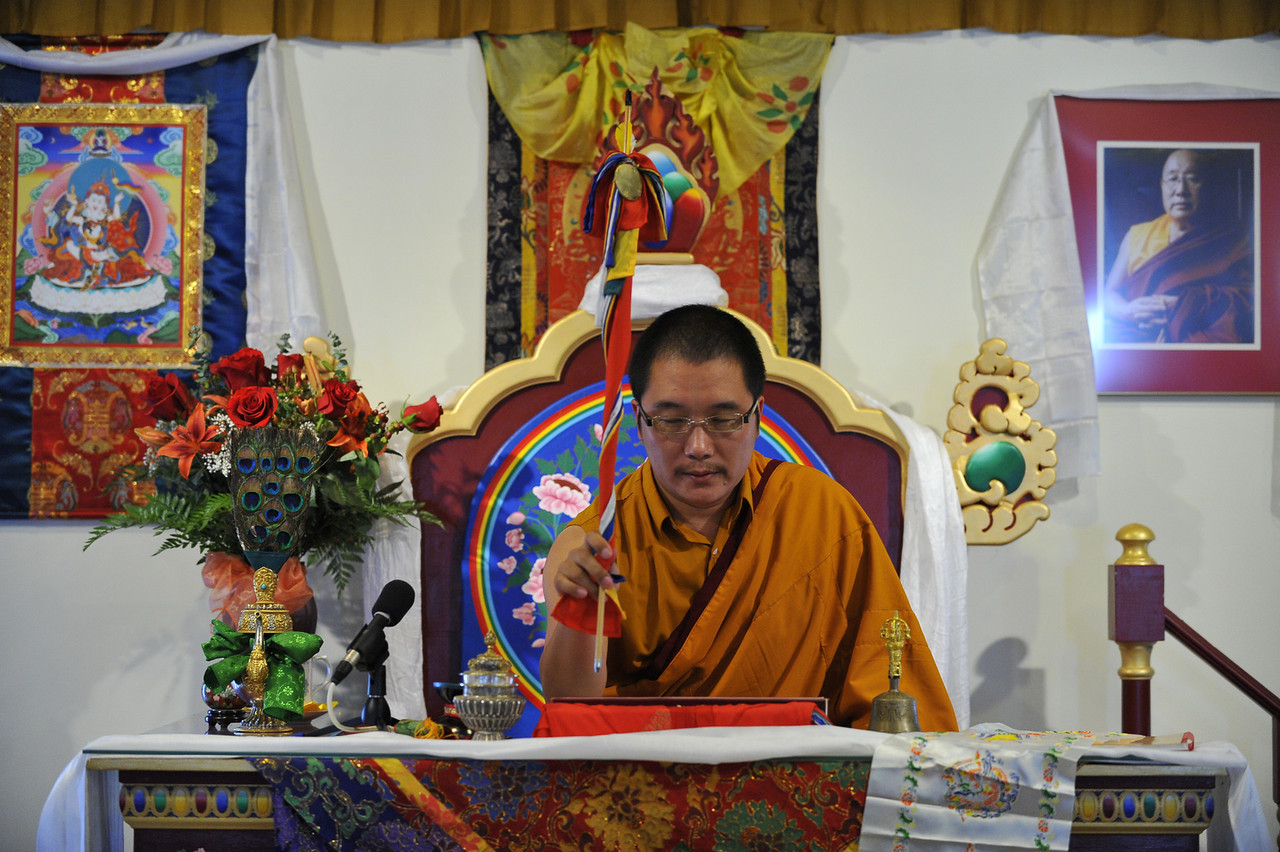
One of the practices that we are taught as Buddhists is that always, always, Guru Rinpoche should be above the crown of our heads.  We should be mindful that Guru Rinpoche is always there, seated on his lotus throne.  Upon going to sleep, we should visualize that Guru Rinpoche becomes like light or liquid and then pours into the top chakra and through the central channel, and remains in the heart throughout the night.  We fall asleep with Guru Rinpoche in the heart.  This kind of mindfulness is the best part of practice.  No matter what else I do, even if I don’t sit down and practice formally, I practice like that all the time.  That’s the backbone that I rely on.

When I talk to any of my students, the way that I practice View is that, as a Lama, I consider that the students are higher than me.  (You should never do that!  But I can do that.)  I consider that the students are higher than me because there are many of them and I am only one and our nature is the same.  It’s a little bit like the posture of Jesus washing the feet of the disciples. There is an element of sacrifice, there is an element of viewing the propagation of Dharma and the display of Bodhicitta to be all there is, the highest.  There is nothing else higher.  So I practice in such a way that the students are higher.  I hold them in high regard.  They are more precious to me than the other stuff that I do. I hold the students much higher than I hold myself.

It is the student’s job to practice that discrimination constantly.  One thing that we should do is consider that every event, every moment, every hour, every day, every breath has as its core nature Guru Rinpoche, the blessing of Guru Rinpoche, the appearance of Guru Rinpoche.  How does one practice that?  It is the kind of thing that you have to grow into.  You can’t just think all of a sudden, “Well, I’m never going to think about anything else.  I’m just going to think about Guru Rinpoche from now on, and therefore that’ll be real easy.  He’ll just always be on my mind.” That would make you crazy, wouldn’t it?  Trying to force that little monkey in a cage to do what you want? You don’t have to do it that way.

We start by creating habitual patterns that include body, speech and mind.  We want to include these three elements.  One way to practice this kind of mindfulness is to have an altar in your home.  If you don’t have an altar in your bedroom, perhaps you can have a picture by your bedside of Guru Rinpoche or your Root Teacher, maybe both. That’s a good visualization. Then, when you first wake up in the morning, the first thing you do — even before you go to the bathroom, even before the coffee — the first thing you do is look at that picture and reorient yourself: that this day the Guru is above the crown of my head.  This hour, this day, right now, the Guru is above the crown of my head and you make three prostrations.  You have it in your mind that this day is therefore sacred and then you dedicate the sacredness of this day to the liberation and salvation of all sentient beings. No one can take that away from you no matter what happens during the day.  If you get hit by a car and both your legs come off, they still can’t take that away from you.  Even if you were to lose your life, the sacredness could not be taken away from you.

Any time you go into a specific event, whether it’s ordinary or whether it’s a spiritual event, hold the picture of Guru Rinpoche or the Root Guru in your mind, reestablish the picture above the top of your head, and know that this experience begins and ends with the Guru.  If you’re going to the grocery store to buy food for your children or your family, this is an excellent thing to do. Gradually, over time, even in ordinary experiences that had no flavor, that seemed to have no connection between this ordinary activity and spirituality, you will begin to establish more of a View and begin to see every experience as spiritual.  Whatever job you have, whatever activities you engage in, look for the Guru there.  If you look, you’ll find him.  If you don’t look, you’ll never find him.

With that kind of discrimination and Guru Yoga, I find that the amazing opportunities and blessings come through the most ordinary experiences.  To the degree that I see all phenomena as the mandala of the Guru, and I hold to be in union with the Guru constantly, then ordinary people, like gas station attendants, will say things that will blow your head off.  That has happened to me, where I’ve been in that frame of mind, looking for the Guru and constantly mindful, and then pull into a gas station, and the gas station attendant says something that just rocks your world.  And it’s about something weird, like renunciation or karma or something like that, and you say to yourself,  “I’m listening, OK!”  That happens.  That doesn’t make the gas station attendant your Guru.  You see the difference, don’t you?  But it does mean that you are beginning to discriminate that nature.  You’re beginning to awaken to that nature.  It’s just a little thread, but it’s something.  It is the beginning of awakening to that.

Somehow we have to think of incorporating this distinction of what is extraordinary into our lives.  It has to be an effort that we actually provide for and make substantial, that we actually create in our lives.  This opportunity to practice like that will never simply come to you.  You may simply meet your Guru, but that’s because you practiced in your last life.  That’s because you practiced before, that’s because you earned it, but once you meet the Guru, once you are on the path, this practice of Guru Yoga becomes your responsibility.  To the degree that you really address it in a very profound, deep and heartfelt way, to that degree, it will benefit and it will awaken the mind.

© Jetsunma Ahkön Lhamo

Get Real

Yeshe Tsogyal

From The Spiritual Path:  A Compilation of Teachings by Jetsunma Ahkon Lhamo


The Vajrayana path is a great gift. Your mind can be purified through the practice of allowing it to arise naturally with those qualities of perfect union and perfectly purified perception. “Well,” you may say. “That sounds good, but will it work?” Yes, it will work. It will work by the power of the transmissions, by the intensity of your effort and faith, and through the power of the mantra and through devotion. These mantras are not invented by ordinary people. They come from primordial wisdom itself.

Though your perception is still faulty, understand that within the center of this confused mandala you have found the perfect path. You have found your teacher and you have received initiation. Something is happening. Therefore the process is not as endless as you may think. This is your precious opportunity, and you should take advantage of it. Where will you find another like it? You have so much help and all the necessary tools and nourishments. Keep in mind the choice. Do you wish to be a practitioner seeking that one precious virtue, or are you just a person wearing a costume? If you are a serious Vajrayana practitioner, you will stop dancing around with rules and regulations and, pardon the slang, “get real about it.” Get real about this path. Understand that you must have the only thing of value—the perception of primordial mind, the realization of the natural state of all phenomena. This is true purity, true virtue.

© Jetsunma Ahkön Lhamo

Intention and Vows

An excerpt from a teaching called Bodhicitta by Jetsunma Ahkon Lhamo

From this very moment forward, I offer this life as a gift to the Three Precious Jewels.  My pure intention is to accomplish the purpose of self and others, supreme enlightenment, quickly and surely.  Thus I vow that all my life, every portion shall be used to accomplish that goal.  All my activities shall accomplish that goal.  All my thoughts and feelings are directed towards that goal.  All my possessions shall be strengthened to support that goal.  I shall seek all appropriate teachings, empowerments, and spiritual activities in order to secure that goal.  My own enlightenment is now considered to be equal to and non-dual with the enlightenment of others.  Therefore I vow to support fully and without hesitation the practicing spiritual community.  I vow to support fully with unconditional love the Three Precious Jewels, the recitations, the Sangha and the temple.  I will not kill; I will not lie to accomplish selfish purpose.  I will not steal.  I will not become intoxicated and therefore forget my purpose and vows.  I will not engage in adultery, promiscuous activity by which my intention will be compromised.

I fully intend to do all that I can to accomplish the liberation of all sentient beings.  I consider the realization of all beings to be equal with my own and of equal value.  I fully support the spiritual community and its purpose on Earth.  Should any activity, or possession or relationship be contrary to those purposes, I will systematically change them or eliminate them from my life.  This I promise so there will be an end to hatred, greed and ignorance in my mind stream and in the 3,000 myriads of universes so that all beings and I myself shall achieve the precious awakening.

The Refuge Vow

I take refuge in the Lama,

I take refuge in the Buddha,

I take refuge in the Dharma,

I take refuge in the Sangha.

The Bodhisattva Vow

I dedicate myself to the liberation and salvation of all sentient beings.  I offer my body, speech and mind in order to accomplish the purpose of all sentient beings.  I will return in whatever form necessary under extraordinary conditions to end suffering.  Let me be born in times unpredictable, in places unknown until all sentient beings are liberated from the cycle of death and rebirth.  Taking no thought for my comfort or safety, Precious Lama, make of me a pure and perfect instrument by which the end of suffering and death in all forms may be realized.  Let me achieve perfect enlightenment for the sake of all beings.  Then by my hand and heart alone, may all beings achieve full enlightenment and perfect liberation.

Copyright © Jetsunma Ahkon Lhamo.  All rights reserved

From the Great Lotus

665103896_JCc8h-S

An excerpt from a teaching by Jetsunma Ahkon Lhamo from the Dakini Workshop

When the Buddha’s activities are accomplished in the world, through our lack of understanding, we will see lots of different things.  For instance, in this temple, we may see the need for fundraising, and we may see the intensive effort that is supposed to go into that.  We may see the need for expansion and how intensive the effort for that can be and we may see the extent of our own effort, which seems to be awesome.  Yet, every bit of that perception is only based on the belief in self-nature as being inherently real.  There is no one to struggle if the belief in self-nature is not clung to.  It is that clinging that is the basis for the struggle.

From the point of view of enlightened intention, one can understand that from a tiny event that seemed in our continuum to take place 2,500 years ago and then continued on with a thread of different experiences and different incarnations, it may seem that that tiny event gave birth to the oddest things in the oddest of places in Poolesville, Maryland where the Dharma is born.  Then we think about all of the things in India and we think about all the things in Tibet and we think about all the things that are happening around the world concerning the Buddha’s activity.   From the point of view of the intention of that one life, that is a very small piece of effort.  But from our point of view, of course, we are seeing the great effortfulness and it seems to be continuing endlessly, especially within the context of our lives.  We seem to think that it is continuing endlessly.

One must understand, however, that even thinking that all of this came from one small life, even that is an outrageous delusion.  It is a contrivance that we make to satisfy ourselves.  One must understand that from the point of view of enlightenment, from the unborn vast expanse of emptiness, of blissful emptiness, within that sphere of truth that we call the great mother, all potency spontaneously arises and is born, demonstrates itself or dances or moves in as many displays, forms, formlessnesses as we can possibly imagine and beyond what we can imagine.  And even as it is born, even as it moves, it is inherently and therefore immediately complete.  That means that all sentient beings have within them the inherent Buddha nature and therefore will achieve enlightenment, but that is our confusion.  In fact, we have never been separate from the sphere of truth.  We have never been anywhere else but born and completed in the great lotus of the great mother.  Anything else is complete fabrication.

We have never left the space of emptiness and we have never lost the scent of emptiness.  From the point of view of enlightenment we have never beheld or looked at anything other than emptiness.  We have never seen anything other than our own face.  We have never lost a moment’s time.

Yet, here we are trying to understand the nature of the dakini, like trying to be seduced back into remembering our own face, straining to hear the sound of our own name.  From the point of view of the enlightened activity that is consistent with the dakini nature, there is no loss.  There is no distinction.  There is no separation.  There is no need for struggle.  Yet it is clear that we remain fixed on the idea of separation between self and other.  We remain hooked with concepts such as the distinction between dirty and clean.  We remain addicted to the idea of hatred, greed and ignorance and seem to be unable to let them go so that they can simply do what they do naturally so that all phenomena, the moment that it naturally arises, is immediately completed.

From the point of view of enlightenment, no phenomenon continues itself.  No piece of what we experience, whether we wish to experience or do not wish to experience, by its nature continues or completes itself.  The experience of continuation that we have is only due to our own continuing it, our own determination to continue it.  No phenomenon is exempt.  All things arise from the sphere of truth.  They are spontaneously born and instantly complete.

Copyright © Jetsunma Ahkon Lhamo.  All rights reserved
 

Cessation of Suffering

665086315_yKjCP-S

An excerpt from a teaching by Jetsunma Ahkon Lhamo called “How Buddhists Think”

The Buddha’s next teaching is that there exists a cessation of suffering, which is the same as the cessation of desire.  This cessation is called Enlightenment, and it is the only true cessation of suffering.

In a very poor society, people focus on basic survival.  But what happens in a society like ours, in which survival is not a main concern?  (If nothing else works, we can go on welfare.)  Since we don’t need to focus on survival, we have time to be neurotic.  The more we seem to satisfy our needs, the more needs we develop.

In cyclic existence, there is no way to solve all our needs.  Everything constantly changes.  And temporary happiness is almost a mixed blessing:  it always ends, and in the meantime, we are preoccupied with it.  The problem is that we haven’t done anything about viewing our true Nature.  It’s almost as if we keep ourselves satisfied by eating the icing off the cake; never really obtaining genuine nourishment.

When the Buddha taught that there is an end to suffering, it was a major revelation.  Why?  Although the great yogis and gurus at that time taught that one could achieve God-consciousness, cosmic consciousness, the Buddha superseded that.  Due to the ripening of his great generosity in past lives, he was able to come to a level of meditation in which he realized the cessation of fixation––fixation on godliness and even fixation on the consciousness of self.  He attained a level of realization that was simply “Awake.”  No consciousness, no sameness, no union.  Simply pure luminosity: “I am Awake.”

At that moment, all the cause-and-effect building blocks accumulated throughout time out of mind, all the building blocks from endless involvement with subject-object fixation, all the fixation on ego as real––all of this was pacified.  The Buddha realized the sameness and indivisibility of subject and object, the inseparability of action and stillness, the sameness, the “Suchness” of all that is.  All was dispelled in clear, uncontrived, luminous awareness. This non-specific awareness is the pure view of one’s own true Nature.  It is simply being awake.  The Buddha teaches that this is the end of all suffering, because it is the end of what you make suffering with.  It is the end of cause-and-effect relationships––and therefore, according to Buddhism, the end of karma.

Copyright ©  Jetsunma Ahkon Lhamo.  All rights reserved
WP2Social Auto Publish Powered By : XYZScripts.com