
Understanding the Four Thoughts

The following is an excerpt from a teaching by Jetsunma Ahkon Lhamo called “Relationship with the Lama in Vajrayana”

In the beginning of every Buddhist teaching, , before one actually begins any of the deeper practices, there is one practice that is called the Four Thoughts That Turn the Mind.

The idea is to think of the mind as having the potential, like the earth, to raise the flower of enlightenment. Any field that you look at, unless it’s been poisoned in some way, has the potential to grow within it the crop of your choice – in this case, the crop of enlightenment. But before you actually begin to grow that crop, you have to cultivate the earth. You have to plow it and water it and fertilize it. You have to take care of it. The mind is very much like that. Even though it has the potential for enlightenment, because of our dualistic thinking, and because from time-out-of-mind until this point, we have been involved with the delusion of ego as being the central factor, and with the survival idea that is associated with that, we haven’t had time to really adopt the idea of enlightenment as being the primary focus. And therefore, we haven’t had time to prepare our minds for that idea.

You may consider that this is true for you even though it isn’t pleasant to think about. It isn’t pleasant to think that we’ve spent so much time only on survival. But it’s probably true. And you’re not the only person on the earth for whom this is true. It’s true for so many of us that it’s normal.

You might try to determine whether or not that is true for you personally, and you might be able to honestly and sincerely look back on your life and see that it is true. But if you can’t do that, then you might think of this as evidential. You might think whether, first of all, you have found a path that you are certain leads to supreme enlightenment. And the way you can ascertain that is by looking around and seeing whether in the past, or even in the present, it has produced, and continues to produce, enlightenment that is visible, predictable and reportable.

If you have found such a path, then are you able to maintain that path with diligence? That means, are you able to maintain that path in such a way that you don’t get that on-again-off-again cyclic involvement that so many people in meditation do? Are you able to remain firm? When you find this path, and it becomes a central focus in your life, in times of both joy and fear, is this path always the answer to your problems? But most of all, you should look to see whether you are certain enough about this path to have it be your source of refuge. Is it the thing you turn to? And do you consistently practice it everyday? If all these factors have been met, then your mind has been turned.

For 99.9% of the human beings on this earth, not only have they not found a path that always leads to supreme enlightenment, but once they do find it, they’re on-again-off-again. And even when they’re on-again, their true source of refuge seems to be the ordinary human addictions that we all have like material goods, or trying to find things in an ordinary way that make you feel up like mood manipulation, relationships, physical safety. These things are our addictions, and these are what we consider to be our sources of refuge.

So for 99.9% of all the people on the earth, the Four Thoughts That Turn the Mind are extraordinarily useful. And even a dyed-in-the-wool Buddhist, a person who has taken ordination, who has been a practicing Buddhist all their lives, and whose first teaching was the Four Thoughts That Turn the Mind, still even for that person, I personally recommend that they practice the Four Thoughts That Turn the Mind continually, from now until the end of this incarnation. Maybe having it be the last thing you think of before you die.

Copyright © Jetsunma Ahkon Lhamo.  All rights reserved


Understanding the Four Thoughts

The following is an excerpt from a teaching by Jetsunma Ahkon Lhamo called “Relationship with the Lama in Vajrayana”

In the beginning of every Buddhist teaching, , before one actually begins any of the deeper practices, there is one practice that is called the Four Thoughts That Turn the Mind.

The idea is to think of the mind as having the potential, like the earth, to raise the flower of enlightenment. Any field that you look at, unless it’s been poisoned in some way, has the potential to grow within it the crop of your choice – in this case, the crop of enlightenment. But before you actually begin to grow that crop, you have to cultivate the earth. You have to plow it and water it and fertilize it. You have to take care of it. The mind is very much like that. Even though it has the potential for enlightenment, because of our dualistic thinking, and because from time-out-of-mind until this point, we have been involved with the delusion of ego as being the central factor, and with the survival idea that is associated with that, we haven’t had time to really adopt the idea of enlightenment as being the primary focus. And therefore, we haven’t had time to prepare our minds for that idea.

You may consider that this is true for you even though it isn’t pleasant to think about. It isn’t pleasant to think that we’ve spent so much time only on survival. But it’s probably true. And you’re not the only person on the earth for whom this is true. It’s true for so many of us that it’s normal.

You might try to determine whether or not that is true for you personally, and you might be able to honestly and sincerely look back on your life and see that it is true. But if you can’t do that, then you might think of this as evidential. You might think whether, first of all, you have found a path that you are certain leads to supreme enlightenment. And the way you can ascertain that is by looking around and seeing whether in the past, or even in the present, it has produced, and continues to produce, enlightenment that is visible, predictable and reportable.

If you have found such a path, then are you able to maintain that path with diligence? That means, are you able to maintain that path in such a way that you don’t get that on-again-off-again cyclic involvement that so many people in meditation do? Are you able to remain firm? When you find this path, and it becomes a central focus in your life, in times of both joy and fear, is this path always the answer to your problems? But most of all, you should look to see whether you are certain enough about this path to have it be your source of refuge. Is it the thing you turn to? And do you consistently practice it everyday? If all these factors have been met, then your mind has been turned.

For 99.9% of the human beings on this earth, not only have they not found a path that always leads to supreme enlightenment, but once they do find it, they’re on-again-off-again. And even when they’re on-again, their true source of refuge seems to be the ordinary human addictions that we all have like material goods, or trying to find things in an ordinary way that make you feel up like mood manipulation, relationships, physical safety. These things are our addictions, and these are what we consider to be our sources of refuge.

So for 99.9% of all the people on the earth, the Four Thoughts That Turn the Mind are extraordinarily useful. And even a dyed-in-the-wool Buddhist, a person who has taken ordination, who has been a practicing Buddhist all their lives, and whose first teaching was the Four Thoughts That Turn the Mind, still even for that person, I personally recommend that they practice the Four Thoughts That Turn the Mind continually, from now until the end of this incarnation. Maybe having it be the last thing you think of before you die.

Copyright © Jetsunma Ahkon Lhamo.  All rights reserved


Astrology for 01/19/2018

1/19/2018 Friday by Jampal & Wangmo

Theme: Spiritual pursuits 

Continue to keep your eye on the road.   Even though there are challenges at the moment there are offsets to these. Perseverance pays off. Creative self-expression and acts of generosity bring real rewards. Communications are improved but not where details are concerned. Spiritual pursuits continue to be emphasized. It is the last day of the Sun in Capricorn. As one famous Capricorn, Janis Joplin advised,  ‘Don’t compromise yourself. You are all you’ve got’.

Today the Moon is Void of Course from 6:53am EST USA until 328pm. It’s best to avoid making major decisions or signing contracts during this time.

Astrology for 01/18/2018

01/18/2018 by Jampal & Wangmo

Theme: Eratic energy and revisiting past connections

Be mindful today as the energy is disruptive. People do unexpected maneuvers:  is that bad yoga or bad driving? As George Carlin said: ‘Have you ever noticed that anybody driving slower than you is an idiot, and anyone going faster than you is a maniac.’ Venus has moved into Aquarius: relationships are lighter but people need their space. There is a strong possibility today someone from your past reconnects with you. Communication tends to be focused more on the spiritual aspects of life. Spiritual study is favored.

Samsara – Living in a Material World

An excerpt from the Mindfulness workshop given by Jetsunma Ahkon Lhamo in 1999

In practicing bodhicitta in a mindful and discriminating way, one has to understand first of all the faults of samsaric existence.  One has to understand the basic logic if it. If we are giving rise to the aspiration to be of benefit to beings, it only makes sense if we understand why and what the connecting factors are.  Otherwise it is just acting.

One of the greatest obstacles I’ve seen, is the current pop religion culture that says, “Everything is perfect; the world is perfect.” So many people are into the idea of seeking happiness that on some level they must realize that there is suffering, because they’re trying to cover up that suffering.  They’re trying to affirm it away by saying that suffering doesn’t exist.  They tell themselves everything is light and love and suffering doesn’t exist and that’s wonderful, and so the world is a great place.  We don’t have to practice compassion, because everything is already blessed and very holy.  The world is perfect. Can you hear the superficiality in that?  What you need to hear next is what’s really going on in the world because if you’re in that mind state, you haven’t been watching, you haven’t seen.

There is such an extraordinary amount of suffering in all the realms of cyclic existence.  In this world alone, just look at the human condition: the extraordinary, unconscionable suffering.  How can you look at these people marching out of Kosovo and think that’s perfect?  How can you watch children and innocent civilians being torn up, with no understanding as to how this could have happened to them?  They are modern people like us.  How can you look at that and say everything is love and light; that everything is perfect?

If you’ve had the good fortune of knowing one person throughout the course of your life, think of all the different ages and stages they’ve gone through.  Watch what it’s like to be a child and to go through all the struggles that children go through?  It’s tough being a child.  They don’t really understand what’s happening to them.  They don’t really understand why it is when certain things happen, other things happen.  It’s tough being a child.  That little brain is forming.  It doesn’t work in its entirety yet.  And then watch that person grow up to be a teenager.  It’s tough being a teenager.  It’s awful being a teenager.  I remember being a teenager.  I don’t think there are words for that!  You have all these feelings and your body is all grown up and your head is still childish and nothing works.  And then you grow up, and suddenly you’re supposed to be an adult.  You don’t feel any different, though, than you did when you were a teenager or a child.  You still feel like you don’t understand diddly-squat, and yet suddenly, because you have a child maybe, you’re supposed to be an adult.  You think, “Wow, I’ve waited all my life to be an adult.  This is great.  Now I can vote. I can drink.”  Yeah, you can also get up early every morning and go to work.  You can also work every single day.  You can also have very little fun.

Do you remember what it was like when you were just trying to build your life?  There’s an obsession with that.  You think, “Ooh, I’ve just got to do this.  If I don’t do this, I’ll never be happy.”  All that reactive delusion kind of beats you up.  Then, when you get to the point of maturity and you realize that not all the things you thought really mattered actually matter, there’s a little spaciousness.  Maybe you have a pause that lets you know that maybe now it’s time to relax a little bit about getting all these material things lined up; maybe now it’s time to stop and smell the roses and then even beyond that, plan for your maturity.  Maybe you think, “I should think about my death. I should think about how to take care of my children.”  So you get this glorious moment of thinking, “Yeah, okay. I’m pretty stable now.  I’ve got a car, got a house, got some kids, so things are okay.”  You have about five minutes of that before everything you have goes south, and I mean the body.  This thing that we put so much energy into shining up and growing up and waiting until it is matured, and then everything you have from the waist up is now from the waist down.

As Buddhists we are required to study these images of a young woman or a young man, middle-aged or mature and then older, and then see that this is the same person.  Understanding what that’s all about is the key.  For us to not wander through life with everything happening to us unexpectedly.  That’s the most amazing thing about us. Everyone around us gets old; everyone we see gets old; we’ve got old people everywhere, but it’s always a surprise when it happens to us. How can we possibly go through life in any meaningful way when it constantly surprises us?  Instead, what we need to do is to really study the conditions that we are involved with and do so truthfully and honestly.

In the practice of bodhicitta, the first things that we can understand are the faults of cyclic existence.  Cyclic existence is impossible. It’s ridiculous.  It’s not only flawed and faulted, it’s a real pain in the neck.  The amazing thing about cyclic existence is that no matter what you do in the material realm, in the realm of experiences, if it arises from samsara and is within the realm of samsara, it’s all going to come to nothing because anything that you accumulate, build, or create, you lose when you die.  You won’t be able to take that with you.

The saddest thing and the thing that we have compassion about and try to become mindful about, is watching someone who is no different from us, wanting to be happy just like we do; spend all of their time pulling stuff together, accumulating or not accumulating, setting up their little gigs, their little power things, all their little personality dramas.  We watch people that are so entrenched and lost in that, and generally, before we’ve had any training, we’d think that was normal.  But having had training, we think, “Oh, maybe that’s not so good.  Maybe that’s not the way to go.”  We might judge that person as being superficial.   We might have a lot of judgment about that person.  But in order to be truly discriminating and mindful and to actually benefit our practice, we should be saying, “Yes, that’s what it’s like here.  That is the fault of cyclic existence,” and feel compassion for them.

Creating mindfulness in the arena of practicing bodhicitta is like that.  We have to constantly caution ourselves not to simply go down the road in the way that we ordinarily do, but instead, to be in a state of recognition and awareness.  When we see ourselves act in a superficial manner, just going through the motions of life thinking, “Oh, I’ve got to have this money or this power or this fame or this fortune or this car or this family or this whatever” — instead of judging these terrible faults in ourselves or in each other, simply say, “This is the fault of cyclic existence.”  Rather than saying that person is superficial or that person is lost or that person is damned, we ought to say, “What a fabulous opportunity to study the faults of cyclic existence.”  You should look at that person, and say, “Oh, I’m so sorry, because that’s how it is here.  What can I do to help?  How can I benefit sentient beings so that it is no longer the case?”  It increases your bodhicitta practice rather than taking it down by judging others.   To say, “They’re so material; they’re just about money” or, “I’m just about money, I’m just about material things.” is not beneficial because you are not contributing to mindfulness; you are contributing to judgment.  Can you see the difference?  You are not contributing to a state of recognition.  You’re only recognizing appearances.  Big deal!  Dogs can do that!  Do something dogs can’t do.

© Jetsunma Ahkön Lhamo

Samsara – Living in a Material World

An excerpt from the Mindfulness workshop given by Jetsunma Ahkon Lhamo in 1999

In practicing bodhicitta in a mindful and discriminating way, one has to understand first of all the faults of samsaric existence.  One has to understand the basic logic if it. If we are giving rise to the aspiration to be of benefit to beings, it only makes sense if we understand why and what the connecting factors are.  Otherwise it is just acting.

One of the greatest obstacles I’ve seen, is the current pop religion culture that says, “Everything is perfect; the world is perfect.” So many people are into the idea of seeking happiness that on some level they must realize that there is suffering, because they’re trying to cover up that suffering.  They’re trying to affirm it away by saying that suffering doesn’t exist.  They tell themselves everything is light and love and suffering doesn’t exist and that’s wonderful, and so the world is a great place.  We don’t have to practice compassion, because everything is already blessed and very holy.  The world is perfect. Can you hear the superficiality in that?  What you need to hear next is what’s really going on in the world because if you’re in that mind state, you haven’t been watching, you haven’t seen.

There is such an extraordinary amount of suffering in all the realms of cyclic existence.  In this world alone, just look at the human condition: the extraordinary, unconscionable suffering.  How can you look at these people marching out of Kosovo and think that’s perfect?  How can you watch children and innocent civilians being torn up, with no understanding as to how this could have happened to them?  They are modern people like us.  How can you look at that and say everything is love and light; that everything is perfect?

If you’ve had the good fortune of knowing one person throughout the course of your life, think of all the different ages and stages they’ve gone through.  Watch what it’s like to be a child and to go through all the struggles that children go through?  It’s tough being a child.  They don’t really understand what’s happening to them.  They don’t really understand why it is when certain things happen, other things happen.  It’s tough being a child.  That little brain is forming.  It doesn’t work in its entirety yet.  And then watch that person grow up to be a teenager.  It’s tough being a teenager.  It’s awful being a teenager.  I remember being a teenager.  I don’t think there are words for that!  You have all these feelings and your body is all grown up and your head is still childish and nothing works.  And then you grow up, and suddenly you’re supposed to be an adult.  You don’t feel any different, though, than you did when you were a teenager or a child.  You still feel like you don’t understand diddly-squat, and yet suddenly, because you have a child maybe, you’re supposed to be an adult.  You think, “Wow, I’ve waited all my life to be an adult.  This is great.  Now I can vote. I can drink.”  Yeah, you can also get up early every morning and go to work.  You can also work every single day.  You can also have very little fun.

Do you remember what it was like when you were just trying to build your life?  There’s an obsession with that.  You think, “Ooh, I’ve just got to do this.  If I don’t do this, I’ll never be happy.”  All that reactive delusion kind of beats you up.  Then, when you get to the point of maturity and you realize that not all the things you thought really mattered actually matter, there’s a little spaciousness.  Maybe you have a pause that lets you know that maybe now it’s time to relax a little bit about getting all these material things lined up; maybe now it’s time to stop and smell the roses and then even beyond that, plan for your maturity.  Maybe you think, “I should think about my death. I should think about how to take care of my children.”  So you get this glorious moment of thinking, “Yeah, okay. I’m pretty stable now.  I’ve got a car, got a house, got some kids, so things are okay.”  You have about five minutes of that before everything you have goes south, and I mean the body.  This thing that we put so much energy into shining up and growing up and waiting until it is matured, and then everything you have from the waist up is now from the waist down.

As Buddhists we are required to study these images of a young woman or a young man, middle-aged or mature and then older, and then see that this is the same person.  Understanding what that’s all about is the key.  For us to not wander through life with everything happening to us unexpectedly.  That’s the most amazing thing about us. Everyone around us gets old; everyone we see gets old; we’ve got old people everywhere, but it’s always a surprise when it happens to us. How can we possibly go through life in any meaningful way when it constantly surprises us?  Instead, what we need to do is to really study the conditions that we are involved with and do so truthfully and honestly.

In the practice of bodhicitta, the first things that we can understand are the faults of cyclic existence.  Cyclic existence is impossible. It’s ridiculous.  It’s not only flawed and faulted, it’s a real pain in the neck.  The amazing thing about cyclic existence is that no matter what you do in the material realm, in the realm of experiences, if it arises from samsara and is within the realm of samsara, it’s all going to come to nothing because anything that you accumulate, build, or create, you lose when you die.  You won’t be able to take that with you.

The saddest thing and the thing that we have compassion about and try to become mindful about, is watching someone who is no different from us, wanting to be happy just like we do; spend all of their time pulling stuff together, accumulating or not accumulating, setting up their little gigs, their little power things, all their little personality dramas.  We watch people that are so entrenched and lost in that, and generally, before we’ve had any training, we’d think that was normal.  But having had training, we think, “Oh, maybe that’s not so good.  Maybe that’s not the way to go.”  We might judge that person as being superficial.   We might have a lot of judgment about that person.  But in order to be truly discriminating and mindful and to actually benefit our practice, we should be saying, “Yes, that’s what it’s like here.  That is the fault of cyclic existence,” and feel compassion for them.

Creating mindfulness in the arena of practicing bodhicitta is like that.  We have to constantly caution ourselves not to simply go down the road in the way that we ordinarily do, but instead, to be in a state of recognition and awareness.  When we see ourselves act in a superficial manner, just going through the motions of life thinking, “Oh, I’ve got to have this money or this power or this fame or this fortune or this car or this family or this whatever” — instead of judging these terrible faults in ourselves or in each other, simply say, “This is the fault of cyclic existence.”  Rather than saying that person is superficial or that person is lost or that person is damned, we ought to say, “What a fabulous opportunity to study the faults of cyclic existence.”  You should look at that person, and say, “Oh, I’m so sorry, because that’s how it is here.  What can I do to help?  How can I benefit sentient beings so that it is no longer the case?”  It increases your bodhicitta practice rather than taking it down by judging others.   To say, “They’re so material; they’re just about money” or, “I’m just about money, I’m just about material things.” is not beneficial because you are not contributing to mindfulness; you are contributing to judgment.  Can you see the difference?  You are not contributing to a state of recognition.  You’re only recognizing appearances.  Big deal!  Dogs can do that!  Do something dogs can’t do.

© Jetsunma Ahkön Lhamo
Astrology for 01/17/2018

01/17/2018 Wednesday by Jampal & Wangmo

Theme: Zany days and new starts

With the new moon in Aquarius its a time for group activity, starting new projects and being innovative. It’s not so much a ‘connecting with your feelings’ day but it is a good day for start-ups. It’s also a good day to celebrate  relationships and friendships. There might be someone positive who surfaces from the past to remind you of the power of generosity. Remember to smile! ‘A smile is a curve that sets everything straight.’~ Phyllis Diller

Take Yourself to Task

An excerpt from the Mindfulness workshop given by Jetsunma Ahkon Lhamo in 1999

Most of us were trained from early childhood that you’re wrong when you get caught.  A lot of times when our parents schooled us and disciplined us, they didn’t really relate to any profound level regarding the development of our consciousness.  Very few parents walked up to their children and said, “You know, you’re not developing good inner qualities.”  Mostly we were told, “You didn’t wash the dishes!”  So we learned that it is the visible things that really count, and it’s when we get caught that life really takes a downward turn.  That’s what we’re told, and that’s what we really understand to this day.  It’s very hard for us to make that leap from thinking with this get-away-with-it mentality, with this as-long-as-you-hide-it-it’s-OK mentality, into a deeper level of practice where you require of yourself that you do more than look ‘as if.’  That’s a step that only you can take.

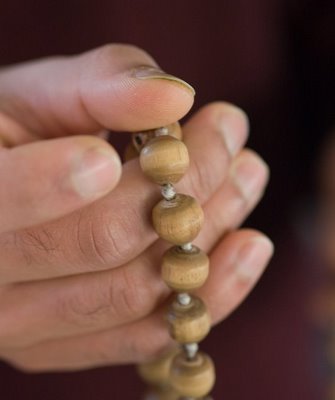
My personal experience has been that when we take that kind of step and become inwardly responsible for giving rise to a state of recognition, then at that point our path becomes potent, empowered, and deeper than we thought possible.  But then you could say that about any avenue of life.  So as long as we’re faking it in any avenue of life, so long as we’re simply trying to hold the image that we think is appropriate, we are missing a lot.  So why wouldn’t it apply to Dharma activity also?  It is particularly important where the state of awakening, as opposed to being in this narcotic, samsaric mind state is at stake.  How much more so, then, in Dharma practice is it to be aware of one’s own mind state and to take oneself to task?  If you find that you’re just fulfilling the form of the practice and you’re just acting as if you have reverence, or acting as if you can have some kind of spiritual discrimination or recognition, only you can say to yourself, “W-w-w-wait a minute, go back and do that again.”  Only you can sit there doing Seven-line Prayer, and realize you don’t even remember what you’re doing.  Things are coming out of your mouth you don’t even know and the mind is all askew and you don’t know where you are and if you didn’t have the beads, you really couldn’t count, you’re so far gone.  So when that happens, do you stop, pull yourself together again, and focus?  Maybe you even lose a few of the Seven-line Prayers on your little bead thing, and go back and say, “Wait a minute, I think I’ve been gone for about 10 minutes.  Only you can do that.  I know it sounds silly; it sounds like much ado about nothing, but that is the power that you have.  Don’t take it lightly.  The potency that we have on our path comes from that kind of mindfulness, that kind of discrimination.

© Jetsunma Ahkön Lhamo

Astrology for 01/16/2018

01/16/2018 Tuesday by Jampal & Wangmo

Theme: Building lasting structures

With so much Capricorn energy abounding consider the quality of the structures you are creating today and into the future. With Capricorn the magic ingredients are perseverance, discipline and a willingness to climb to new heights. This is a time of ripening karma in the physical world in particularly. So physical activities matter. Excercise is a micro example of that – keeping the structure of the body health. If you put in the effort there will be a result. ‘The secret of the universe is hard work’~ Jetsunna Ahkon Lhamo

Developing the Heart of Practice

An excerpt from the Mindfulness workshop given by Jetsunma Ahkon Lhamo in 1999

In practicing mindfulness within the context of guru devotion, one elevates the object of devotion.  One elevates that appearance which is in accordance with the Buddha’s miraculous and compassionate intention, as being different than ordinary phenomena.  What we are trying to do is overcome the condition of non-recognition. In this condition of non-recognition or dullness, where our mind becomes very flat-line, the mind is actually filled with so many defilements of non-recognition that the mind becomes disabled.  The consciousness becomes unable to discriminate what is extraordinary from what is ordinary.  We literally are not able to see that which arises from the Buddha nature and are not able to discriminate between that and what is ordinary appearance.  So we practice Guru Yoga for the purpose of being able to make that kind of discrimination.

When we hold an object of refuge in reverence, we should not bring it into the realm of the ordinary.  In order to bring it into the realm of the ordinary, you have to think the way you ordinarily do.  You would basically be saying, “Okay, now, this is me, the student, acting like that in front of the object of reverence, of refuge.  This is me acting like that.  I put myself in that posture because that’s what I’m supposed to do as a good Buddhist.” Having the opportunity to discriminate, to give rise to a state of recognition or awakeness, yet remaining in the realm of the ordinary is simply throwing away the opportunity.  We’re bringing it into the realm of ordinary context.  We’re saying, “This is here and that’s there.” and we’re practicing the sense of division, the sense of duality, while not truly making any kind of distinction.  In that particular kind of thinking, you, the ego, you, the self, are still the star on that stage.  You are bowing.  You are in a posture of being reverent.  Don’t you look good!  That kind of attitude is different from what I’m talking about.  What I’m talking about is a true, honest, delusion-free recognition of that which is extraordinary.  So the practice has to go accordingly, and only you can know.  Only you really can measure the subtleties of your own mind and your own perception to see honestly and truly how this is going.

To go through one’s career as a Buddhist and practice in such a way that we only look as if we are holding up what is precious, practicing only the posture and the demeanor of reverence without really having the inner discrimination and mindfulness, has very little result.  In fact, you can have a negative result, because still and all, this solid self-nature, this ego that we cling to, is the star on the stage.  When you are practicing refuge and doing all the right movements without the inner discrimination, what you’re really doing is performing.  We’re onstage, and that means that the ego, or the idea of a solid self-nature, is held in much higher regard and we are much more deeply aware of that than the object of refuge.

Therefore, we have to be careful and mindful.  Here is where we have to practice true discrimination.  If I were to treat a Dharma book in a certain way, for instance, saying, “Oh, now everybody’s watching me because I’m up high on the throne, so, when I put my Dharma book over there, I’d better do it very gracefully.”  Well, it might look like I was being mindful, but it wasn’t true mindfulness because, in thinking like that, the ego is the star.  In thinking, “Oh, I’d better do this just right. I’d better follow the rules, better be a good girl,” without any inner recognition that these are the Buddha’s teachings, without any inner recognition that what comes from this Dharma book is not the same as what comes from a dime store novel, there is no discrimination.  Only you can be responsible for that kind of inner recognition.  In a way, that is the great strength, as well as the great difficulty, of practice.

The great strength of practice is that you have the jewel in your hand.  Use it or not, you have the jewel in your hand.  You can determine the depth of your practice.  You can practice as deeply as you wish.  We should be aware that only we could practice in such a way as to actually deepen in our level of understanding, or our level of wisdom.  Only we can practice in such a way as to give rise to recognition, but we have to stop just going through the motions.  It is so important to really develop the heart of practice.  But your inner posture can really only be sensed by yourself, and perhaps maybe the intuition of your teacher.  Only you know what’s going on.  That’s the pitfall also.

© Jetsunma Ahkön Lhamo

WP2Social Auto Publish Powered By : XYZScripts.com