Astrology for 11/2/2016

11/2/2016 Wednesday by Norma

Listen carefully to a partner, this person’s thinking is based on reality and affirms a connection that is supportive and stabilizing. As the day passes, a difficult conversation or bit of information comes. Pay attention, what you learn is true and represents a solid base for your thinking. A source of information that you did not know existed has news for you. You’ll be both sad and happy today, in that order. Take what comes today and don’t worry about the rest. Josh Billings said, “There are people who are always anticipating trouble, and in this way, they manage to enjoy many sorrows that never really happen to them.” Be as kind and diplomatic with others as possible and notice how your field of knowledge is expanding and deepening.

The astrology post affects each person differently, depending on individual horoscopes. Look to see how this message reflects your life today!

Right View – The Essential Nectar Drop

An excerpt from a teaching called The Eight-Fold Path by Jetsunma Ahkon Lhamo

Right view should be understood as the underpinning, the beginning and the ending, and everything in between on the path.  It is in some ways the essence, the essential nectar drop of the path.  In right view through meditation, through contemplation, and through receiving teachings, we come to understand the nature of samsara. We meditate on samsara and understand its flaws, its faults, and how it is so confusing to all of us.  By understanding the nature of samsara, we know what to avoid and what to pick up.  But without contemplating on and understanding the nature of samsara by remaining constantly in a reactive stage, there will be no accomplishment. We grasp what is impermanent, what is imperfect.  We begin to contemplate and study the empty nature of phenomena.  That phenomena is what it seems to be, yet even now we know from the scientific world that it isn’t what it seems to be.  It seems to be this way, but we know that it isn’t.  We know that for instance that on the surface, the nature of glass, the nature of wood, the nature of material, all of it is basically molecules with a bunch of space in them.  And so while they appear solid, its all really energy, electromagnetic energy that binds molecules together.  It is not the way it appears to be.  We have the habit of seeing what we see.  But when one is awake, phenomena is basically empty of self-nature.  And subtle energies, the very display that is samsara is understood in its nature.

In order to attain right view, you don’t have to be smart.  Even though the people that are teaching it often use these wonderful big words, “all pervasive this,” and “foundational whatever.”  And you think, “Wow, this sounds like you have to have a PhD to understand this.”  And it’s not true.  Correct view or right view isn’t about smart.  It’s about wisdom.  It’s about experience through contemplation and meditation.  Even if you don’t have the big words, you can have a direct experience through contemplation. It begins with the insight that is brought to bear by having meditated on the Four Noble Truths in that we understand that all sentient beings are suffering.  We begin to realize that desire is the problem, to understand the nature of reaction and attachment, and to understand the nature of phenomena and the truth that the Buddhas and the bodhisattvas prevail and are indeed omniscient and powerful.  They have brought us the path and they remain.  In other words it is the awareness and belief in the Three Precious Jewels – Buddha, Dharma and Sangha.

We all have view.  We have view right now.  We are viewing each other.  I’m viewing this lady’s pretty necklace, and I’m viewing my daughter, and I’m viewing you.  We have it.  Whatever we think in our mind, when we are viewing, this is our view.

To practice Right View, one trains the view. One trains so that when you look at somebody you don’t say, “I like him or I don’t like him.”  You don’t react with attachment or repulsion.  Right View means that you train yourself to see differently what is.  For instance, say I am Caucasian and you are a black man.  I look at you.  If I say to myself, “Oh, I’m Caucasian, and he’s a black man.”  That’s my view.  That’s what I’m seeing.  And in the Buddha dharma, it is not correct view.  Not correct at all.  Because we are to understand that within each of us, we are equal and we have the Buddha nature and that view is so completely superficial.   If we look at someone else from another culture or family or another planet, and see only the differences, right view would be to correct that.  It would be to see the sameness, to wake up to the fact that all sentient beings are inherently equal and that we share the same nature.  I may be one color and you may be another but we share the same nature, and there is no color on that nature.  So, this is where you begin.  You see how this is a foundation where you become mindful and thoughtful?  It’s not a generation stage practice where you are actually doing a puja, but it’s where you contemplate the fundamental meaning of the path.  Having trained oneself in Right View, its so much easier later on when you begin to approach the bodhisattva vow and the compassion that we learn in Mahayana Buddhism, because with Right View as the foundation, we are half way there.  We can have compassion for others.  We can uphold others as the same as ourselves.  And we can do for others what is kind and good to do.  If we understand Right View properly and we have done the preliminary contemplations, then in Vajrayana it is much easier to have proper view with Vajrayana meaning.

In Vajrayana meaning we should see every female as the goddess, and every male as a god. We see each being in their truer nature.  And we respect the women as being dakinis.  We respect the men as being dakas.  We respect, that is the View in Vajrayana.  And nobody’s higher than anybody else except in the practice of Guru Yoga where we actually use the Guru as a focus to understand our own nature.  But we’re not there yet.  We’re still on Right View.

So it behooves us to contemplate the meaning of this, and how to approach viewing others, viewing your life, viewing your potential, and viewing the world at large.  This is mind training.  This is where you train your mind.  If you don’t train your mind here, when you get to the higher levels of practice, you are too wobbly and unstable.  You can practice real well for a while, but then you are gone.  You must have this underlying stability, this understanding in order to really practice the path well and keep flourishing on it.

© Jetsunma Ahkon Lhamo

Astrology for 11/1/2016

11/1/2016 Tuesday by Norma

Nothing much happens early in the day thanks to the void of course moon, but you’ll know when the moon changes signs-everyone has an opinion about everything! Prognostications about the future (all bad!), alarmist musings (all bad!), sweeping generalizations (ditto) are everywhere. Fortunately, these can be sidestepped by a foray into creative projects, imaginative ventures, visualization, anything related to water and medical interventions. Listen to people who dish up the truth today and ignore alarmist speculation. Elbert Hubbard said, “The thing we fear we bring to pass.” What’s good today? A renewed joie de vivre ( if you ignore the doomsayers), happy partnerships, underground discoveries and investing!

The daily astrology post affects everyone differently, depending on individual horoscopes. Look to see how this message reflects your life today!

The Wish to Benefit Others

Tibetan Buddhism Wheel Of Life 06 00 Six Realms

The following is an excerpt from a teaching by Jetsunma Ahkon Lhamo called “Bodhicitta” 

The subject today will be Bodhicitta, or compassion. From the traditional point of view, it is considered that Bodhicitta is divided into two basic categories. There is the aspirational Bodhicitta and the practical Bodhicitta. The aspirational Bodhichitta is the first relationship with Bodhicitta or compassion. In this sense, you can use the word Bodhicitta and compassion interchangeably. The aspirational level is the first relationship with Bodhichitta that each of us would approach, and this is a very important step. This step is the beginning of the cultivation of a stability of compassion within the mindstream. The practice of aspirational Bodhicitta begins with very small baby steps. It is absolutely dependent on understanding some of the Buddha’s basic teachings in order to do it effectively, in order to approach it effectively. One of the reasons why this is so necessary is that the Buddha teaches us of the faults of cyclic existence. The Buddha teaches us, as well, that suffering ceases when we achieve enlightenment. The Buddha teaches us of the cause of our suffering. He teaches us that suffering is caused by desire. And we come to understand suffering in a completely different way than we do just as ordinary sentient beings. 

Upon hearing the Buddha’s teaching, we might view suffering differently. Before we heard the Buddha’s teaching, we might think it possible to solve suffering through manipulating circumstances in ordinary human ways. We might think that a poor person is suffering because they have no money. We might look at the superficial angle of suffering. Looking at that suffering from a superficial angle, we actually can only develop a very superficial understanding of it. Ultimately we will have very little understanding of the nature of suffering at all, and therefore, will be incompetent to prevent more suffering or the continuation of suffering. To look at suffering from the ordinary superficial sense, we might consider that a poor person suffers because they have no money, or a sick person suffers because they have no health. And this would seem perfectly logical. Everything in our environment points out that this is the case. We would think that whatever we are lacking, that thing is the cause of our suffering; and whatever we have that we don’t want, that thing is the cause of our suffering. But according to the Buddha, this is really symptomatic. These things that we witness are symptomatic, and they do not necessarily lead us to understand the deeper cause of suffering. So we must turn to the enlightened teaching of the Buddha, of one who has crossed all of the barriers of suffering and has experienced the cessation of suffering in order to determine what the real cause of suffering is.

According to the Buddha, the things that we suffer from, such as poverty or sickness, or old age, sickness and death in the human realm, or all of the different sufferings that are potential and possible within the six realms of cyclic existence, in fact, are only symptomatic of a deeper underlying suffering, That suffering is actually the belief in self-nature as being inherently real. The suffering of the belief in self-nature being inherently real, or the delusion of the belief in self-nature as being inherently real actually leads to the suffering of desire. Because the tricky thing about belief in self-nature as being inherently real is that once you decide you have a self, you have to maintain it. Once you have the view that the self is here and it’s very real, then you have to constantly redefine and clarify the meaning of self by defining the distinction between self and other, And then all phenomena appears to be separate. Even one’s own feelings appear to be separate. All things that are present in the world appear to be separate and they are filled with the sense of distinction. Whenever something registers on the five senses, whether it be an altar, or whether it be something like food, or whether it be another person, whenever that thing arises in the mind, we determine whether we like it or don’t like it. There is an automatic attraction or repulsion phenomena that occurs. If you will examine yourself, you will see that this is true. It simply is not possible for you to see something or to have something come to your awareness without having the immediate, almost knee-jerk reaction of deciding if you are attracted to it or repulsed by it; or there is some aspect of that within your mind. It may play out a little bit differently; but if you examine it, you will see that the root of it is attraction and repulsion. All things play on the senses in that way.

The thinking then of the separation, or the erroneous perception of the duality between self and other, becomes more and more profound. It actually progresses and it builds on itself. It becomes more exaggerated. Each time that you react with attraction or repulsion toward anything, there is a karma, or a cause and effect relationship, that is begun at that time. This cause and effect relationship then continues to create more cause and more effect. And there is an almost continual building of these instances, one on top of the other; and they are endless. There is no way for this to stop. It occurs in a cycle. And it occurs in such a way that while cause and effect are being experienced, more cause and effect continue. While one is dealing with the effect of previous causes, one is beginning new causes because of the reaction to the effect of previous cause. And it continues to be so that it seems to be unbreakable and unshakeable.

© Jetsunma Ahkon Lhamo all rights reserved

Astrology for 10/31/2016

10/31/2016 Monday by Norma

This is great day to plow ahead at work, taking the steps you need to progress on your path. Still something keeps pulling you off course, creating the danger of coming down too hard on an irritant. Do your best to be as firm and gentle as possible today, which will require self restraint as Scorpio values results over diplomacy. Washington Irving said, “A sharp tongue is the only edged tool that grows keener with constant use.” Put that tool away! A sad moment is behind you and it’s best not to look back or turn the matter over in your mind, let it disappear. What’s good? Your sense of humor is coming back, the future is opening up, and your ship is in proceeding full speed ahead!

The astrology post affects everyone differently, depending on individual horoscopes. Look to see how this message reflects your life today!

The Origin of Suffering

An excerpt from a teaching called Eight-fold Path by Jetsunma Ahkon Lhamo

I have known of cases, it is very rare, and beautiful to behold of people who have gone through terrible terrible suffering and have used that as a way to become strong.  In fact there are entire cultures of people who through tremendous need to survive and tremendous suffering, have found some way to become strong through that suffering rather than to let that suffering take them down.  But that’s very rare.  Most people react to suffering as though something outside had occurred to them, and they were merely standing there.  They don’t understand the relationship of cause and effect, and how karma prevails, and always is exacting. If you give rise to any cause, that very effect will occur.  We don’t realize that, and so we react in an odd way.

What causes our reaction is our deep attachment and desire for things to be as we wish.  For instance, if we have to live on beans and rice all week because we don’t have enough money for steak and potatoes, we might think, “Oh this is terrible suffering.  This is just so terrible.  But then another person might say, “I really dig beans and rice.  Take the Beano and you’ll be fine.  What’s the problem?”  I’m being funny now, but you get what I’m saying.  It’s really your reaction.  One person can have some catastrophe happen to them, and they will use that almost as a guru to pull themselves up by the bootstraps and get stronger.  But most of us don’t.  We react because we don’t have our heart’s desire.  So, if we lose a relationship that is very dear to us, a death happens or loss of friendship or loss of love, when we really look from a practical sense at what changes in our lives as a result of the loss of this person, most of it is manageable usually.

What’s really terrible is our own pain.  Our own pain is caused by our attachment to that person and our desire to be with that person.  Attachment to a person or a desire to be with a person is not necessarily a bad or unethical thing, but understood within the context of the Buddha dharma, we must understand that too much attachment and not enough unconditional positive regard for all sentient beings – placing all of our hopes and desires on one person or maybe a small family – means that our suffering will be very great at the time of losing that relationship.  We know that whatever comes together must also separate.  Whether it is in life or in death, nothing remains and everything is impermanent.

It is our reaction that causes us to suffer.  One person can lose a job or a position and totally flip out, and ruin the rest of his life simply by the thoughts and activities that he takes while he is not stable or in good shape.  Then another person can take a challenge like that, examine himself, and say, “What’s going on here? Maybe I should change this or that about myself?”  There are many ways to react, and what the Buddha has taught is that the suffering is caused by desire and attachment and the purpose of practicing the Buddha dharma is to pacify and lessen that desire and attachment.  Another way to put it is to see through its narcotic effect.  We want what we want.  It stimulates us and makes us happy.  Then we want more.  But if we really examine the desire and attachment, we’ll find out that most of what we cling to is relatively unimportant and in the end, will bring us suffering because we are too attached to it.  So, the Buddha taught that the origin of suffering is attachment and desire.

© Jetsunma Ahkon Lhamo

Astrology for 10/30/2016

10/30/2016 Sunday by Norma

The New Moon in Scorpio generates strength, determination and certainty about your affairs. If you’ve felt indecisive or lacking direction, that is in the past! Relationships have been reconfigured and are on a more solid basis: you now know what you can and cannot expect from others. You have a different perspective on disappointing people and you recognize the capabilities of those around you. Seven Point Mind Training says, “Don’t put an ox’s load on a cow.” What’s good today? Inspiration based on a workable format, a new direction that offers a better understanding of what you’re doing, and a serious, down-to earth assessment of what is possible. Older, wiser and more experienced people are absolute gems: listen up! Relationships and partnerships are fun, but a bit disconnected from the action. Don’t let them distract you.

The daily astrology post affects everyone differently, depending on individual horoscopes. Look to see how this message reflects your life today!

Back to Basics

An excerpt from a teaching called the Eight-fold Path by Jetsunma Ahkon Lhamo

Recently it has come to me very strongly that if we lose sight or connection with the very foundations of the path of Buddha dharma, we tend to lose our way eventually.  There are well-documented, well-preserved teachings that Lord Buddha gave that are very pristine and very concise.  They concern the first turning of the wheel of Dharma.  This is what Lord Buddha taught during the time of his life.  As the Dharma grew and spread, there were other developments within the Dharma.  So, there are basically three levels of the Buddha dharma.  One is called the Theravadan point of view, the original teachings that Lord Buddha himself taught.  There is the Mahayana point of view, the accomplishment of the original teachings, and the addition of the idea of wisdom and compassion – primarily the idea of the Bodhisattva vow – this was all taught by highly realized Buddhas and Bodhisattvas.  Then there is Vajrayana, which is what we actually practice, and which has a lot of ritual to it.  A lot depends on the inner rather than the outer display.  It is powerful yet subtle.  There is technology that goes with it, and as one accomplishes the technology, one begins to advance and change and move ever closer toward awakening.

We should never consider the first level of Buddhism to be somehow lesser.  Instead we should think of the first level of Buddhism as the absolutely necessary foundation.  If you don’t accomplish and don’t understand what Buddha originally taught, then there is no real understanding later on.  I would consider it to be something like building a house.  If you are building a house you don’t want to build it on a sandy beach where it slopes down to the sea and the waves are big.  You want to build it on a very firm foundation.  You want to pour your concrete slab, and make it really secure.  When you are practicing the path of the Buddha dharma, it is very good to understand these primary teachings.  To understand their meaning to the degree that as you move further on the path, you can always reflect back on the original teachings to give you context, strength, and inspiration.  It is necessary to understand exactly what did the Buddha taught.

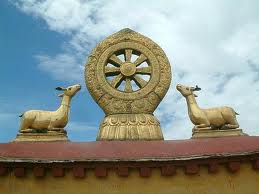
When we talk about the Buddha teaching, we say, “turning the wheel, an expression meaning, “give the dharma.”  The symbol of dharma is a ship’s steering wheel, an eight-spoke wheel, and it symbolizes the eight-fold path.  “Turning the wheel” is a symbolic way of saying, “teaching the eight-fold path.”

When the Buddha first turned the wheel, he taught the four noble truths. The Buddha himself was considered peerless, fully awakened, fully developed.  Having experienced all of the content of samsara and nirvana, through his realization, and in his awakened state he was able to take all that he saw, and make it concise, something very understandable.  Small in words, but big in meaning. This is what the Buddha taught.  You can’t argue with it.

He first taught that in samsara or in life, suffering is all-pervasive, meaning that life is suffering.  We don’t like to think of it that way.  We prefer to think that we’re happy, and we try to coax ourselves into a happy mood.  Still if we look around we see that there is suffering wherever we look.  The human suffering is old age, sickness, and death.  I’ve experienced two out of three, and I know I’ve done the other one but it is hard to remember.  We all know that this is true.  Human beings suffer from old age, sickness, and death.  You can try to think positively about it, but we all know that when it gets down to it, when you’re sick, you feel rotten, and if you are critically ill, it is so much worse.  It’s horrible to have your own body betray you.  If you get to the point where you are experiencing old age, we can look at Madonna, and we can look at all the different wonderful people who have kept in shape and all, and we think, “Oh, its not so bad.”  Its bad!  Getting old is bad.  For those of you who don’t believe and are too young to know, it’s bad. And that is the suffering of the human realm.

Each different realm has its own form of suffering.  For instance, animals suffer from fear and stupidity.  An elephant is much stronger than its trainer, and much stronger than the means usually used to contain them, but they don’t know that.  Elephants are very smart in their own way, but in that particular way, they are not so smart.  In India you see bullocks pulling carts and what not, and their whole life is just toil and work.  They experience the whip if they don’t do it.  That stupidity keeps them there.  I mean, they could basically turn around and knock the driver senseless if they so chose.  They are powerful animals but they don’t know that.  And so that’s the suffering of the animal kingdom.  That and fear since in the animal kingdom you are either prey or predator.  And even predator can be prey sometimes.  So fear is rampant.

The Buddha taught that everywhere you look, suffering is all-pervasive.  That no matter what a person’s life looks like, there is suffering.  And then he taught the cause of suffering is attachment or desire.

When we come from a materialistic society and an ordinary world, we think to ourselves, “How can that be?  Suffering is when you don’t have enough money.  Suffering is when you get hit by a car.  Suffering is when your beloved child grows up and does drugs or something.”  We can name all of these sufferings that happen to us, and so it is hard for us to understand how desire or attachment can actually be the cause of suffering. The way it is explained is that while things do happen and they are caused by our karma, the cause and effect relationships that we have given rise to in the past, and we see our karma ripening as events that seem to happen to us.  What really makes us suffer is our reaction.

© Jetsunma Ahkon Lhamo

Astrology for 10/29/2016

10/29/2016 Saturday by Norma

A surprising event occurred in the night and you probably slept through it but pay attention, it affects you. People are trying to explain away awkward behavior. Listen for the facts about what has happened, not evasions or rationalizations. Unwelcome secrets are coming to light. Ludwig Borne said, “Losing an illusion makes you wiser than finding a truth.” (There’s no Santa Claus, Waaaah!) A good thing about the day is the the shrewd intelligence of the times that allows you to absorb the news and make wise decisions. It’s a great day for discovery, investments, estate planning and creative matters. Water is important today, as are long term companions and people you trust.

The astrology post affects everyone differently, based on individual horoscopes. Look to see how this message reflects your life today!

What’s Your Goal?

An excerpt from a teaching called Intimacy with the Path by Jetsunma Ahkon Lhamo

Ask yourself again and again, “What’s the goal here?”  If you are more interested in expressing your fundamental, uncontrived, primordial nature which is free of discrimination, free of that which is complete and that which has just begun, in a joyful, symphonic musical way with wings?  If you are more interested in giving flight to what is precious than in following a dogma or a religion or playing church, then you are going to be an excellent practitioner.

On the other hand, if you are interested in playing church and you have a time clock for this and it’s just a thing that you want to do, part of your life, then that will be the result.  If you practice religion only to make your life different, then you will have a different life, but if you practice wisdom and Bodhicitta in order to awaken, if you recognize everything as inseparable from you, if you are able to move into the posture of moving through the sacred as that which you are, as something precious, then I think you’ve got a shot at it.

That’s going to take you working at it and you’ve really got to determine this for yourself.  You have to build the marriage inside of you.  Don’t make the mistake that we make in ordinary marriages, waiting for the romance, hoping that the path will somehow woo you so that you can feel good about the path.  That’s not going to work.  It’s a lot deeper than that.

What I’m suggesting is that you really take this into your heart, really consider this, turn the page on a new kind of life.  You can start today.  Supposing you were never to take another bite of food into your mouth without offering the nourishment of that for the liberation and salvation of all sentient beings and giving thanks and realizing the divine, precious inseparable nature of that food.  Supposing taste for you became more like chameleon than yum, yum.  Think about that.

Supposing love and friendship became for you a holy sacrament rather than a way to fill your time.  Supposing the spiritual life became for you an expression of something that exists and fills your heart, rather than something that you’re doing in order to look a certain way.  You know you want this.  You know you want to feel it to the depth of your heart.

Why won’t you be your own best friend?  Take yourself by the hand and give birth to a truly spiritual life.  I don’t care if you call it Buddhism.  I do care that you practice compassion and Bodhicitta.  I do care that you awaken to the primordial wisdom nature.  I do care that you begin to understand the sublime nature and emptiness of self and all phenomena.  This I care about very much, but what you call it is up to you.  Call it love. It’s about really going for it, really taking it in until it’s yours and bonding with it.

Practicing the path the way we’ve practiced it is kind of like having a baby and putting it up for adoption and checking in on it every once in a while and  expecting to have the same kind of bonding and connection that you do with a child that you nursed with your own body and gave your own milk to and formed that kind of unbreakable connection with.  What a difference.

Don’t make spirituality in your life the bastard child.  Let it be your life.  Let you be that.  And of course you are.  You are the ground, the basis, the primordial wisdom nature.  You are the movement and display, which is also called method, and you are the result.  And it only seems like we’re on the path now because it seems like we are traveling toward the result, but in fact nothing is going anywhere.  You are not moving.  Nothing is far away from you and there is nothing to uncover or to build or to establish.  It is simply the precious awakening, and to truly live a spiritual life you must understand that this is your nature.

Transform your life into the sacred, the sacrament, the beauty that you long for as though it were an external thing, and I’m asking you to do it by 1 o’clock.  The reason why I’m naming this time is because it’s so simple.  It’s just as simple as what you’re doing now.  In fact, it’s much more simple, because what you’re doing now is feeling separate from the source, separate from your path, neurotic and needy.  And by 1 o’clock you could have that all fixed.

© Jetsunma Ahkon Lhamo

WP2Social Auto Publish Powered By : XYZScripts.com