The Student-Teacher Relationship

An excerpt from a teaching called Awakening from Non-Recognition by Jetsunma Ahkon Lhamo

This relationship between the student and teacher absolutely depends on the connection between what appears to be two things. On the part of the teacher, the relationship requires the capability to express, display and communicate Dharma, and certainly the intention of Bodhicitta first and foremost. The student’s well-being and realization, recognition, awakening, enlightenment is the goal of the relationship. The teacher’s responsibility is to connect with the student in order to bring about that result and to provide all of the necessary components on the path in order to achieve that result.

What is the student’s responsibility? The student’s responsibility is not to treat this relationship as an ordinary thing, once you have determined that it is not of the world. That would be inappropriate. Have you ever seen children make collages? They take a piece of construction paper and they glue pretty sparkled things on that piece of paper and then they give it to mom. They just make a play-pretty. That’s their artistic endeavor because they can paste and glue. You don’t think students do that with their teacher? The equivalent would be to take a most precious jewel, like the Hope Diamond, exquisitely precious, immeasurable in worldly and monetary terms, put some Elmer’s glue on it and stick it on a piece of paper right next to all the fuzzy things and play-pretties and sparkles and colored macaronis and all the things kids use to make collages, and say “Because I can paste and glue. Because I’m six years old now and I can do this.” That would be the equivalent. You would take that precious jewel and paste it on that piece of paper and just throw it around with the other things you make because you can, because you’re smart, because you’re human, because you’re American. Can you see what I’m saying here?

This precious relationship should not be dealt with in that way. It’s absurd. You cringe when you think of a diamond—that’s worth so much money that it could probably feed all the homeless in our entire country for at least a period of time—used as a play thing, pasted on construction paper with colored macaroni and stuff.  It’s exactly the equivalent of practicing Guru Yoga in the way that we practice it.

That precious relationship provides a format in which we practice recognizing. When we are born in samsara we have a certain experience. As a human being we are born of a mother and a father. You can’t get away from that. As far as I know, no one has just appeared somewhere. If you have, please tell me. I want to see that you’re missing a belly button. We pass through the birth canal and we experience the world as infants and then we grow into consciousness. There seems to be this continuum that expresses itself in time. Why does that happen? Well, it’s because we believe self-nature to be inherently real. Self-nature is not the same as the Buddha nature. It has a certain kind of limitation, and the format seems to be that it moves through space. It takes place in space. To take place in space you need to take place in time also. So we have this experience and we take it for granted. That’s simply the way it is.

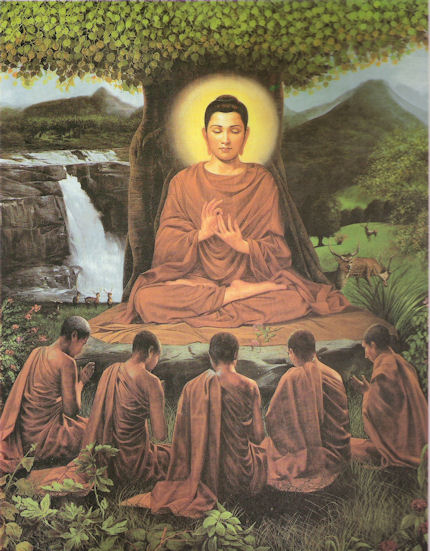
The Buddha is able to look at you and see everything about you, every single condition that brought you to this present moment. What kind of perception is that? When the Buddha looks at this experience, the Buddha sees in awareness, in the awakened state. In that recognition there is something else. There is an appearance of this nature in a display form, like the sun’s rays coming from the sun. The Buddha understands this nature and does not distinguish between this and that, between empty and full, between high and low, between hot and cold, between solid and non-solid. The Buddha recognizes that face, that nature, that ground-of-being simply in emanation form.

When we meet with our teacher, there is a different relationship, and this is how we have to understand the necessity and power of Guru Yoga. If you have chosen your teacher correctly, the teacher is a Bodhisattva with enough wisdom, enough awareness, and enough accomplishment in meditation so that there is recognition, so that the teacher knows your nature. The teacher recognizes this potential, this seed, and the teacher/student relationship is completely based on that recognition. Even though the teacher may occasionally interface with a student in a way that appears to be ordinary, it’s always about bringing the relationship full circle until the student’s recognition occurs. That is the basis of the relationship. Don’t make it ordinary. It’s not about a warm fuzzy. It’s not about being comfy cozy. It’s not about feeling good. It’s not about whether we both like to ice skate or have the same color skin. It’s not about any of that.

It’s about the appearance and the recognition of that appearance. The student has an incredible opportunity and that is to begin to practice entering into a state of recognition, utilizing the Guru Yoga, utilizing the teacher. Why should we utilize the teacher rather than sit down and chant “Om” and just meditate and see if we can recognize our natural state? Well, because it’s not likely to happen that way, that’s why.

We are ordinary sentient beings lost in samsara. We have been conceptualizing self-nature since time out of mind. We have unbelievably strong habitual tendencies. If you think addiction is strong, as it appears in the world now with drugs and alcohol, it’s nothing compared to the level of addiction to a habitual tendency that we have in our clinging to ego as being inherently real. It doesn’t even come close!

In this relationship we are going to conceive of something different. We are going to determine what is ordinary and what is extraordinary. We are going to go through this whole process we’ve outlined. We determine that this relationship is extraordinary. It arises from the Buddha nature. It results in the Buddha nature. In the middle is the path or the method. This being the case, we begin to understand that if this relationship arises from the Buddha nature and it is the Buddha nature and that is our nature, when we see the teacher, we have at last seen our own face. That precious moment—when that face that is our nature arises in some way that we can recognize—is the beginning of recognition.

Now it seems external. It seems like the teacher is out there. It is the student’s responsibility to practice in such a way that they begin to recognize this appearance as the most precious, holy experience. It’s not like worshiping a statue. It’s not like that. It’s recognition of the nature. What is the nature? It is the Buddha nature, indistinguishable from our own nature, therefore the recognition of our true face.

We talk about how to see our teacher when we meet him or her for the first time during the day. There are practices and beautiful writings—I myself have even written things about this and spoken about this, but it’s not my particular talent. In our heart without pride, with surrender, with beauty, with gentleness, with regard, without rigidity, without ideas, without taking that jewel and putting it on that collage, on that piece of paper, we behold the teacher and we say, “This is my heart, my mind, my breath. All that is precious and holy to me, all that is beautiful in this world.” And we place the teacher in our practice above the crown of our head. Are we stupid people worshiping something else? Are we kind of limp or weird? Are we maybe not American anymore? Try to understand. This is not about a personality cult. This is not about putting one being or body or personality above any other. It’s not like that. This is about recognition. The same pride, confusion and preconceived ideas that cause us to say, “Well, I just don’t know. This person is just an ordinary person and maybe I should just be friendly and try to do some practice and some reading.” That kind of holding oneself back from recognition is the exact same holding oneself back from recognition that is occurring right now to you and causes you to remain suffering in samsara. If you insist upon putting the teacher in the ordinary category, you insist upon putting the nature in an ordinary category.  It’s the same problem, the same habit, the same disease.

© Jetsunma Ahkon Lhamo
Astrology for 10/23/2016

10/23/2016 Sunday by Norma

This is a great day to bustle around contacting people, touching bases and catching up on neglected tasks. Let yourself be seen, be out and about and open to the possibility doing a good deed. A secret is revealed and encouragement can mark a turning point today. If you meet someone in need of assistance, drop what you’re doing and give that person the gift of your time. It’s possible to bring light into a situation where darkness has taken hold. Alexander the Great said, “Remember: Upon the conduct of each depends the fate of all.” Confidence and happiness banish fear and obsession today. Athletics, parties and get togethers are favored, and it’s important to spend time outside or in light places.

The astrology post affects everyone differently, depending on individual horoscopes. Look to see how this message reflects your life today!

Your Chance at Recognition

An excerpt from a teaching called Awakening from Non-Recognition by Jetsunma Ahkon Lhamo

Guru Yoga must be seen not as an end but as a means to an end. Quite frankly, speaking for myself and I’m sure most other teachers, we could care less. I’ve described this many times before. I just hate the whole prostration thing. It takes me forever to get through a room. If one practices in a profound way, these prostrations are an opportunity, and that’s why I allow them to be practiced here in the same way that they are practiced generally in our tradition. Otherwise I wouldn’t, because they bother me, but I allow them because it is an opportunity to make an offering and to move immediately—body, speech and mind—into a posture of recognition. You are speaking, “I take refuge in the Lama. I take refuge in the Buddha. I take refuge in the Dharma. I take refuge in the Sangha.” You are engaging in conduct with your body. You are engaging in intention with your mind. With body, speech and mind you are connecting to recognition, and that’s why I allow it.

The relationship with one’s teacher is utilized as the water of life or some sort of ultimate nectar or ultimate empowerment that provides a way for us to begin to recognize that which is holy arises in the world and that each of us is that. Each one of us should practice like that. To the degree that we hold the teacher above the crown of our head and then take the teacher into our hearts, without finding reasons not to—because those reasons not to are the very reasons we are using to remain lost in samsara—to that degree we learn to recognize. Yes, we know you’re clever enough to find reasons not to recognize the nature. If you need to be clever in the way Americans need to be clever in this day and age, you are already clever, very good, now let’s move on. Let’s see if you can learn recognition.

The relationship with the teacher then becomes this precious opportunity, this precious bridge. We see that the Buddha, the Dharma, the Sangha and, all three-in-one as the Lama have appeared in the world, and we see that this is not separate from us. So in the beginning we start practicing by contemplating the difference between what is ordinary and what is extraordinary. We begin to move into relationship with the teacher. We begin to practice devotion. We try to practice some pure view, understanding that this is the appearance in the world and that this is holy and we let it be that way. We simply let it be. Then gradually we move into a much deeper practice where we understand everything is the mandala of the guru. In that practice we begin to learn to turn adversity into bliss.

© Jetsunma Ahkon Lhamo

Astrology for 10/22/2016

10/22/2016 Saturday by Norma

Today begins on an emotional note. Try not to talk to people early in the day as misunderstandings can occur, just do what you need to do to get the day moving. Have a plan and follow it, changes will generate disagreement. The energy transforms as the day progresses and everything settles down. Dress your best; you could find yourself suddenly in the spotlight and your appearance matters. An amusing companion helps pass the time and partnership is favored over solo activity. Travel goes well, the longer the better. What’s good today? An enthusiastic, off-the-wall sense of humor that lightens the atmosphere. David Ogilvy said, “The best ideas come as jokes. Make your thinking as funny as possible.” Do your best to see the humor in everything and you’ll enjoy the day.

The astrology post affects everyone differently, based on individual horoscopes. Look to see how this message reflects your life today!

Astrology for 10/21/2016

10/21/2016 Friday by Norma

Practically everything generates an emotional reaction today; compliment someone’s outfit and they burst into tears, leaving you bewildered and wondering what just
happened. Hint: The more you try to be nice to people the worse it gets, so don’t bother. The Moon is in Cancer and everyone’s acting like a baby, remembering sad things from the past (“Mom always liked you better!”). What’s a rational person to do? Feed the baby! Offer a snack and watch the situation defuse. Buckminster Fuller said, “A problem adequately stated is a problem well on its way to being solved.” What’s good today? A sense of humor that finds silliness in what’s happening, tact that overlooks immature behavior and empathy, the understanding that people are all alike at the core. Mainly food, though.

The astrology post affects everyone differently, depending on individual horoscopes. Look to see how this message reflects your life today!

Life on the Merry-Go-Round

An excerpt from a teaching called Awakening from Non-Recognition by Jetsunma Ahkon Lhamo

According to the Buddha’s teachings and according to everything that we can surmise from the information we receive as we travel along the path, we as sentient beings, are in a state of non-recognition. When you hear a term like “non-recognition,” it’s hard to really understand what it means. When we think of the word “recognizing,” we think in superficial terms such as “I recognize you” or “you recognize me.” We recognize people with whom we are familiar.

That concept still holds true, but there needs to be a deeper, more able way to understand what non-recognition means. According to Buddhist philosophy, we contain within us the seed that is the Buddha nature. It is not smaller than the Buddha’s nature. It is not bigger than the Buddha’s nature. It is not different from the Buddha’s nature. It is the same. It is that nature inherent within us that is the primordial wisdom state or the natural ground-of-being that is our nature. As we move toward enlightenment, we don’t construct that nature. It doesn’t become complete. It doesn’t become bigger. It simply is what it is, but we move from a state of non-recognition into a state that the Buddha clearly described as being awake. And that’s the only difference.

In our culture we tend to think in a materialistic way even about things that are very subtle, very pure, very profound and very spiritual. We tend to think that perhaps the Buddha or a great Bodhisattva or even one’s teacher has a bigger Buddha nature than we do. Somehow their Buddha nature is bigger and maybe more muscle-bound, more fit or stronger than ours. At the risk of being crude, we wonder if the teacher’s isn’t bigger than ours. According to the Buddha’s teaching, that is not the case. The simple difference is recognition. One Buddha nature is not different from another.

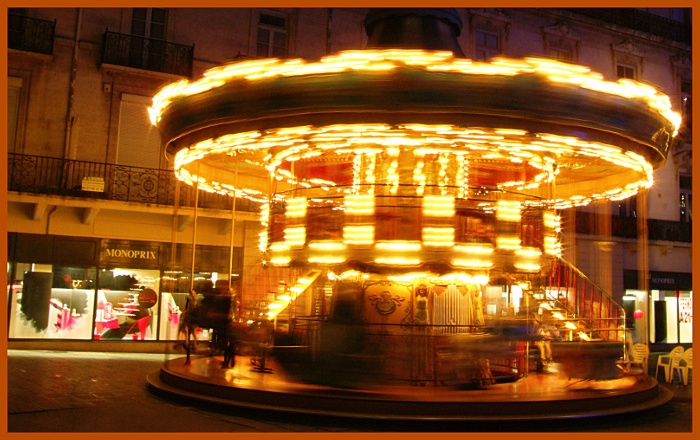
As ordinary sentient beings we are locked in the state of non-recognition, and that non-recognition is so all-pervasive that it becomes invisible. It’s like being born on a merry-go-round. If no one ever stops the merry-go-round and you spend your whole life on the merry-go-round, you will never know that you’re on it. You will never know anything other than that reality. Our condition of non-recognition is very much like that. It has always been this way. We project everything outward onto a screen. We know no other way to be aware. So that is the dilemma of sentient beings. We wish to awaken as the Buddha is awake. We wish to come to understand our true nature, our primordial wisdom nature, which is the ground-of-being, and yet we are locked in a state of non-recognition.

© Jetsunma Ahkon Lhamo

Astrology for 10/20/2016

10/20/2016 Thursday by Norma

An agreement is reached that stabilizes a partnership. Entertain unusual ideas and incorporate them into your strategy. It’s important to be as open-minded as
humanly possible and listen for a brilliant idea that changes everything. Expect interruptions everywhere: phone calls losing connections, streets rerouted, objects barging in front as you go about your day. Hidden or buried things surface like a submarine emerging from a calm sea- who knew it was there? Expect the unexpected. A.A.Milne said, “One of the advantages of being disorderly is that one is constantly making exciting discoveries.” It’s a great day to engage in
discussions with others, to see every side of issues and to enjoy food. Plan a large meal at the end of the day and everything goes well.

The astrology post affects everyone differently, depending on individual horoscopes. Look to see how this message reflects your life today!

Devotional Yoga

An excerpt from a the teaching, When the Teacher Calls, by Jetsunma Ahkon Lhamo

In Buddhist tradition and particularly in Vajrayana Buddhism, there is a kind of practice called devotional practice. One of its most meaningful and foundational aspects is developing a relationship of pure devotion with one’s lama or teacher. In Vajrayana, the teacher is considered to be the door to liberation because even though the Buddha was once on the earth and even though the Buddha’s teachings are written in books, it is just about impossible to enter onto the Path without the blessings of the teacher. The lama, who is necessary for empowerment, transmission and teaching, is considered to be the blessing that is inherent in the Path.

In the Vajrayana tradition there is a devotional aspect to every practice that is done,from the most preliminary to the most superior practice, and it is considered to be the means by which blessing is actually transmitted. In the Nam Chö Ngöndro, the preliminary practice accomplished at this temple, there is a beautiful song of invoking the lama’s blessing called “Calling the Lama from Afar.” It has haunting melody, and it is done from one’s heart in order to soften the ego and make the mind like a bowl ready to receive any blessing.

This type of practice functions like a cultivator. Think of planting a field of grain.  One has to plow the field and work the soil so that it’s capable of receiving the seed.  Otherwise, if the soil were not ready, when seed was thrown out it would just bounce, as on a hard surface. Likewise, devotional practice is considered to make one ready. Its benefit is immeasurable. Without it there is no possibility of the blessing being fully received.

Devotional yoga is meant to benefit the student. The teacher is not “pleased” by devotional yoga. Rather, the teacher is pleased by movement and the softening, the gentling and the change that occurs within the student.  In the  same way as the student calls the lama from afar in traditional practice by putting one’s heart in a position of surrender, we may talk about what the lama experiences when the lama calls the student from afar and the student responds to that call.

When a student calls the teacher, with his or her mind and heart like a bowl, many things are happening. First, there is fantastic auspicious karma ripening. In order for a student even to make that step, he or she must have accumulated a tremendous amount of merit or virtue in the past. A nonvirtuous mind cannot call the teacher with devotion.

When the student calls the lama, it’s because the student has realized certain things. First of all, they have looked around and have seen that cyclic existence or ordinary life is flawed or faulted. Sometimes it’s older students who, in some ways, are able to do this more readily because they’ve seen their lives pass, and they have looked around and said, “What have I done? I’ve worked so hard my entire life, and what have I really accomplished? What am I going to take with me?”

At any rate, the student that is prepared to call the teacher has been awakened, stimulated, has understood that much time has passed and that very little can be really accounted for. There has been some fun. It’s been up and down. We’ve all experienced getting older; we’ve all experienced sickness, and we will certainly experience death. At some point we look at all of this and ask ourselves, “Isn’t there something more? There must be something!”  We begin to think in this way, and then we see someone who can give us a path, not just thoughts about the path, not just ideas that are popular in the New Age, but a technology that is succinct and exacting, a method that has shown itself to give repeatable results. When students see this they become hopeful and joyous. Suddenly they’re excited, and they begin to want to come in closer to this experience. It’s a beautiful, precious moment, but that moment can only happen due to the virtue of the student’s previous practice.

Eventually students will come to the point, due to the virtue of their practice, where they will do anything because they know their time is short. They know that they’ve tried everything and nothing has worked. Nothing has produced permanent happiness, so they are looking at the door to liberation, and in part, that is how the teacher is considered. They want to walk through that door.

© Jetsunma Ahkon Lhamo

Offering Oneself

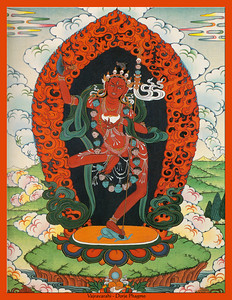
Dorje Phagmo

An excerpt from the Mindfulness workshop given by Jetsunma Ahkon Lhamo in 1999

In our Ngöndro practice we find the practice of offering oneself, the practice of generosity.  It’s called the practice of Chöd. Chöd can very easily be practiced constantly.  The practice of Chöd is based on eliminating ego-clinging through transforming oneself into that which is beneficial to all sentient beings and offering oneself.  In Chöd there is actually a visualization where you see all your different elements separated into piles: skin and bones and muscles and fat and eyeballs and stuff like that.  All of that stuff is put into little piles and you cook it all up and you offer it up to the Buddhas.   And you’re thinking, “That’s kind of an interesting little practice there, isn’t it?  Whoa, dude!” But just remember that this is meant to antidote our ego-clinging because as we walk through our lives, we are all about ‘what can you do for me, and what do I want?’  Remember, as we’re walking through our lives as ordinary sentient beings, our mantra is “Gimme gimme gimme, I want I want I want I want.”  So this kind of practice is meant to antidote that.

The very habit that we have of assuming self-nature to be inherently real and reacting with hope/fear, want/not-want to our environment and the things in it constantly perpetuates itself! So, we are taught instead that, wanting to make oneself useful in some way, wanting to be of benefit and awakening compassion, one way to practice that is by offering the self, offering self-nature, and transforming it into something that is useful to sentient beings.

So how can we do that as we’re walking around?  Try to remember that we’re practicing Recognition.  Here’s a great way to think about it.  Have you heard about the guy who recently had a cadaver’s hand sewn onto his arm, and it’s working?  Now those of you that have heard about that, what did you think about that?  You probably said, “Ugh!”  I mean, it sounds amazing in one way, doesn’t it, that somebody who didn’t have a hand now has a hand, but it’s not his hand.  So when we think about it, that’s kind of gnarly, right?  Just think about it: you know what your hand looks like.  You’ve seen it your whole life.  It changes, but it’s your beloved hand.  It’s so recognizable.  It has a certain shape, and it feels a certain way.  Well, now suppose you had an unmatched set, and one of them was not your hand.  Think how you’d feel.  This kind of clinging is so automatic that until we hear something like that, we don’t even know we do it. It is the very basis for our recognizing one another and ourselves as selves.

We grow attached to the shape of our face, the shape of our head.  Even if we don’t like the shape of our face and the shape of our head, we grow attached to it because it is us, (we think), and so it constantly perpetuates that idea of self-nature being inherently real.  It constantly perpetuates that ego-clinging.  Our bodies are, for us, something that we have to protect.  Even if you think that you’re very brave and not afraid of being hurt, or not afraid of even losing your life, I say to you, baloney!  I’ll start chopping, and you tell me when to stop.  We protect our bodies.  If anything scary comes around us, we react, “Aaaggh!”  And if we can’t protect ourselves any other way, we protect our head because that’s the part that keeps us going — we think.  So we have this automatic clinging.  Any sense of recognition of oneself as self is a clinging kind of phenomenon.

To antidote that, we practice Chöd, separating all the parts.  When you’re done separating all the parts, you can ask yourself, “Well, what part am I?  The skin or the bones or the fat or the muscle or the brains or the tongue or the eyeballs?  Which part am I?”  Of course, we begin to learn that that question is not answerable because ‘I,’ or self-nature, is simply a concept.  It’s simply a concept.

How can we practice this as we walk around through our lives?  Well, one way to do that is to develop the habit of when it is you notice yourself…do you notice yourself?  You notice yourself constantly!  It’s all you notice.  We notice our hands; we notice the position that we’re in; we constantly move to be in a different position, don’t we?  We think, “Do I want my hand like this or like that?”  We are constantly doing that.  It’s a constant phenomenon.

Suppose we were to develop the habit of considering the hand.  “Well, this one matches that one.  I like that.”  But what if we were to consider our hands in a different way?  Instead of thinking, “This hand is mine and it looks like this,” think, “How can this hand be of benefit to sentient beings?  What use is this hand?”  Consider it.  You can develop a sense of Recognition of the true nature of our body parts.  You can think to yourself, “Do you know what I like best about me?  I really like my eyes.” I like your eyes too, but I like my eyes, and so when I think about that, I think, “Oh, you know, wherever I go, I have these eyes, and they can see.  That’s really cool.  And other people can see me.”  And I can work those eyes, can’t I?  And that’s really something.  All we know is that our sight, our eyes, are part of us: that is us.  We cling to that.  Suppose we were able to understand our eyes in a different way.  Supposing when we think of our eyes and how wonderful the capacity to see is, or how amazing it is that we can express ourselves with our eyes, we can offer that entire scenario, that entire experience, to the Buddhas and bodhisattvas for the benefit of sentient beings. Your relationship to your own body parts, your own eyes, for instance, your own hand, becomes different.  Rather than thinking, “These are my brown eyes and I have great brown eyes,” or “This is my right hand and it’s a great hand” — rather than thinking like that as an extension of our ego, we can develop the habit of offering the whole phenomenon of sight, the whole relationship to our different body parts, by evaluating how it is that these eyes can benefit sentient beings, and how it is that we can offer them.

© Jetsunma Ahkön Lhamo

Astrology for 10/19/2016

10/19/2016 Wednesday by Norma

The planet of unexpected behavior doesn’t have any friends today; if you behave inappropriately, don’t expect people to defend you or back you up, you’re on your own. This comes as a complete surprise to people who don’t realize they’re operating outside normal boundaries, but it is a learning opportunity. If you’re the outlier, drop your defenses and listen to feedback; you’ll emerge a better person! Abraham Lincoln said, “It has ever been my experience that folks who have no vices have very few virtues.” Listen carefully to everyone today, there’s a lot to be learned. What’s good? The ability to change deeply held convictions for something better, cheerful conversations, happy partnerships, and growth opportunities in multiple directions.

The astrology post affects everyone differently, depending on individual horoscopes. Look to see how this message reflects your life today!

WP2Social Auto Publish Powered By : XYZScripts.com