The following is an excerpt from a teaching by Jetsunma Ahkon Lhamo called “Vajrayana and Kaliyuga”
Besides making it possible for the teachings to be readily available to all who wish them, Kaliyuga is valuable in another way: Namely, one can practice in a way that is extremely condensed.One can learn the philosophy of the nature of mind, as the Buddha taught in his first teachings, and the philosophy of samsara and really understand how all of this is. And one can also generate oneself as the deity, which is a very condensed way to generate merit. It isn’t the same as merely learning and then doing no more harm. It doesn’t have the same passive quality. One generates oneself as the deity, one utilizes the mantra, and one visualizes the seed syllable. These are all extremely condensed manifestations of primordial wisdom and of certain aspects and qualities of that wisdom in display form.
These two different kinds of condensed activity coming together produce an enormous amount of merit. Karma ripens more quickly; it ripens in a condensed way, more deeply and more richly. What can happen because of that is that we can create, through our practice, windows of spaciousness, windows of opportunity to perceive the primordial wisdom state much more easily than we ever could in a different time or by utilizing a different practice. It is a most perfect opportunity and a most perfect time; and it is also a very difficult time.
If we are irresponsible about the teachings, that is to say, if we hear teachings about the nature of mind and do not utilize them, that also ripens in a very condensed way, and it ripens very quickly. If we hear teachings about the nature of mind and do not respond to them but allow them to lie fallow, the karma of those teachings lying fallow only increases, and increases rapidly. So basically, we are in a position of tremendous responsibility. The responsibility is for us to utilize these teachings, to utilize them effectively, so that we can attain supreme realization in order to be of benefit to beings. We also have a tremendous responsibility to uphold the teachings. We should consider ourselves, then, upholders of the teaching, propagators of the Dharma.
How does one propagate the Dharma? One doesn’t have to be a teacher to propagate the Dharma, or somebody that distributes books. One propagates the Dharma when one practices the Dharma because one holds it and utilizes it and does not allow it to remain fallow.
There are three different levels on which you can recognize your Teacher. One is an extremely poor level, a common, ordinary level. One is an intermediate level in which you see that the teacher holds the teachings purely and gives the teachings purely and you really admire the Teacher and feel great respect for the Teacher. That, however, is only an intermediate level of recognition.
The deepest and supreme level of recognition is recognizing the Teacher not as a person, but rather, as a door to liberation, as one’s own nature. This supreme level recognizes the Teacher as one’s mind, recognizes the Teacher as the miraculous intention of the Buddha, appearing in a manifest way in order to benefit beings. It recognizes the Teacher as that original longing, the longing to know that nature, to recognize the Teacher as the answer, to recognize the Teacher and primordial wisdom itself in some incarnate form, in the same way that your own relationship to the path becomes not an ordinary thing, but a very profound and mystical thing, a thing of truth, a thing able to bring about awakening.
The relationship with the Teacher is especially difficult for Westerners. We have lots of training on authority figures, we have lots of training on mothers and fathers, but we have no training on to how to deal with this longing. The way we have dealt with it in the past has hurt us. It has brought us a great deal of pain and suffering. It has made us act in ways that we do not understand. We are people who had a particular karma and it did not quite fit in with the karma of the society in which we were brought up. If that were not so, then more of the society in which we were brought up would be able to approach the idea of awakening, would be able to approach the idea of having a Teacher in order to follow a supreme path in order to achieve the great awakening.
So, if we can reprogram ourselves by looking back at that original longing and understanding its depth, understanding the ways in which we compensated and forgiving ourselves and confessing the lack of recognition, we will then be able to establish a relationship with the Teacher, the path, the Buddha and with the meditational deities that we practice. If we can establish that relationship anew in that way, the quality of the path that we practice will be completely different. The quality of the experience that we have will be completely different. We will feel healed, and the need for that healing is very sharp and very strong.
It’s my job to watch over my students. Some of you spend 75 percent of your energy blaming yourself for the way you are. Some of you spend a lot of energy trying to act out things that will never bear fruit concerning the Dharma and concerning your Teacher. Some of you spend 75 percent of your energy trying to pretend that you don’t feel or trying to take issue with one thing or another so you don’t have to feel that longing.
I look at you and I have a sense of how you’re managing that longing. It’s like you come so far and you’re right here, almost to my heart, and then you turn away. Some of you stand in the background and look from afar, look hungry, peek out from behind the door, close the door again, stand back there and be hungry for some more. Then you open the door and do like that. Each one of you has a particular and peculiar different way that you deal with this, but you are all living with this.
You were born with the longing to awaken. You were born with a longing to know your own nature, to taste that nature. You were born with a longing and a homing instinct to find your Teacher. You were born with a longing to find a pure path and there were no words like that when you grew up.
You compensated by substituting other things and trying to make them the object of your longing. You made lots of mistakes because of it. That’s not the point, though. There is nothing you can do in one lifetime that is as meaningful a miscalculation as simply reaching for that nature and trying to find it in something small. That is the biggest miscalculation that any of us can make and we do it constantly. That’s what keeps us revolving endlessly in cyclic existence.
An excerpt from a teaching by Jetsunma Ahkon Lhamo called “Longing for the Guru”
We’re all sleeping until we reach supreme enlightenment, but most are really sleeping in a very profound way. In that coma, they are not even able to say, “I want”. They merely act out, and they act out in different ways.
While we are still asleep and until we achieve supreme realization, the fact that you are here listening to teachings is the evidence to know that you have felt that longing. You should find it and relate to it purely. You should encourage it in that it is a dynamo of energy by which to really touch the nature that you are seeking, that the bliss that you want, the union between the student and the teacher.
But you are so ashamed to feel that feeling directly, because you’re so macho, you’re so tough, or you’re so cool or you’re so advanced. You are so ashamed to feel that feeling that you want to say, “Oh, the longing for the Teacher is only me longing for my own nature”. Well, yes, it is that, but you should face directly the longing for the teacher on the deepest level. You should not be ashamed of that. You were ashamed of it as a child and you were taught not to feel it and this longing created a lot of mistakes for you. You should not be ashamed of that now.
I have that longing. I have it, it is the strongest longing, I cannot imagine another longing like it. I live with that longing constantly. I use that longing to provide the means by which I can accomplish Dharma, or I can accomplish kindness for all sentient beings. I realize that the true longing is the longing for the Guru, it’s the longing for my Teacher, for the Guru on all of the different levels, on the apparent level as well as the deepest, most primordial level. And I realize that I will only find that longing satisfied so long as I try to live the qualities that are my Guru.
So, if I were to turn away from students and say, “Oh, I don’t want to do this anymore, I’m tired,” or, “I’m lonely doing this. I don’t want to do this anymore.” If I were to do that, I would never find my Guru. I would never be with my Guru, because those are the qualities of my Guru. My Guru never leaves me. He cannot turn his face from me. And so, that being the case, if I were to turn my face away from anyone that had hopes of me, it would be hopeless. I would never find the Guru. The longing would never be satisfied, because I would have turned my face away.
You must begin to practice in such a way that the face of the Teacher is understood in everything that you do. No matter what you experience, whether it is loss or whether it is having, whether it is joy or whether it is sadness, whether it is life or it is death, whether it is sickness or health, poverty or wealth, whatever you experience, you should think that everything you experience is a blessing from the root Guru.
By the time you have grown and begun to find your path, you have already lost yourself somewhere. You don’t understand yourself any more. You have already done things for which you do not forgive yourself. You have already substituted something else for the longing that you felt. You have already substituted something else for your Teacher. In having done that, it is difficult to find your way home. It is difficult to reach what was originally very pure in your mind. It is difficult to rebirth what was very pure and tender inside of you.
And now, you can’t just say, “Oh, I found it at last. The longing is finished. I found what I’m looking for. I found my path, but in the meantime, I’ve been promiscuous and I don’t forgive myself or I’ve become tough, or numb or I’ve become materialistic.”
What happens is that because you see what’s in front of you, it’s so precious and it’s just what you’ve been waiting for, instead of being able to just grab it and eat it, what we do, then, is try to deal instead with the numbness or the hardness or the promiscuity or the materialism. Because we have become used to this feeling of longing, the longing remains, and we are not able to truly be one with the path and with a Teacher.
We’ve forgotten how to satisfy ourselves. We’ve forgotten how to do anything except blame ourselves and be angry. We make lots of mistakes, compulsively make mistakes. We do not follow the path purely and with a full heart. You have to ask yourself: Is the person who says I’ve got to get my Three Roots practice done today, is that the same person, who, as a child, was waiting for something, was just hungry for something? It’s not the same person. We feel differently now than we did back then and we don’t know how to get back to that original place of purity. We feel something is amiss when we think we’ve found our path because we feel anger, guilt and we feel dirty. We feel different, impure. Then we try to approach the Teacher and the teaching and the path itself in an impure way, because we believe that we are somehow impure.
Having longed for the taste of our own nature for such a long time, now when we look at the Teacher and the teaching, we see it as something altogether different. We see the Teacher as a human being, and we try to get close to a human being. Why do we do that? We do that because we spent our whole lives trying to fit that longing into an acceptable picture, and now we’re trying to do the same thing.
We are afraid to long. We are afraid to experience the depth of that longing and instead, we try to get close to the person. We are afraid to experience the bliss of the union between the meditator, the meditating mind and the nature that is meditated on. The bliss of that union is so strong and we are afraid to experience it. So instead, we long for some kind of union with the person who is our Teacher at this time. It is even common to feel a strong sexual urging for our Teacher. It doesn’t matter if the Teacher is the same sex. Students can have dreams and they will have strong sexual urgings for the Teacher. If you think of the Teacher as a mother or father figure, or an authority figure, or a therapist that you come to with your ordinary stuff, there will never be satisfaction, because that isn’t the truth. That is not the nature of the Teacher. That longing has once again been diverted into a way that you understand. It becomes a perpetuation of the suffering that you had as a child where the longing was not understood, where it was diverted and where it could not be satisfied.
So, the feeling of longing is mistaken. The longing is for union, not for sexual behavior. It is misunderstood. And what generally happens is a feeling of rejection, because the Teacher does not comply with our wishes. There is a feeling of guilt. There is a feeling of wondering what’s wrong with you. There’s a feeling of a lack of acceptance of yourself. There’s a feeling of a lack of confidence, a feeling that you are somehow impure in your motivation. The longing sometimes becomes so strong that one is unable to practice.
You want the Teacher to hold you and love you, or you want the Teacher to be with you as a friend. You are unable to practice because you are so busy watching how your Teacher acts towards you. Does he or she smile at me? Does he or she hold my hand when I’m lonely? Does he or she notice when I’m ailing? Does he or she come after me when I’ve strayed? You’re so busy noticing that that you do not practice. The practice is the caring for you. The practicing is the coming after you when you have strayed. The practice is the taking you home into that acceptance and awakening to that nature. The teachings that you receive are the relationship with the Teacher. They are the fruits the Teacher brings to you. If you are longing for union with the Teacher, when the Teacher teaches you from his or her mind, and offers you the essence of what they know, that is the union, far more so than any physical friendship could ever be. There is nothing more intimate than that.
Yet, we continue to not understand. We continue to divert the longing, not accept ourselves and blame ourselves. We continue to create a bad relationship with our Teacher. If we understood what was happening, we would run to the teacher, run to the path, run to the experience of being on the path and of practicing in order to achieve enlightenment with open arms and with an open heart. But instead, we are doing these other things that do not accomplish the awakening that we wish.
An excerpt from a teaching by Jetsunma Ahkon Lhamo called “Longing for the Guru”
The following is an excerpt from a teaching by Jetsunma Ahkon Lhamo called “Perception”
The Buddha never really bothered to address cosmological questions. It is true that in the Vajrayana tradition there is a cosmological history that is given, but to my understanding that history does not teach us how the original assumption came about. This cosmology speaks of the absolute void, and it says that from the void came movement. In the way that it is spoken of, one understands that the void is the totality of form and formless as one. They are the same. They must both be contained in the void because form came from the void. Emptiness and fullness are the same taste, the same essence, and the nature is pregnant with all potential. In the state that is called the void there is non-distinction. Form and formless are not distinguishable from one another; they are the same. They are the same taste.
However, we do not perceive form and formless to be the same. Neither do we experience the clear luminous nature that is our own true nature and is also the nature of all phenomena. Why don’t we experience that?
We don’t experience that because we are involved in consciousness. We are involved in taste; we are involved in feeling; we are involved in subtle and gross perception. And this process, this entire process of elaboration and exaggeration that extends from every single perception that we have, is so elaborate it extends, seemingly, forever. We are so involved and so tremendously tripped up by and so compelled to compute instantly, because consciousness deals with relativity and specific perception and specific computation. We are compelled to be involved in that. We do not, then, perceive the true nature.
When you compute in the way that I have described, as quickly and as compulsively as you do, while you are utilizing these experiences which are a function of the assumption of self, there is no space to perceive that nature.The nature hasn’t gone away, nor has the void disappeared. The void isn’t something that used to be back there in time out of mind and now it’s not here anymore because everything developed. This is how we think, isn’t it? We think in terms of relativity. That space, that emptiness, that voidness is the same. It remains. It is steadfast. It is unchanging. It is as close as it has ever been and as far as it can ever be. Close because voidness is the nature. Far away because we cannot see it, not even for an instant, due to the functions which are based on an assumption of self-nature.
What conclusions can we draw from this? Perhaps we can think that there is a tremendous amount of intelligence and logic in the Buddha’s teaching when he taught that the relative view, the relative world view, does, in fact, exist. You, in fact, exist. The world exists. Relative view exists. Yet, the nature that is your nature, that is the nature of all phenomena, that is the nature of the world, that is the same nature of both form and formless, that nature is the true nature. One cannot say that because you perceive yourself to be real and your experiences to be real that one can then deny the truth of your primordial wisdom nature, the nature that is really you.
The following is an excerpt from a teaching by Jetsunma Ahkon Lhamo called “Mindfulness of Cyclic Existence”
As a Westerner, in a subtle and also in an overt way, we have a certain attitude that we should present ourselves in a certain way. In our culture, it is considered to be an excellent indication of our status, our development and our maturity, if we have a noble, very obvious and very positive sense of hope. This is normal for us. We must have a good attitude about things. We must think positively or seem to be positive.. We must think with a “can do” attitude. That’s a big thing in America. We really think like that. All our movies glorify that attitude. If you don’t believe me, check out some movies from the video store. I can probably give you some titles. Go home and look at the movies that really honor the American “can do” ideal. We have very strongly in our minds and in our culture this idea of positive-ness, that we can do what we want to do, that we should hold to certain ideals in a very enduring way, and that we should just go onward up the hill—Charge!—that kind of thing. We may not realize it, but this particular and peculiar American ideal,is very wrapped up in the concept of hope and fear.
According to Buddhist tradition, not only is this not advisable, but it also creates a certain instability to the mind. In fact, where we consider it an admirable quality, in Buddhist philosophy it is considered a symptom of imbalance, a symptom of a lack of the realization of the primordial wisdom state, a symptom, in fact, of the lack of the realization of the emptiness or the illusory quality of all phenomena.
In Buddhist philosophy we are cautioned not to engage in the two extremes of hope and fear. We are taught that hope and fear are essentially the same. In the same way that the balancing parts of a scale are part of the same apparatus, or in the same way that both sides of the coin are essentially the same coin, hope and fear are exactly the same and are based on several presuppositions. First of all, they are based on the solidity or reality of self-nature as we understand it with all of its ramifications and conceptualizations. They are also based on the belief in the solidity and reality of all phenomena, and in the belief in the separation of all phenomena. They are based on dividing all that you see—self is here and phenomena are there—the belief in separation. They are also symptomatic of the tendency to consider that happiness can be won or gotten by running after it, that happiness is an external phenomenon. We feel inside that happiness is out there. That it’s something that we can go towards, something we can grasp; or that there is something that we can manipulate to get happy.
According to Buddhist philosophy, all of these concepts are erroneous. Basically, the Buddhists teach that true enlightenment, or true realization, occurs when one realizes the primordial wisdom state. The primordial wisdom state is actually considered to be free of conceptualization of any kind. It is a state that is innately wakeful. It is wakeful, and yet it is not aware of some “thing”. So it is, if we can imagine such a thing, aware but not specifically aware. It is simply awake.
Buddhist philosophy also teaches in terms of realizing the emptiness of self-nature. Now, that sounds really strange. Every time Americans, as a materialistic society, hear “emptiness,” we get extremely nervous, because we don’t understand what that means. The emptiness of self-nature actually means that one doesn’t perceive self according to the concepts that are popular. In other words, one might perceive the primordial wisdom nature, one’s own true nature, or one might perceive self as being separate from others. In truth, the only way one can describe self is as being separate from something else, but self does not exist in that way. What Buddhist philosophy denies, or pushes aside, is the idea that self-nature exists according to the concepts that we put upon it. It does not deny pure perception. It does not deny the perception of the true nature that is one’s inherent reality. But it does deny the concepts that surround the idea of self.
The following is an excerpt from a teaching by Jetsunma Ahkon Lhamo called “Perception”
Think of the experiences that constitute our lives and then single them out. For instance, we certainly have the experience of form, and we have the experience of that which is formless. We have the experience of touch. We have the experience of taste. We have the experience of hearing. We have the experience of sight. We have the experience of smell. We have the experience of consciousness. We have the experience of the perception that one computes, such as the perception of time and space, as well as the perception of sense, such as internal sense. We have the perception of immediacy and distance, on both an emotional and a physical level. We have many gross and subtle perceptual avenues. Perception of some kind is an experience that we live with constantly.
Each one of these experiences is extremely compelling. It is compelling beyond what can be easily described. What I mean by compelling is not in the gross sense that we think of, like, for instance, an alcoholic might be compelled to drink alcohol or a really thirsty person might be compelled to drink water. It isn’t that kind of compelling. It’s more subtle, but it’s extreme, it’s very strong. For instance, if I pick up this object I am compelled to compute it. I can’t not compute it. I have to compute it. I pick it up, and I immediately have the experience of how big it is, of how hard it is compared to my hand, of how hot or cold it is compared to my body, compared to my temperature, my own body temperature. The sense of color compared to what? Compared to my own color. All phenomena are relative to my perception of self. It’s extremely compelling. The moment I have this kind of contact I immediately compute it in this most compelling way, and I can’t help myself. I can’t come between myself and that computation. The inability to come between yourself and that computation is the lack of spaciousness that is the karma of our minds. There is no space. There is the immediate fixation, compulsive computation of the relativity factor, the relativity between self and other.
Now, when I have any kind of awareness, subtle or gross, when I have any sense of time and space -such as I have a sense of being in this chair, being so far from you, of being halfway through my talk, it’s nighttime, these things – this kind of perception is actually a conglomeration of many different factors that have come together. It takes a tremendous amount of computation to have this kind of perception. It’s tremendously complicated. Usually, all of the senses are used. The air feels different. Not only is it dark but things sound differently. Things happen differently at night; usually you don’t come here this way during the day. Many different things must take place to compose – and I mean the word “compose “– the experience that I’m having.
There’s also a general awareness of a process of distinction, or a process of differentiation, that constantly occurs. You could call that process, that awareness, consciousness. Consciousness, as we understand it, is a specific consciousness. This consciousness that we have is a very specific function. You cannot have consciousness without, on some level, computing relativity because consciousness is specific awareness. By the way, you really should not use the word consciousness when you talk about the nature of mind. That’s done commonly, and it really is not correct. You should not think you want to move into Buddha consciousness or that you want to have primordial consciousness. Consciousness is specific, and the state that we speak of when we speak of the primordial wisdom state or when we think of the Buddha nature or when we think of an awareness that is non-specific, is pure and undifferentiated. It is free from any such contrivance as specific “-ness”.
Even when you have experience in your meditation that feels like it’s very vast and you’re congratulating yourself on how vast that experience just was and you’re so impressed with the vastness of your experience and you think that you’ve surely attained cosmic consciousness or something like that, under those conditions – probably especially under those conditions – the consciousness is extremely specific and computes relativity. Consciousness means that I am conscious. I am having this experience. To be able to have this experience requires consciousness.
So what is this consciousness a function of? This consciousness is a function of the assumption of self. One cannot have consciousness, or taste, or feeling, or any kind of subtle or gross perception, without the assumption of self. The assumption of self comes first. The main thing that’s confusing about this point is that you want to know, well, who is having this assumption? Who is having this consciousness? Who is having this taste? I am. I am conscious. I have feeling.
Anybody want to test feeling? We’ll give them the old Ahkön Lhamo test for feeling. If you think that you are beyond feeling, I have a pin somewhere on my undergarment that I can take out very quickly and there you go! I will show you that you have feeling.
So what is your answer? Who has consciousness? Who’s conscious? Who’s having this feeling? Your answer has to be, although you’re terrified to say it: I am. You are, aren’t you? Can you doubt that? Can you say that you can’t see? Only if you close your eyes, but they have to be your eyes that you close. You are conscious.
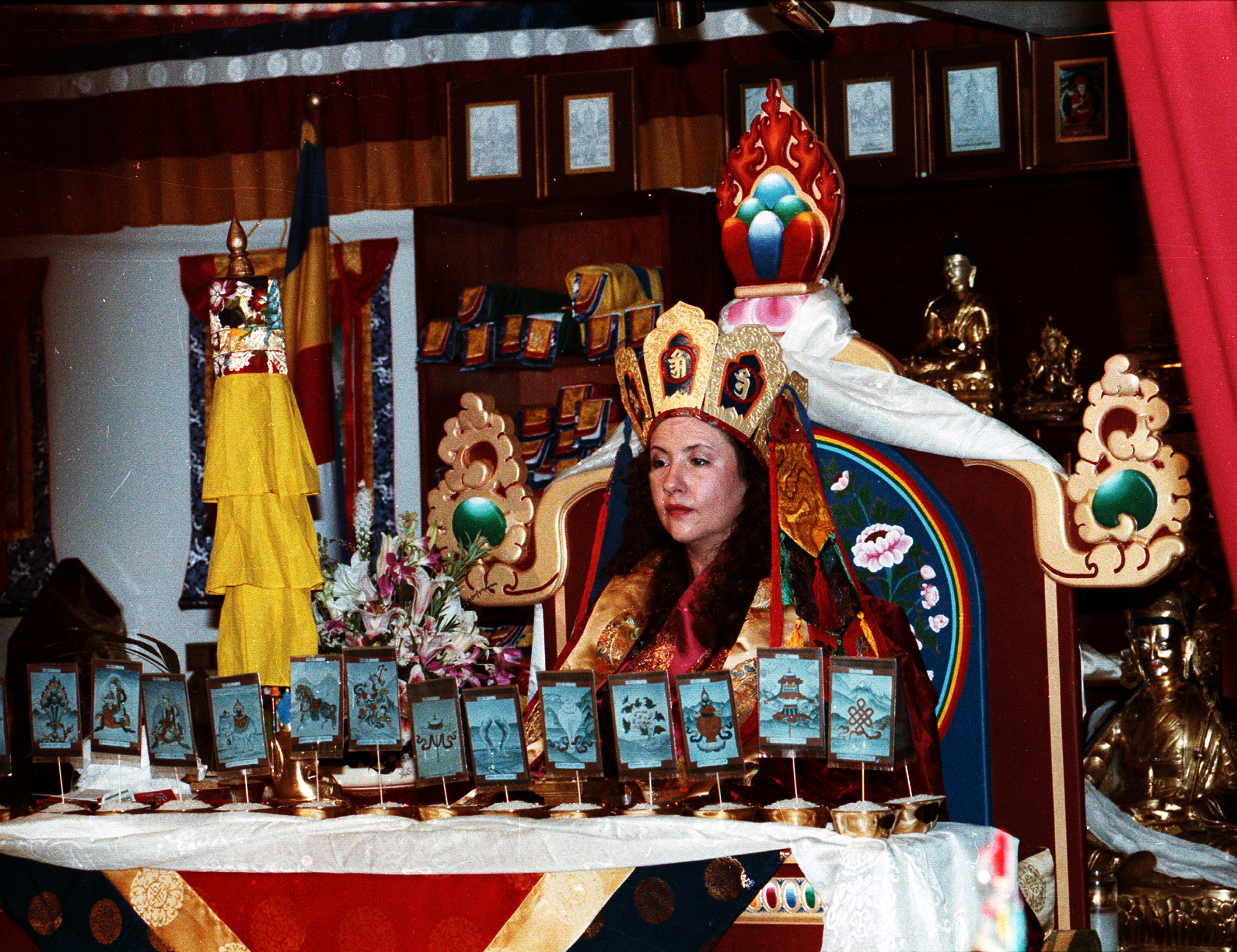
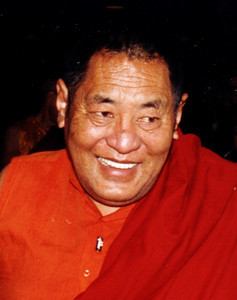
His Holiness Khenpo Jigmey Phuntsok gave the following commentary on the recognition of Jetsunma Ahkon Lhamo on July 30, 1993 at Kunzang Palyul Choling in Poolesville, Maryland
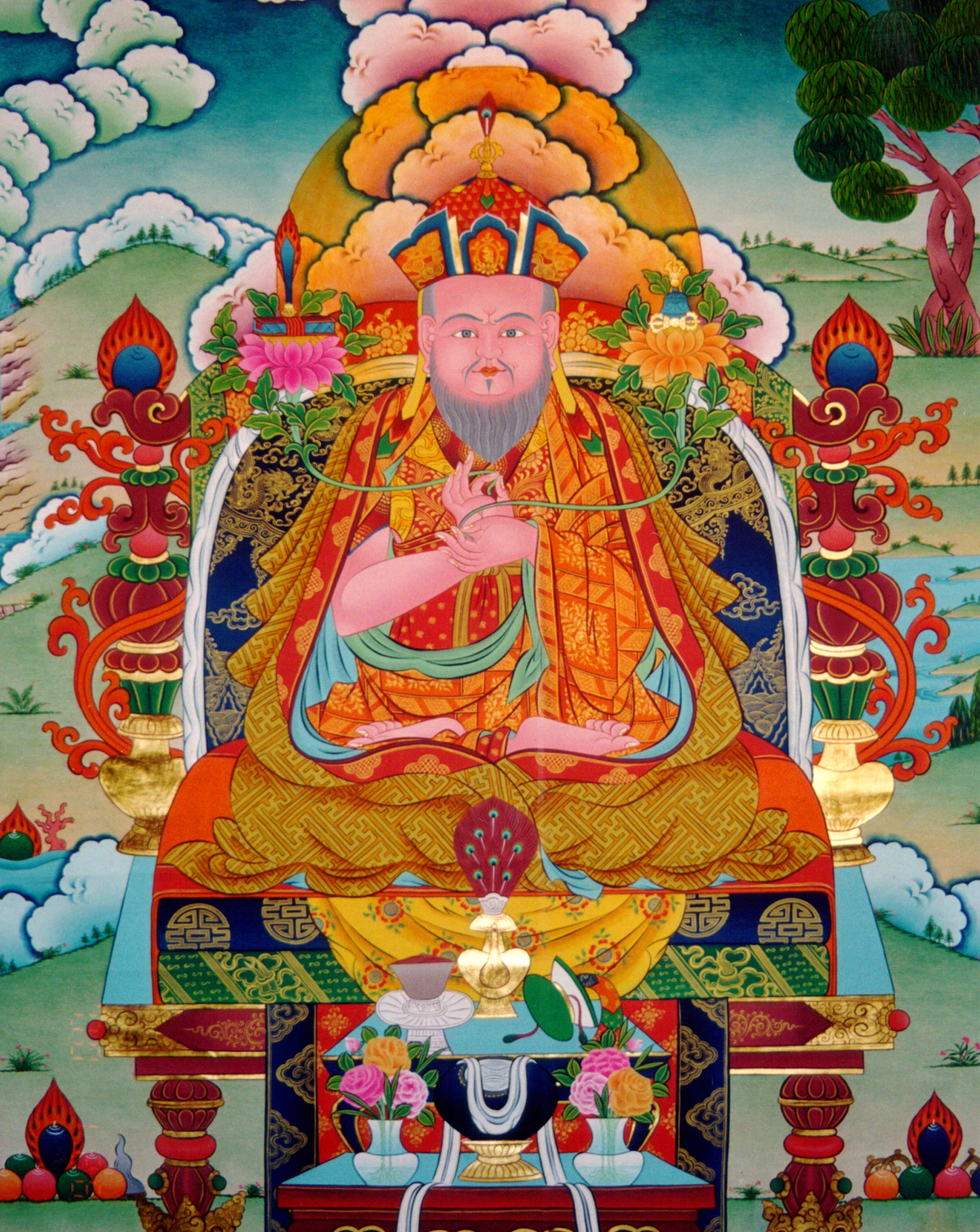
Padma Norbu Rinpoche was discovered by the fifth Kongtrul Thupten Chokyi Dorje. Thubten Chokyi Dorje by indicating who Padma Norbu Rinpoche’s parents would be. When we look at the qualities of such a recognition, we find in someone like His Holiness Padma Norbu Rinpoche has lived up to every aspect of who he has been indicated to be, in terms of being an emanation of the previous Penor Rinpoche, in terms of the qualities of his scholarship, of his honor and morality, of his excellence and of his accomplishment which are all inconceivable. And so in terms of spiritual and secular qualities he is absolutely fully endowed and lives up perfectly to the recognition, which has been bestowed upon him.
It is someone as supreme as Mahasiddha Padma Norbu Rinpoche who with his eye of primordial wisdom awareness has understood that this is an incarnation of the previous Ahkön Lhamo. He has not recognized her just suddenly without basing it on any type of investigation, as though it were something that he just did spontaneously when it came to his mind. The recognition of her occurred as a process that he had been looking into for an extended period of time. He had been checking about who she was with his own heart deities, and he received some visions from his deities giving explanations to him. He also had other experiences in his meditation and experiences in his dreams and in the least, also received indications through divination procedures. And so when he finally made the formal recognition, it was from a point of view of total confidence.
As for Ahkön Lhamo herself, first we have to look at the status of her brother who is Vidyadhara Kunzang Sherab who came from the lower Do-Kham region of Tibet.
Vidyadhara Kunzang Sherab
Secret Mantra Tradition
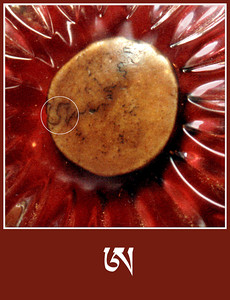
In terms of establishing the secret mantra tradition in this region of Tibet, there are three principal monasteries that were founded: Kadok, Palyul, and Dzogchen. And of these three, the Palyul mother monastery and its branches came to be, even in its time of origination, the most essential of the three monasteries for the establishment of the vehicle of secret mantra. Vidyadhara Kunzang Sherab was responsible for initially establishing the mother Palyul monastery from which there are now some three hundred branch institutions. His sister was Ahkön Lhamo and she was also very connected with him in these types of activities during their lifetime together. But she was primarily renowned for her ability to practice the Dharma. She was well-known as an accomplished yogini on outer, inner and secret levels who spent her entire life in practice And so this is why, later on, when she passed from that particular life she was well-known for the self-embossed syllable “ah” which appeared in her skull which was a sign of having achieved the highest accomplishment through the practice of that life.
“Ah” relic at Kunzang Palyul Choling
As a symbol of faith and devotion, it’s not an empty symbol. It is a symbol that exists due to scriptural authority and lineage, the lineage that she belongs to, the authority of the lineage as well as the scriptural references to that authority in the lineage. And so it is something that we can have confidence in terms of its validity. And so, therefore, we can also have confidence in her in terms of background, from a point of view of intelligence, and from the point of view of scientific proof.
We can have total confidence then, in terms of proof, that she is an exalted rebirth. Now in one way, in this lifetime, she appears as a common American woman, but in another way she appears very uncommon, because she has faith in the Dharma unlike that of a common person, and she has a very strong wish to be of benefit to others, which is unlike that of common people. She has a tremendous love for her lamas and her spiritual mentors and an ability to make impressions on the minds of others, and to actually control or have some positive influence on the minds of others. And so this sets her apart from the ranks of common folk.
Through her own wishes she traveled to India where the Dharma has existed for thousands of years. And there she had an opportunity to listen to the teachings and receive many teachings directly from His Holiness Penor Rinpoche so as to increase her own noble qualities.
She also had an opportunity to receive the entire transmission for the Rinchen Terdzod directly from His Holiness, all of the empowerments, all of the pith essential pointing out instructions and commentaries that are found in that precious terma treasury, and she received it in a way that an elderly lama would receive it, an elderly Tibetan lama. And so she had this opportunity to completely internalize all of those blessings, which is very extraordinary.
And from the time that the title of Ahkön Lhamo was bestowed upon her, she didn’t succumb to pride and arrogance and go on a separate pursuit, which would be of benefit to her with fame and glory. Instead she used that title to, even more than before, do what she could to accomplish the purpose of sentient beings and the doctrine, which she has been able to establish more extensively since her title has been bestowed upon her.
And I also think that her enlightened activities have been most excellent in terms of what she’s been able to manifest, the establishment of this temple which is filled with many wondrous supports of enlightened body, speech and mind, and all of the many stupas that she has been able to erect, which are found here on the grounds which are also amazing supports for the presence of the doctrine in this world.
Then also here in the dharma center, she has established the ordained sangha in a way, which is unlike any other place, with so many disciples who have taken the vows of ordination. This is a clear sign of her miraculous activities being manifest and her strong intention to accomplish the pure dharma in this land. Not only that, the lay householders in the community also obviously have very strong motivation towards the accumulation of that which is wholesome and that which is virtuous. And this unceasing effort towards prayer and practice carried on in the temple is yet a further display of her miraculous activities manifest.
What she has been able to accomplish up until now will continue to be accomplished in an even greater way in the future, and will have large effects on this country in general. Not just here in this place but in a widespread way. This will have an effect on many people in this country. And so this is yet a further sign of the wide-reaching effects of her miraculous activity, which will continue to increase.
And as the Buddha said that if there is fire, there will be smoke, as a sign of the fire. And if water; there will be a sign of water birds gathering there. Likewise, if there is a Bodhisattva, there will be a sign of the Bodhisattva’s presence, and that means there will be external signs that are apparent and those signs are signs of bringing benefit to sentient beings. This is something that we can notice and we then know that a Bodhisattva is amongst us.
As her students you should know how to rely upon her purely in the three ways. And you should do your best to accomplish the stages of learning and the stages of accomplishment so that the doctrine can be firmly established in this land, so that it can be of benefit to both self and all other beings.
Khenpo Jigme Phuntsok
Khenpo Jigme Phuntsok (1933 – 2004) was a Nyingma lama from the Dhok region of Kham. At the age of two he was identified as the reincarnation of the Terton Sogyal, Lerab Lingpa (1852–1926). He studied Dzogchen at Nubzor Monastery, received novice ordination at 14, and full ordination at 22 (or 1955). Khenpo Jigme Phuntsok was the most influential lama of the Nyingma tradition of Tibetan Buddhism in contemporary Tibet. A Tibetan Buddhist meditation master and renowned teacher of Great Perfection (Dzogchen), he established the Serthar Buddhist Institute in 1980, known locally as Larung Gar, a non-sectarian study center with approximately 10,000 monks, nuns, and lay students at its highest count. He played an important role in revitalizing the teaching of Tibetan Buddhism following the liberalization of religious practice in 1980.
In July 1993, HH visited KPC, ordaining a number of monks & nuns, and giving empowerment and teachings on recent termas he had revealed.
The following is an excerpt from a teaching by Jetsunma Ahkon Lhamo called “Longing for the Guru”
One of the great difficulties we have as practitioners and people involved in a materialistic culture is that we have very little understanding of the longing we feel for the Guru. In a culture that has a spiritual foundation, in a culture that recognizes the role of the Guru, that recognizes the role of the Teacher or that recognizes and approves of a tendency to long for spiritual fulfillment, it is much easier to put a name and a label on that longing.
But in our culture, in order for us to survive that kind of longing, we have to make believe that it’s something else. We have to pretend that it has to do with human relationships. We have to pretend that it has to do with prosperity. We have to pretend that it has to do with a certain lifestyle. We have to pretend that it has to do with intelligence or that it has to do with mental health. We have to pretend all sorts of different things in order to put the longing into some slot that our society recognizes, because if not, as we grow up in the formative years, it’s crushing to know in your heart of hearts that you are very different from others. No one seems to have quite the same feeling that you do.
And so, because it is so crushing, because it is such a lonely thing, often, the very people that longed the most are the ones that diverted that longing into, perhaps, promiscuity, or perhaps becoming almost fanatical about this thought or that thought or this idea or that idea. They could have diverted that longing into drugs or alcohol. They could have diverted that longing into making themselves into a way that they are not, such as a superficial way or a hard way or a tough way or a dull way or a dead way. They might have pretended that they had no feelings in order to deal with the ones that they did have.
Now, it’s true that lots of people have these same feelings and lots of people have these same ways of dealing with feelings. For instance, it’s very possible that someone whose mother or father didn’t love them could become promiscuous simply for that reason. Yet, that does not preclude what I’m saying. You should listen to your life. You should listen to what you did and what was underneath it and you should come to understand that perhaps there was something a little different in your heart and in your mind. It was there and it was with you always.
An excerpt from a teaching by Jetsunma Ahkon Norbu Lhamo on October 18, 1995
What would it be like for you if Guru Rinpoche himself, appearing in a way that you could understand, were to actually walk through every day with you? In your mind, in your heart, seeing what’s in there? Walk through all your efforts, and watch you when you turn away and say, AO.K. that’s enough of that. I’m going to go and do what I want to do. Enough of that high thinking. Let me feel the way that I naturally feel, the hell with all of you. You know, that kind of thing?
If we actually had the eyes of the Guru, if they could be felt watching us, you know what you would feel like if you had seen that happen. If you had felt that even for one day. There would never be an end to your grief. There would never be an end to the sorrow that you would feel knowing that in the face of the Guru you had made such a stinking offering.
We remain content with our self-cherishing, content with our pride, content with our ego and our hatred and our bigotry and our bad qualities. We remain content with these while the eyes of the Guru watch. Because there is no moment that you exist, that you can have a thought, that you are alive in samsara that the eyes of the Guru are not watching. And I don’t mean this like you should think of yourself as a little kid thinking, “Oh no, Mommy’s watching.” It’s not like that. The Guru doesn’t get mad at you. It isn’t an approval thing. It isn’t like your mother or your father. It’s that these eyes are like a radiant connection through which we can see directly the primordial nature, which is free of any kind of contrivance and separation and ugliness and superficiality and any of the possibilities that make it likely that we are going to practice any kind of non-virtue. This nature is so pure that it’s like having the eyes of supreme, unnamable, unspeakable sweetness looking at us always, looking at us with love and compassion. And we are taking shit and throwing it against the wall and wiping it all over ourselves: scratching and burping and farting and hitting and killing and carrying on. And yet, these eyes that hold us up, watch us always, even while we, like apes in a zoo, fling shit on them.
And yet, we wonder why it is that we cannot awaken to the Buddha nature. “When is ‘it’ going to happen? When is ‘it’ going to come from ‘out there?’ How old am I going to be when ‘it’ happens to me?” — as though it were going to be visited upon you like something air-dropped; as though it were going to come to you from another city, or another state or another world. And all the time, we are turning away from those eyes, those loving, perfect pure eyes, that are actually like guiding beams of light, if you can imagine such a thing.
When we turn our face away from the Guru, we are only creating more suffering. There is no other result that can come from that, no matter what it looks like. You might say that there are extenuating circumstances. All right, name them! I’d like to see an extenuating circumstance that’s going to change what I’ve just said, because it doesn’t exist. You might say, “Well, I did my practice from this time to this time and I really tried very hard with my Guru Yoga. I worked very hard at that and I kept it mindful as much as I could and then, well, you know, you have other things to do. You have to go work, and you have to go do this, and you have to go do that.” This is the kind of thinking that we have. Basically, what we have done is, while we were in the state of devotional practice, while we were aware of being in the presence of the Guru, while we were practicing that kind of view, we have only created causes of future bliss and happiness. The moment we turned away, that act of saying, “Okay, that’s that. Now on to this” — the moment we said that, we have practiced that non-virtue which has caused us unthinkable suffering in this and every life that we have experienced up until this point. The moment we turn away from the face of the Guru and find “something else”: in that moment we have turned away from the primordial nature that is our nature, and found suffering. The moment that we go on to the next thing, is the moment that we go on to our suffering. The moment that we move away from our practice into another state, at that moment we have moved away from what causes bliss and moved into what will only bring about more suffering. This is true even if our activity is just as pure and clean as apple pie. Let’s say we ended our practice to go feed the baby. You can’t argue with that. You got to feed babies, right? Of course, you’ve got to go feed the baby, but the problem is that you had to turn away from the Guru in order to do it.
Now you haven’t actually figured all of this out yet, but now it’s time to practice so deeply that you understand that it is possible not to turn away ever. It is possible to be in that space, to be with that face and of that face, to be inseparable, to be constantly in union with that which is union itself, to be inseparable with the Guru. This is the goal!
Why wouldn’t it be the goal? Is it samsara that you wish to be inseparable from? Is it suffering? Is it non-virtue? Do you like to turn away? Maybe you like the result, the suffering that comes after! Of course, now that I say it this way, it seems ridiculous! Of course, you don’t want that! Yet, in our practice, in our lives, what do we do? We offer the five cups of poison. This is our standard offering, every day. And then we read the text and the text says if we could just offer one butter lamp, we would remain in unmovable samadhi. And we wonder, “I’ve offered lots of butter lamps! What is the hold up? What’s the problem?” I’ll tell you what the problem is. It’s those five other cups that you offer so much more of than that butter lamp.
Maybe the butter lamp needs to be understood as a symbol, not only as a literal butter lamp on an altar, but like a light in the window, a constant reminder. When you know that a loved one is nearby and you’re trying to create the connection whereby the loved one would be guided home. In this case, we’re trying to create the connection. You would keep a lamp in the window, wouldn’t you? Keep a light on? Maybe that’s what we need to do. Maybe the butter lamp we need to offer, the one that brings us to immovable samadhi is the light that never extinguishes: the light of recognition.