To What Do You Aspire?

An excerpt from a teaching by Jetsunma Ahkon Lhamo from the Vow of Love series

In the Vajrayana tradition one contemplates very deeply on certain thoughts before you ever go on to any deeper practice, and these thoughts are called the ‘Four Thoughts that Turn the Mind.’  The idea is that your mind becomes turned in such a way that your intention to practice is firm, like a rock.  If you were wishy-washy about why you should practice meditation, your meditation will be wishy-washy.  There’s no doubt about it.  If you were convinced that your job could bring you more eternal and natural happiness than enlightenment, you would practice your job with greater fervor than you would practice enlightenment.  Therefore you try to turn your mind so that it has a firm foundation, hard as a rock, upon which you can build your practice.

It’s that way with aspirational Bodhicitta.  You have to turn your mind in such a way that you understand the value of compassion and you have to actually ignite your mind.  You have to set it on fire, and that fire has to be stronger and hotter and fiercer than any other feeling or idea that you have.  It has to burn so strongly that you can’t put it out.

In order to practice aspirational Bodhicitta, you must first of all look around you with courage.  Because we Americans, even New Age Americans, don’t like to look around and see that others are suffering.  We hate to think about that.  We think somehow it’s bad to think like that. According to the Buddha, it isn’t bad to think like that.  In fact, you must think like that in order to go on to the next level of practice.  You must look around you and be honest and be courageous. If you don’t see suffering in your life, if you don’t know that the people around you are lonely or getting old or getting sick, that they live with worry and with fear, then what you need to do is go to the library and check out books about other cultures and other forms of life, and see what the rest of the world is like.  Have you ever seen pictures of Calcutta, India?  Have you ever seen pictures of Bangladesh?  Have you ever seen pictures of Africa?  If you don’t believe that suffering exists in the world, you’ll see it there.  Have you ever studied the lives of people who continually do non-virtuous activity? Even though they might look like they’re tough and in control, they are deeply suffering. It behooves you to be courageous enough to examine that.  You should look at other life forms. You should look at animals.  You should look and see how oxen are treated in India.  I speak of India a lot, not because it’s a bad place, but because I’ve been there, and I was shocked.  I had no idea how sheltered Americans are from suffering.  I had no idea until I saw lepers in the street with no limbs and with open sores.

Having studied these things, you will come to understand that there is suffering in the world.  You should cultivate in your heart and mind a feeling of great compassion. You shouldn’t stop until you’ve come to the point that you are on fire and you cannot bear that they are suffering so much.  The Buddha says that we have had so many incarnations in so many different forms that every being you see, every one, has been your mother or your father.    Whether you believe that or not, it’s a great way to think.  Because you look at other beings and see how they are suffering helplessly, with no way to get out of it.  And that they, at one time, had given you birth.  In that way, you can come to love them in a way that you can practice for them.

You should allow yourself to become so filled with the urgency to practice loving that your heart is on fire and there’s no other subject that interests you as much.  Even if it’s uncomfortable; we Americans think we should never be uncomfortable. Sometimes discomfort is very useful.  Be uncomfortable and let yourself ache with the need to practice Bodhicitta.  Cultivate in yourself that urgency and that determination.  You might get to the point where you feel something, and you feel sort of sorry for all sentient beings.  You might think, “Okay, now I’ve got it.  I’ll go on to the next step.”  No, you haven’t got it.  You should cultivate compassion from this moment until you reach supreme enlightenment.

Unless they are supremely enlightened no one is born with the perfect mind of compassion.  I, and everyone I teach and everyone I know, including my teachers, practice aspirational Bodhicitta everyday, reminding ourselves that all sentient beings suffer unbearably and that we find it unbearable to see.  You should continue to cultivate compassion every moment of your life. It will begin to burn in your heart. It’s like love.  It’s beautiful.  You won’t want ever to be without that divine fire in your heart.  It will warm you as no other love can.  It will stabilize your mind as no other practice can.

© Jetsunma Ahkön Lhamo

Walk In Recognition

An excerpt from the Mindfulness workshop given by Jetsunma Ahkon Lhamo in 1999

Practice deeply and mindfully every minute of your life. I’m asking you, I’m pleading with you: don’t practice like a robot.  If you can only start with just moments of Recognition throughout the day, start there.  Even one.  It will increase, I promise you.  It’s like building muscle.  What a noble and honorable way to live.  How amazing!  Rather than just clinging to our egos, constantly defining them, and reacting to everything else, practicing some sort of profound Recognition, some sense of the sacred — I mean, is it a real choice?  You can see that one life is so much more precious than the other, so much more meaningful, so much more profound, so much more useful for sentient beings.

I hope that you will, in your practice, begin to institute a way to be mindful, not only when you’re sitting down.  Sometimes we’re not even mindful when we’re doing our sit-down practice.  But to not only be mindful and stretching for that sense of Recognition when we do our practice by carefully, nicely accomplishing the visualization and really discovering its meaning, but also in our lives, to Recognize the nature of appearances, to Recognize that everything is the face of the guru, everything is an opportunity to practice – perhaps that’s a little deeper than walking around saying “Everything is beautiful, everything is love and light.”  I hope that you will practice in that way.

I invite you to go deeper and deeper every moment.  As a practitioner, every moment that you live with this consciousness, with these precious Dharma teachings in your hands, each moment is like a gift.  Each moment is like a Christmas present.  Most of us have them, and we just squirrel them away.  We just take our moments, we move through linear time collecting moments.  But as a practitioner, you can open that package.  Each and every gift has Guru Rinpoche’s face in it.  Each moment as a practitioner has the capacity in it, the ability and the responsibility, to move into a state of recognition, to awaken.

When you find that you’re thinking, “Oh, some of these monks and some of these nuns aren’t so good,” and, “Now I’m really pissed off at my teacher because she moved to Sedona and then not only that, but it’s my week to clean the bathroom” — when you think things like that and you have these ideas about how it should be and you’re judging this and feeling bad about that, what are you doing?  You’re practicing the mandala of self-absorption.  You’re putting that ego right in center stage.  How amazing instead to turn it around and, should you see that you have some reaction, to question your perception.  Question the depth of your practice.  That’s where you have potency.

That’s what makes this practice of Buddhism so amazing:  the ball is in your court, the practice is in your hands.  You’re not waiting for salvation; you’re learning to Recognize it.  What’s so potent and so powerful about understanding that is that no one can take that away from you.  There is no power that can take Recognition away from you, no power that can take the face of the guru away from you.

I hope you will include this in your practice.  I hope you will walk a sacred life.  Whatever it takes to remind you, walk a sacred life.  Walk in Recognition, not in ignorance.  When you use these practices, use them throughout all of your experience.

© Jetsunma Ahkön Lhamo

Aspirational Bodhicitta

The following is from a series of tweets by Jetsunma Ahkon Lhamo:

One very important step on entering the path is to make aspirational prayers. It is the beginning of right focus and view. This habit is the very underpinning of one’s spiritual journey. Aspirational prayers are also a way to train the mind, based on altruism, to give birth to the great Bodhicitta in one’s mind.

For instance, one might pray “as I open this door may all pass through the door of liberation”

Or if eating delicious food one prays “as I receive nourishment may all sentient beings be fed by DHARMA”. This trains the mind to be less self absorbed and more likely to put the welfare of others before one’s own, to see one’s life as a vehicle by which to serve. To AWAKEN from the death-like sleep of ordinary view. For some kindness is not a natural habit. This is the life, the time to make it so!

If you can read the word Bodhicitta then you have the karma and power to accomplish it, and should NOT hesitate to practice! Life is quick, short and we must grab the opportunity while we may to make ourselves and our world BETTER. In human physical realm we all suffer from old age sickness, and death. These are inescapable! So we must use this time to prepare for our rebirth.

Kindness will bring happiness. Generosity will bring wealth in our future time. Keeping vows purely will make a beautiful body and Form. Pure thought will bring a clear balanced mind. As we make aspirational prayers we are beginning all that. To whom do we pray? Not to a conceptual god, old man on a throne. But to the 3 jewels, Lama, Buddha, Dharma, Sangha, which are the very display of one’s own pristine primordial nature. This is our own true face.

So one is in a sense purifying one’s own perception in order to wake UP as lord Buddha is awake. Selfishness, dullness, anger, cruelty are ALL causes for a low rebirth. One must build pure view by examining the condition of other sentient beings to understand. They are the same in their nature: separated only buy habitual tendency; Karma. All suffer. All wish to be happy. All strive as you do. With very little result until they train their minds. We must apply method, which is stated clearly in the 8-fold path as Buddha taught. And I have also,as I follow his teaching.

“As I offer these humble words, may they bring benefit to all beings. May all who suffer find the WAY!” This is my prayer. And after I teach all I know, may I have the honor to see ALL cross this ocean of suffering; to be last in order to guide others to the Ship to Liberation! For their sake, my children. OM AH HUNG BENZAR GURU PEMA SIDDHI HUNG Sarwa mangalam!

Thank you for offering your attention, and allowing me to speak the precious lessons taught by Buddhas and Bodhisattvas through the ages.

By this merit may the sick be healed, may the hungry be fed, may cruelty and hatred end, may confused minds be mended and may there be PEACE!

Gratitude and Guru Yoga

MG-150-9 HHPR, JAL on patio

An excerpt from the Mindfulness workshop given by Jetsunma Ahkon Lhamo in 1999

Another aspect of constant mindfulness – it’s sort of like hand-in-glove with offering – is gratitude.  When you think about the appearance of all phenomena, like beautiful flowers, beautiful trees, all of our beautiful stuff, suppose you were able to develop the habit of thinking like this: “How great must be the Buddha nature, that this display of the Buddha nature is so beautiful,” with gratefulness.  It’s not like ‘thank-you-God-for-everything.’  It’s not like that.  It’s a deep response, joyfulness, the Recognition to see that the nature that is our deepest, most profound nature, the nature that is all-pervasive, the nature that is our Buddha nature is actually inherent in all appearances. To acknowledge that, to move into any kind of Recognition of that is so amazing.  To think that we are somehow connected.  How amazing!

A sense of wonder that encourages you, not just to see and react in a dull and stupid way, but to perceive more deeply.  By doing that, we develop the habit of letting the mind be more profound, letting the mind reach its depth, and consequently, one’s practice becomes so much more profound and our level of Recognition becomes so much more deepened.  This sense of gratitude ultimately, as we begin to practice, gives rise to an awareness of the emptiness of all phenomena and the inherent nature that is the heart of all phenomena.

As we begin to think like that, every time we take beauty into our eyes and have the opportunity to offer that beauty, perhaps we can say, “That is Guru Rinpoche’s.  This is Guru Rinpoche speaking to me.  I see this beauty and now I have, because of that, the opportunity to offer this beauty to the Buddhas and the bodhisattvas for the liberation and the salvation of all sentient beings.”  If you have a marvelous personal experience and remember to offer the joy of that experience for the sake of sentient beings, or to the Buddhas and the bodhisattvas, to be able to do that, in that moment, you are with Guru Rinpoche.  Guru Rinpoche is speaking to you.

If we learn to Recognize the intrinsic nature of phenomena, isn’t that like learning to see the face of the guru?  What’s important about this is the power that we have to practice this way.  In ordinary situations, if you love somebody, they can be taken away from you.  They themselves can walk away from you.  You could lose them.  But in this way of thinking, this kind of practice of mindfulness, no one can ever take the appearance of Guru Rinpoche away from you.  No one can ever take from you, nothing on this earth has the power to hide from you, to keep from you, the face of the guru.  So if you’re able to look at your environment, and think, “Oh, this is so beautiful, such a beautiful place,” and you’re able to really offer it and feel that blissfulness of just letting go and surrendering all the beauty that you see to the Buddhas and the bodhisattvas, praying fervently that somehow that virtue will be used to benefit beings, praying that all of that virtue will go to nourish sentient beings, at that moment, you are in the very arms of the guru.  You are not separate from the guru.

In ordinary relationships, someone can take that away from you.  Samsara has that power, and there’s not a thing you can do about it.  How amazing to distinguish between that and the extraordinary relationship that is brought about through mindfulness and Recognition: this one relationship that nobody on this earth, even Guru Rinpoche himself, could take away from you, not that he’d want to.  We have this extraordinary opportunity.

Regarding recognition and mindfulness in our Guru Yoga, remember how I’ve taught you that ultimately the practice of Guru Yoga helps us to recognize our own nature, to recognize our primordial wisdom nature as being inseparable from the teacher?  How amazing to use this practice of Recognition in such a way as to expedite all of that and make it so much more profound and so much more meaningful instead of reacting constantly as we habitually do.  How amazing if even once, twice, three times in one day, in one week, we can practice that Recognition and remove ourselves from that neurotic scenario, using the appearance of phenomena and our reaction to it as a way to see the face of the guru. How amazing!

© Jetsunma Ahkön Lhamo

Watch It

An excerpt from the Mindfulness workshop given by Jetsunma Ahkon Lhamo in 1999

You’ve heard this so many times in Buddhism: watch your mind.  That is an indication to give rise to a state of recognition, the ability to discriminate the nature of phenomena.  When we begin to practice in such a way that we can get a little spaciousness in between the assumption of self-nature as inherently real and the reaction to the tree, there is a natural pause that develops.  It’s a very small pause, but as you continue to practice, it will grow.  That moment of spaciousness will grow.  Then you are empowered to do something that you couldn’t do any other way, and that is to get ready to start dealing with your emotions and seeing them for the empty phenomena they actually are.

You know, we have all kinds of techniques for dealing with our emotions.  We take Prozac, we go to therapy, we drink – self-medication – we suppress our emotions.  Some of us are just champs at that.   We repress our emotions, or we divert them.  We divert them into something else entirely, and then we’re completely crazy.  There are all kinds of different ways to deal with our emotions, but one way to deal with your emotions, if you’re really going to practice this path and you’re really going to treasure this idea of recognition and treasure this idea of practicing mindfulness, you’ve got to watch the mind.  You have to watch; you have to perceive the nature of experience, perceive the nature of appearance, perceive the nature of phenomena.

Instead of suppressing emotion, diverting emotion, glossing over emotion, the thing to do here is to practice when we are very relaxed so that when we are in a highly emotional state we can begin to insert that same wedge, that same bit of spaciousness.  It’s not that you judge yourself harshly and say, “God, I’m just such a terrible person. I’m just so angry all the time.  I hate that about myself!”  I actually have a student that does that to herself.  “I just hate that about myself!”  Well, that’s a solution, isn’t it?  “I just hate that about myself.”   Instead of doing that, you can simply observe.  Observe like a mind that is calm like a lake.  You’re observing.  That’s all you’re doing.  You don’t need to do anything else.  Watch yourself in the equation.  Watch yourself clinging to the idea of self-nature as being inherently real.  Watch yourself assuming that everything else is out there, and watch yourself react to, with hope, fear or neutrality, everything.  Watch yourself also go into that emotional state which is really only the elaboration of that original equation.  That’s all it is.  It’s just an elaboration of the original equation.  We think our emotions are us; they’re so precious because we areour feelings, and that’s what makes us unique.  That is bull hockey.  I don’t know how better to say that.

Instead we have to begin to realize what these emotions are.  They are just the continuation or elaboration of that original equation: ego-clinging reactiveness, that equation is simply a more elaborate form.  In order to insert the spaciousness that is required, what we have to do is find a way to observe.  Even when you’re getting ready to kick the dog and throw the kid through the wall, technically speaking it’s very, very hard when you’re in that state to do much about it.  Once you’re there, just wait for it to go away.  That’s all you can do.  Once you’re there, it’s very difficult, but even if in that aroused, inflamed state we are able to observe ourselves, that is the unique capacity of human beings.  Won’t you use it?  It’s what distinguishes you from the rest.  If there’s anything that makes you special, that’s it: the ability to put that spacious moment in there through observing the reaction.  We can just say, “That’s just like me.  Yeah, that’s just like me.  I do that.”  And then maybe questioning oneself later on and understanding, “Well, I do that because I’m protecting my turf; I’m protecting my space; I’m not wanting to change anything; I’m wanting to be powerful and right, so I need to put everybody else down.”

Whatever it is, simply observe, just observe, and you’ll find out that if you do that as consistently, deliberately, honestly, truly and deeply as you can, that after a while – and it doesn’t come immediately, so please don’t look for immediate results necessarily – there will be a spacious moment.  It might be just a little moment between you and your reaction, but eventually in your practice, by practicing Dharma, by using generation and completion stage methods, you will be able to recognize.  In that spaciousness, you can begin to recognize the emptiness of both the ego and that which affects it.  But it takes a combination of things.  It takes the ability to practice Dharma the way that our teachers teach us in generating oneself as the deity and practicing completion stage practice, but it also takes this deliberate, walking, waking mindfulness.  This is part of the path.

© Jetsunma Ahkön Lhamo

Another Glass of Samsara?

An excerpt from the Mindfulness workshop given by Jetsunma Ahkon Lhamo in 1999

Do you ever sense that there is a thickness in your mind, almost like pudding?   We can’t break through it.  It’s like we go through these sleepwalking motions, and you lose days, hours, years.  You just lose time, and that thickness is because we already decided, way back somewhere else, that one of the goals in life was to get such-and-such, and in order to get such-and-such, we have to act thus-and-so.  Once we decide that, we never think about it again, not really. We never stop to reevaluate.  That is the unique thing about our brains.  It’s something we really need to understand.  Once you come to a conclusion and you conceptualize something, that’s it.  You act by rote afterwards. You have to break through that.

In order to really give rise to true compassion, one has to recognize the faults of cyclic existence, and be in a state of recognition. In order to awaken to a state of recognition, to begin that process of discrimination, you have to rouse your mind from going through these preset patterns which are based on deluded ideas that you were given somewhere early on that you’ve never bothered to change.  If you don’t change those, you will still try to attain the same type of goals, but you’ll be wearing Dharma clothes and doing Dharma activities when you do it.  If you got the message that you have to be a star, be powerful, be smarter, or be some kind of special person, then when you practice Dharma, if you don’t go back and reevaluate that in a mindful and discriminating way, you will simply do the same thing with Dharma clothes on, with Dharma words in your mouth.  Basically what we’re doing there is continuing to practice sleepwalking.

This discrimination that I’m talking about is not like a generalized, euphoric state where you walk dreamily outside and you say, “I’m mindful of the Buddha nature and everything.” That’s not what we’re talking about here.  This mindfulness is requiring of yourself, stimulating yourself, rousing yourself to rethink, to reassess, and to try to give rise to some recognition of what is precious and what is flawed; of what is extraordinary and what is ordinary.

We can equate the condition we are in ordinarily to be like drunkenness.  It’s exactly like drunkenness.  Some of my best students –Best with a capital “B,” as in Buddhist – are recovering alcoholics.   Recovering alcoholics have a wonderful opportunity because having emerged from the cocoon of constant, chronic alcohol consumption and the cycle of craving and the response, the recovering alcoholic has the opportunity to put aside the drinking and go through the process of picking up one’s awareness again and focusing it.  They have the sense of knowing what it’s like to do that for the first time.  I’ve talked to many recovering alcoholics, and they always say the worst time is the first time.  The worst time is right after you quit drinking, and you notice that you have no mind, and you try to get one going.  You try to punch start it somehow.  You try to teach your mind how to think in a way that does not always go back into obsession, compulsion, and desire. Recovering alcoholics have this magical understanding of what it’s like when you first get sober and the difference between that sober state – even if it’s a little raw and painful at first – and that other state.  They realize that they were not functioning.  They understand that they were not “there.”  There was nobody home and they were being driven by craving alone.  There was nothing else going on.  There was nothing in your head but buzz, and the buzz got louder when you walked away from the liquor store, and it got better when you walked toward the liquor store.  The opportunity to experience what that’s like, to awaken to sobriety, is a fabulous teacher because it gives one a sense that all sentient beings are alcoholics.  We may not be drinking alcohol, but we are guzzling down the samsara!  We are high on ego!  We don’t ever want to get off that.  If we ever, in just one day, spent as much time on our practice as we do on our ego, we would be changed forever.

Having that experience of suddenly awakening to a sober state is not so different from moving out of the drunkenness of preconceived patterns and ideas, with all of their judgments, reactions and habitual tendencies of doing what you thought you were supposed to be doing, and into that sobriety that one attains when one begins to move into a state of recognition.  At that point, one begins to discriminate what the problems of samsara are, and what the difference is between what is extraordinary and what is ordinary.  One begins to see what’s really going on here.  That state of discrimination is just like the very beginning of sobriety, and like the beginning of sobriety, it can be a little raw and painful.  In the drunken state, you try to stay comfortable in the time and space grid where you are in ignorance, saying, “Oh, I’m sitting here right now, so I’m not dead, therefore I’ll never be dead. I’m sitting here right now and I’m middle-aged, therefore I’ll never be old.”  To awaken from that kind of deluded thinking and say instead, “I’m middle-aged now and I used to be a kid. Uh-oh, that means there’s a progression happening here.  Whoa!  Where’s that taking me?”

We don’t like to think like that.  As sentient beings, we try to keep ourselves in a safety zone, thought-wise, don’t we?  One day you look in the mirror, and you say, “Wow, what happened to the flesh that used to be up on that cheekbone?”  And although you see it, and you think it’s kind of funny, you know it’s happening, but you tell yourself it’s not really happening.  You tell yourself it’s just that you had a potato chip last night so you had too much salt.  We try not to think that any of this is happening, and we stay in our comfort zone.  We spend most of our calories trying to stay in this comfort zone.

© Jetsunma Ahkön Lhamo

Wisdom Merit

[Adapted from an oral commentary given by His Holiness Penor Rinpoche in conjunction with a ceremony wherein he bestowed the bodhisattva vow upon a gathering of disciples at Namdroling in Bozeman, Montana, November 1999. —Ed.]

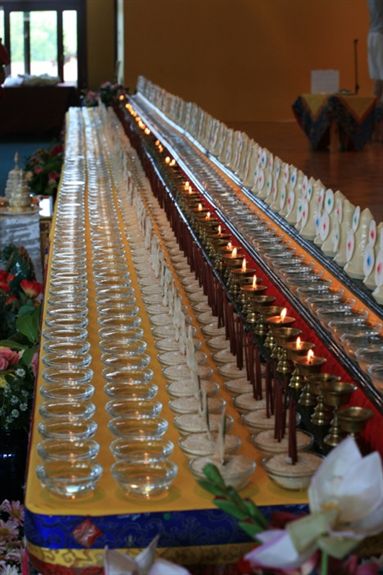
General offerings please the senses. Imagine those offerings to be vast and inconceivable. However, if you were to [attempt to] compare the outer offerings with a single particle of the realms of buddhas and the quality of offerings made in the minds of enlightened ones, [you would find that comparison] to be beyond the scope of your imagination. That is why it is so important while presenting offerings to try to connect with the ultimate nature of offering, which is mental and not just material. Material offerings you make are supports for your mental or imagined offerings, which should be as inconceivably vast and wondrous as you are capable of manifesting. The actual offerings you use as a support should also be the best substances you are able to offer. At least they must not be old, dirty, or leftover substances; they must be suitable supports for the basis of virtue. The pure material offerings you make will be the support for the continual manifestation of inexhaustible offerings that will remain until samsara is emptied.

There is a well-known story of an accomplished practitioner named Jowo Ben. One day Jowo Ben made a very beautiful, clean, and pure offering on his altar. As he sat and looked at his offering, he thought, “What is it that makes this offering I’ve made here today excellent?” Then he remembered his sponsor was coming to visit that day, and he realized he had made the beautiful offering in order to impress his sponsor. He jumped up, picked up a handful of dirt, and threw it on the altar, saying he should give up all attachment and fixation on worldly concerns. Other lamas, on hearing what Jowo Ben had done, proclaimed his offering of throwing dirt on his altar to have been the purest of offerings, because Jowo Ben had finally cleared his mind of attachment and aversion.

When offerings are made, they are rendered pure and excellent by a mind free from attachment and aversion to the ordinary, material aspect of the offerings—and they must be made with a mind that is also free from avarice. Don’t think you can throw dirt on your altar and think that will benefit you. You must adjust your mind. If your mind is free from attachment or fixation and aversion, then whatever you do will be right. If your mind is not adjusted and your intentions are impure, then no matter how beautiful and magnificent the offering is, it will be insignificant. If you present all offerings, whether abundant or meager, with fervent devotion from the core of your heart, that will produce profoundly amazing results.

In order to be free from the suffering of existence, the mind must be free from dualistic fixation. In freedom from duality, everything is inherently pure. Just imagine all the wonderful offerings that are made that are free from duality: pure water possessing the eight qualities, garlands of flowers, incense, light, superior perfume, celestial food, musical instruments, fine garments, beautiful umbrellas, canopies, victory banners, the sun, the moon—the finest and best of everything is offered. Consider those as offerings arranged in a magnificent array equal in size to Mt. Meru. Furthermore, know that those offerings are pure and free from duality. For example, if you were to pick a flower and think, “Oh, this is such a beautiful flower; I want to offer it,” but then you also think, “My flower is more beautiful than the others,” and you offer it with that dualistic thought, then that offering would be defiled by your dualistic fixation. On the other hand, if you focus on the pure nature of the offerings and present them with pure devotion, you will make offerings that are pure or free from dualistic fixation. Recite the verses of the branch for offering, and make the most excellent, immeasurable offering you are capable of with the enlightened attitude [bodhicitta], faith, and pure devotion.

It is important to understand that presenting offerings is the antidote for [having] desire. Offerings are not made to the Three Jewels because they are considered to be poverty-stricken and in need of receiving from their disciples; offerings are made to accumulate merit. By making offerings with actual material substances, we accumulate ordinary conceptual merit; by using the mind to manifest immeasurable offerings, we accumulate nonconceptual wisdom merit.

From “THE PATH of the Bodhisattva: A Collection of the Thirty-Seven Practices of a Bodhisattva and Related Prayers” with a commentary by Kyabje Pema Norbu Rinpoche on the Prayer for Excellent Conduct

Compiled under the direction of Venerable Gyatrul Rinpoche Vimala Publishing 2008

Recipe for Results

An excerpt from a teaching by Jetsunma Ahkon Lhamo from the Vow of Love series

As long as the idea of self exists, self will experience other with either attraction, or repulsion. There is no other way to experience other. Whether it’s subtle or not, even if you are a proponent of New Age philosophy, and are supposed to love everybody and have unconditional positive regard towards others, if you could really examine your mind with determination, courage, innocence and willingness, you would discover that you are either attracted to or repulsed by everything you see, no matter how you gloss it over. No matter what you say, the karma is still forming. That is how the consequences of one’s life actually manifest: through that constant inter-reactive relationship, through that interplay, through attraction and repulsion, through desire. That’s how it’s possible for you to be born. That’s how it’s possible for you to do things you feel uncontrollably forced to do.

Even if we are so convinced that we know all of these teachings, don’t we still get into trouble? Don’t we find that we react to circumstances in a way that is not skillful? Don’t we, in fact, on an on-going basis make everything worse? I mean, it’s true, if we are honest with ourselves. Every time we react, we make things worse. Even when we can’t see that we’ve made things worse, I’m telling you this is the truth: we are constantly compounding the karma of our own minds. Even if in retrospect, we could see that we should have been loving, and we should have been kind and good, blah, blah, blah, blah, still, we are compulsive about it. We are what we are. We are ‘feeling junkies.’ We are hooked on sensual experience. And we react to it.

What then is the answer? If all of this is true, and desire is the foundation of all suffering, then what if the Buddha is right? What if all of suffering comes from the belief in self-nature? Will it do to pacify our minds with positive thinking? Will it do to walk around with the idea or the New Age philosophy saying, “Oh, I’m already enlightened because I understand I am the creator, or one.” I’d have to say you’re talking about two selves there. You’re talking about ‘creator’ and ‘I,’ and so long as there is distinction, so long as there is the belief in self-nature, you still have desire. You still have attraction and repulsion. You still have hope and fear. You haven’t gone yet into a deep and profound understanding of the emptiness of self-nature. Of course, we have to do that through meditation. There is no ordinary language or ordinary experience that will teach us that profound understanding.

The best thing to do, actually, is to find a qualified teacher who can begin to help you, not only in terms of giving you the words – the verbal teachings – but also some kind of virtuous or valuable energy transmission. On the Vajrayana path, that is done through the transmission of the lineage. The teachings on the nature of emptiness, the teachings on the generation-stage practices, all of the different teachings that we receive here, are passed down through a lineage. That lineage originates in the mind of enlightenment, in the primordial state. It then is transmitted to us. It doesn’t stop there. The minute we receive an empowerment, we’re not going to instantly become enlightened. I wish it were that easy, but it is not. At that point, we are qualified to practice, and it is through the practice and our meditation – with the help of the transmission of the lineage – that we will achieve results.

Copyright ©  Jetsunma Ahkon Lhamo.  All rights reserved

About Self

A teaching by Jetsunma Ahkon Lhamo from the Vow of Love Series

What is the root cause that goes underneath and beyond the thinking and reckoning of the human mind? What is so ancient that it has existed for time out of mind, even before you could think? What is so old that you were born with the certainty you too will die? In order to uncover these mysteries, you need to examine the idea of suffering. Once you can answer these questions, you are free to explore the path of enlightenment.  According to the Buddha’s teaching, the real cause for suffering is the belief in, and clinging to, self-nature as being inherently real. And here is a little bit that is so embarrassingly superficial, you could call it the Kellogg’s cereal box-top version of the nature of mind. Anyway, having made my apology and legal disclaimers, I will continue!

For the very idea of self to arise there has to be a division in which there appears to be a separation between self and other. In other words, the mind arises in such a way that it becomes divided at that time. In order for that division to exist in any form, even the most subtle form, that which considers itself to be self, with the impetus to divide, must begin to gather data around itself. In order to be a self, self has to be distinguishable from other. Different discriminating thoughts begin to form, and self begins to clothe itself.

Once self begins to clothe itself, a tension arises. There is a need to maintain self in order to distinguish self from other, because if at any moment self drops the conceptualizations that surround it, self becomes indistinguishable from other, and there is only suchness. Therefore, the idea of survival becomes important. With survival comes the idea of clinging. With clinging, comes desire. If there is self, then, there is other, and there must be cause and effect. It is at this level that cause and effect arises. In the natural state, the uncontrived state, there is no cause and effect.

The moment there is the consideration of self-nature, the reality of cause and effect, or karma begins immediately to appear in the most profound way. From that point on, karma is very, very real. We should not kid ourselves, thinking that we can talk our way out of cause and effect. It is real. Self then, in order to become distinguishable from other, must have a kind of inter-reactive relationship. In order to maintain the idea of self, there has to be the distinction of self. There has to be an idea to formulate self more and more firmly, to form ideas around self. The only way to do that is to react for or against other. Self has to have something to bounce off of. That is the way the idea of self is formed.

Copyright ©  Jetsunma Ahkon Lhamo.  All rights reserved

A State of Recognition, Not Neurosis

An excerpt from the Mindfulness workshop given by Jetsunma Ahkon Lhamo in 1999

As human beings, some of the greatest downfalls and difficulties are the constant messages and self-imposed kinds of structures or ideas regarding how we should be and shouldn’t be.  When we fail to come up to these standards and these ideals, the guilt that we have is so profound that it stops us dead in our tracks and we feel worthless and a whole, neurotic scenario begins about worthlessness.  It is absolutely the opposite from the kind of practice that we want to do.  We may think that as spiritual people we should feel like nothing, be humble.  Try to understand it a little differently.

If you’re walking around superimposing an idea on yourself and you’re feeling worthless and guilty and like nothing, that’s not really spiritual.  One is supposed to be in a state of Recognition, not in a state of neurosis.  So this guilt, which results from having all these ideas of how we ‘should be’ in this materialistic society, and the feeling that we are criminal if we don’t measure up to these ideas, is very much all-pervasive.  Witness how it is as a mother; when you have small children.  You know what it’s like when you develop that cord between yourself and your child where they become little satellites.  They’re out there, but there’s this little cord, this connection, between the mother and the child so that if the child is no longer in your sight, as a mother, you react to that.  That pulls the cord.  There is a big feeling of, “Oh, I have got to take care of my child, and I have to make sure my child is safe.  I have to supervise my child.”  If for one moment we respond differently to it or perhaps not quickly enough, or if there’s a moment of confusion, we immediately think of ourselves as criminals, and we immediately think the first thing to do is hide that.  Then we carry around this block of guilt and criminal feelings that make us act out in certain ways that are unfortunate.

Training the mind to constantly be in a state of offering, to constantly be in a state of more and more increasing Recognition is a way to circumvent the criminalizing-guilt neuroses.  To be able to gain a deeper recognition of the nature of phenomena, of what is sacred and what is ordinary, what is meaningful and should be gathered and what should be abandoned; to gain a better recognition of the faults of cyclic existence, and be able to distinguish between a diamond and a piece of glass — to train oneself in that way moves us out of that realm of being ego in the center of our own mandala, constantly being good or bad, blaming, judging, being hopeful or fearful — that constant neurotic scenario that ultimately, when you really look at it, is what we call ‘us.’  In training the mind to a deeper Recognition as an extension to one’s practice, and to practice constantly as we move around, is an antidote that is extremely powerful.

In terms of thinking about how our minds work, did you ever try to just sit down and just still the mind, just kind of relax and go blank?  Did you ever try to do that?  To try to get your mind to do that is like screaming at a monkey in a cage to stop jumping up and down.  What do you think is going to happen?  The monkey is going to go even crazier.  So in practicing in the way that I’ve described, constantly offering and not clinging, (therefore applying the antidote to clinging), constantly moving deeper and deeper into a state of better Recognition rather than deeper and deeper into ego-clinging, self-cherishing and neurosis, what happens is that it actually calms the mind.  It’s like it begins to apply the remedy or the medicine that makes our mind change from something that is inflamed to something that is much more relaxed so that our minds actually begin to change.  That happens in our sit-down practice, and that also happens in our mindfulness as we walk around.

© Jetsunma Ahkön Lhamo

WP2Social Auto Publish Powered By : XYZScripts.com