Western Baggage and Eastern Philosophy

From The Spiritual Path:  A Compilation of Teachings by Jetsunma Ahkon Lhamo

As human beings, we avoid looking deeply at our ingrained habits and beliefs. We avoid testing them for the qualities needed to develop properly on the Vajrayana path. It’s easier to “go with the flow.” We dislike challenging ourselves. Most of all, we dislike change. We are somehow more comfortable with remnants of our old beliefs, translated into Dharma terminology.

Eastern philosophy is difficult for Westerners to understand. There are so many major differences, including the basic premise and the value system. Though the various motivations for practice set forth by the Buddha are universally true, people tend to select what resonates most with what they learned while growing up. Your culture strongly influences your reasons for practicing Dharma—and how you under-stand it. Those whose needs are generally satisfied react very differently from people who have seen war, suffering, and famine. The latter tend to hang on to Dharma for dear life. But many Dharma-practicing Westerners complacently think: “If I can just get another precious human rebirth, I’ll be okay.”

Not so for those who have seen intense suffering. They are apt to think: “I want out. I want my mind to be free of the causes of suffering. I am sick of revolving helplessly on this wheel. I’m tired of watching my loved ones go hungry and die young.” When you have seen war, you know that death could be just a moment away. But we Westerners rely on medical marvels. We have faith that if someone can just get us to the hospital in time, we will be saved.

The great blessing here in the United States is that many people have a strong karmic relationship with compassion. Thus, I talk more about compassion than about suffering. But it may not be enough to practice Dharma because you feel a sense of mission and purpose—however pure your intention might be. That is not the same as hanging on to Dharma for dear life. If you have not understood in the depths of your being how impermanent this life is, if you have not really understood the terrible prospect of revolving endlessly in cyclic existence—you tend to be much more casual in your attitude toward practice. You may not challenge yourself to do your best.

Westerners need a constant shot of inspiration. We seek it out. We eat it like candy, and we love it! But just like candy, it soon lets us down. And even if we practice with the intention to help sentient beings, there is still a catch: our practice gives us a sense of identity. Right now, your sense of identity determines why you live, what you do, what is important to you. But it also makes you a traveler who is standing still. We can move very fast in our practice and yet remain quite stiff inside. If we practice because we want to be a good person who helps others, we become comfortable with that identity. We do not feel the urgency of someone living with the constant threat of being bombed—or someone who has known hopeless hunger.

We may adopt some new ideas, but our beliefs are basically unchanged. And so is our predicament. We still believe that we will exist as we are forever, if not in the same body, then with the same consciousness. We hope to attain the goal of realization as ourselves. We believe we can keep ourselves intact, and then, we will somehow appear in a celestial form in order to benefit beings. As to what we will actually do, we vaguely envision bringing love and light to the world, the bounty of our great wisdom. And to do that, we will continue to exist in some way that is recognizable to us.

We have now come to a delicate but crucial distinction, and we must tread carefully. We pray to retain awareness throughout the process of death—so that during the bardo transference we can achieve realization or, at least, rebirth in a most fortunate way. We also want to come back in an emanation form in order to benefit beings. However, we may not yet have really challenged our ideas of foreverness and sameness. That is, we haven’t given up on ego, on surviving. This is a product of our culture. Christians aspire to survive death and go to heaven. A Buddhist, however, hopes to remain awake and not faint during the time of transference in the bardo state, but understands that what remains is not the self or the ego: it is awareness itself, the pure, essential mind-nature, unobscured, un-hindered by dirty winds and channels. It is not the natural state of you, the person you are right now. If you are hoping that this “you” will remain intact, you have a different religion programmed into your brain. The correct goal is not to survive in an eternalistic way, reaching a heaven-like Dewachen and then returning as a Buddhist angel to help people.

When you pray for others, do you wish for all sentient beings to know love and light? As Buddhists, we can no longer have this as our prayer. Why? When you do that, you are wishing for sentient beings to remain intact forever, revolving in a state of impermanence. This is very different from praying that the causes for suffering will be erased from their minds, that they will realize the primordial-wisdom state.

What should you as a Buddhist hope for? That when you enter into the bardo, or into your prayers, or even into the next moment, you will instantly come to know the emptiness of all phenomena, the emptiness of self-nature. Self-nature is like a puffball. You should pray to see it for what it is: poof! Just like that. You should pray with all your heart to realize the primordial, natural, pure view—the Nature which is free of all concepts, all mind-chatter. That Nature miraculously survives beneath all the garbage we pile on top of it. That Nature is pure, all pervasive, with neither beginning nor end. When you attain that view, form and formless are seen to be the same, and self is only luminosity.

© Jetsunma Ahkön Lhamo
Root It Out

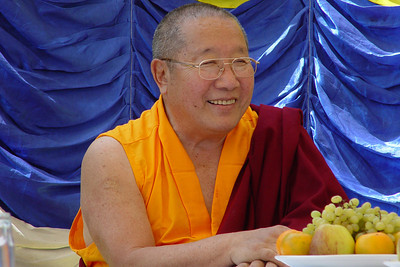
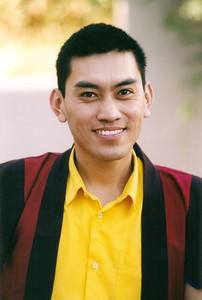
HE Mugsang Kuchen Rinpoche

An excerpt from a teaching by Jetsunma Ahkon Lhamo from the Vow of Love series

How can you develop the kind of love that sustains itself? How can you cultivate compassion like a fire that never runs out of wood to burn? That never goes out. The fire of compassion is based on being courageous enough to come to an understanding of suffering. You have to come to a deep understanding that all sentient beings are suffering endlessly and helplessly, and bring yourself to the point where you can’t bear it. Cultivate the understanding that even though you know you can’t see all sentient beings, you can’t feel them, you can’t touch them, still, you want nothing more than to rid hatred, greed and ignorance from their minds, because you understand this is the cause of their suffering. You understand the whole dynamics of suffering: why it exists, how it exists, where it exists, how it grows, and at that point you become deeply committed.

You can begin by renouncing the causes of suffering yourself. If you have not renounced the causes of suffering, you can’t do a thing for anyone else, and so it takes a tremendous amount of courage. According to the Buddha, hatred, greed and ignorance in the mind are the causes of suffering. Hatred, greed and ignorance are preceded by desire. If there is no desire in the mind, there is no root from which these poisons can grow; there is no cause for hatred, greed and ignorance.

© Jetsunma Ahkön Lhamo

Like Vibes With Like

From The Spiritual Path:  A Compilation of Teachings by Jetsunma Ahkon Lhamo

Let’s say that your immediate family consists of four people, so you have a particular karma with three others. Those three all have both negative and positive karmic seeds coming to the surface, just as you do. When you four came together, you did so because certain karma was ripening. You could not marry; a child could not be born to you, unless that particular karma was ripening in your mindstream, and in someone else’s. When this karma comes together, it has a kind of interactive characteristic. Like tends to attract or “vibe with” like.

Perhaps you have some horrible negative karma associated with cruelty to animals. You may have a child, or there may be someone else in your family, who has a similar negative karma. Though you won’t understand why, it is likely that something will happen to reinforce the catalyzing effect of your relationship. For instance, you might get a dog that both of you abuse. Or you might develop a terrible animosity toward animals that you would not have experienced so overwhelmingly, if you had not been with that particular person. In your past, you also have karma of being kind to animals. And had you come together with a person with strong kind-to-animals karma, that relationship might have catalyzed something completely different. Let’s say that you have a period of intense anger: the karma of anger is coming to the surface. If you let yourself fall into that anger, really wallow in it, then you will tend to ripen still more anger from the deeper past, and those bubbles will continue to come forward. On a superficial level, the anger will seem to feed on itself. You will feel compelled to be angry.

But suppose you do everything you can to overcome your anger. Though angry at someone, you tell yourself: “This person is suffering just as all sentient beings are, and doesn’t really mean to act that way.” If you truly try to circumvent the anger by reasoning it out, what will happen? Instead of having more anger ripen and come forward, you will ripen a different kind of karma. Perhaps the karma of clear thought. Basically, you can prevent future ripenings of negative karma by taking hold of yourself at any given point. You have a precious human rebirth; you have the Dharma; and you can think logically. You are able to choose how to cope with any anger that arises.

When some people have an unpleasant feeling, such as anger, hatred, or grief, they habitually cover it over. If they become angry, for example, they say, “I feel only love.” Or: “There is only love.” This is like slapping a Band-Aid on an ulcer, which only continues to ripen and grow deeper. By plastering one thought on top of another, you actually link them together. And what happens? Either your anger and hatred will remain inflamed on an underlying level (a frequent result), or you may ripen the karma of delusion. Your mind will be very unclear. Those who use such methods over a long period of time become deeply set in delusion. It seems as if they have gone somewhere else, and one is tempted to ask, “Are you still in there? Anybody home?” There are just too many layers of Band-Aids. What you need is to examine the contents of your mindstream. And begin to view your own mind as something you can work with, something you can take responsibility for.

© Jetsunma Ahkön Lhamo

Dharmakaya

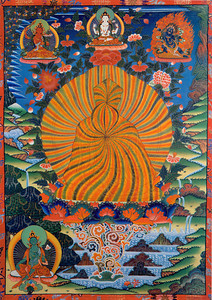
Guru Rinpoche Rainbow Body

From The Spiritual Path:  A Compilation of Teachings by Jetsunma Ahkon Lhamo

It is not enough to visualize the form of a teacher or lama, thinking that you see only a man or a woman. Such a shallow perception does not put you in touch with what is truly happening. In fact, it causes virtually all the value and function of the lama to be lost to you. Guru Rinpoche comes to us as a direct emanation of the Dharmakaya Buddha, Amitabha. The nature of Amitabha is non-dual. The Dharmakaya is clear, crystalline, uncontrived. It is mind as it is—without limitation or conceptualization of any kind.

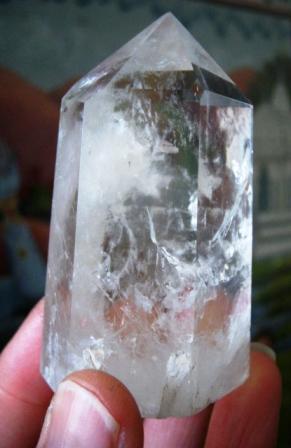
This is difficult to understand because we have never had a direct experience of our essential nature. Even our moments of deepest meditation—of what we might call Samadhi—are merely intermediate stages, not to be misconstrued as the ultimate, true realization that occurs when one reaches liberation from all conceptualization. The nature of mind is much like a crystal: clear and uncontrived. It has no sense of self and other. Its nature is such that it can reflect all forms of emanation, and there is nothing that is separate from that all-pervading mind. From that nature, Guru Rinpoche is born. Guru Rinpoche can be understood as a form of the Dharmakaya that is visible to our eyes. He can also be understood, more correctly, as the result of the all-pervading compassion of that mind. If it were possible for the Dharmakaya to reveal itself in some form, that form would be, and is, Guru Rinpoche.

The nature of Dharmakaya is compassion, but not as we usually think of it. Humans generally understand compassion to be directed toward a certain object, for example: “I feel compassion for you.” In our language, that means, “I am sorry for you.” True compassion, in the nature of mind—in Dharmakaya—is quite different. It is objectless. It is not directed toward any specific other, and thus it is all pervading. Why is it not directed toward any specific other? Because in the nature of true mind there is no other. If this all-pervading nature, in its non-dual reality, considers that there is no other, then it must fully embrace and never keep itself away from any object. That is true compassion because it is unconditional.

Such compassion cannot be earned or bought; nor can it be destroyed. It is the nature of the primordial mind. There is nothing you can do to distance yourself from this mind, which is your true nature. You can cover it up by developing thoughts of duality, contrivance, and judgment. You can create so much non-virtue that you fail to perceive that nature, but you cannot distance yourself from it. It is still your nature, unaltered and indestructible. That which is seemingly far away is therefore quite close; in fact, it is non-dual with all that you are.

© Jetsunma Ahkön Lhamo

Developing Pure View

From The Spiritual Path:  A Compilation of Teachings by Jetsunma Ahkon Lhamo

Students who are flirting with, considering, or entering the path may become confused by the term “pure view.” Why? Because they register the ordinary meaning of these words, unaware that they will understand more later. If at this moment we were able to awaken in the primordial wisdom state, if we were somehow able to move into Lord Buddha’s posture of being awake to that nature, pure view would be instantly established. When we first come to the path, we are excited to have found something precious. It’s like waking up on Christmas morning and discovering a gift. We realize that Dharma provides tools we didn’t have before, deeper ways to understand. We realize that we are going to be let in on a vast secret…Something that will enrich our lives, change our lives.

We enter a romantic period. We fall in love. It’s quite normal: in some ways, it is helpful. Falling in love with a person enables you to see that person’s best qualities. You become open to that person and the same thing happens with Dharma. You become receptive. Some students fall in love with the very idea of being on a path, being part of a group experience, part of something that moves together as one body, and with the idea of having a teacher. Some students fall in love with the exotic things they encounter in their Dharma practice. “Hey, this temple looks like Nepal or something! It’ll be cool to bring my friends!” Silly and superficial as this sounds, it is absolutely normal when you first come to the path. It is also normal to begin “The Great Adventure Of Imitation.” Walking the Dharma walk, talking the Dharma talk. Trying to look serenely pure upon hearing the term “pure view.” Periodically rolling the eyes skyward to appear saintly. As we try to act in a way that we think is pure, we approach Dharma externally. Materialistically. Wait! How can approaching Dharma be materialistic? Isn’t it a religion of renunciation? Unfortunately, it is very possible to practice materialistically. It’s possible to collect Dharma—and things associated with Dharma—just as we collect rare stamps or works of art.

This is all sadly far from practicing pure view. What must be pure is the way you think. When real change comes, you have nothing to show off to your friends. The change is inside. It’s very subtle, very quiet. And it grows like a seedling coming out of the soil, at first almost invisible. That is how pure view should grow.

When you enter the Dharma, what you need to protect most is your innocence. You should come almost as a child, a seeker, as someone whose mind is open. The traditional Buddhist analogy likens the mind to a bowl. Some people have dirt in their bowls: judgment and preconceived ideas. Some complacently extrapolate their own religion. Some don’t really listen to the teachings. Their bowls are turned over. As the milk of Dharma is poured, it simply runs down the sides. Some come to the path with poison in their bowls: negative habitual tendencies and negative emotions. They have a hard edge. The way for a new student to practice in harmony with pure view is to relax the mind as much as possible, to have a mind that is gentle and receptive. Where you’ve been before, what’s happened before, and even your opinion of yourself, doesn’t really matter.

What matters is what you do today. Today you can focus on self-honesty. You can closely examine your mind, what it does, how it works. You can finally see how much of what you do results from self-absorption. How much of what you do is selfish, judgmental, and manipulative. And with your new insight, you can decide to examine yourself in the mirror very squarely. You can examine your own root poisons, and you can decide to eradicate them systematically.

The best way to do that, at first, is not to act any differently, and this is why. You may correctly realize that you are now lonely because you haven’t been kind in the past. But if you simply try to act kind all the time, you will act the way you think kindness ought to look. I have watched people try it. They learn a few things about what kindness ought to be and they conduct themselves accordingly. This hampers or prevents the necessary subtle internal change. Take a rubber band and stretch it all the way out. When you let go, it will snap back to its original shape. Now, if you yourself try to change on an external or gross level without examining the teachings and without letting your mind create a new, gentle internal habit, your mind will do the same thing as the rubber band. It has a natural shape, yes, and you can make it perform. In the past, you have made yourself jump through hoops. So you can do that, you can make your mind change. But the result will be temporary, because it’s happening in a gross and inappropriate way.

So it’s better to be gentle with yourself. Let your bowl be filled with some real milk. Absorb the teachings. Listen with a pure mind. This is like taking a rubber band and rubbing it with an oil to help it expand —perhaps only slightly. Then you rub and work it a little more, actually changing the fiber of the rubber band. Eventually, it becomes a much looser thing. Eventually, that will happen to your mind. It will become looser, more spacious. It will be more receptive to truth, a place where Dharma can live. So in the beginning, pure view for students is like an honest, gentle effort. Like an innocence. Like a relaxation.

Further along the path, pure view becomes something more meaningful, more profound. It actually arises from some of the meditational practices, specifically from what is termed “generation-stage practice.” One meditates on emptiness, which is our true primordial nature, on oneself having that nature, and then one gives rise to the particular meditational deity chosen for this practice. That is to say, one’s own self appears naturally as the meditational deity. The deity symbolizes the mind of enlightenment; meditating on oneself as the deity is actually a tool. When you engage in non-virtuous activity, you don’t have much respect for yourself, although you may cover it up with arrogance. Inside, sometimes way inside, there is a person crying because that person is not happy with non-virtuous behavior. When you do generation-stage practice, that crying is satisfied. And no matter what deity you are practicing, whatever his or her attributes, there is always the quality of kindness, and there are always the elements that produce happiness. In generation-stage practice, you begin to lose the tightness of your ordinary habitual tendencies, and you begin to develop the new habitual tendency of spontaneously abiding in pure virtuous compassion. And happiness begins.

After the generation-stage practice is completed, you pray that all sentient beings will be happy. Then you close your book and put away your mala, but your practice doesn’t really end, for you are now particularly involved with pure view. Through this practice, the mind has increasingly taken on the virtue and the attributes of the deity. Even when the practice is over, you maintain deity pride. This is not a personal pride, involving conceit or arrogance. Deity pride is different. It is confidence. Courage and a confidence that begins to change your life. If you practice the deity Chenresig, for example, deeply aware that Chenresig’s main attribute is benefiting sentient beings through compassion, you will maintain, in a solid way, an inner virtuous upright quality. You will maintain the idea that compassion is your lifeblood. That this is everything to you. You declare it. You wish it. You look for it in your mind. You try to bring it out. You do your best to live it. You create the habit of kindness.

© Jetsunma Ahkön Lhamo

Golden Vase of Wisdom

Stupa Rainbow.JPG

A poem by Jetsunma Ahkon Lhamo

From the ordinary clay of samsara,

brilliant jewels of pure intention arise

Qualities are stable and virtuous,

as those things to be accepted or rejected are defined.

Slowly, with effort and renunciation,

the beautiful golden vase of wisdom and knowledge arises.

A new heart filled with comfort and joy is realized.

Copyright © Jetsunma Ahkon Norbu Lhamo.  All rights reserved

Joy

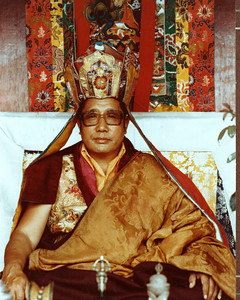
His Holiness Penor Rinpoche

From The Spiritual Path:  A Compilation of Teachings by Jetsunma Ahkon Lhamo

The quality of joy is not as we usually think of it. Our culture teaches—though we may not be consciously aware of this—that to be happy, we should act happy. By developing a positive attitude, we will look happy and become happy. We are also taught to keep up with the Joneses. We are taught to get ahead—or be left behind. We expect joy to come from getting what we want.

The joy of which the Buddha speaks is vastly different. Once we realize equanimity, loving kindness, and compassionate concern—then, when we hear that someone has a new car, we will be happy for that person: he has attained at least some temporary happiness. There is no need for judgments such as: “Many people are starving, yet he spends so much on a new car.” Or: “He already has three cars. Why does he need a fourth?” The Buddhist attitude is: the happier you are, the happier I am. If even for one moment you have achieved some level of happiness, I should be joyful and think: “I love you so much I wish you could have everything that makes you happy. May your happiness bring you to a point of great stability and regard for others. May it afford you the generosity to wish for their well-being to the extent that you will attain realization. May that car somehow promote your realization, and may you be free of suffering in all its forms.”

This joy in the happiness of others can only be attained when equanimity, loving kindness, and compassion are realized. It is a joy that occurs naturally. It occurs from sincerely wishing for the happiness and well-being of all sentient beings, for the end of their suffering. To the extent that any degree of relaxation, peace, or alleviation of suffering is of any benefit to them, I am happy because they are the same as I and not separate from me. In other words, I realize that the nature of “me” and “other” are that same Suchness and have the same taste.   Without these four qualities, known as the Four Immeasurables, and the pure view implied by their attainment, there is no enlightenment. This attainment has not come easily to anyone. When you think about all the great Buddhas and Bodhisattvas who have the means to liberate minds, remember that they all began as sentient beings. They all used the same methods that are offered to you. Through determination, you too will develop the Four Immeasurables. There is no doubt that they are within you.

© Jetsunma Ahkön Lhamo

Compassion

His Holiness Penor Rinpoche

From The Spiritual Path:  A Compilation of Teachings by Jetsunma Ahkon Lhamo

Compassion is a deep commitment to bring about the end of suffering. The vow of a Bodhisattva is to return in whatever form necessary, under any conditions, in order to accomplish this. We are told that in one of the Buddha’s previous lives, he was a huge female sea turtle. This turtle saw a shipwreck, and she thought: “The sailors are about to drown. I must help them.” With that compassionate intention, she swam to the sailors and supported them until they reached land. The exhausted turtle then fell into a stupor on the beach. So deep was her sleep that she did not feel the thousands of insects who began to eat away her body. They consumed her to the point that she awoke with intense pain. She started to move away but realized that if she went into the water to wash off the insects, they would all die. Since there were eighty thousand of them and only one of her, she thought: “Their nature is the same as mine, and since there are so many more of them than there are of me, it’s much better to let them live.”

Thus she allowed the insects to consume her. Just before she died, she made a wish: “I pray that when I attain enlightenment, the first ones I teach will be the insects that were eating me and the sailors I helped. May they attain enlightenment quickly after I do.” Later on, the sailors became the Buddha’s first disciples in the Deer Park, while the eighty thousand insects were eighty thousand celestial beings who came to hear His teachings. This story exemplifies the dynamic of equanimity, loving kindness, and compassion.

This precious dynamic occurs when you become convinced that only the end of suffering and the realization of true nature are important. It gives rise to wisdom, stability, and intensity of determination. The turtle understood the fragile nature of the eighty thousand insects: not long after their ample meal, they would need more food. Or, if the turtle had entered the water, they would have lost their good meal and suffered greatly by drowning.

© Jetsunma Ahkön Lhamo

Loving Kindness

His Holiness Penor Rinpoche

From The Spiritual Path:  A Compilation of Teachings by Jetsunma Ahkon Lhamo

How is it that one’s beloved and one’s enemy become essentially the same? Because their true nature is understood. The Buddha taught that all phenomena, however they arise, have the same taste, the same nature. It is attraction and repulsion that make us experience them the way we do.

Loving kindness is a profound wish for the welfare and happiness of others. We were raised to consider loving kindness a code of behavior to make us a nice person. This is far from the Buddha’s view of love. By realizing that all phenomena have the same nature, the same taste, you understand that all sentient beings are equal. Thus, their happiness has exactly the same weight, the same importance, as your own. It is from this viewpoint that loving kindness is developed.

If your mind is not stable, if there is no awareness of the natural state, if there is no real progress in meditation, you will not be able to actualize loving kindness. Yet without a determined effort to understand loving kindness, you will not make progress in meditation. It is a “Catch-22” situation. You must be determined both to realize the primordial state and to realize loving kindness as a naturally arising result. Only then can both be firm and stable within your mindstream.

© Jetsunma Ahkön Lhamo

WP2Social Auto Publish Powered By : XYZScripts.com