A slideshow compiled by a student of dharma who was inspired by the compassion retreats of Jetsunma Ahkon Lhamo:
 Jetsunma Ahkon Lhamo
Brief History Of KPC
The following is a brief history of Kunzang Palyul Choling:
Confession: His Holiness Penor Rinpoche
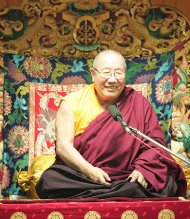
The following is adapted from an oral commentary given by His Holiness in conjunction with a ceremony wherein he bestowed the bodhisattva vow upon a gathering of disciples at Namdroling in Bozeman, Montana, November 1999:
The next branch involves [making] confession. From beginningless time, throughout countless life-times, we amassed negative karma and non virtue before we encountered the dharma. As followers of the teachings in this lifetime, we still engage in non-virtue and accumulate negativity. Consider all that negativity to be like [the result of] having ingested poison. Knowing that as poison that will certainly end your life unless you apply an antidote to neutralize it, you immediately apply the antidote. That is exactly how you should feel about the nonvirtue accumulated in the past and present.
With tremendous remorse, confess your accumulation of non virtue and vow that from this time onward, even at the cost of your life, you will no longer repeat the same pattern of negativity. Then focus on the objects of refuge in the space in the front, the buddhas and bodhisattvas of the ten directions. Supplicate, knowing that in your omniscience they will always look upon you and bless and purify you. Pray to them with heartfelt faith and devotion, and with genuine remorse for your accumulation of negativity, feel confident that all negativity is completely purified. Confession is the antidote for anger. In anger, people commit many grave errors, such as even the taking of others’ lives.
Holding Back The Darkness
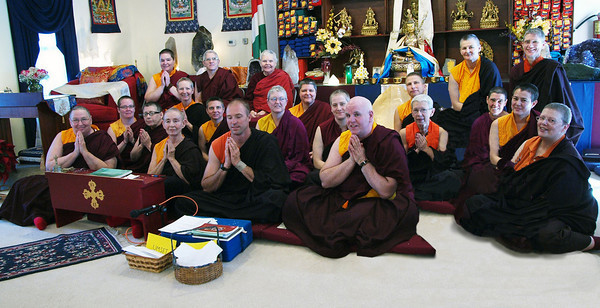
The following is an excerpt from a teaching by Jetsunma Ahkon Lhamo called “Reclaiming Our Merit”
This is a really difficult time, not only for the Sangha, but it’s really a direct reflection of what we’re seeing on our planet right now. There is corruption in business and government like I’ve never seen before. Many of us have become professional samaya breakers, meaning that we have not kept our commitments and, in many cases, have dropped our robes, or whatever. And because we are lost in samsara, we simply don’t understand cause and effect. Not only are they connected, but they arise interdependently. Time and space is our delusion. Cause and effect arise at the same instant.
So exacting is cause and effect. Yet we have not really milked the essence out of that understanding so that we can create better lives for ourselves, or practice for ourselves and make a deeper commitment for ourselves. We simply have not utilized what we have received. And here in this time, you don’t know where to look, left or right. What is pure, what is sacred, what is wholesome? All of it seems to be confused and dark; and right now our hearts are heavy. We were so innocent when we were younger, and some of you that are still young are still innocent, so innocent thinking that can never happen to us. So learn.
In this time of debilitating darkness and confusion, we have to strengthen ourselves. I’ve had students propose the question to me: What is the benefit of the robes? I look around at you and I say to myself, ‘Aren’t you terrified to be without them?’ Well you should be, because these robes now are like a shield of virtue. You are what we have. The power of the Buddha’s blessing is such and the robes are so potent that a quorum is considered four ordained monks and nuns with yellow robes. That quorum has the power and the stamp of the Buddha’s blessing. We can get four other people together and you won’t have the same conditions. And even knowing that, we barely use it. It’s so powerful. It’s such refuge in these dark times. And yet we don’t call up three of our friends and say, ‘Hey, you know, let’s get together and pray for the world. Or maybe we should get together and pray for our Sangha.’
You have, on your bodies, the most excellent and extraordinary tool one can have in this time other than realization and giving rise to the bodhicitta. If you think somehow that compassion and realization and awakening are separate, you are fooling yourself because they are the same essence, the same taste.
We are approaching this really dark time, where lamas are sick, things are happening to people that we know and love; monks and nuns that we had great hope for, great hope for, have gone. And so what are we left with? We are left with this. How many lifetimes do you think it took you to earn wearing these robes? And for those of you who are in the halfway step, wearing your red and white robes, I appreciate that, too. The genyen population and the genyen Sangha, myself included, having been genyen for many lifetimes, many lifetimes, this is a support. But the real princes and queens of our Sangha, our Dharma, this is the ordained community. The more often you get together with your yellow robes and make prayers together with depth and honesty and true compassion; and seeing what is happening in this world, give rise to that compassion in a certain way, the power that you wield is phenomenal. But we’re kind of like this: ‘Oh, I can’t do it. Oy, oy, oy.’ We suddenly all became Jewish. Oy, oy, oy. I’m half Jewish. I can say it.
But that’s how we are. We got into kind of crying, kind of whining like babies. We have so much power if we will only utilize it with faith. The reason I wanted to talk about that is because it’s important that you guys who are ordained have real confidence in the fact that you are wearing the Buddha’s robes. You have to think, ‘I have this jewel. I have this nourishment that I can pass on and give to others.’ I want you to be cognizant of the power of the commitment that you keep. And you must keep it squarely and purely in order for it to provide for you the protection and nourishment that you need. So as far as I am concerned, the ordained community are the nectar of what we can do here. I would love to see you all take more initiative in practicing together and understanding that four is a quorum and that you can change things.
And even beyond that, I want to talk about not only the corruption of this time and the darkness of this time, but I’d like to say that this time has been predicted and taught about and we knew it was coming and nobody believed. This is the time when even the most profound Dzogchen teachings are passed out like candy; and I’m afraid it’s often passed out like seeds thrown onto cement. And why is that the case? Well, lamas predicted when the conditions might be right to give Dzogchen teachings, so you either get them or you don’t. You get them based on the capacity and generosity and accumulated virtue of the lama, or you don’t get them.
And the reason why this is happening is because we haven’t bothered to create the foundation upon which these kinds of practices, wisdoms and awarenesses are built. And if they are practiced with no foundation, there is no result. You are at the circus. You are seeing phenomena in your head. And once phenomena is perceived, you’re off. You’re lost without a compass.
Now Is The Point Of Power
A YouTube Video Teaching by Jetsunma Ahkon Lhamo:
The Meditation Upon The Four Immeasurables
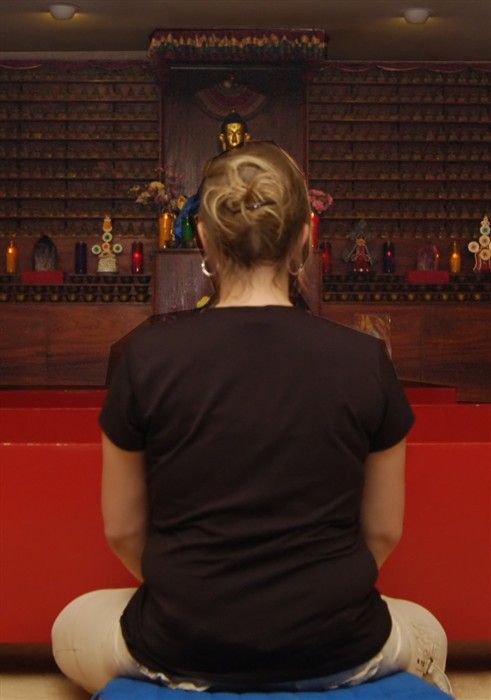
The following is respectfully quoted from “Buddha in the Palm of the Hand” Nam Chö Terma Revelation by Terton Migyur Dorje:
MA NAM KHA DANG NYAM PAI SEM CHEN THAM CHED
May all motherly sentient beings equal to space
DEWA DANG DEWAI GYU DANG DEN PAR GYUR CHIG
Achieve happiness and the causes of happiness
DUG NGAL DANG DUG NGAL GYI GYU DANG DRAL WAR GYUR CHIG
May they be free from suffering and the causes of suffering.
DUG NGAL MED PAI DEWA DAM PA DANG MI DRAL WAR GYUR CHIG
May all never be separated from the sacred happiness which is sorrowless
NYER RING CHAG DANG DANG TRAL WAI TANG NYOM CHEN POI NGANG LA
And free from the partiality of attachment and aversion. May they live believing in
NEI PAR GYUR CHIG
The equality of all that lives.
Sending and Receiving:
While exhaling from both nostrils, consider that all of one’s merit and the root of all virtue
Is sent forth to all parent sentient beings who equally receive it. Meditate that all sentient beings
Experience immeasurable happiness.
Essence of Buddhism: by His Holiness Penor Rinpoche
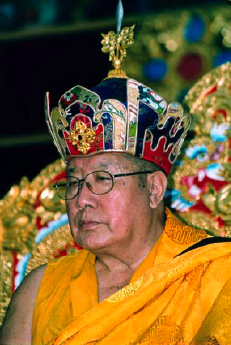
The following is a teaching by His Holiness Penor Rinpoche
We are born in this Zambu-dweep world and have acquired the precious human rebirth due to the gathering of the compositional factors of the eight leisures and ten blessings. This is a most perfect and auspicious opportunity. That we are fortunate enough to receive the teaching of perfect Buddha dharma and also be able to meet so many qualified teachers is the result of the ripening of our positive merits from countless past lives.
But due to our attachment from time beginningless towards the repeated pattern of samsara, we have developed strong emotions towards this samsara. Therefore, it is common for sentient beings to find themselves emotionally drawn towards the attainment of worldly concern regardless of difficulty and hardships, which in turn generates all types of karmas in the process.
If we truly want to learn the teaching of Dharma, we must first find a qualified teacher. Buddhism has Mahayana and Vajrayana traditions, of which Vajrayana and especially the Great Perfection (Dzogpachenpo) is especially beneficent for the degenerated times like now. The actual practice to Dzogchen consists of preliminary and the main practices, that has visualizations, recital of mantras and the sadhanas.
In fact, we might all think we know about Dharma and might even want to practice these teachings, but because of our attachment to worldly distractions, we are not able to practice accordingly as instructed, as if we show no concern for the effect of karma, as though karma is not real and does not really exist, and thus as a result, succeed in continually creating more negative karma. Only at the end of our lives, when we come face to face with the imminent sufferings of death, do we start thinking that we should do something about it! But by that time, even if we come to realize that we have not studied the Dharma and neither have we applied ourselves properly according to the pith instructions of the teacher and hence the prospect of falling into the three lower realms is imminent; the time of seeking the Dharma and practicing has already passed, so now what do we do?
Commentary on the Bodhisattva Vow: HH Penor Rinpoche – Our Kind Parents

The following is adapted from an oral commentary given by His Holiness in conjunction with a ceremony wherein he bestowed the bodhisattva vow upon a gathering of disciples at Namdroling in Bozeman, Montana, November 1999:
[The second way to adjust one’s intention in order to be in harmony with the special feature of this instruction is through] developing attraction to enlightenment. According to this tradition, what leads one to develop an attraction to enlightenment is the cultivation of love for all beings, which begins by contemplating the suffering of cyclic existence and then cultivating repulsion and weariness [toward that existence].
Think about all living beings that at some time or another, throughout the course of innumerable past lifetimes, have been your own kind father or mother. Consider how a mother will anything for her child–even give her own life, without hesitation. Consider how all living beings have been that kind to you at some time in the past–not just once, but countless times, in countless different circumstances and situations over the course of countless lifetimes since beginningless time. Consider also that to not think carefully about repaying this kindness, and thereby to go through your life without the intention to truly benefit parent sentient beings, and so to actually ignore them, is truly shameless.
Many people in the West may think, “Wait a minute! My parents were not very kind to me. In fact, we are not even close, and I don’t even like them, so why should I feel that I need to repay their kindness now?” If that is what you think, then take a moment to think about how you acquired your body. Is it not due to the kindness of your parents that you have your precious human body? From the time your consciousness entered the union of your father’s seed and your mother’s egg, your mother carried you in her own body. Her body nurtured you as you grew within it. Then with pain and difficulty she gave birth to you. Her kindness did not just stop there: for many years she cared for you and lovingly fed, cleaned, clothed, and wiped you; she provided shelter and cared for you when you were sick, and thus she protected you and looked out for you constantly. If you think you don’t need to repay the kindness of your parents, just remind yourself of those events, which you were the recipient of time and time again.
If that still does not change your attitude, so that you still do not understand the kindness your parents showed you, then think about your body, the gift of your body, which is who you are; your parents gave you that. Because your parents showed you the great kindness of giving you your body, your precious life, here you are. Sure you had the causes for your precious human rebirth, but without parents you wouldn’t have your body. And if you didn’t have your body, you wouldn’t be able to receive these vows.
In our present state of ignorance, we have an inability to recognize that all beings have been our parents in the past, and we certainly don’t know what the particular situations and circumstances of those lifetimes were. Nonetheless, it is certain that we have had countless sentient beings as our parents over and over again in countless past lives. The truth is, at the present time we just do not recognize that.
Imagine you are on the bank of a river with your mother and suddenly she falls in and is being carried away by the rushing water. There you stand on the bank, watching that happen. What would you do? Would you do something to try to save her, such as throw out a rope? Or would your turn your back and walk away rather than risk your own life? Would you be concerned for her, or would your concern be only for yourself? The intention of hearers and solitary realizers can be likened to the later case, while the intention of Mahayana practitioners can be likened to the former. While it is important to develop attraction toward peace, you should never, for any reason, be attracted to the quiescence of the hearers and solitary realizers.
His Holiness Penor Rinpoche Heart Teaching from Palyul Ling
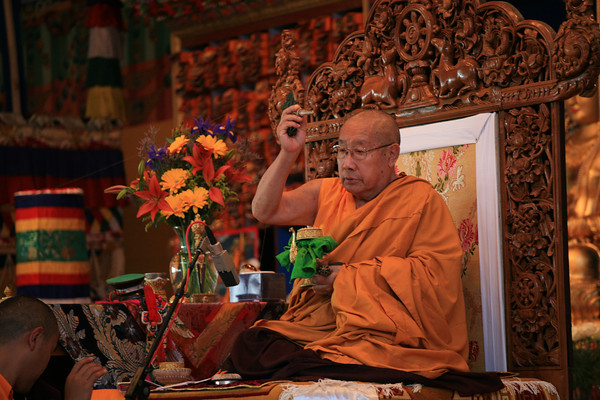
His Holiness Penor Rinpoche offered this teaching prior to doing a Ganachakra Puja for Jetsunma’s long life at New York Palyul Retreat Center in 2005.
Today is the 15th day of the sixth month of the lunar calendar. Jetsunma has some sickness or obstacle, so we are doing this Rigdzin Dupa Ganachakra Puja for her. Some of Jetsunma’s students here requested this puja.
I met Jetsunma a long time ago. I examined her for a while, and then recognized her as the incarnation of Rigdzin Kunzang Sherab’s sister known as Ahkön Lhamo. Ahkön Lhamo, the sister of Rigdzin Kunzang Sherab lived near the Palyul monastery in a nunnery, which is in front of the monastery, and then in a place called Trong Mar, which means Red Valley. It is called Red Valley because there were lots of nuns. Ahkön Lhamo used to give teachings there to the nuns who wore red robes, filling the small valley, so that is why the place is called Trong Mar, the Red Valley. Since then there has always been a nunnery there. Even these days there are still about 200 nuns there.
I recognized her and then at KPC a long time back we did an enthronement ceremony. Before I met her, she was giving the teaching on generating bodhicitta. Just among her disciples, there are 2-3 at all hours of the day and night trying to meditate on bodhicitta. And she carries on Dharma activity in accordance with the other activities.
Since I named her in that way, there are lots of people in America who are jealous and have all sorts of problems with it. That kind of jealousy doesn’t harm her; it harms the person who is jealous. Many people also try to complain and say things to me. Although people ask me many questions about that, I don’t have to humiliate myself, because I am a Palyul Throneholder, and I have my own rights regarding what I need to recognize. Of course I cannot tell lies, but what I need to do, I’ll do.
Most of the other Nyingma schools just believe whatever I say, and especially all the Palyul traditions or Palyul monasteries. Of course they believe me 100%. There isn’t just one Palyul Monastery. There are hundreds and thousands, and in all those monasteries there are a hundred monks or a thousand monks, and all of them respect whatever I command. There is nobody who says, “This is right or this is not.” But in America because of jealousy, some people say certain things, but there is no meaning. In general America is a strange country. Sometimes it is said that, “In your tradition there are mostly male teachers, and there aren’t any female teachers.” And then Jetsunma is appointed and then again they are jealous and say something else.
Since we are human beings of course it is possible to make mistakes. There is no one who just sits there like an enlightened Buddha. Just because one doesn’t understand or makes a little mistake or does something, then you start complaining.
Jetsunma is a good and perfect teacher. I don’t think she is deceiving anybody. And among Jetsunma’s students, there are a whole bunch of monks and nuns, and she disciplines them all. There is nobody else among women in America who could do that. She is good and special. It is good for everybody to know that she is also one of the Palyul tulkus. These days she is getting older and she has all sorts of sickness. So for her longevity of life, we are doing this Ganachakra Puja.
It’s not just Jetsunma. In America there are many other females and males who are incarnated ones. But the problem is that the nature of Americans is to have so much pride. With the recognition, the pride and ego develop so much that in the end it is difficult to benefit. As a practitioner and as a bodhisattva family, then naturally one should be humble and peaceful and loyal to the practice. Developing pride doesn’t really help anybody. When it is said that you are good or something special, then their pride or ego develops. If that happens, then it is more harmful than beneficial. For those who are noble beings, receiving all these teachings and doing the Dharma practice can benefit other beings. Otherwise thinking that, “Oh, I’m something very special,” is like having a horn on your head and walking around. It doesn’t help anything.
Anyhow, today we are doing this Ganachakra Puja for the longevity of her life. Thank you.
Bodhichitta: From “Enlightened Courage” Commentary by Dilgo Khyentse Rinpoche
The following is respectfully quoted from “Enlightened Courage” a commentary by Dilgo Khyentse Rinpoche:
Bodhichitta is the unfailing method for attaining enlightenment. It has two aspects, relative and absolute. Relative bodhichitta is practiced using ordinary mental processes and is comparatively easy to develop. Nevertheless, the benefits that flow from it are immeasurable, for a mind in which the precious Bodhichitta has been born will never again fall into the lower realms of samsara. Finally, all the qualities of the Mahayana path, as teeming and vast as the ocean, are distilled and essentialized in Bodhichitta, the mind of enlightenment.
We must prepare ourselves for this practice by following the instructions in the sadhana of Chenrezig, “Take refuge in the Three Jewels and meditate on Bodhichitta. Consider that all your virtuous acts of body, speech, and mind are for the whole multitude of beings, numerous as the sky is vast.”
It is said in the teachings that “since beings are countless, the benefit of wishing them well is unlimited.” And how many beings there are! Just imagine, in one small garden there might be millions and millions of them! If we wish to establish them all in the enlightened state of Buddhahood, it is said that the benefit of such an aspiration is as vast as the number of begins is great. Therefore we should not restrict our Bodhichitta to a limited number of beings. Wherever there is space, beings exist, and all of them live in suffering. Why make distinctions between them, welcoming some as loving friends and excluding others as hostile enemies?
Throughout the stream of our lives, from time without beginning until the present, we have all been wandering in samsara, accumulating evil. When we die, where else is there for us to go but to the lower realms? But if the wish and thought occur to us that we must bring all beings to enlightened state of Buddhahood, we have generated what is known as Bodhichitta in intention. We should then pray to the teacher and the yidam deities that the practice of the precious Bodhichitta might take root in our hearts. We should recite the seven-branch prayer from the Prayer of Perfect Action, and, sitting upright, count our breaths twenty-one times without getting mixed up or missing any, and without being distracted by anything. If we are able to count our breaths concentratedly for a whole mall, discursive thoughts will diminish and the practice of relative Bodhichitta will be much easier. This is how to become a suitable vessel for meditation.
ABSOLUTE BODHICHITTA
Consider all phenomena as a dream.
If we have enemies, we tend to think of them as permanently hostile. Perhaps we have the feeling that they have been the enemies of our ancestors in the past, that they are against us now, and that they will hate our children in the future. Maybe this is what we think, but the reality is actually quite different. In fact, we do not know where or what we were in our previous existences, and so there is no certainty that the aggressive people we now have to contend with were not our parents in former lives! When we die, we have no idea where we will be reborn, and so there is no knowing that these enemies of ours might not become our mothers or fathers. At present, we might have every confidence in our parents, who are so dear to us, but when they go from this life , who is to say they will not be reborn among our enemies? Because our past and future lives are unknown to us, we have the impression that the enemies we have now are fixed in their hostility, or that our present friends will always be friendly. This only goes to show that we have never given any real thought to this question.
If we consider carefully, we might picture a situation where many people are at work on some elaborate project. At one moment, they are all friends together, feeling close, trusting and doing each other good turns. But then something happens and they become enemies, perhaps hurting or killing one other. Such things do happen, and changes like this can occur several times in the course of a single lifetime–for no other reason than that all composite things or situations are impermanent.
This precious human body, supreme instrument though it is for the attainment of enlightenment, is itself a transient phenomenon. No one knows when, or how, death will come. Bubbles form on the surface of the water, but the next instant they are gone; they do not stay. It is just the same with this precious human body we have managed to find. We take all the time in the world before engaging in practice, but who knows when this life of ours will simply cease to be? And once our precious human body is lost, our midstream, continuing its existence, will take birth perhaps among the animals, or in one of the hells or god realms where spiritual development is impossible. Even if life in a heavenly state, where all is ease and comfort, is a situation unsuitable for practice, on account of the constant dissipation and distraction that are a feature of the god’s existence.
At present, the outer universe–earth, stones, mountains, rocks, and cliffs–seem to be the perception of our senses to be permanent and stable, like the house build of reinforced concrete that we think will last for generations. In fact, there is nothing solid to it at all; it is nothing but a city of dreams.
In the past, when the Buddha was alive surrounded by multitudes of Arhats and when the teachings prospered, what buildings must their benefactors have built for them! It was all impermanent; there is nothing left to see now but an empty plain. In the same way, at the universities of Vikramashila and Nalanda, thousands of pandits spent there time instructing enormous monastic assemblies. All impermanent! Now, not even a single monk or volume of Buddha’s teachings are to be found there.
Take another example from the more recent past. Before the arrival of the Chinese Communists, how many monasteries were there in what use to be called Tibet, the Land of Snow? How many temples and monasteries were there, like those in Lhasa, at Samye and Trandruk? How many precious objects were there, representatives of the Buddha’s Body, Speech, and Mind? Now not even a statue remains. All that is left of Samye is something hardly bigger than a stupa. Everything was either looted, broken, or scattered, and all the great images were destroyed. These things have happened, and this demonstrates impermanence.
Think of all the lamas who came and lived in India, such as Gyalwa Karmapa, Lama Kalu Rinpoche, and Dudjom Rinpoche; think of all the teachings they gave and how they contributed to the preservation of the Buddha’s doctrine. All of them have passed away. We can no longer see them, and they remain only as objects of prayer and devotion. All this is because of impermanence. In the same way, we should try to think of our fathers, mothers, children and friends. When the Tibetans escaped to India, the physical conditions were too much for many of them and they died. Among my acquaintances alone, there were three or four deaths every day. That is impermanence. There is not one thing in existence that is stable and lasts.
If we have an understanding of impermanence, we will be able to practice the sacred teachings. But if we continue to think that everything will remain as it is, then we will be just like rich people still discussing their business projects on their deathbeds! Such people never talk about the next life, do they? It goes to show that an appreciation of the certainty of death has never touched their hearts. That is their mistake, their delusion.