The following video is a true story as presented by Ben Zeoli expressing his personal experience with the power of prayer:
Jetsunma Ahkon Lhamo
Fourteen Root Downfalls: Jamgön Kongtrul
The following is respectfully quoted from “Buddhist Ethics” by Jamgön Kongtrul:
Fourteen root downfalls of the commitments of training are explained in [Shantideva’s] Compendium of Trainings in accordance with the Akashagarbha Scripture. Five of them apply mainly to kings, one applies exclusively to ministers, and eight apply to beginners. The five [downfalls] that apply mainly to kings who are bodhisattvas-in-training are the following:
- To steal [or have someone steal] property that has been offered to representations of [the Buddha’s] body, speech, and mind, or to the monastic community.
- To reject [or cause someone to reject] the teachings of the Universal or Individual ways [by saying that they are not the words of the Buddha or that they are not the means to attain liberation];
- To harm someone who wears the attributes of a monk, regardless of whether he maintains vows purely or is an immoral monk.
- To commit any of the five evil deeds of direct retribution, i.e., matricide, patricide, murder of a saint, causing a schism in the monastic community, or out of malice, causing a buddha to bleed; and
- To profess nihilistic views claiming that actions do not bring results and that there are no future lives, and engaging in unvirtuous types of behavior [or encouraging others to do so].
Five root downfalls that apply mainly to ministers: the first four are the same those prohibited for kings, and the fifth is to plunder a town.
The five root downfalls that apply mainly to ministers who are bodhisattvas-in-training include the first four root downfalls for a king, plus plundering a town and the like.
To plunder [a town] comprises five kinds of ravage: of a village (inhabited by four castes); a town (inhabited by eighteen kinds of artisans); a county (an area that includes several towns); a province (an area consisting of several counties); or a country (an area consisting of several provinces).
The eight root downfalls that apply to beginners are to teach emptiness to the untrained,
To cause another to give up the intention to awaken, to make someone abandon the Individual Way,
To assert that the Individual Way does not conquer emotions,
To praise oneself and belittle others,
To falsely claim realization of emptiness,
To cause a king to inflict a fine and then accept stolen property as a bribe,
To disrupt meditation or to give the possessions of a contemplative monk to one who merely recites scriptures.
The eight root downfalls [that apply mainly to] beginner bodhisattvas are as follows:
- To teach the profound subject of emptiness to those who are of limited intellect or those who are untrained [in the Universal Way], causing them to be intimidated [by the Universalist’s doctrine] and thereby to lose faith in it.
- To cause someone to give up the intention to become fully enlightened and to enter the way of the proclaimers or solitary sages when that individual is already following the Universal Way, by declaring that he or she is not able to practice the six perfections and other aspects of [the Universal Way].
- To advise someone with an affinity for the Individual Way to abandon that path and then cause him or her to enter the Universal Way without special necessity to do so.
- To believe and to cause another to believe, without any special necessity, that by following the Individual Way, one cannot conquer the emotions.
- To praise oneself when one is not worthy and to belittle others when they do not deserve it, for the sake of wealth and honor.
- To [falsely] claim, for the sake of wealth and honor, to have attained [direct] realization of profound [emptiness] by saying that one has understood profound truth and to incite others to meditate to achieve the same goal.
- To cause a king or other person in a position of power to inflict a fine on a Buddhist monk by slandering him. If as a result the monk steals property of the Three Jewels in order to bribe oneself [the instigator] and one accepts it, one incurs this downfall. If one gives the property to the king, both [instigator and king] incur this downfall.
- To cause a good monk to abandon mental quiescence or other forms of spiritual practice by imposing unfair punishment on him, or to deprive a contemplative monk of his life necessities to give these directly or indirectly to a monk who merely recites scriptures. If the recipient is an accomplice to one’s act, he or she also incurs this downfall.
These are the fourteen downfalls that apply to acute practitioners, five for kings, one exclusive to ministers, and eight for beginners.
Four downfalls that Apply to Average Practitioners[B’]
Downfalls for average practitioners are to give up awakening mind, be ungenerous, angry, or hypocritical.
Four [downfalls] apply mainly to average practitioners. These are stated in the Compendium of Trainings, based on their presentation in the Skill in Means Scripture:
To abandon one’s awakening mind;
Not to give alms to mendicants
Out of strong attachment and avarice;
Not to forgive
But to strike others in anger
Even though they try to please one;
And to present false teachings as the Buddha’s teachings
Motivated by an emotion or in order to please others.
One Downfall that Applies to Obtuse Practitioners [C’]
An obtuse practitioner must at least maintain the aspiration to awaken.
Having entered the Universal Way, an obtuse practitioner must, at the very least, maintain the aspiration [to awaken]. Accordingly, the Advice to the King Scriptures states that all precepts are fulfilled in this alone. To abandon one’s [aspiration] is a very serious root downfall for any bodhisattva, whether acute, average, or obtuse. The Condensed Transcendent Wisdom Scripture states:
Though [a bodhisattva] may have tread the path of the ten virtues for ten million eons,
If his goal shifts to becoming a solitary sage or a saint,
His ethics deteriorate and his commitments are lost.
Such a setback is far more serious than the defeating offense [of a monk].
The Three Higher Trainings and Components of Practice
The following is respectfully quoted from Jamgön Kongtrul’s “Treasury of Knowledge: Journey and Goal“
On six levels there are the three higher trainings, while on four the results of these are ensured. With the realization of the actual nature of phenomena, five components of practice are successfully refined.
On the first bodhisattva level, one trains in the causes leading to the three perfectly pure higher trainings. One the second level, one applies oneself to the higher training in discipline; on the third level, to that of mind; and on the fourth, fifth and sixth levels, to that of sublime intelligence. Thus, one focuses in succession on the factors that contribute to enlightenment, the Truths, and interdependent origination.
The results of these trainings are as follows: On the seventh level, timeless awareness of what cannot be characterized is ensured; on the eight level, the spontaneously present experience of timeless awareness, on the ninth level, the spiritual maturation of all beings; and on the tenth level, all the supports for meditative stability and power of complete recall.
Once one has directly realized the actual nature of phenomena on the first level, on the second level one trains successively in the component of discipline; one the third level, in the component of meditative stability; one the fourth, fifth, and sixth levels, in the component of sublime intelligence; and on the seventh and higher levels, in the component of complete freedom from anything obscuring the four aforementioned results. On the level of buddhahood, the total refinement of the component of complete freedom from anything obscuring any possible object of knowledge, [2.123.a] as well as the component of the vision that is the liberated state of timeless awareness.
Purity, Elimination, and Realization [e]
Endowed with three causes, what is fundamentally positive becomes even purer. Cognitive obscurations are gradually eliminated, and ten aspects of timeless awareness are ensured.
Due to the three causes (those of making offerings to the Three Jewels, bringing beings to complete spiritual maturity, and dedicating one’s fundamentally positive qualities toward enlightenment) carried out over eons, from the first to the tenth levels these fundamentally positive factors become ever more completely purified. Analogies are used to describe the different degrees of purification that apply to successive levels; one can learn about these in the sūtra the Ten Spiritual Levels.
As for the distinct states of elimination and realization that pertain to those on these levels, the 112 factors to be eliminated on the path of seeing are removed on that path, and those to be eliminated on the path of meditation are removed on that path. But when we discuss the ten levels, on these respective levels there are specific aspects of timeless awareness (that is, of realization concerning the basic space of phenomena) that successively eliminate the cognitive obscurations that are the counterproductive factors specific to any given level.
As well, the five states of fear are eliminated, as the sūtra the Ten Spiritual Levels states:
Immediately upon attaining this level, one is free of the five kinds of fear;
free of the fear of being without livelihood, of death, of not being acknowledged,
of lower states of rebirth, and of one’s retinue. One has no feelings of anxiety concerning these.
Any why, one might ask? These no longer have any hold over one.
Spiritually advanced beings have thoroughly removed
the sufferings of death, illness and aging.
Rebirth takes place due to the influence of karma and afflictive states;
but because they are not subject to these, they are not subject to the rest.
Which is to say, one has eliminated the four “rivers of suffering.” In these and other ways, one has been freed from an inconceivable amount of fear. The point to be understood [4.123.b] is that these processes continue to increase from the first bodhisattva level to the tenth.
Even though one is freed from these four kinds of suffering, one manifests as though one were still not freed, which is to say one consciously takes rebirth in conditional existence. As the same source states:
Because they perceive reality authentically, just as it is,
they have transcended birth and so forth;
nevertheless, through the power of their compassion
they demonstrate birth, death, illness, and aging.
As concerns realization, in meditative equipoise, those on all ten levels realize the spacelike nature of phenomena (that is, the ultimate mode of reality, just as it is, free of the limitations of conceptual elaboration). In postmeditation, they realize the illusion-quality of objects in the phenomenal world (that is, the relative mode of things in all their multiplicity, apparent yet lacking any independent nature of their own).
Other than the authenticity of this actual nature of phenomena, which is initially perceived on the path of seeing, there is no other kind of realization, nothing “new” to be seen; nevertheless, when we consider the distinctions between these ten levels, we can analyze ten aspects of realization as the certain knowledge that derives from eradicating false assumptions in the aftermath of factors to be eliminated having been removed.
Father: Devotional Song by Jetsunma for HH Penor Rinpoche
A devotional song by Jetsunma Ahkon Lhamo for His Holiness Penor Rinpoche:
Copyright © Jetsunma Ahkon Norbu Lhamo All rights reserved
Have Fun and Help Support the Garuda Aviary
Aviary for Neglected Birds Hosts Day of Fun and Learning
Enjoy a day of fun, food and entertainment to learn about and support the Garuda Aviary, a non-profit lifelong shelter for abused, neglected and abandoned companion birds. The event will take place on the grounds of Tibetan Buddhist Temple, Kunzang Palyul Choling (KPC) on Saturday, June 22, 2013 from 12 noon to 4:00pm.
A number of the colorful aviary birds will be on view in their outdoor flight cage for all to see, weather permitting. Talks focused on the plight of captured exotic birds will be presented.
Live entertainment will be presented by musical group “Crosswinds”, playing an eclectic mix of hits from the 60’s through today. This family friendly event will also feature children’s activities, and a variety of foods, including kid favorites such as hot dogs and a sampling of vegetarian and non-vegetarian entrees. There will also be a bake sale.
All proceeds will benefit the parrots and birds of the aviary. It takes an average of $19 per bird, per month to feed the birds their diet of fruits, vegetables, seeds and nuts, in addition to medical and facility expenses.
The aviary was created by Spiritual Director of KPC Buddhist Temple , Jetsunma Ahkön Lhamo, starting with one neglected Moluccan Cockatoo. Now, the aviary houses more than 55 birds, including several types of Macaws and Cockatoos, African Gray parrots, Amazon parrots and Conures.
Parrots have the social and intellectual development of a 2 to 5 year old child, and a potential lifespan of about 80 years or more. Because many people who purchase birds are ill-prepared for such a long, intensive commitment, parrots are often the subjects of mistreatment and neglect. To ensure that the cycle of suffering for the birds is broken, Garuda Aviary does not adopt out its parrots and instead provides a sanctuary until the end of their natural lives.
All are welcome to be a part of this fun and educational event. Admission is free. The location is 18400 River Road, Poolesville, MD 20837. For more information, contact [email protected], call 301-710-6259 or visit www.garudaaviary.org.
A Way to Help KPC DoMore24
Dear Friends,
Today is DoMore24 Day–a one-day fundraising campaign for nonprofits based in the Washington DC area. Local DC organizations in our area (almost 1,000!) are competing for funds awarded by DoMore24 Day, $75,000 $99,000 worth!
What a win-win situation this is for everyone. For those nonprofits who do not win the additional awards, they are still raising needed funds for their organization. Either situation results in a tax-deductible donation for the donor.
We are excited to participate in DoMore24 as part of our ongoing fundraising efforts at KPC. You can learn more about our efforts atwww.tara.org
Be part of this fun event! You can support our efforts here. With your help, we have a chance at winning our share of the rewards. Not located in DC? No problem! The only requirement is for the non-profit to be in the DC area.
*** UPDATE *** ***UPDATE*** ***UPDATE***
Today during the DoMore24 Day campaign, the servers were unable to keep up with the outpouring of generosity! The result? See below:
“The United Way of the National Capital Area Gives 24 more! You will have 24 more hours to raise funds. Now, the campaign will end tomorrow, June 7 at 11:59 pm. And, we are giving you the opportunity to earn $24,000 in more awards.
We are awarding today’s ½ day award winner. Congratulations to Homeward Trails Animal Rescue Inc. who mobilized 306 donors by 12:00 pm on 6/6.
We are extending the following overall awards to be named at midnight on 6/7 (tomorrow). And, we have increased the above awards by $24,000.
Most donors $15,000
Most donors by sector (8 sectors) $4,000 each (INCREASED $1,500 each)
Most dollars $5,000
Most dollars by sector (8 sectors) $2,000 each (INCREASED $1,000 each)
ADDED – $4,000 for most donors at noon on 6/7 (tomorrow)”
We hope you enjoy being part of this fun-raiser!
Thank you for being part of our compassionate activities in the world.
The Process of Enchantment: Jamgön Kongtrul
The following is respectfully quoted from “Treasury of Knowledge: Journey and Goal“
- Once one has attained the experience of primordial unity that still requires training, one engages in conduct to attain the experience of primordial unity that requires no more training.
These three occasions are dependent on a certain level having been gained, for it is indeed the case that conduct becomes the primary emphasis once the meditative warmth of the stage of completion has been attained.
Thus there are five special occasions. It is not necessary for one to engage in conduct in order for an enlightened embodiment that is simply the unity of one’s subtle energy and mind to be achieved. The first two occasions, which are associated with more ordinary attainments, do not definitely require that one engage in conduct. It is the later two occasions that involve the necessity of one’s engaging in conduct.
Purpose [iii]
The purpose is that of ensuring complete accomplishment of the two kinds of spiritual attainment and of causing those attainments to flourish and swiftly be brought to consummation. Due to the specific variables concerning consorts (such as essence and number), one’s realization of the unity of supreme bliss and emptiness occurs in specific ways. [4.1.44.3]
Fire Puja
Sang Offerings are performed regularly at Kunzang Palyul Choling. Prayers for the benefit of all beings, that every being may be totally satisfied.
Via Flickr:
Fire Puja at KPC
A Hero Named Jinx: Jataka Tale Video
The following is a Jataka Tale prepared by students of Jetsunma Ahkon Lhamo on the value of friendship:
Copyright © Jetsunma Ahkon Norbu Lhamo All rights reserved
Heart Advice on Saga Dawa Duchen 2013
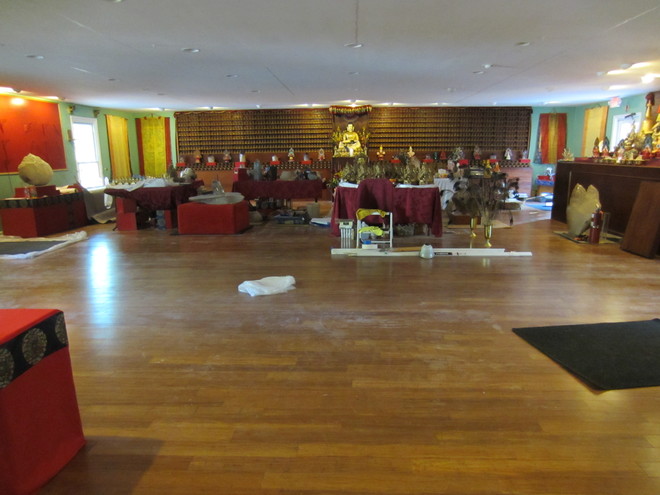
The following is a full length video teaching offered by Jetsunma Ahkon Lhamo on Saga Dawa Duchen 2013. Kunzang Palyul Choling temple is currently closed for public assembly due to required renovations to meet Montgomery County, Maryland Use and Occupancy Codes. Read more about the situation here.
Copyright © Jetsunma Ahkon Norbu Lhamo All rights reserved