Song to Tara

whitetarastatuejalpr

Clear Mind
Holy Mind
The arguments we have used against you are like dust…

Against You?
You, who flow silently… eternally in the well of our hearts.
Have we robed you in filthy rags
Hatred… greed… ignorance?
You have remained steadfast, unchanging.

Today we lift you up to the lips and hearts of beings without number
And are feasted forever.

Precious mind unchanging
Clear mind eternal.
The promise we have searched for is enthroned within our  hearts.

Clear light, holy light
Stainless, precious heart.
Here in this clear place we are robed in sweet scent and victorious forever.

Copyright © Jetsunma Ahkon Norbu Lhamo All rights reserved

Homage to Śrī Samantabhadra: Longchenpa

LONGCHENPA

The following is respectfully quoted from “Kindly Bent to Ease Us” by Longchenpa:

Homage to the beginningless primordial Lord,
an ocean great and full of capabilities,
Whose range of intuition and depth of
tenderness cannot be fathomed,
Who is the birthplace of the Wish-fulfilling Gem, the
Buddhas and their spiritual sons, and
From whom cloud banks of prosperity and bliss arise.

Sheer lucency, founding stratum of meaning,
immaculate, man’s Buddha-nature,
Through ego-centered apprehensions following the loss
of pure awareness, strays into fictitious being.
Wearied and weakened in the deserts of
Karmic actions and turbulent emotions may Mind
today find comfort and ease.

Friends, a precious human body, being a unique
occasion and the right juncture,
Is very hard to find within the six-life forms.
As delighted as a blind man who has stumbled on a
precious hoard,
Use this body for prosperity and bliss.

What is meant by a unique occasion and the right
juncture?
I am a person beyond the eight unfavorable
conditions:
My mind has not been born in the realms of hells,
of hungry spirits,
And of animals, I am not dumb, and I am not one of the
long-living gods, nor one of the savages, and
I do not harbor wrong views, and do not live in a period
in which there are no Buddhas;
And I represent the right juncture; five events affecting
me directly by being complete in me–
I have become a human being, I live in the central
country, and I possess all senses,
I do not revert to inexpiable evil deeds, and I have
confidence in the foundation of spiritual life; and
Five events affecting me directly;
The coming of a Buddha, his having taught the
doctrine, the presence of his teaching now,
The following so that it continues, and the loving
guidance by others.
These are the eighteen facets of a unique occasion and
the right juncture.
While they are thus complete,
Thoroughly exert yourself and realize deliverance.

If in this lifetime you do not make good use (of your
existence)
You will in the hereafter not even hear the word ‘happy life-form’
But for a long time will roam about in evil forms of life.
Not knowing what is to be rejected and what to be
accepted, so going the wrong way,
You cannot but drift about in Samsāra that has
no beginning nor end.

Therefore, while you still have the power now,
Apply yourself to the accumulation of inexhaustible
positive qualities,
In view of the fact that you are the juncture for the path
to happiness,
And pass beyond the stronghold of fictitious being.

But if I dare not cross the endless ocean of Samsāra,
Although I have a precious boat,
What shall I do when forever
Emotional reactions and frustrations are raging in
tumultuous waves?

Then quickly don the armor of perseverance
And, in order to let the turbid state of mind and mental
events be cleared,
Set out on the path of sheer lucency, of immaculate
pristine cognitions,
And let no obstacles impede the road to limpid
clearness and consummate perspicacity.

He who has become the foundation for bliss and
happiness
And has found a precious and clean vessel,
But does not gather the refreshing rain of the
nectar-like doctrine,
Will let himself be crushed by the swelter of Samsāra.

The downpour of (the Buddha’s) truth, the refreshing
water of pristine cognitions
With clouds of glorious bliss and happiness and
prosperity,
Will fall on the pure mind of living beings, the fertile
soil of a unique occasion at the right juncture.
Therefore, with joy and from your heart engage in the
quest for the real meaning of life.


A Unique Occasion at the Right Juncture: Longchenpa

longchenpa-sergey-noskov

The following is respectfully quoted from “Kindly Bent to Ease Us” by Longchenpa:

A Unique Occasion at the Right Juncture

Traditional philosophy has been dominated by the contrasting ideas of essence and existence. Essence is said to be that factor in finite entities which determines them and marks them off from others, while existence is the act that makes them actual and separates from nothing. As the determinate whatness of finite entities, essence was further conceived to be something universal, timeless, and inactive, and the various essences of the multiplicity of finite entities were held together by necessary logical relationships. All this led to the construction of conceptual systems, and to the assumption that essence preceded existence in the case of man determining his nature, which remained fixed for all times. Similarly existence was tied up with particular entities. When in more recent times it was claimed that existence preceded essence and that in the act of existence man determined his own essence, this existential reversal of the essentialist trend did not change the basic conceptualism.

Whether we give precedence to essence or existence, we deal with an abstraction, and this means that we have taken something smaller from something greater. It is a fact that the greater can never be caught by or reduced to the smaller. It cannot even be pointed out. Attempts to do so are more often than not attempts to dwell on elements which are merely ingredients, aspects of rationalization upon which the construction of a conceptual system rests, but which in a work of art is known as beauty and in a life situation as Being.

While we cannot point out beauty or Being, we can point to it and this pointing may help people to experience for themselves this something greater. Such pointing is indicated by the use of word ‘Being’ which is the most universal of concepts, for it covers anything and everything — even ‘nothing’ which, in the sense that it is spoken or thought, is something. Beyond the domain of this concept there is, in the strictest sense of the word, nothing more on which ‘Being’ could rest and on the basis of which it could be more specifically determined. This is tantamount to saying that the more comprehensive a concept is the more indeterminate and ’empty’ is its content. There is ‘nothing’ of either essence or existence in it, and yet there is the awareness and feeling of ‘Being’ in the sense that ‘Being’ is awareness and awareness if feeling.

Of course, terms like ‘awareness’ and ‘feeling’ are quite inadequate. We have the tendency to say that we are aware of something and we tacitly assume that this something is always something finite, as is the awareness itself. The same applies to feeling, as when I say that I feel happy or comfortable, unhappy or uncomfortable. What we have done in all these cases is that we have made up a concept and, in our efforts to bring the something greater under the concept, we have attempted to make it something smaller and have quite literally strayed away from it into fictions of our own making–whether we call it ‘essences’, ‘existences’, or ‘minds’. It is as if, and it seems almost inevitable to do so, we were desperate to fill nothingness, the ’emptiness’ of Being, with ‘essences’, fundamental characteristics, and to replace pure awareness by distinct acts of cognitions. However, rather than to see we ‘fill’ nothingness it seems more correct to say that we tend to ‘falsify’ ‘Being’ into some sort of ‘existent’ which we then further split up into essence and existence, and to ‘falsify’ Mind (as a pointer to awareness that is Being) into ‘some’ mind which also is split up into a mind and mental events. Thus the openness of Being is lost, its sheer lucency becomes dimmer and dimmer until it is as dull as the ‘existents’, the objects it deals with as mind.

This falsification, however, makes us uneasy. This uneasiness not only signals the fact that something, somewhere, sometime has gone wrong, and that something has to be done about it, it also makes clear that what is at stake is man’s humanity which cannot be defined in terms of ‘essences’ but is inseparable from, if not identical with, Being, to which, in the context of man’s being human, the name ‘Buddha nature’ is given.

Insofar as Being operates through a human existence which illustrates this working of Being as the rediscovery of Being by itself, a human existence is a ‘unique occasion’ and ‘right juncture’. To the extent that Being is allowed to penetrate man’s ‘existence’ and return it to ‘Being’ , to heal the wounds of fragmentation and to restore the wholeness of Being, a human existence is precious. This means neither more nor less than that the presence of something already there, and the direction and scope of the question (and the quest) of being human, are determined by the question and the quest of Being, which aims at making the meaning of Being explicit through its immediate experience.


Revealing the Hidden Faults: Longchen Rabjam

The following is respectfully quoted from “Drops of Nectar” by Ngagyur Nyingma Institute:

Revealing Hidden Faults (Longchen Rabjam)

The great ship of primordial wisdom of vast compassion Liberates all beings without exception from the ocean of cyclic existence.

I bow to the feet of the glorious protector, the sacred guru who has gone to the precious continent, peaceful and immaculate.

The ocean of samsara is extremely difficult to cross;
With its raging waves of birth, old age, sickness and death,
It is hard to escape from and boundlessly deep.
To you confused ones who are floundering here I offer these
suggestions from my heart!

Without applying these suggestions to dig out hidden faults,
There will be no time to cast off all your unwholesome behavior.
Without looking back into your mind,
There will be no time to see your negative faults.
Therefore, today I offer these suggestions from my heart!
Keep this in mind. It is beneficial spiritual advice.

Even if you live in solitude, you can become accustomed to depending on others;
If you are not free from the eight worldly concerns and the distractions of this life,
You can become someone who appears to benefit others while pervertedly benefiting himself!
Consider whether you can get by with such conduct!

By abiding in solitude, the Victorious Ones of the past attained enlightenment
And even former practitioners of the dharma achieved accomplishment,
But you are completely distracted.
Consider whether you can get by with such conduct!

Not recognizing all material wealth, fame, glory and valuable possessions as magical illusions.
And deceptive obstacles to accomplishment,
It’s like you are receiving something from one person and giving it to another.
Consider whether you can get by with such conduct!

Not recognizing as manifold demons of distraction and illusion
All kinds of business with many different people,
You think that babbling platitudes about the dharma will benefit others.
Consider whether you can get by with such conduct!

Being uncertain about exactly where you are heading,
You gather material wealth, build castles on dung heaps and so on.
Reckoning that you will live there forever, you take illusory appearance to be real.
Do you think such conduct will suffice?

Failing to tame and stabilize your own mind,
But hoping to tame and stabilize the minds of others,
You will experience incessant suffering and torment.
Do you think such conduct is good enough?

Never applying yourself to actual essence,
While day and night making great efforts for this life is a great mistake.
Such childish and imprudent ones are objects of the noble beings’ smiles and laughter.
Consider whether you can get by with such conduct!

When a group of many aimless ones have gathered,
Distracted teachers and students fetter one another.
This is like making an aimless search for a guesthouse.
Clinging to never-ending appearances of magical illusion
As happiness and bliss, you lose the enlightened path to liberation
And feel no weariness toward cyclic existence.
Do you think such conduct is good enough?

This year is the dwelling ground of Female Fire-Hog,
And twelve years from now will be the ground of the Male Iron-Dog, when
Foreign invasion is prophesied. Yet you make no effort to escape.
Do you think such conduct will suffice?

From all directions, war and strife will increase,
People will become intolerant and there will be many types of destruction,
But you are not trying to find the precious hidden land.
Consider whether you can get by with such conduct!

Even if you always perform good deeds without deceit,
Since there won’t be time to complete this, both inside and out,
The foundation of purposeless suffering will be uninterrupted.
Do you think such conduct is good enough?

Remaining in solitude in the mountains, but acting like you were on the edge of a city,
Accustomed to countless meetings and gatherings,
You become completely careless and your occupations never end.
Consider whether you can get by with such conduct!

Although you mentally renounce this life, you cannot let it go;
Although you dismantle deluded ego clinging, it doesn’t fall apart;
Even remaining alone in the mountains, you’ll find no occasion for solitude.
Do you think you can get by with that kind of conduct!

Although with words you talk about needing nothing, you pursue food and clothing;
Although you speak of impermanence of life, you’re still not mindful of death;
Even remaining in solitude to practice, you’re still distracted by entertainment.
Consider whether you can get by with such conduct!

Despite talking about the delusion of ordinary life, you chase the eight worldly concerns;
Despite talking about the pointlessness of illusory appearances,
you still find a lot to do;
Although you say all things are equal, you maintain your partiality.
Do you think that kind of conduct will suffice?

Even if you sit down to accomplish the natural state, present worldly concerns deceive you;
Even practicing the Dharma of your own free will, external influences mislead you;
Whatever you do, day and night you are beguiled by illusion.
Consider whether you can get by with such conduct!

Although you ponder everything, this is not the essence.
Whatever you do lacks meaning and is a cause for suffering.
Abandon everything in an empty place without people.
If you could go today itself, this would be best!

Since there is nothing nearer than oneself,
I give this useful advice out of pity,
Listen, you virtuous-minded one who desires liberation!
If you heed these suggestions it will always be virtuous!
At the outset, the virtue is to abandon your present worldly activities.
In the middle, the virtue is to discard entertainment in solitary retreat.
In the end, virtue is to achieve exhaustion in the natural state.
Ease in the present life and happiness in the future is the intention of the advice!

I composed this advice by myself and for myself
To encourage others as well I offer this instruction.
It will be excellent if both others and I listen carefully!
Please pursue this excellent permanent aim from today!

From the Vajra Song of Instructions for Rousing Myself, this completes the first chapter of exposing one’s hidden faults.


The Power of Devotion: Wisdom of Kyabje Drubwang Pema Norbu Rinpoche

The following is from a series of tweets by Jetsunma Ahkon Lhamo, quoting her Root Guru, His Holiness Penor Rinpoche:

From His Holiness Penor Rinpoche:

In the Tantras it is stated again and again the importance of relying on the Lama as the source of blessing in one’s practice. Regardless of the particular prayer that the student offers to the Lama, regardless of how small and insignificant it may be if it is based upon the student’s complete trust and faith in the Lama then the blessings of the Lama are always accessible to the student. In the Tantra of the Ocean of Timeless Awareness it states that it is much better to recite one small prayer to one’s own Lama out of pure faith and devotion then it is to perform hundreds of millions of recitations of Diety Mantras. The effect of prayer is far more powerful when it is truly an expression of one’s own faith and devotion in one’s Lama.

Heart teaching from Kyabje Drubwang PemaNorbu Rinpoche

What Makes You Not Buddhist: Dzongsar Jamyang Khyentse Rinpoche

The following is respectfully quoted from “What Makes You Not Buddhist” by Dzongsar Jamyang Khyentse Rinpoche:

Sometimes out of frustration that Siddhartha’s teachings have not caught on enough for my liking, and sometimes out of my own ambition, I entertain ideas of reforming Buddhism, making it easier–more straightforward and puritanical. It is devious and misguided to imagine (as i sometimes do) simplifying Buddhism into defined, calculated practices like meditating three times a day, adhering to certain dress codes, and holding certain ideological beliefs, such as the whole world must be converted to Buddhism. If we could promise that such practices would provide immediate, tangible results, I think there would be more Buddhists in the world. But when I recover from the fantasies (which I rarely do), my sober mind warns me that a world of people calling themselves Buddhists would not necessarily be a better world.

Many people mistakenly think that Buddha is the “God” of Buddhism; even some people in commonly recognized Buddhist countries such as Korea, Japan and Bhutan have this theistic approach to Buddha and Buddhism. This is why throughout this book we use the name Siddhartha and Buddha interchangeably, to remind people that Buddha was just a man and that this man became Buddha.

It is understandable that some people might think that Buddhists are followers of this external man named Buddha. However, Buddha himself pointed out that we should not venerate a person but rather the wisdom that person teaches. Similarly, it is taken for granted that reincarnation and karma are the most essential beliefs of Buddhism. There are numerous other gross misconceptions. For example, Tibetan Buddhism is sometimes referred to as “lamaism,” and Zen is not even considered Buddhism in some cases. Those people who are slightly more informed, yet still misguided, may use words such as emptiness and nirvana  without understanding their meaning.

When a conversation arises like the one with my seatmate on the plane, a non-Buddhist may casually ask “What makes someone a Buddhist?” That is the hardest question to answer. If the person has a genuine interest, the complete answer does not make for light dinner conversation, and generalizations can lead to misunderstanding. Suppose that you give them the true answer, the answer that points to the very foundation of this 2,500-year-old tradition.

One is a Buddhist if he or she accepts the following four truths:

All compounded things are impermanent.
All emotions are pain.
All things have no inherent existence.
Nirvana is beyond concepts.

These four statements, spoken by the Buddha himself, are known as “the four seals.” Traditionally, seal means something like a hallmark that confirms authenticity. For the sake of simplicity and flow we will refer to these statements herein as both seals and “truths,” not to be confused with Buddhism’s four noble truths which pertain solely to aspects of suffering. Even though the four seals are believed to encompass all of Buddhism, people don’t seem to want to hear about them. Without further explanation they serve only to dampen spirits and fail to inspire further interest in many cases. The topic of conversation changes and that’s the end of it.

The message of the four seals is meant to be understood literally, not metaphorically or mystically–and meant to be taken seriously. But the seals are not edicts or commandments. With a little contemplation one sees that there is nothing moralistic or ritualistic about them. There is no good or bad behavior. They are secular truths based on wisdom, and wisdom is the primary concern of a Buddhist. That is not to say that we have license to be wicked or immoral.

Broadly speaking, wisdom comes from a mind that has what the Buddhist calls “right view.” But one doesn’t even have to consider oneself Buddhist to have right view. Ultimately it is this view that determines our motivation and action. It is the view that guides us on the path of Buddhism. If we can adopt wholesome behaviors in addition to the four seals, it makes us even better Buddhists. But what makes you not Buddhist?

If you cannot accept that all compounded things or fabricated things are impermanent, if you believe that there is some essential substance or concept that is permanent, then you are not a Buddhist.

If you cannot accept that all emotions are pain, if you believe that actually some emotions are purely pleasurable, then you are not a Buddhist.

If you cannot accept that all phenomena are illusory and empty, if you believe certain things do exist inherently, then you are not a Buddhist.

And if you think that enlightenment exists within the spheres of time, space and power, then you are not a Buddhist.

So, what makes you a Buddhist? You may not even be born in a Buddhist country or to a Buddhist family, you may not wear robes or shave your head, you may eat meat and idolize Eminem and Paris Hilton. That doesn’t mean you cannot be a Buddhist. In order to be a Buddhist, you must accept that all compounded phenomena are impermanent, all emotions are pain, all things have no inherent existence, and enlightenment is beyond concepts.

It’s not necessary to be constantly and endlessly mindful of these four truths. But they must reside in your mind. You don’t walk around persistently remembering your own name, but when someone asks your name, you remember it instantly. There is no doubt. Anyone who accepts these four seals, even independently of Buddha’s teachings, can be considered to be on the same path as he.

When I tried to explain all of this to the man next to me on the plane, I began to hear a soft snoring sound and realized that he was sound asleep. Apparently our conversation did not kill his boredom.

I enjoy generalizing, and as you read this book, you will find a sea of generalizations. But I justify this to myself by thinking that apart from these generalizations we human beings don’t have much means of communication. That’s a generalization in itself.

By writing this book, it is not my aim to persuade people to follow Shakyamuni Buddha, become Buddhists, and practice the dharma. I deliberately do not mention any meditation techniques, practices or mantras. My primary intention is to point out the unique part of Buddhism that differentiates it from other views. What did this Indian prince say that earned so much respect and admiration, even from skeptical modern scientists like Albert Einstein? What did he say that moved thousands of pilgrims prostrate themselves all the way from Tibet to Bodh Gaya? What sets Buddhism apart from religions of the world? I believe it boils down to the fours seals, and I have attempted to present these difficult concepts in the simplest language available to me.

Siddhartha’s priority was to get down to the root of the problem. Buddhism is not culturally bound. Its benefits are not limited to any particular society and have no place in government and politics. Siddhartha was not interested in academic treatises and scientifically provable theories. Whether the world is flat or round did not concern him. He had a different kind of practicality. He wanted to get to the bottom of suffering. I hope to illustrate that his teachings are not grandiose intellectual philosophy to be read and then shelved, but a functional, logical view that can be practiced by each and every individual. To that end I have attempted to use examples from all aspects of all walks of life–from the romantic crush to the emergence of civilization as we know it. While these examples are different from the ones Siddhartha used, the same message Siddhartha expressed is still relevant today.

But Siddhartha also said that his words should not be taken for granted without analysis. So, definitely someone as ordinary as myself must also be scrutinized, and I invite you to analyze what you find within these pages.

Prayer for the swift rebirth of His Holiness Penor Rinpoche

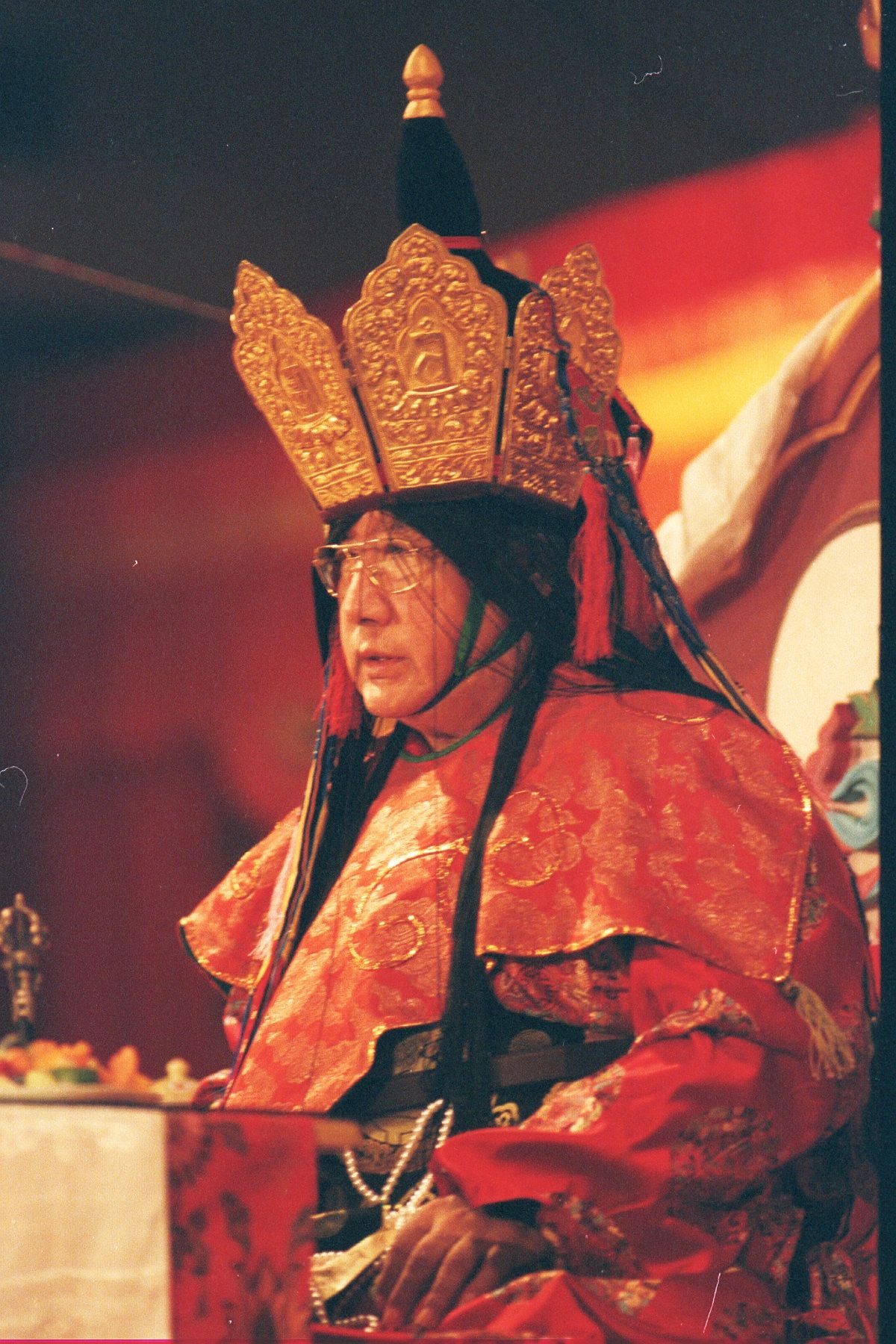
His Holiness Pedma Norbu Rinpoche
His Holiness Pema Norbu Rinpoche

I dream of the day my Guru will be reborn and found. I long for it. This Precious Incarnation is sorely missed–every day.

I have my Palyul Lineage and all our AMAZING throneholders. But HHPenor Rinpoche is my root Guru, enthroned upon the Lotus in my heart.

HHPR is present always! Through my humanness I long to see His Precious Face- hear His voice, the fragrance of His holy breath! Ah, tears…

I must satisfy my heart with His many teachings, prayers, and mixing my mind with His. Like milk with water, inseparable! The way…

I have never seen such compassion in anyone else but HHPR. He was a living Buddha, peerless. He made Palyul what it is today!

His Holiness Penor Rinpoche

To His Holiness Penor Rinpoche, Tsawei Lama I pray– O great treasure of Love and Blessing, Supreme Wisdom Holder! Return for the sake of all sentient beings!

Come, lead us out of confusion into Pristine Awareness as only a true Buddha can! I await the Bliss of Your return!

Show us the way to attain Supreme Enlightenment as you have always done! Return to us! There is such suffering!

Show us how to awaken from this deep, narcotic trance- to the Pristine Primordial Nature, free of contrivance! E MA HO!

Beloved Guru, may I always, in every future time be reborn in Your Entourage and serve you and all beings with body, speech and mind.

Nirvana Is Beyond Concepts: by Dzongsar Khyentse Rinpoche

The following is respectfully quoted from “What Makes You Not a Buddhist” by Dzongsar Jamyang Khyentse Rinpoche:

Nirvana Is Beyond Concepts

According to Buddhists, before this life in which he attained enlightenment, Siddhartha lived countless lives as birds, monkeys, elephants, kings, queens, and many as a bodhisattva, a being whose sole aim is to overcome ignorance in order to benefit all beings. But it was in his lifetime as the Indian prince Siddhartha that he at long last defeated Mara beneath the bodhi tree and finally reached the other shore, the other side of samsara. This state is referred to as “nirvana.” Having reached nirvana, he gave his first sermon in Sarnath, near Varanasi, and continued to teach throughout northern India for the rest of his long life. His students were monks and nuns, kings and warlords, courtesans and merchants. Many members of his family became denunciates, including his wife, Yashodhara, and is son, Rahula. He was venerated as a supreme human by many people from all over India and beyond. But he did not become immortal. After a long life of teaching, he passed away in a place called Kushingagar. At that moment he went even beyond nirvana to a state that is called “parinirvana.”

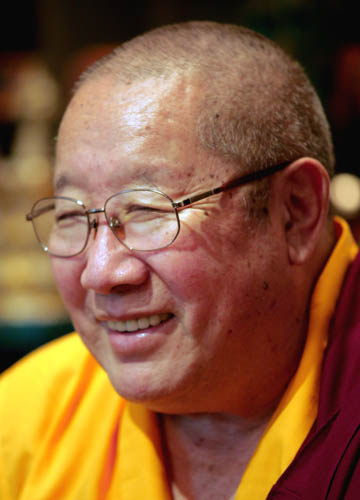
Biography of His Holiness Pema Norbu Rinpoche

The following is respectfully quoted from “How to Follow a Spiritual Master” as translated by the Ngagyur Nyingma Institute:

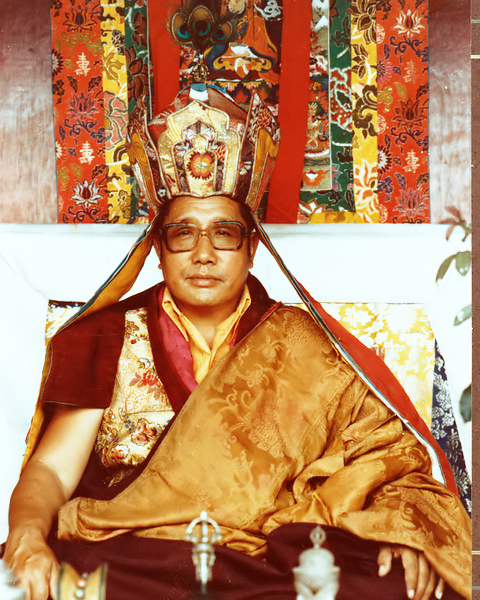
H. H. Pema Norbu Rinpoche, an emanation of Pundit Vimalamitra, was born in the twelfth Tibetan month of Water Monkey Year 1932 at Powo in Kham, Eastern Tibet. His father’s name was Sonam Gyurme and his mother Zom Kyid. At the time of his birth, sweet scented flowers miraculously bloomed in his village where no flowers usually appear in the cold and dry winter month. He was recognized as the Third Drubwang Penor Rinpoche through the prophecy of the Thupten Choekyi Dorje, the fifth Dzogchen Rinpoche.

In the upper region of sacred Powo,
At the foot of a majestic hill,
Surrounded by beautiful trees and lakes,
With large rivers flowing from the south,
To a couple bearing names, Sonam and Kyid,
A noble child will be born in the Water Monkey Year,
Possessing great qualities, he will benefit the doctrine and beings.
I the fifth Dzogchen prophesy this.

Khenpo Ngagchung, a prominent Dzogchen adept of the time, foreseeing the exceptional destiny of the new incarnation, gave him the refuge vow and empowerment of Manjushri, a sacred statue and composed a long life prayer used by thousands of his followers around the globe today. Penor Rinpoche was brought when he was five to the Palyul Monastery, the seat of his previous incarnations and was enthroned by Thupten Choekyi Dawa and Karma Thegchog Nyingpo as the incarnation of the Second Drubwang Penor Rinpoche and was the eleventh throne holder of the Palyul tradition.

Palyul Namgyal Jangchub Choeling, one of the six great Nyingma Monasteries, was established under the patronage of Lachen Jampa Phuntsog, the King of Dege and Trichen Sangye Tenpa in 1665.

Rigzin Kunsang Sherab, a prominent Dzogchen master and Terton prophesied by Guru Rinpoche became the first head of the monastery. He was a close disciple of Mahasiddha Karma Chagme and Terton Migyur Dorje, who discovered the Namcho Cycle. Both through the influence of his masters and his own inspiration, the monastery grew rapidly into one of the largest in Tibet. In the following centuries, Palyul often referred to as “the Glorious Palyul of the East”, became the famous center of ardent learning and practice under the guidance of successive throne holders. Hundreds and thousands of monks attained the rainbow body or other spiritual accomplishments from there. Penor Rinpoche was to oversee this large monastery comprising more than four hundred branch monasteries and over three hundred thousand monks and nuns.

Penor Rinpoche spent his early youth in Palyul and Dago, studying and receiving teachings from many masters including Karma Thegchog Nyingpo (the Tenth Throne holder) who prepared him to become the eleventh throne holder. When, as a small child, he was playing with a precious Vajra, he accidentally dropped it, breaking it into pieces. Fearing that his teacher would reprimand him, he quickly glued it back together with his own saliva, making the Vajra stronger than ever. On another occasion, he accidentally dropped a fragile ritual bell on the stone floor. Everybody present assumed that the bell had broken, and yet when Rinpoche picked it up, the bell was as whole and the ring more melodious.

One day when Rinpoche was a small boy, and old man who insisted that Rinpoche practice phowa on him approached him. Rinpoche innocently complied with the old man’s request. To his dismay, he realized that he had actually killed the old man. He immediately practiced again to revive the corpse that lay before him. To Rinpoche’s utter relief, the old man came back to life and said, “For heaven’s sake, why did you call me back? I was already in the pure land of Lord Amitabha.”

Another incident illustrating Rinpoche’s extraordinary power at a tender age occurred when he left his footprints permanently etched in a stone. This incident among others testifies to the karmic continuity of Rinpoche’s former practices. Penor Rinpoche also used to make intricately woven knots in a blessing cord using only his tongue.

Among his numerous masters, Penor Rinpoche benefited immensely from a very warm and close relationship he enjoyed with his master Thupten Choekyi Dawa. At the age of thirteen, he received novice ordination from him, at twenty-one full ordinations and a vast number of teachings including essential instructions and empowerments from the Nyingma tradition. Despite his old age and poor eyesight, his master said, “If I am not able to give the entire teachings, instructions and empowerments to Penor Rinpoche, then I would not have lived my life.”

Penor Rinpoche then underwent a long-term retreat with Thupten Choekyi Dawa at Darthang. Beginning from preliminary practices to the most profound esoteric teachings of Dzogchen, he stressed every practice until naked truth was revealed to him. His Holiness Dilgo Khyentse once said,

Penor Rinpoche is a saint who has transcended the boundary of samayas”.
Khenpo Jigme Phuntsog repeatedly applauded him as an enlightened Buddha in flesh and blood.

During an accomplishment ceremony (Drubchen), many monks saw a rainbow appear around the mandala and amrita boiled in the skull cup. While conducting the accomplishment ceremony of Magon, the ritual cake of Dakinis was seen shaking vigorously. One day while receiving Kangyur transmissions, Penor Rinpoche had a recollection of Lord Buddha seated at the bank of a river giving profound teachings to him and thousands of others.

According to Khenpo Ngagchung, Penor Rinpoche is also a manifestation of Vajrapani. Rinpoche’s recollection clearly indicates that he had sat at the feet of the Enlightened One in a previous lifetime in the form of Vajrapani.

It was a dream of every Tibetan to make a pilgrimage to Lhasa, especially to see the famous Jowo. In 1956, at the age of twenty-four, Penor Rinpoche with a large entourage began to travel to Central Tibet. There they visited numerous monasteries, ancient temples and sacred places, which revealed the sanctity and glory of Tibet’s past. He also visited His Holiness the Dalai Lama at his winter palace, the Potala and received a long life empowerment. Lhasa Monlam Chenmo was in progress and he offered tea and money to the entire assembly of monks. By then the situation in Lhasa was very tense. With a heavy heart, Penor Rinpoche returned to his monastery in Palyul.

Foreseeing the irreversibility of the Chinese occupation and the threat this would pose to the very existence of the Buddha dharma, Penor Rinpoche and three hundred others fled together to the North Eastern Frontier of India. Only thirty people reached India. Many died at the hands of the Chinese. The journey was a long and a dangerous one. Bullets would fall at Penor Rinpoche’s feet sending clouds of dust. Hand grenades would fall at his feet and when he had moved to a safer distance, they would explode. To survive, people with him would kill animals for food. Penor Rinpoche could not see innocent animals being butchered. Therefore he use to walk ahead and drive away those possible victims. He reached Pema Koe in the Indian state of Arunachal Pradesh with his group and in 1961, moved to South India in Mysore with approximately six hundred people.

The purpose of Rinpoche’s escape from Tibet was to keep the flame of Buddha dharma alive so that beings would not plunge into the darkness and gloom of ignorance. Keeping this in mind, Penor Rinpoche re-established the great Palyul Monastery, Thegchog Namdrol Shedrup Dargyeling in Bylakuppe, Mysore. Rinpoche had at his disposal only a paltry sum of three hundred rupees to rebuild his entire life and that of his monastery. Rinpoche had, however, insurmountable hidden resources – his enormous courage and determination.

People around him did not see the vision that he had and therefore insisted he reduce the size of his planned monastery. At that time, there were only a handful of monks. When later monks by the hundreds crammed into the monastery and found no place to sit, one can only wonder at the foresight that Penor Rinpoche had three decades ago. Few masters of Penor Rinpoche’s status would have undergone the hardships that he went through. In the hot scorching sun, he would carry bricks and sands and would work the cement, his hand bleeding and full of sores. Lack of water and motor roads made the construction even more difficult. Penor Rinpoche had to fetch water from the river that runs by the side of the monastery.

At times during the working day, he and his monks did not mind mixing dirty river water with tsampa. In the early days of settlement, he lived in a tent making Tibetan tea with cheap cooking oil, as he had no butter, and drinking out of a tin can. Rinpoche even cut his zen to share it with another lama. An old woman found him one day digging sewage alone in a deep trench for one of his monks staying in retreat.

One day a man arrived at the site where Rinpoche was working with the group of monks under the sun, he briskly walked up to Rinpoche and said, “I have come a long way to see Rinpoche. May I see him?” “Oh! Sure, why not?” replied Rinpoche. He then took his visitor to his humble room and asked, “Yes, what can I do for you?” The man was both surprised and embarassed. He never expected Rinpoche to be so earthy and accessible. His idea of Penor Rinpoche was different, a well dressed monk on a high luxurious throne. But Rinpoche appeared as a true gem lying on the common soil upon which he himself toiled.

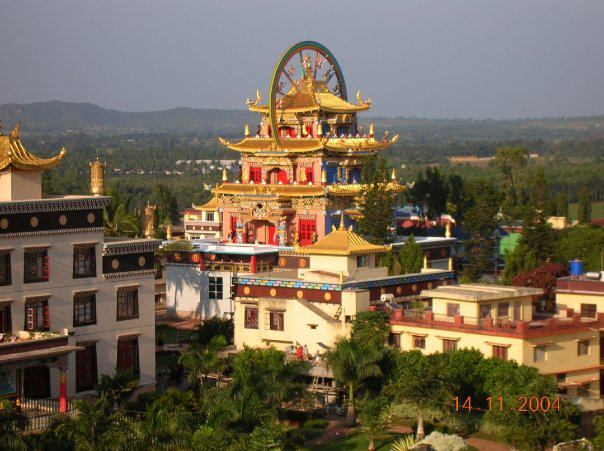
Year after year, Penor Rinpoche with inexhaustible energy and commitment, trudged steadily along the path of progress, undeterred by the numerous obstacles and hardships. The energy that Penor Rinpoche invested was not spent in vain and has borne him abundant fruits. Today Namdroling monastery in Bylakuppe, with over four thousand monks and nuns can bost of being the largest Nyingma monastery in the world. Penor Rinpoche established the Ngagyur Nyingma Institute in 1978 unable to bear the sight of priceless Nyingma doctrine at stake. The NNI, which is now a renowned center for advanced Buddhist education and research studies, has become a special pride for Penor Rinpoche.

Namdroling monastery also hosts a retreat center where several dozen undergo intensive three-year retreats. Penor Rinpoche personally instructs them on the Dzogchen Longchen Nyingthig cycle and Namcho Cycle of Terton Migyur Dorje. Every three years, a large group of Vajracharyas comes out of the retreat. Each year, Rinpoche also gives instructions on Ngondro, Tsalung, and Dzogchen during a month long retreat undertaken by a large number of monks, nuns and lay people. Studies are always coupled with practice and therefore Penor Rinpoche’s monastery is an ideal place for both intensive study and practice. That was Penor Rinpoche’s dream and that is what he still emphasizes today.

Over eight hundred small monks go to the primary school where they are taught basic reading and writing both in Tibetan and English. They also learn basic monastic duties and primary Buddhist teachings. Senior students from the institute teach these young monks. In 1993, Penor Rinpoche also founded Tsogyal Shedrubling Nunnery where over five hundred nuns study and practice and a home for the elderly where thirty people live and practice. These elders can be seen with their prayer wheels and malas, either sitting under the trees or circumambulating the sixteen large stupas that Penor Rinpoche built and dedicated to world peace.

The compassion of Rinpoche also extends to the local Indian people too. He has constructed many roads and bridges to benefit people. The money that he receives in the form of donations is always spent on worthy causes, such as the above named projects. While both in India and Tibet, Penor Rinpoche is also famous for making timely rain when the seasonal rainfall does not fall. The local Indians have nick named him, “The Rain Lama”.

Penor Rinpoche has given the entire Rinchen Terzoed Empowerments six times and the Nyingthig and Namcho Cycles several times more. He was the first Tibetan Master to give Rinchen Terzoed in the West. Rinpoche is looked upon by so many as having an infinite variety of skills and capacities. To his followers, especially to his beloved monks, he is more than a father, doctor, psychiatrist, therapist, healer, and teacher.

Being a peerless full-fledged monk himself, Penor Rinpoche has given ordination to thousands of monks and nuns. Apart from the teachings and empowerments he dispenses, he provides solutions to various human problems. Day in and day out, he selflessly works for the benefit of the living and dying or dead. The marvelous activities of His Holiness are expanding exponentially. During his four return visits to Tibet since 1959, he renovated the mother Palyul Monastery and its numerous branch monasteries. He further established new dharma centers in the Himalayan region as well as Hong Kong, Taiwan, Singapore, Malaysia, and the Philippines. There are also centers in the USA and Europe. Rinpoche travels tirelessly throughout India, the Himalayas, South East Asia and the West bestowing teachings and empowerments to his countless disciples.

The representatives of the Nyingma Buddhists around the world unanimously appointed Rinpoche in 1993 during the Nyingma Monlam Chenmo under the Bodhi Tree at Bodh Gaya. He assumed responsibility and title formerly held by His Holiness Dudjom Rinpoche and Dilgo Khyentse Rinpoche.

His recent visible achievements are too numerous to list fully, not to mention the full spectrum of his hidden activities for the benefit of beings, may it be his countless disciples or all sentient beings.

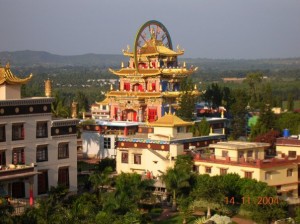
The below mentioned are some of his main achievements. He established among other an imposing, beautifully decorated New Temple in Bylakuppe, able to accommodate several thousand  monks and nuns. The sheer majesty of this building as well as the enormous size of the three statues of the Lord Buddha, Guru Rinpoche and Buddha Amitayus, covered in gold leaf, the extensive collection of thangkas masterpiece gracing every wall, the ornate wooden carvings have prompted the numerous Indian visitors to name it the Golden Temple. However, Rinpoche insists in saying that he has not build any golden temple yet, a feat he is currently achieving with the new project of building Sando Pari — Guru Rinpoche’s Paradise — on the site of the first temple recently brought down. The current “Golden Temple” was inaugurated amidst sumptuous celebrations and many auspicious ceremonies in the presence of His Holiness the Dalai Lama and thousands of monks, nuns and invited guests on September 23rd 1999.
In New York State, in a beautiful quiet environment of the Catskills, Rinpoche founded the seat of his work in the USA, a retreat center complete with all facilities, a fully decorated Temple with statues and religious paintings where he bestows annually the whole retreat cycle of the Palyul tradition to his disciples coming from America, Europse and other Asian countries. There are rooms and outdoor accommodations for retreatants. There are also numerous students who have now offered centers to Rinpoche throughout the whole of the North American continent as well as Canada, which Rinpoche visits every year and where he bestows Teachings, Empowerments and advice to his rapidly growing number of followers.

In Mysore, he is also currently completing the building of a large hospital equipped with the latest facilities to serve the needs of a rapidly expanding community of monks, nuns, children and local people. Rinpoche finds every year extraordinary resources to provide absolutely all that is needed to accommodate, feed, cloth, educate and guide in the purest spiritual tradition all his followers and buildings are springing forth in a near uninterrupted stream to keep up with the expansion of his activities. Surrounded by over seventy tulkus whom he has recognized and enthroned, he dispenses generously whatever is needed, and well beyond to all his followers, ordained and lay people alike, upholding the purest vinaya tradition as a great unassuming Enlightened Bodhisattva.

From Student to Teacher: Pure Offering

The following was submitted by a student of Jetsunma Ahkon Lhamo, Kunzang Drolma:

From Student  to Teacher

His Holiness Pema Norbu Rinpoche

I dream of the day my Guru will be reborn and found. I long for it. This Precious Incarnation is sorely missed–every day.

I have my Palyul Lineage and all our AMAZING throneholders. But His Holiness Penor Rinpoche is my root Guru, enthroned upon the Lotus in my heart.

His Holines Penor Rinpoche is present always! Through my humanness I long to see His Precious Face- hear His voice, the fragrance of His holy breath! Ah, tears…

I must satisfy my heart with His many teachings, prayers, and mixing my mind with His. Like milk with water, inseparable! The way…

I have never seen such compassion in anyone else but His Holiness Penor Rinpoche. He was a living Buddha, peerless. He made Palyul what it is today!

~ Jetsunma Ahkon Lhamo


The relationship between Teacher and Student is the foundation of Tibetan Buddhism. Devotion is the method of awakening to the true nature of compassionate wisdom or Bodhicitta, and through which the Teacher’s pure blessings pass to the Student. The Student is in a posture of offering, of holding nothing back, with the certainty that their pure Teacher will not, can never, abandon them, but will work ceaselessly for the benefit of the Student and all beings.

Jetsunma Ahkon Lhamo has never wavered in her devotion to her Root Guru, His Holiness Penor Rinpoche, who passed from this life in 2009. Her public expression of her love of, devotion to and yearning for His Holiness is a display of humble reverence for the most holy being who appeared in her life. Holiness recognized Jetsunma as the reincarnation of the first Ahkon Lhamo, who – along with her brother Kunzang Sherab – founded the Palyul Lineage in the Nyingma School. In so doing, Holiness firmly established the presence of Palyul in the West and acknowledged the purity of Jetsunma’s presence in the world. On one occasion, as Jetsunma was prostrating to welcome Holiness to the Sates, he responded. “It is I who should be prostrating to you.” Such was his reverence for Jetsunma.

Jetsunma never ceased to make offerings to Holiness during his most recent lifetime, including a song she wrote and recorded for him, titled, Father. Holiness in turn never ceased to support and respect all of Jetsunma’s activities, even in the face of overt criticism and hostility from Westerners who questioned Jetsunma’s authenticity. At least twice, during Palyul Summer Retreat, Holiness spoke from  the throne about Jetsunma and her purity as a Tulku or reincarnate Lama, and her absolute commitment to ending the suffering of all beings.

It is no surprise that Jetsunma’s generosity and gratitude to her Root Teacher did not end with his passing from this life, as evidenced by her heartfelt prayer to him. For she and Holiness remain inseparable in her heart. It is from this pure posture that Jetsunma has offered the entire holdings of Kunzang Palyul Choling, the Buddhist Temple of which she is Spiritual Director, to the Labrang of His Holiness’ Yangsi.

Labrang  refers to the offerings held on behalf of His Holiness Penor Rinpoche until his Yangsi, or reincarnation, is recognized. His Holiness Karma Kuchen Rinpoche, current Throne-holder of Palyul, will hold the Labrang on behalf of the Yangsi until his reappearance and recognition. Jetsunma is making a pure and uninhibited offering of her activities and her purpose in this lifetime, in the form of the KPC Mandala, because she can hold nothing back from her Root Guru. It is this posture that proves her purity of heart and devotion, and teaches all of us that Vajrayana is not an intellectual concept; it is an expression of love, commitment, yearning, joy, devotion and certainty there is nothing of true value in this ordinary world, other than the constant presence in one’s heart and mind of the blessings of one’s Root Guru. 

To His Holiness Penor Rinpoche, Tsawei Lama I pray 

O great treasure of Love and Blessing, Supreme Wisdom Holder! Return for the sake of all sentient beings!

Come, lead us out of confusion into Pristine Awareness as only a true Buddha can! I await the Bliss of Your return!

Show us the way to attain Supreme Enlightenment as you have always done! Return to us! There is such suffering!

Show us how to awaken from this deep, narcotic trance- to the Pristine Primordial Nature, free of contrivance! E MA HO!

Beloved Guru, may I always, in every future time be reborn in Your Entourage and serve you and all beings with body, speech and mind.

~ Jetsunma Ahkon Lhamo


WP2Social Auto Publish Powered By : XYZScripts.com