Compassion

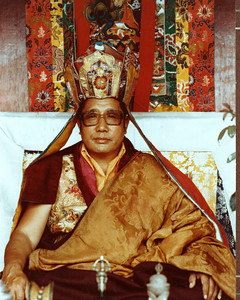
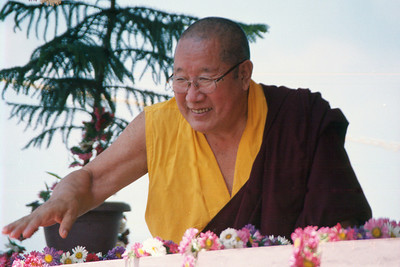
His Holiness Penor Rinpoche

From The Spiritual Path:  A Compilation of Teachings by Jetsunma Ahkon Lhamo

Compassion is a deep commitment to bring about the end of suffering. The vow of a Bodhisattva is to return in whatever form necessary, under any conditions, in order to accomplish this. We are told that in one of the Buddha’s previous lives, he was a huge female sea turtle. This turtle saw a shipwreck, and she thought: “The sailors are about to drown. I must help them.” With that compassionate intention, she swam to the sailors and supported them until they reached land. The exhausted turtle then fell into a stupor on the beach. So deep was her sleep that she did not feel the thousands of insects who began to eat away her body. They consumed her to the point that she awoke with intense pain. She started to move away but realized that if she went into the water to wash off the insects, they would all die. Since there were eighty thousand of them and only one of her, she thought: “Their nature is the same as mine, and since there are so many more of them than there are of me, it’s much better to let them live.”

Thus she allowed the insects to consume her. Just before she died, she made a wish: “I pray that when I attain enlightenment, the first ones I teach will be the insects that were eating me and the sailors I helped. May they attain enlightenment quickly after I do.” Later on, the sailors became the Buddha’s first disciples in the Deer Park, while the eighty thousand insects were eighty thousand celestial beings who came to hear His teachings. This story exemplifies the dynamic of equanimity, loving kindness, and compassion.

This precious dynamic occurs when you become convinced that only the end of suffering and the realization of true nature are important. It gives rise to wisdom, stability, and intensity of determination. The turtle understood the fragile nature of the eighty thousand insects: not long after their ample meal, they would need more food. Or, if the turtle had entered the water, they would have lost their good meal and suffered greatly by drowning.

© Jetsunma Ahkön Lhamo

Loving Kindness

His Holiness Penor Rinpoche

From The Spiritual Path:  A Compilation of Teachings by Jetsunma Ahkon Lhamo

How is it that one’s beloved and one’s enemy become essentially the same? Because their true nature is understood. The Buddha taught that all phenomena, however they arise, have the same taste, the same nature. It is attraction and repulsion that make us experience them the way we do.

Loving kindness is a profound wish for the welfare and happiness of others. We were raised to consider loving kindness a code of behavior to make us a nice person. This is far from the Buddha’s view of love. By realizing that all phenomena have the same nature, the same taste, you understand that all sentient beings are equal. Thus, their happiness has exactly the same weight, the same importance, as your own. It is from this viewpoint that loving kindness is developed.

If your mind is not stable, if there is no awareness of the natural state, if there is no real progress in meditation, you will not be able to actualize loving kindness. Yet without a determined effort to understand loving kindness, you will not make progress in meditation. It is a “Catch-22” situation. You must be determined both to realize the primordial state and to realize loving kindness as a naturally arising result. Only then can both be firm and stable within your mindstream.

© Jetsunma Ahkön Lhamo

P’howa: Conscious Living and Dying Part 1: Full Length Video Teaching

The following is a full length video teaching offered by Jetsunma Ahkon Lhamo at Kunzang Palyul Choling:

Part 1 deals with the overview of samsara and begins describing the 3 lower realms of cyclic existence. In later parts, Jetsunma will go into the other realms and begin describing how to die, and wat happens in the bardo after death.

Copyright © Jetsunma Ahkon Norbu Lhamo.  All rights reserved

Incalculable Benefit of Stupas: Excerpt from Lama Zopa

The following is an excerpt from “The Benefits and Practices related to Statues and Stupas” by Lama Zopa Rinpoche 

The conclusion for Buddhists and non-Buddhists alike is that the stupa is a way to purify defilements. A holy stupa is a way to benefit sentient beings without words. It will liberate beings from samsara in silence. To have such a holy object existing in a country makes it very rich and very lucky. Many people will come to visit for pleasure as tourists, but it will at the same time make their life meaningful. The most important point is that holy objects help beings to purify their mind and to collect extensive merit so that it is possible for them to easily have realizations of the path. That is the main function of these holy objects – to help us sentient beings have quick realizations of the path to enlightenment by the power of the holy object.

Those who build and work to actualize those holy objects will bring these beings to enlightenment. So anyone who sees it, touches it, remembers it, even dreams of it will have the seed planted for their own enlightenment. As well, prostrating and so on to the stupa helps bring them to enlightenment. By have the Secret Relic mantra within the stupa, any animals, ants, butterflies, etc. that go around the stupa even just once are purified of their negative karma to be born in the hot hells.

Even if we all die, as long as the holy objects that we have created last, our work, our effort [to create holy objects], is still benefitting sentient beings continuously. For all the many hundreds and thousands of years that the stupa will last, every day it will liberate sentient beings in silence…without words…without our talking Dharma to them. You see, just by seeing the stupa, the minds of of sentient beings who come here get purified. So many negative karmas get purified. Even the insects who are killed by machines during the construction – even they will not be reborn in the lower realms. Even those that die during the building process will receive a good rebirth. It is mentioned by a great Indian teacher in a text calledMatasara, or something like that, that even if you make food for the people building the temple, your negative karma will be purified.

Even if the holy object is destroyed, still for days, months, years, hundreds of thousands of years, so many sentient beings continue to receive so much benefit from the positive imprints [they received from having seen that holy object]. These positive imprints cause them to meet the guru, to actualize the path, etc., until they achieve enlightenment. The positive imprints are still working in them. Even if the holy object does not exist anymore, the effect is still working in that being. That person will then help to bring other sentient beings to enlightenment.


Experiencing Bodhicitta: Full Length Video Teaching

The following is a full length video teaching offered by Jetsunma Ahkon Lhamo at Kunzang Palyul Choling:


Bodhicitta is the natural expression of the “ground of being”. You can not lose it, taint it, or otherwise change it. You have oly to unveil it within yourself. Learn how.

Copyright © Jetsunma Ahkon Norbu Lhamo.  All rights reserved

Back to Basics

The following is from a series of tweets by Jetsunma Ahkon Lhamo:

In Vajrayana, Guru Yoga is a preliminary stage practice from Ngondro. And without it there will be little benefit in later practice, as we depend on a pure transmission from a Lama with good qualities, without delusion, having wisdom. We must mix our minds with the Guru and avoid making up our own stuff. The Guru provides the “Door to Liberation.”

Blah blah blah does not, just more smoke and mirrors. Fear and rage.

The thing to do is go back and do Guru Yoga like your spiritual life depended on it. Like you care and have eyes, mind, heart…A human.

© Jetsunma Ahkon Norbu Lhamo

Compassion – Antidote to Suffering

248175515_ekELp-S

A Teaching by Jetsunma Ahkön Lhamo

In Vajrayana Buddhism (literally the Diamond Vehicle), which is the form of Buddhism preserved in Tibet and Mongolia and the one followed in my temple, one of the foundational teachings is the understanding and practice of compassion.  I personally find that a religious philosophy based on selfless compassion is deeply satisfying, and I believe that it strikes a chord with many Americans.

However, although there are many people who embrace the idea of compassion as love and a deep caring for others, they do not realize that to actualize the mind of Great Awakening requires a deliberate and disciplined path.  Human beings are not born with great compassion automatically realized.  Thus, the Diamond Path can be described as a technology for spiritual development.

From the Buddhist point of view, there are primarily two ways to approach compassion: aspirational compassion and practical compassion.  When one begins to practice on the Diamond Path, one begins straightaway to make wishing prayers, cultivating the idea of being of benefit to beings who are revolving helplessly through cycles of existence.   This is aspirational compassion.

Every practice in which we engage, every teaching we hear, every empowerment we receive, every prayer we chant, can all be dedicated to the liberation of all beings from all forms of suffering.

Thus, aspirational compassion is practiced in the beginning by many repetitions of wishing prayers.  These prayers are meant to benefit beings through developing the sincere desire to utilize all one’s activities — from the mundane to the sublime — as a means of eliminating the causes of suffering in all its forms.  One prays for the cessation of war, poverty, sickness, death and rebirth, loneliness, hatred, greed and ignorance.  One adopts a posture of pure intention based on the idea that every portion of this life, as well as future incarnations yet to come, might somehow be useful to sentient beings.

As an example of this type of wishing prayer, I will paraphrase a famous practice:

If there is a need for nourishment, let me return as food.  If there is a need for shade, let me be a tree.  If there is a need for shelter, let me be a house.  If there is a need to cross over, let me be a bridge.  If there is sickness, may I manifest as the doctor, the medicine and the nurse who restore health.  May I be land for those requiring it, a lamp for those in darkness, a home for the homeless, and a servant to the world.

While this may sound very kind and loving, the intention here goes far deeper than the apparent words because one must strive to be of benefit not only to fulfill the immediate needs of beings, but also to bring future benefit.  Providing things such as food, housing, and medicine bring about benefit, of course, and this type of kindness is profoundly virtuous.  We should all strive to meet the needs of others in just these ways.  Yet, from a Buddhist perspective, being able to practice only this type of compassion does not bring ultimate benefit.  For instance, if it were possible to feed an entire nation or perhaps even the world and completely eliminate hunger and hopelessness, we still would not be solving the root of the problem.

According to the Buddha, there is no condition or circumstance without a cause.  Just as the fruit does not manifest without first appearing on a tree, which came from a seed, neither does any circumstance, good or bad, in which we find ourselves manifest without a cause.  These causes may not be found in this life only, but may come from previous lifetimes.

It is not possible for people to be born randomly into difficult circumstance or to suddenly experience the onset of tremendous suffering and upheaval.  These events are always the result of a tapestry of cause-and-effect relationships (karma) woven around the delusion involving the definition and maintenance of an ego.  Thus, to solve the immediate needs of beings may bring some relief, but it does not guarantee that they will not experience great difficulty in the future, because it does not break the continuum of cause and effect that ripens unexpectedly and constantly.  This continuum originates from the belief in an ego self and the desire that results from that belief.  It is through the pacification of desire that one can begin to transform one’s karma.  When the delusion of ego begins to dissolve, karma also begins to dissolve.  But if the mindstream is not purified of the karma of suffering, the potential for suffering remains.

We were raised to believe that reality can be manipulated.  Our libraries are filled with books of great American success stories.  These tend to be about material successes.  But the spiritual aspirant must ask: Will this success last?  Even if it lasts for an entire life, will it survive death?  If we had the power to bring peace to the world, to disarm nations and maintain order and harmony, would that peace last beyond our lifetime?  Many leaders have exhausted their lives forging great nations and empires only to have them destroyed shortly after their deaths.

To provide beings with the ultimate benefit of freedom from all suffering, one must apply the ultimate technology.  The aspiration to be of benefit to beings, the cultivation of pure intention, the continued observance of human kindness, the making of wishing prayers, and constantly hoping from the core of one’s mind and heart to be of lasting benefit to others, are practices to develop compassion.  Yet at some point the ultimate step must be taken.  This begins with the realization that temporary happiness is not enough, that feeding and clothing people, along with other acts of kindness, are not enough.  These things cannot undo the certainty of death, which puts people beyond our reach.  How can we follow them into future incarnations to ensure their safety?

There is only one way to cease the ripening of the seeds of suffering: enlightenment, which dissolves the belief in ego, pacifies all cause-and-effect relationships or karma, and reveals one’s true primordial nature.  The Diamond Path utilizes many techniques to purify the five senses and the mindstream itself.  When these practices are engaged in, not only for one’s own benefit but also to purify the karma and suffering of others, the practical aspect of the Awakening Mind — practical compassion — is engaged.  This is “practical” because it is the technology to completely rid oneself and others of the causes for suffering.  Buddhists view this type of compassion as the act of ultimate kindness.

While ordinary kindness is a valid undertaking and should be part of the activity of every spiritual aspirant, one must address the question of ultimate benefit, of eliminating suffering at its roots.

We should take to heart what the great Indian Buddhist Shantideva wrote a thousand years ago.  “May I act as the mighty earth or like the free and open skies to support and provide the space whereby I and all others may grow.  Until every being afflicted by pain has reached to nirvana’s shores, may I serve only as a condition that encourages progress and joy.”

© Jetsunma Ahkön Lhamo

Offering Mandala and Chod: Full Length Video Teaching by Khenpo Tenzin Norgay

The following is a full length video of a teaching by Khenpo Tenzin Norgay offered at Kunzang Palyul Choling:


Khenpo Tenzin Norgey teaches from the Nam Cho Ngondro practices from Terton Migyur Dorje. Each of these has the capacity, if practiced diligenly, to accru a tremendous amount of merit.

The Western Habit of Externalizing All: Full Length Video Teaching

The following is a full length video teaching offered by Jetsunma Ahkon Lhamo at Kunzang Palyul Choling:


The habit of making everything external is the opposite of the path to enlightenment which is an internal event. How do we bridge this gap?

Copyright © Jetsunma Ahkon Norbu Lhamo.  All rights reserved

WP2Social Auto Publish Powered By : XYZScripts.com