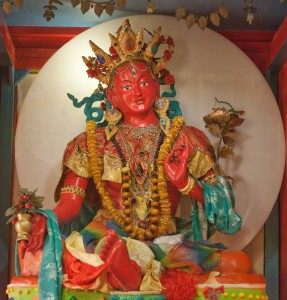
21 Homages to Tara: Verse Seven Commentary Khenpo Tenzin Norgay

Thupten Shedrub Gyatso, who was a Tulku  in one of the Palyul Monasteries, wrote this commentary.  His present incarnation, Rago Chogtrul currently lives in Tibet.

Translation by Khenpo Tenzin Norgey ~ Spring, 2004,
Palyul Retreat Center, Mc Donough, NY USA ~Wood Monkey Year 2131

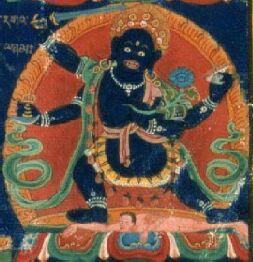
Homage to you, who destroys malefic magical wheels,
With the sounds of TRAT and PHAT
And tramples with right leg outstretched and left leg drawn in
Dazzling amidst whirling flames.

The seventh homage is to Tumo Zhenge Methubma,Tib the “Unchallenged Furious Lady”, who averts wars, lightning and hailstorms by intoning TRAT and PHAT, which in Sanskrit means to tear and cut.  These syllables thwart the magical wheels of the intentional evil deeds of the eight classes of spirits.  They avert lightning strikes and hailstorms, and destroy cannons and other weapons of war.  To depict that she has gone beyond of the extremes of samsara and nirvana by her compassion and realization of emptiness, her right leg is outstretched and her left leg is drawn in, and tramples on malignant beings.  She conquers all fears of nirvana and samsara with her  power  of  realization of emptiness and compassion.  She is black, and sits amidst flames.  Her wrathful wrinkles whirl like  ocean waves.  Homage is paid to the lady who wields a mystically blazing sword held atop a blue lotus that burns all foes to ashes.  The inner meaning of her outstretched and drawn in legs is the sensory cognitions; when the sensory cognitions perceive and harmonize the sensory objects, the samsaric wars arise.  By saying tear and cut, she severs attachment to sensory objects and purifies them.  This is the base of the male and female Bodhisattvas.

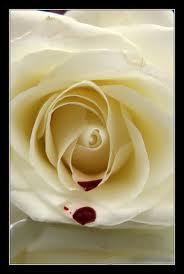
BLEEDING

The following poem is from a series of tweets by Jetsunma Ahkon Lhamo, inspired by the Occupy Wall Street movement:

I cried so much earlier, then I stopped a while. Time to cry again, no tears now. Too late for tears.

I wish I had some tears left over. I wish the well wasn’t dry. I wish I could speak to those with ears. So few.

I wish we all had understanding and Wisdom. And Compassion. But we are so busy, no time, even to pray. And so we lose our way.

Busy in our minds, dead in our hearts, eyes blind. I speak to a tree. At least it listens. Goodbye beautiful one.

Please awaken in spring, give us hope, a place to be. A place to Love again. A shady spot to remember when we were innocent.

We were so innocent while being eaten alive. I will always remember. If I don’t, who will?

21 Homages to Tara: Verse 6 Commentary Khenpo Tenzin Norgay

Thupten Shedrub Gyatso, who was a Tulku  in one of the Palyul Monasteries, wrote this commentary.  His present incarnation, Rago Chogtrul currently lives in Tibet.

Translation by Khenpo Tenzin Norgey ~ Spring, 2004,
Palyul Retreat Center, Mc Donough, NY USA ~Wood Monkey Year 2131

Homage to you, who is worshipped by Indra,
Agni, Brahma, Vayudeva, Visvakarman and Ishvara,
And praised in your presence,
By a host of spirits, zombies, gandharvas and yakshas.

The sixth homage is to Jigyed Chenmo,Tib  the dark red “Great Terrifying Lady”, who holds a phurba[i] sparkling with HUNG syllables that destroy all evils.  Indra, the king of gods; Agni, the sage; Brahma, the creator; Vayudeva, the wind god; the great Ishvara and all the great ones of the world, and the main guardians of the directions worship her.  In front of her kneel a host of evil spirits who harm beings by their misguidance.  There are spirits who cause insanity and memory loss, and spirits who turn corpses into zombies.  There are gandharvas[ii] of the bardo and the realm of Yama; yakshas like Semo, who deceive by seducing; king spirits who makes beings crazy and angry; and pishaca demons that eat flesh.  All these evildoers await her orders with humility and respect.  Homage is paid to Tara who crushes the heads of those difficult to tame, and makes them faint into the state of dharmadhatu.  The inner meaning of this is that Indra and the other gods are the personification of five elements[iii], and the spirits are the personification of the five aggregates[iv].  Their reverence symbolizes the purity of the elements and aggregates, which are the base of the male and female Buddhas[v].


[i] phurba skt (kilaya) ~ A ritual dagger, usually having three sides, used in wrathful diety practices.

[ii] gandharva skt ~ A smell eater, a category of beings who sustain themselves on smell like the odor of  the smoke of burnt eatables.

[iii] five elements ~ Earth, water, fire, air, and space.

[iv] five aggregates ~ The components of the psychophysical personality, on the basis of which beings commonly impute the false notion of self.  They five aggregates are form, feeling, perception, compositional factors and consciousness.

[v] Buddha skt ~ One who has perfected compassion and wisdom though following the bodhisattva path. Characterized by the development of omniscience, and actualization of the three bodies: complete enjoyment body, truth body and emanation bodies


21 Homages to Tara: Commentary on Verse 5 Khenpo Tenzin Norgay

Thupten Shedrub Gyatso, who was a Tulku  in one of the Palyul Monasteries, wrote this commentary.  His present incarnation, Rago Chogtrul currently lives in Tibet.

Translation by Khenpo Tenzin Norgey ~ Spring, 2004,
Palyul Retreat Center, Mc Donough, NY USA ~Wood Monkey Year 2131

Homage to you who fills all of the realms of Desire,
Its Aspect and Space with TUTTARA and HUNG syllables,
You trample the seven worlds with your feet,
You have the power to command all forces.

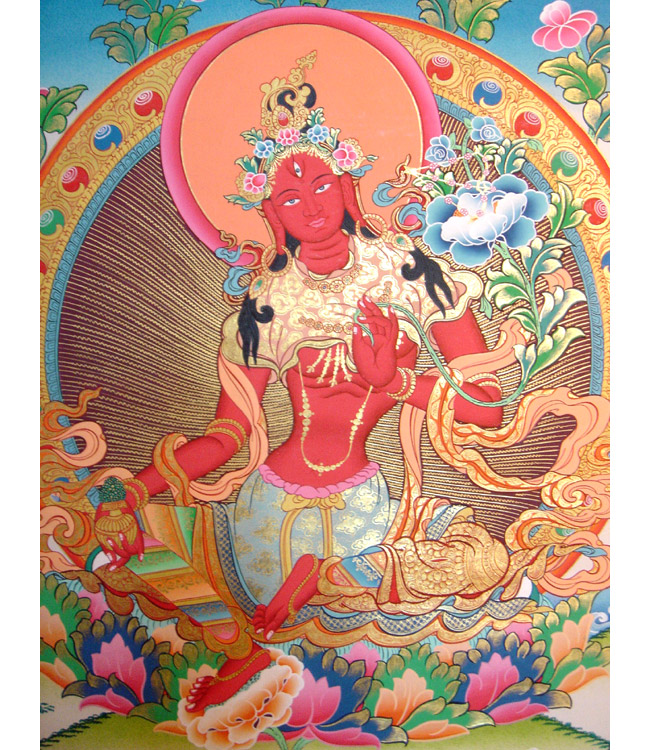
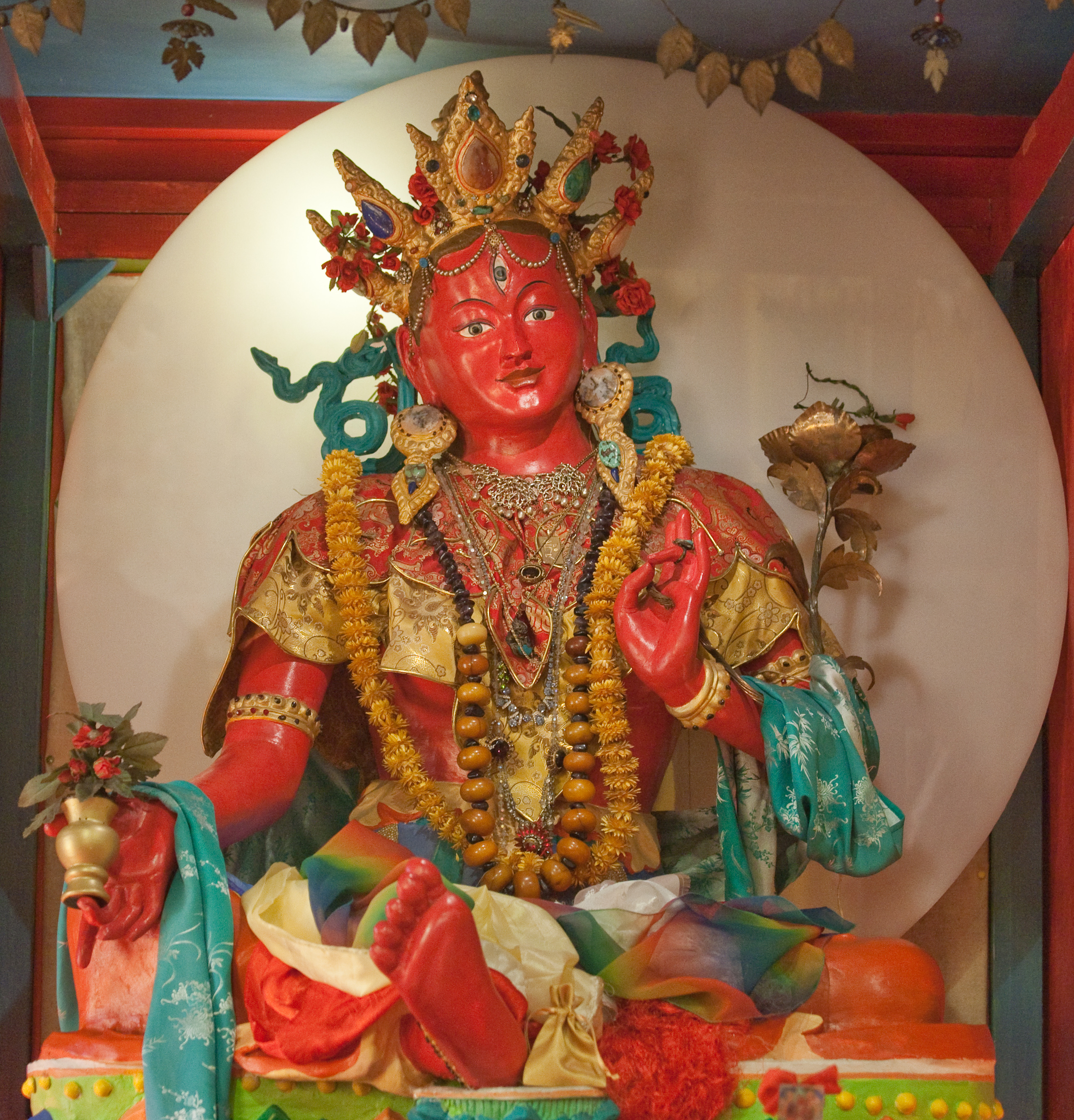
The fifth is the praise to Rigyed Lhamo,Tib the “All-Knowing Lady” who has the quality of magnetizing[i].  This red Tara sits on blue lotus and holds a bow and an arrow.  She fills the desire realm, its aspect, which is the form realm, and space, which is the formless realm, with the brightly radiating TUTTARA mantra[ii], and the sound of HUNG.  (Phyogs in Tibetan is an ambiguous word.  In this instance, the author of the commentary interprets it as “the aspect” of the desire realm.)  This is because beings in both the desire realm and the form realm share the same aspect of having form.  Likewise, “space” is interpreted as the formless realm.  The radiance of the TUTTARA mantra and the sound of HUNG symbolize her realization of emptiness[iii] and compassion.  She conquers the seven worlds by just trampling them with her feet.  If she is able to summon all of these forces without exception just by the power of the mantra, there can be no doubt of her power over the lesser forces, for example: sangha, kings, ministers, and landlords.

There are a number of different identifications of the seven worlds.  Jetsun Drakpa Gyaltsen points out they are the five goers, and the two upper realms, which makes seven.  Drolgon Zhab says the seven worlds are the realms of the nagas, pretas, asuras, humans, vidyadharas[iv], kinaras and gods; the seven realms with power.  In the commentary by Gedun Gyatso, the seven realms are comprised of the six realms: (the realms of the gods, jealous gods, humans, animals, hungry ghosts and hell-beings), and the realm of the bardo, (which is also known as the intermediate state).

Others write that the seven worlds are: the sky, the form and formless realms, and the worlds of ten directions.  Rigyed Lhamo magnetizes and leads beings to the path of the three yanas.  The ultimate meaning is that through practice, when non-conceptual neutral alaya’s clarity is cognized, the formless realms dissolve.  When the simple pure luminosity of the undiscriminating clarity of alaya-vijnana[v], or “base of consciousness” is cognized, the form realms dissolve.  When mental consciousness is free from delusion and the five sensory cognitions, the desire realm ceases.  These cessations are the abiding purity, or the fruition of purification.  At this stage of awareness, the seven worlds are the seven cognitions, where all the concepts of desire and the other three realms without exception dissolve into dharmadatu[vi].


[i] magnetizing ~ One of the four powers used by a practitioner to remove obscurations and obstacles to practice.

[ii] mantra skt ~ A ritual formula used in Tantric practice, literally means “protection of the mind”.

[iii] emptiness  ~ The absence of true existence of all phenomena.

[iv] Vidyadhara skt  ~ An “awareness holder”, one who has realized through profound skillful means awareness of the Buddha-body, speech and mind.

[v] alaya-vijnana skt  ~ The foundational consciousness, one of the eight types of consciousnesses.

[vi] dharmadatu skt ~ The sphere of reality, the ultimate truth.

Two Steps Forward…

The following is from a series of tweets by Jetsunma Ahkon Lhamo:

Many of my followers know I’ve been stalked and harassed in some cruel and unthinkable ways – and recently I’ve made great progress with The PTSD. But it is often two steps forward, then 1.5 steps back. I just don’t have my life back. Days like today I wonder if I’ll ever recover completely.

I’ve always felt my life had such potential. How do I get it back? I’m still a good teacher, but I feel panic in public, and have Irritable Bowel Syndrome now. Sometimes I feel completely beaten. The man is in prison now, but there is no assurance he will stay there, and even now his friends carry on. But I am unaware of his friends having any violent past as has the stalker.

Want to stay strong and carry on. Some days are good, as they once were. Some days it is just too damned Hard. Fear is a mind and life killer. OM MANI PEDME HUNG

21 Homages to Tara: Verse 4 Commentary Khenpo Tenzin Norgay

Thupten Shedrub Gyatso, who was a Tulku  in one of the Palyul Monasteries, wrote this commentary.  His present incarnation, Rago Chogtrul currently lives in Tibet.

Translation by Khenpo Tenzin Norgey ~ Spring, 2004,
Palyul Retreat Center, Mc Donough, NY USA ~Wood Monkey Year 2131

Homage to you born from the Tathagata’s crown
Who enjoys boundless total victory,
Relied upon by the Sons of Conquerors
Who have achieved perfection.

The forth praise is to Namgyalma,Tib the “Victorious Lady”, the “One Who Has Accomplished Immortality.”  The “Wisdom Goddess” of wisdom mantra, who emanates from the crowns of the Tathagatas[i], enjoys total victory over the boundless disruptive forces.  Her complexion is golden, and she holds a vase of longevity.  Bodhisattvas who have achieved the ten bhumis[ii], the essence of the ten transcendent perfections, without exception, rely on her guidance as their spiritual mother.  She enriches practitioners by dissolving the fourteen subtle essences of the animate, inanimate, and other subtle essences of samsara and nirvana[iii].  In reality, she has achieved the sacred, unchanging body of eternity through the intention of Atiyoga[iv], the crown of nine yanas[v].


[i] Tathagatas skt ~“Thus Gone One”, an epithet of Buddhas.

[ii] ten bhumis skt ~ The progressive levels of realization through which practitioners pass as they journey toward complete enlightenment.

[iii] nirvana skt ~ The state of liberation from the sufferings of cyclic existence.

[iv] atiyoga skt ~ The highest of the three inner yogas, the summit of the nine vehicles (yanas), according to the classification of the Nyingmapa.

[v] nine yanas skt ~ The nine vehicles or levels of accomplishment of the Nyingmapa tradition that represent progressive stages of attainment.

21 Homages to Tara: Commentary on Verse 3 Khenpo Tenzin Norgay

Thupten Shedrub Gyatso, who was a Tulku  in one of the Palyul Monasteries, wrote this commentary.  His present incarnation, Rago Chogtrul currently lives in Tibet.

Translation by Khenpo Tenzin Norgey ~ Spring, 2004,
Palyul Retreat Center, Mc Donough, NY USA ~Wood Monkey Year 2131

Homage to you, the golden lady
Whose hand is adorned with a blue lotus,
You are the lord of the domain of the activities of generosity,
Diligence, austerity, tranquility, patience and meditation.

The third praise is to Sonam Thobkyedma,Tib the “Yellow Lady of Good Fortune”.  She is beautiful; her skin is the color of pure gold glittering in the early morning sun.  Her left hand is adorned with a blue lotus, upon which sits a gem that bestows all wishes.  She is the lord of the Bodhisattvas’[i]sphere of activity, which encompasses the transcendent perfections of generosity, patience, diligence, ethics, tranquility, wisdom, and meditation.  Austerity, (in this context) is ethics, and tranquility is wisdom and meditation.  We pay homage to the unchallengeable lady who has the ten powers: the power over life, the power over mind, the power over wealth, the power over action, the power over birth, the power over inclination, the power over aspiration, the power over miracles, the power over primordial wisdom, and the power over dharma.  The outer meaning is that she has attained the completion of the six perfections, in just one meditation.  The inner meaning is that her singular meditation is like a lotus, free from the flaw of adherence to subject and object, and is endowed with the completion of the six perfections.


[i] Bodhisattva skt ~ One who has generated bodhicitta and seeks enlightenment for the benefit of others.

21 Homages to Tara: Commentary on Verse 2 Khenpo Tenzin Norgay

Thupten Shedrub Gyatso, who was a Tulku  in one of the Palyul Monasteries, wrote this commentary.  His present incarnation, Rago Chogtrul currently lives in Tibet.

Translation by Khenpo Tenzin Norgey ~ Spring, 2004,
Palyul Retreat Center, Mc Donough, NY USA ~Wood Monkey Year 2131

Homage to you whose face is like
The gathering of a hundred full moons in autumn,
Shining resplendent light
In the perfect, spacious constellation of a thousand stars.

The second verse is homage to Yangchenma,Tib the “Treasure of Wisdom”.  The “Lady with a shining face like an array of hundred autumn full moons,” means her face is a hundred times fairer and more beautiful than the moon.  Her right hand holds a mirror, which is like a full moon engraved with an HRI[i] syllable.  The “perfect spacious constellation of a thousand stars,” refers to the field of her wisdom, which is abundantly spacious, and vast, like the countless, resplendent rays of the full moon.  This light clears the darkness of the ignorance of practitioners, which is the cause of dullness, disease and possession by evils.  It opens the door to the treasury of knowledge by illuminating the light of the four specific perfect understandings.  These are the perfect understanding of the Dharma[ii], (teachings) the perfect understanding of the definitive meaning, perfect confidence (in the doctrine) and the perfect knowledge of the Victorious Ones, (brilliance).  According to a tantra, the inner meaning is “to serve the mother of the sphere” which means emptiness or the nature of mind.  In order to look at our innate self, the face of the ultimate Vajravarahi, we must accumulate merit[iii] and purify our mind-streams[iv], so that they are like an “array of a hundred pure white moons.”  Because of these practices, the door to her blessing will be opened by our true inclination.  In that way, we can see ultimate luminosity and ignite our dynamic wisdom.


[i] HRI syllable ~ Seed syllable of Avalokiteshvara.

[ii] dharma skt ~ It is an ambiguous Sanskrit term, here we can take it as spiritual path.

[iii] merit ~ Good karma, the energy generated by positive actions of body, speech and mind.

[iv] mind-stream ~ The continuation of consciousness, Buddhist way of expressing our mind.

21 Homages to Tara: Commentary on Verse 1 by Khenpo Tenzin Norgay

Thupten Shedrub Gyatso, who was a Tulku  in one of the Palyul Monasteries, wrote this commentary.  His present incarnation, Rago Chogtrul currently lives in Tibet.

Translation by Khenpo Tenzin Norgey ~ Spring, 2004,
Palyul Retreat Center, Mc Donough, NY USA ~Wood Monkey Year 2131

There are many different Indian and Tibetan traditions explaining this “tantra[i] [1]of praise”.  Motivated by devotion, I will explain this tantra in accordance with “The Treasure Vase of Essential Great Bliss of Inner Practice”, which is the profound mind-treasure[ii] teaching of the omniscient Rigdzin Jigme Lingpa.  Each of the twenty-one verses is praise to twenty-one manifestations.


Homage to mother Tara, swift and fearless,

Your eyes are like flashing lightning.

Born from the blossoming stamens

Of the lotus face of the Lord of Three Worlds.


The first praise is to Nyurma Palmo,Tib the “Fearless Swift Lady”.  Here we pay homage to the lady of activity who liberates beings from the temporal and perennial sufferings of samsara[iii].  She is called “Swift Lady” because her impartial compassion[iv] benefits beings without even an instant’s delay.  She is the “Fearless Lady”, because she has the unhindered power to subdue demons, as well as the afflictions of beings.  She protects beings from all fears.  Her wisdom eyes move like the flash of lightning as she fully cognizes all phenomena.  The lady endowed with omniscience, compassion, power, and activity was born from “the teardrops of the stamen-like eyes of the fully blossomed lotus-like face of Avalokiteshvara[v], the Savior of Three Worlds”.  The three worlds are the sub-terrestrial, terrestrial and celestial realms, (the worlds of nagas[vi], humans, and gods, respectively).

Tara is seductive, and has the youthfulness of the rising sun, and a semi-wrathful smile.  Her right hand is in the boon-giving mudra[vii], and her left hand holds a blue lotus upon which is a right-turning conch.  This symbolizes her mastery of the two truths[viii] and bodhicitta[ix] in this world, and in the god realm[x].  The outer meaning of the praise literally praises the nirmanakaya aspect of the Noble Lady.  In the inner aspect of the praise, if not taken literally, her sambhogakaya and dharmakaya aspects are praised.  The “Savior of the Three Worlds” is the dharmakaya, and its manifestation is the rupakaya, or “form body,” (which is composed of the sambhogakaya and nirmanakaya).


[i] tantra skt ~ Buddhist texts that outline the practices of the Vajra vehicle

[ii] mind treasure ~ An inspired teaching (terma) revealed directly from the Buddha-mind,  by a treasure revealer, (terton) .

[iii] samsara skt ~ Cyclic existence, the endless cycle of birth, death and rebirth characterized by suffering and dominated by the three poisons: ignorance, desire and hatred.

[iv] compassion ~ Sensitivity to the sufferings experienced by sentient beings, coupled with a desire to help them overcome suffering and its causes.

[v] Avalokiteshvara skt (Chenrezig) ~The Buddha of compassion.

[vi] naga ~ A snake-like being living in the depths of water or underground.  Although they have miraculous powers, they are classified as belonging to the lower realm.

[vii] mudra skt ~ A gesture that has specific meaning used in Tantric practice as a support.

[viii] two truths ~ The absolute truth and relative truth.

[ix] bodhicitta skt ~ The mind of enlightenment.  The altruistic intention to become enlightened in order to benefit others

[x] god realm ~ One of the six realms of cyclic existence, characterized by seemingly unending pleasure and leisure.

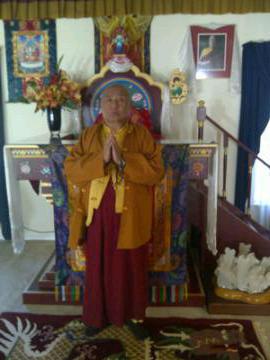
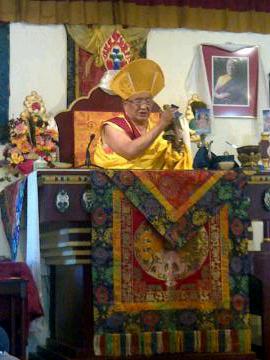
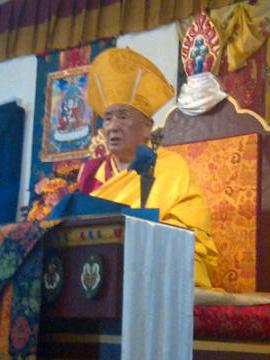
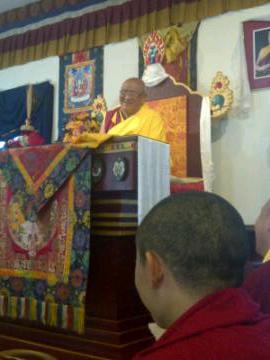
Gratitude to His Holiness Ngawang Tenzin

The following is from a series of tweets by Jetsunma Ahkon Lhamo:


Since the visit of Kyabje His Holiness Ngawang Tenzin I am feeling much better! How can I thank him? Gratitude!
His Holiness Ngawang Tenzin “knew” I wasn’t doing well, and came to practice until I did. Night and day. I feel His Holiness saved my life.

Kyabje His Holiness Ngawang Tenzin of Bhutan is a living Buddha, so kind and powerful, so pure! I was too sick to see him.

Kyabje His Holiness Ngawang Tenzin is also a root Guru for me. His Holiness never gave up until he knew I’d be fine. The day His Holiness left he rose early, still doing Puja for me.

I Pray I will someday travel to Butan to see His Holiness. I love and feel devotion for His Holiness Ngawang Tenzin. For all getting ready to jump down my throat, His Holiness Ngawang Tenzin is Kagupa, yet I am and will always be a Lineageholder in Palyul. Even I am allowed to have friends and feel devotion for a living Buddha Kyabje His Holiness Ngawang Tenzin of Bhutan. This is a miracle!


Drukpa Mila Center

The Melodious Sound of the Auspicious Dharma Conch with the Clockwise Swirl

A Long Life Prayer for H.E. Ngawang Tenzing Rinpoche, the Great Piercing Arrow of Accomplishment.

OM SWASTI NGEY SANG DAM PAI DÜ TSI MA LÜ PA THUK SU TAM PAY NGA DOI DÜ THAR YANG

May all be auspicious! The immortal nectar of the ultimate secret teachings without remainder filling our hearts even in the degenerated times.

NYING POI RING LUK PEL WAI CHHÖ KYI JE NGA WANG TEN ZING KAL GYAR ZHAB TEN SÖL

King of Dharma, propagating the essence of the doctrine, Ngawang Tenzing, I pray your life remain firm for hundred eons.

MI GYUR ZHI YI NAY LUK JI ZHIN ZIK KYE DZOG LAM GYI DRÖ PA TSE MOR SÖN

Seeing all things in their basic unchanging reality, you have reached the summit of the path of generation and completion.

ZUNG JUK DRE BUI SA LA WANG GYUR WA JE TSUN LA MA KAL GYAR TSHO ZHEY SÖL

You have dominion over the state of the union, the bhumi of fruition. Noble Lama, I request you to live for hundred eons.

DE TAR SÖL TAB LU MED DEN PAI THÜ GANG GI SANG SUM TSHEN MOI GÖN PO TAR

By praying thus, with the infallible power of truth, your three secrets like the Moon, the protector of the night,

PHEN DEI YOD TONG THRO WAI PAL YON GYIY DAK SOK DED PAI KU MÜD ZHED GYUR CHIK

With its glorious quality emanating a thousand moonbeams of benefit and happiness, may our water lilies of devotion blossom.

Gelong Tshering wrote this upon the request from practitioners when the retreat center at Kyungseng Dargye Gonpa was inaugurated.

WP2Social Auto Publish Powered By : XYZScripts.com