Sustainable Foundation

805352146_bd6ae2109f

The following is an excerpt from a teaching by Jetsunma Ahkon Lhamo called “Faults of Cyclic Existence”

I have found that after a certain point, if compassion is the main motivation to practice, it will sustain you; but it constantly requires inspirationbecause we sort of become drawn back into ourselves. You know how you do that. You sort of wake up in the morning and think, ‘Today I am going to live a spiritual life, and I am going to help everyone, and I am going to be nice.  I am going to be good and that is it. That is the kind of day I am going to have.’ And somewhere around 4:00 (or at least it is 4:00 for me), you need a little inspiration. Well, we are like that with our lives. We have moments of touching, moments of experience of spiritual point of view. We have precious moments; and in those moments we think, ‘This life is only important if I accomplish meditation or if I accomplish enlightenment. This is very important. This is really the meaning of life; and I have a sense of the meaning of life; and I have a sense that kindness and love are the core elements in life; and that is what it is really all about. And I am changing my life starting now.’

Two weeks after that point, maybe three days, we start to wear down a little bit. I have found that in practicing the Buddhadharma, even if in the beginning we are on fire—your heart is just on fire with compassion, and you feel so strongly the sense to benefit all sentient beings—unless inspiration is constantly experienced or given, or had in some way, that that will wear thin. At that point, even Westerners must begin to understand the foundational concepts associated with the Buddhist thinking. That foundational concept I will entitle “The Faults of Cyclic Existence.”  If a real competency in understanding the faults of cyclic existence is not adapted at this time, the foundation is incomplete. Because it is not sufficient only to practice in order to benefit beings and for compassion if one does not really understand the faults of cyclic existence. So I would like to go into that.

Copyright © Jetsunma Ahkon Norbu Lhamo All rights reserved

Covering the Bases

mountain

The following is an excerpt from a teaching by Jetsunma Ahkon Lhamo called “Faults of Cyclic Existence”

I just wanted to take a moment to thank you and give some little cookie as to what the prayers are all about and as to why we use them as we do. I think that if you are not used to pronouncing Tibetan you must have something of the same experience that I had when I first began to learn these prayers and began to pronounce them. I remember being a little Jewish and a little Italian, I rolled up my eyes and did like this and went, oy!  It seemed to me so cumbersome. It seemed to me intensely uncomfortable; and I just could not believe that I was investing myself in doing this. But eventually over a period of time and patience, which is not something I have a lot of, I did manage to listen to these prayers in such a way that they became meaningful to me. And now that I have come to understand something of the meaning of them, I really take a great deal of joy in reciting them. I feel a tremendous amount of joy and regard for taking the time to recite these prayers on a regular basis and in a heartfelt way. They are truly wonderful and a great blessing.

For those of you who come every week, or come fairly regularly, you will find that there are many times that I will repeat things that I have already taught. There is a reason for this; there is a method to my madness. First of all, I have found that almost never do people internalize philosophical concepts the first time they hear them. Almost always is it necessary to hear them again and again and again. Actually it is better to hear them in different ways, and then they begin to become a part of us. It is almost like climbing a mountain from several different directions in order to understand the shape of the mountain. If you can’t look at the mountain as the Buddha might look at it, from kind of a bird’s eye view, or an elevated posture, you have to rely on climbing the mountain in order to understand its topography, in order to understand its shape and its form and its dimension, and how big it is, and to really internalize what the mountain is all about, to see all its different faces. One climb won’t do it and climbing the same way all the time won’t do it. It seems as though we have to climb from all the different beginning places, from all the different sides of the mountain, in order to really accomplish understanding what that mountain is.

I feel that philosophy and religion are something like that. In order to really understand them and internalize them, they must be approached again and again and again; and they must be approached at different times and from different angles. For one thing, you are constantly changing. There is nothing about you that is permanent. You are constantly growing and changing; and even from day to day, your particular mood, your particular depth, your particular understanding is very flexible. It is constantly changing. What you understand one day, you might not understand the next day. And I am sure that you have had experiences like that where you have read a religious thought or a spiritual thought or had an experience in your meditation that one day seemed unbelievably deep, seemed to you to really click, seemed to really mean something to you. And then the next day, you might read it and you might as well be reading a bubble gum wrapper. It is just about that meaningful to you. So we change constantly. There is nothing about us that is permanent, plus the fact that our karma is constantly changing. Of course, that is what makes us change. Different catalysts cause the ripening of different karmic structures, different karmic events. We are constantly effected by these ripenings. From time to time, obstacles arise that effect our minds and our perception. And also we have a characteristic way of understanding. There is a characteristic karma that is our karma. Each one of us has our own particular mode of understanding.

I was listening to the radio yesterday for a little while and there was an interesting example of that. A man who was a linguist would go to different movie stars and different movie sets and he would teach people how to speak in a different dialect or with a different accent. He was so proficient; he was just amazing. He could speak three different dialects of… How can I explain this? He could speak English with an Irish accent, but he could sound as though he had come from three different regions in Ireland. He could sound like any different state in the union. Each state has a characteristic way of speaking. Not all Southern states sound the same, not even all Appalachia sounds the same. Anyway he was so good at that that he could make a difference between the Bronx and Brooklyn; he could make a difference between India. He could act as though he were speaking from a specific region from any country in the world, and he could teach anyone to accomplish that.

His observation, and the reason why I am bringing this up, is that people learn differently and you have to be skilled in many different ways in order to teach people. He was describing Jane Fonda and he was saying that she has an incredible ear. Only three two-hour sessions, I think he said, and she could mimic a certain regional Appalachia dialect that was very difficult to accomplish and very specific; and she had an ear that was like a tape recorder. That was the way that she learned. A lot of what she learned she had to learn from ear. She couldn’t really learn it by reading it as she could by hearing it. And then he described Charlton Heston. He is not able to learn by ear at all. He has to learn it by phonetically spelling out the accent. Then he can read it from cards, and he can do it perfectly that way.

So each of us has a characteristic way in which we learn. It is not as simplistic as that. It is not that some of us hear better than read or read better than hear. There is that, but there is a characteristic karma or an outlay or a fabric that our minds seem to have and the way in which we learn. It may be that you may hear an entire philosophy laid out in a very explicit way. It may be just perfect. It may have everything in it, and it may not make any sense to you. It may be like Jane Fonda trying to read a card or Charlton Heston trying to mimic a voice. It may not do anything for you. And yet something may be laid out in a different way and it may be fairly sketchy; and from that you may have an understanding that is deeper than the one that you could have gotten from a very specific teaching.

So we try to cover all of our bases here and make sure you hear this teaching in as many different ways as possible. And for those of you who are here for the first time or come only once in a great while, I try to not build the classes one on top of the other too much so that when you come here, even if you only come occasionally, you can come away with a whole cameo piece, or a whole thought or a whole teaching that you can use for your own benefit and also eventually to benefit all sentient beings.

Copyright © Jetsunma Ahkon Norbu Lhamo All rights reserved


Anything Is Possible: Advice from HH Penor Rinpoche

hh-penor-rinpoche-1980

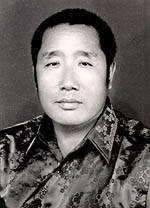
The following is an excerpt from a teaching given by Kyabje His Holiness Penor Rinpoche at Palyul Ling in New York:

This tradition starts with the Ngöndro Four Foundations, and goes all the way to the great perfection Dzogchen Treckhöd meditation practice. This Dharma teaching on the Four Foundations itself is inconceivably profound. If you have devotion, inclination and faith in this Dharma and do proper practice, then even though one may not have great signs of realization or miraculous activity, at least one will not be scared of dying.

For all the disciples who engage in the Dharma practices, it is most important to have devotion and then pure perception. We mainly concentrate on the Guru Yoga practice, because until we attain complete enlightenment, one must rely upon the master. That is why we pay more attention to it.

There are many other teachings relating to generation and completion stage that you might not understand or might be confused about.   Although I don’t have any experience or any kind of realization,  I have received all these instructions from my master and everything is in an accomplished state. That is why with all these teaching instructions that you have received, you should always try to carry through practice properly. Don’t pay so much attention to this present life, because there is not much real benefit.

With the intention of liberating and leading all sentient beings to enlightenment, and then from the core of one’s heart try to carry through the Dharma practice. All phenomena by its nature is emptiness, and from emptiness the samsara and nirvana phenomena arise. So don’t just have impure perception. If one understands the interdependent nature, anything is possible.

As explained before when we think of emptiness, we should not understand it as complete voidness. The nature of phenomena and the nature of mind is emptiness. Since everything is emptiness in nature, that is why everything arises. The nature of emptiness is appearance and the nature of appearance is emptiness. That is why appearance and emptiness are non-dual. It is not like a separate identity. All is within one’s mind. Nothing is external.

[chants OM BENZAR GURU PEDMA SIDDHI HUNG]

It is important to always maintain a very positive discipline.


Blessings on Chokkor Duchen 2017 at KPC

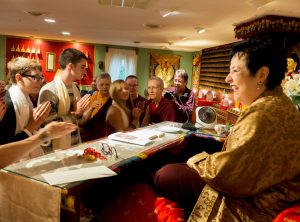
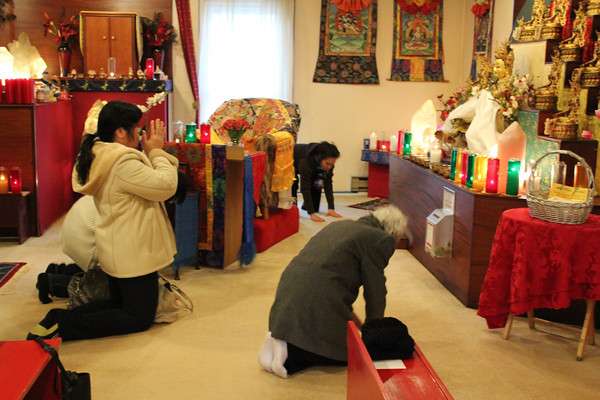
On Chokkor Duchen 2017 Jetsunma Ahkon Lhamo offered Refuge and Bodhisattva Vows to teens who have completed Bodhisattva Training available at KPC:

Click on Photo for more Images from Chokkor Duchen!


Refuge Vow
I take refuge in the Lama.

I take refuge in the Buddha.

I take refuge in the Dharma.

I take refuge in the Sangha.

Bodhisattva Vow

I dedicate myself to the liberation and salvation of all sentient beings. I offer my
body, speech and mind in order to accomplish the purpose of all sentient beings. I will return in whatever form necessary, under extraordinary circumstances, to end suffering. Let me be born in times unpredictable, in places unknown, until all sentient beings are liberated from the cycle of death and rebirth.
Taking no thought for my comfort or safety, precious Lama (Buddha), make of me a pure and perfect instrument by which the end of suffering and death in all forms might be realized. Let me achieve perfect enlightenment for the sake of all beings. And then, by my hand and heart alone, may all beings achieve full enlightenment and perfect liberation.
— Jetsunma Ahkön Lhamo

Preliminary Practice

guru_padmasambhava3

The following is an excerpt from a teaching by Jetsunma Ahkon Lhamo called “Faults of Cyclic Existence”

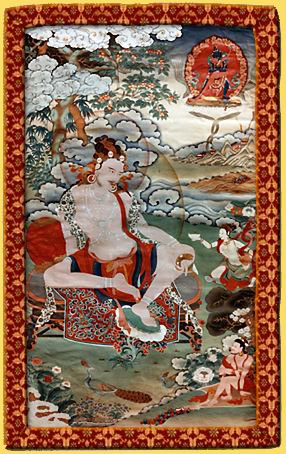
I am grateful to those who go through the Sunday prayers without having the foggiest idea what they mean. I commend you completely with all my heart and soul, if I had one. (That is a joke. You see according to the Buddhist philosophy there is no such thing as a soul.)  It is considered that there are three objects of refuge: the Buddha, the Dharma, and the Sangha. The Buddha, of course, is the enlightened mind. The Dharma is the speech or teaching of the Buddha, the path of the Buddha; and the Sangha is considered to be the religious or spiritual community that propagates the Dharma, that brings about a way for us to practice. And these being our objects of refuge, we consider that all of the teaching and all of the opportunity that we have to practice actually comes from the Buddha, the Dharma, and the Sangha. So we feel that before beginning any practice it is good to make offerings. And when reciting these prayers, once you understand what the prayers are about, you can visualize certain offerings.

It is considered that it is good to request the Buddha to turn the wheel of the Dharma, or to continue to offer the path of the Dharma. It is a combination of offering and request, honoring and praising. It is our custom to do these things before we actually begin to accomplish a practice or hear a teaching. Some of the meanings of the prayers are pretty evident when you read them. Yet, you must understand that almost everything that exists on the Vajrayana path seems to exist on three levels of meaning. I am not sure why it happened that way. I think that it is just a propensity for secrecy, or drama, or something wonderful like that. It appeals to me very much.

At any rate, I think that what is addressed here are different levels of understanding. There is a preliminary level of understanding in which one first approaches the path and, almost like walking into a room, you need to figure out where the door is, how to turn the handle. We have to turn on the light; we have to figure out where the table is so that we don’t bump into it. It’s that kind of thing. We have to look at the bones of it, or the structure of it, and the inner and secret levels of meaning. One actually develops a capability for understanding as practice begins. Almost never, at least traditionally, are deeper, very mystical teachings given right at the onset of engaging in Dharma practice because it is considered that the mind needs to be deepened and gentled. At the point when that process begins through the use of preliminary practice, then additional teachings, intermediate teachings, and then ultimately the deepest teachings are givenThere are some lamas that deviate from that for their own reasons. But it is considered, from the traditional point of view, that you can give the deepest teachings to someone, but if their minds are not prepared for it they will not really accomplish the deepest teachings until they go through a period of preliminary practice and preparation. And I, for one, feel very strongly that that is the case.

Copyright © Jetsunma Ahkon Norbu Lhamo All rights reserved


Commitment

maitreya2

The following is an excerpt from a teaching by Jetsunma Ahkon Lhamo called “Love Now, Dzogchen Later”

If you can’t be bothered to join and give some help, some support through having given rise to the bodhicitta, and having habituated oneself towards understanding the nature of samsara, which is also your responsibility, and habituating oneself towards deeply understanding the suffering of all sentient beings, which is also your responsibility, then there’s not much hope for good practice, no matter what practice you do. You can’t get away from it, no matter how wonderful you are. Compassion is in the mix. And there’s not much time. None of us knows how long we will live. It is not appropriate to say I’m going to wait, wait, wait, wait, wait until I get my stuff ironed out, and then, THEN I’ll try the bodhicitta. You’ll never get the chance. Believe me, my friend. I’ve seen it time and time again. You will never have the opportunity.

When you accept the path of the Dharma, and you commit yourself to the idea of liberation, at that point, you have to accept what has actually been taught. You can’t pick and choose what you want. You can’t make up your own little gig and call it Buddhism. Because all of the Buddhist teachings, every one, from the simplest level in the Deer Park when Lord Buddha was actually alive to this very day and whatever terma revelations may even be realized in this time, the heart beat, the essence, the blood and spirit and truth of Dharma is the bodhicitta, the great compassion. That is the way.

If you think you can simply muster up great pride in your accomplishment by keeping your ordinary qualities—pride, self-absorption, slothfulness—and yet somehow do a very high practice, and magically give rise to the perfect awakening, it won’t be so. Time and time again, we have been taught that the way of the Buddha Dharma is the way of the bodhicitta. So it is easy to say, ‘I graduated last year. I’m going to graduate this year, too.’  It is easy to say, ‘Well, I didn’t do this, and I didn’t do this, and I didn’t accomplish a bhum [one hundred thousand repetitions] of this, and I didn’t accomplish a million of that, but I’m practicing Dzogchen.’ That’s very easy to do. But it behooves us to go back and see what we’ve missed.

You are not too advanced to love. You are not too advanced to get off your duff and help somebody. You are not too sanctified to look at other beings on this planet and say, ‘I know that you are wandering in samsara. I know that we are basically human and that we share many of the same sufferings, and I find that unbearable. I wish to help.’  You are not too holy to care that there is war, that there is hunger, that there is suffering. And shame on you if all you do to honor Guru Rinpoche’s teachings is to sit on your little cushion and have it be all. Yeah, you can dedicate your practice. That’s right. You can also help. It wouldn’t kill you. Do you see what I’m saying?

It’s good to go all the way. It’s very good to get these precious inconceivable teachings, but since you are not in that perfect situation where you will be constantly reminded except by maybe me… And how much do you listen to me?  Unless you are in that perfect situation, it is up to you to make up the difference. This is the karma of our times. And you find yourself here at 18400 River Road. You can’t skip anything. You should accomplish your Ngӧndro. You should finish it even if you’re working on Togyal. You should accomplish your Ngӧndro. And that means finishing it, not just saying, ‘I did a lot of it so I accomplished it.’  And you should accomplish your Three Roots. And most especially you should give rise to the precious bodhicitta.

Read the lives of the saints. Read what they went through in order to give rise to compassion. And that in any case, in every case, no real progress was ever made unless there was compassion, unless there was bodhicitta.

Copyright © Jetsunma Ahkon Norbu Lhamo All rights reserved


What Really Matters

kag-02

The following is an excerpt from a teaching by Jetsunma Ahkon Lhamo called “Love Now, Dzogchen Later”

You should read stories about lamas in the past, stories of the saints, where lamas in the past have gone into retreat or gone to their teachers and said, “I really want to accomplish Dharma. I’m ready. I want to accomplish Dharma right now. So what will I do?”  And the lama would say, “Take some retreat. Go into the cave and practice a certain mantra.”  And time and time again students would go to the caves and would practice mantra.  And they would come back out and they would say to the lama, “I’ve practiced this mantra and yet I don’t seem to have any result.”  “Well,” lama says,  “then you need three million more. Go back into the cave and practice some more.”  And then again more advice. “Well I’ve not been able to practice any Dharma. Not given rise to realization although I’ve said mantra repeatedly.”  Then the lama would give some other advice. “Well, go back and accomplish the bodhicitta.  Accomplish the motivation.”

There are just uncountable stories like that of these great saints who struggled like you do, like we do, to accomplish their practice. And they didn’t go and get promoted every year. They had to accomplish the underpinnings, the basics, before they could move on to the next level. And it’s according to the lama’s wisdom. The lama would be able to see whether that accomplishment had really happened. And there are also many stories of disciples who would come to the lama after practicing in a cave some time or practicing in some kind of retreat, and they would say to the lama, “I have accomplished this.”  And the lama would say, “See ya. Keep trying. Go back. Another three years for you.”  Because that’s not what you say to your lama.

So, uncountable stories, uncountable stories that seem completely ridiculous and irrelevant in this time because of the experience that we’re having. But I’m telling you that they are not irrelevant. It’s something for each of us to take personal responsibility to study. And I really think that some of the elder monks and nuns should take on the responsibility of studying the lives of these saints and then reporting on them to other students. Maybe we could take turns giving some classes on that.

But just to go every summer and say,  “I have Dzogchen. I must be okay to die now.”  Or something like that, you know?   Thinking that, you know, somehow magical thinking. You’ve got the bumpa on the head and you’re just set to go. I’m afraid not. I wish that it were so. There is no bumpa on this planet that is hard enough. I mean how many times has His Holiness said that without giving rise to Guru Yoga, to true devotion, you know, egoless devotion, the lama could literally bang you on the head with the bumpa until it was dented and you are too, and there wouldn’t be much value. Even though the lama had practiced. Even though it had been an unbroken chain all the way down to the original source of the teaching.  Because in our practice there is a call and response. The lama gives the blessing; the student is invited to respond accordingly. It’s in the call and response connection that the growth occurs. It isn’t really what the guy above you tells you to do that makes you grow.

Our concern should always be loving concern for the welfare of sentient beings. If we are so puffed up with our own view of ourselves that we cannot bother ourselves to be of benefit to sentient beings; we cannot rouse ourselves to do something that will bring benefit to all sentient beings; we cannot bring ourselves to study on the suffering of humans, of animals—these being the two that we can mainly see on this planet— and to bring some relief, let alone worry about sentient beings in other realms that we cannot see and know are suffering,… We can’t even be bothered to look at human beings and animals. But we are going to sit there and do secret teachings, and look at others and wonder why they can’t do the same. Not appropriate. Not appropriate at all, and no benefit. No benefit.

Copyright © Jetsunma Ahkon Norbu Lhamo All rights reserved

Essential Motivation

HisHolinessPenorRinpoche

The following is an excerpt from a teaching by Jetsunma Ahkon Lhamo called “Love Now, Dzogchen Later”

Ngondro purifies the five senses to such a degree that many of the gross defilements.  The ones that you meet up in your life where you are happily going along the road of life and you get punched in the face by karma.  Those obstacles.  You know.  They purify some of that and they keep that sort of thing from happening or they make it happen more benignly pacified is the idea.  And then accumulation of the Three Roots stabilizes the mind.  Begins to ripen the mind.  At that time we are trying to accomplish the Vajra confidence of the deities, their very pure qualities.  Their ability to establish virtue.  Their ability to accomplish view.  All of these things are accomplished through this recitation.  But nowadays, we don’t even have to do that.  We go to Tsa Lung.  And we don’t even have to finish Tsa Lung.  Then we can go to Trekchod, and then we can go to Togyal.  I think that is right.  We don’t really have to graduate.  And you have to ask yourself at this point.  What has changed?  Did His Holiness change?

I think of His Holiness like the Copper Mountain.  Our perception of the Copper Colored Mountain may change.  It may be connected to our own capability but does the Copper Colored Mountain ever change?  No.  It is absolutely empty of self-nature and yet spontaneously accomplished.    Figure that one out.  So, there is no fault here.  The fault is not with His Holiness.  His Holiness made a decision based on the times and I understand his decision.  It is not for me to agree or disagree, but I absolutely understand what his method is.  But the thing that I want to express to you is that it puts the responsibility on us.  To accomplish when we are not with His Holiness what we have to accomplish in order to make what he is teaching us next worthwhile.

One of the worst things that I have seen happen, that is a terrible result, and indeed it is not unusual in the sense that it is different from the way the world is acting now.  But still I have to say that it is not a good result and that is that most people on the path blow right by giving rise to the Bodhicitta.  Giving rise to the great compassion, to the way that actually is the very essence of awakening.  The Bodhicitta.  Now, His Holiness always teaches about Bodhicitta.  He never denies an opportunity.  Never abandons an opportunity.  He teaches about the Bodhicitta every time.  Like for instance when he starts to give a teaching or he starts to do a practice, often he will remind us to establish our motivation and the Khenpos will always say that we must establish our motivation or that we must understand that we are hearing this teaching not just to hang out here or that we are doing some practice not just because we are bored or for some other self-oriented reason.  But the only valid, righteous and appropriate motivation to accomplish Dharma is for the liberation and salvation of all sentient beings.  So, we can repeat that back. We’ve heard this so many times.  And we can say if I say to you, “Why are you doing this practice?”  You’ll say, “Oh, liberation and salvation of all sentient beings.”  We’ve heard this so many times that we can parrot it back.  Sort of like a Malaccan Cockatoo or an African Gray.  But have we really given rise to the Bodhicitta?  Have we really accomplished it?  Have we worked really clean?  Thank you!  Somebody said no.  I appreciate that.  You know?  Have we worked cleanly and purely with our motivation?  Do we tutor ourselves on our motivation everyday, every moment?   And when we have choices to make, do we reestablish the motivation so that we can make the correct choices by saying, “Thus for the sake of sentient beings, I will open this altar, close this altar, pray, circumambulate, do my practice, study some Dharma.  Benefit sentient beings in some way.  Feed the hungry.  Heal the sick.  Walk a dog.“ Anything!  Anything.  Do we remind ourselves that that is our reason for taking our next breath?  That other than giving rise to compassion, giving rise to the mind of Bodhicitta which by the way, is the pure awakened state, our primordial wisdom nature, that that is the reason for anything that we do.  And should remain so.  And if we do not have the proper karma to be born in a monastery amongst many learned monks and nuns and many learned Khenpos, and lamas and Rinpoches, then we must accept that as our karma.  And shouldn’t leave ourselves to say, “Oh those poor guys.  They have to work for years trying to accomplish some Dharma and all they get is a couple of maroon colored sheets and a rug.  And you know, they just stay there in the Monastery.  And gee, I get to hang out here in America with cars, and TVs, and you know, stuff.  I have a great house.  And I can buy another car if I want.  And you know there are so many things that I can do do do.  And have have have  have.  And yet I get some Dzogchen.  Whoopee!  I must be the most fabulous person in the world. “

Unfortunately, our response to being given this great blessing is a little more like the whoopee part than it is the honest internal watchfulness that makes us ask ourselves, “Have I given rise to the Bodhicitta?  Have I accomplished good qualities?”  I mean when you practice the root deities, the Three Roots you accumulate so many repetitions of the mantra and you put so much energy into visualizing their different hand held implements and even their posture, which means something.  The handheld implement and the posture are the very display of the deities’ excellent qualities and activities.  So, we practice many repetitions of the mantra of the root deity.  And we think now we have accomplished the qualities of the root deity.  What are the qualities of the root qualities of the root deity?  We study the hand implements.  We study the posture, and we begin to inhabit those qualities.  We begin to display those qualities.  We accept those qualities.  We habituate towards those qualities and even one of the qualities that we habituate toward is Vajra pride.

Vajra pride which is different from American pride.  American pride is the bullshit that knocks you off the path.  Vajra pride is the confidence in the method.  Confidence in the method through meditating on Shunyata and giving rise to the deity.  And so there is the confidence.  Not having practiced mantra like that.  Not having gone through those different accomplishments, we instead have given rise to ordinary pride.  And ordinary pride is stupid pride.  It tells us to argue with the elder sangha members, lamas, and Khenpos, thinking that we know better, or to make up our own religion.  Or to just do it the way we want to, or to just self cherish.  To meditate on self-cherishing, ego cherishing, which is giving rise to the ordinary pride and back to that ordinary cycle.  But when we accomplish the deity, something different rises up.  And then when we move on to the other levels, we move on with Vajra confidence and unshakeable Bodhicitta – compassion.

Now, when that foundation is properly laid, and we have properly practiced Bodhicitta, and we have properly accumulated mantra and we have purified our senses through the Ngondro, then when we are introduced to Dzogchen.  The mind is matured.  The blessing of the lama, particularly if we have accomplished purely the accumulation of Vajra Guru mantra within the context of Guru Yoga in Ngondro.  And what is it, 1.5 million of those?  Or 1.2, I forget.  Huh?  1.2?  Thank you.  She knows but did you do it?  Oh see!  Yeah.  So, after you accomplish that many Vajra Guru mantras in the context of Guru Yoga, you have changed.  Your capability is different.

Copyright © Jetsunma Ahkon Norbu Lhamo All rights reserved

We Were Born to Do This

Offering Prayers

The following is a message recorded on June 1, 2013 as a message from Jetsunma Ahkon Lhamo to her students (audio file below):

This really has been the hardest time of our lives as a sangha, because we don’t know what the future is going to be.  We don’t know whether we will stay together.

A sangha is a precious thing.  It has to stay together.  It’s like a family.  When it is broken something precious is lost.  It is tragic.

I just want to speak to my sangha, because right now we don’t have a building that we can use the way we normally would, but I want to remind you that we still have the land.  So, don’t abandon it.  We are coming back online pretty darn soon.  Not soon tomorrow, not even soon next year, but soon.  And it will be progressively better and better and better.  So don’t give up.  I haven’t.  I would live in a tent if I had to, as long as I had a fence for my dogs.

I just want to say that we have to make this the best effort of our lives.  We cannot say, “Oh I pay this much every month, and so I shouldn’t have to pay any more.”  Or I pay this much every year, or whatever.  You can’t say that and think that’s enough.  It’s not.  Not right now.  That was enough before, and we counted on you.  If you didn’t help us in the way that we’d agreed on way back in the past, then we wouldn’t have anything.

This was a group of people that stuck together for a long time; learned to love each other.  Then of course because they are sentient beings, they learned to argue with each other.  And as usual, we don’t even realize that we are doing it.

I hope to get your attention.  I have had a hard time getting your attention lately.  It is like trying to herd cats.  And of course we all know that is impossible, because cats are cats.  Could you not be a cat for a while, and learn how to work for the larger group, for the group of sentient beings that we are and the group of sentient beings that we serve? To work for all sentient beings ultimately.  If we could just get back there, everything would come back.  It is cause and effect.

We have been too selfish.  I have broken it up the best I could by just giving everything away.  Have you noticed?  Many of you don’t even know.  I hope you will pay attention.  I hope you will wake up.

I am glad that people are having weddings and family things. I’m glad for all of you.  I don’t have any of those things in my life at this point, but I am glad for all of you.

At this part of my life I feel like I have got to keep moving forward or it’s all on me.  The truth of the matter is that no one person can do it, and it’s not all on me.  So you have to help me figure this out.  I am actually working hard every day.  Not just sitting here trying to think it out.  But talking to people who might be able to help us.  So help me.  I have helped you over the years.  Why can’t you help me?  Amen.

I hope you hear me.  We were made to do this.  I hope you hear me.  We were born to do this, and it is hard, but I hope you hear me.

You can hear the message here: Messsage From Jetsunna

Copyright © Jetsunma Ahkon Norbu Lhamo All rights reserved
Kaliyuga – Pay Attention

MG-001-36 JAL & HHPR-M

The following is an excerpt from a teaching by Jetsunma Ahkon Lhamo called “Love Now, Dzogchen Later”

Remember I used to give this old teaching years ago about how being enlightened doesn’t mean you are suddenly too stupid to catch a cab?. Remember I used to? You know that suddenly you don’t become blissed out somehow. His Holiness personified that.

When I went to India, I stayed there for a while.  His Holiness used to have this white car that looked like a beetle, a Volkswagen, on steroids, you know, kind of kind of roundish and puffed out like it had muscles. And that was his car, and he would drive it. And he was very spontaneous, very different from the way he is here in America, like terribly spontaneous. Like one morning he came to my house, looked in the window(there is only a cloth covering the window), and it was like 5:30 a.m. “Ahkon Lhamo!  Wake up!  We’re going to town!”  “Okay, alright. We’re going to town.” So, we went to town. We bought stuff, went shopping. And he said, “You Americans, you like shopping, uh? I just want to go back to bed. I didn’t say that to him, but you know. So he was like that. And we would drive.  He would do a lot of driving. His favorite thing was to drive his car. And when he would drive, he would talk excitedly. And his hands would be all over the place. If you’ve ever been in a car in India, the traffic is so terrifying. But you know, hey you can steer my ship anytime you want to. So, he’s driving the car. He’s talking. And His Holiness when he talks, he has like a funny accent lisp thing where he spits if he’s talking really excitedly. So I’m in the back and I’m getting showers of blessing.  And I’m thinking what is this fabulous karma I have that I’m in the back seat with His Holiness getting this shower of blessings; and I was just holy spit all over me. So I was really happy. I didn’t have my coffee that morning, but that worked. So I knew him well enough to know that he didn’t change his ways very easily, even though he is spontaneous. He is flexible. He is awake.

It was hard for me to understand how he could go from being very protective of Dzogchen to suddenly handing it out year after year. And it made me think a lot. And I thought,  ‘That is His Holiness telling us these truly are degenerate times.  And that in these times, there is so much spiritual sickness that only the most powerful medicine can work. The most powerful Dharma medicine can work.’ And of course there are the teachings that Guru Rinpoche himself has given that said that in the future in times of great darkness Dzogchen would be the method that would cut through darkness. And so I thought to myself, ‘You know, most people may not be thinking that, may not realize that. But that’s what his giving this out means. That this is something important, something to pay attention to.’

And then I began to,… Well, I talked about it with my teachers. I talked about it with other lamas that I had been connected to at that time, and studied on it myself a great deal and realized that at the monastery there is shedra and there is a different subject in every year of shedra. It’s kind of like in a college where you have a semester; then you wait a year and then you have a semester. And it’s kind of like that. So when you’re ready, between the times that you are entered into a specific solid learning semester, they have the elder monks and other Khenpos and other lamas that are constantly there at the monastery keep the monks in line and keep them progressing. They don’t let them get out of control. They don’t let them get sloppy. They don’t let them get, you know, non-virtuous. They don’t let them lose their way. They watch them. It’s a communal family that works well together so that students can progress from year to year. And even that is different from the old days, and I mean the old days when in order to progress to the next step, you had to accomplish the step before. In other words, if you were given Ngӧndro to do, you had to complete your Ngӧndro.

Nowadays you get promoted whether you complete it or not. And it is a dangerous position in one way. Well, it’s not dangerous because you have His Holiness’ blessing; but it is a dangerous position in one way because you don’t have time to do the five accumulations, and they are so important. They are so important. That many Vajra Guru mantras, that many prostrations, that many vows of Bodhicitta, that many Vajrasattva, that many of all the countables, the mandala offering. They are so needed to stabilize the path. So needed to stabilize one’s mind. And to go on to the next phase before finishing the baby steps is a difficult thing to do. And the reason why it is happening now is because these are difficult times. It’s a rather explosive combination, don’t you see? Difficult times and not having the underpinning that you need.

And then after Ngӧndro, students would usually practice the Three Roots and that would mean you would have the Lama deity, the Yidam deity, the Dakini deity and protectors. And for the Three Roots, Lama, Yidam and Dakini, you would have to do 100,000 accumulations of each. Bare minimum. Usually it was a million of each mantra. And that’s what they call accomplishing mantra, when you do like a gazillion of them. Nowadays we think it means accomplishing mantra when we say I’ve done this mantra. I do it everyday. Therefore I have accomplished it. How many have you actually done? 25,000. I’m sorry. I don’t think so. Back in the old days, it was more like 100,000 or a million, depending on how the lama taught you to practice.

Copyright © Jetsunma Ahkon Norbu Lhamo All rights reserved

WP2Social Auto Publish Powered By : XYZScripts.com