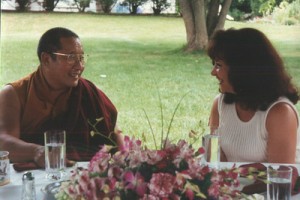
True Virtue: A Twitter Teaching by Jetsunma Ahkon Lhamo

ordained-M

The following is from a series of tweets by Jetsunma Ahkon Lhamo on twitter:

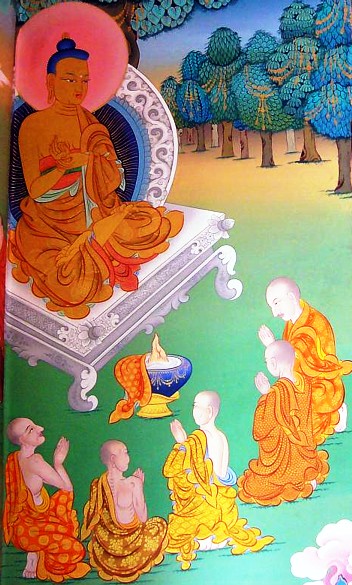
What I look for in a monk or nun is renunciation, faith, kindness, willingness to help, deep and sincere love of the Three Precious Jewels. What I don’t like in a monk or nun is wearing robes for the sake of status, or to dominate others, to make yourself seem important.

If vows are broken there are ways to restore most of them but you must actually perform them according to your Teacher’s instruction. The need to boss people around is a very bad reason to take or restore robes. And not to brag that you are a good practitioner, that is bad. As an ordained Buddhist you must not use your robes to make money or to put yourself up as “the boss.” Monks and nuns must be humble and help.

Copyright © Jetsunma Ahkon Norbu Lhamo All rights reserved

Understanding Duality

Fly

The following is an excerpt from a teaching by Jetsunma Ahkon Lhamo called “Art of Dispelling Anger”

So what happens in the awakening? Well, we’ve worked with our poisons sufficiently. We have some inner knowledge and honesty. We’ve worked some method and now we’re accomplishing view. That’s where we really start to get cooking is where we practice the view. The view is—I love this part—every woman you see is a goddess and I’m the queen. We see that all beings are Buddha. We see that the females, whether they look like goddesses or act like goddesses, are goddesses in their nature. They are Tara. They are, as are you, the primordial pristine state. We look at men, and rather than list their faults, which most of us do, we look at them and think, ‘This is Buddha. When you think of your husband, your child, your friend, your enemy and even President Bush, you think, ‘Yeah, this is Buddha, in his nature.’ And when we look around and we see that the appearance in relative view doesn’t look like Buddha, we shouldn’t take that as proof that the teaching is wrong and that we have a good excuse to hate.  We should take that as a reasonable display of the fact that we are lost in samsara. Here we are in our nature, the very Lord Buddha. When we awaken, we are Buddha. And yet we are in prisons; we are in hell realms; we are in abusive situations; we are hungry; we are angry; we are at war; we suffer. And yet we are the very Buddha we aspire to follow.

In Buddhism we are taught there are the ground, the path, and the fruit. All three must be present in order for liberation to be possible. And this is one way in which we understand our natures. The ground is the basis of accomplishment. If you did not arise as phenomena from the fundamental primordial self-luminous view, if you did not arise from that, if you were not the very bodhicitta in its display form, if the Buddha seed did not rest within you, if it were not so that each and every cell of your body is replete with the entire mandala of peaceful and wrathful deities, if that were not true, there would be no basis for accomplishment. But in our nature, we are Buddha. That is the basis.

And then there is the path. The path is as important as the basis, because while we have the Buddha seed, we may not have method or a way in which to awaken to that or to bring it forth. A fly is Buddha. He also arises in the display of duality in the samsaric world; and yet his nature is Buddha. His nature is the very same, no different. We each of us stand in the presence of our root teacher, whether it’s in our private practice or whether it’s here at the temple, and we could be a fly. But the difference between you and the fly is the fly has no method. The fly cannot practice method. The thing he is doing is not prostrations. He’s wiping his thighs or something. So we have to apply method. That’s what the Buddha’s teaching is all about. It’s all about different methods at different stages for different people.

Copyright © Jetsunma Ahkon Norbu Lhamo All rights reserved

Holding Back the Darkness

ordained-M

The following is an excerpt from a teaching by Jetsunma Ahkon Lhamo called “Reclaiming Our Merit”

This is a really difficult time, not only for the Sangha, but it’s really a direct reflection of what we’re seeing on our planet right now. There is corruption in business and government like I’ve never seen before. Many of us have become professional samaya breakers, meaning that we have not kept our commitments and, in many cases, have dropped our robes, or whatever. And because we are lost in samsara, we simply don’t understand cause and effect. Not only are they connected, but they arise interdependently. Time and space is our delusion. Cause and effect arise at the same instant.

So exacting is cause and effect. Yet we have not really milked the essence out of that understanding so that we can create better lives for ourselves, or practice for ourselves and make a deeper commitment for ourselves. We simply have not utilized what we have received. And here in this time, you don’t know where to look, left or right. What is pure, what is sacred, what is wholesome? All of it seems to be confused and dark; and right now our hearts are heavy. We were so innocent when we were younger, and some of you that are still young are still innocent, so innocent thinking that can never happen to us. So learn.

In this time of debilitating darkness and confusion, we have to strengthen ourselves. I’ve had students propose the question to me: What is the benefit of the robes?  I look around at you and I say to myself, ‘Aren’t you terrified to be without them?’  Well you should be, because these robes now are like a shield of virtue. You are what we have. The power of the Buddha’s blessing is such and the robes are so potent that a quorum is considered four ordained monks and nuns with yellow robes. That quorum has the power and the stamp of the Buddha’s blessing. We can get four other people together and you won’t have the same conditions. And even knowing that, we barely use it. It’s so powerful. It’s such refuge in these dark times. And yet we don’t call up three of our friends and say, ‘Hey, you know, let’s get together and pray for the world. Or maybe we should get together and pray for our Sangha.’

You have, on your bodies, the most excellent and extraordinary tool one can have in this time other than realization and giving rise to the bodhicitta. If you think somehow that compassion and realization and awakening are separate, you are fooling yourself because they are the same essence, the same taste.

We are approaching this really dark time, where lamas are sick, things are happening to people that we know and love; monks and nuns that we had great hope for, great hope for, have gone. And so what are we left with?  We are left with this. How many lifetimes do you think it took you to earn wearing these robes?  And for those of you who are in the halfway step, wearing your red and white robes, I appreciate that, too. The genyen population and the genyen Sangha, myself included, having been genyen for many lifetimes, many lifetimes, this is a support. But the real princes and queens of our Sangha, our Dharma, this is the ordained community. The more often you get together with your yellow robes and make prayers together with depth and honesty and true compassion; and seeing what is happening in this world, give rise to that compassion in a certain way, the power that you wield is phenomenal. But we’re kind of like this: ‘Oh, I can’t do it. Oy, oy, oy.’ We suddenly all became Jewish.  Oy, oy, oy. I’m half Jewish. I can say it.

But that’s how we are. We got into kind of crying, kind of whining like babies. We have so much power if we will only utilize it with faith. The reason I wanted to talk about that is because it’s important that you guys who are ordained have real confidence in the fact that you are wearing the Buddha’s robes. You have to think, ‘I have this jewel. I have this nourishment that I can pass on and give to others.’ I want you to be cognizant of the power of the commitment that you keep. And you must keep it squarely and purely in order for it to provide for you the protection and nourishment that you need. So as far as I am concerned, the ordained community are the nectar of what we can do here. I would love to see you all take more initiative in practicing together and understanding that four is a quorum and that you can change things.

And even beyond that, I want to talk about not only the corruption of this time and the darkness of this time, but I’d like to say that this time has been predicted and taught about and we knew it was coming and nobody believed. This is the time when even the most profound Dzogchen teachings are passed out like candy; and I’m afraid it’s often passed out like seeds thrown onto cement. And why is that the case?  Well, lamas predicted when the conditions might be right to give Dzogchen teachings, so you either get them or you don’t. You get them based on the capacity and generosity and accumulated virtue of the lama, or you don’t get them.

And the reason why this is happening is because we haven’t bothered to create the foundation upon which these kinds of practices, wisdoms and awarenesses are built. And if they are practiced with no foundation, there is no result. You are at the circus. You are seeing phenomena in your head. And once phenomena is perceived, you’re off. You’re lost without a compass.

On The Suffering of Beings

A slideshow compiled by a student of dharma who was inspired by the compassion retreats of Jetsunma Ahkon Lhamo, founder of Kunzang Palyul Choling:

The music accompanying this video is a prayer offered by Jetsunma Ahkon Lhamo for the benefit of any being who is suffering (human or non), especially those suffering from illness or death. More information on this prayer and a download link can be found here: https://www.tibetanbuddhistaltar.org/prayer-to-be-reborn-in-dewachen/

AA and Buddhism

hitting-rock-bottom-when-to-seek-treatment-200x300

The following is an excerpt from a teaching by Jetsunma Ahkon Lhamo called “AA and Buddhism”

In our teaching today, strangely enough, I’m going to talk about alcoholism and addiction; but I’m not going to talk about alcoholism and addiction in a way that specifically is meant to treat or help a person who is addicted to a substance. What I’d like to do is examine addiction, examine the idea of substance addiction or alcoholism and see how very much it actually is like the condition that we all find ourselves in in samsara. Although I myself have never been involved in the program, I know people who have and some of my best students actually have. I have been fascinated with the program that is used by Alcoholics Anonymous, the 12 Step Program, fascinated by it in that I can hardly believe the more I learn about it how completely compatible it is with the Buddha’s teaching, how completely compatible it is with Buddhist thought.

Now I can’t even say that about other religions. I myself saw His Holiness the Dalai Lama speak to the highest Episcopal bishops in the country, and heard these bishops say to His Holiness the Dalai Lama, ‘Well we’re all one religion anyway and we basically believe the same thing.’Now you must understand this is a man who is the head of a theistic religion talking to a man who is the head of a non-theistic philosophy. So, of course, His Holiness the Dalai Lama said, ‘While I appreciate that there are certain things that we hold in common, such as the wish to benefit sentient beings, the wish to act compassionately, and these are the important things that we have in common, still I must say your religion and my religion are not the same. And it betrays both of them to pretend that they are.’ Because, in fact, the heart of Buddhist philosophy is the awareness of the primordial empty state and that is not the heart of Christianity. The heart of Christianity is different than that and the way that it‘s practiced is different than that. The technology is different than that. So there are some common denominators. But I can say that far more than other religions, a program like Alcoholics Anonymous is very, very similar to Buddhism, and I find that fascinating. I’m really quite taken with that.

The reason why I want to bring this up at all is because of the way, personally, I view samsara, or the cycle of death and rebirth, and the way that I have been taught to view samsara by my teachers. Also, I’m bringing it up because of the similarity in a certain point or inner posture that one has to get to, that each one of us has to get to, in order to go further in either program. Whether it be Buddhism or Alcoholics Anonymous, there is a certain point that one has to get to. That point is the recognition of the condition. That point is the recognition of one’s state, the condition that one finds one’s self in. Now, again, I know very little about Alcoholics Anonymous, and any of you who wish to argue with me or contribute to what I’m saying are free to do so. But one thing I do understand is that generally it’s considered that an alcoholic is not help-able, is really beyond help, until they bottom out. That means they get to a point where they are just disgusted. They see that their life is really falling apart and there is literally nowhere to go other than forward or up. There is a bottom that’s reached. And many times during the history of an alcoholic, they’ll reach low points certainly, but they will not reach a point at which they bottom out. And it isn’t until they reach that point that they are help-able. They have to basically find themselves stripped down to a point where there is no other useful or beneficial or pleasant way to go. It’s just the bottom. How else can you describe the bottom? It is the bottom. And it is at that point that alcoholics are help-able, that they can begin to help themselves. Am I right, any of you guys who know about this? OK.

So from that point of view, when an alcoholic’s or an addict’s life becomes bottomed out like that, they are at the first good point they’ve been at for a long time. It may not feel like that to the alcoholic. To the alcoholic it is the most deluded and confusing time. It is the most helpless of times. It is the time in which they have almost no skills, no resources, and they are quite helpless. But it is the first time where any benefit can actually happen.

Copyright © Jetsunma Ahkon Norbu Lhamo All rights reserved


Cultivating a Good Heart

Eat At Joes

The following is an excerpt from a teaching by Jetsunma Ahkon Lhamo during a “Good Heart Retreat”

Seriously, I do feel that there’s something wrong with the way we’re practicing religion. I really do feel that it is the job of spiritual people, who have as a centerpiece in their religion the idea of compassion, to really move forward towards ending suffering. A great first step is a good, hot meal for someone who’s hungry; some nice warm clothes for someone that doesn’t have enough; to know for sure that there is no child in your community who doesn’t get a Christmas present, a good one, not just left over crap, a good one.

Last year I remember when I was doing a little Christmas shopping, I think it was at Borders Bookstore, that I had this great, terrific little plan. I like to buy my daughter a lot of books. She’s a big reader and they keep her really quiet, when she’s not listening to Alanis Morrisette. So anyway, I buy her a lot of books and she’s very much a lover of books. When I went in there to buy a stack of books for her Christmas present, there was this great idea. It was a Christmas tree, and the Christmas tree had kids’ names on it and what grade they were in, what sex they were. You could pick one of the ornaments with the kids’ names off of the tree and you could buy them a book right there. I bought about ten books that day. How much more trouble is it to make it 11 or 12? It was a great idea. It was just a great idea. If we really started to brainstorm and think like that, we would come up with similar ideas.

Most of the lack that we experience, most of the poverty that we profess to have is merely conceptual. You know, it kind of goes like this: You say, ‘Gee, you know, it’s Sunday night and I’d really like to go out to eat, but I already went out to eat on Friday night and my budget only let’s me go out to eat once a week. So I can’t go out to eat tonight, but I’d really like to. Well, maybe I’ll just kind of mosey on over to a very cheap place, and I’ll get a very cheap thing.’ So you go to “Eat at Joe’s” or something, and it may not be the best food in the whole world, but you’re getting to eat out tonight. That means no dishes, so this is great. So you sit down at this place and you think, ‘All right now, I’m sticking to my budget, so I’d better get a cheap thing.’ You look at the cheap things and you go, ‘Well, you know, for just $2 more I could have a nice thing. And for $1 more than that I could have a salad too.’ So pretty soon, you kind of warm up to the idea that $2 or $3 extra’s not so bad. You know? Well, that kind of thinking can be encouraged in other ways also, because that extra $2 or $3 or that thing that you did by going out to eat and treating yourself is not going to break the bank. You have a concept that it’s going to break the bank, but it’s not going to break the bank.

So what if we were able to think that way ourselves. Like for instance, what about when we go grocery shopping? Supposing when we go grocery shopping, we have to spend $150, some families $200. Hey it happens, right? When was the last time you walked out of the grocery store with less than $100 worth of food? So, let’s say we walk in there and we think to ourselves, ‘Well, I’m going in to buy $100 worth of food, $150 worth of food.’ Would it really kill us if it cost us an extra 10% this time? Maybe $15 worth of canned goods or some food that we could share with our community. How painful is that? How painful is that when we see ourselves going up and down the Keeblers little elves aisle thinking which one of these gizmos do I want, because I can have them all. Or we go by the deli and think, ‘What deli thing must I have today?’ You know, we are an affluent society and we do that. And that’s fine, that’s fine. But supposing while we’re doing that, we could also buy some food that we could share with the community.

It’s not so unimaginable. Okay, maybe you don’t have that extra 10%, or don’t think you do. Start with 5%; start with one can. Start by asking somebody else if they have a can to lend you. But start, anywhere. I mean this is something that’s just easy to do. No one in our community has to go hungry. Even if we’re living here in Montgomery County and there’s not so much hunger here. If we can’t find any here, cross the line folks. There’s plenty in D.C.. What’s wrong with that? How hard is it? It’s not hard at all. So maybe this week you get Bartlett pears rather than exotic pears, and with that extra money you can buy a can of soup for somebody. That’s okay. You’ll live.

What I’m asking you to do now is to begin to formulate how as a community we are going to move into the world. As I explained earlier in the retreat, we are to some degree following a monastic format that was presented to us in Tibet. We have our ordained community. We have our lay community. But it’s never going to fly in that format here. In Tibet, the monasteries were isolated and separate. They experienced a whole different world which did not interface with the community very much. That’s not going to work here. The majority of Buddhists are probably not going to be ordained. So Buddhists have to get involved with the lives of householders. That has to be part of the Buddhist community in as respected and as strong a way as the ordained Sangha. So it would seem to me that while we are searching for a way to express the Buddha’s teachings in our society without fear and hesitation, with compassion and equanimity, let’s also toy with the idea of, as a Sangha, as a spiritual family, as a community, being a visible presence in our world. There should be a place to go to, and someone you can count on, but mostly a good heart in our community.

Copyright © Jetsunma Ahkon Norbu Lhamo All rights reserved

The Way Out

Four_Noble_Truths

The following is an excerpt from a teaching by Jetsunma Ahkon Lhamo called “Faults of Cyclic Existence”

According to the Buddha’s teaching, the only end to the sufferings of cyclic existence in a permanent way is the cessation of cyclic existence. There is no intermediate or impermanent means that can accomplish the end of suffering that we experience in cyclic existence. Only the termination of the causes by which we are reborn in cyclic existence actually produces the end of suffering.

So the fault of cyclic existence is that there is suffering, and even happiness is impermanent; that it is unpredictable, and that its causes and effects are so interdependent that it is inescapable. The means by which one can escape cyclic existence is the miraculous intention of the enlightened mind, kind of penetrating into cyclic existence as a light being would penetrate into a tunnel and give us the means to go out of the tunnel. There is nothing about the tunnel, or the darkness in the tunnel that brings about the end of the tunnel. It is the light at the end of tunnel that brings about the end; and it is toward that light that we walk. In the same way, it is the practicing of a pure path, such as the Buddhadharma that brings about the cessation of the causes of being entrapped in cyclic existence. That is the cessation of desire, the cessation of the belief in self nature as being inherently real through meditation and practice. These things are actually the ones that bring about the end of the tunnel, or the end of cyclic existence and its sufferings.

It is necessary for us to examine the faults of cyclic existence. I believe that. Even if our intention is so kind, even if we have extreme kindness, even if we are so completely tuned into the suffering of the world that we are willing, at least initially, to practice til the end of our lives until we accomplish Dharma for the sake of sentient beings. And we should hold to that practice. I have taught again and again and again that our hearts need to be on fire with that love. I have tried to describe that fire as being the only allowable passion, the one that should warm you and should sustain you in every way. Still we must also discipline ourselves, really, or cause ourselves, or allow ourselves to experience what the faults of cyclic existence truly are. We must have an understanding of that in order to gain a firm foundation in our practice.

If we do not understand that all the joys of cyclic existence are impermanent, as well as the sufferings, that all of the circumstances are constantly changing and unpredictable, and if we do not understand that cause and effect are never ending and inescapable, we may not understand that nothing that we do in an intermediate way will really help the situation. And we will continue to do what we are doing now which is to try to solve our problems by moving things around a lot.

You know how we manipulate the circumstances of our lives. We will change our job, or we will find a new loved one or find a new boyfriend or girlfriend, and have another baby, or take ourselves out or go on vacation. These things are great. You should do them all. I don’t care. Have ten million babies. Have a hundred thousand lovers. Do whatever you want to. I don’t mean any of that. You will find out that ultimately all of these are very impermanent; and at that point we have to understand that it doesn’t matter how we manipulate the circumstances of our lives. Ultimately we have to understand that cause and effect relationships continue to cause cause and effect that continues and perpetuates cyclic existence. That’s it. The only way to really end suffering, to really bring about the cessation of suffering, is through accomplishing enlightenment. Nothing intermediate can work. In fact it tends to bring about more disappointment.

Haven’t you ever understood or seen yourself when you experience great happiness? Say you do have the boyfriend or girlfriend, and say you do have that new baby, and you do find yourself on vacation, almost afraid to experience how happy you are at that moment because you know that pretty soon that happiness will be terminated. There is almost a superstition that we have that if we are too happy right now that pretty soon that happiness will wear off real quick. And you know there is something to that in that if we think of that happiness as the end of suffering, we will be disappointed. You should allow yourself to be happy. Every moment that you can have a moment of happiness, by golly, be happy. Don’t worry, be happy just like the song says. One of my favorite songs. However, while you are not worrying and while you are being happy, please understand the faults of cyclic existence. Please understand that in order to accomplish the end of suffering truly and completely and permanently, and in order to be in a place and to be at a level of wisdom and understanding that you yourself can actually bring about the end of suffering for all sentient beings, that you yourself can experience the competency and the qualities necessary to bring about the end of suffering for all sentient beings, in order for that to occur, you must understand the faults of cyclic existence.

There is nothing in cyclic existence that brings about the end of suffering. It is the cessation of desire and of all causes that trap us in cyclic existence. These things brought to an end will bring about the end of suffering. And the name of the end of suffering is enlightenment. It is the only name of the end of suffering. There is no other way to look at it. Anything else is impermanent. It is okay, but it is merely phenomena. The end of suffering is enlightenment.

Please hold that in your mind as you catch yourself manipulating your life. Use that manipulation as you catch yourself trying to make yourself happy through intermediate ways or through holding on to instant gratification or doing all the things that we do so habitually. I don’t expect that we will change overnight, but use those situations as a catalyst to motivate yourself, to really hold on to and accomplish a true path. Use these things as a means to make your understanding move in the direction of a true path so that you can begin to establish a firm foundation or motivation in order to accomplish enlightenment. This is really the end of suffering, and in fact the only one.

So I hope that you will take these things to heart and use them. They are no good if you don’t use them. It doesn’t do you a bit of good if you just come here to listen. You really have to use these insights and try to develop for yourself a way to bring about your own enlightenment.

Copyright © Jetsunma Ahkon Norbu Lhamo All rights reserved


Meditation Instruction: Tonglen

HHPR and JAL

The following is an excerpt from a teaching by Jetsunma Ahkon Lhamo:

I would like to show you one more technique that you can use. This is a very common technique. It’s a sending and receiving, but with a slight variation.

The first time that I met His Holiness Penor Rinpoche,  this was the first thing he told me to do. His Holiness asked me, “Do you wish there to be no more suffering?”

“Of course! Of course, this is my only wish.”

Then he said, “As a Bodhisattva, will you take on the suffering of others, if you have the opportunity?”

I said, “Of course!”

And then he said, “Do you think if you do, that it will harm you?”

I said, “No, of course not. How can love harm somebody? That’s ridiculous!”

And he said, “Well, I’ll tell you, when you have faith in the Three Precious Jewels, the Buddha, the Dharma and the Sangha, and you align yourself with the great purpose of the Bodhisattvas, then you have nothing to fear.” And he said, “In that case, let me teach you how to practice.” He said, “Every breath that you take, every moment that you walk around, your breath is a cycle of OM, AH, HUNG.”

OM. We take in the suffering, no matter what it is, of all sentient beings, no matter who they are. We breathe it in. OM.

AH —is the space between the inhale and the exhale. AH is an immediate meditation on non-duality with the Three Precious Jewels, an immediate meditation on the nature as it is—inseparable, indivisible, free of concept. So there’s that meditation. AH.

And then, HUNG. Breathe out all of the virtue and merit that you and all practitioners have accomplished in the past, in the present and in the future. (This is like a spiritual credit card deal. You get to borrow on what you hope you’re going to do later).

So it’s OM, I take in the suffering of all sentient beings. I’m not separate. AH, I rely on the Three Precious Jewels. I am inseparable from the Three Precious Jewels. I rely on the strength of the Three Precious Jewels. And I am that. HUNG, I offer all of my virtue and merit, all the good I have ever accomplished in the past, present, and future, for the liberation and salvation of all sentient beings, every breath.

To walk past poor people, different colored people, people of different religions, and breathe in their suffering, breathe it in, really breathe it in. Hold your place, hold the line. Hold your place as a representative of the Buddhas and Bodhisattvas on this earth with confidence, vajra courage. Then breathe out to them all of the virtue and merit that you have accomplished in the three times. Every breath of your life. It’s very, very hard to do at first because you get a little obsessive. OM-AH-HUNG, OM-AH-HUNG. People that have practiced watching the breath realize that once you start watching the breath, the breath starts acting weird. But little by little, you practice and you get through that. It becomes a very natural, sincere and very deep intention. Freely, I take on. Spontaneously, I abide naturally. Freely, I offer what I have. In a way, you become like a circle, inseparable from all that is, inseparable from others. You have the sense, eventually, of breathing for them, of inhaling and exhaling for them, of carrying them, of being completely inseparable from them. In that meditation, you find yourself just singing, ‘I love you.’. Is it okay for a Buddhist to say something, oh I don’t know, gushy? Yes it is. Because although the Buddha used different words, like compassion, in the west we are more familiar with the word ‘love.’ And so, to hold ‘all that is’ within you and from that place of mystical awareness, instead of painting a picture, ‘I love you,’or an affirmation, ‘I love you,’ to know from the depth of your being, ’I love you,’ it will change your life. And it will change our community if we begin to practice in that way.

Here we are asking for recognition. Not just saying the words. Not just doing the practice. But recognition. This is a different step. If we are going to be potent in our spiritual lives, and if Buddhism is going to be a potent force in this world, that’s where it has to start. And the great thing about spiritual practice is that there is no time better to start it than right this minute. I’d like to invite you to participate in that.

Now you know my everlasting practice. This is what I do all the time, because my teacher told me to, and I wish to repay his kindness. So I’m doing that all the time. I also find that when I meditate in a mystical way, and experience, accept and awaken to the inseparability and non-duality of all that lives—the sameness, the equality of all that lives—I’m always inspired, because there’s nothing else but to offer all that I have—my feet, my legs, my torso, my arms, my neck, my head, everything—for the liberation and salvation of all sentient beings. This is how to be moved by your practice, to be deep in your practice. This is why you’re wearing the robes, because you are ministers. It’s hard for us to understand because of the cultural change, but you are ministers. Make circumambulation around the Stupa. Pray to Guru Rinpoche as sincerely as you can that this pact that you have made is sealed. Pray that you will accomplish this. Pray that you will be a spiritual voice in a world that is longing to hear such a voice.

Copyright © Jetsunma Ahkon Norbu Lhamo All rights reserved
 

Force and Energy of the Buddhas

Phurba

The following is an excerpt from a teaching offered by Jetsunma Ahkon Lhamo during a Phowa retreat:

The wrathful deities are the same pure, holy, primordial wisdom nature that is your nature. They’re fully awakened. They are just as terrific as the guys that sit around looking fancy in their robes. But these deities, when you see them, will look terrifying, because what you are seeing is a visual display, or a visual indication of the quality that they are displaying. That is the quality that they are displaying registering in your eyes. That and none other—it is your eyes that do the interpreting. Now when we see them artfully drawn for our purposes, we see them in a way that we can interpret. We see them with skull necklaces and we see them with animal skins on them. We see them with a mala or necklace of dead skulls, and then we see some of them with necklaces of freshly severed heads. I mean, really, what an outfit! Myself, I wouldn’t mix gold and silver, and I wouldn’t mix dead heads with fresh heads, just seems inappropriate to me. But anyway, that’s different! Anybody listening? Or is it thunder outside, huh? So, they appear to us in a form that we can understand. We are to understand, for instance, that the mala of freshly killed heads indicates the death of ego. I mean, he didn’t run around and chop off heads and make a necklace. This is an indication of the death of ego, you see. So a functional display is what that is.

Now you will see the wrathful deities in the bardo also with a similar functional display; and it may look exactly the way the thangkas look, or it may look slightly different according to your individual interpretation. But guaranteed, when you see the wrathful deities, the first tendency will be to run and be frightened because you are looking at the activity of the Buddhas. If we were to jump up and down in our ordinary bodies and make as much noise as we possibly could, we would still be only gathering together samsaric powers. You see what I’m saying? We’d only be using what we have right now to use, and that’s not even all of our brains, let alone all of our nature. We’re not even awake to our nature. So we’d only be able to use this kind of power.  And yet we could make a fearsome din if we really tried, couldn’t we? Well, think about, then, the wrathful deities. They are expounding all of the forcefulness of the Buddha nature as it transforms ignorance into bliss, and it’s being displayed. Well, it’s going to be noisy, it’s going to be really dramatic, it’s going to be impressive, it’s going to be colorful, and it’s going to be unusual as hell! Because there is nothing usual or ordinary that we have ever seen that can, in fact, pop us from ignorance into bliss. So you must prepare yourself for the seeing of the wrathful deities.

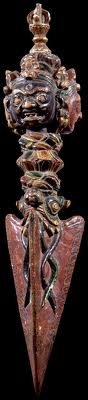
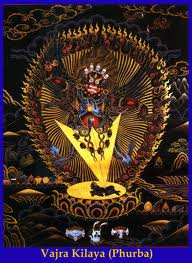
Those of you who  practice Vajrakilaya and have taken the time to purify your minds through the actual visualization of Vajrakilaya, will then become familiar, even if you do not recognize Vajrakilaya per se, which may happen, because in the bardo state one of the things that you’re fighting is the same thing you’re fighting when you’re sleepy in practice. To the degree that you are able to overcome sleepiness in practice and while you are receiving teachings, to that degree you will have clarity in the bardo. Doesn’t that scare you! To the degree that you have the dullness and the lethargy and the inability to stay awake during class and the inability to stay awake during practice, you have in the bardo a funny kind of…  Y know how it is when you’re either practicing or just waking up during the practice, when you try to remember what the visualization is and your mind kind of slides off of it? You know what I’m talking about? You sort of get the visualization and suddenly it’s almost like you fell off. It’s slippery almost, and you find yourself someplace else. Well, you’re kind of half in and out of the bardo of dreaming there, believe it or not; not too well in the bardo of concentration or meditation. You’re kind of half in the bardo of dreaming, and the mind has this slip-slidey kind of funniness, a jelly-like quality that sort of runs everywhere. Well it’s the same thing in the bardo. So you may look at Vajrakilaya and if your practice has not been that good you may not actually truly recognize Vajrakilaya and what that is. But you may be able to center on one small object, like, let’s say, the phurba that Vajrakilaya holds. That may key you and you just recognize the hand implement. All you have to do is take refuge in the hand implement. That is the first step, and it will lead to liberation in the bardo. Recognizing the meaning of the hand implement, thinking to yourself, “That is the very phurba that will pierce the ignorance of my mind. I see that, I want that.” The devotion comes up, like ‘that is the phurba that will pierce the veil.’ You look at that phurba and with the force of your own inner awareness that you still have in the bardo state, you will go toward that phurba. And that is liberation through recognition.

That is the kind of thing that happens with the blessing of generation stage practice, but, remember, you have to be prepared and forewarned for the movement, dynamism, the dramatic display of the wrathful deities. They are the force and activity of the Buddhas. What do you think that’s going to look like! That’s a big deal. That’s a big deal. That is equal to the force that it takes to liberate all sentient beings. It’s got to be more forceful then Hiroshima, any bomb that we have ever seen, the biggest bombs that we can imagine. It must be more forceful than that. Therefore, prepare yourself to recognize the blessing of the wrathful energy of the Buddhas.

Copyright © Jetsunma Ahkon Norbu Lhamo All rights reserved

The Appearance of the Wrathful Deities

Vajrakilaya

The following is an excerpt from a teaching by Jetsunma Ahkon Lhamo offered during a Phowa retreat:

So, you are training; you are preparing. You know what to expect. You know that you will go into a state that is unfamiliar to you, with senses that act differently than your senses act now, although they will be similar in some ways. You know that you will have many choices. You know you will see things that are uncomfortable for you and unfamiliar; you will see things that are more familiar. You are beginning to understand that there are things that you should look for and things you should go toward, but mostly, you have heard the most precious piece of information. You will hear it again and again and again. And that is that these things that you see in the bardo are not to be feared. They are displays and emanations of your own mind. No matter what they look like, no matter what you see, no matter how unfamiliar you are. From the very brightest lights to the very most confused and deluding negative lights…  The lights that emanate from the hell realm are things that are an expression of some particular aspect of your own nature—whether it is your nature in a state of defilement, or the samsaric elements of your nature, or whether it is your nature in this most pure form, which is your ultimate primordial Buddha nature. Everything that you see in the bardo will be you. There is nothing to run from; it is childish and stupid to run. You cannot run away from yourself; it will pursue you. As you will see in the bardo, there are cycles of coming back and trying to choose again, coming back and trying to choose again. You’ll see that as we move on. So let’s move on.

Now we have come to the part of the bardo where the peaceful Buddhas have finished appearing. In order for you to be continuing in the bardo now, this means that the peaceful Buddhas have appeared. You have seen your nature in all its different elements and displays;. You have seen the displays of the qualities of your nature, but you did not recognize them, and you did not follow them. Fortunately, you also saw the displays that are sort of vibrational showings or displays, and also ways to enter the different six realms of cyclic existence, and so far you have not entered those either, for whatever reason.

It is hard to say what the reasons are. It can be that habitually you are a person of extreme caution and are unwilling to do anything without a great deal of examining. Of course that won’t work, because if you have not been trained, you are examining bardo with the same, if not more, delusion than the delusion that you have in life, when you could not examine enough to be able to get yourself out of samsara anyway. So that kind of examination will not serve you. It is this training and devotion to one’s spiritual mentor that will save you. That is what actually works. But somehow you’ve managed not to go into rebirth at this time. You are still in the bardo. Now at this time, the wrathful deities appear.

When the wrathful deities appear, they do so singularly and they do so en masse. They appear to you in different ways—it’s a very dynamic kind of presentation. It is also with the peaceful Buddhas, but with the wrathful Buddhas it is even more so. The reason why is that the wrathful Buddhas—you’ve seen pictures of them, or the next time you go into the Prayer Room you should look at some of the wrathful Buddhas and you will see—they are downright spooky looking. And you ask yourself, “Whoa, what, are they like Guido and Raoul, the hit men from New York?” What is it? When the good guys can’t talk you into it, the bad guys beat you into it? You must wonder what the wrathful deities are. The wrathful deities actually are symbolic and are meant to display the aspect of enlightened compassion and method that is forceful, dominating, expanding, progressing, purifying. These are all very active words, aren’t they? They’re very dynamic and active words. There are, of course, displays and expressions of one’s Buddha nature that appear as absolute stillness and absolute emptiness, and very peaceful kind of display. Of course, that is the wisdom aspect of one’s own nature. But what is the method aspect of one’s own nature? If wisdom and method are non-dual and completely inseparable, as they are, looking at them from the purely awakened state, then it must also be, just as much, if stillness is your nature, then movement is your nature. They are the same and indistinguishable. If emptiness is your nature, then fullness is your nature, because in truth, in the awakened state, emptiness and fullness cannot be distinguished. They are not only inseparable, they are not distinguishable. It is only we that separate emptiness from fullness and peacefulness from aggression or activity.

So, as in the case of Vajrakilaya, which many of you here practice, Vajrakilaya is the very wrathful display of Vajrasattva. Vajrasattva. Who could be more peaceful than that deity who is meant to purify all of our samsaric afflictions, who has the capacity to purify all of our “sins,” all of our afflictions, all of our ego clingings, our hatred, our greed, and our ignorance? Who is more forgiving and more peaceful than that? And yet the wrathful display of Vajrasattva is Vajrakilaya. Does that mean that Vajrasattva has PMS and on a monthly basis emerges as Vajrakilaya in a real bad mood? Do you think that’s what it is? No, that’s not what it is; of course it’s not. It is the same nature. It is the same. Vajrakilaya is completely indistinguishable from Vajrasattva. They are the same in their function.  They are the same in their capacity.  They are the same in their enlightenment. But they are different in the display of method. That is all.

Copyright © Jetsunma Ahkon Norbu Lhamo All rights reserved
WP2Social Auto Publish Powered By : XYZScripts.com