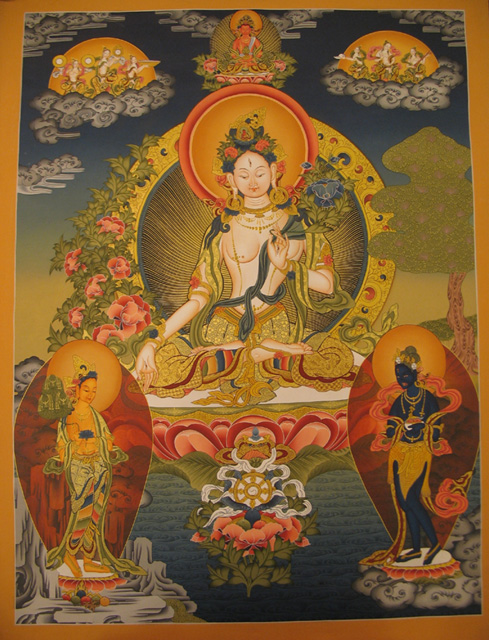
Spiritual Maturity

The following is an excerpt from a teaching by Jetsunma Ahkon Lhamo called “The Bodhisattva Ideal”

When we first enter onto the Bodhisattva path, we are thinking that maybe we are doing this because we’ve always wanted to be a good person.  We have all kinds of mixed motivations.  Maybe we never got enough approval when we grew up.  Maybe mama was always telling us that we were never going to amount to very much, or something like that.  Maybe dad was always telling us that we have to live our lives in a certain way in order to meet with his approval.  Maybe our society has taught us that if we don’t attain certain things we are a “n’er do well.”

For whatever reason, when we first meet with the Bodhisattva path, we think that we are going to make something good of ourselves.  We are going to approve of ourselves, finally.  We are going to be good people.  We fall in love with the romance of being saintly. But ultimately, the life of a Bodhisattva has not one thing to do with that, nothing to do with that.  The purpose, the intention, the planning of a Bodhisattva is not according to that.  The planning of the Bodhisattva is based on logic and reason. Since we have met with the ideal of the Bodhisattva, this is the time for the beginning students, or the student who has been a practitioner for some while, to really determine for oneself what the true meaning of the Bodhisattva ideal actually is—to see the reasonableness of it, to see the logic of it. To understand that to do anything else is to walk through one’s life as a child, mindlessly, just grabbing and playing and having “la la” land in your head.  The life of a spiritually mature Bodhisattva is a life of understanding, a life of clarity, a life of reasonableness, a life in which that spiritual participant thinks in full equations, which ordinary people simply do not do.

Now, having learned these virtuous patterns, these virtuous habits, these virtuous actions, and understanding that this is what results in happiness, and not grabbing in an egocentric way, the spiritually mature Bodhisattva begins to plan, and begins to understand also, that according to the Buddha’s teaching, all sentient beings are in that same condition of revolving hopelessly in samsara. Not understanding what the components of happiness are and what brings relief from suffering.  Not understanding as well, what intensifies suffering and makes it much worse.  Sentient beings literally are revolving in samsara helplessly, like bees flying around in a jar, not understanding how to get out, just bumping, bumping, bumping on all the sides.

Having looked at that, having looked at the suffering of the world, having seen that in places all over the world there is hunger, there is war.  There is disease, old age, sickness and death constantly claiming even those on the seen realms where there is less suffering than in many of the other realms. And, according to the Buddha, we are taught that in the unseen realms, all sentient beings are suffering horribly. They have no understanding really of what makes the cessation of suffering.  Having met with the path and understood all these things, and then understanding as well the Buddha’s teachings, then we make an intelligent choice. “I and all sentient beings have been wandering helplessly and hopelessly in samsara, not understanding the cause of my suffering, not understanding the cause of the suffering of other, not understanding the causes of happiness for myself and others. Now I have come to this place of choice, intelligence, clarity and responsibility.  Therefore, having seen the truth and understanding that there is an end to suffering, I will practice for the sake of sentient beings.”  This is the choice that the spiritually mature Bodhisattva brings—to practice temporarily by bringing happiness and relief to those that they can in any way possible.  And then to practice ultimate or extraordinary Bodhicitta, which is to bring the ultimate happiness, the ultimate joy of the revelation of the path to others so that they too might attain ultimate happiness.  The spiritually mature Bodhisattva chooses to give others the method by which they can end their suffering and gain happiness, the method of clarity that teaches that virtuous seeds bring virtuous and joyful results, and nonvirtuous seeds bring nonvirtuous and negative results.  Understanding that, I myself will be a guide and a light to benefit others through their confusion. The prayer of the Bodhisattva is that we would live and exist as a Bodhisattva long enough to be the one to watch the very last of them cross over through the doors of liberation into freedom.  That is my prayer and that should be the prayer of each and every one of us, that we would be the last and would be able to see every single sentient being cross the ocean of suffering into freedom.

Copyright © Jetsunma Ahkon Lhamo.  All rights reserved
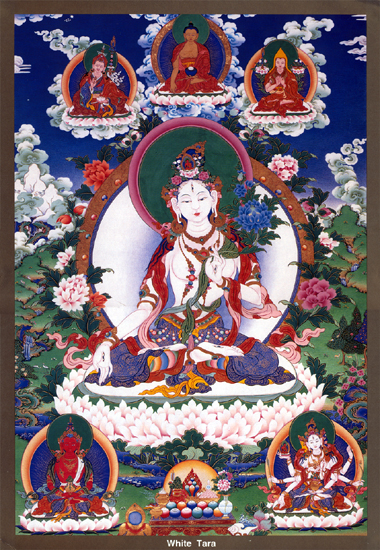
The Path is Love

The following is an excerpt from a teaching by Jetsunma Ahkon Lhamo called “The Bodhisattva Ideal”

Is the Bodhisattva unafraid?   Heck no!  The Bodhisattva is afraid just like anyone else.  Why not?  Nobody wants to be challenged.  Nobody wants to have difficulty or obstacles.  Nobody wants to suffer.  The Bodhisattva is not less afraid than anyone else. But what is fear in the face of the needs of the many?  What is fear, knowing that what I might collect out of my fearfulness will ultimately lead to my unhappiness and disappointment?

I’ve been practicing the Bodhisattva Path for some time.  I am afraid of everything.  Everything frightens me.  I’m a jellyfish by nature.  But I don’t stop, because it doesn’t make any sense to stop.  Does the Bodhisattva no longer want anything or need anything?  No!  I want and need everything!  Anything you want to give me would be much appreciated!  But I do not concern myself with gathering such things.  I concern myself with the liberation and salvation of all sentient beings.  That’s what I concern myself with.

I’m not a perfect Bodhisattva, but there have been perfect Bodhisattvas. And I can tell you that with the understanding that the Bodhisattva naturally obtains through this kind of conduct: There is a natural kind of internal ease or lightness of being, a kind of quiescence that is a natural byproduct of that lack of emphasis on self-concern and increased emphasis on the well-being of all sentient beings, and the reasonableness of accumulating only those virtuous characteristics which can benefit in all future times.  There is a reasonableness about that and, as we emphasize that reasonable method, and do not emphasize ego-cherishing and ego-clinging, there is a natural lightness of being that occurs that, even while if someone punches us we will be punched and we will roll over, it isn’t so heavy because, as a Bodhisattva, although you may experience phenomenal reality in the same way that others do, there is not the suffering of suffering, which only actually occurs when one is filled with desire, just like the Buddha taught—filled with self-cherishing and ego-clinging, filled with hatred, greed and ignorance. The deep neurosis of acting inappropriately according to what you actually are, the suffering of suffering, comes from that.  It comes from acting like something that is death-oriented, that is contracted, that is separate and limited as opposed to acting as though you understood that you are that primordial wisdom nature, that ground of being, that Buddha nature, that state of innate wakefulness, that quiescent light.  That is the great Bodhicitta that is your nature.

If we could act in accordance with that, that deep neurosis that is characteristic of samsara, that suffering of suffering, could not exist in such a life.  So then, for such a one who practices in that way, all efforts become a benefit to sentient beings, no matter what they appear like.  Ultimately they will result in benefit.  This is the life of the Bodhisattva and this is the practice of the Bodhisattva, and this is what each one of us must attain to because I will tell you, no matter how good you are at sitting in the lotus position or how good you are at looking like a meditator or how many of the rules of meditation you know or how many of the books on spiritual practice you have read and can memorize, if you do not have the Bodhicitta, if you are not alive in love, you have no path.  If you do not consider others before you, you have no path, because the path is love.

Copyright © Jetsunma Ahkon Lhamo.  All rights reserved

Disappointment

The following is an excerpt from a teaching by Jetsunma Ahkon Lhamo called “The Bodhisattva Ideal”

As children, we are only interested in taking care of ourselves.  We are only interested in getting what we want.  Well, we don’t actually understand taking care of ourselves, because really, if we understood taking care of ourselves, we would mature.  But as children, we just delight in everything and we want everything. It’s gimme this, gimme this, gimme this. I need this new piece of equipment. I need this new piece of clothing.  I need this new gizmo. I have to have this car. And I’m just gathering all of this, you see?  As spiritually mature people, we realize through experience (and it’s experience that teaches us), that after we’ve gathered a few of these things, we still aren’t happy.  We are still neurotic.  In fact, the more we gather to please ourselves without consideration for cause and effect relationships, or without considering whether or not this is of any true value within our lives, we find that we are disappointed and disappointed and disappointed. And it continues, and the level of disappointment never ends.  Every time we try to get something for ourselves that makes us feel better without any thoughts of cause and effect relationships… It’s just the oddest thing.  It’s like we have this little, I don’t know, kind of heartbreak, with this disappointment.  Every time we try to make ourselves happy and it doesn’t work, there’s this part of us, somewhere inside that sighs, “Wow, I really thought that was going to work!  How come that didn’t work?”  And we’re confused and lost.

But as spiritually mature people we begin to learn,, in the same way adults learn, that children’s toys aren’t much fun anymore.  And the spiritually mature people will begin to understand that what we have to do now is to live a life that has more meaning than that.  We have to live a life where we can plot out and plan and understand the results.

Copyright © Jetsunma Ahkon Lhamo.  All rights reserved

What Are You Gathering?

The following is an excerpt from a teaching by Jetsunma Ahkon Lhamo called “The Bodhisattva Ideal”

In the view of the Bodhisattva, we realize that everything in life is impermanent, that nothing we can gather has any meaning other than the collection of virtuous habitual tendencies within our mindstream. Having realized that, one travels a moderate path in which one’s own enlightenment and the enlightenment of others become the same weight, and nondual.

Further, we come to understand that we are one and others are many. Even in this room, let’s say, if I am practicing as a Bodhisattva, I think that yes, my happiness is equal to the happiness of any one of you. But there are so many more of you than there are of me that it only makes sense for me to do what is beneficial for you rather than what is beneficial for me.  This I try my best to live by. As a Bodhisattva, I consider this to be the most precious understanding that I have.  It’s my treasure and my wealth. It’s reasonable and logical that the needs of the many would outweigh the needs of the one.   Because we are the same, and because we all wish to be happy, and because in our nature we are absolutely inseparable and indistinguishable from one another, I find that I cannot be happy without you. So all of the different gatherings and collections that one can make during the course of one’s lifetime have to be understood in that way.  Are they really worth anything?  Or are they the gaudy childlike baubles that we play with until we have a better understanding of what the Buddha has taught.

Copyright © Jetsunma Ahkon Lhamo.  All rights reserved
Non-dual: The Middle Way

The following is an excerpt from a teaching by Jetsunma Ahkon Lhamo called “The Bodhisattva Ideal”

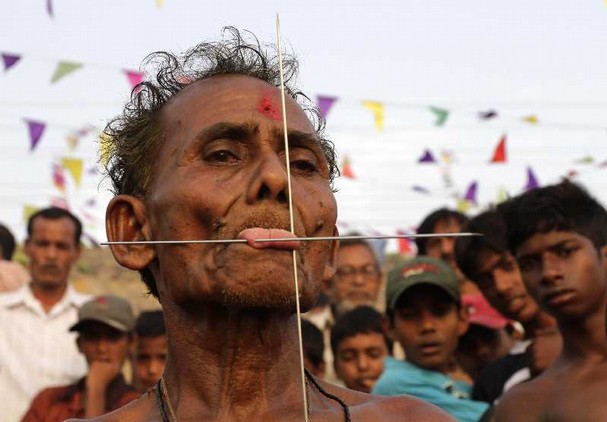
So the Bodhisattva thinks and meditates constantly on which things are worth putting effort into, and which things are not.  Now the Buddha also taught about the Middle Way.  When the Buddha realized the suffering of sentient beings, he tried at first the life of the ascetic. And he even tried to sit with those who engaged in the kind of meditation that was based on self-mutilation, a kind of meditation that was very strict and very severe.  He meditated with yogis who would mutilate their bodies in order to overcome pain and renounce the attraction of comfort.  So the Buddha tried that. These yogis did not eat or sleep comfortably.  They meditated constantly.  They remained in this one little grove and they ate very little.  They might live on bits of plants and even bits of mushroom that grow in the ground. If someone gave them something to eat, they might eat on that, but they had no determination about wanting a certain kind of food.  Whatever they found that day, that’s what they ate.  There was no dependence on comfort for their happiness and well-being.  So Lord Buddha practiced with them for a while and eventually he gave up on that method.

He gave up on that method because he saw that there is a kind of limitation to that focus, that that particular focus was sort of a dead-end street.  It can result even in a kind of poison, or a kind of pridefulness, where the yogi is more concerned with their strict discipline than they are with the liberation and salvation of all sentient beings. It becomes something of an obsession, you know. It becomes something of a medal of honor that one wears. So Lord Buddha found that kind of rigidity, that kind of narrow view, somewhat distasteful. And so Lord Buddha went on to the Middle Way.

Therefore, as a Bodhisattva we are not being asked to never have a moment of comfort.  No one is asking you to pierce your tongue or do any of those things those funny yogis did.  No one is asking you to sit on a bed of nails and sleep on a bed of nails.  No one is asking you to hang out in a grove and not have a house, not keep warm in the wintertime.  No one is saying that you have to wear the same robes until they rot off your body.  Lord Buddha does not teach that as a method.  Lord Buddha teaches instead that all sentient beings are suffering, that we are suffering due to desire, that there is an end to suffering, and that end to suffering can be practiced as the eightfold path which we, in our tradition, condense into the practice of wisdom, or the realization of emptiness, and compassion, or the Bodhicitta.  These are the two legs of the path, and this is the moderate Middle Way that Lord Buddha taught.

So as a Bodhisattva you are not being asked to never be happy.  One’s own happiness, both temporary and ultimate, and the happiness of others, becomes instead inseparable, nondual.  One would not honor oneself and cling to ego because that would be a nonsensical thing to do.  There is no good result from that.  The Bodhisattva realizes that.  The Bodhisattva, however, would not make oneself suffer purposely, or hurt oneself in some way, because there is really no point to that.  The point of practicing the path is the liberation and salvation of all sentient beings, and you are one of them.

Copyright © Jetsunma Ahkon Lhamo.  All rights reserved

The Bodhisattva’s Logic

The following is an excerpt from a teaching by Jetsunma Ahkon Lhamo called “The Bodhisattva Ideal”

The posture of a Bodhisattva is misunderstood in our culture.  When a parent raises a child, the parent does not say to the child, “What I’d really like you to do, darling, is to be a great, generous mystic.  I want you to be so generous that you give your life up for others.  I want you to be so generous that you pay no attention to your own welfare or comfort, but instead I would like you to live and die for the benefit of sentient beings.”  Nobody’s mother told them that!  Due to the culture that we are raised in, we are told by our parents, their parents before them, and everything around us that there are certain things that one must do in order to be successful.  One must gain recognition, power, money, ease of living.  These are the things that one must do. But when one enters onto the path and becomes a Bodhisattva, one is faced with an entirely new set of ethics and morals and responsibilities.

This entire process must be understood as an intelligent, logical and reasonable process, simply by virtue of the fact that no matter what we accomplish during the course of this lifetime, other than the impact it has on our own bouquet of habitual tendencies, there is not one piece of what we collect that we can take with us, not one thing.  So here is the Bodhisattva’s intelligence. And it is an intelligence.  It is based on truth.  It is based on fact.  It is something like the intelligence of a person who receives a great deal of money, let’s say, or something precious and, if they’ve never had that before, if they haven’t thought it through, they might say, “Oh now I’ve got, let’s see, I’ve got $10,000 here so I’m going to go out and I’m going to spend that money and have a really good time.  I’ve never had $10,000 before, so I’m just going to go spend it, and I’m going to get all the things that I wanted to get.  Get some of my bills paid up, and I’m going to get a, let’s see, a down payment on a car, and I’ve got some clothes that I have in mind and all these different things. Maybe I’m going to buy a new TV. I’ve got all this laid out.”  A sentient being’s normal reaction to having blessings in their life, or to life itself, is a little bit like that.  I’ve got this thing.  How am I going to spend it?

The Bodhisattva thinks very differently.  The Bodhisattva realizes that, according to the Buddha’s teaching, life is like a precious jewel.  When one meets with Dharma, meets with the teacher, and meets with the method by which we can accomplish realization, this life is understood as wealth for sure.  We understand that there is a tremendous gift here.  But how is the gift utilized?  There comes in a completely different kind of logic.

The Bodhisattva realizes that, in the end, all will come to nothing.  If our only gain is on the material realm, in the end all of the effort that we put into self-cherishing and beautifying ourselves, and the ease and comfort of our lives, and the accomplishments on the mental and physical levels of our lives, even those greatly cherished social institutions like vast education,  even that will come to nothing, other than perhaps the discipline of studying.  That habit may be brought into the next rebirth. .But everything that we have learned to love and cherish will come to nothing.

And so the Bodhisattva thinks, therefore, if in samsara, all efforts come to nothing, if all that survives is one’s virtue or lack of virtue, if all that matters in samsara eventually breaks down, then why should I put much effort into these things?  Why should these things be precious to me? Because ultimately they will be lost, they will come to nothing.

The Bodhisattva then thinks more like a smart investor.  You want to invest in that which brings ultimate returns:  kindness, generosity, spiritual habits, habits associated towards travelling on the path of Dharma and developing oneself spiritually.  Making offerings, living with generosity, meditating, praying, contemplating, teaching—these virtuous acts are the things that will bring a result that one can carry over into the next life.  So the Bodhisattva is not so much a martyr as someone who has been trained through logic and reason to understand not to put all of one’s emphasis and hope in that which will ultimately disappoint.  The Bodhisattva has been trained well enough to know that ultimately all things in samsara are disappointing.  And so the Bodhisattva then makes the choice, based on training, to put one’s emphasis and one’s effort only in those things which will produce the excellent result of enlightenment and benefit to others.  This is how the Bodhisattva thinks.

Copyright © Jetsunma Ahkon Lhamo.  All rights reserved

Dissolving Constituents: Understanding Death

The following is an excerpt from a teaching by Jetsunma Ahkon Lhamo called “The Bodhisattva Ideal”

The Bodhisattva understands that everything we amass during the time of our lives—everything we strengthen around us, all of the protection we build, the superstructuring that we do when we meet up with other than self-nature and react with hope and fear and begin to do the dance of self-protection and of self-establishment—the entire structure of self and its relationship to other, the entire idea, the Bodhisattva knows that eventually this will come to nothing.  This is an intellectual response due to the Bodhisattva’s training, not a feeling response.  The Bodhisattva is trained to understand that no matter what we accumulate and gather together during the course of our lives, by the time of the end of our life, none of that will have any meaning.  At the end of our lives we experience the winding down of all of our energies. And as we die, even the physical, psychological, emotional constituents, particularly the physical elements, one by one, all begin to dissolve.

The fire element within our body begins to dissolve. The body cools.  The water element within the body begins to dissolve and break down.  The body becomes drier as we approach death.  The mouth, the mucous tissues within the body become drier and drier.  The earth elements within the body all dissolve.  The body itself begins to break down and even the wind element within the body begins to dissolve.  Mental process begins to slow and one’s activity level also begins to slow at the end of one’s life.

Then at the time of death, all of the constituents actually break down and separate.  As the consciousness abandons the body and the body becomes simply a heap of broken-down constituents, what remains is the consciousness, which has its habitual tendency fully established. It is not able to take with it any of the real or material objects that it has gathered in its drama during the course of its life. And so all that remains is the consciousness, that, like a basket, held these material things, these solid, impermanent realities associated with that particular life.

The consciousness, however, remains. And if the consciousness spent most of its lifetime in establishing material wealth or gathering substance to support the ego, then at the time of death the consciousness has only that habit of supporting the ego to take with it, only that habit.  On the other hand, if a life of generosity and caring have taken place, then that habit moves as consciousness into the next rebirth.  Now the Bodhisattva knows this and so the Bodhisattva’s prayer is not based on a feel-good emotion of “Gee I’d like to be a really cool person, be so kind and so neat, and so terrific that everybody loves me and calls me saint somebody.”  That’s not what the Bodhisattva thinks.

The Bodhisattva thinks instead in a very logical and precise way, according to the Buddha’s teaching: Everything will dissolve. All the efforts of my life together will come to nothing. All the efforts of my life to build up my treasure-house of material goods and keep them for myself will ultimately come to nothing.  All of my efforts to preserve my power will ultimately come to nothing because power dissolves at the time of death also, but the habit of grasping at power is reborn as consciousness.  So if gathering power will come to nothing, if gathering wealth will come to nothing, if preserving myself in this extraordinary way, thinking only in a self-cherishing and egocentric way, will ultimately come to nothing other than suffering in the next rebirth, why not give everything now?

Copyright © Jetsunma Ahkon Lhamo.  All rights reserved

The Futility of Habits

The following is an excerpt from a teaching by Jetsunma Ahkon Lhamo called “The Bodhisattva Ideal”

If you create the habit of compassion and generosity, then that habitual tendency will stay with you, and in some future life it will affect your rebirth and your circumstances.  There will be much more joy and happiness.  When one engages truly on the Bodhisattva’s path, one goes beyond that superficial kind of view.  One goes much deeper into the understanding of how to live one’s life. And so one’s morals and ethics and values are developed because of this Bodhisattva ideal.  The Bodhisattva understands these teachings that the Buddha has taught— that all things are impermanent.  The Bodhisattva understands that whatever material gain we can amass during the course of this life can only bring temporary happiness and, ultimately, if that’s all we do, it will bring suffering.  So this is what the Bodhisattva studies and the Bodhisattva comes to the point of realizing that.

Then there is another kind of amazing logic that enters into the mind of the Bodhisattva. It becomes part of our life experience, and becomes the most profound law that we can live by.  And that is this:  Think about this body of ours, this body that we cherish and hold onto. We decorate it, we love it, we keep it safe. We make sure that it’s happy.  We revolve much of our time and our effort around this body and its upkeep.  And then we think about this ego, this ego that is our mind and our consciousness and our awareness of self. But even beyond that, the extended effort to maintain ego is part of the egocentric structure that we call “me.”  We have developed our own habits and patterns over time in order to avoid the chaos of the idea that what we are as egocentric beings might change in any way, shape, manner or form.  We put amazing effort into perpetuating ourselves and our needs, into reacting with either hope or fear towards every other thing, so that we can determine whether we want it or whether we want to move away from it.  That kind of self-cherishing requires us to think of our own well-being and to look at other sentient beings as objects from which we can get what we need, like love, approval, romance, money, power, anything.

The Bodhisattva realizes these kinds of ideas and habits are futile. And this is the reason why:  During the course of our lives we spend much of our time amassing, structuring, creating support for ourselves, for our ego, because we fear annihilation. Once you have the belief in self-nature as being inherently real, that self has to be supported and continued, because the idea is that if self-nature were to dismantle or not be the same, that somehow chaos would result.  We have no knowledge of our true nature as being the primordial Buddha ground of being, no knowledge of that primordial wisdom nature that is our true nature.  We rely on this idea that self-nature must be perpetuated.

Copyright © Jetsunma Ahkon Lhamo.  All rights reserved
How To Wake Up

brain

The following is an excerpt from a teaching by Jetsunma Ahkon Lhamo given on Saga Dawa 2016

The great Bodhicitta permeates everything. It is our true nature. It is up to us to activate it in the same way in order to wake up the deities inside.

How do you do that? You practice the Bodhicitta. It doesn’t come naturally to most people. You have to practice it. A very new student that I had once came up to me and said, “I don’t have any Bodhicitta,” and I said, “Well, make some.” Practice. You have to practice. You have to understand that you are the same nature as the person that you may have bad feelings about. We are not different. We are intimately connected and we are actually in the same place. You appear to be over there when, in fact, you are in here. I appear to be up here when I am in your heart, too. There’s no reason for us to act as we do and make the world worse. There’s no reason for that because we are the same. The great Bodhicitta that emanated from seemingly nothing is empty, and yet it is the nature of everything. It is your seed nature. The Buddha seed that is within you is Bodhicitta. There’s no reason why any of you cannot accomplish the Dharma. You are the Dharma. We are all Dharma inside. We only have to wake it up. There’s nothing we can do to make Dharma appear where it is not. It has to be where it is, and it is within our minds and our hearts. The Bodhicitta first emerged, and then everything came from that. Everything. I’m seeing all the different forms in the world, and when I see them I know that they are not separate from me. They are not separate from you.

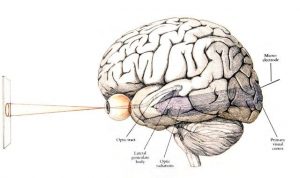
We have to learn that it’s different than what we see because the five senses are liars. They will deceive you. They tell us what our consciousness believes to be true, and our consciousness is born in samsara. The tools that we use to tell us definitely that this is five feet long, definitely this is that high, definitely this is definitely that, are lying to us. You can’t believe them. You have to believe what you see in your deepest nature and that’s comes through practice. It’s the only way you can see it. Sometimes I look at peoples’ bodies and I can see if they are sick or not, and where they are sick. I did that yesterday and I was 100% correct. I’m not bragging. It’s not like that. It’s that we all have this kind of vision if we practice. We all do. The root of it is Bodhicitta. That view, that understanding, is Bodhicitta. We have to doubt the tools that we use to learn things because they come from samsaric minds. The only things you can’t doubt are the Buddhas and Bodhisattvas. Their wisdom is what it is. Yes, they may have five senses too, but their five senses have been tamed and awakened. The Buddhas and Bodhisattvas see differently. We could do that too, but it takes a lot of contemplation and practice. You have to doubt your own eyes. If you could see with pure view, you would see dimensions sliding across and around each other. You could see how they are related to each other. You can see one person disappearing here and then reappearing in another dimension. Once the senses are purified, you can see that, but with ordinary senses we don’t really see, we just make up things. We have to tame our senses and bring them in harmony with Dharma so that they can awaken.

Contemplation is good. Don’t believe in what you see automatically, but look deeper. You can’t be so shallow in your practice. You have to understand it’s not what you’re seeing. I hope this makes some sense. Whatever deity you practice, he or she lives within you—every deity that you practice—and you live within him or her. This is why we practice the deities. To wake up.

Copyright © Jetsunma Ahkon Lhamo.  All rights reserved
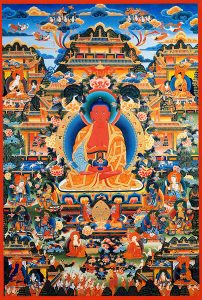
Awakening the Deities Within

Amitabha's Pureland

The following is an excerpt from a teaching by Jetsunma Ahkon Lhamo given on Saga Dawa 2016:

Would we ever be able to get to another galaxy? I don’t think so. Because we think the galaxy is far away and it’s not. It’s not. As long as we think it’s far away, we’ll never get there. If we look at a star and we think, ‘Oh, that’s a star over there’, we don’t understand that not only is the star within us, but we are within the star. There is nothing separate. Nothing. It’s very difficult to understand. When we try to understand it, we try to understand it with our ordinary minds, and we can’t. No matter how hard we try.

The ticket is we have to wake up in our practice and, in doing that, wake up the deities within. When that occurs, we’ll understand that we are not separate and that the different dimensions not only connect with each other, but they are within each other. That’s why sometimes I can see things from other dimensions, because they aren’t somewhere else. They are layered together. These dimensions are not only connecting, they are in the same place. Nothing is separate from you. It’s hard to learn that and hold that in our minds in a strong way. Instead we are not kind to each other. We think negatively, and things like that. In fact, we are the same nature. We are the same nature. Out of the corner of my eye, I see a car. Out of the corner of my other eye, I see the corner of a building. Then I don’t see it anymore. I’m not schizophrenic. This is just the way I see. I know that these are different dimensions, but they are in the same place. You can’t even say in the same place because that indicates that everything is solid, and it’s not.

Copyright © Jetsunma Ahkon Lhamo.  All rights reserved

WP2Social Auto Publish Powered By : XYZScripts.com