True Virtue: A Twitter Teaching by Jetsunma Ahkon Lhamo

ordained-M

The following is from a series of tweets by Jetsunma Ahkon Lhamo on twitter:

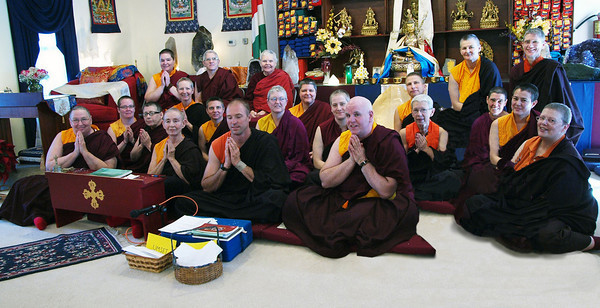
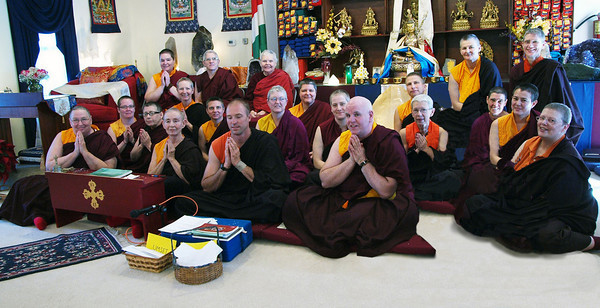
What I look for in a monk or nun is renunciation, faith, kindness, willingness to help, deep and sincere love of the Three Precious Jewels. What I don’t like in a monk or nun is wearing robes for the sake of status, or to dominate others, to make yourself seem important.

If vows are broken there are ways to restore most of them but you must actually perform them according to your Teacher’s instruction. The need to boss people around is a very bad reason to take or restore robes. And not to brag that you are a good practitioner, that is bad. As an ordained Buddhist you must not use your robes to make money or to put yourself up as “the boss.” Monks and nuns must be humble and help.

Copyright © Jetsunma Ahkon Norbu Lhamo All rights reserved

The First Jetsunma Ahkön Lhamo

Jetsunma Ahkham Lhamo was an emanation in human form of Arya Tara, the holy mother of all the Buddhas. She was born in the province of Do Kham, in Ah Chog Drolhey village in the Bubor Mountains of the Palyul region of Tibet. This place has all ten positive auspicious signs present. Her father, Dorje, came from the highly revered family heritage of Mutshaga, and her mother was a wisdom Dakini named Gurutso. She was born around the later part of the eleventh Rabjung (according to the Tibetan Calendar), which corresponds to the later half of the seventeenth Century A.D. She was the youngest sister of Rigzin Kunzang Sherab.

She started her education with reading and writing at an early age, and she learned without much effort. Together with Rigzin Kunzang Sherab, she received many teachings from Terton Migyur Dorje and Khedrup Karma Chagmed, who was the emanation of (Lotsawa) Chogro Lhuyi Gyaltsen, as well as teachings from many other scholars and accomplished masters. With them, she perfected her study and practice of both Sutras and Tantras beyond any doubt.  She entered with perseverance into single-pointed practice at various undisclosed places, and many meditational deities appeared to her and gave instructions to her. Through her practice she purified all illusory phenomena into primordial non-conceptual pure awareness, and became a ruler of the realm of Kuntuzangpo.

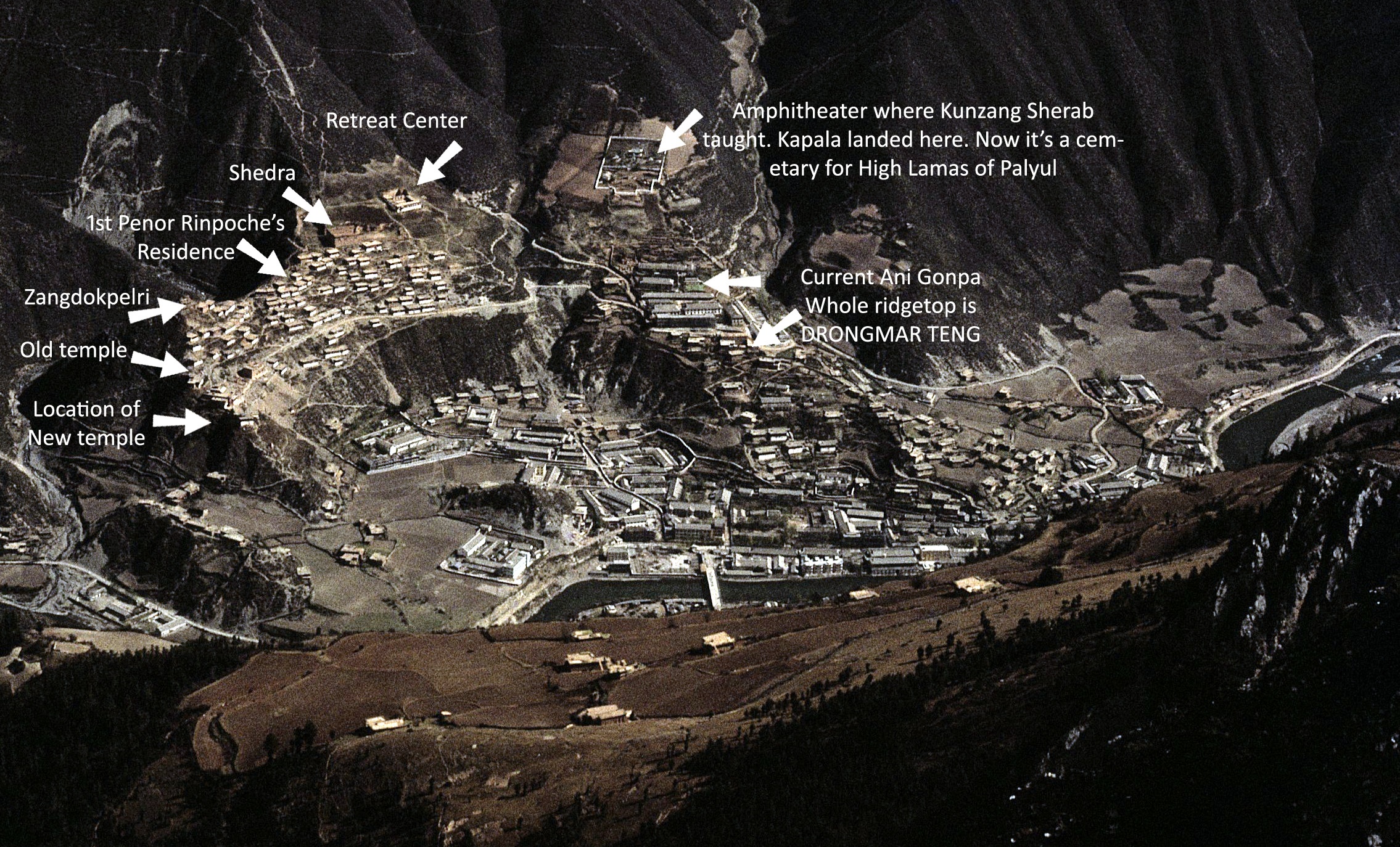
She lived on the mountain ridge towards the east of Palyul Namgyal Changchub Chöling (Palyul Monastery) and unceasingly turned the wheel of Dharma to a large community of Ani disciples, gradually turning that place into an expansive Ani Gonpa. Thus the location was called JOGONGDONG (nunnery on the ridge) and because of the huge numbers of nuns with red robes, that whole area has been called DRONGMAR TENG (red knoll village) ever since that time. In short, through turning both wheels of Dharma – both teaching and practicing – Jetsunma trained numerous students, not only as Buddhist scholars but many of them became highly realized practitioners.

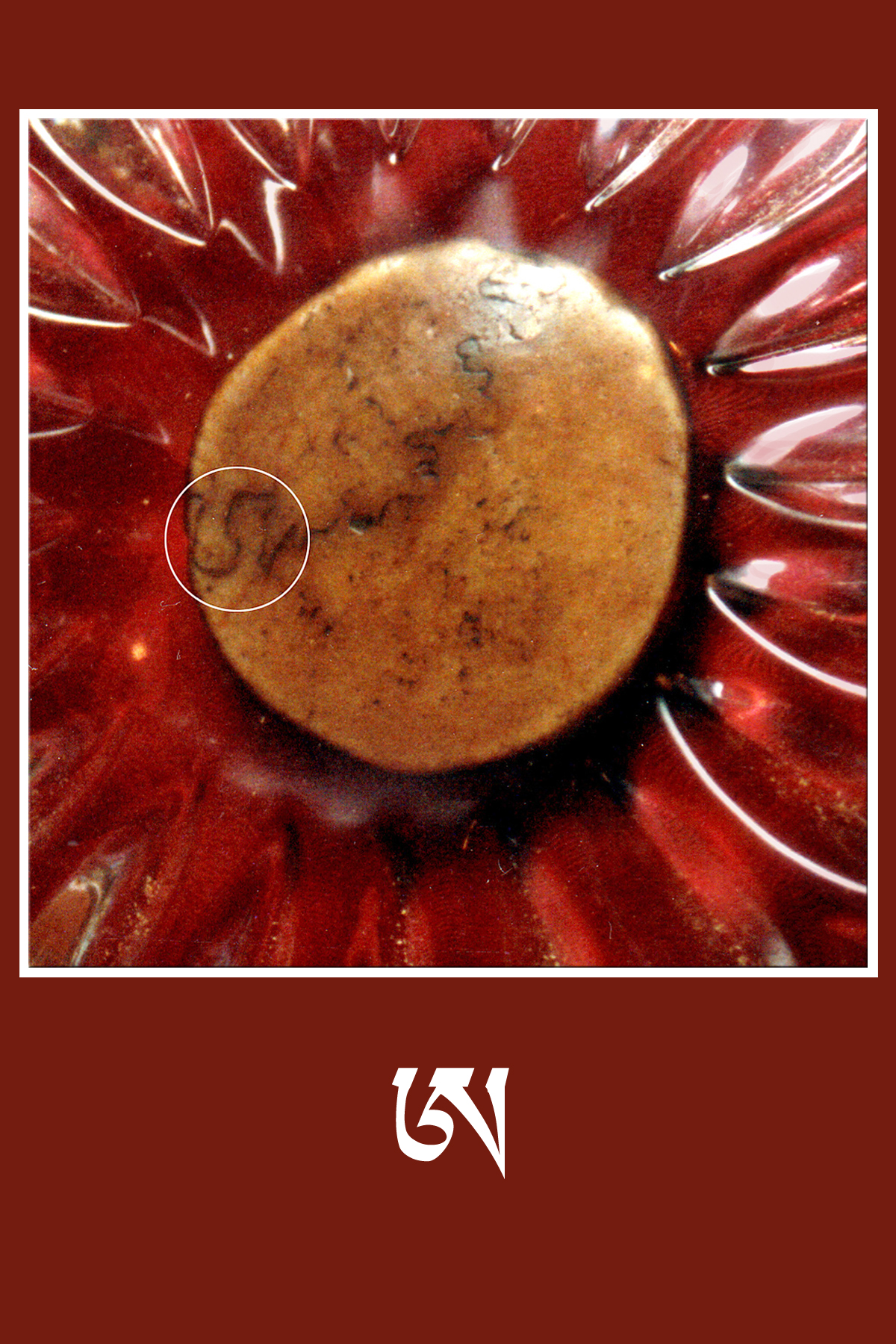
The “AH” on the skull relic

When she saw that her activities to benefit the doctrine and her students had reached the limits of this lifetime, she passed into the peaceful Dharmata. While her holy body was being cremated, her skull flew over and landed on top of the throne of Rigzin Kunzang Sherab in the place where he used to give Dharma teachings. Since that time, that place has been used as a sacred cemetery and to this day, all the revered Lamas of Palyul Monastery have been cremated there.

Additionally, her skull has been used as THOEYAB during all major accomplishment ceremonies in Palyul Monastery to invoke the blessings even up to the present day. I heard there is an awakened reincarnation of her who has been born in America.

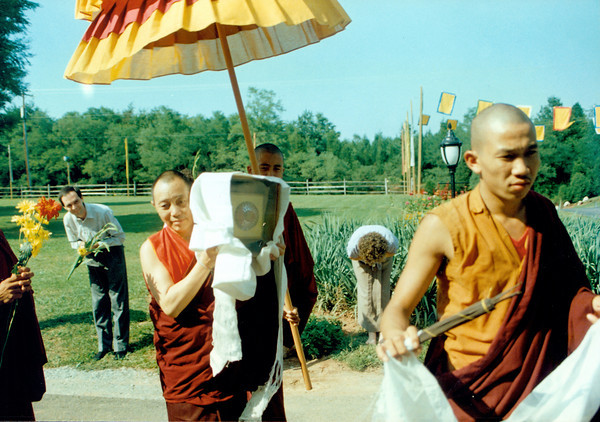
Ven. Gyaltrul Rinpoche carries the Kapala


Excerpted from Palyul Namgyal Changchub Chöling Ge Denrap, a history of the Palyul Lineage, written by Mupo, a contemporary Tibetan scholar and historian. Originally published in China, May 19, 2002, Seventeenth Rabjung Iron Horse Year. Reprinted in Taiwan. [Ed note: The first Jetsunma Ahkön Lhamo has sometimes been referred to as Genyenma Ahkön Lhamo]


Ahkön Norbu Lhamo

The following is respectfully quoted from “Reborn in the West” by Vicki Mackenzie:

After Penor Rinpoche had left, the group dwelt on all that had happened and what he had said. Dutifully they began looking for a property, and sure enough, they found a beautiful place which would suit their purposes perfectly. It had white pillars all along the front. But the price was astronomical. Scraping together whatever money they could, and taking out a huge mortgage (which now necessitates many ingenious fund-raising schemes), they bought what is now KPC and established what over five years later has become the largest ordained Tibetan Buddhist community in the USA. Every Sunday over 120 people came here from the surrounding area to hear Jetsunma’s teachings.

At this stage Jetsunma still didn’t know precisely who she was. That was still to come.

A year after Penor Rinpoche’s visit Jetsunma felt the urge to see again the small, round man who had come into her life and touched her so deeply. She decided to go to India, to his monastery in Bylakuppe in Karnataka state. For the girl from Brooklyn who had never set foot outside the USA, landing in Bombay with its chaos, colour and poverty was merely a prelude for the greater revelation that was to follow.

Facing Penor Rinpoche on his own territory, she said she wanted to take the bodhisattva vows. This is the ceremony in which you formally promise to dedicate your life to the well-being of others. She asked if he would give her a spiritual name, as was the custom at such an occasion.

‘When the time is right,’ replied Penor Rinpoche.

‘When will the time be right?’ pushed Jetsunma, with typical Western impatience.

‘I’ll give it to you when the right day comes,’ continued Penor Rinpoche.

‘When is the right day going to come?’ persisted Jetsunma, not giving up.

‘When I say so,’ retorted Penor Rinpoche firmly.

Jetsunma gave up.

One day, when the moon was in a particular place in the heavens, Penor Rinpoche called her to him and announced: ‘Now I am ready to give you your name.’

He then wrote out her spiritual name on a piece of paper, rolled it up into a scroll, put his personal seal on it, then handed it to her with the white katag (scarf) of respect wrapped around it. ‘That’s your name–Ahkön Norbu Lhamo,’ he said.

There was no apocalyptic vision, not instant flashback to another time, another place, another body. There wasn’t even shock or surprise. Just a sense of intense familiarity.

‘I experienced serious dejà vu,’ was how Jetsunma recalls the occasion. ‘I felt a strong connection to that name. I asked him to say it again. It was like milk to my ears.’

Through his translator he then uttered the monumental words: ‘I now recognize you as the sister of Kunzang Sherab. Her name was Ahkön Lhamo. In that life she and Kunzang Sherab co-founded the Palyul tradition. I recognize you as her incarnation.’

And in those few simple sentences Penor Rinpoche made sense of the extraordinary life that Jetsunma had teched out for herself and the otherwise inexplicable abilities she possessed. This, at last, was the official explanation of how a woman with no Buddhist training whatsoever, no books on Tibetan Buddhism, no teacher, no outward example to follow, had been driven to enter years of strict meditation by herself and to emerge with not only profound wisdom but also the wish and the ability to help others fulfill their spiritual potential.

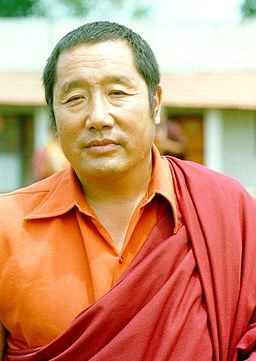
Peerless Guru: His Holiness Penor Rinpoche

PenorRinpoche

The following is an excerpt from a teaching by Jetsunma Ahkon Lhamo called “Love Now, Dzogchen Later”

At the same time I first got to know His Holiness and we began to actually have conversations,  I was talking a great deal to Gyaltrul Rinpoche, because I met him soon after that visit. But I remember first learning about Dzogchen, not from my teachers, but from other students, which was kind of horrible. I kept hearing the term. I questioned; I tried to find out what it was. I tried to read some books. I asked my teachers, and His Holiness particularly said, “Soon I’ll give you plenty of explanation so you will understand.” And I questioned. Actually I didn’t question His Holiness, but I questioned Gyaltrul Rinpoche, “ Why is it then that some people are talking about Dzogchen, but His Holiness seems to be holding back on Dzogchen.” And at that time Gyaltrul Rinpoche told me, “Well, you should ask him directly; but from the conversations I’ve had with him, Americans are not ready for Dzogchen. He says that they are, you know, too prideful, too arrogant. They don’t really understand the benefit. It would be like throwing something precious on the ground where it can’t be used, for instance, like a seed. You would want to throw it into fertile ground or put it into fertile ground. You wouldn’t want to put it on, you know, a highway where it’s never going to sprout.”

So that was the explanation I got, and I was satisfied with that. But then later on I kept seeing that more and more, particularly in Dudjom Rinpoche’s lineage, they were always talking about Dzogchen this and Dzogchen that. And if you didn’t know Dzogchen, they thought you were a little silly. You know, they didn’t think you were quite there. So I persisted in trying to find out. And His Holiness reiterated again and again,   “You have to get the preliminaries. You have to build a foundation. Americans are not ready.” For quite a number of years, even though His Holiness returned here many times, he did not want to give out Dzogchen. And it was like that until he set up the summer program in New York where you could go Shedra style—step by step, stage by stage, from one level to the other. When he did that, he kind of reversed his direction in a sense, because he was real hesitant to give Dzogchen and really held back for a long time. And then suddenly he was offering it; and I remember thinking, ‘Well, students will have to go stage by stage no matter what.’ You know, they’ll have to do like in India where if a student wants to go to level 3, he has to graduate from level 2. That sort of thing.

And then I heard that His Holiness had totally opened it up where he left it to the student in conference with the teacher there to decide what practice, to say what practice they had accomplished and what they had done. And if you receive Year 2 the year before, you could always go on to Year 3 unless you were having terrible obstacles. You could always go on to Year 3, and then the next. It’s kind of like the “No child left behind.” No Dharma student left behind here. I remember at that time being completely blown away by that. I was so completely blown away because it was such a reversal for him, such a change.  And I tried to seek the reason for that. His Holiness had switched his tone so thoroughly. He was saying, “Not much time left.”  And, of course, that scared me. I thought he meant for him. “No, it’s not like that,” he said. “No, not much time left for sentient beings.”

And so, that was his decision. He is peerless. There is no lama like him. There is no lama that can top him in any way. He is extraordinary. He is a living Buddha. I mean he is extremely orthodox and yet extremely flexible, an unbelievable combination,  because with orthodoxy comes dogma and rigidity. He is fully qualified and fully able to be the head of his lineage and to steer the course of this great ship, the Buddhadharma. Yet, he is completely flexible.

Copyright © Jetsunma Ahkon Norbu Lhamo All rights reserved

Understanding Duality

Fly

The following is an excerpt from a teaching by Jetsunma Ahkon Lhamo called “Art of Dispelling Anger”

So what happens in the awakening? Well, we’ve worked with our poisons sufficiently. We have some inner knowledge and honesty. We’ve worked some method and now we’re accomplishing view. That’s where we really start to get cooking is where we practice the view. The view is—I love this part—every woman you see is a goddess and I’m the queen. We see that all beings are Buddha. We see that the females, whether they look like goddesses or act like goddesses, are goddesses in their nature. They are Tara. They are, as are you, the primordial pristine state. We look at men, and rather than list their faults, which most of us do, we look at them and think, ‘This is Buddha. When you think of your husband, your child, your friend, your enemy and even President Bush, you think, ‘Yeah, this is Buddha, in his nature.’ And when we look around and we see that the appearance in relative view doesn’t look like Buddha, we shouldn’t take that as proof that the teaching is wrong and that we have a good excuse to hate.  We should take that as a reasonable display of the fact that we are lost in samsara. Here we are in our nature, the very Lord Buddha. When we awaken, we are Buddha. And yet we are in prisons; we are in hell realms; we are in abusive situations; we are hungry; we are angry; we are at war; we suffer. And yet we are the very Buddha we aspire to follow.

In Buddhism we are taught there are the ground, the path, and the fruit. All three must be present in order for liberation to be possible. And this is one way in which we understand our natures. The ground is the basis of accomplishment. If you did not arise as phenomena from the fundamental primordial self-luminous view, if you did not arise from that, if you were not the very bodhicitta in its display form, if the Buddha seed did not rest within you, if it were not so that each and every cell of your body is replete with the entire mandala of peaceful and wrathful deities, if that were not true, there would be no basis for accomplishment. But in our nature, we are Buddha. That is the basis.

And then there is the path. The path is as important as the basis, because while we have the Buddha seed, we may not have method or a way in which to awaken to that or to bring it forth. A fly is Buddha. He also arises in the display of duality in the samsaric world; and yet his nature is Buddha. His nature is the very same, no different. We each of us stand in the presence of our root teacher, whether it’s in our private practice or whether it’s here at the temple, and we could be a fly. But the difference between you and the fly is the fly has no method. The fly cannot practice method. The thing he is doing is not prostrations. He’s wiping his thighs or something. So we have to apply method. That’s what the Buddha’s teaching is all about. It’s all about different methods at different stages for different people.

Copyright © Jetsunma Ahkon Norbu Lhamo All rights reserved

Holding Back the Darkness

ordained-M

The following is an excerpt from a teaching by Jetsunma Ahkon Lhamo called “Reclaiming Our Merit”

This is a really difficult time, not only for the Sangha, but it’s really a direct reflection of what we’re seeing on our planet right now. There is corruption in business and government like I’ve never seen before. Many of us have become professional samaya breakers, meaning that we have not kept our commitments and, in many cases, have dropped our robes, or whatever. And because we are lost in samsara, we simply don’t understand cause and effect. Not only are they connected, but they arise interdependently. Time and space is our delusion. Cause and effect arise at the same instant.

So exacting is cause and effect. Yet we have not really milked the essence out of that understanding so that we can create better lives for ourselves, or practice for ourselves and make a deeper commitment for ourselves. We simply have not utilized what we have received. And here in this time, you don’t know where to look, left or right. What is pure, what is sacred, what is wholesome? All of it seems to be confused and dark; and right now our hearts are heavy. We were so innocent when we were younger, and some of you that are still young are still innocent, so innocent thinking that can never happen to us. So learn.

In this time of debilitating darkness and confusion, we have to strengthen ourselves. I’ve had students propose the question to me: What is the benefit of the robes?  I look around at you and I say to myself, ‘Aren’t you terrified to be without them?’  Well you should be, because these robes now are like a shield of virtue. You are what we have. The power of the Buddha’s blessing is such and the robes are so potent that a quorum is considered four ordained monks and nuns with yellow robes. That quorum has the power and the stamp of the Buddha’s blessing. We can get four other people together and you won’t have the same conditions. And even knowing that, we barely use it. It’s so powerful. It’s such refuge in these dark times. And yet we don’t call up three of our friends and say, ‘Hey, you know, let’s get together and pray for the world. Or maybe we should get together and pray for our Sangha.’

You have, on your bodies, the most excellent and extraordinary tool one can have in this time other than realization and giving rise to the bodhicitta. If you think somehow that compassion and realization and awakening are separate, you are fooling yourself because they are the same essence, the same taste.

We are approaching this really dark time, where lamas are sick, things are happening to people that we know and love; monks and nuns that we had great hope for, great hope for, have gone. And so what are we left with?  We are left with this. How many lifetimes do you think it took you to earn wearing these robes?  And for those of you who are in the halfway step, wearing your red and white robes, I appreciate that, too. The genyen population and the genyen Sangha, myself included, having been genyen for many lifetimes, many lifetimes, this is a support. But the real princes and queens of our Sangha, our Dharma, this is the ordained community. The more often you get together with your yellow robes and make prayers together with depth and honesty and true compassion; and seeing what is happening in this world, give rise to that compassion in a certain way, the power that you wield is phenomenal. But we’re kind of like this: ‘Oh, I can’t do it. Oy, oy, oy.’ We suddenly all became Jewish.  Oy, oy, oy. I’m half Jewish. I can say it.

But that’s how we are. We got into kind of crying, kind of whining like babies. We have so much power if we will only utilize it with faith. The reason I wanted to talk about that is because it’s important that you guys who are ordained have real confidence in the fact that you are wearing the Buddha’s robes. You have to think, ‘I have this jewel. I have this nourishment that I can pass on and give to others.’ I want you to be cognizant of the power of the commitment that you keep. And you must keep it squarely and purely in order for it to provide for you the protection and nourishment that you need. So as far as I am concerned, the ordained community are the nectar of what we can do here. I would love to see you all take more initiative in practicing together and understanding that four is a quorum and that you can change things.

And even beyond that, I want to talk about not only the corruption of this time and the darkness of this time, but I’d like to say that this time has been predicted and taught about and we knew it was coming and nobody believed. This is the time when even the most profound Dzogchen teachings are passed out like candy; and I’m afraid it’s often passed out like seeds thrown onto cement. And why is that the case?  Well, lamas predicted when the conditions might be right to give Dzogchen teachings, so you either get them or you don’t. You get them based on the capacity and generosity and accumulated virtue of the lama, or you don’t get them.

And the reason why this is happening is because we haven’t bothered to create the foundation upon which these kinds of practices, wisdoms and awarenesses are built. And if they are practiced with no foundation, there is no result. You are at the circus. You are seeing phenomena in your head. And once phenomena is perceived, you’re off. You’re lost without a compass.

Beginning Spiritual Training

The following is respectfully quoted from “Reborn in the West” by Vicki Mackenzie:

‘There was no one to put me in touch with Buddhism. Not at all. The only thing that could have connected me, but didn’t, was that my mother took me to Coney Island and a palm-reader there told me I was an old Tibetan. That was all. I had no idea about Tibet. Not a clue. When I thought about Tibetans I thought of smelly old men on rugs!’

When she ran away from home on the advice of the police she headed for Florida, where she met a man, and married him. She had a baby and they moved on to an isolated farm in North Carolina. That was when Jetsunma’s spiritual story began. Finally away from the hubbub of city life and the distress of her own family situation, the greatness that was lying within her began to evolve. Without any particular emotion or even interest in her voice, she explained the extraordinary series of events that followed.

‘I started to have a series of dreams–I’ve had odd dreams all my life. And in these dreams I would be told what to do. A succession of very strange things happened.

‘Most of these dreams told me to look for a sign. The first involved meeting a an old woman, she was like a witch in a turreted castle. This woman placed a circle on my forehead and said, “This is who you are, now you have to commence.” Three days later a friend of mine asked me to go with her to this woman who did astrological charts, which interestingly are drawn in a circle. We thought it would be a bit of a lark, and so we went. This woman opened the door and, as surely as I’m sitting here, she was exactly the same as the woman in my dream. She had the same face and was wearing the same clothes. I remember breaking out in a sweat!

‘She was really old, but somehow I was very attracted to her. I remember looking at her and thinking she was beautiful. Anyway, she said she wanted to do my chart. After a while she came back and said, ‘My dear, I have nothing to say to you. Your whole life is laid out, you don’t need any advice from anybody.’ I think she was very skillful because she didn’t crystalize anything–she let it stay fluid.

‘Three days later I had another dream which showed me the farm where I was living, but there were extra cars outside the porch. A thunderstorm blew in, and the sky was unusually green. Well, three days after this dream–it all seemed to be happening in three-day-periods–I’d gone out shopping and come home with some friends in their cars and the thunderstorm happened. In the dream the voice had said, “When you see this, it is time to begin your meditation.”‘

To say Jetsunma was taken aback would be an understatement. She was just nineteen years old at the time, and wondered why these things were happening to a poor ‘girl from Brooklyn’. Furthermore, she had no knowledge of or training in meditation.

‘I went out to the front porch and looked at the scene to make sure it was exactly like my dream. It was. Then I went back into my bedroom and lay down! I knew that if I prayed for guidance I would get to learn how to meditate, as the dream had instructed. That was the start of my real spiritual training.” she said. It was to be highly individual and quite unorthodox.

‘The first thing I was “told” was that I had to make a very deep commitment that everything I did from here on would be a channel for blessings. So I use to do this meditation where I would say things almost as if I were chanting a mantra: “I commit myself to benefitting all beings, my life has no meaning other than the benefit of all beings.” Unbeknown to her at the time, she was uttering stock Tibetan Buddhist concepts in stock Tibetan Buddhist jargon. Every day she diligently continued feeling her way along her meditations.

‘The picture I had was of being a faucet–the water was in there, and I just had to turn the faucet on, kind of thing. I tried to align myself with the principle of broad-spectrum compassion.”

Meeting Her Teacher

The following is respectfully quoted from “Reborn in the West” by Vicki Mackenzie:

I spent a couple of days at KPC admiring the grounds and meeting some of Jetsunma’s followers. One of them was Wib Middleton, a friendly, open man who was one of Jetsunma’s earliest students and is now the chief administrator. I asked him for his impressions of this first female Western tulku as she ventured out on her mission.

‘When we met her it was 1981 and she and her family had moved to Washington. We were really drawn to her. We were a group of seekers, about ten of us, New Age-type people who felt there was a lot more to life and who had an innate sense of wanting to contribute to society. But we didn’t have a vehicle for that. We looked around, but a lot of the New Age stuff seemed to be so self-focused and self-centered. When we met her she had a very expanded way of talking about things. She talked about “planetary consciousness and planetary quickness” and the “vibrational zero” which was her word for emptiness. It was really amazing stuff,’ he said.

‘We went and asked her to teach us, and said said “Sure.” So we began meeting in living rooms about once a week. She started teaching us meditational practices and we’d have discussions which she would lead. Looking back, I can see that she was addressing the specific needs of people around her,’ he said.

‘Although she taught confidently, as though from an inner authority, she never made claims for herself in terms of what her abilities were,’ he continued. ‘She has never done that. In fact, she has always publicly refuted the idea that she has any special qualities at all. She was always very humble. She says things like she is not a very good teacher, that she has no particular abilities. Still, we could see that she had developed certain inner qualities and crossed certain lines of consciousness,” Wib said.

If Jetsunma’s spiritual life was accelerating, her material life was deteriorating quickly. Money and physical comfort were in extremely short supply. She and her family were living in a one-roomed place with crates for furniture. She had steadfastly refused all payment for her meditation classes and was working in the clothing department of a big store while her husband was trying to find a teaching job. When things got really right, Jetsunma announced that she was thinking of returning to North Carolina where her husband had the chance of a teaching position.

‘When we heard that, we went crazy,’ said Wib. ‘We thought, “This is our teacher, we need to keep her around.” The group had grown to about a dozen or more. Late one night we dashed over to her place, knocked on the door and said, “Look, here’s the deal. We’d like to start formal classes. We’ll pay. We’ll start an organization, and the organization pays you.” She replied, emphatically, that she didn’t want to be paid to teach. We said we’d worked it out so that it wasn’t like that. We’d have an organization with a board of directors and we’d take care of it. And that’s what we did. We started formal classes and an organization called the Centre for Discovery and New Life. We had a little logo and a board of directors,’ he recalled.

After that the organization grew organically. Soon there were two classes a week, then three. And all the time the teachings that Jetsunma was giving were becoming deeper and deeper.

‘Every week it would be more mind-stretching, more amazing than the week before. We would walk in and think, “There is no possible way that the information she is going to give us could get more profound”, but it was. She was teaching about the nature of mind, the void, different subtle bodies. At that stage we were between Western metaphysical language and Eastern concepts. We certainly weren’t calling ourselves Buddhists.’

The teachings continued pouring forth out of Jetsunma–week after week. Little did the group know it then, but they were all being prepared for what was to follow. “When it happened, they didn’t notice it at all.”

‘One of our friends introduced us to a Tibetan called Kunzang Lama from a monastery in south India,’ continued Wib. ‘He came to our centre on a rainy night with a lot of carpets he was trying to sell to raise money for the monastery. He also had a book of pictures of small Tibetan kids–mostly young monks who needed clothing, books and food. At the meeting we decided to take them on as a project. None of us knew anything about Tibet and we knew very little about Buddhism. Our knowledge was restricted to Vietnamese monks burning themselves–and there was some confusion with the Hare Krishna movement! It was the typical American response to somebody else’s culture and religion,’ he said, laughing.

Entranced by the pictures of the little monks, they realized there was an excellent opportunity to put Jetsunma’s teachings into practice. ‘Right from the beginning she had emphasized compassion, seeing suffering and doing something about it. She said that suffering came about because thought of ourselves as “separate”. She talked about “union consciousness”–recognizing that there’s one operating principle–and that the one way to understand our own and everybody else’s nature was through love and kindness. She talked a lot about “stewardship” and “caretakership” of the earth and all the creatures on it.’

Within two or three weeks of the carpet-seller’s visit they had managed to sponsor seventy-five children back in south India, and a rewarding correspondence followed. They learned what the little monks were doing and discovered it wasn’t so different from what they were doing in Washington. They also learned that the abbot of the monastery was called His Holiness Penor Rinpoche, who was the head and 11th throneholder of the Palyul lineage of the Nyingma school of Tibetan Buddhism.”

The tale fast-forwards a year to when the group received a letter from the carpet-seller saying that Penor Rinpoche was making his first-ever teaching tour of the United States. He wanted to visit Washington to meet and thank the people who had generously sponsored so many of his young monks.

The group was delighted, but had no notion of who or what Penor Rinpoche was nor how to treat him. By this time Jetsunma had moved to a bigger house because they could no longer fit into her living room, but she was still doing everything herself, including all the cleaning, setting out chairs, organizing the coffee and snacks, and of course looking after her family.

Penor Rinpoche arrived in spring 1985. When the group went to Washington Airport to meet him they found a large crowd of Chinese students already waiting to greet their guru. Unknown to the members of the Centre for Discovery and New Life, Penor Rinpoche was an extremely eminent lama with several established centres in Asia. Later they learned that back in Tibet he had been responsible for a hundred thousand monks and nuns situated in over a thousand monasteries. Like most of the great Tibetan lamas he had left his homeland in 1959 after the Chinese invasion. Starting with three hundred followers, he arrived in southern India fourteen months later with only 26: the rest had died on the perilous journey. Undeterred, he took the five acres of land and the elephant that the Indian government offered and, against what seemed insurmountable odds, proceeded to build a monastery that could hold five hundred. When Jetsunma and Wib met him his monastery was crammed to overflowing with 650 monks, many of whom had fled from the continuing persecution in Tibetn.

“Penor Rinpoche had a burning life.” Since he was young he had prayed to meet, in this lifetime, the reincarnation of Genyenma Ahkön Lhamo, the female Tibetan yogini who with her brother had founded his lineage, the Palyul sect, back in 1665. Penor Rinpoche was sure she was living on this earth somewhere. He had already met Ahkön Lhamo’s brother, a Tibetan who was also teaching in America in Ashland, Oregon. But he knew female reincarnates were immeasurably harder to track down. Tibetan yoginis, although reaching the same exalted peaks of consciousness as their male counterparts, were generally free spirits who did their meditations alone in caves. There was no system set up for finding them.

None of this was known to the small group of Americans who turned out to meet Penor Rinpoche’s plane on that spring day in 1985. What followed next was a scene befitting a Hollywood movie. Jetsunma described it to me in detail.

‘We arrived at the airport and there was this huge group of Chinese people who had got wind that he was coming and had arrived with a limousine. They knew who he was. We didn’t have a clue. They were all grouped around something or someone I couldn’t see, clicking their cameras and carrying on. Now Penor Rinpoche is short, about five foot three inches, and fat. I tower over him. I thought, “Well, I guess he’s in there somewhere, but what’s happening?” Somehow the sea of Chinese people parted, I saw him, and burst into tears!

‘Now I’m not the sort of person who usually does this kind of thing, you understand. I’m a hard-headed lady. I’m from Brooklyn, for heaven’s sake!’ she joked. ‘But I just could not pull myself together. I felt like such a ninny. I cried and cried, I just looked at him and thought, “That’s my heart…That’s my mind…That’s everything.” ‘ Her voice was soft. “How do you feel when you have just seen everything? I just knew that was it. That was what I’d been looking for my whole life. And the tears poured down my face.’

I asked her precisely what that meant.

‘Padmasambhava, the founder of Buddhism in Tibet, actually said, and I’ll paraphrase “I will reappear as your root teacher, the one with whom you have such a relationship that you understand the nature of your own mind. When you meet your teacher you will in some way see your own face, and it will be the face that turns around and moves you. It is the beginning of your awakening.” ‘
 

Phowa

OM AMI DEWA HRI

Throughout all lifetimes

Wherever I am born

May I obtain the qualities of birth in a higher realm

May I met Dharma swiftly after taking birth

And have the freedom to practice well

May I please Guru Rinpoche

And practice Dharma day and night

Understand Dharma, drink its pure nectar

May I traverse the ocean of worldly existence in this life

In the world, may I expound highest sacred doctrine

And never become bored or weary of helping others

By my loving and dedicated service

May all beings attain Buddhahood together

Together, oh together

I see the Buddha that you are

I will return, I will come back

I won’t abandon you

Never, never leave you

Never in this world

AH, AH, AH, AH

I will return, I will for you

HRI, HRI, HRI, HRI, HRI, HRI PHAT

HRI, HRI, HRI, HRI, HRI, HRI PHAT

I will never abandon you

©Jetsunma Ahkön Lhamo 2009

WP2Social Auto Publish Powered By : XYZScripts.com