The Happiness Machine


An excerpt from a teaching by Jetsunma Ahkön Lhamo from The Spiritual Path

Sometimes the ordained have problems with desire. When you take on robes, it doesn’t mean that desire ceases. Why not make that desire meaningful? You can offer desire to the Three Precious Jewels. It’s not a big secret that you’re feeling it. Use it as an offering! It is the most profound and auspicious offering. Of course, this is true for lay people as well. All the ego-clinging that you participate in can be offered. But what do you do instead? How many precious minutes do you waste? You sit there and think about how profound your understanding of the Dharma is, and you juggle your insights in the air. Aren’t you just continuing the habitual tendency of perceiving phenomenal reality according to you? You use your insights to increase your ego-clinging. Maybe you’re doing it right now, contriving your own version of the insight you think I want you to have. What you are not doing is offering your perception to the Three Precious Jewels. You aren’t, are you? You forgot. With this practice, you can break through the seduction of phenomenal existence. It is a way to break the cycle of desire and ego inflation. It is a way to awaken to the Nature. If you did that and nothing else, you would be an excellent practitioner, and you would achieve the auspicious result.

How can you break the cycle? If you remember just three times during the course of one day, three minutes of generosity, that’s a start. If you lose it after a minute, don’t give up. Keep climbing back on. When you fall off the horse, climb back on. That’s how you establish generosity in your mind. Write yourself a note. Put it on all your favorite places: your mirror, refrigerator, CD player. Whenever you turn on your CD player, you’ll remember to offer the experience of sound. A little at a time, day by day, you can have that experience. I have had the experience of going for a walk and doing that for an extended period of time. Each time I sensed the experience of perception, I would turn it over immediately, turn it over.

Your habit is to take a perception, hold on to it, and make something. Have you noticed that? But you can come between that moment of perceptual experience and making something. It’s tricky, and you have to practice it, but you can learn to put a little space in there. And you can use that space to turn it over, to dedicate it, to offer it. You can develop a repeatable experience. It can even become automatic. Just remember: the moment you experience your own perception, avoid forming it into a superstructure that enhances your ego. Turn it over, turn it over, offer it. What will happen? Your whole personality will change. Your behavior will change. It will have to change—because your behavior has been based on desire and on inflating your ego. Not only that, but if you engage in this kind of practice for an extended period, you can have something like a blissful experience. I say this with dread in my heart because I know what’s going to happen. You’ll go for a walk. You’ll put some minimal effort into this practice, and you’ll contrive for yourself an amazing, blissful experience. And then you’ll seize upon that experience and have a more meaningful self because of it. Don’t do that! Just engage in the practice and continually make that offering. You’ll find there’s a happiness that comes with it. There’s a joy, a spontaneous feeling of joy. But don’t cling to it. The minute you see yourself sensing the feeling, you’ve got to turn that over too. You simply make an offering. That experience of joy is an offering.  See all your connections with the world through the five senses as a kapala filled with precious jewels. But don’t contrive something out of it. Instead, find the subtle moment right before the experience. Then, once you find it, simply use that moment to make the offering.

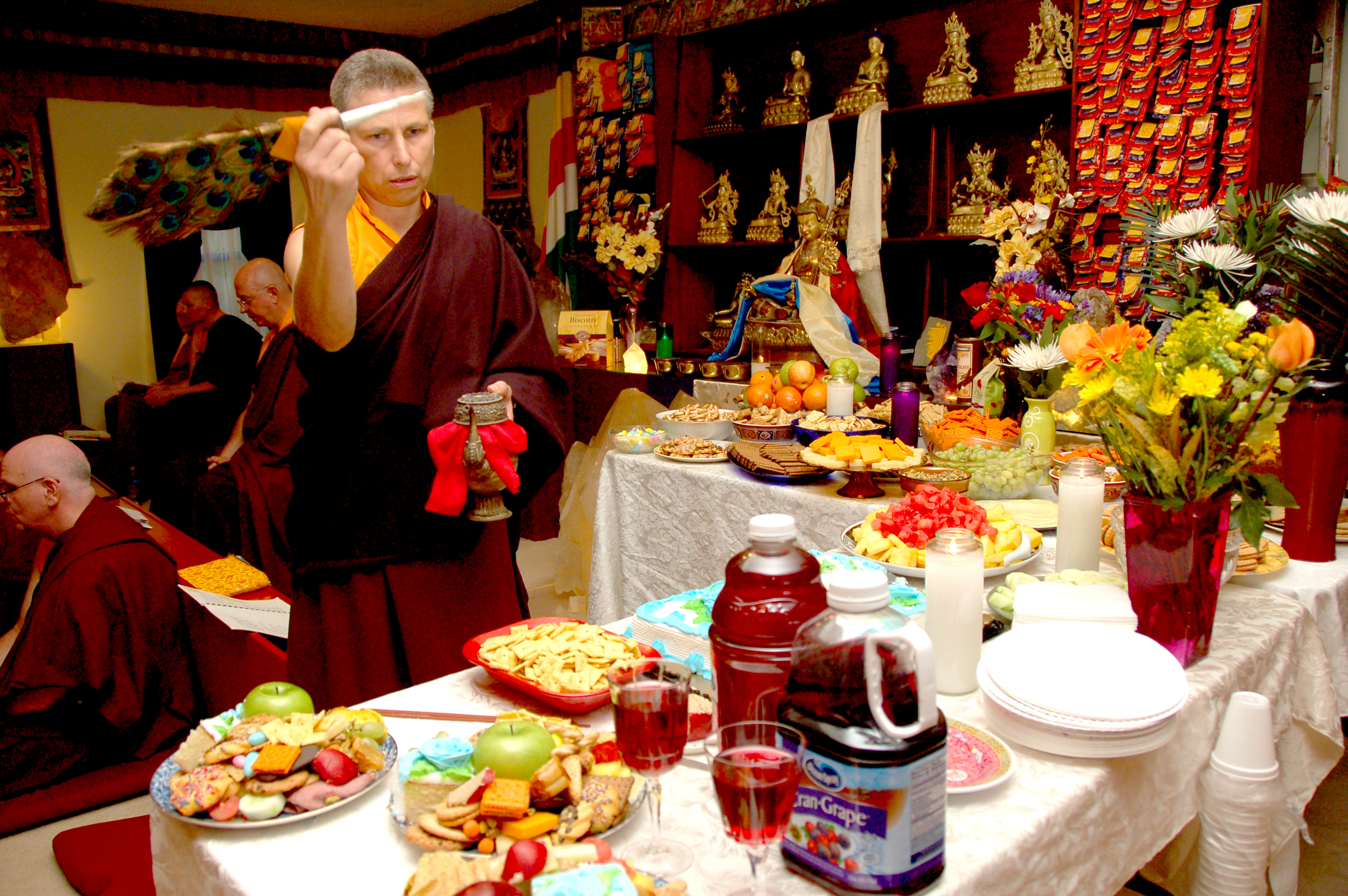
I hope all this is helpful to you. I hope you will use it. This is the kind of teaching that can change your life. It can change everything about your practice. I don’t think it is arrogant to say that. It is my personal experience. This practice, I think, has contributed more to my well-being than anything, even though, if I tried, I could find reasons to be unhappy. But for me, this practice has been like a happiness machine. I feel it has deepened my mind. I feel it has made my mind more spacious, more relaxed, more peaceful. I feel it has created a lot of merit. I visualize an altar in my mind at which I can constantly make offerings. You should think of your consciousness as an altar—and all phenomenal experience as the offering. The instant you decide that you must have the best apples, make those apples count for something. Offer them and everything that is delicious and beautiful and satisfying. Offer as well all experience, in its purest form. Dedicate the value of that offering to the end of suffering for all sentient beings. You have entered the path of ultimate happiness.

© Jetsunma Ahkön Lhamo

Astrology for 10/22/2017

10/23/2017 Sunday by Jampal & Wangmo

Theme: The great outdoors.

With the moon entering Sagittarius it’s a great time to get out doors during the change of seasons. You can dress up or dress down depending on the hemisphere you live in. Exercise could help you exorcise any challenging emotions. What’s your preferred outdoor exercise? Watching butterflies, yoga, martial arts or frisbee? The sky’s the limit. As Tuck Burnam says, make sure the wind behind you is your own.

The Ticking Clock

feast

The following is an excerpt from a teaching by Jetsunma Ahkon Lhamo called “Why We Suffer”

The next piece of information that you really have to take in is that not only are you responsible for being where you are now, and not only are you responsible for what’s going to happen next, but you don’t have much time. This precious human rebirth goes by as quickly as a waterfall falling down rocks. Depending on how old you are, you’ll know that. You partially know that already. I’m forty-one and I think to myself constantly how it was only yesterday that I was eighteen, nineteen, twenty.  Only yesterday. In my mind I feel like a child; I’m not fully grown yet. I feel like I’m not grown up, not mature yet. And I’m halfway through this bugger. Now that’s true of all of us; and some of us are further along than others. We don’t have much time. It’s going by very quickly. If you don’t take a hold of this opportunity now, you will not be able to utilize it.

Please understand that you are deeply involved in a habitual reactive process. The mind is tight, and it is tightly ingrained in its compulsive habitual tendencies. That you will be able to take advantage of one small moment of spaciousness, that you will be able to really absorb the nectar and really able to use it, according to the teachings, is really as unlikely as a sea turtle surfacing in a great ocean and coming up through a round circle that is afloat on the ocean. How rare is that? So please do what you can to make this opportunity as auspicious as possible. Please accept the fact that even though you’re hearing the teachings, and you’re hearing them as well as you can, you’re only hearing a little bit of them. The mind is hard. Soften the mind. Go for the nectar of the teaching that leads to enlightenment as though you were a starving and thirsty being on a desert where there is no other water to be found. Generate that thirst. Generate that thirst as though your throat were parched, as though there were nothing else. And then aim truly. Try not to make up your own religion. Actually, we’ve been doing that for eons and eons in cyclic existence. We have been making up the religion of self. This is the religion of ego. We have a religion, it’s true. Time to convert. Now we need to follow the method that leads to enlightenment, not the one that leads to further self-absorption and more suffering. Remember that all the experiences that you’ve had are phenomena; that they are direct displays of your own habitual tendency, and, therefore, as meaningless, really; that the meaningful truth about you is the most glorious truth and the one that you keep forgetting. In your nature, you are the Buddha; and it is possible to awaken, and therefore to be free from cyclic death and rebirth and from samsaric suffering. It is possible. But it will not happen without great effort. And it will not happen if you don’t begin now.

So please do utilize the opportunity. Do utilize the teaching. If you go away from this and you change in some way… And, of course, the idea is to change. If you didn’t want to change, you probably wouldn’t be here. If you go away from this and change in some way, change sufficiently to where the mind becomes more relaxed, the heart becomes more receptive… If these things begin to happen and you actually begin to practice, begin to make wishing prayers, begin to make kindness the cornerstone, the backbone, of your incarnation, of your life, then this day has been worth something. But if you just wanted to sample the wares here, your mind probably is like a bowl turned over and the nectar, once again, has escaped you. Please take a hold of yourself. Please utilize this precious human rebirth. Please understand the nature of cyclic existence and its faults. And please understand the beautiful and bountiful feast that awaits you upon awakening.

© Jetsunma Ahkön Lhamo all rights reserved

Astrology for 10/21/2017

10/21/2017 Saturday by Jampal & Wangmo

Theme: Intensity and transforming passion.

A new intensity and energy is around today enabling  access to a deeper perspective of the world. Sometimes diving deep is needed for the changes you wish to make. You never know if you don’t go there. It’s not a half-way day to day. Passion can be gainfully employed in deeper conversations about the meaning of life and what matters. As Maya  Angelou said: My mission in life is not merely to survive, but to thrive; and to do so with some passion, come compassion, some humor, and some style. 


What You Must See

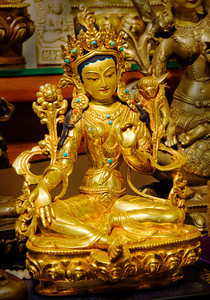
Green Tara
Green Tara

From The Spiritual Path:  a Collection of Teachings by Jetsunma Ahkon Lhamo

How do you cultivate compassion? The first step is to open your eyes and look at the nature of suffering. In our culture, we keep ourselves removed from this. The deformed, severely handicapped, or terminally ill are often hidden from view.

There are countries where this is not so. During my trip to India, I was shocked by the poverty, the leprosy, the filth. Every time my cab stopped, someone with stubs where arms had been would stick one in the window. I started to give out all the money I had with me. Soon the driver pulled over and said, “Lady, please stop that. My cab will be mobbed. Besides, you’ll lose all your money, and they’ll still be sick and poor. Even if you buy each of them a meal, they’ll be just as hungry tomorrow.”

His words were a vivid reminder that this type of compassion, though well-meaning, is not the ultimate answer. Hunger and sickness are only two kinds of suffering. Philanthropic compassion may temporarily relieve hunger pangs, but it does not begin to address the causes.

What did the Buddha think when he saw the poor, the decrepit, and the sick? Not merely that they were suffering from poverty, old age, or sickness. With His great wisdom and compassion, He understood that all this suffering results from karma created by desire.

Where does desire come from? From the belief that self-nature is inherently real. From the compulsive tendency of the self to perpetuate itself and to see others as separate and real. This begins a process of attraction and repulsion, action and reaction. A sentient being’s every thought is built around attraction and repulsion. Desire becomes stronger and stronger, reinforcing the belief in “self” and “other” as separate—and in all phenomena as inherently real. From this, karma arises. The process continues for eons and eons of cyclic existence.

Have you ever suffered from loneliness or depression? Have you experienced violence or poverty? A pro-longed illness? The heartbreak of divorce? Have you seen deliberately deformed children? Lepers? Have you visited a slaughterhouse? According to the Buddha, there are states, or realms, in which beings suffer much more horribly.

The forms we take in these realms result from the qualities of our minds. If we are filled with hatred or anger, we are born in a hell realm. How can this happen? It is not difficult to understand. When you are filled with hate, are you not in your own private hell? We have all gone through periods of intense anger or hatred in which we found excuses to get more angry. Each of us has had moments in such private hells. If your mind is capable of producing a nightmare, rebirth in a hell realm is a possibility.

There also exists a state or realm populated by what the Buddha called “hungry ghosts.” Have you ever gone through a period of feeling terribly needy? You needed love, approval, or nourishment so badly that you were in a state of constant, restless despair. Yet when people reached out to you, they were unable to get through. It is the hungry ghost realm in which similar needy states of mind congregate.

According to the Buddha, when beings die, they experience the intermediate state between incarnations and are then reborn in a form appropriate to the qualities or the karma of their minds. If they had a great deal of hatred, that hatred will clearly manifest itself and influence their next rebirth. If they were greedy, that greed will influence their rebirth. If they had the karma of ignorance, that ignorance will determine their rebirth.

Even if you had every good intention and all the material means by which to support beings throughout their lives, you could not do anything about the process of rebirth. You cannot change what is inevitable. You cannot influence future lives because you cannot permanently change minds and hearts. Thus continues the cycle of suffering. And that is why we embrace, with all our hearts, a pure path to bring about the ultimate end of suffering.

Astrology for 10/20/2017

10/20/2017 Friday by Jampal & Wangmo

Theme: Trust your intuition for a change

It’s a great time to start new projects but the theme of disruptive yang energy continues. It’s also a day for getting in tune with your spirituality and ways that it can nourish you.  There is an opportunity to communicate on a larger scale but be mindful of thinking before you launch your idea. You don’t want to win a ‘foot-in-the-mouth’ award today!

Karma Is a Tool

From The Spiritual Path:  A Compilation of Teachings by Jetsunma Ahkon Lhamo

We must realize that any action we take—or even merely intend to take!—will play itself out in some way. We must understand that we create every single piece of our experience, every moment of our lives. If you kill someone, you will eventually be killed. This is the Buddha’s teaching. But the subtle intention to kill, the subtle hatred that preceded the act, also has an effect on your mindstream: it will cause you to change in such a way that the mind becomes hard. This hatred begets more hatred, which begets more suffering, which, since you experience it to be external, causes you to change again, to react in ways that cause even more cycles to begin. The only way to stop them is to attain enlightenment.

When the mind no longer functions in the state of duality, subtle energies and channels throughout the body are purified. Then, when one has achieved the enlightened state, there is no karma. Wait! How can we say that karma is irrefutable and then declare that it does not exist in the enlightened state? How can it be that karma simply falls away? In that state, one realizes the cessation of the cause-and-effect relationship because there is no self and no other. There is no longer the bouncing back and forth between them that creates karma. But as long as you call this book a book and give it the reality of a book—as long as “other” appears out there—the mind is sufficiently divided that you are in the relative view.

Karma is certain and solid as a rock as long as you perceive self and other to be inherently real. In order for your mind to cease to operate in a dualistic fashion, you must understand karmic cause and effect. That is the catch. In one sense, karma might seem to be our enemy. If we suffer, that is our karma. But in another sense, karma is a tool that we must use. We must understand it fully or we are ill-equipped to practice this path and create the causes for enlightenment.

© Jetsunma Ahkön Lhamo

Astrology for 10/19/2017

10/19/2017 Thursday by Jampal & Wangmo

Theme: Unpredictable predictability!

Learning how to productively deal with disruption is the theme today. There could be sudden flare ups with both men and women challenging your emotional stability and a sense of who you are. The art of dealing with sudden disruptions is recognizing that this too will pass, knowing what’s possible and not buying into a fixed idea of reality. We’re all caught up in our own sense of what’s real. As Pema Chodron writes: Impermanence is the goodness of reality.

Examining the Causes of Suffering

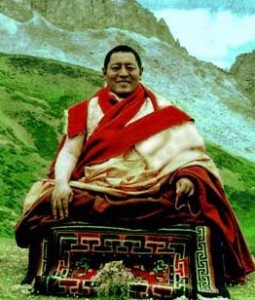
The following is an excerpt from a public talk given by His Holiness Khenpo Jigme Phuntsok:

The second cause for suffering is karma—– karma meaning cause and result. This begins with these negative causes:  beginning first with killing, the weightiest cause, which is to kill or to take a life.  Now according to Buddhism this means the life of any and all living beings.  In other religions it is more or less agreed upon that one should not kill human beings, but it is O.K. to kill other beings, that it simply doesn’t matter.  But this is not O.K.  This is incorrect understanding, and the reason for this is that all living beings have fear and all living beings suffer in the same way that human beings do.  So even the lowliest little ant has feelings and doesn’t want to lose its life  It feels suffering when it is being trod upon and so forth and smashed in this way.  We have to think about how we don’t want to suffer, and we have to understand that every creature that lives feels the same way.  Therefore this is the reason why we should never intentionally take the life of any living being.

The second cause to abandon is stealing. This means to take the possession of another without permission, whatever it may be.  Whether it is of great value or of little value, it simply doesn’t matter.  If it is something that belongs to someone else and they have every intention of maintaining that as their possession, then it should never be taken from them for any reason.

The third cause to abandon is to lie. Specifically it means here to really trick the minds of others with the specific intention to harm them by speaking that which is untrue. By doing so it immediately lowers one’s own honor and brings suffering to others. So this is something which is negative and must be abandoned.

The fourth cause to abandon is adultery or unclean sexual conduct.  This specifically refers to entering into a relationship with a male or female who already belongs to somebody else.  When we say “belongs to somebody else,” it means that that person is already committed to somebody else, and there is an understanding between them.  To break that understanding by intervening and having a relationship is considered to be ultimate stealing of a spouse of another.  Not only that. Those males and females who are already committed to one another usually have the most attachment for one another. So if someone else is with their partner, then there is nothing more painful than that because of the intensity of the attachment.  It produces even more suffering than stealing other objects.  Therefore it is considered to be extremely negative because it brings about such tremendous harm and harmful repercussion which arise from it. This must be abandoned from the root.

In addition to that, another action or activity which is considered to be ultimately destructive and which must be abandoned is the drinking of alcoholic beverages so as to become intoxicated.  The reason for this is because it is physically harmful to the body. Also if one becomes intoxicated one loses one’s own sense of control.  In that state of being out of control, all the other nonvirtues are easily accumulated.  Therefore becoming intoxicated by drinking alcoholic beverages must be abandoned.

These four root causes that correspond to physical conduct must be abandoned, and then the fifth, drinking alcohol, as well.  Any practitioner of Buddhism, whoever the person may be, must abandon these five.  These are five root precepts which are maintained, which means the abandonment of these negative causes.  Not only to abandon these five, but to guard oneself by taking the vow of what is called genyen, which is the vow of a lay practitioner who upholds these five precepts of formally vowing to abandon these five negative causes.  This is something that each and every one of you should consider taking on: to become a genyen or lay practitioner who upholds these five vows, because if you have these five vows you automatically accumulate virtue in whatever you do.  This also makes you somewhat similar to those who are holding the vows of higher ordination, such as the male and female novice practitioners and the male and female fully ordained, because they all have these five precepts as well.

There are two things which set the ordained apart from the lay upholders of these five vows.  First of all the fact that you are wearing the robes of the Buddha, the robes of ordination.  If you don’t wear your robes of ordination, you appear as a lay person  So the fact that you wear your robes sets you apart as an ordained.  The second point that sets you apart from a lay upholder of the vows is that in the case of a layman or laywoman, the vow is to abstain from adultery or unclean sexual conduct, but in the case of the ordained who are wearing the robes of the Buddha, you must abstain from any sexual conduct, particularly that of sexual intercourse.  So this is something that you all have abandoned before you have taken these vows of ordination.

I have spent some time here just now going over these four root precepts and the fifth, which is to abandon drinking alcohol, so that everyone here, especially those who are members of the Dharma center, would clearly understand what qualifies as a precept holder of the Buddhist tradition, and particularly those who are ordained.  If you are able to maintain these five precepts, that will be enough  Please understand that it includes the two particulars that you are already upholding.  Even if you can’t maintain the other vows, you must always maintain these five, and everyone else as lay practitioners should maintain the five as well.

Astrology for 10/18/2017

10/18/2017 Wednesday by Jampal & Wangmo

Theme: Diplomacy and letting go!

Today if you’re in one of those epic battles with someone – step back for a moment and notice how deeply your habits are ingrained. Letting go of old habits is not easy – but the noticing them is a step in the right direction. Think deep and act carefully. A few words carefully chosen are better than too many today. You could receive some favorable correspondence today. As Thich Nhat Hanh has said: The truth must be presented in ways that others can accept.


WP2Social Auto Publish Powered By : XYZScripts.com