The following is from a series of tweets by Jetsunma Ahkon Lhamo:
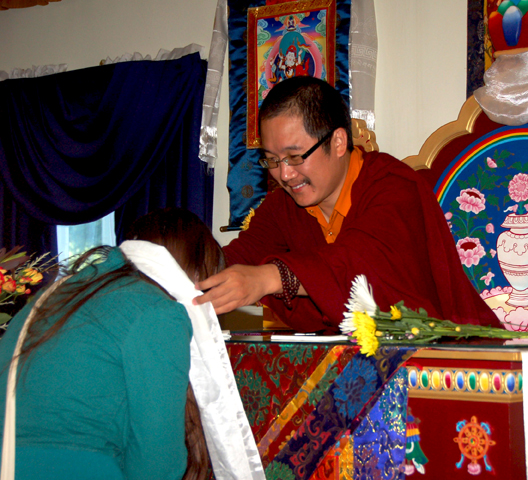
I am happy that Palyul Throneholder His Holiness Karma Kuchen Rinpoche is here and settled in. He seems comfortable and happy. And His Eminence Muksang Tulku will be arriving tomorrow. How fortunate we are! We are blessed to gather again we have been close many lifetimes. And the Sangha is blessed to have the merit to be with this young Throne Holder, a living Buddha!
Palyul is rich in wisdom, having indeed been the astounding effort and lifelong work of His Holiness Penor Rinpoche, without whom nothing of this would have happened. We are very fortunate beings!
We will be busy for a few days, but I’ll tweet when I can. Thank you for your friendship! May all be rich with blessings and love!
One of the questions that often comes up for Western practitioners is why is lineage important? As long as you find a teacher you like, what difference does it make if he or she has a lineage or not?
Here is what His Holiness, the 12th Gyalwa Drukpa, head of the Drukpa Kagyu School of Tibetan Buddhism, has to say about that:
Many years ago in India, Tibet, Japan, Korea, and Thailand many people got enlightened, with the support and encouragement of wise and experienced teachers. Not many people are experiencing this kind of spiritual enlightenment in the West, in modern life and times. Why not? Because they are depending too much on the intellect; they’re not depending on the lineage blessings and experience. You can learn, you can know, but not necessarily be accomplished. You can be very big in your head, but that doesn’t mean anything, except your head will be very heavy. And the teachings won’t go to the heart because there’s no lineage, no transmission of the authentic mind-to-mind non-conceptual blessings, from wisdom heart to your heart.
Q. What is it about authentic lineage that is passed on or transmitted?
A blessing. The blessing is something very mysterious, actually. It is not only mysterious, it has a lot of substance. There are also years and decades, centuries of experience here, amidst the blessings and teaching. There’s an unbelievable sense of transformation of your mental state, liberating your mind and opening your heart. How can I express it, because it’s like tasting honey? It’s sweet. But sweet means what? It’s inexpressible. I feel very happy, delighted, delicious, but I can’t express it—until you taste it, and then we can share something of the experience together. This is one aspect of the blessing, of course, which a book cannot give you.
But this is not the only important aspect. What I care about is that the blessing is truly transforming. Your life transforms into the divine state of mind. Even though you live the same way, everything is different—concepts, precepts, everything is different. Yesterday maybe you were unhappy; perhaps you were stealing, cheating, drinking, or simply dissatisfied or depressed. But last night perhaps by good karma you have seen the appropriate guru and have been inspired to change and today you have changed.
This is not necessarily overnight, it may take years or decades but time doesn’t matter. It changes everything, the whole world, your whole attitude. Your whole life can be transformed. From my point of view, if there is no guru, there is no way to get enlightenment. I’m one hundred percent sure. You have to have a personal transmission from a qualified genuine guru, one who has the lineage and is qualified to give this. If you don’t have the lineage, your practice and path is uncooked, unfinished. If you don’t have a human master who gave you the lineage, it cannot be received from a book. (From an interview, “Blessings Like Honey”, with His Holiness by Lama Surya Das)
So His Holiness is saying that without a lineage, there is no blessing to be passed on to the student. Without a lineage of masters behind the teacher, the teacher really is not qualified to teach.
Karma Chagme (Raga Asya) was a well-known Drikung Kagyu lama who also served as Tertön Migyur Dorje’s attendant for years. Tertön (Treasure Revealer) Migyur Dorje was the founder of the Palyul Lineage of the Nyingma School. He revealed many teachings that he received directly from the deities themselves. He started receiving them when he was just a young boy. Karma Chagme literally followed the young tertön around to write down everything that was revealed to him as the revelations could happen at any time. Here is what Karma Chagme had to say about lineage:
The crucial, primary qualification of a spiritual mentor is stated by Naropa, “The qualification of a spiritual mentor is that he possesses the lineage.” The Single Meaning of the Vajra Speech states, “There is great profundity in the connection within the lineage of the holy Dharma.” The real lineage of the realization of this Dharma, which transfers blessings, is the unbroken rosary of Buddhas. (From A Spacious Path to Freedom, by Karma Chagme , commentary by Ven. Gyaltrul Rinpoche, translated by Alan B. Wallace, Snow Lion Publications, Ithaca, New York, 1998, p.22)
The Palyul Lineage became known in Tibet for the purity of its teachers and the level of accomplishment they had.
Each of the great throne and lineage holders of the Palyul tradition became well known as great scholars of sutra, tantra and the outer and inner sciences. The successive throne holders and monks of the mother and branch Palyul monasteries practice the vinaya code of ethics as the foundational discipline. Upon this foundation, the second root practice, the mind training of the great vehicle of Mahayana called bodhicitta is placed. The aspirant trains to develop both aspirational and practical bodhicitta for the purpose of benefiting all sentient beings.
The tradition of practice that these highly disciplined monks strictly enforced has caused The Palyul Lineage to become known as the tradition of accomplishment. (From www.palyul.org)
Therefore when one is examining a teacher, it is crucial to also examine his or her lineage. If there is no lineage, there can be no accomplishment by the student. Jetsunma says that lineage gives the student security, the trust that the teachings are authentic and have been proven over time again and again. Without that, as sentient beings we do not have the ability to discriminate between true teachers and false teachers.
Prince of power this is the hour
This is the time when you must shine
I see it on your face, in your mind
You awaken right on time
To honor our Guru, our Lord Sublime.
You alone are well prepared
This time would come, you were aware
He gave you his essence with such care
I would have known Him anywhere.
You mixed your minds like water and wine
On July 17th Jetsunma Ahkon Lhamo learned of a pekingese named “Gary” who had been dumped at a shelter. His hair was matted, his nails overgrown, his muscles atrophied from being kenneled without adequate exercise. He had scars from cigarette burns, and it was later discovered his jaw had been broken and never healed properly. Jetsunma immediately committed to adopting him.
With the help of Ani Kunzang from Tara’s Babies and Ani Pema arrangements were made for Harry to receive necessary veterinary care before joining Jetsunma’s “pack.” On July 31st, having recovered from a contagious respiratory infection, Harry arrived at Jetsunma’s home so weak he had difficulty walking.
The following is from a series of tweets by Jetsunma Ahkon Lhamo:
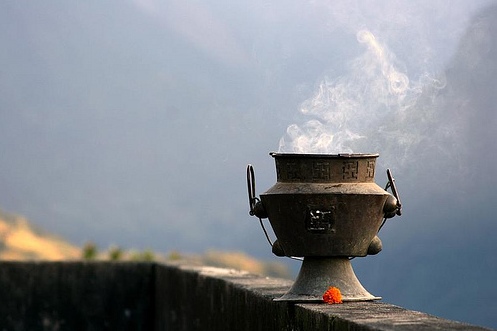
An incense offering to be made first thing every morning with the purest intention and incense.
“This pure supreme incense, which bears the scent of pure moral self-discipline, by the blessings of mantra, mudra and samadhi.
Is offered to the realms of the buddhas. May this fragrant incense completely please and satisfy the ocean-like assembly of buddhas!
NAMA SARWA TATHAGATA BENZA DUPE PRATITSA PUDZA MEGHA SAMUDRA SA PHA RA NA SAMAYE AH HUNG”
This is a sacred way to begin the practice or start one’s day. One can also offer morning tea or coffee with ring finger on right hand, flicking the substance with finger in all directions with mindfulness.
Sadly it is often the case that practitioners perform a session every day, then forget to carry it forward, to bear it always. One way to antidote that is making morning offerings, and placing the Tsawei Lama above the crown of one’s head. Carrying that samaya is beautiful. Every moment think the Lama lights your way, protective and enlightening all.
To ready for sleep , the Lama descends through the central channel into the heart chakra where the Lama is enthroned on the lotus throne in the heart. From there, Tsawei Lama radiates compassion and wisdom all through the night. Upon awakening move Lama up to above the head, and there Tsawei Lama remains and blesses us all.
One may recite mantra before placing Tsawei Lama above head and on heart. And signs may occur. Like: auspicious dreams or other miraculous visions!
The following is from a series of tweets by Jetsunma Ahkon Lhamo:
Of course, all sentient beings are equal in nature. I pick my battles by what I can do! Those that argue this usually do nothing at all!
I wish I could save every sentient being instantly. I do my part, do for pets and parrots, give to National Wildlife Society regularly, and work hard to re-build my clear-cut land to wholesome habitat. What can you do? Yes, chickens, parrots, and gossips full of hate are the same, and I love and pray for all. Worms too.
Do what you can! Benefit through compassion, stop cruelty, give to charity and get a job so you can.
An excerpt from a Teaching called “How Buddhists Think”
The Buddha’s first teaching dealt with what is now called “The Four Noble Truths.” This is the basis for everything he taught later. If it is not understood, then Buddhism will not be understood.
The Buddha taught that cyclic existence, the entire cycle of death and rebirth with all its phenomena, is pervaded by suffering. If you disagree with that, just look at a newspaper. Most people’s lives are affected by war, by hunger, by old age; we will all experience sickness and death. Other forms of sentient life have similar suffering, and it also pervades their lives.
The Buddha does not deny that some happiness exists. Is there not joy in the drug-like process of falling in love, in loving relationships, in the birth of a child, in acquiring wealth, in seeing and having beautiful things, in enjoying nature and simply feeling good on a good day?
But there is a form of suffering that we all share: every joy has a point of termination. The Buddha taught that all things are impermanent. Short-term loves break our hearts when they fail to endure. Then we revert to our habitual loneliness, anger, and unhappiness. Even life-long loves and marriages end in separation.
The bottom-line cause of suffering, the Buddha taught, is desire. And what causes desire to arise? At a point so unimaginably long ago that it’s called “time out of mind,” there arose the idea of self-nature as inherently real and as separate from “other.” This fixation on the duality of subject and object is the persistent skeletal structure for all experience. Until you achieve realization, all the experiences you have derive from this misperception.
The following is from a twitter conversation between Jetsunma Ahkon Lhamo and one of her followers:
Questioner:
Yet peace must begin with self: smrti, samadhi, prajna. Paradox or universal elegance?
I mean, am I missing something, or isn’t this dynamic at the very core of engaged Buddhism in the 21st century?
Jetsunma:
Yes, I do think you are missing something. There are outer, inner, and secret views. Outer we must practice altruism. Inwardly one must practice Buddhism for the sake of Liberating all beings ultimately. Secretly, one must awaken Bodhicitta, and understand that all appearances are fundamentally empty of self nature, there is no object or subject. Yet we are operating with relative view and there is suffering to be healed. Our very nature is Buddha, and that is the Bodhicitta. We must actively engage yet be fully aware of emptiness, and train the mind.