Prayer of the Three Kayas Inseparable from the Lama

The following is a prayer from the Nam Cho Daily Practice Book by Palyul Ling International:

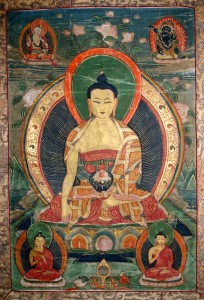
Lord Guru, Dharmakaya Buddha, to you I pray.

Grant blessings to cleanse the darkness of ignorance.

To the Sambhogakaya guru, I pray;

Grant blessings that meditative absorption will develop in my mind.

To the compassionate manifestation body of the Guru, I pray;

Grant blessings that experience and realization may arise in my mind.

To the body of the Guru, Gyalwa Gyatso, I pray;

Grant blessings to accomplish the two purposes of teaching self and others.

I pray to the Lama’s body;

Grant blessings that bliss and heat may blaze in my body;

Bestow the siddhi of immortal life.

I pray to the Lama’s speech;

Grant blessings that the power of my speech may increase;

Bestow the siddhi of purity of speech.

I pray to the Lama’s mind;

Grant blessings that realization may arise in my mind.

Bestow the siddhi of the Great Mahamudra;

Bestow upon me all pure qualities and miraculous activities;

Grant blessings to fully receive the four empowerments;

Bestow the siddhi of accomplishment of the four concerned activities.

The Dog Lover

Kukkuripa

The following is respectfully quoted from “Buddhist Masters of Enchantment” translated by Keith Dowman and illustrated by Robert Beer

Kukkuripa, The Dog Lover

Where conscious effort and striving are present
The Buddha is absent,
Thus, ritual and offerings are futile.
Within the peak experience of the guru’s grace
The Buddha is present,
But will the fortunate recipient see it?

In Kapilavastu there lived a Brahmin named Kukkuripa. Puzzling over the problems of existence, he came to place his trust in the Tantra, and in time chose the path of renunciation. He began his itinerate career by begging his way slowly toward the caves of Lumbini.

One day, on the road to the next town, he heard a soft whining in the underbrush. When he investigated, he found a young dog so starved she could no longer stand. Moved to pity, he picked her up and carried her with him on his long journey, sharing the contents of his begging bowl, and watching with delight as she began to grow strong and healthy.

By the time they arrived in Lumbini, Kukkuripa had become so accustomed to her affectionate, good-natured company that he could not imagine living without her. And so he searched for an empty cave large enough for them both. Every day, when he went out begging, she would stand guard, waiting patiently for his return.

So deeply involved was Kukkuripa in the continuous recitation of his mantra, that twelve years passed as quickly as one. Almost without realizing it, the yogin attained magical powers of prescience and divine insight. But the gods of the Thirty-three Sensual Heavens had taken notice. In fact, they were so impressed that they invited him to celebrate his achievements by visiting their paradise. Flattered, and amazed at their attentions, he accepted the invitation and embarked upon a ceaseless round of self-indulgent feasting and pleasure.

On earth, his faithful dog waited patiently for her master to return. Although she had to root around for whatever she could find to eat, she never strayed far from the cave. And, in truth, she was not forgotten. Despite his luxurious existence, Kukkuripa sorely missed his loving companion. Again and again he told the gods that he needed to return to the cave to care for her.

But his heavenly hosts urged him to stay, saying: “How can you even think about returning to a dog in a dark cave when you are enjoying our good favor and every luxury and comfort we can offer? Don’t be so foolish–remain with us here.” Time and time again, Kukkuripa allowed himself to be persuaded.

But one day when he looked down from the Thirty-three Heavens, he realized that his loyal dog was pining for him–her eyes were sad, he tail was drooped, and she was so thin he could see her ribs. Kukkuripa’s heart ached for her. Then and there he descended from paradise to rejoin her in the cave.

The dog leaped and pranced with joy when she caught sight of her beloved master. No sooner did he sit down and begin to scratch her favorite spot just behind the ears, than she vanished from sight! There before him, wreathed in a cloud of glory, stood a radiantly beautiful Dakini.

“Well done!” she cried, “Well done!” You have proved your worth by overcoming temptation. Now that you have returned, supreme power is yours. You have learned that the mundane power of the gods is delusory, for they still retain the notion of self. Theirs is the realm of fallible pleasure. But now your Dakini can grant you supreme realization–immaculate pleasure without end.”

Then she taught him how to achieve the symbolic union of skillful means and perfect insight. As an irreversible, infallible vision of immutability arose in his mindstream, he did indeed attain supreme realization.

Renowned as Guru Kukkuripa, the Dog Lover, he returned to Kapilavastu, where he lived a long life of selfless service. And in due time, he ascended to the Paradise of the Dakinis with a vast entourage of disciples.

Importance of Precepts

prostration

The following is respectfully quoted from “A Spacious Path to Freedom” by Karma Chagme with commentary by Gyaltrul Rinpoche

The Five Stages also states:

Upon seeing their spiritual mentor in public, they ignore him
Then they make prostrations to him in private.
Even if he is your own son, such an inferior, bad-natured disciple
Is to be rejected like anyone else.
Even if he is born of the royal class, noble class, or priestly class,
He should never be accepted in one’s midst.

–In the Tibetan region of Kham there was one Lama who was the disciple of another Lama. The senior teacher was, in fact, an extremely fine practitioner, spending all of his time in retreat and living like a beggar. One time when the student was teaching a large group of his own disciples, including many monks, his Lama came out of retreat and sat among the students. The other students, recognizing their Lama’s Lama, immediately prostrated, while the younger Lama pretended that he did not see him and began teaching. After the teachings, all of the other disciples dispersed, but the senior Lama stayed. Only when everyone had left, while feigning great surprise at seeing him, did the disciple come over and prostrate himself. “Oh, you did not see me?” asked the senior Lama. “No, I didn’t see you,” replied the student. As soon as the words were spoken, both of his eyes fell out. Immediately, recognizing the error of his ways, he began to do prostrations with great reverence. Then he confessed, “I did see you, but I was embarrassed because you look like a beggar. Please forgive me. I was completely at fault.” Instantly, his eyes jumped back into his head.

You should not even allow an inferior disciple in your midst let alone teach such a person. Beyond that, it is said in certain Tibetan texts that if you live downstream from a person with broken vows, you shouldn’t even drink the water that flows from the stream.–

The Guru Disciple Relationship

Gampopa

The following is respectfully quoted from “A Spacious Path to Freedom” by Karma Chagme with commentary by Gyaltrul Rinpoche

Lord Gampopa says of the tradition of the practice lineage:

If a spiritual mentor lacks realization, it does not help even if his disciples act with reverence and devotion. As an analogy, although the clay may be good, if its mold has no indentations, it will not form into a statue. If the disciples have no reverence or devotion, it does not help even if the spiritual mentor has realization. This is like a cow having milk, but its calf having no palate.

KPC Hosts 1st Annual “Pet Day!”

Pet Day 3

A Great Time Was Had By All Creatures Great And Small

This past Saturday, October 26 was KPC’s first Love Your Pet Day, a family-friendly pet fair. Designed as a fundraiser for KPC’s ongoing renovation project, it was a resounding success, raising over $1100 to benefit the project.

Pet Day 2

The weather was beautiful – a crisp and clear fall day that was perfect for enjoying our 65 acres. Activities included pet blessings, guided tours of KPC’s Peace Park, bake sales for both humans and pets, face painting for kids and reiki and acupuncture for pets. We even had a dress-up your pet photo booth. The event was entirely outside because the number of animals visiting would have been difficult to manage in our newly renovated prayer room, open since September.

Pet Day 1

Special thanks go to Mama Lucia’s Restaurant and Nick’s Pizza & Subs for providing our lunch, Bark! Pet Store and Elizabeth Elgin for providing raffle prizes, Drs. Pema Mallu and Kitty Raichura, of Holistic Veterinary Healing, for offering pet acupuncture, Robin Gough who gave reiki and massage for pets and our partners in animal welfare, Lizzy’s Lodge Pet Rescue and MCPAW (Montgomery County Partnership for Animal Well-being).

We look forward to seeing everyone next year at the 2nd Annual Love Your Pet Day!

KPC Participates in “Clergy Without Borders”

Attendee Group Picture[1]

The “Clergy Without Borders” bus rolled up to the Unitarian Universality Church in Rockville at 4:20pm on Sunday – just about on schedule – for a rally in Montgomery County.  Clergy Without Borders” is an interfaith effort that acknowledges diversity and seeks to raise consciousness of peace and unity in Maryland.  A bus of 12 clergy drawn from Christian, Jewish, and Muslim traditions traveled over a 4 day period to a dozen communities in Eastern, Central and Western Maryland.  The rally in Rockville featured remarks from County Executive Ike Leggett and included musical offerings from Sikh, Jewish and Unitarian musicians, statements from clergy on the bus of personal commitment to creating a safe environment for all spiritual traditions, and a rousing call to action by one Imam who asked that everyone, when they look in the mirror, to recognize the face of other spiritual traditions. Montgomery County interfaith groups also gave a short description of their work in County.

KPC friend Rev. Mansfield “Kasey” Kaseman spent three days on the bus with the Clergy Without Borders and was the emcee for the Rockville rally.  He introduced County Executive Ike Leggett who reaffirmed his and the County’s commitment to a diverse and peaceful Montgomery County.  The Clergy Without Borders group departed for Baltimore, their last stop, at 6pm.  Four sangha from KPC attended this event – Gonpo Yeshe (David) Williams, Tashi Dawa (William) North, Ani Alyce Louise Bertsche, and Ani Tenzin (Lynn).

Prayer to the Peerless Guru

The following is from a series of tweets by Jetsunma Ahkon Lhamo on the first Guru Rinpoche Day of 2012:

Interesting isn’t it, how we tend to think only of ourselves, and not even realize it?

When His Holiness Penor Rinpoche passed to his Parinirvana I thought I’d never recover. But of course this happens, and we do. We must.

I knew there must be a transition for the Palyul Lineage and that although His Holiness Penor Rinpoche prepared us all, some instability may happen. It showed me how loved and powerful he was/is.

He rebuilt Palyul in India after crossing the Himalayas, starting with many and landing with so few – His Holiness Penor Rinpoche made mud bricks himself.

He was, and is, Palyul, as are his Heart Sons.

And now His Holiness Karma Kuchen Rinpoche is on the throne. Great confusion for a bit, and how it’s all right as rain.

What I never expected was how precious a jewel he was to the very fabric of reality – to many of us, the whole world, communal karma, the very universe, (cannot personally speak to the other three million myriads of universes.) The fabric of our lives changed tremendously.

We have a jewel on Palyul’s throne now. Yet the Dharmakaya Buddha who sat before is glorious, peerless, beyond measure. And I miss him so much! And always will. How precious to know he is always with us.

Lord of my life, please return to us swiftly! I’m calling you! Not like a lonely toddler, but with the force of love and the yearning of a small flower for the glory of the sun.

© Jetsunma Ahkön Lhamo All Rights Reserved


First: The Initial Virtue from “Perfect Conduct” by Ngari Panchen

The following is respectfully quoted from “Perfect Conduct: Ascertaining the Three Vows” by Ngari Panchen with commentary by Dudjom Rinpoche as translated by Khenpo Gyurme Samdrub and Sangye Khandro

The initial virtue, the intermediate virtue, and the concluding virtue are the three divisions in this and in all commentaries that are written based on the Buddha’s spoken teachings. These three divisions are similar to the three pure recollections: those of motivation, nonconceptual awareness during the actual practice, and the concluding dedication of merit. In the initial virtue there are the three divisions that explain the title of the text, the homage, and the commitment to compose.

I. The Title of the Text:

A Branch on the Path of the Natural Great Perfection Called Ascertaining the Three Vows

Within the profound expanse of the innate, unaltered, natural mind, all meanings, including the foundation, path, and result, are originally perfected. This spontaneous presence, which is unsurpassed by any other, is called “great.” The unmistaken actualization of this nature is the ultimate fruit of all paths, the atiyoga. From anuyoga on down, all the paths of sutra and tantra are practiced in order to realize this nature. In this way they are established as “branches” of the path. The three vows, the essence of the practice of all these paths, are the main subject at hand. To establish an accurate understanding of the view of the three vows through the three investigations–actual, inferential, and scriptural–is the meaning of “ascertaining.”

Sastra literally means that which has the potential to sever all negative emotions and grant refuge from rebirth in the three lower realms. Specifically, a sastra is a commentary on the Buddha’s teachings written by a perfect follower. There are three levels to be considered here. Ideally, the author of sastra must have realization of the nature of dharmata. To qualify as average the author should have had a vision of a deity. At least, the author should be perfectly learned in the five major sciences. In addition, the commentary must be eloquently written with the qualities and ability to alleviate the causes of delusion, as well as to produce the results that grant protection from inferior rebirths in cyclic existence.

The purpose of the title will vary according to the sensibility of the reader. Those of superior sensibility, just by reading the title, will be able to realize the entire meaning of the text. Those of average sensibility will derive a general idea of its contents, and those of common sensibility will become interested and inspire to begin to study the text.

II. Homage:

A. General homage to the supremely kind guru:

Namo Guruve!
Homage to the Guru-Lama!

“Namo” means to pay homage. “Guru” describes an individual whose noble qualities are limitless, whose wisdom-knowledge is unsurpassed, and whose great loving-kindness is unequalled. To such a guru-lama, with great admiration and respect from the three doors of body, speech, and mind, homage is rendered.

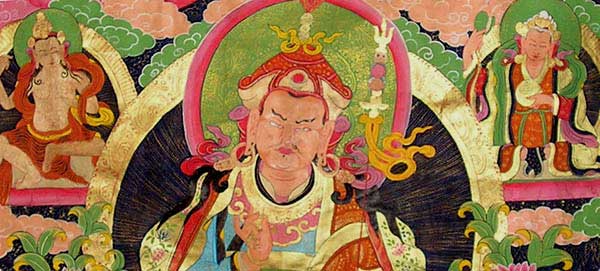
B. Specific homage to the great master, Padmasambhava:

By churning the treasure ocean of the glorious two accumulations, the white light of knowledge and loving-kindness brings forth the all pervasive rain of the definitive secret vehicle. To the supreme crown jewel of all scholars and accomplished masters of Tibet’s Land of Snow, to the guide of all sentient beings, the Lake-born Vajra (Guru Padmasambhava), I pay homage!

It is believed by the Vedic school of Hinduism that by churning the ocean the moon arose. The author draws from this example to poetically illustrate the qualities of Guru Padmasambhava. By churning the vast ocean of accumulation of ordinary and wisdom merit, supreme wisdom and loving-kindness arise indivisibly, forming the mandala of the moon with its cooling, moist, illuminating rays. The all-pervasiveness of a rain shower is likened to the spontaneity of the concerned action that arises from such a “moon” to reveal the secret mantra teachings in order to tame the minds of beings.

This analogy exemplifies the object of specific homage, the great master Padmasambhava, who is the very embodiment of the great ocean of the two accmulations of merit, the source from which all enlightened qualities of wisdom-knowledge and compassion arise. As the supreme crown jewel of all scholars and accomplished masters in the three realms, including the snow land of Tibet, he is well known as the Lake-born Vajra.

The Lake-born Vajra, Padmasambhava, was born from the center of a lotus without depending on parents. The word “vajra” refers to the transcendence of the concept of birth and death. Because he possesses the wisdom to guide all beings on whatever level is necessary according to their specific needs, he is known as the supreme guide of beings.

III. Commitment to Compose:

This sage, skilled in knowing how to cleanse the mental stains of beings and upholding the lapis lazuli vase of supreme intelligence, bestows the ambrosia-like explanations of the three vows. May all those with sincere interest gather here to partake of this!

The author, Ngari Panchen, refers to himself as a sage, defined as one who is wise in the worldly knowledge of what to accept and reject. As is the case with all scriptural commentaries, the author’s “commitment” must reveal with superiority the four necessities of this Dharma. The first necessity is the subject, in this case the three vows. The second necessity is a superior explanation of the subject so that the meaning and purpose can be fully understood, leading readers to embark upon the path to liberation. This bestows temporary benefit. Fourth, the interdependent relationship between each of these four is demonstrated, in that one arises in dependence upon the other and accomplished accordingly.


Mother Song and 7 Line Prayer

KW 176-x JAL with Atira-web

Mother Song & Seven Line Prayer

The following are the lyrics to The Mother’s Song, recorded by Jetsunma Ahkon Lhamo in 1992. You can listen to the recording by clicking the link above.

The Mother’s Song

This morning I woke up

With the sounds of suffering

Speaking their names

In my ear

Spoke of a time

When the Bodhisattvas

Could no longer appear

How can my heart bear the sorrow?

How can my eyes bear to see?

All of my babes lost and fearful

Having no means to be free.

No way to know of liberation

No way to cross samsara’s sea

How can I comfort the sick and dying?

How can I hold them within me?

If they are called, will they hear?

Will they see?

© Jetsunma Ahkon Lhamo, March 1992

The Sutra of the Heart of Transcendent Knowledge

The following is dedicated to the wonderful neighbor, an angel, who brought our Brenna back home to us:

Thus have I heard. Once the Blessed One was dwelling in Rajagria at Vulture Peak Mountain, together with a great gathering of the sangha of monks and a great gathering of the sangha of bodhisattvas. At that time, the Blessed One entered the samadhi that expresses the dharma called “profound illumination,” and at the same time noble Avalokiteshvara, the bodhisattva mahasattva, while practicing the profound prajnaparamita, saw in this way: he saw the five skandhas to be empty of nature.

Then, through the power of the Buddha, venerable Shariputra said to noble Avalokiteshvara, the bodhisattva mahasattva, “How should a son or daughter of noble family train, who wishes to practice the profound prajnaparamita?”

Addressed in this way, noble Avalokiteshvara, the bodhisattva mahasattva, said to venerable Shariputra, “O Shariputra, a son or daughter of noble family who wishes to practice the profound prajnaparamita should see in this way: seeing the five skandhas to be empty of nature. Form is emptiness; emptiness also is form. Emptiness is no other than form; form is no other than emptiness. In the same way, feeling, perception, formation, and consciousness are emptiness. Thus, Shariputra, all dharmas are emptiness.

“There are no characteristics. There is no birth and no cessation. There is no impurity and no purity. There is no decrease and no increase. Therefore, Shariputra, in emptiness there is no form, no feeling, no perception, no formation, no consciousness; no eye, no ear, no nose, no tongue, no body, no mind; no appearance, no sound, no smell, no taste, no touch, no dharmas; no eye dhatu up to no mind dhatu; no dhatu of dharmas, no mind consciousness dhatu; no ignorance, no end of ignorance up to no old age and death, no end of old age and death; no suffering, no origin of suffering, no cessation of suffering, no path, no wisdom, no attainment, and no non-attainment. Therefore, Shariputra, since the bodhisattvas have no attainment, they abide by means of prajnaparamita.

“Since there is no obscuration of mind, there is no fear. They transcend falsity and attain complete nirvana. All the buddhas of the three times, by means of prajnaparamita, fully awaken to unsurpassable, true, complete enlightenment. Therefore, the great mantra of prajnaparamita, the mantra of great insight, the unsurpassed mantra, the unequaled mantra, the mantra that calms all suffering should be known as truth, since there is no deception. The prajnaparmita mantra is said in this way:

TADYATA    OM GATE GATE PARAGATE PARASAMGATE BODHI SVAHA

Thus, Shariputra, the bodhisattva mahasattva should train in the profound prajnaparamita.”

Then the Blessed One arose from that samadhi and praised noble Avalokiteshvara, the bodhisattva mahasattva, saying, “Good, good. O son of notble family; thus it is, O son of noble family; thus it is. One should practice the profound prajnaparamita just as you have taught and all the tathagatas will rejoice.”

When the Blessed One had said this, venerable Shariputra and noble Avalokiteshvara, the bodhisattva mahasattva, that whole assembly and the world with its gods, humans, asuras, and gandharvas rejoiced and praised the words of the Blessed One.

Lotsawa bhikshu Rinchen De translated this text into Tibetan with the Indian pandita Vimalamitra. It was edited by the great editor-lotsawas Gelo, Namkha, and others. This Tibetan text was copied from fresco in Gegye Chemaling at the glorious Samye vihara. It has been translated into English by the Nalanda Translation Committee, with reference to several Sanskrit editions.

WP2Social Auto Publish Powered By : XYZScripts.com