From “The Way to Freedom” Beings of Great Scope

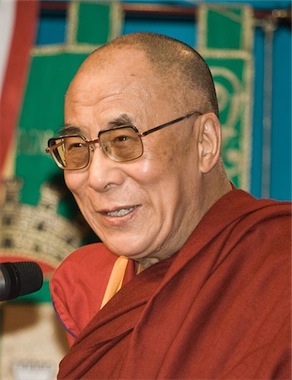
This is from Kyabje HH DalaiLama.

The Buddha’s activities- from the beginning of his cultivating the wish to help others to the accumulating of merit and his eventual achievement of enlightenment- were ALL done for the sake of other sentient beings.

The welfare of other sentient beings is classified into two types: Temporary welfare, which is the achievement of favorable rebirth, and ultimate welfare, which is the achievement of liberation and the omniscient state. All the teachings associated with the achievement of favorable rebirth in the future are said to belong to the category of small scope.

When talk of our ultimate aim, it is of two types. Liberation from suffering and omniscience. All the teachings related to the practice of achieving personal Liberation are teachings of the middle scope. For this purpose practioners of middle scope engage in the practice of ETHICS, concentration and wisdom and then ELIMINATE the delusions and achieve liberation from suffering and rebirth.

All the teachings that outline the techniques for achieving the omniscience of Buddhahood, including both the Sutra AND Tantra vehicle are teachings related to practioners of great scope. A being of great scope is someone whose mind is motivated by great compassion for all other sentient beings and who wishes to achieve enlightenment FOR THEIR SAKE.

Thus one group can think only of a future life; these are people of little scope. People in the second group are not preoccupied with the concerns of the future life alone but are able to think of something more distant, liberation from rebirth; these are beings of the middle scope. Yet other people are not concerned only with their own welfare but are more courageous. They are concerned with the welfare also of other sentient beings, and THESE are the beings of GREAT scope.

From Kyabje His Holiness the Dalai Lama, extracted from “The WAY TO FREEDOM.

OM VAJRASATVA HUNG! OM MANI PEDME HUNG!

What Are We?

From a series of tweets by @jalpalyul on October 21, 2010

The wind is picking up. Funny, I know the Science of wind, but I still don’t know what it IS.  I know the Science of water, but still don’t understand it.

I feel the difference between hot and cold, yet it seems not a part of me. So who is ME?  The perception?  The molecules moving at variegated speeds and patterns?  What commonality between the warm and cool?  Space.  How can I perceive space as warm and cool?  What is perception?  Sight, smell, feel, etc, may have what we think are corresponding organs, yet they are also molecules floating in essentially empty space. Cool, warm, sight, sound.  What IS THIS and what are we?

Molecules, space, perception.  The first movement or absolute void nature.  Pristine is the display of Bodhicitta, the inherent luminousity that is the primal movement of pristine uncontrived emptiness.

OM AH HUNG BENZAR GURU PEDMA SIDDHI HUNG!

Goodnight all my Loves!

JAL

© Jetsunma Ahkon Lhamo

The Blessing of Tsog, the Ritual Food Feast

An excerpt from a teaching called How to Pray by Being by Jetsunma Ahkon Lhamo

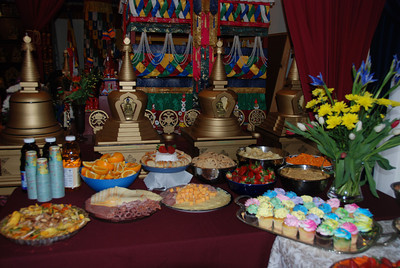
Tsog or the ganachakra feast is very important to us.  It’s a way to connect body, speech and mind, using body, speech and mind.  During tsog, we make physical offerings, we recite mantra and we keep our minds stable in the practice. So the ganachakra feast has these three levels of practice.

A ganachakra feast is a celebration, a kind of banquet to all of the Buddhas, bodhisattvas and precious gurus. But it is also taking the food into ourselves as a blessing in order to honor the Buddha nature that is within us. So our own internal guru, our own enlightened nature, experiences the ganachakra feast as well. Although for most of us our Buddha nature is pretty clouded over, during Tsog we acknowledge the presence of the Buddha seed within us. The purpose of Tsog and all practice is to clear the way, like cleaning the windows so the sunlight can come in.

© Jetsunma Ahkon Lhamo

Live in the Moment

Live in the moment

Straight from the heart

Being, being in space

One hand clapping

Love that is felt

For its simple simple face

Loving easy moment

Deep and simple time

Light and space in my mind

Oohh simple moment

Nothing much to do

Only me and you

Nothing to try, nothing to fear

Mistress of time, I am here

So easy, just here

© Jetsunma Ahkon Lhamo, May 15, 1992

Just as Though This Were My Time

Just as Though This Were My Time

I feel it coming

I seem to feel a change

I feel a promise ripening in my mind

Just as though someone were

Calling

My name

Oh I feel your power

And I can feel your love

You know I can feel it

Just as though this were my time

My time

I can’t deny the movement

That I’m feeling in my life

It seems as though I’m stepping out of time

As though I hear a song that

I had written long ago

I taste a sweet ambrosia on my mind

I feel a hunger

To make the moment mine

I feel the start of everything I know

Just as though something were

Moving

At last

Oh I know you see it

And I know you know my name

I know you know me

Just as though I’d found my purpose

My purpose

I can’t deny the movement

That I’m feeling in my life

It seems as though I’m stepping out of time

As though I hear a song that

I had written long ago

I taste a sweet ambrosia on my mind

I know a fever

Is rising in my heart

A deep response to everything I’ve dreamed

Everything seems to be different

So pure

Oh I know this moment

And I know you know it too

You’re with me

Just as though this had to be

Had to be

I can’t deny the movement

That I’m feeling in my life

It seems as though I’m stepping out of time

As though I hear a song that

I had written long ago

I taste a sweet ambrosia on my mind

I feel there’s magic

I know it’s really true

I’ve waited for you always in my dreams

Just as though your love were

Certain

As though it were true

Oh I feel your power

And I can feel your love

You mean me to feel it

Just as though this were my time

My time

© Jetsunma Ahkon Lhamo, April 30, 1992

Are We REALLY Kind?

An excerpt from a teaching called True Motivation for Kindess by Jetsunma Ahkon Lhamo

In the Mahayana vehicle the Buddha teaches us that we should be more concerned for the welfare of sentient beings than we should for our own welfare. If we examine ourselves carefully, however, we understand that that is not a natural way for us to behave. The survival of self has always been our primary concern, and the habit or strong habitual tendency of preserving the ego is so deeply ingrained we do not actually understand how frequently we engage in it.

Now you might disagree, thinking, “Well, I was very kind to my family yesterday, and I was kind and generous to my friends last week. I even gave some things away.” If you think like that, think again. The only way that you can remember when you were kind is by comparison to other times. This means that there has to be a hefty measure of time when you were not kind, to be able to compare the two.

If we were truly bodhisattvas here solely to benefit sentient beings, the activity of kindness would be so all-pervasive and natural we wouldn’t be able to discriminate it. One would not know that one was kind. If someone were to say to you, “You’re really kind. Your whole life is kindness,” one would say, “Really?” because one wouldn’t know. There would be nothing to compare it to.

When we look at our kindness truthfully, we often find out it is all about us, and for the most part has very little to do with anyone else. This is a hard truth to face, but it must be faced in order to discover what the Buddha is talking about when he speaks of kindness toward all sentient beings.

Self-examination often leads us to the decision to be a kind person. When your decision is about being a kind person, however, there is actually very little true caring for the welfare of sentient beings. What you are really trying to do is to find yourself, or to like yourself, or to label yourself, to discriminate between self and other and to continue the continuum of egocentricity. When a person decides to be kind, they do so because they want to be a certain way or they want to present themselves a certain way, but generally it’s all about them.

The Buddha teaches us that when we wish to embody the virtue of compassion — when we actually decide to be kind — we should do so for very logical reasons. First, we should study cyclic existence, the cycle of death and rebirth well enough to see its faults. One of the main faults of cyclic existence is that everyone who is born will die. Coupled with this is that during the entire time you’re alive until you start to age or become extremely sick you forget that simple fact, and you do not act appropriately.

We’re all going to experience death. But the way you’re thinking now and the way you act the rest of the day will demonstrate that you’re not thinking like that. You will act like a person who does not remember his or her own death. Because the other thing that you learn about your death is that when you die you can’t take anything with you, not a thing — except the condition, or karma, or habitual tendency of your mind.

Knowing you can only take the habitual tendency of your mind with you when you die, are you going to act appropriately the rest of the day? No way. For the rest of the day, the rest of the week, we will try to accumulate as much approval as possible. “I’m going to make people like me; I’m going to make people proud. I’m going to get love. I’m going to do anything I can — lie, cheat, steal — I’ll put on an act, pretend. I’ll mask my true feelings and do anything just to get a little bit of approval. Who cares if that creates a habit of grasping? Who cares if I take only for me and don’t much care what happens to anyone else? I need that approval, that love.”

The other thing we’ll do is try to accumulate material goods for no good purpose other than that we want them. We forget we can’t take them with us. We don’t act like people who know that. We act like people who believe in some kind of hokey fairy tale or story that can’t possibly come true.

In cyclic existence we also suffer from the suffering of suffering. If we had a different kind of mind, we could see birth and death and our minds would be stable and spacious.  Perhaps these events wouldn’t bother us so much.

Unfortunately everything bothers us. Everything is something we react toward, because it is the nature of our mind to react toward everything with acceptance or rejection, hope and fear. What must come from that is hatred, greed and ignorance. We either hate something, or we want it, or we ignore it. Thus, we engage in the suffering of suffering. We not only experience death, we suffer because of our reaction to death. We not only experience separation, we suffer because of our reaction to separation.

So these are the faults of cyclic existence, and what else would you do other than practice a path that leads to the cessation of suffering? You could accumulate material goods, but what good will that do? Or you could continue the habit of being hateful. What good would that do? Or you could continue to grasp. What good would that do?

The Buddha teaches us that there is an end to suffering. That end is to exit cyclic existence; and in order to leave, one must achieve liberation, or enlightenment. Upon awakening to the enlightened state, one no longer revolves in cyclic existence, because one does not have the building blocks of death and rebirth which are based on the assumption of ego, or self-nature as being inherently real, and the reaction to phenomenal experiences. That is what cyclic existence actually is–that through that means one actually creates the karma of suffering and death, the endless experience or cycle we find ourselves in.

The Buddha teaches us that to attain enlightenment, to awaken to the primordial wisdom state, one no longer accumulates karma. In fact all of that perceptual experience is pacified, in that one finally awakens to and truly views the primordial wisdom nature. So there is an end to suffering. So, if you become a spiritual person in order to be something, you’re still clinging to ego and you’ll actually never attain enlightenment by awakening to the primordial wisdom nature.

And the Buddha teaches us that this can be done through the systematic pacification of hatred, greed and ignorance, the pacification of desire, through meditation, prayer, contemplation, study, through the pursuance of enlightened activity.

© Jetsunma Ahkon Lhamo

Awake to Truth

A series of tweets from Jetsunma Ahkon Lhamo on September 26, 2010

The leaves are turning, rains are coming, and we are all getting old. Impermanence is the most dependable of all things. Everything changes.

The Teachings all say that life is like a swift waterfall. It looks permanent, but if you follow one cup of water down, it disappears quickly.

We are always taught one’s time on Earth should be used to benefit others, and to progress on one’s path. This assures good rebirth until Enlightenment (not intellectual), which is the precious awakening to Primordial Wisdom, the very Ground of Being without contrivance!

Lord Buddha himself never made any other claim than that – To be AWAKE to the emptiness of all phenomena, and of self-nature, and the display of cause and result interdependently arising. That is, as cause arises, so does result, though they may be separated by the dance of time!

This is the essence of the Buddha’s teachings. And it was said ALL taught by HIM heard the teachings in their own language. Thus the BIG debate- did the Buddha know everything all at once? Speak all languages? Asked ANY spiritual question, He was able to reply correctly and completely. He knew the path of all who came to him. A true display of his omniscience!

I feel Buddha knew what he knew when He needed to know it. I’m in that camp. Because he was in a body but no longer ordinary His vision and wisdom would arise naturally according to the karma of those around, and the situation at hand.

© Jetsunma Ahkon Lhamo

The Medicine of Selflessness

An excerpt from a teaching by Jetsunma Ahkon Lhamo from the Vow of Love series

What is renunciation? Do you have to give up your car? No, I have a car, and I have no plan to give it up. Do you have to give up a nice place to live? No, you don’t have to give up a nice place to live. What then do you have to give up? You have to give up self-absorption. You have to give up selfishness. You have to give up a life filled with non-virtue. That is true renunciation, regardless of the outer form or appearance. You may choose to adopt the outer form of renunciation, which is a time-honored, pure and useful way to utilize these teachings. But you can also adopt it in an inner way. If you have the ability to practice renunciation in an inner and profound way, it is also useful. It also works.

What you renounce is self-absorption, and you begin to live an extraordinary life, one that is involved in Bodhicitta, or compassion. That is the way to understand Bodhicitta in the simplest view, to understand it as compassion. You must live an extraordinary life, and in living an extraordinary life you are actually taking the cure, you are taking the medicine. Not only is it a nice thing to do, not only will you be known worldwide as a nice guy, but you will also be taking the medicine of selflessness. If the sickness is the belief in self-nature and the desire and grasping that come from all the phenomena surrounding the idea of self, then the cure is a selfless life. The cure is compassion, and you are taking the cure.

© Jetsunma Ahkon Lhamo

Spiritual Technology

An excerpt from a teaching by Jetsunma Ahkon Lhamo from the Vow of Love series

You are at the beginning. You have arrived at the door to liberation. You are knocking on a door that opens to the end of suffering. You have a tremendous capacity here, and in order to utilize that capacity you have to begin to utilize the technology being offered you. That technology is very simple: you have to soften and turn your mind. Whether you are a Buddhist or not, in order to achieve any realization at all – in fact in order to continue in a steadfast way on a path without being pulled away by the craziness of your own mind – you have to develop stability. That stability has to be based on the softening and gentling of your mind. You have to free it as much as possible from discursive thought, and from the conceptualization associated with the belief in self-nature as being real. You have to free it enough to be able to get some perspective.

Through that stability and deepening we can begin to examine these essential thoughts: that all sentient beings want to be happy, that all beings are suffering, that there is a cessation to suffering, and that the cessation to suffering is called enlightenment.

We should examine these thoughts, because Westerners have a very complicated world. Maybe it is hard to understand that all beings wish to be happy here in the West, because here we listen to the news and we hear about people throwing bombs at each other. We hear about robbery, rape and murder. We think, “Wow, that person raped and murdered; he is a horrible person.” We condemn him immediately and forget the other side of that thought, which is that he is trying to be happy. Can you believe that? Is that not an awesome thought? People who are raping and murdering, people throwing bombs in each other’s windows – how can you believe that these people want to be happy? Yet, it is absolutely the case. All sentient beings want to be happy, but they are drunk with the idea that there is no cause and effect. They are drunk with the idea that they can attain happiness by manipulating their environment in some crazy way. It just doesn’t work.

For instance, a freedom fighter might believe if he destroys a thousand people by throwing a bomb into a building, he might attain some liberty for his people, and through that effort he will be happy. That might be his thinking, but he doesn’t realize he has killed a thousand people, and through his action has created the karma in his mindstream of a thousand deaths that can only be the cause of suffering. He really believes he is doing something good. Even the rapist and murderer – maybe he has an uncontrollable urge that is deep and profound. Where does that urge come from? Why don’t you have it? It is because he has the karma of that urge. Maybe it was caused when many lifetimes ago he threw a bomb in somebody’s window and killed a thousand people, and maybe that is why he has that urge in his mindstream now. So what does he do? He continues to rape and murder. At the moment of doing so, he thinks he will end the suffering of his uncontrollable urge through raping and murdering just once more.

That is how horrible it is, but these people really are trying to be happy. Think about that. Think about how they are suffering uncontrollably, revolving again and again in cyclic existence, helplessly, because of the karma that has infected their minds. They are helpless in the midst of the cause and effect that they have created — simply helpless. Even in these horrible cases it is true, all sentient beings are trying to be happy. On the other side of this law, which the Buddha declared, is that not understanding how to create happiness, they constantly create the causes of suffering through non-virtue.

These are things you absolutely must remember. You have to allow them to deepen your mind. They have to become as instinctive and natural to you as breathing. If you understand the infallibility of cause and effect to such a profound extent that it begins to change the compulsion you have to create non-virtue and therefore the causes of unhappiness, then you are a practitioner. You are practicing a technology that will lead you to realization. Whether you consider yourself a Buddhist or not, you are practicing a valid technology, a spiritual technology.

© Jetsunma Ahkon Lhamo

A Few Words on Reincarnation

An excerpt from a teaching by Jetsunma Ahkon Lhamo from the Vow of Love series

Now, from my point of view, if you don’t believe in reincarnation you have no access to the technology of Buddhism. You have to accept the idea you have lived before, and that some of the results you see ripening in your life now are ripening due to causes created in a time you do not know. And that some of the causes you are creating now – because you are creating causes constantly – will ripen in a time you cannot see. If you don’t accept that, Buddhist or not Buddhist, you cannot evolve in your mind; you cannot adapt and have the strength to continue. In fact, you cannot have the perspective to practice the antidote to suffering. Everyone who has ever been considered a living Buddha on this earth has taught reincarnation. So maybe you might want to consider it an idea that you could adopt.

© Jetsunma Ahkon Lhamo

WP2Social Auto Publish Powered By : XYZScripts.com