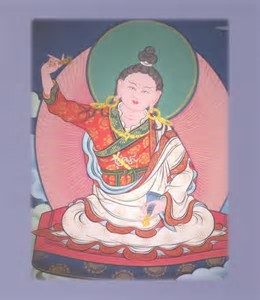
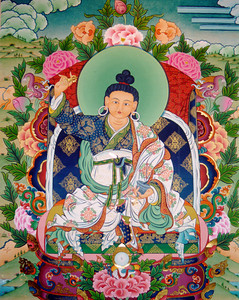
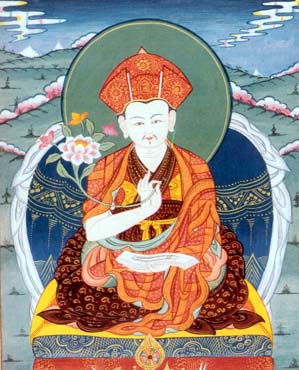
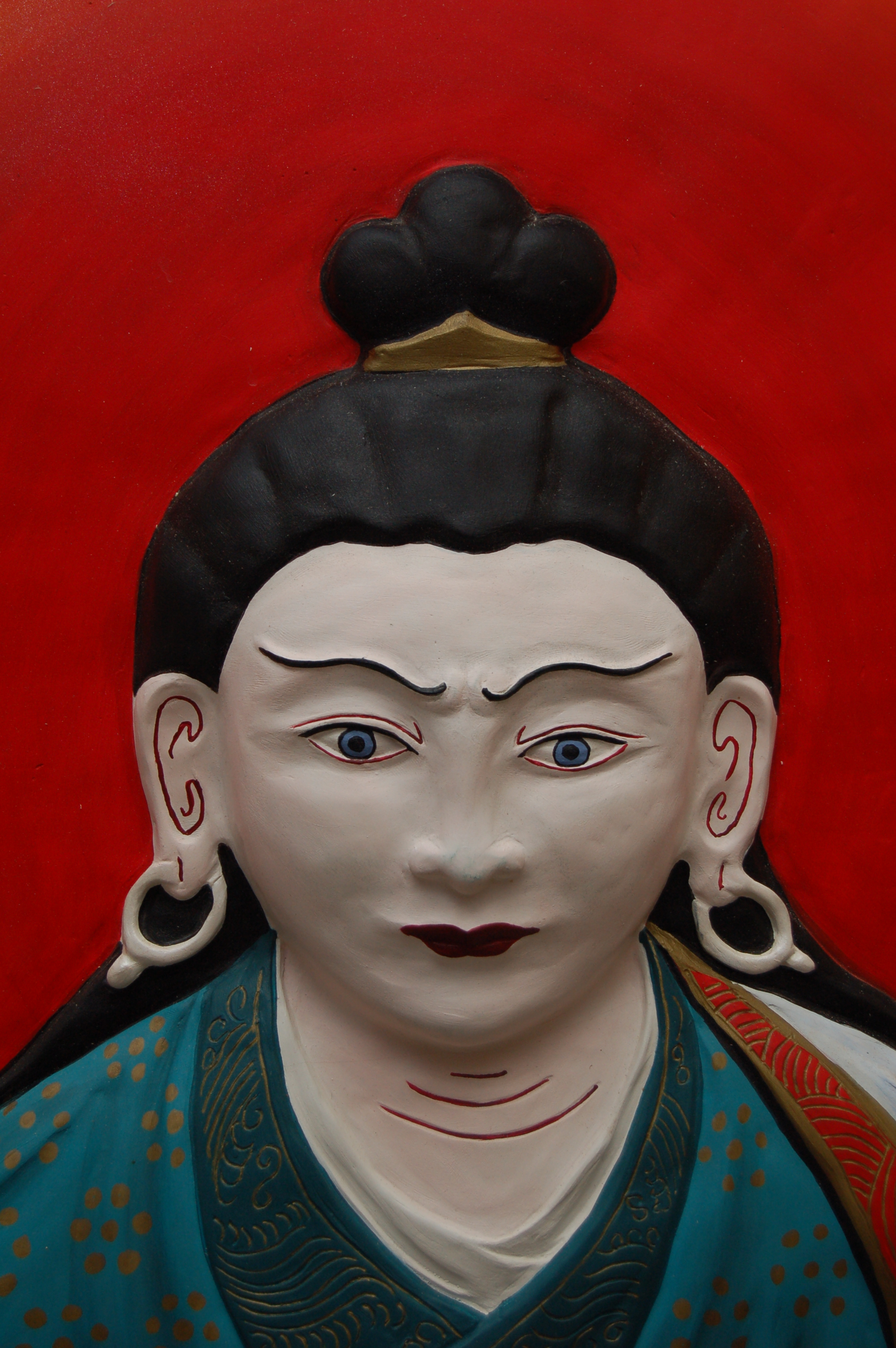
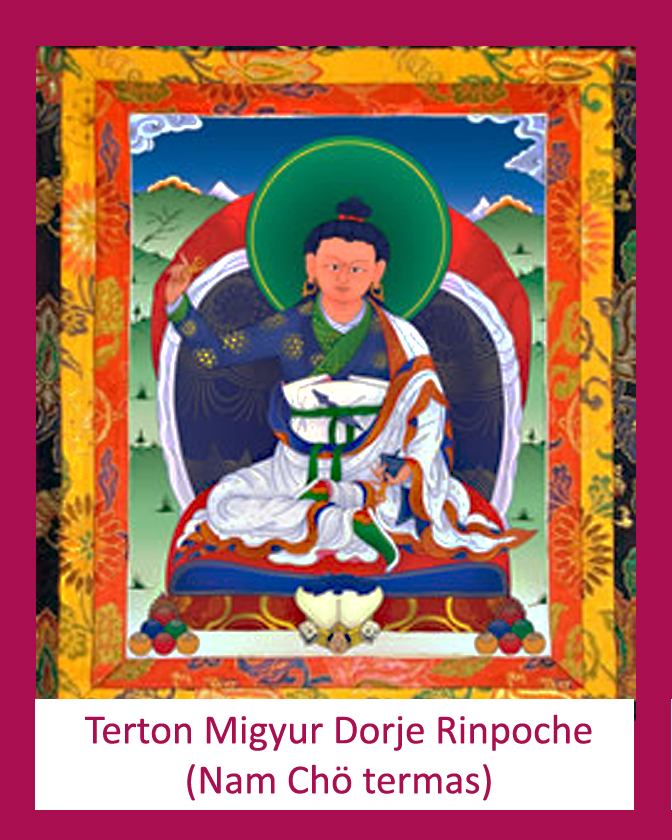
The following is an excerpt from a teaching offered by Tulku Dawa Gyalpo at Kunzang Palyul Choling in Maryland. Future posts will continue with the teaching on the Life of Migyur Dorje.
In that way, the years passed. He went to Karma Chagme’s cave one time when he was seven. He liked staying there, but he was very shy and scared of his grandpa. His grandpa and his father would not let him stay over in a cave with Karma Chagme. At that time they met and they separated. And from there for three years, nothing. I think his grandpa was now drinking alcohol. He was always drinking, not taking much care of his grandson. And there’s another reason too. However, when he turned ten, he was able to go to Karma Chagme. Then they allowed him teach. Now it was time to study. Fortunately, it seems like grandpa didn’t know how to teach. Otherwise, he would teach. Then they passed Tulku Migyur Dorje to Karma Chagme to teach. Karma Chagme started teaching basic needs and all that, and about the spiritual path, too. From refuge, Karma Chagme started with the Dzogchen tradition.
He started teachings, then gradually he gave empowerment to that ten year old boy. The first empowerment he gave was the Amitayus empowerment in accordance with Ratna Lingpa’s treasure, and he gave Peaceful Guru Rinpoche and Wrathful Guru Rinpoche empowerments. Before giving empowerment, he checked karmic relations, which kind of deity or buddha was more akin to him or which he had his karmic relationship with. Throwing the flower, checking which is more suitable for you, to determine during the empowerment what kind of deity you have to visualize yourself as. In all three of those empowerments, whenever Tulku Migyur Dorje threw the flower, it either fell in the middle or in the east, always these two. Then Karma Chagme thought, “Now I will give him a name. He is always throwing in these two, so I’m going to name him Orgyen Migyur, Orgyen Migyur. Actually Karma Chagme said, “The east is Vajra and the center is Migyur. Migyur Vajra, Migyur Dorje. But he thought, “No, maybe I’ll give Orgyen Migyur.” And he gave him Orgyen Migyur, and that boy did not accept that name. That boy said this is not my name.
Now this is amazing. He said, “This is not my name.” Karma Chagme went back to his first thought. He said, “Well, I will give you Migyur Dorje,” and the boy was happy. He loved that. “Yes, this is my name.” That’s what he said when he was ten. From there on, he was cared for by Karma Chagme. Karma Chagme provided all the teachings and whatever he needed. The first year, when Tulku Migyur Dorje was ten, Karma Chagme gave teaching, empowerment, everything. The second year when Tulku Migyur Dorje turned eleven, then Karma Chagme started his retreat. At the same time, he let Tulku Migyur Dorje stay in retreat with him. So Tulku Migyur Dorje started three year retreat when he was eleven. He was receiving teaching and practicing. All this. Just two of them in a cave, in retreat. Right after he turned twelve, within this three years actually, he began to reveal the Sky Treasures, for which we have the sadhanas and the teachings we do in summer retreat. He revealed all this teaching during those three years. Some of them were revealed in a dream, some of them were revealed in his experience, some of them were revealed in actuality. That’s why it’s called [Tibetan].
The following is an excerpt from a teaching offered by Tulku Dawa Gyalpo at Kunzang Palyul Choling in Maryland. Future posts will continue with the teaching on the Life of Migyur Dorje.
After nine months, Tulku Migyur Dorje was born, in the tenth lunar month and seventh day. When he was born, he was related to Karma Chagme. At that time, Karma Chagme was not checking about him. Karma Chagme sent just one profound protection cord, which was normal. In Tibet, the Lama used to give to everybody. Especially when a son or daughter was born, they would give that. So Karma Chagme was an uncle now. He heard that his nephew was born, so he sent that red cord that we are put on our neck. He himself was doing retreat. He didn’t come out. He sent some sumdi for his nephew. I think that was the first connection with him, the first connection between Karma Chagme and Tulku Migyur Dorje. Tulku Migyur Dorje got his first things from Karma Chagme.
Later, Tulku Migyur Dorje’s sibling was born. His brother’s name was [unintelligible] Tashi. When his brother was born, his mother could not take care of him anymore. He was mostly cared for by his grandpa. He had two grandpas, one from the father’s side, one from the mother’s side, but seems like among the two, he would be cared for by one. He didn’t go one day here and one day there. One grandpa’s name was Tsering Bum and the other one was Adrup. Adrup and Tsering Bum. When Tulku Migyur Dorje started to speak, he said amazing things. He said so many different things, but they didn’t care. The grandpas, the parents, they didn’t care about what he was saying. Actually they didn’t know what he was talking about. He was saying things that every child does not commonly say, but they had no idea what he was saying. He said so many things at that time. It says in his story. Our Holiness also used to say that. At that time, he actually taught, but nobody listened to him.
Among those two grandpas, Tsering Bum was a good person, with a good nature. Adrup had a very bad nature. His grandpa Adrup didn’t like Dharma so much. He didn’t practice Dharma so much, and he liked to hunt. He had an arrow and bow, bow and arrow and everything, those weapons which can kill deer and those things. His grandpa, Tsering Bum, was kind of a spiritual man. He practiced; he meditated. He recited MANI mantra and all those mantras. When he did those things, his son, not Tulku Migyur Dorje, his son came to him saying, “You are very good. You are making very good your way.” He appreciated what he was doing and he said all those things. Mostly Tulku Migyur Dorje lived with Adrup. Adrup was the more powerful. He wanted to take of his grandson. He didn’t want to give him to Tsering Bum. Unfortunately, he mostly was taken care of by Adrup. Adrup’s nature was not so spiritual. He did not do meditation. He did not recite any mantras, and he didn’t practice at all. Whenever Tulku Migyur Dorje saw his grandpa Adrup, he felt very sad, and he said that, “You are making a very bad way for your future.” He used to say that at that time, but they just ignored him. Let the kid say whatever he says. They didn’t care much. This really happened. If some kid two years, three years, four years said this kind of strange things, nobody cares, right? Just let him. Let him say. Grandpa was not caring what he said. Also it is said that when he was a kid, he liked to wear clothing of monk’s colors. He did mudras and recited mantras naturally from his mouth. These kind of things happened with him, but nobody cared at that time.
When he was seven years old, he saw the Loden Chogsed, Guru Loden Chogsed. Guru Loden Chogsed is among the eight manifestations of Guru Rinpoche. Guru Loden Chogsed tried to teach him the vocabulary at that time. He also saw the Dharma protector, Nechen Shenphen Marnak. Actually Nechen Shenphen Marnak was the Sky Treasures protector. Nechen Shenphen Marnak appeared to him and he also tried to teach some more vocabulary. He said, “From Kathog [monastery], some monks will come to look after you,” because he was the reincarnation of Wangdruk Jatso, who was Kathog’s lama. This happens normally in Tibet. Still today, no matter where you are from they will take you. As you can see now with our little Holiness, it is very obvious. Our little Holiness was born in Phakpo, in the center of Tibet, but he was grabbed by Kham. Now he’s in Kham, Palyul. This really happens. Nechen Shenphen Marnak told Tulku Migyur Dorje when he was seven, “They are coming to look after you, but they won’t get you. Karma Chagme will come and he will get you. He will teach you very well.” When Nechen Shenphen Marnak said that to him, he was seven. At that time he was still not Migyur Dorje. I don’t know what his name was.
The Kathog lamas came to [unintelligible]. They heard about this family and a child born there. Also the letter that Wangdrup Jatso wrote was possessed by them, not Karma Chagme, and according to that letter they came to find their master. Three monks came to his house. What can I say? This is fortunate or this is unfortunate. I don’t know. If you look from one hand, it seems fortunate, but if you look from the other hand, it looks unfortunate. When those three monks came to look for him, he was staying with his bad grandpa. When those monks talked about him, grrrr, grandpa was angry. He didn’t want to listen to anything about that, and they couldn’t get the boy from him. He kicked them out. Later again, other monks came from Kathog. At that time, he was with his father, but his father scolded them instead of accepting them, and let them go away. He didn’t give his son to them. Normally it is very difficult to give. If somebody came to you that you didn’t know asking for your son, how could you give? It’s very difficult. However, they couldn’t get him in accordance with what Nechen Shenphen Marnak prophesized.
The story of the Life of Migyur Dorje will continue in future posts.
The following is an excerpt from a teaching offered by Tulku Dawa Gyalpo at Kunzang Palyul Choling in Maryland. Future posts will continue with the teaching on the Life of Migyur Dorje.
Maybe you have no idea what I am talking about here. If I talked about New York and Washington, D.C., then all the locations would pop up in your mind. In my mind, this location is also very blurry. Probably most of us know the Kham region, close to China, in eastern Tibet. That location we can imagine easily. Actually it’s in the praise or the invocation in Tulku Migyur Dorje’s stanza.
They’re describing about why it’s named Nhom. They describe so many different meanings. When they praise their own land, they say it’s named Nhom because there is very fertile land there. Actually, Nhom is show, you know? Show off. Yes, Nhom is show off. The meaning of the name is like that. When they describe why it’s named show off, then they will say, “Oh, there’s a fertile field there, and there’s a great person which we can show off to other regions; and we have very good land that we can show off to others.” They give so many reasons, but this is not necessary. This is not important. Just let it be. Maybe it is not appropriate for me to say that because my region is the U-Tsang, which is poorer. He was born in Nhom.
Guru Rinpoche prophesized, that Tulku Migyur Dorje’s previous lama, who’s named Wangchuk Jatso, was a monk in Kathog monastery. He spent most of his lifetime in retreat. When Wangchuk Jatso was about to pass away, then he himself prophesized his next life. Wangchuk Jatso said that his reincarnation would be born into the land between Karma and Riwoche. The old tradition also mentions this in the writings. That shows that Tertön Migyur Dorje is the reincarnation of Wangchuk Jatso.
Karma Chagme also mentioned that it wass said that Wangchuk Jatso’s reincarnation would be born bordering Riwoche and Chamdo, exactly where Tulku Migyur was born. Karma Chagme checked, analyzed, whether this was the exact person he was looking for or not. He checked all these things. Normally this is one way that we recognize the tulku. This shows how we recognize a tulku. Also I think that this is Karma Chagme’s own master. That master, whose name is Rigdzin Dudul Dorje, is also very much related with Tertön Migyur Dorje. It seems like he’s from the center of Tibet, not from Kham. However, it seems that Karma Chagme, himself respects that person very much when we look to the history later. Rigdzin Dudul Dorje was also a tertӧn. Before Tulku Migyur Dorje was born, he prophesized is the Lama called Shupal Palgyi Senge… Who is Shupal Palgyi Senge? Shupal Palgyi Senge is the one great disciples of Guru Padmasambhava, one of the 25 great mahasiddhas. Shupal Palgyi Senge, Lochen Berotsana, Longdrol Konchok Chonyi, these three are related with Tulku Migyur Dorje, especially Shupal Palgyi Senge.
Lama [Lama’s mother?] had been [blessed?] by the mandala of the Precious Jewels, which means kind of like Tulku Migyur Dorje went in their womb. Tulku Migyur Dorje who is called the precious mandala of Dharma got into the womb of the mother and received the empowerment of the Rigpe Tsalwang. He also has been empowered through the yidam deities practice or experience or empowerment through this phak. He can experience or receive the teachings from the yidam deities either through actual experience or through dreams. He was actually named by Tertӧn Rigdzin Dudul Dorje. His secret name was Pema Totrentsal. The common name was Migyur Dorje in the future in the place close to Riwoche in the Dokham area. His name will be the name of Dorje. To represent the spontaneous achievement of the three kayas, his body was marked with a blue mole. In order to represent that he had achieved the three kayas, he had a mole on his body. In some texts, like Pema Khatang, it says that in order to be an authentic tertӧn, these moles will be in certain spots like at the forehead, the throat, the navel and heart, those special spots. That’s why at the beginning, Karma Chagme is saying I know how to check the treasure revealers. Whoever he teaches or sees his face will be free from birth in lower realms.
He prophesized that kind of person is coming in the future. Also Ratna Lingpa’s treasure, that Ratna Lingpa’s treasure is very clear that Chöying Dorje was also one person’s name and Migyur Dorje was his name. He said Chöying Dorje was another great master’s name during that time. Karma Chagme was saying that when Tulku Migyur Dorje was born, Chöying Dorje was 42 years, but Ratna Lingpa had already prophesized Tulku Migyur Dorje’s birth before that. Ratna Lingpa had already passed away long before. He prophesized the future and he prophesized that Tulku Migyur Dorje would come during the time when a great master named Chöying Dorje was on this earth. Karma Chagme put together all these prophesies from the different treasure revealers and masters. He did this to show that he analyzed all of this to see if it matched with Tulku Migyur Dorje exactly or not.
Actually, Migyur Dorje was not his name when he was born. Migyur Dorje was not born. Somebody had to name him that later. This was prophesized before Tulku Migyur Dorje was born in Nhom region. Migyur Dorje was conceived in the womb of his mother during the first month of the wood female rooster. Karma Chagme heard from his mother that when that baby was conceived in her womb, she had a dream. She saw a very beautiful pond or a lake, full of blue water, very clear water. In that water, there was one golden turtle, shining. Everybody, all of us [in her dream] were just looking at it. How beautiful it was! Everybody lost themselves just looking at it and enjoying it. Suddenly, one strong man showed up and grabbed that gold turtle and gave it to her. That was the sign or dream that Karma Chagme heard from Tulku Migyur Dorje’s mother.
The Life Story of Migyur Dorje will continue in future posts.
The following is an excerpt from a teaching offered by Tulku Dawa Gyalpo at Kunzang Palyul Choling in Maryland. Future posts will continue with the teaching on the Life of Migyur Dorje.
It is very important to understand about the history because if you don’t know the history of these secret Vajrayana things then people might have doubt because they don’t know the original source of such things. Tulku Migyur Dorje’s whole life was spent practicing the secret Mantrayana path. Is this Vajrayana path in accordance with tantra or not? If the treasure revelation of Tulku Migyur Dorje is not in accord with the tantra then it is hard to believe that it is authentic treasure. Any kind of treasure has to be in accord with tantra. So if we look at the history, then we will know whether the treasure revealed by the Tertön is in accordance with tantra or not. If we don’t analyze the history of the Tertön and the treasure revealed, then we won’t know whether that treasure is in accordance with tantra or not. If we don’t know that, then we won’t have confidence in this treasure. In that way, it might be doubtful that we will be able to receive the blessing. For general purposes, this is the case. If there are certain people who have no doubt at all whatsoever and who believe in this treasure and then practice it accordingly, then for that kind of person, for sure, there are blessings. Normally we people have so much doubt. Therefore, in order to remove that doubt, studying the history is important.
Now let me begin the history of Tulku Migyur Dorje. Most of his history was written by Kyedup Karma Chagme. Kyedup Karma Chagme was actually his uncle. Kyedup Karma Chagme himself was a great practitioner before Tulku Migyur Dorje was born. He was always doing retreat. He spent most of the time in retreat. Before he started to write about Tulku Migyur Dorje’s life history, he said—this is very important—“I myself learned so many things, so I know how karma works. I learned what the virtuous and non-virtuous actions are. I learned what virtuous action does, and what non-virtuous action does. I myself practice the path of the Bodhisattva. I know and have confidence about looking at all sentient beings as the mother, and as such I look at every single person as the mother. I know how to practice the Bodhisattva’s path.” Another thing he said before he started to write [the history of Tulku Migyur Dorje] was, “I started to receive all the tantric teachings, and I have all this knowledge. I know how to check an authentic treasure-revealer. I also know that Guru Rinpoche prophesized that there will be fake treasure-revealers and deceiving persons. I know how to check that too. I am a fully ordained practitioner.”
There is one history, also related with that, in the Gonjo region. Maybe like me, you don’t know about the Gonjo region, but I know where it is located. I know there is Kham, and Dege. Our Palyul monastery is located in Dege. Khamdo, Riwoche, Ganze, Amdo. I belong to central Tibet, U-Tsang, which is close to the Nepal border. My father’s village, is called Nya-dham. It borders with Dham. I am from there. It is considered the worst place in Tibet, actually. That’s what I have heard. I have never been there. Some of my friends came from that way, and they told me, “I never saw any worse place than this—ever!” I have no idea, but maybe I will see for myself one day.
When one of the re-incarnations of the Karmapa, Karmapa-chi, came to the Gonjo region, he showed many miracles. He gathered together many disciples, many people, and led them onto the path of the Dharma. One person from Gonjo, who was very devoted and had faith in Karma Chagme, suggested to Karma Chagme, “In the past, Karma Chagme, you came here and showed so many miracles. Can you please show many miracles and teach many people?”
Karma Chagme said, “I have this very clean karsugo-re, morality. That is my great miracle. This is all the miracles I have.” That’s what he said. Because he is a fully-ordained monk, a Bhikshu, or in Tibetan, Gelong, if he told a lie about his realization, then his vows would be degenerated. So if a fully ordained monk, Gelong, tells that he saw a god, demon or devil, that becomes a lie about his realization, which makes a condition to lose his vow. He said all of this in detail. This is exactly what he said, “If it doesn’t have the main meaning, there’s no point of writing a whole lot of books.” He also wrote over 250 pages. So difficult to read, and how difficult for him to write. “So if there is not any meaning, I have no time to write these things.”
There is a great meaning behind this history. Before that, he started with his personal introduction. It said, “I know what to do, what not to do. I know what fully ordained are supposed to do or not, what bodhisattvas are supposed to do or not.” Whatever he wrote is based on what he saw and what he heard directly from Tulku Migyur Dorje. At the end, he used information from some others. He had no choice but to get information from them. Except for that, he wrote all this, exactly whatever he heard and whatever he saw.
He’s said all these things so that people can have confidence and faith in this writing of his. From here I will start the full life story of Tulku Migyur Dorje.
Tulku Migyur Dorje was prophesized by many different people, such as Guru Padmasambhava. Actually, Guru Padmasambhava prophesized about all the tertӧns. In the future, any treasure-revealer who comes on this earth has to be related with Guru Rinpoche. There is no treasure-revealer who doesn’t relate to Guru Padmasambhava. We have to understand that. Before Guru Padmasambhava there were some, but they aren’t called treasure-revealers. The name of treasure-revealer is very related with Guru Padmasambhava. Guru Padmasambhava prophesized exactly Tulku Migyur Dorje’s name and the place where he was going to be born. Dorje Mingjen shows one part of his name, Dorje. Mingjen means named, named as Dorje. A person named as Dorje will be born in Nhom. That’s the name of the place exactly where Tulku Migyur Dorje was born, Nhom. Nhom it seems is a little bit big. It’s not small, like a few, few houses. It is not like that. Nhom seems like a town. Within Nhom, in Tibet, they said there is an upper part of Nhom, a middle part of Nhom, and a lower part of Nhom. Thus, so far, what we’re getting from Guru Rinpoche’s prophesy is only Nhom, where Tulku Migyur Dorje was born. Actually he is born in the upper part of Nhom. He was born in the upper part of Nhom, which is exactly close to the border with Riwoche and Chamdo. Actually he was born the upper part of Nhom. I think that place is also named Karma, Karma and Riwoche. This is all in the Kham region.
The story will be continued in future posts. Please subscribe or check back in!
The following is an excerpt from a teaching offered by Tulku Dawa Gyalpo at Kunzang Palyul Choling in Maryland. Future posts will continue with the teaching on the Life of Migyur Dorje.
First of all, generate this altruistic bodhicitta thinking that for the sake of all sentient beings, I am going to listen to the life story of the great Tertön Migyur Dorje. By listening to his life story, I’m going to generate confidence in the revelation teachings of Tertön Migyur Dorje. Then I’m going to put the generation and completion stages into practice, to be able to lead all sentient beings into the complete state of Vidyadharahood. For that purpose, I’m going to listen to this and generate bodhicitta.
Today’s talk is about the life story of Tertön Migyur Dorje. I came to know that Jetsunma Akhön Lhamo had this sudden experience, or some kind of thing, that made her ask me to talk about his life story. This was related to me from Gonpo and others. I heard about Tertön Migyur Dorje’s life story here and there from our late Holiness Penor Rinpoche Holiness, but I didn’t really study his life story deeply. Because I was told to talk about his life story, that became a catalyst or a condition for me to look into the life story of Tulku Migyur Dorje. I heard the life story of Tertön Migyur Dorje from our late Holiness, my own root guru, as well as from our Khenpos and tulkus. They taught me about Tulku Migyur Dorje’s story. I know their personalities very well, so I didn’t look at it in detail. Today, when Jetsunma Akhön Lhamo asked me to talk about this, then I started to look in detail. Actually it is not possible to complete this in two hours. There is an outer history, inner history and secret history. There are over 250 pages [in this book] and that is not all. There are also some others [books] that I have to look at. Here I am trying to shorten over 250 pages [to fit] within this two hours. I think maybe tonight it will take a little longer than usual.
When I looked, I enjoyed myself very much. I felt bliss after I looked at those histories. Before I start this, I would like to thank Jetsunma Akhon Lhamo so much because she made this condition for me. I am so pleased and happy to talk about it. Not just only for me; for all who follow this tradition. It’s very important. He is the head, or root, of this tradition, where it comes from, when it started, and from there, what is going on in the Palyul lineage. He is like Shakyamuni Buddha, the person who started Buddhism on this planet. Likewise, Tulku Migyur Dorje is the person who started this Palyul tradition, especially this Sky Treasure. Therefore, I’m considering myself very fortunate to have a chance to talk about it.
Before I start, I would like to describe a little about the namthar, which is a kind of liberation. thar is liberation. Nam is like aspect, if you translate it word for word. The life history of a normal person isn’t namthar. We don’t call it namthar. It is “history,” but in Tibetan we have a different word. If the life has a very deep meaning and is very beneficial, it’s called namthar. If it is just a normal person’s life story, we call logyu, a different way of saying it. In English, it is Tulku Dawa’s history or it is Tulku Migyur Dorje’s history. It’s the same. There’s no different “history.” But when we talk in the Tibetan way, there is a big difference.
Nam is the aspect, or it could also be “appearance.” Thar is liberation by looking in that person’s aspect, which means their life. Their life is their aspect, their appearance. Through looking at their aspect, or the appearance of their three doors, we can get liberation by studying their life story. For that it is very important to look at the great person’s life story so we will know what we have to do in order to follow their path. Like Shakyamuni Buddha’s life history. If I am trying to follow him, then what should I do? This is Tulku Migyur Dorje’s history, the namthar.
The following is an excerpt from a teaching by Jetsunma Ahkon Lhamo offered during a Phowa retreat:
So where were we the last time we met? We were dead, weren’t we? We were, weren’t we? Let’s see, how dead were we? I think we were pretty much all the way dead. We had finished with the red and with the white, and we were talking about the black path or the dark path, but I have more to give you on that. Anyway, we definitely are dead here.
There are some interesting passages in this book that I would like to use as well. There’s one point that the lama in this book makes that I think is worth making. Even though it isn’t what you’d call an essential point, still, it is definitely a worthwhile point, and it’s because of the way we think. When we think about practicing for death, or when we think about, even talk about the different kinds of sufferings that people may undergo, even talk about the kinds of death experiences that we will all definitely share in common, and some of the unique experiences that some of us may share, there are many people who give Buddhism a bum rap. What I would call a bum rap. And the idea, of course, that they confer when they have that thought is kind of a bum idea, if you think about it. It isn’t thought through; it is an idea born of ignorance. What people say about Buddhism often is that it makes them think in a depressive way, or it makes them think in a melancholy way. Since one of the main points in Buddhism is to prepare for what happens after this life, there are many people who accuse Buddhism of being a sad religion or depressive or having a bad effect on one’s mood. Well, these very people are the people who are in denial about the fact that they too will actually go through this experience.
You may not want to learn what to do in an emergency…Here’s a good example: When I was in junior high school, believe it or not, I learned how to deliver a baby, in case of emergency. Can you believe that? This Red Cross representative came to our school and gave us lessons on different things one could do in case of an emergency. And in this case I learned what to do if someone is having a baby and there’s no way to get to a hospital and one is shut off and it’s an emergency. Now you might think to yourself, “So what? What are the chances that I’m going to deliver a baby in this lifetime?” I’m mostly called on when people die; I’m not necessarily called on when they’re born. I’ve had the great, wonderful pleasure of naming babies. I’ve been there right after the baby’s born, but so far, not ever having taken that job as a taxicab driver that I once thought about, I’ve never had to deliver a baby, ever in my life. So you think to yourself, “How useful was that?” Well, the only reason why you would think that is because so far I haven’t had to deliver a baby. But let’s say, any of you who are women capable of having babies, you and I were stranded in a snowstorm some time, and I was the very one that saved you from trouble by delivering your baby. Would you say that that course was useful to me? I would say it’s useful to me, because I would have been climbing the walls if I hadn’t known what to do when you were having a baby! You can count on that. That just would have been the scariest moment of my life! I’d rather usher people out than usher them in! Less messy.
So what does all of this have to do with the Buddha Dharma? Well, I’ll tell you. If the day ever comes that I do get caught in a snowstorm with somebody and have to deliver a baby, and I remember those skills and have to use them, suddenly those skills will be considered by me to be completely different than they were before. Now I think of it as a kind of interesting and unusual thing that happened. Not many people learn how to do this. This is not something that is commonly taught in junior high school. So I can look back and think, “What an interesting episode for the New York school system to bring in these people. It’s just a very interesting thing that the New York school system did.” But the idea that I would have if I were to actually help someone give birth, and I were to actually possibly save a life that way, or at least make a life more comfortable in its beginning, if I were able to do that, suddenly that teaching, that course that I took would take on new dimensions and new meaning. Wouldn’t that be true? Suddenly I would really see the benefit of that in a way that I could not have seen if it were only a theoretical event that I might have to deliver a baby some day. So I would have seen the definite result of that.
Now some people think that it is unfortunate that Buddhism teaches, first of all, about the faults of cyclic existence, and then secondarily about the situation of dying and how our lamas constantly remind us that we in fact will definitely go through this event. This is something that we will all experience. We will not experience it together, so each one of us is responsible for our individual practice. But we will all experience it; there’s no doubt about that. None whatsoever.
An excerpt from a teaching called Dharma and the Western Mind by Jetsunma Ahkon Lhamo
As Westerners practicing the Dharma, we have a hard job ahead of us. If we want to accomplish Dharma, and make Dharma stable, if we want to be fully instated in our practice, and if we want to be successful, we are doing so in a culture that is not really sympathetic to it. It is hard. It is really hard. We are doing so under circumstances in which we have to work, we have to eat and where nobody is going to pay us to pray. It is not going to be easy. We have to stabilize ourselves with that pure intention to love and to do that we have to do three things.
These are my three rules of etiquette for newly starting practitioners and also for old ones. First of all, give yourself a break, there are things on this path that you will not understand and you should not fall into the trap of saying, “This can’t be right, or this isn’t right.” Give yourself a break, take time to let it fall into the slot that your Western mind is, just give it time to settle in. These concepts are very logical, they all make sense, they all work, and they are given to us by a fully enlightened mind which makes me think that they are worth more than a lot of other things that I have heard. And they work. It is a workable path. If there is something that confuses you just say, “Okay I will just give myself some time about this. If I am not comfortable with the idea about being empty of self-nature let me first find out what that means before I decide that this is not good and once I find out I can make a better decision.” So give yourself a break.
The next thing is to do the best that you can. Don’t try to slide into Dharma, and don’t think that you can slide by. Do the best that you can. Cultivate that loving every day. Don’t ever fall into the trap of thinking that you are too old, or too experienced, or too educated to learn the simple lessons that Buddha gives us that are associated with loving. Do not think that you are too far advanced that you can no longer be taught compassion. Don’t ever think that and please don’t think that you have come too far to learn and re-learn renunciation of ordinary things, because no one ever comes that far until we have reached supreme enlightenment. So do the best that you can.
The third thing is to take it slow and take it easy. Try not to burn like paper – hot and fast. Try not to burn like pinewood. Try to burn like good aged oak or maybe even coal – slow and hot and stable. The way that you build the stability on this path, as a Westerner, is by cultivating that slow, hot fire of loving. Keep it going. You don’t have to do anything crazy but you have to do something steady and stable.
Remember you have to practice this path till the end of your life so that you can fully accomplish it and so that you can truly be of benefit to sentient beings. It is going to take some juice so please try to burn like good oak or coal, slow and hot. Just think of yourself as a vehicle. Think of yourself as a bowl, turned up, clean, pure, with no cracks, not turned over, and no poison of judgment or delusion at the bottom of it. Your mind is like a bowl. Let yourself receive teachings in a very pure and uncontrived way. In this way you will understand Dharma better.
Look for a good teacher and when you find that teacher you should take time to examine that teacher. What is the teacher’s motivation? Can this teacher really offer me the path? Is this teacher really teaching the path that leads me to supreme enlightenment? You should examine these things and in a stable way, slow and easy, begin to accomplish Dharma.
In this way there is no doubt that you will achieve supreme realization. There is no doubt that you will in this life and in all future lives be of some benefit to sentient beings. Ultimately you will be of ultimate benefit to sentient beings, there is no doubt.
Keeping these things in your heart I hope that you will be cultivating that stability. Do that and remember what a glorious and wonderful opportunity you have. Please don’t waste this life. It is so precious.
The following is an excerpt from a teaching by Jetsunma Ahkon Lhamo called “The Habit of Bodhicitta”
Now if we really understood that and meditated on the suffering of beings, we wouldn’t have some of the same ideas that we have now. For instance, sometimes we think that because we’re following a spiritual path, we should be just a little self-righteous. Don’t you think? We look around at other people who are very materialistic, who are spending their whole lives doing things that we consider to be lower activities. And we look around at people that even society labels as being lower. We look around at prostitutes; we look at people who rob banks. Both are doing things that they’re doing for similar reasons to why we’re doing what we’re doing. The prostitute wants money; she wants to make a better life, she or he. The bank robber wants money; they want to make a better life. They’re looking for power. Same reasons as we do, just the activity is different. Of course, we feel ever so much better, for whatever reason. But if we really understood and really meditated on the fact that all of us are in exactly the same condition, there would be no room for judgment. We would really realize the plight of humankind, and, in a greater sense, the plight of all sentient beings.
Now the Buddha’s teaching gives us the foundation, or fundamental necessities, by which we can give rise to the bodhichitta, or the great compassion. But that’s only the foundation. And here is why: The problem with our trying very hard to awaken to compassion is our own habitual tendency. Our own habitual tendency is such that we only concentrate on our own plight. Sometimes we do empathize with others. We think, ‘Oh, gosh, that must be awful. That’s too bad. Gee, that would be awful for me.’ It’s almost like you take a rubber band and you stretch it out just far enough to see what the plight of the other person is, but then the habitual tendency comes back in and BINGO! Rubber band lets go and now we are thinking about ourselves again. And that is how it is, isn’t it? That is how it is. That is really the only way that we understand others, because we can understand how we would feel about that and we’re sure glad that it’s not happening to us. It’s kind of like that.
The following is an excerpt from a teaching by Jetsunma Ahkon Lhamo called “The Habit of Bodhicitta”
Another method that we are given is to think about the plight of sentient beings. We should think, for instance, that in the animal realm, some animals are whipped and beaten as beasts of burden. I saw some of that when I went to India: the bow ox that pull huge carts, literally four times their size. These are huge animals. They have a great deal of muscle and yet they were carrying so much that they could only barely move. And they were constantly whipped; and actually painted up and decorated in this terribly hot climate under terrible conditions. Think about oysters that are harvested for their meat and their pearl, that they live only for that. Some of them were born in cultivated areas, you know, cultivated oyster farms, just to be eaten for their meat and pearl. And we think about all the different animals that are completely victimized. Think about the animals that are food for predators and are constantly being hunted and killed, that live in fear. Their main instinct is this highly inflamed and developed fear instinct, simply in order to preserve their lives. So we develop a kinship with other forms of life by understanding what their suffering is.
And then we look at the plight of human beings: How human beings are basically taught by their authority figures and parental figures and by their culture. It is dictated to them what they should do. Here in America, for instance, we are told that material values are of the utmost importance. And we spend a great deal of time in school, and then we spend a great deal of time in different kinds of preparation in order to become materially successful. And if you don’t become materialistically successful and comfortable in a certain way, you’re not considered to be an adequate human being, quite frankly. There is a problem there. You never quite feel good about yourself, and there’s an innate dissatisfaction.
For those of us who do succeed and do well in our lives, towards the end of our lives, we have a great suffering. We realize that we’ve gone to school and we’ve practiced, and we’ve worked, and been work-a-holics and done what we thought was the right thing—supporting our families, and caring for our families and just doing the very best that we can,. Then we realize at the end of our lives we have nothing. Nothing! All that we worked so hard for we cannot take with us. We look around us and the people to whom we gave whatever we worked for, too, also have suffering. How come it didn’t heal them? Why didn’t the money and the cooking and the housework and everything that we gave them, why didn’t it do them any good? They’re still crying.
We look around at our lives and we go, what was that? And we realize that the only thing that we can take with us into the bardo, the intermediate state that prepares us for our next life, is the habit patterns of our mind. And the habit pattern of our mind under those conditions is only intense grasping.
And that’s a great suffering that we human beings experience together.
The following is an excerpt from a teaching by Jetsunma Ahkon Lhamo offered during a Phowa retreat:
The next thing that happens, if we are continuing through the bardo, is that the female bindu, or tigle, disengages from the base of the spine, and that is the mother seed. The mother seed then rises up to the heart. When that happens, we will see red luminosity. Now literally, we have never seen red luminosity before. We don’t know what it is, complicated by the fact that it’s like no red we’ve ever seen before, and no luminosity we’ve ever seen before. It’s extraordinarily brilliant. Extraordinarily profound. It is the kind of experience where we don’t just see the light ‘out there,’ it effects one totally; and so there may be a fear of that. Generally speaking, practitioners run from the red light.
The red light is actually the appearance of the female buddhas or the dakinis. It is the true, essential nature that was your mother’s nature, without the level of delusion that your mother carried, her true nature, her buddha nature. That is the truth of that. You will see this red light and, in most cases, sentient beings will run away from that red light. They will not know what it is. It will confuse them. And at that time there is also an impact of sound and feeling as well. You can’t explain that, but try to imagine light that registers so strongly that it registers on every sense you’ve ever experienced. So there is a feeling and a hearing and every kind of component to it as well. It’s just too much for the unprepared.
Then the white and the red light come together in the heart. They meet. And at that time an extraordinary thing happens. All the elements have dissolved, the male and female buddha principles have united within your mind, and , temporarily, you have none of any of the attachments and hangups and clinging associated with physical life. All the elements have dissolved. There is a moment of spaciousness at that time such as you have never experienced before, and cannot experience at any other moment.
This moment is so precious. So precious. Because at that moment when the male and female principle unite within the heart, one sees clearly the Dharmata, the true face of one’s own nature. All phenomena is seen at that time to have the same taste. One cannot make a distinction. One cannot literally make a distinction between subjective and objective. All of the components of deluded mind are temporarily disengaged at that period of time; and there is, at that moment, the most extraordinary potential for liberation. But the Dharmata, our true nature, has no visible light, because, what would be that that is lit? Our nature is not that which can be described, let alone colored or lit. What would be that thing that is lit? So our perception, when these two elements come together, is an experience of black luminosity for the non-practitioner, and this black luminosity affects the non-practitioner as a fainting or a sleep. This is the time during the death process when the sentient being actually goes under, goes dead—goes dead in their minds. They actually experience death.
For the practitioner, that dark luminosity, if we are prepared and if we have experienced meditation successfully even for a moment, can be perceived as clear luminosity. Now remember, the condition of our mind affects us. If we are fearful, if we are running in the bardo state, it will be dark luminosity and it will frighten us; and it will be tremendously impactful. But if we are prepared and our minds have been changed through meditation, then it will be a clear luminosity and a recognition of one’s own mind, of one’s own supreme buddha nature. It will be very much like a mother and a child who have been separated: Suddenly the child sees her mother and she runs to her mother, and there’s no denying her mother. The smell, the touch, the view of her mother is like… There is no one else. I could not deny that this is my mother; this is my long lost mother. And the child, literally who—this is the practitioner, of course—jumps into the mother’s lap and drinks the milk from the mother’s breast. And that is what happens if one is prepared for death. When that moment occurs, we jump through pure view into the arms of the Dharmata and we drink the nectar of our buddhahood. And that is a happy and profound and joyful moment for that one who is prepared for death.
Unfortunately, however, and this is where we are going to close, so that you have something to think about tonight, for those who are unprepared for death, this is the moment they miss utterly. It is never known. This precious moment where we come face to face, freely with our own nature—and we sleep through it, we literally sleep through it—and it’s because we cannot recognize. It is like a person who is suddenly without eyes. They see blackness, and not knowing that this is their life, without eyes, they think it is time to sleep. They instinctively go towards sleep. If the person recognizes this nature, the liberation that occurs at the moment of the union of the mother principle and the father principle, that occurs when these two principles have united, is supreme realization. Very difficult to do, but the result is supreme, in that one can return in a form to benefit sentient beings having accomplished the pure view of recognizing one’s own buddha nature. One literally abides spontaneously in the mind of the buddhas. One literally is awake. Having remained awake in that time, one has created the potential and the connection with the awakeness of one’s own nature. And so this extraordinary moment, this extraordinary benefit, for most of us, is completely unrecognized. Because we have no experience with meditation we cannot recognize our mother, our nature. We cannot recognize the Dharmata. We have no experience with it. It is like a child who is taken out from the mother’s womb, never having seen the mother’s face, and is raised separately from the mother. That child would not recognize its mother and would not drink from its mother’s breast.
So this is the experience that we are fighting for in our practice of Phowa. We are fighting to recognize those moments and to prepare ourselves for something that, while frightening to ordinary sentient beings, for the practitioner can be an extremely joyful, happy, and productive moment.