Walking the Talk

Kapala relic from Genyenma Ahkon Lhamo

An excerpt from a teaching called Walk the Talk – Ethics by Jetsunma Ahkon Lhamo, June 8, 1994

There is a direct relationship between a person’s ethics and their stage of development, spiritually.  If a person has a very loose, wobbly and insufficient ethical system, you can count on the fact that they have not trod very far on the spiritual path.  I think that is very clear.  However, before you make such a judgment it is not a good idea to get into the habit of evaluating people spiritually. Different people have different kinds of ethical responses according to their development.  What you want to see is whether the person walks their talk  – not necessarily what their ethical system is.

An extreme example might be if a person lived a very simple life and was very poor and the circumstances of their life were very cut and dried, such that when they milked the cow they got the milk.  There are many, many cases of great bodhisattvas that, for whatever reason not only manifest as the farmer that milks the cow, but sometimes manifest as the cow.  In any case, when you see someone who has developed enough spiritually to have a set of ethics that they simply do not transgress, then you know you have got something to work with there.  Or, at least the person has a set of ethics that they try hard not to transgress and they are mindful of that whole situation.  That is important. To the degree that a person keeps their commitments, to that degree, you are looking at spiritual advancement, spiritual development or distance on the path.

I gave you the ‘simple person’ extreme example. What about in the case of a lama? The one that comes to my mind immediately is the first Ahkön Lhamo.  Generally speaking, the stories specifically about her are about when she would be sitting in her cave doing whatever and people would come to her with some life threatening illness or something like that, and she would beat them with sticks to remove their obstacles.

Now, most people think, particularly if you are a nurse, that if a person comes to you with a life threatening disease, beating them may not be the best thing!  Did Ahkön Lhamo not hold to her ethics, whereas the simple person held to their ethics more strongly?  Well, of course not.  In the case of Ahkön Lhamo, she was removing obstacles to their lives and that was her method.  That was simply her method so that in the case of a very advanced bodhisattva or lama, you cannot look at the ethical system – you cannot even understand it, really.  They will hold to a different view.  It is as though you were looking at the world from a street corner – from the world on a street corner, you can see the street and you can see stoplights and you can see the cars coming from different directions.  You can see the buildings going up.  But the Lama might be looking from the top of the building, or maybe even up in a helicopter somewhere, looking down, and the lay of the land is quite different.  Where the person on the street may think that the big thing they have to do right then is to buy a loaf of bread on the way home, the one who is looking from the helicopter may be seeing that the big thing they have to do right then is stop a tragedy that is about to happen three blocks away and they might forget the bread.

It is a question not necessarily about determining what the ethics are or making a judgment according to that, but rather looking and seeing that whoever you are looking at is able to walk their talk, is actually able to live in such a way as to obviously display that they have a strong ethical system.  That is what you want to look at.  And in the case of sentient beings, there is often a very huge distance between our ethical systems that we have through even our own simple logic to understand and our performing of the ethics and holding and sticking to them.

For those of us that feel that we have strong ethics and feel that we always hold to them, then I have to say, unless you are a living Buddha, either you are lying to yourself, or you are not deep enough and not sufficient in your search of your own mind, which you should know better than a book by now.  I would say to you that you have not searched your mind and your heart, that you have not really observed yourself truly.  I would say that you are fundamentally being dishonest and you may not know it.  It is not possible for sentient beings to keep closely and truly their commitments easily. It is not that it cannot be done, but it is not easily done.  Generally when people do, they hold the commitment up like a shining bauble and they find circumstances that match up easily with their commitment and they are able to fulfill them and say, “See, I’ve done this” and they wear it a bit like jewelry or some sort of gaudy bauble.  In that case, you would say that that person is maybe, in a few cases, holding up the letter of the law about their ethical equation, but not the spirit of the law. The spirit of the law is much deeper than that.  The spirit of the law requires you not only to be happy when your life situations easily match up with your ethics, but rather in every circumstance.  When you practice your ethics deeply you look for a way to display your ethics in every circumstance. When that begins to happen, you are also going to look at your ethics and think they are not big enough, because you want to live a bigger life than that and you will be hungrier as you develop; hungry to live a bigger, broader spectrum of spiritual development.

Copyright © Jetsunma Ahkon Lhamo.  All rights reserved

A Courageous Life

An excerpt from a teaching called Dharma and the Western Mind by Jetsunma Ahkon Lhamo

I think a difficulty that Westerners have is so much input and so many different kinds of teachings.  Do you remember the first time you ever heard anything metaphysical? I don’t care if it was about flying saucers or about ghosts or whether it was the first time you picked up the Ouija board or did something weird like that. The first time you did anything that was metaphysical, you thought, “Hey I am on to something, this is it” and you got really excited and that excitement was a real joy to you. But haven’t you noticed that as you continued to go on this path in this direction you became less and less excited each time and finally you became a little cynical, and then suddenly you are just cool, “I’ve heard this before.”  When you start getting to the point where you say I am cool and I have heard this before, you are dead.  That is real cool.  That is about as cool as you can get.  But the problem is that most Americans are like that.

I find that when I teach new students the first thing that I have to do is a little razzle dazzle. Why? To get their attention.  We have heard so much stuff and everybody has got a sales pitch.  Of all the nations on earth this has got to be the nation with the most salespeople.  Of all the nations this has got to be the only place where everything gets sold, no matter what and you get to pick and choose no matter what and there are four different varieties.  It is almost a sickness.

It is a problem because now we are presenting Dharma, which is an ancient path, it is a path that describes supreme enlightenment, it is a path, which lays out the technology of supreme enlightenment, and it does it very well.  It does it consistently, and it does it purely.  It has done it in the same way for such a very long time and it has had proven results.

We even have stories of people who have practiced Dharma who have achieved what is called the rainbow body and have incredible miraculous signs at the time of their death. We think,  “Make me a believer, I dare you.”  We think like that and we act like that and we hope that someone will convince us.

I have found that another problem with Westerners is that we become a little hard.  I love you desperately, this is not an insult but we are a little cynical, a little hard to please. We have to have a certain percentage of entertainment value while we are being taught the Dharma.  I understand that but it’s a hard row to hoe.

Finally when we get this fire, this incredible love, this feeling that we only want to live this courageous life in order to benefit beings then we are okay but it is hard to get our attention and so this is another thing that I wish you would examine: how much you have been exposed to many different kinds of spiritual thought, and how many things you have been excited about that if you went back and examined, you would find were a puff-ball.  How many different systems have you thought, “Wow, this is exciting, this sounds right” and then you go back to it and you ask and find, “Who is it invented by, nobody; nobody that knows anything.” And nobody that got anywhere, anyway. Where did it come from, you can’t trace it back, you can’t figure it out.  Did it come from the mind of supreme enlightenment, maybe not?  If you go back and see the things that you got excited about you may find that from time to time you have been a little duped.

Mom told us that we would be happy if we did this and this and this.  The old idea about being rich, marrying a doctor, having children and dressing them nicely and wearing Polo shirts and Carter’s underwear; if you get all these things right then we will be happy.  We have become disappointed because we did everything correctly.  We got educated and we got a little prosperous. We have a Crock Pot; there is a chicken in it that, even as we speak, is overcooked.  We did all of these things and in mid-life we have a crisis.  It is so normal in our society that we write books about it.  The ‘Mid-Life’ crisis, the one you are bound to get to. It is weird if you think about it.   We tried all these things and we are not happy any more and we never were happy and it didn’t work. Basically what has happened is that we have become cynical and we are afraid to try.  We are one culture that has a particular problem: we are not believers actually, we are afraid to try. We say, “I have heard this and I have tried this.  I am not going to do anything hard.  I am going to get by and then I am going to die and that is how I am going to work this thing out.”

I find that Westerners have a tremendously hard time with the idea of making a real commitment with their lives, saying “Okay I get it.” I see that everybody is suffering, I see that there must be an end to suffering, I see that desire may be the cause of suffering, I see all of these things and I now understand the nature of emptiness.  Maybe it isn’t so dark and bleak and horrible.  Finally I can see where practicing Dharma would be right, I can see where this is what you should do with your life.”  But that moment at which you say, “Let this life only be a vehicle in order to practice Dharma, let that be the value of this life, let that be what I do” and be really courageous about it; that is hard for us.  We have a hard time. Understanding that the real value of this precious human rebirth is that we can accomplish a path to supreme enlightenment is a little difficult for us to get inspired about in that way.

If we could devise a way to help us to be less in love with what we should collect in our society, and how to be prosperous and have meaning in a material society, if we could become less involved with that idea and more involved with understanding the really important factor – the way in which we cultivate our minds and practice a proper technology to accomplish a pure and awakened mind state.  The point is to be of benefit to beings, to be awake as the Buddha was awake so we can bring about the end of suffering for ourselves and for all sentient beings.  The moment that which we discover this and it becomes meaningful to us we also need to divine a way to accomplish it.

©Jetsunma Ahkön Lhamo

Emptiness = No thingness

An excerpt from a teaching called Dharma and the Western Mind by Jetsunma Ahkon Lhamo

I like Dharma and I have a Western mind. I feel that this is something that I need to talk about a great deal.  I also feel that there have been certain challenges that I have become aware of in speaking to Westerners, and that these things need to be addressed, brought out in the open where we can examine them, see what they mean and how they affect us.  In doing so we will derive some useful answers that will help us to remain firm in our practice and keep us on the path of Dharma.

There are certain ideas and kinds of conceptualization that are natural for each culture.  Each culture formulates its own specific ideas about reaching conclusions, and accepting ideas and conceptualizations as their own.  We reach our own conclusions about norms and what is right, what is normal and what is appropriate. When you bring a system or a teaching to a culture, it is necessary to address the peculiar way in which that culture listens.  In order to do that you have to understand the way in which that culture hears.

When I first began to teach Buddhist philosophy and Buddhist ideas, I found that there was a tendency for Westerners to hear certain ideas in a particular way otherwise it turned them off. However, if these Westerners were given the idea in a different way it would be all right and appropriate.  They would understand it and it would not be distasteful to them.  I found that it was a particular challenge to speak to Westerners in this way. I would like to express some of what I learned about that to you.

When you speak to a Westerner about the Primordial Wisdom State it must be done very carefully.  I discovered that trying to convey to Westerners the idea of self-nature as being inherently empty is a very difficult thing for Westerners to deal with.  We hear emptiness and we think about something that we don’t like.  We hear “empty” and we think empty pocketbook, empty stomach, empty, dark, cold, lonely, and no good.  That wasn’t the emptiness that Lord Buddha was talking about.  That was not the idea to be conveyed.  When we think of emptiness we think of the opposite of fullness and that is not what Lord Buddha is talking about.  When we think of emptiness we think of something that is bereft of any comfort, of any meaning, of any glory and of anything beautiful. We are an emotional people and we like our ‘glory’ and our ‘beautiful’ and all that stuff, so we think that emptiness is not good.

Actually when the Buddha spoke of emptiness, he spoke in such a way that he was delivering his message from a state that does not distinguish between emptiness and fullness; a state that actually understands emptiness and fullness to be the same taste, the same nature. When we speak of emptiness we actually don’t speak of emptiness as nothing and cold but rather we speak of “no thingness.” In this case nothing doesn’t mean gone, it doesn’t mean black, it doesn’t mean terrible, it means no thing, just what it is supposed to mean.

The Buddha spoke of a state that was actually free of conceptualization.  For the most part all that we perceive, everything that we have ever known in fact, is conceptualization. We know nothing then of that underlying nature which is empty of that conceptualization.  We think that to not have that conceptualization is simply not to have – that there is an absence rather than a fullness.  This is very difficult for us.

One of the reasons that it is so difficult is first of all we have not become awake to the Primordial Wisdom State and we have never had a taste of it.  And that taste is important; it is important to sense the reality of it.  Also, we are a materialistic society.  We are a society that is based on ‘thingness’ and all of the things that become important to us, all of our goals, are so much a part of our pattern of thought.  There is a tendency to wrap our minds around ‘thingness,’ it is all that we know, all that we are aware of.

© Jetsunma Ahkon Lhamo

I WON! A Precious Human Rebirth!

An excerpt from a teaching called Dharma and the Western Mind by Jetsunma Ahkon Lhamo

When the Buddha speaks of the reasons why we should practice, he speaks primarily of the fact that all sentient beings are suffering and that they experience this suffering in one form or another every moment.  Even when they are extremely happy, sentient beings experience the suffering that is inherent within that happiness.  The happiness is impermanent and will soon be over: we have all experienced that.  We have all been afraid of our really good moods because we know that they will end.  And there are some times we are not willing to give ourselves over to a wonderful experience of wholeness, or happiness or love because we know that there will be a day when the mood swing will go in the opposite direction and then ‘kurplunk’ – there we are again.  So we have difficulty in relating to that kind of concept.  We also have difficulty in relating to the fact that we should be motivated to practice because the conditions of cyclic existence are unpredictable.  There is something about our culture that is pretty regimented.

Here in this country we know that if we are born, probably we will get to eat.  We know that there are people who are hungry but we don’t get to see them very often.  Most of the public knows that it is going to eat.  They may eat on welfare or caviar and pâté but they will eat.  We know pretty much that if we are sick, there is a place that we can go to get help.  Even if we have to get free help; still we can get help.  It’s true there are exceptions but I am thinking of the greater population.  The greater population has a certain regimentation that it is accustomed to things upon which it can rely.  We really don’t see too many people dying very young.  Proportionally there is less infant death and death by disease in young people than elsewhere.  We see it but somehow it is not a major part of the fabric of our lives and so we find a way to work around that.  We think that it is not a good reason to practice because the chances are good that we will scoot through it okay and even though we really do know that we might not be okay.  It could be that we could die young or experience some suffering; still we think that the chances are that we will be okay.

We have also been shielded from some of the more gruesome forms that suffering can take.  We don’t see a lot of gross deformity or retardation.  We don’t see a lot of things that are kept away from us, really for our protection, so it will be more pleasant.  We don’t like to think about the poverty that other people experience.

The way that our society works is that there is enough option for change. If we are aware that some people are suffering because there is a prejudice against them or some people are suffering because they are lonely, there is enough movement within our society that we can stay away from that.  We don’t have to look.  That isn’t the same in other societies, you have to look, and it is there.  Unless you close your eyes when you are crossing the streets, there is no way that you can deny it, because it is there.  So you are not particularly motivated by the fact that suffering if you do not develop the skill through the technology of practice (of insuring that you have a positive rebirth) that you could be reborn in conditions that are unbearable.  We don’t accept that as being true or we don’t think about it.

We also have certain ideas that we have grown up with and these ideas are part of our culture: they are sort of children of religious systems that are inherent in our culture.  They are part of what was handed to us.  There is an idea that so long as we do our best and consistently stay good and improve that predictably the next moment will be a little better.  I am not exactly sure how that happened but I think that it has to do with the fact that this is not, generally speaking, a culture that believes in cyclic death and rebirth.  It is not a culture that understands that you have had many lifetimes before, and unless you achieve supreme realization, you will have many lifetimes yet to come.

Instead we look at the fabric of our lives and we see that children eat and they get a little bigger and they eat some more and they get a little bigger and they get a little smarter and then there is a period of decline at the end of our lives, but we don’t think about that too much.  We think that things improve.

Even if you have come to accept the idea of rebirth, and that it is important, still the idea is that somehow I won’t get worse than I am.  We tell ourselves it is not going to get worse than it is right now.  It’s only going to improve because I am going to continue to do well and I am going to be good spiritually.  I am going to be a good person and if I have already become a human being and I have these fortunate circumstances then this is all that there is so it is just going to get better.

We think this way because we don’t understand how awesome the components of the phenomena that we experience are.  We think that things are so stable, that the circumstances that we experience now are the sum total of all the learning that we have ever done and all of the goodness that we have ever been involved in: all of the good and bad, it’s all been worked out.  It’s only uphill from here.   Basically I think that this belief is the result of an absolute marriage with the idea of linear progression.  Therefore we are not motivated to practice.  But this is inconsistent with what the Buddha teaches.

The Buddha teaches us that we are here through a miraculous set of circumstances because we must have done something wonderful in the past.  In order to hear the Buddha’s teaching, in order to even have a shot at enlightenment, in order to not be suffering so much that it is possible to practice, to have a shot at listening to Dharma, to be able to think of helping others, we must have had an extremely fortunate past.  We must have had wonderful circumstances and really have done some good.  What they call good karma.

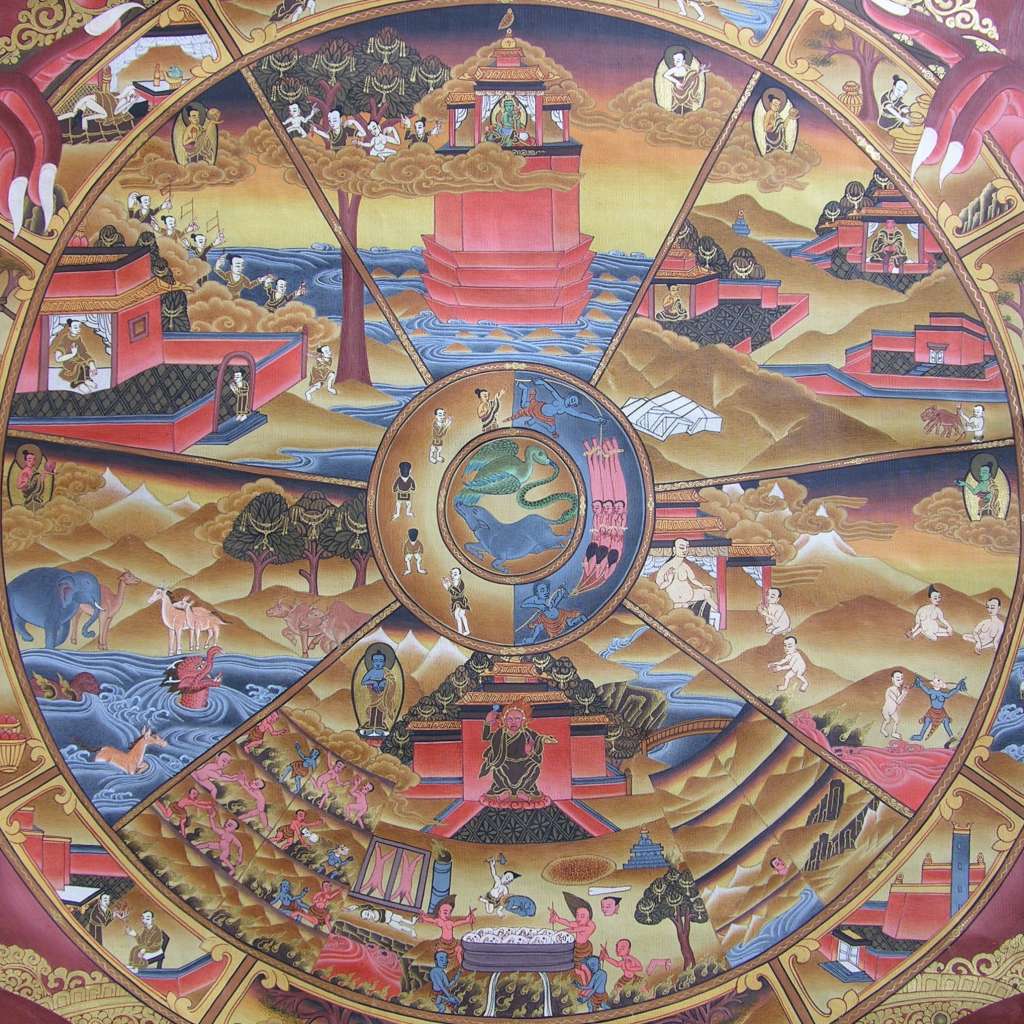
However, according to the Buddha we have lived incalculable eons.  From beginningless time we have been doing this.  We have experienced so many lifetimes that the causes that were begun during those times, many of them have not even actualized themselves.  They are still seedlings within our mind stream.  We have so many under the belt, that we literally have accumulated the causes for rebirth in the highest and most fortunate state and we have also accumulated causes for rebirth in the lowest and most difficult realms.  We have all of these circumstances and somehow, almost like a gambling wheel going around we stopped at a precious human rebirth and here we are experiencing this precious human rebirth.

What makes it precious is that we have all of our faculties; we have the opportunity to practice the Buddha’s teaching.  What makes it precious is that we have a shot at attaining realization and we aren’t suffering too much to do it.  We have the leisure to practice.  Understand that finding this precious human rebirth is, as the Buddha taught, very similar to finding a precious jewel while sifting through garbage.  It is that rare.  Finding this precious human rebirth with these fortunate circumstances is as common as dust on the fingernail compared to dust on the earth.  That’s how many more options you had of other kinds of rebirths.  If you understand how rare this birth is, you will find motivation to practice.   But Westerners have a tremendous difficulty with that.

Feeling that there is only linear progression Westerners have a certain pridefulness that unfortunately says, “Well if I have what it takes to get to this point where I can think as I do and practice as I do and be as wonderful as I truly am, then surely I can keep that stuff going somehow and it will remain stable in that way.”  The Buddha says not.  The Buddha says that there are specific reasons that you are here and if you utilize this life to increase your merit, good karma, virtue and value inherent within your mind stream, and if you purify your mind, thereby increasing its beauty and luminosity, then you will proceed on a path that will lead to supreme enlightenment.

But think about how many people here in the West kid themselves about this.  We feel safe in a life that is ever changing.  We feel permanent in the midst of impermanence and we feel that we have got it knocked and we go up and down every day and then we don’t do anything to improve our state.  Maybe we change a few things as a token gesture, we try to live a good life, we are nice to our kids.  We are good upstanding people, but in the end we find that we have been sitting on top of a precious jewel and a fantastic opportunity, and at the end of our lives we come to a realization that we have wasted it. What has happened is that it takes such an enormous amount of good qualities, virtue, good karma and merit to have gained such a life as this and when we could have done something, when we had an opportunity to accomplish the Dharma we didn’t.

©Jetsunma Ahkön Lhamo

The Meaning of Refuge

The following is an excerpt from a teaching by Jetsunma Ahkon Lhamo called “Essence of Devotion”

When we take refuge in the Buddha, in the Dharma, and in the Sangha, we consider that all of those are equal and they are all one, that they are inseparable. The Buddha, the Dharma and the Sangha are important; the Buddha, because only enlightened method and enlightened presence can bring enlightened result in the same way that apple seeds can bear apple fruit.  Grape seeds cannot. You see?  Enlightened seed will bring enlightened fruit.  So the Buddha.  The Dharma in that that is the perfect vehicle, the vehicle that has proven itself to transport all sentient beings across the ocean of suffering.

The Sangha because, within the spiritual Sangha, once you enter into practice and come into a relationship, which you automatically do by taking vows with your vajra brothers and sisters, at that point you have joined with the Sangha.  The Sangha becomes then a family.

Talk to some of my students and find out what it means to have a Sangha family.  Those of my students who came to the path in a very general way but don’t have experience of various sufferings such as the suffering of grave illness, or life-threatening situations or just terrible suffering on some sort of emotional or mental level, have found that the support of the pure Sangha which gathers around them at times like that, and supports them with practice and prayer and help and love and kindness, is absolutely essential.  Without the Sangha we would be incapable of keeping on.  It would be so hard.  It would be like a little sapling trying to survive in a hurricane. The Sangha is rich with that kind of support and help. Furthermore, it is the Sangha’s responsibility to propagate the Dharma. So the Sangha are considered to be an object of refuge, particularly those with robes and particularly also those who have taken the Bodhisattva Vow because, having taking the Bodhisattva Vow, we can see that they intend to benefit us. Therefore we can rely on them for secure friendship and not betrayal as in ordinary friendships. So the Sangha becomes very precious.  And that is the taking of refuge—the Lama, the Buddha, the Dharma and the Sangha.

As for the Bodhisattva Vow, it is said that when one receives the Bodhisattva Vow, if one were to remain secure, absorbed, with a mind spacious and relaxed, absorbed mentally and emotionally and spiritually within the taking of the Bodhisattva Vow, that is to say, extremely mindful,  right there with it on a very deep level, appreciating and understanding and grieving for the suffering of sentient beings, as well as our own suffering, and seeing them as being non-dual and longing to help… You look at an AIDS march on TV and you look at people dying and you say to yourself, “Enough is enough!  This is awful.  This is unacceptable.“ You look at war and you look at the bodies of children laying broken and bleeding in the street and you say to yourself, “This is enough!  Enough, not acceptable!”  You look at hunger.  You look at homelessness. You look at all of it and you say, “Enough!  Enough!” To remain absorbed in that, to understand that this is the fate of everyone who is in cyclic existence without the method.  To remain absorbed in that, it is taught that, in that moment of absorption, if one were to give rise to such a depth of absorption that tears would come, then at that moment of absorption, you have removed 10,000 years at least, many thousands of years of gross karmic negative obscuration because, for that 10,000 years or however many lifetimes, we have been absorbed in ourselves. Self-absorption—I am!  I think!  I feel!  I will!  I must!  I need!  I have to have!  I’m like this!  We still are like that, aren’t we?  We still do that.  But that one moment of absorption in compassionate activity, with pure intention serves to purify so much of that, and gives us the method by which we can continue to remove all subtle and gross obscurations until we at last are free, and until we at last are able to return, ennobled and finally capable of leading others toward Dharma and making for them the auspicious connections so that their days of suffering, while perhaps not immediately over—well it won’t be like flip a switch and everybody is happy, I wish it were like that—but their suffering days, because of your absorption and compassion, are now numbered.

There are many students, of course, who have a connection with me and I will do my best. I will return life after life, not caring whether I am tired, not caring anything.  This isn’t just my idea. All the teachers, all the lamas, all the reincarnate lamas, those realized ones, will return without thought for themselves, until the very last one of those sentient beings with whom they have a connection, is finally liberated.  If they have to return even a hundred lifetimes for that very last one, they will.  I will.

Now if you take a similar vow, even if you can’t fully practice it, even if it’s just the first baby steps, there are those with whom you have a connection and I don’t have a connection, and neither do any of my teachers or any of the teachers who are able, but you have a connection to them simply through ordinary means.  They were your mother in some previous life.  Who knows?  You could have been a cockroach.  Some funny little corner in obscure reality where you have a connection with uncountable beings that no one with any realization has a connection with.  Do you know what that means?  You are their only hope and object of refuge.  You are their only hope.  So you must take this vow with complete absorption and think that you are taking it for their sake, for their sake, because they are waiting for you. And the moment that you take this vow for the first time with complete absorption and every time therefore that you continue to remind yourself and freshen that vow, their days of suffering are finally numbered.  So at that point these teachers all begin to nag a little bit and they say “Hurry.  Hurry, because they need you and there is no one else.”  So you must hurry for the sake of sentient beings. You must.

There are 3,000 myriads of universes, uncountable lives, connections that must be made and you should pray every day of your life, “Whether I have a good or bad connection with every sentient being, let it bring them to Dharma.  Let me find a way to be connected with all sentient beings and let me never pass into nirvana until they are all free.”  This is our prayer as a Bodhisattva.

Copyright © Jetsunma Ahkon Norbu Lhamo.  All rights reserved


The Eightfold Path

An excerpt from a teaching called The Eightfold Path by Jetsunma Ahkon Lhamo

The Buddha taught that the end of suffering is possible.  That’s very important.  Many times in our society, we go to church, make lots of prayers, do what is required in our respective religions, but perhaps we have never been told that there is an end to suffering, and there is something that we can do rather than just wait on the rapture.  There is something that we can do to pacify our suffering, purify our karma, get relief, and begin to dispel desire, attachment, and its hold on us.

The Buddha taught that the cessation of suffering is the Eightfold Path. The Buddha teaches that by following the Eightfold Path we will move towards nirvana.  If we follow it diligently and accomplish it diligently, we will pacify suffering, and achieve nirvana.

I feel that no matter where you go in Dharma, you must understand the Four Noble Truths and the Eightfold Path.  Without understanding these, there is no result.  Even if you are doing the highest levels of Vajrayana, you must understand these fundamental teachings.  So, what is this magical Eightfold Path?

The Noble Eightfold path is: (click on the links below to learn more)

  1. Right View
  2. Right Intention
  3. Right Speech
  4. Right Action
  5. Right Livelihood
  6. Right Effort
  7. Right Mindfulness
  8. Right Concentration

Sometimes if you look in a book, it may use a slightly different word.  It’s just because the original language was translated slightly differently, but this is the right stuff.

The Eightfold Path is basically divided into three sections. The first section is wisdom, the second is ethical conduct, and the third is mental development.  All of these must happen at the same time, and so it is essential to understand all of the Eightfold Path, and not simply rely on one angle and think you’ve really got it.

In the wisdom section there is right view and right intention.  In the ethical conduct section there is right speech, right action, and right livelihood.  In the mental development section there is right effort, right mindfulness, and right concentration.  The wisdom section explains how to apply right thinking and gain wisdom.  The ethical conduct section shows how to construct an ethical way in which to gain merit and do no harm. The mental development section is the actual meat and bones of the path.

We should never think of the Eightfold Path as a sequential, linear path. It isn’t that first you do right view, and then you go for right intention, and then you go for number three – right speech.  It isn’t like that.  It must be considered like the petals of a lotus in the sense that it is all one flower, and it opens up together.  It should be thought of as interdependent because it gives rise to an interdependent method and it helps one to understand the many different factors of the path in a concise way.

This level of the Buddhist practice does not lead to enlightenment in one life.  It takes lifetime after lifetime of consistent practice of the Eightfold Path in order to achieve some realization.  So, that’s the slow route.  Mahayana is a bit quicker, and Vajrayana is the one method in which you can achieve realization in one lifetime or at the time of death.  We want liberation in one lifetime, but in order to do that you must train your mind according to the Eightfold Path.  There is no doubt that this is the foundation of the Buddha’s teaching, and by itself will produce tremendous result.

© Jetsunma Ahkon Lhamo

The Practice That Results in Enlightenment

  • guru

The Practice that Results in Enlightenment

The kind of practice that we are talking about – that results in supreme enlightenment – is the continuous, natural, graceful effort – a happy, blissful, joyful continuous effort.

So we should always then be in the posture of the teachings.  That means that you literally walk around with your heart like a bowl, your mind like a bowl and you are in the posture of a constant wish:

“Please Lord Guru

Change me into whatever form is necessary.

Change my mind – Change my heart – Purify my karma.

Please Lord Guru

The only thing that I request that you do is to not let me remain the same.

Please Lord Guru

Constantly pour the nectar of your Dharma into me.

Lord Guru,

Do not abandon me in samsara.

Do not leave me in the condition that I am now.

Change me utterly and completely to where I do not recognize

myself as an ordinary samsaric being any longer.

Think of the Guru like a mother bird.  Constantly remain in the posture of beseeching the Guru for teachings.

The thing that you have been terrified of – the thing that you have guarded yourself against – is the very thing that you should be requesting constantly is that you should be transformed and changed according to the wishes of the Guru.

Do not let me be separate from your teachings even for a moment.

Have courage.

— Jetsunma Ahkön Lhamo

Right Effort

An excerpt from a teaching called the Eightfold Path by Jetsunma Ahkon Lhamo

Right effort is the blood of the Eightfold Path.  It is the sort of like a precursor, because you have to establish right effort and there has to be effort for the path to work.  To engage on the path, you have to be rightfully making that effort to engage on the path.

Now, there is no shortage of effort in our lives here in the US.  Contrary to what struggling people might think.  In other countries where survival is an issue, one works very hard from dawn to dusk, and probably most days of the year, but for Americans survival is not so difficult and so it looks as though we have a lot of leisure time.  In fact we do have a lot of leisure time relative to other unfortunate sentient beings.  And that’s why we have the opportunity to practice.  But there is no shortage of effort in our lives.

We are actually very hard at work.  We have determination.  Americans have a lot of ingenuity.  You know?  We can be a strong people. So, right effort is something that we have to understand.  Its not that there is a shortage of effort, but you have to determine what is the right effort?

On this path, nothing will be achieved if we do not contemplate, study and practice right effort.  What is behind right effort is our own mental energy.  Everything that we experience is from mental energy.  Everything that we interpret is about our mental energy.  The lens of our mind, the habitual tendency of our mind controls how we experience.  For those of us who are habituated to living in a certain way, we have to take very specific steps and efforts.  A great example of this are the steps that recovering alcoholics must take, because the seduction of alcohol is so all-pervasive and the habit so strong and reinforced by the drug alcohol itself.  People use alcohol in a self-medicating way. As far as I’m concerned, getting sloppy drunk is very unattractive, and not that much fun, and the next day it’s not very fun either.  So I don’t think that’s what draws people.  I tend to think that they are self-medicating.  That they are suffering in some way, and they think, “This will do it.”  Sometimes we are depressed, and we self-medicate.  I’ve known people that have mania who self-medicate.  And they use whatever they can get their hands on.  Some people just have pain in their hearts, and are too thin skinned for the world.  I’ve known alcoholics like that who underneath it were very vulnerable, very pure, delicate people who just can’t take it.  And so they drink.  They don’t know that there’s another answer.

It takes a lot of effort to drink that much.  It takes a lot of effort to self medicate.  It takes a lot of effort to do the things we do to cope, get to work, get home, take out the garbage, send the kids to college.  All this stuff is so effortful, and we know exactly how to do it, because society trains us to do it.

Right effort invites us to train differently.  We are always exerting effort.  Right effort brings us fulfillment, peace of mind, and certain contentment.  Unwholesome effort leads to mental confusion.  If you want to be mentally confused, just keep right on with the ordinary efforts without any guidance and you will keep spinning around in samsara like a bee in a bottle.

Let’s say a person leaves the path.  For whatever reason they find dissatisfaction with the path.  Heads up on that.  That tells you something right there. If you leave the path, if you find dissatisfaction with the path, it is because you haven’t done it right.  The path is the path.  It leads to liberation if you work it right.  If you don’t’, you just look stupid because you haven’t done it right.  And so most people that leave haven’t done it right.

Having done some right effort in order to travel on the path and do some practice, they maybe gained some benefit, but karma ripened. They didn’t quite get it right.  Didn’t keep themselves inspired on the path.  Didn’t really keep Vajra confidence when they were moving forward on the path.  And now all that attention and energy that they used to put into meditation and the path, they now put into gossip, wrong-headed and harmful activities such as speaking ill of others, or trying to destroy others, or trying to destroy another person’s path or trying to destroy an organization or something like that.  The person who is doing it feels in their mind right.  They feel self-righteous.  Of course you know that there is no room for self-righteousness on the path because there is no self, and the attachment to righteousness is something that we should be working on right now.  Being right.  Being in charge.  Being on top.  All that stuff is just attachment and desire, and that’s something that we should be working on right away.

Lets say that this person is doing all of these negative things, and they feel righteous.  They feel they have the right to do this.  If they didn’t get anywhere on the path, they make the path wrong.  And they say, “Well, the path is just nothing.  It doesn’t help, and I’m not happy in it, and therefore its wrong.” Once they make that decision they go off and try to seek happiness in another way.  At first, if they have a lot of anger, maybe vengeance, maybe they just let their anger rip?  After trying to work with it for many years, they just let it rip.  Letting the monster out of the closet that was always in there, and probably was the problem in the first place.  So, this person is now engaged in unwholesome activity and what will happen to this person?  If a person like that wants to do some harm, if they get a punch in, they feel a kind of satisfaction.  Does anybody know what that kind of satisfaction feels like?  It’s an evil, dark, stinky, smelly kind of satisfaction.  Not wholesome.  Not helpful.  Not going to make the world a better place.  Nothing but harm doing.  And when that person has that feeling of unwholesome, victorious satisfaction, their mind then becomes more aroused and inflamed, like a giant mental zit – inflamed, pussy, and nasty.  That’s how the person’s mind becomes.

If a person has manic-depressive disorder, in the state of mania, it is very hard to be kind.  It is very hard to have good judgment and it is very hard not to be raging and angry in mania.  It is very hard.  You don’t have any kindness when you are manic.  You are just too enraged.

Psychiatrists will tell you that if you are a manic person, a bipolar person you tend to go up and down.  What happens if you are not treated is that your mind, which is like a muscle exercising, learns how to go up and down, up and down, up and down. It habituates to being all over the place.  No steadiness there.  No stability.  It’s up and down, up and down.  Some people with bipolar disorder can cycle through moods in a day.  Other people go through seasonal cycles – manic in the summer and then lower in the winter.

What I’ve learned is that if manic-depressive disorder, because there is so much rage in it, goes untreated, then over the years it tends to make the mind toxic, and it leads to dementia.  It is not because there is a direct correlation, and it won’t be a strict dementia like old age dementia that tends to have certain parameters, but it leads to a kind of discombobulation.  What happens is that the mind is so filled with stress hormones, so filled up with the inflammation of rage and anger, and in mania tends to go round and round and round and round with no solution.  If untreated, then as a person ages, the mind becomes so toxic that even if a person goes for treatment in their older age, the first thing that has to be done, is treat them for this brain toxicity, before you can even treat them for the bipolar disorder, which is the disorder. A lot of times you have to backtrack by using anti-psychotics.   You have to backtrack and detoxify the mind until you can get to where you can treat it.  And that’s the main reason why when I see a person who I recognize as having the symptoms of bipolar disorder, I beg them to go get treatment because I see what happens to people who are untreated for such a long time and what happens to their mind.  At that point the mind becomes unreachable.  When the mind is toxic, it is unreachable.  Anger is the king.  Inflammation is the queen, and running around is the baby.

It matters so much how you structure your inner mental life.  Many people think that as long as their behavior is good, it doesn’t matter what’s going on in their mind.  For instance, you can think about kicking puppies in your mind but on the outside you are really kind to puppies, and think that it’s okay.  It’s a silly example, but the actual truth is that it’s not okay.  The actual truth is that one will bring the other about.  Eventually, if the mind stays in that condition without changing, then the outer behavior will change.  And so it is imperative that we make the correct effort, the right effort, and that is to study, contemplate, and understand, to begin to look at the nature of your perception and your mind, and to actually put in the time and the effort to study.

You practice Right Effort by preventing unarisen unwholesome states from arising, abandoning unwholesome states that have already arisen, arousing wholesome states that have not yet arisen, and maintaining and perfecting wholesome states that have already arisen.

1.  Prevent the arising of unarisen unwholesome states So, through good contemplation and right effort, you can prevent the arising of new habits by simply not engaging in them.  You make an effort not to engage with an unfortunate habit.

2. Abandon unwholesome states that have already arisen With right effort examine your mind, examine your life, examine your habitual tendencies and see what needs changing.  To begin to abandon unwholesome states that have already arisen can happen through antidoting behavior.  For instance, if you are extremely selfish, you have to practice little by little learning to give. Practice little by little even if it’s just a flower or a dollar or a gift or even something of your own that you treasure very much.  Right effort would be learning to give that joyfully.  So abandon already unwholesome habits.

3.  Arouse wholesome states that have not yet arisen  What would that look like?  It would be practicing generosity.  If you are that person who is selfish, then practice generosity in everyway that you can.   If you are not nurturing and kind and you really admire people like that and want to be that way, then you can practice five minutes at a time.  You put the right effort into stepping outside of yourself and looking at the other being to see what they need, what would make them happy.  To think of others before yourself.  It’s a practice that’s very simple but no one does it.  To put others in front of you and say, “How can I support this person?”  Rather than always being the one whose getting support and needing support, and wanting support.  That’s not really a wholesome habit.  That’s a dependency habit.  If you were to practice and realized that you’re like that, there’s no shame in realizing that.  You have to realize that you’re like that.  But then little by little you begin to act differently.  And at first its baby steps.  And then eventually those baby steps become habits.  And eventually those habits become recognition and awakening.  And even on the simplest level, lead to a better life.

4.  Maintain and perfect wholesome states already arisen You examine them and you find that you have certain good qualities.  Like lets say, you feel yourself to be very interested in the Dharma,  interested in a real way.  It excites you.  You really like the thought of it. You like the practices, you like the atmosphere, you like everything about it.  That’s a wholesome condition because if you’re going to have an attachment, then have an attachment to Dharma because if you’re practicing it right, it will take care of itself.  Lets say that you have that habit and you really like Dharma, and you decide you’re going to use that to help others to like it.  Lets say, you want to become a chopon (person who handles the spiritual substances in puja) or an umdze (practice or chant leader).  You become really practiced at that.  That would be taking a natural wholesome habit and bringing it up to the next level.

Lets say that you basically like animals. You like dogs.  That’s a good habit, as long as you’re not too attached to them and you’re not like an animal hoarder or something.  But say you like dogs.  What would you do about that?  Your next step would be, “How can I help them?”  How can I alleviate their suffering?”  Same thing with the birds.  You know, I love that birds are so beautiful.  We love them but do we take the next step, which is to make their lives less horrible and more wonderful?  That’s the kind of habitual tendency that you constantly invite yourself to take and go over and make firm in your mind. It’s so important to understand that on the pat.  That’s really the basis of everything.   To be on the path and not make any effort, one is not on the path.  One is simply along for the ride.  And it won’t last.

A person who is on the path and makes no effort to correct their mind habits and is still mean and hateful and angry, and makes no effort to correct that, is not practicing the Buddhadharma, even if they are wearing the robes, even if they have got the beads.  No matter what, they are not practicing the Buddhadharma, because the Buddhadharma is about making one’s mind wholesome.

© Jetsunma Ahkon Lhamo

Then I Asked The Dakinis: From “Mother of Knowledge”

yeshe-tsogyal-sergey-noskov

The following is respectfully quoted from “Mother of Knowledge” translated by Tarthang Tulku and J. Wilhelms:

Yeshe Tsogyal recounts entering the Mandala of the Dakinis:

“Eight cemeteries formed a ring, rimmed by walls of beautiful lotuses. Predatory flesh-eating birds and wild blood-drinking animals wandered about, and demons and demonesses, roaming in great numbers, stood out vividly against the landscape.

“Although the beings there did not attack me or threaten me, neither did they make friendly overtures. As I advanced upwards, I passed along a path that circled in a zigzag fashion three times, and ended at a door. Within were many dākinīs whose external appearance was that of women but they were of many different colors. They were carrying offerings to present to the principal dākinī.

“Some of the dākinīs had cut their bodies into small pieces with razor-sharp knives and prepared offerings of their own flesh; others were giving their streaming blood. Some were giving their eyes, some their noses. Some were giving their tongues, still others, their ears. Some were giving their hearts, others were giving their viscera. Some were giving their outer muscles, some their inner organs. Still others were giving their bones and marrow.

“Some were giving their life energy, others their breath, and still others, their heads. Some had cut off their limbs, and so on. They had cut up their own bodies and had prepared offerings of them for the principal dākinī, who appeared Yab-Yum before them. The offerings were then blessed as signs of their faith.

“Then I asked the dākinīs: ‘Why do you suffer in this way? To what purpose? If one lives in accordance with the Dharma until death, is that not sufficient?’ And they answered me:

‘Dear woman of irresolute mind!
The compassion of a great teacher who has all the qualifications may only be available briefly.
If you do not offer whatever he wishes when he looks upon you,
later nothing you do may lead to fulfillment.
If you procrastinate, obstacles will multiply.

‘Your insight and certainty may last only a moment;
natural and spontaneous faith may not stay long.
If you do not make the offering when Pristine Awareness arises,
later nothing you do may lead to fulfillment.
If you procrastinate, obstacles will multiply.

‘Now, at least you have a human body–you may not have it long.
The chance to practice Dharma seldom arises;
if you do not make offerings when you meet a qualified teacher–
if you procrastinate–obstacles will multiply.

‘The teacher may only be here briefly;
only now can you be certain to enter the door of the secret teachings.
If you do not offer yourself
when you have access to the highest Dharma–
if you procrastinate–obstacles will multiply.’

“Thus they spoke, and I felt ashamed. Then, as each dākinī presented her offering, the Vajra Yoginī appeared before her, snapping her fingers. Instantly each supplicant was healed and became as before. After requesting a regular Dharma practice from the principle dākinī, each one returned to her own meditation place.”


WP2Social Auto Publish Powered By : XYZScripts.com