The Challenge of Generosity in the West

The following was a spontaneous teaching offered by Jetsunma Ahkon Lhamo:

Jetsunma on Generosity in America, May 6, 2012

Jetsunma was speaking about His Holiness’ first trip to the United States in 1985

In the beginning when His Holiness came to America, he was angry that people charged for empowerments and for dharma teachings.  He was particularly angry when we did, because we were one of his centers, and he didn’t like that.  Then we explained to him, “Then we will have to close the doors, because we not only have a monthly mortgage but we are taking care of nuns, and doing all the things that KPC does, which costs at least $9,000 a month [in 1985]. There is no other way to make it.  We don’t have any large gendoks.  We are not like you who can get these large gendoks.  We have no gendoks.”  And he started thinking about it, and he said, “Well, I guess this is kaliyuga.  And if you have to, you have to.”

So that is when we were permitted.  There was no other way to keep the doors open.  It was his first visit to the United States, and he really didn’t understand what we were up against, and how proud and opinionated people are here.

People take these things for granted and think that you should do it out of the thin air without supporters.  Are you somehow supposed to magically sell a finger every so often so that you can pay for this?  Those people never started a center.  Those people never started a Temple.  Those people don’t feed the ordained.  Those people don’t feed poor people.  They sit in the ivory tower and they get their special teachings and they don’t pay for them.  They don’t make an offering.  It’s sick.  They make it all about themselves.  What about the lama that conferred it?  Sure you fed him.  But what is he supposed to get home on?  What’s he supposed to start his next event on?

We have to be generous, and in this country that’s the only way that you can, because there are no major donors or at least not for us.  In some cases a gendok will pay for everything, because they understand the merit, and they understand what’s going to be in their next life.  They understand that they are going to have Phowa done for them.  They understand a lot more than we do, especially about merit.  And so a lot of the really great gendoks who have lots of money, pay for everything.  Can you imagine that merit?

I wish I could do that.  I wish I could not only run this place, but pay for it too.  Wow.  But then I want to feed the poor and save all the animals.  Save the whales and the planet.  Japan.  And that’s why I don’t have a nickel to my name.  They hardly make nickels anymore.  They don’t mean anything.  Used to be you could buy a candy bar with them.

Oh well, it is what it is, and we will do what we can do to sally forth.

Listen to the teaching here: Challenges of Generosity in the West

© copyright Jetsunma Ahkon Lhamo All rights reserved

Analysis Through the Application of Reason

The following is respectfully quoted form “Treasury of Precious Qualities” a commentary on the root text of Jigme Lingpa by Lonchen Yeshe Dorje and Kangyur Rinpoche:

Analysis through the application of reason:

This method consists of four or five great arguments that establish the fact that phenomena are without inherent existence. The specific explanation of these arguments is preceded by a general exposition of how such assessments are made.

To begin with, the prasangika approach is unlike that of the Svatantrikas. Svatantrikas disprove true existence on the relative level but then assert an illusory existence. Likewise, they disprove conceptual construction on the absolute level, but then go on to assert (positively) that this absolute is beyond conceptual construction. The prasangika method is simply to demolish the defective propositions of their opponents by directly refuting every assertion to which the mind might cling. But they do not accompany this with any kind of independent pronouncement. In order to eliminate clinging to real existence, it is essential to eradicate the conceived object of such clinging. Therefore, as we have said before, it is necessary to analyze and achieve certainty about the true nature of the two selves which are the object of refutation. Otherwise it is like shooting arrows without seeing the target, and it is impossible to eliminate the assumption of the real existence of a self.

When one uses madhyamika arguments to search for the meaning of suchness, the idea that “the opponent is wrong” is enough to cause one to stray off the point. Therefore, from the outset, do not refute only the assertion of an opponent, but work to eradicate completely all the innate discursive thoughts in your own mind, which have been left unexamined from beginningless time and which deviate from the Truth of Suchness. Likewise, eradicate all clinging to positions or theories, which are imputations arising from philosophical inquiry and which are found in all tenet systems whether Buddhist or non-Buddhist. Subsequently, when you meditate, simply rest without clinging to anything, in the sense of having an object of meditation. This, however, is not to say that you should remain in a state of blankness, a “foolish meditation,” so to speak. On the contrary, through the certain knowledge deriving from the realization of the absence of inherent existence, your vipashyana will be rendered extraordinary and you will have no doubts. All this is the sign that your analysis has hit the mark.

Generally speaking, at the present time, all the great beings who uphold the Madhayamika declare that the way the phenomena of samsara or nirvana appear is as the mere imputation of thought; they are without dependent arising are indissociably united. Everyone is in agreement about this. In our tradition, however, we do not consider that the expression “imputed existence” implies the presence of a “something” that lacks true existence and to which true existence could be ascribed. We say that the object referred to is a kind of empty form, an originless display of the mind’s creative power.” Consequently, when emptiness is said to be inseparable from dependent arising, this is not meant to imply that there is a validly established appearance from which emptiness is inseparable. On the contrary, we understand that phenomena are themselves ungrounded and rootless. There is no way in which they could exist. And yet they arise freely, produced in interdependence.

Therefore, once the object of refutation, which is to be identified as the two really existing selves, has been eliminated, its place is not still occupied by some (residual) basis of refutation–a so–called person or phenomenon. There is simply nothing left at all. Persons and phenomena are empty of themselves. For one cannot say that they are empty of true existence while holding that phenomena themselves (the basis of emptiness) are not empty of themselves on the relative level. It is rather that form, for example, is empty of form and so forth. Therefore, because all phenomena are devoid of real existence, there is no “concrete” object of refutation. All that is refuted is the false imputation that ascribes existence to what does not exist. Nagarjuna says in his Vigrahavyavartant:

Since no object of negation can be found,
I myself have nothing to negate.
And so, by saying “I refute,”
You’re the ones who falsely testify.

It might be objected that there is a contradiction in saying, as we have just done, that the two selves are devoid of true existence, while at the same time affirming that persons and phenomena exist on the relative level. All we mean is that as long as there is the tendency to delusion, relative appearances arise constantly and unhindered. But this does not mean that they exist inherently.


Understanding the Poison

The following is from a series of tweets by Jetsunma Ahkon Lhamo:

Hate is a poison no one should drink. Or give to anyone else. If you have it unrepaired it will ruin your life. No one should tolerate hate in their minds or activities. It is the basis of war and crime. It is the downfall of nations and lives. It is a terrible cause with a terrible result. It is death and sorrow. No one benefits.

It is so common we think it is natural and normal. It is in fact not even reasonable as we are of the same nature, field of being. So hate ripples out to all. Everyone gets hurt.

For instance, now, in modern music there is so much name calling, self preening, body part naming, (everyone is a ho, a c— a d—: sick!) We are no longer actually listening to music, we are listening to hate. We trash our minds with low life reading and writing. We could be so much better- do so much more. We don’t even try. We think it stylish to be trashy. We don’t even place any value on wholesome cognition. If we did, personal issues could be used to study the path and develop enlightened qualities. Too bad – because we can all awaken to Buddhahood. We are that.

May whatever merit I have ever gathered and all I and my students have ever done as well, be dedicated to the liberation and salvation of all!

Copyright © Jetsunma Ahkon Norbu Lhamo.  All rights reserved

Meeting His Holiness for the First Time

An excerpt from the Mindfulness workshop given by Jetsunma Ahkon Lhamo in 1999

When I first met His Holiness Penor Rinpoche, he came to where I was in Kensington, Maryland, and wanted to stay at our house.  I had only met one Tibetan in my whole life.  I had no idea what a Tibetan lama even was.  I had no idea what to do with a Tibetan lama.  Where do you put them?  What do they eat? I wasn’t being silly, I just didn’t know.  So I thought, “Well, we’ll have a barbecue!” I didn’t know what to do.

I remember it, and I think about the way I was then.  Of course, it was natural, but there was His Holiness sitting on a bench!   I remember plopping down right next to him and asking casually, “So, what do you think of the barbecue?” If I did that now, my head would explode!  Thankfully, some spiritual discrimination has been developed since then!

During that visit, His Holiness said he wanted to talk to all of my students.  He wanted to ask all of my students, “What does she teach you?  What do you know about this, that and the other thing?  What do you think about compassion?  What does she tell you to do?  How does she tell you to practice?”  He questioned all my students, and I hadn’t even talked to him alone yet. I didn’t know that you were even supposed to ask Tibetan lamas questions.  I just didn’t know.

I saw that when he was interviewing my students, they also had the opportunity to ask him these great questions, and he gave them these really cool answers, about karma and how things are and why things were, and I thought, “I’d like a chance.  Give me the opportunity.”  I asked His Holiness if I could come and talk with him, and he agreed.  So I went in and I talked to him and I said, “Rinpoche, when I first saw you, I knew that you were purity itself; that there is nothing more pure than you.  So based on that, I’m asking you, at a certain age it just came to me to start teaching like that — teaching about emptiness, teaching about compassion, teaching about benefiting others, but I wasn’t taught this.  Until you, I didn’t have a teacher in this lifetime.  How can this be?  Have I done something wrong?”

I told him I felt like there were two justifications for me to teach before I had met my teacher.  One of them was that when these practices, like the natural kind of Chöd that I was doing, came to my mind, and I did them, they worked.  I could feel the renunciation that was happening.  I could feel it.  That was one determining factor.  I could feel that when I spent a large percentage of my time trying to be of benefit to others, I could feel that it worked.  I could feel that it made me happy.  So I began to practice like that, and I felt that I was authorized to teach others because I practiced it and I could see that it worked.

The other thing was that I looked around — ever since I was a child I could see that there’s nothing but suffering here, that suffering is all-pervasive, and even when it’s temporarily alleviated by some kind of temporary happiness, it’s all-pervasive and it returns, and the suffering is primarily spiritual.  I told His Holiness, that being the case, I felt I couldn’t wait.  I felt that if I knew something, anything, that would help, I’d better do it.  I asked him how these things have just come in my mind: this practice of generosity, this meditation on emptiness, this Chöd, where does it come from?  And by what authority am I passing this out?  How is this happening, and why doesn’t it happen to everybody?    And he said to me, “You were a bodhisattva in so many past lifetimes and you accomplished your practice — and he spoke of mindfulness and awakening and stuff like that — you accomplished your practice to the degree that it is mixed like milk with water into your mindstream.  You are not separate from that.  In every future lifetime, when you appear, you will remember the teachings.  You’ll remember them because you practiced them so mindfully.”

Do you hear what that tells you? I’m not different from you.  I use deodorant.  I stink when I sweat.  I am not different from you.  That tells you that, according to His Holiness, a Living Buddha, this practice of mindfulness is so potent, so perfect, that if you really invest all that you have into it in an honest and deliberate and profoundly deep way.  You can take it with you! To think that that is the one treasure, the only treasure we can take with us when we die.  You can’t take your car, you can’t take your TV, and you can’t take your boyfriend or girlfriend, husband, wife, or kid.  Even if you and your whole family die together, you can’t take them with you.  It doesn’t work that way.  But that profound Recognition, that habit, the constant making of that habit of Recognition and mindfulness, that you can take with you.

© Jetsunma Ahkön Lhamo

Daily Offerings

An excerpt from the Mindfulness workshop given by Jetsunma Ahkon Lhamo in 1999

I’d like to talk about mindfulness in practice of making offerings.  As you know, when you do your preliminary practice of Ngondro, at some point you accumulate 100,000 repetitions of mandala offerings.  That’s a fairly elaborate practice where you sit down and you work with the mandala set and you make the mounds and you have a very extensive visualization.  So is that where your offering practice stops?  Do you make your offerings to the deities and then walk away from your practice and not be involved in your practice anymore?  No, of course not.

In order to practice truly and more deeply, what we have to do is remain mindful of the practice constantly.  Remember that we are trying to antidote ego clinging.  We’re trying to antidote the belief in self-nature as being inherently real.  We are trying to antidote the desire, the hope and the fear that results from that identification of self-nature as being inherently real and other as being separate.  Remember that this is the point of what we’re doing.  So if we were to practice accumulating mandala offerings, or make offerings at a temple and then have that practice end and no longer be a part of our lives, we wouldn’t be applying that antidote very well — at least not as well as we might.

How would it be possible for us to avoid this ego clinging?  How would it be possible to avoid simply reinforcing samsara’s unfortunate message when we go around and simply enjoy ourselves?  Remember that it is a worthy thing to notice, when you perceive something like a house or a tree or a flower, how automatic your reaction and response to that is.   How is this flower going to affect me?  This flower, this tree, how is it going to be meaningful if it doesn’t affect me?  That is its meaning: it affects me.  That is how we think.  The practice that I’m suggesting is something that you can do without ever sitting down and meditating, so for those of you that have no time, this is a great practice.

When we’re doing anything, no matter what it is, we see appearances.  Images come to us.  They are sometimes very favorable, sometimes very beautiful, sometimes wonderful, and we enjoy them, and sometimes not.  When we enjoy them, we enjoy them by clinging, by taking that experience, in a sense, and holding onto it, grabbing it.  We’re grasping that experience.  That tree is only relevant because I see it.  Out of sight, out of mind.  When the tree is out of my sight, it no longer exists.  We think like that.  My suggestion is that rather than just doing your practice when you’re sitting down, why not be mindful constantly? When you see the appearance of any phenomenon, when you see any kind of beautiful thing — like for instance when you look outside and you see how lovely it is out there, how gorgeous it is, the trees and the flowers and the sweetness of the air — how can you not let that beauty simply reinforce our clinging to ego, that clinging to identity?

One way to do that is to develop an automatic habit, and again, those habits start small and end up big.  We start at the beginning, and we simply increase.  Develop the habit of offering everything that you see. You think, “Huh?  How can I offer it if it’s not mine?”  Well, that’s not the point.  Whether it’s yours or not, your senses will grab it as yours.  You will react to it, you will respond to it, you will judge it, and so it becomes, in a way, your thing.  You collect it.  When you see something, you collect it, and you hold onto it.  The experience is what you take away.  Maybe we can’t take away the tree, but that doesn’t mean anything because we’ve taken away our experience of the tree.  It has become ours, and it reinforces that delusion of self and other.  Instead of doing that, isn’t it possible upon seeing something beautiful, upon taking a walk, having a good feeling, accomplishing something wonderful, seeing beautiful things, having meaningful relationships with other people, any kind of pleasure that is part of your life, that it can be offered?  It can be thought of in a different way.

For instance, if I were to walk down the street and see a field of flowers, but didn’t know about any of these teachings of the Dharma, then maybe I might pick some of the flowers think that’s a meaningful experience because I feel good about it; I’m really happy with that.  The only reason these flowers have become meaningful is because they’ve affected me in a certain way, and it continues the delusion.  Having heard about Dharma, we have another option.  When we see and enjoy a whole field of flowers, we can visualize in a very simple way, making it an offering to all the Buddhas and bodhisattvas.  Instead of that automatic clinging to this image and trying to take it with us, trying to make it part of us, there can be an instant habit that we form of offering this to all the Buddhas.  “This field of flowers is so wonderful.  I love it so much.”

If we work on it, instead of clinging to it in some subtle way, our automatic habit can be to offer it to the Buddhas and bodhisattvas.  Take any good taste, for instance, a good flavor in your mouth; a lot of times when we have a pleasurable experience like good food or good taste you may have noticed that ultimately it’s not so good.  The food turns into…well, you know what it turns into, doo-doo. The experience does us no good because when we were tasting it, we were clinging to it.  That’s mine.  You see?  I’m tasting it.  It’s in my taste buds.  It’s that relationship between my taste buds and that food that’s really important: we’re stuck in that delusion.  We’re stuck in that dream.

Suppose we were able, instead, to develop the habit that when we eat something we are practicing as well by automatically offering the flavor and the taste of that to the Buddhas and the bodhisattvas?  Then you’re not grabbing onto it, you’re not making it your experience.  Offering it, you’re not reinforcing that dynamic of self and other, but rather when you taste, you’re just simply offering it.  You can learn to do it very quickly.  When you first start, it’s a little bit cumbersome because you take a bite of food, and you say, “Okay, I offer this to the Buddhas and the bodhisattvas.”  You take another bite of food, saying, “I offer this to the Buddhas and the bodhisattvas.”  At first, it may seem a little dry and uncomfortable, but there’s an inner posture that can be developed that’s an automatic response, as automatic as deciding whether or not you like that taste.  As the taste hits you, the experience of that can be just offering it to the Buddhas and the bodhisattvas.  It can be so immediate that no words are required.  At that point, you’ve developed the habit of making this constant, constant, constant offering.

As parents, when we bond with our children and hold our children and have that wonderful, pleasurable experience of cuddling our kids and feeling wonderful, as ordinary human beings we think, “Oh, this is my child.  This is the extension of my ego.  I made that.  I made an egg, and look what happened.”  So we have very great pride about that, and our family becomes an extension of our ego, an extension of what we call ourselves.  What if were able to offer that as well?  As we hold our beloved children, as we feel that feeling, rather than putting another star in our own crown and thinking, “Oh, yeah, this is my kid and I’m holding her now” – what if we could offer that feeling? What if we could even offer the connection, the incredible, powerful connection between mother and child?  That, too, can be offered to the Buddhas and the bodhisattvas.   When you offer something to the Buddhas and the bodhisattvas, it’s not as though it disappears.  It’s not as though the feeling disappears once you offer that feeling of loving your child to the Buddhas and the bodhisattvas, and suddenly you don’t love your kid anymore.  It’s not like that.  Anything that we offer, really in some magical way becomes multiplied.  It becomes even more than it originally could have been.  In not using what we see with our five senses as a way to practice more self-absorption, but instead using what we see with the five senses as a way to accomplish some kind of Recognition, this is a very powerful practice and a very excellent, excellent adornment for the sit-down practice that we do.

© Jetsunma Ahkön Lhamo

Refuge and Bodhicitta

The following is respectfully quoted from the Namcho Daily Practice book published by Palyul Ling International:

OM AH HUNG

KHA NYAM SI ZHI KYAB KUN NYING PO CHU
Of all the refuges in samsara and nirvana present throughout space, the quintessence

WANG DRAG RIG DZIN PEMA TO TRENG SAL
Is the powerful and wrathful vidyadhara, Pema To Treng Tsal.

KHYOD KUR NANG SI GYAL WE KYILKHOR DZOG
The phenomenal world is totally perfected within his body as a Buddha mandala.

DRO KUN SI LE DRAL CHIR KYAB SUM CHI
We take refuge so all may cross over unenlightened existence.

Repeat three times

SANG CHOG YESHE OSAL TIG LE SHIR
We generate Bodhicitta on the fundamental ground (alaya) of the sphere (bindhu),

DRO KUN DRIB SUM DAG NE KU DANG SUNG
The supremely secret clear light and ultimate wisdom,

TUG CHI TIG LER LHUN DRUB NANG ZHI NGAG
So all beings may purify the three obscurations,

SHON NU BUM KUR DROL WAR SEM KYED DO
And attain the spontaneously self-perfected bindu of body, speech and mind, and through the four spontaneous visions, attain liberation in the youthful vase body.

Repeat three times

Your Guru

Ven Gyaltrul Rinpoche

From The Spiritual Path:  A Compilation of Teachings by Jetsunma Ahkon Lhamo

In Vajrayana Buddhism, the Teacher is the cornerstone of all practice. The Teacher is everything—the underlying strength and the means by which transmission and understanding occur.

Let us compare the Teacher’s function with the function of various other objects of refuge. All people—not just Buddhists—have such objects. Try for a moment to determine your own. If you think that the accumulation of material wealth is the way to happiness, money has become your guru. The material things you treasure are your guru. If, on the other hand, you choose the beer-and-sports routine, watching ESPN every night until you fall asleep, you have accepted the TV as your guru. It pacifies you. It makes you temporarily happy. You betray yourself: these things are unreliable, impermanent, and deceptive. Yet you put your trust and faith in them. Nothing in our impermanent realm of phenomenal existence can lead to happiness. Nothing—even if it seems ideal, like the perfect job or the perfect relationship in a perfect split-level, with 2.5 perfect children surrounded by a perfect white picket fence. At the moment of death, you are alone.

According to Buddhist teaching, there is a lasting happiness: enlightenment. It is the only end to all forms of suffering, including impermanence. Enlightenment cannot be tainted; it cannot be eaten by moths. It cannot rust; it cannot be destroyed. Enlightenment is the true source of refuge, the only thing that will not allow you to be betrayed. True happiness cannot be taken away. It is permanent and unchanging—the steadfast, stable reality of the enlightened mind. When you achieve enlightenment, what is revealed is your own primordial-wisdom nature. Some people think that they must give birth to enlightenment or that they have to find it. Actually, the primordial-wisdom nature has never left you, nor is it unborn. It remains in the way that a crystal is still a crystal, even though covered by dirt and mud.

Once you accept enlightenment as your goal, you should understand that the Guru is someone who can get you there. What should you look for in a Guru? A Teacher should not be seeking power or personal gain. Your Guru should have profound compassion, profound awareness. Most important, your Teacher should be able to transmit to you a true path. Suppose you go to a psychiatrist who helps you to be happier, more effective. This is very useful, but it is only a temporary way to cope, whereas the Guru offers you supreme enlightenment. This has nothing to do with coping. In fact, it has nothing to do with satisfying the ego.

Do not be fooled by charisma, saying: “I can tell by my feelings. This is the Teacher for me!” Instead, ask: Does this person teach a path that has been proven, time and time again, to stabilize the mind to the extent that miraculous activity can occur? Does this Teacher offer a technology that can stabilize the mind during the death experience? Can this technology result in miraculous signs at the time of passing? Are there indications that others have had success with this path and can now return in an emanation form in order to benefit beings? Look at the people who have practiced before you. Look at their successes or failures. Examine the history of the path, including the accounts of any enlightenment it has produced. At their passing, practitioners may produce miraculous signs: rainless rainbows, sweet scents, the transformation of the body into a rainbow of light, leaving only the hair and nails, the mysterious formation of relics or other unusual substances. On the Vajrayana path, such miraculous signs have been witnessed and recorded by many. People have seen the rainbow body; they have smelled the sweet scents; they have seen these extraordinary events.

The Buddha Himself said that we should use logic in choosing a Teacher or a path. After that, however, you begin to rely on the Teacher for everything. Why? Because you make a god out of your Teacher? Do you lose your brains and become a drone or a bliss ninny? Not at all. We Americans like to think we are unique, important, the best in the world. We think that to be happy, we must develop our individuality, so the idea of following a Guru is unappealing. But a teacher should not be chosen with blind faith or rampant emotion. You should exercise both intelligence and surrender. They are not in conflict. They can coexist very comfortably within the same mind, the same heart.

Note that you do not surrender to a person. It is not about a person. Your Teacher represents the door to liberation, the path that leads to enlightenment. Your relationship with the Guru is the most precious of all relationships. This is you talking to you—and finding out that you are not you at all. This is a glimpse, a taste, of true nature. At last we have arrived at the correct way to understand the Teacher.

Cultivate the precious relationship with your Guru through devotion. Make sure, however, that it really is devotion—not merely the kow-towing to a physical being. Devotion is an understanding of refuge, an understanding of your goal, plus the courage to walk through the door you have chosen. Choose only once, and choose correctly. From then on, allow yourself the grace to love deeply and gently.

© Jetsunma Ahkön Lhamo

Purifying One’s Intention

An excerpt from the Mindfulness workshop given by Jetsunma Ahkon Lhamo in 1999

Another aspect of our Ngöndro practice is purification, the prayers to Vajrasattva. How would it be if we were to sit for maybe an hour and practice the purification and confession of Vajrasattva and accumulate the mantra and then just put our books aside and consider it’s over?  That’s it.  I confessed.  I said all the prayers, the short ones and the long ones, short confession, long confession.  Remember, if you practice like that, you never have to revisit it again.  It’s a lazy, cop-out way to practice.

Instead, we should think, “I’m deeply involved in the practice of purification and confession which does not stop at the end of my practice.”  There are so many ways to practice that kind of purification: by being mindful, by making offerings in the way that I’ve described, by moving into a state of better recognition about what is precious and what is ordinary, and ultimately moving into the state of Recognition of the nature of all phenomena.  Automatically one is constantly purifying the senses, constantly purifying one’s intention, which is the very thing that needs purifying even more than everything else.  If we practice in that way as we’re walking around, it complements any confessional prayers that we make.

In most of the confessional prayers, if you really read the meaning and content of the prayers, there is talk about broken samaya in the confessional prayers.  Nobody really knows what that means.  Does that mean you didn’t do your mantra today?  Well, maybe on one level it means that, but on a deeper level, it is referring to the state of non-recognition.  So in everything that we do, if we continually make offerings, as we continually give rise to a deeper Recognition, then the five senses are being purified constantly. The habit that I’m suggesting you develop will antidote the automatic reaction that is so natural for us, so habitual.   Remember, we can insert this way of thinking or this way of practicing because we are human.

I really like animals, but one thing I’ve noticed about animals, even if they are trainable and very smart, they cannot change or alter the way they perceive their environment.  They can’t do that.  The dog can’t say, “Wait a minute, before I lift that leg, let’s think about the nature of that fire hydrant.”  The dog is not capable of this.  You are.  That is one of the great blessings of being a human being, and yet the habits that we tend to cultivate are the habits that you don’t even need to be a human being to do: that habit of automatically reacting, not taking oneself in hand, not creating any kind of space or a moment where we can Recognize the nature of reality, not making any offerings.  We tend to just automatically move through life like an automaton, like a robot.

However, being human, we can develop a little bit of space in our minds to antidote that constant clinging and reactivity, and yet we’re all about collecting things.  Well, you know, crows collect things.  We’re all about having relationships.  Well, even animals can bond for life.  We’re all about having children.  Well, dogs and cats do that, too.  Isn’t it wonderful that here in Dharma practice, if we choose to, if we practice sincerely, we can do that which only humans can do?  How amazing!

© Jetsunma Ahkön Lhamo

Purification of Moral Conduct

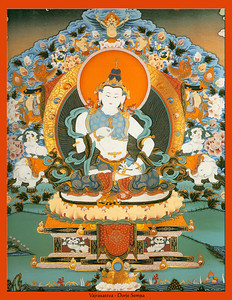
Vajrasattva

The following is a prayer from the Bodhisattva Vow Ceremony as translated in the Nam Cho Daily Practice book from Palyul Ling International:

Prostrate to all the Tathagatas!

Prostrate to Bodhisattva Mahasattva Avalokiteshvara!

OM AH MO GHA SHI LA SAMBHARA SAMBHARA BHARA BHARA MAHASHUD DHA SATO PEMA BHI BHU KHE TE BU DZA DARA DARA SAMANTA AVALOKETE HUNG PHET SOHA (repeat 21 times)

May the Dharma of the perfection of moral self-discipline be thoroughly complete in my and all sentient being’s mind streams!

May all non-virtuous deeds and obstructions arising from discipline broken because of defilements be cleansed and purified!

May there be the fortune of discipline pleasing to the Aryas!

May I be placed in contact with the bliss of liberation not oppressed by defilement.

May proper moral self-discipline be without faults.

May moral self-discipline be possessed purely.

And the perfection of moral self-discipline without hypocrisy be completed!

May I be trained as a follower of all the Jinas,

Completing the conduct of Samantabhadra.

May my conduct of discipline be completely immaculate!

May my moral self-discipline have the sweet essence of being well-kept!

May my conduct always be without damage and without faults!

WP2Social Auto Publish Powered By : XYZScripts.com