The Challenge of Self Honesty

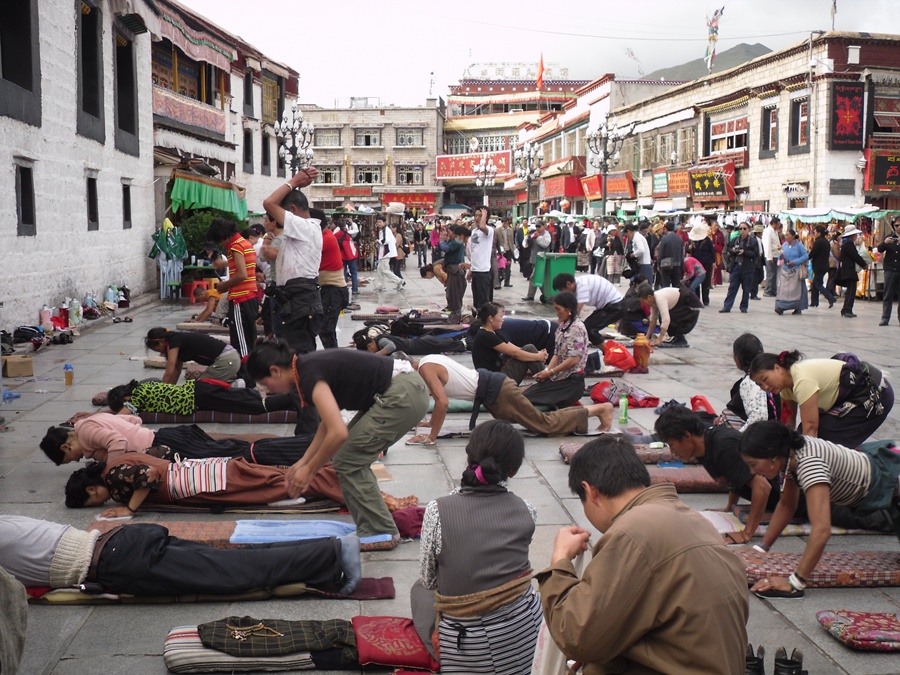
buddhists-prostrating-outside-the-temple

The following is an excerpt from a teaching by Jetsunma Ahkon Lhamo called “Art of Dispelling Anger”

We must take ourselves to task more. I don’t want to speak harshly because harshness doesn’t help, but I want to say succinctly and directly, we have to take ourselves to task regarding our faults and our poisons.   When I think of the Tibetan culture, that’s a lot easier because there isn’t that attachment to materialism.  Even in terms of the roots of the culture itself without religion, they were a nomadic people and they had things, but you couldn’t carry much.  You had your yaks and your yurts and that was it.There wasn’t that much variety in food; there wasn’t that much variety in clothing.  It’s true that the aristocratic Tibetans used to collect jewelry—some of the strangest looking jewelry.  It was intense jewelry, and that was considered a status thing. But for the most part, culturally, a Tibetan Buddhist would not have a hard time understanding that hatred, greed and ignorance and particularly desire, as the Buddha taught, keep us revolving endlessly in samsara.  We, unfortunately, are programmed quite differently.

I know in my household and in those of many people that I’ve talked to, there was confusion.  My mother was sort of a lox and bagel Jew and my father was a twice a year Catholic; and we were supposed to somehow dance in the middle. So when mama won we were going one way and when daddy won we were going the other way. I think that this happens with a lot of people.  They are raised with a lot of confusion around religion.  And even when they are taught that faith and religion should be a part of their life, and even when they are given the Western ten commandments, still there is so much confusion because we seem to find ways around that.

Thou shalt not kill.  But you can kill bugs, animals and enemies.  So who are you not supposed to kill?  I will not kill you.  That will do it.  So there is tremendous confusion around that.  How does one venerate these absolute laws that have to do with a moral and ethical human when there is so much confusion around them?  I mean, thou shall not kill but go to war.  How does that make sense to a child?   And so, as we grow up with religion, even though we have been founded in religion, or have some foundation in it, the information that we’re given is very confusing.  Thou shalt not commit adultery.  Whose family hasn’t had a little bit of that? You know, it’s just crazy.

And so, first of all, we’ve learned to be a little bit hypocritical; but most of all, we’ve learned that these laws don’t really matter, and that’s really sad.  So when we become Buddhist, we hear that there is a Vinaya and there are certain things that we must not do. And that if we take a life,  we understand that we will be giving our lives someday from having taken a life because karma works like that. Karma is exacting. When the cause arises, the results arise independently and simultaneously.  It’s our misjudgment through having the mind of duality that makes it seem like time stretches out. So even though you may not have the result of that bad karma until later on in life or even some future life, definitely we know from studying, at least. And every once in a while we get blessed with a little instant karma, so we have sometimes the opportunity to learn; but still that confusion is rampant, really rampant.

We want to practice Buddhism, so we take the teachings. We get to all the retreats; we see the right teachers; we try to do the practices. Yet we don’t really change ourselves.  It is an amazing thing to me that students can be on the path for so long and even try to go to the completion stage practices,  the tsa lung and the trekchod and togyal, and go to those levels and practice them with some part of their mind, and yet the rest of them is somehow remaining the same.  To me that is probably the worst tragedy on the path.  It’s the one that makes me not like to teach, but that’s the battle I fight with myself, you know. I’m just being honest.

Copyright © Jetsunma Ahkon Norbu Lhamo All rights reserved
First, Study the Preliminaries: from “Enlightened Courage” by Dilgo Khyentse Rinpoche

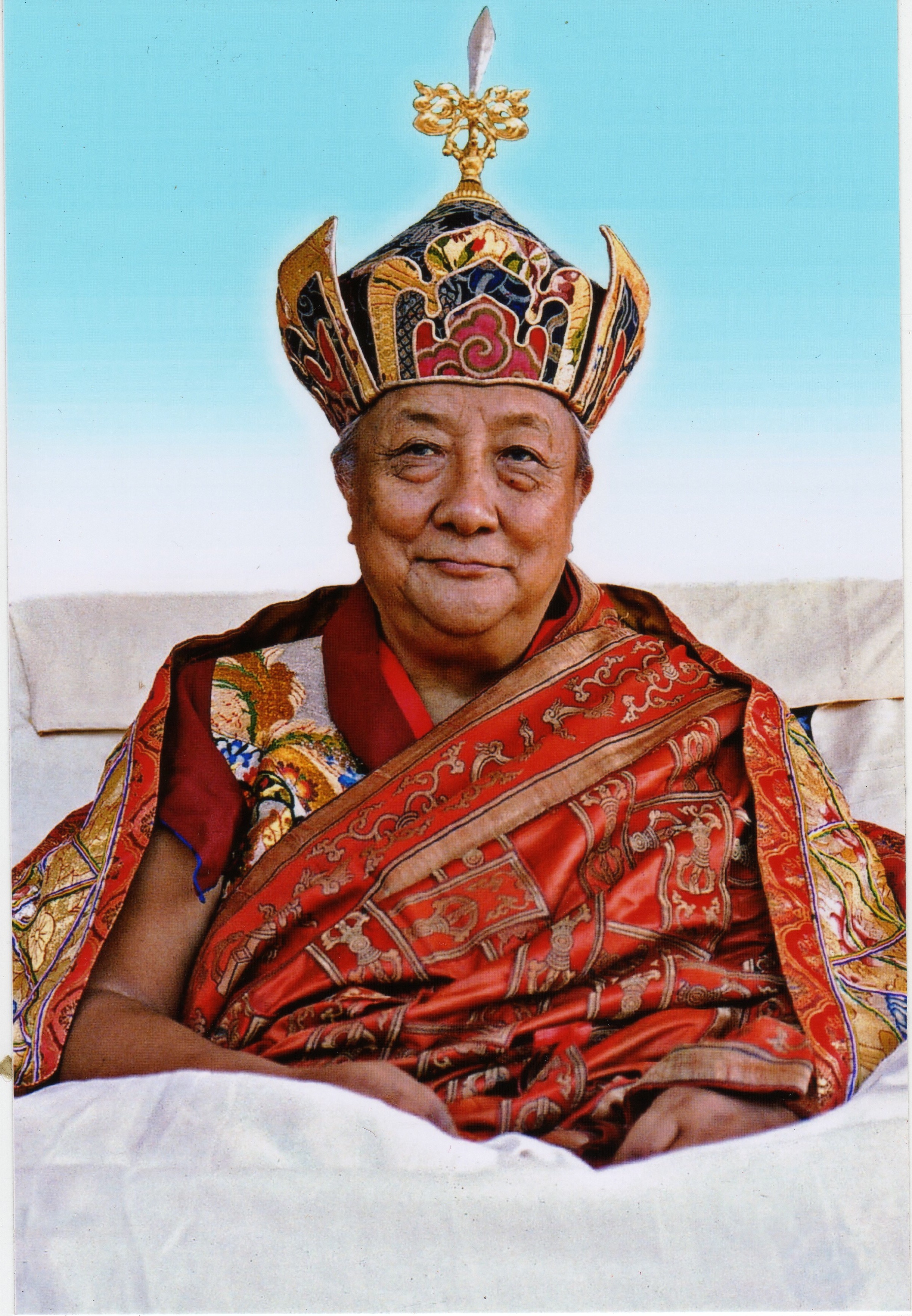
The following is respectfully quoted from “Enlightened Courage” by Dilgo Khyentse Rinpoche:

First study the preliminaries.

Consider all phenomena as a dream.
Analyse the unborn nature of awareness.
The antidote will vanish of itself.
The nature of the path rests in the alaya.
In post-meditation, consider phenomena as illusory.
Train to give and take alternately;
Mount them both upon your breath.
Three objects, three poisons and three roots of virtue.
In all your actions, train yourself with maxims.
Begin the training sequence with yourself.
When all the world is filled with evils,
Place all setbacks on the path of liberation.
Lay the blame for everyone on one.
Reflect upon the kindness of beings.
Voidness is the unsurpassed protection;
Thereby illusory appearance is seen as the four kayas.
The best of methods is to have four practices.
To bring the unexpected to the path,
Begin to train immediately.
The pith instructions briefly summarized:
Put the five stages into practice.
On how to die, the Mahayana teaches
These five strengths. It matters how you act.

All Dharma has a single goal.
Rely upon the better of two witnesses.
Always be sustained by cheerfulness.
With experience you can practice even when distracted.

Always train in three common points.
Change your attitude and maintain it firmly.
Do not discuss infirmities.
Do not have opinions on other people’s actions.
Work on the strongest of your defilements first.
Give up hoping for results.
Give up poisoned food.
Do not be hidebound by a sense of duty.
Do not meet abuse with abuse.
Do not wait in ambush.
Do not strike at weaknesses.
Do not lay the dzo’s burden on the ox’s back.
Do not praise with hidden motives.
Do not misuse the remedy.
Do not bring a god down to the level of a demon.
Do not take advantage of suffering.

Do everything with one intention.
Apply one remedy in all adversity.
Two things to be done, at the start and at the finish.
Bear whichever of the two occurs.
Even if it costs you your life, defend the two.
Train yourself in three hard disciplines.
Have recourse to three essential factors.
Meditate on three things that must not deteriorate.
Three things maintain inseparably.
Train impartially in every field;
Your training must be deep and all-pervading.
Always meditate on what is unavoidable.
Do not be dependent on external factors.
This time, do what is important.
Do not make mistakes.
Be consistent in your practice.
Be zealous in your training.
Free yourself by analysis and testing.
Don’t take what you do too seriously.
Do not be bad tempered.
Do not be temperamental.
Do not expect to be rewarded.

This distilled essence of instruction,
Which transmutes the upsurge of the five degenerations
Into the path of enlightenment,
Was handed down by Serlingpa.
Having roused the karma of past training,
And feeling powerfully inspired,
I disregarded suffering and censure
And sought out the instructions to subdue my ego-clinging;
Though I may die, I shall now have no regret.

The Turning of the Wheel of Dharma

250px-King_Indrabhuti-0

The following is respectfully quoted from “The Small Golden Key” by Thinley Norbu Rinpoche

According to the teachings of the sūtras, the Buddha turned the Wheel of Dharma, teaching the “four truths” (Tib. bDenpa bash) to the “five noble ones” (Tib. lNga.sde bang.po). These four truths are: suffering, the causes of suffering, the cessation of suffering, and the path leading to cessation of suffering. These are the foundation of the Hinayāna teaching.

Later, at Vulture’s Peak in Rajgir, the Buddha taught the “Perfection of Wisdom” (Skt. Prajñā Pāramitā: Tib. Shes.rab.kyi pa role tu phyin.pa) which is the second turning of the Wheel of Dharma called “Characteristiclessness” (Tib. mutton.nyid med.pa) to the general gathering of the Sangha, including male and female Śramaneras, Bhiksus, and Bhiksuni, and to the special gathering of Bodhisattvas, such as Mañjúshri (Tib. hJam.dpal dByangs), Avalokitesśvara (Tib. sPyan.ras.gzigs), Vajrapāni (Tib. Phya.na rDo.rje) and Maitreya (Tib. Byams.pa).

Finally, at a place of supernatural beings unknown to ordinary beings, the Buddha taught the “Doctrine of Absolute Truth” (Tib. Don.dam rnam.par nges.pa) to various disciples such as Bodhisattvas, gods, nāgas, yachts, rākshas, and humans. At these times, the Buddha exhibited many miraculous powers of body, speech and mind.

The full meaning of Mahāyāna is contained in the Buddha’s last two turnings of the Wheel of Dharma where he taught the actual relative truth and absolute truth.

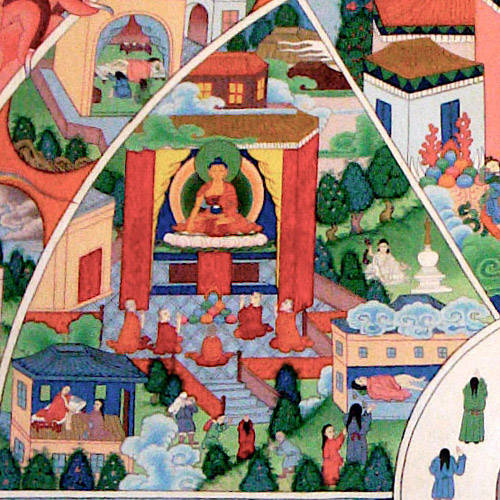
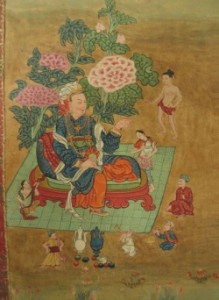
According to the teachings of the tantras, the higher Vajrayāna teachings were first taught by the Buddha at the request of King Indrabodhi of Uddiyāna (Tib. O.rgyan). In the Vajrayāna teachings, the Buddha taught disciples of superior faculties, who had accumulated great merit, how to transform impure phenomenal appearance into a pure mandala. In order to teach King Indrabodhi, the Buddha emanated the Guhyasamāja mandala (Tib. gSang.ba hDus.pa), then bestowed the empowerment of this mandala upon the king and gave him the tantric teachings.

Compassion as Antidote

????????????????????????????????????????

The following is an excerpt from a teaching by Jetsunma Ahkon Lhamo called “The Habit of Bodhicitta”

There’s a funny thing about the human mind that we don’t realize. Do you know how in your mind you think you’re concentrating on a million things at once? Some of you can chew gum, watch TV, listen to the radio and write in a book at the same time. I’ve seen people do this. It’s amazing. I have a son, oh, my god, you can’t believe this son. It looks like he can watch TV, listen to the radio, talk and really carry on a conversation, dance while he’s talking, and if he knew how to fry an egg, he could probably do that at the same time. I mean, talk about a Mongolian juggler. Each of us feels likewe can do so many things at one time; but what we don’t realize about the human mind is that’s not true. It can only do one thing at a time. But what happens is that we do these things in such rapid succession, that if we think about ten things at once, it feels like what is actually happening is that we are thinking about this, switch to this, switch to this, switch to this, very quickly; and our minds actually become inflamed and agitated with the switching from one picture to the other. That’s why it becomes valuable and precious to meditate on bodhicitta and to practice bodhicitta. Because while you are practicing bodhicitta, putting your mind in this pile, while you are doing that, no matter how simplistic it is, even if it’s just opening the door for somebody, while you’re doing that, you aren’t doing the other thing. And the great thing about the human continuum is that if you aren’t continuing it, it doesn’t continue.

The funny thing about continuum is that it loses its definition, its essence, if it’s not being continued. So we are taught to practice kindness and to begin where we can and to increase it moment by moment. Because while you are doing that, you can’t be doing the other. But believe me, when you are not doing that, you are doing the other. You are doing the other. So the bodhicitta becomes now not a great mystical attribute that we all hope we are going to get, it becomes a remedy. It becomes a method. It becomes an antidote. And you should see compassion as an antidote. There is no excuse, none, for you not to start right now. And you can’t get into what is kind of like the diet syndrome with bodhicitta. I don’t know how many of you have actually been on a diet, but if you’re on a diet, you’re like this: You go through, ok, a thousand calories a day. So you’re making your little chart and you’re eating your boiled egg or whatever it is, celery and ice or, whatever horrible thing they are making you eat. And then at one point during the day, you just can’t stand it and you go back to the old habit and think, ‘Ok, I’ve eaten celery all day, now I’m going to eat a piece of chocolate cake.’ What happens in our minds is that we think, ‘Now I’m off my diet. And it doesn’t matter.’ Well, you can’t have that kind of diet mentality with your bodhicitta. For instance, if you practice bodhicitta for a good period of time and suddenly you blow it, not only blow it, blow it big time, you know, I mean, big time, you really blow it, then you think, ‘I’m not a compassionate person. I’m not good, I’m bad. It’s gone for today. I’ll try maybe next week sometime. I’m hopeless. I’m helpless. I’ve blown my bodhicitta diet.’ You begin to form all these exaggerated conclusions based on what has just happened.

If you could approach yourself in a relaxed way, moment by moment, and you did practice bodhicitta for a certain period of time, then when you really, really blow it, there would be no inner tension to prevent you from simply going back to the bodhicitta. What you’ve done is expressed both of your habits, your new one, which is difficult, and your old one, which is easy and you can fall into it any time you don’t practice your new one. It doesn’t mean anything. It only means that you’re expressing both habits and at every given moment you have a choice. You can practice bodhicitta the very next moment right after you’ve blown it. And you should, because the best way to prevent blowing it again is to climb right back on that horse and make restitution. That’s the best way, to get right back on it. If you don’t’ do that, you carry a tremendous burden as a spiritual person, the burden of hypocrisy. You feel like a hypocrite. You feel like you’ve really messed up. You have this idea that you’ve been kind and then this monster in you comes out and then you’re faking it again. You can’t think like that. You can’t think in terms of good and bad, high or low. Think in terms of habitual tendency. Give yourself a break. You have both. Accept it now. Accept it now. And this way, no matter what happens, you’re not going to have to think something vile about yourself. And you have the freedom to make a choice at any moment.

My recommendation is that should you begin to practice bodhicitta and find it extremely difficult, do not form conclusions about it. Only continue. The only conclusion you should form really is the one that I’m giving you: That’s my habit. I understand that about myself. I accept. And I accept that I can change it, little by little. And it’s hard. It’s all right if it’s hard. One day at a time, you know?

Copyright © Jetsunma Ahkon Norbu Lhamo All rights reserved
 

Grasping for Happiness: The Root of Ignorance

dew17

The following is an excerpt from a teaching by Jetsunma Ahkon Lhamo called “The Foundation of Bodhicitta”

In closing, I wish to say this one thing. I talked to someone recently  who was schooled in a meditation that could create a feeling that was kind of blissy. This kind of meditation had bliss-like qualities. It would make you feel that you were kind of drunk, a kind of high feeling, a bliss-like quality. When I asked where the teaching came from, she said she got it from her teacher who had an experience of revelation and developed this teaching from that experience. I asked what the source of revelation was. She said they don’t think of it as a source, but this person had a revelation. This person had developed a technique with breathing and things like that. When I heard what the technique was, I was amazed. I remember thinking that you can horse yourself into a hyper-excited emotional state that is very much like a blissy kind of an experience. You can jerk yourself around psychically, using breath, using visualization, using certain kinds of thoughts and physical and non-physical techniques in which you can feel a certain kind of bliss. But I don’t know why a person would want to waste their time with that. I don’t know why a person would engage in such activity. It seems to me that all they are doing is exchanging one kind of phenomena for another.

The feeling that you have right now is just that. It is a feeling. It is like dew on the grass. When you examine it and even understand that the self that produced the feeling is empty of self-nature and is only the primordial wisdom state, that feeling that you have right now will vaporize. And who is producing this bliss that you can horse yourself into? This bliss, when examined, is produced by that same one. Not understanding the emptiness of self nature, not understanding and awakening to the primordial wisdom state through purifying hatred, greed and ignorance, not understanding this, you can jerk yourself around and experience bliss. And you can think happy thoughts for an hour and you will feel pretty good about yourself; but who is producing that thought the same way and it will vaporize the same way. Why exchange one kind of phenomena for another?

In the Vajrayana view, it is very plain and actually best put in a very stark verbiage. In the Vajrayana view, it is very clear: Chocolate and shit are the same. They are both brown and they are both phenomena. Now, of course, it is the you that would rather it be chocolate, but the you is not inherently real as you understand it. It is empty of self-nature. And it is only in your understanding of yourself, in the way that you do understand, and your clinging to that self, that you crave chocolate as you do and you are repelled by shit.

But phenomena is phenomena and you must understand that in order to practice the ultimate bodhicitta, you must practice the supreme path that does not create just another kind of phenomena. It doesn’t just create another kind of high, but in fact absolutely pacifies, once and for all, all of the building blocks of cyclic existence, all of the grasping, hatred, greed and ignorance, pride, jealousy, all of these things, that will produce this terrible suffering. These must be pacified once and for all. That is the ultimate act of love. There is a technology by which this can be accomplished. You cannot think it away because always  who is doing the thinking will be you.

So the game is then to become awake—to awaken to the primordial wisdom nature, to awaken to that Buddha nature, the ultimate kindness.

That is our teaching today. I hope that it is useful. Please make use of the teaching.


The Habit of Love

rock_pile_sm

The following is an excerpt from a teaching by Jetsunma Ahkon Lhamo called “The Habit of Bodhicitta”

Basically what we have to do is, day by day in a gradual way, reinforce, develop and make larger the habit of loving. It is so mechanical,. You wouldn’t believe how mechanical it is. It’s like this: This hand is self absorption, listing severely to the right. Little by little, it, gets heavier on the other hand, the loving side. At some point,…  And who knows when that day will be? It’s not for you to judge. It’s not for you to know. Not for you to even care about. At some point, the balance will go in the loving direction  and you will really give rise to the bodhichitta. And there will be a time when the loving habit that you develop so outweighs anything else that there is a funny, magical thing that happens. The self absorption becomes invisible.

You won’t believe that in the beginning, especially when you first start trying the habit of true compassion, because it just seems as though the weight of self absorption keeps pulling you back and it just seems overwhelming. But you have to remember: It’s kind of like a rubber band, it’s kind of like a rubber band. It’s so hard, and the agony of feeling yourself go back to that same posture is going to be very difficult at first. But never mind, never mind. Keep putting more and more in the habit of loving kindness. You are going to break it eventually. It has to happen. It’s kind of like a spiritual law of physics, if you can imagine such a thing. Eventually one will outweigh the other. It’s just like that.

In fact, if you would spend a lot less time evaluating yourself and judging yourself and a lot more time just putting pebbles in that loving pile, you’d feel a lot better. In fact, if you take your eyes off  this self-absorption pile entirely, and move towards the loving  pile, you’d feel better still. It’s almost that once you begin to gather some weight in the area of proper virtuous habitual tendency, by magic, this thing starts to disappear. You’re not looking at it anymore.

Copyright © Jetsunma Ahkon Norbu Lhamo All rights reserved

Bit by Bit: Cultivating Compassion

kindness

The following is an excerpt from a teaching by Jetsunma Ahkon Lhamo called “The Habit of Bodhicitta”

We have been revolving in cyclic existence for literally aeons and all during that time, in some form or another, we have conceived the idea of self-nature. Our habit, then, is to hold the idea of self-nature as being very, very solid and very, very real. Our habit, absolutely from the get-go, is to distinguish between self and other. Our habit is to react toward other with hope and fear. Our habit is to think in that relative sense and that comparative sense.  There is no compassion in any of that, and it’s not going to happen.

In order to truly develop compassion, we have to first get the idea and really take to heart the idea that the only thing blocking us from giving rise to the great bodhicitta, or great compassionate activity, is our habitual tendency. So no matter what we feel, if we have the stupid idea that we are good or bad (or whatever our ideas are about life if you have them), set them aside for a moment, and address the singularly important fact that you simply don’t have the habit of truly empathizing and having compassion for the condition of other sentient beings in any consistent and real sense. It’s a question of habit and not a question of good or bad. Are you able to feel compassion?  Many students have come to me and said, ‘Well, I love the idea of compassion. I think it’s wonderful. I hope you are good at it. I hope you continue to teach it to others. But I just don’t really feel compassion for other people.  So I don’t think I can be a Mahayana Buddhist.’ And, really, I cannot count on all of your fingers how many times it has happened to me that a person has said, ‘I love it, but it won’t work for me. I just don’t have any compassion.’

You can’t hide out in that any longer. That’s not a valid excuse, because the fact of the matter is that we are all in the same condition. No one here truly has the habit of compassion. Well, we have a little. Every now and then a jigger of compassion gets mixed into the cocktail of life. (Pretty cute, huh?)  But in truth, we have very little. If we had a great deal of compassion, our whole lives would be given over to benefiting others. There would never be another choice. There would never be another choice. Everything that we do would come out as benefit to others. It would be like magic. You wouldn’t even have to think about it if you had really given rise to the bodhicitta and broken the habit of self-absorption. There would never be another option.

But that’s not the case for sentient beings. We are all in the same condition. So what we have to do is stop waiting to feel compassion, because you are always going to paint yourself into a corner with that one. You are never going to be satisfied with what you are feeling. Until enlightenment, we are never going to be satisfied with anything. So you can’t hide out in that excuse. You simply have to develop a new habit. Sometimes when you are developing that new habit, it can look like this: OK, it doesn’t so much matter what I want here. There are other people that want things in this room, and I’m going to give it up. It can look like that at first. That doesn’t mean that you’re not doing a good job; and it doesn’t mean that you are wrong. It doesn’t mean that you’re bad, and it doesn’t mean that you are a martyr either. It doesn’t mean that you are making an extremely valiant effort and should be rewarded. It doesn’t mean anything. It only means that you are developing a new habit, bit by bit.

Copyright © Jetsunma Ahkon Norbu Lhamo All rights reserved

Jealousy

Jealousy

The following is an excerpt from a teaching by Jetsunma Ahkon Lhamo called “The Foundation of Bodhicitta”

The next realm is the jJealous gods realm. The jealous gods realm is actually the war-like gods, the competitive gods. We have stories about them in our old testament, don’t we? We have stories about a god that is very jealous and war-like. We have stories about Old Testament,not Buddhist but Christian-Jewish Old Testament. The jealous god realm consists of gods who are very willful and very bossy and very competitive; and they really want things done their way, now. And if you don’t do it, kaboom, thunderbolt to you pal, turning you into salt or something like that. They are constantly fighting each other. They are constantly doing things that make you look at them and say, “Get a life.”  I mean I wouldn’t do some of the things that they do, and what do I know? They act like three year olds. (She looks up at the ceiling in anticipation of retaliation. laughter)  Don’t you hope that I would get away with that? If I got struck by lightening, though, it would prove what I just said, maybe.

Anyway, there is terrible suffering in the jealous gods realm; and that suffering is the suffering of warfare and competitiveness; and it is ongoing. It never ends. There is a violence there; there is a constant, violent outpouring there. It is a very strong war-like energy. They are not particularly happy. They are happy in some ways: They have lots of riches, and they have lots of people underneath them. I guess that makes them happy. They are actually always engaging in some kind of very active war-like activity; and therefore they are not happy and eventually they die. All of these realms are impermanent. They all begin with birth and end with death.

So what is the cause of being born in the jealous gods realm?. The cause of being reborn in the jealous gods realm is jealousy, competitiveness and jealousy—that kind of arrogance, ego kind of thing. Have you ever seen people like that? Have you ever been like that? Have you ever seen people who just think they are so glad that they have it and you don’t? Have you ever seen people who sort of set themselves up in a very high place and they really engage in activity to try to get as much money as they can, and they compete and they really like the game? Think of the movie Wall Street. Remember that a few years back? That kind of thing. That is jealous god activity right there, a perfect example of what is going to happen. The people involved with that when they take rebirth could very likely end up in a jealous gods realm. They were like gods, and they were always engaged in that kind of competitive activity.

Copyright © Jetsunma Ahkon Norbu Lhamo All rights reserved

Relief From Suffering

HumanRealm

The following is an excerpt from a teaching by Jetsunma Ahkon Lhamo called “The Foundation of Bodhicitta”

Now having been introduced to the six realms, you should look at all of the different qualities that produce these rebirths: anger, grasping, ignorance, doubt, jealousy and pride.  You should think that the thing to do, if you have any understanding at all, is to begin to engage in activity that pacifies those kinds of qualities.  How does this mesh with compassion?  When you think about engaging in compassionate activity, you have to view compassionate activity in accordance with this teaching because you might think that compassionate activity would only be to be nice to people, and actually that is one kind of compassionate activity, or to give money to the poor, or to feed people.  That is one kind of compassionate activity; that is one kind of bodhicitta, but it is temporary bodhicitta.  It will produce a temporary cessation of suffering for the people that you help.  If you give them food when they are hungry, it will produce the end of temporary suffering.  If you give them money when they are poor, it will produce the end of temporary suffering.  But if you really want to get into ultimate bodhicitta, which is the quintessential practice of the Mahayana vehicle, and Vajrayana as part of Mahayana—Vajrayana is what we practice here—what you really want to do is to practice ultimate or supreme bodhicitta.  Ultimate or supreme bodhicitta is creating some kind of practice that will be a vehicle by which the qualities that produce this result will be pacified both in yourself and in other sentient beings.

I’ve described the six realms of cyclic existence.  Where in the six realms is there relief?  Nowhere.  Will you find relief as a result of temporary help in any of the six realms?  No, because you will be reborn again. And where?  We don’t know.  We just don’t know.  In cyclic existence, there is no true relief.  All there is in cyclic existence are the components of cyclic existence.  That is all that is in that pot.  You cannot expect true relief from cyclic existence.  So ultimate bodhicitta and an ultimately compassionate act would be to become a Buddha yourself.  To become highly enough realized yourself to make that commitment to attain realization in order to return again and again and again, emanating from the mind of enlightenment in order to be of benefit to sentient beings, because that is where relief comes from.

Now let me see if this is a typical thangka?  No this is not a traditional thangka.  The traditional thangkas usually show a path coming out from the human realm leading to enlightenment.  As a human, you can make the ultimate gift.  You can engage in the supreme practice.  You can achieve enlightenment yourself and, therefore, you can be a returner.  You can return again and again and again in order to lead sentient beings through a display of your enlightened compassion.

Copyright © Jetsunma Ahkon Norbu Lhamo All rights reserved

The Mixed Karma of the Human Realm

doubt

The following is an excerpt from a teaching by Jetsunma Ahkon Lhamo called “The Foundation of Bodhicitta”

Now we are getting to the egg yolk. Actually the optimum life is to be born as a human,. even more than the god realm. Interestingly the god realm seems to be more fun. Wouldn’t you rather have a nice cool glass of the elixir of life?. Or would you rather have a glass of water? Now I know the answer to that. You monks and nuns, it’s been a long time since you have had anything to drink. You would like a nice elixir of life, wouldn’t you?. So, it seems like you would want to born in the god realm. The interesting thing about the human realm is that it does have definite suffering, which you have seen (and I have explained what the suffering is). Plus it particularly has the suffering of old age, sickness, and death. They don’t mention taxes. Maybe they didn’t have them when the Buddha was here. You might escape taxes, but you will never escape death. Maybe that is why he didn’t mention it. Even though those sufferings are present in the human realm alone, there is the peculiar meshing of karma, the peculiar evolution of karma that comes together in a certain way that we can practice the Dharma. We can make a choice and practice compassion. We can practice meditation on emptiness. We can practice Dharma in such a way as to achieve realization. We have this kind of queer mixing, or spaciousness, in our mind. In some cases it is not spaciousness, but it is just that the karma is ripening in a certain way that we can practice.

The teaching says that we have time to practice. Time to practice means what? ? Time in our minds to practice, not time in the day to practice. Anyone can get so busy that you don’t have time in the day to practice; but if you can conceive of time to practice, you have time to practice. You can make time to practice. In the animal realm, there is no time to practice because they are too busy being ignorant and fearful. In the hell realm, there is no time to practice because they are too busy suffering horribly. You can’t practice, you can’t think about compassion, if someone is bonking you over the head. You can’t think about compassion, or burning up in a burning house. In the hungry ghost realm, there is no thought of practice because all you can think about is need—I need, I want, I want, I want. But in the human realm, one can consider practice. There is space to practice. In the god realm, one cannot practice very well either because you are too busy enjoying bliss. You are so filled with bliss all you have to do is drink water. Why would you want to practice? All you have to do is touch something and it feels like waves of bliss. Why would you want to practice? Why you would want to practice is that all of these six realms are impermanent, even the god realm. In the human realm, though, you can practice. We too have sufferings—old age, sickness and death.

What causes us to be born in the human realm? Two things: A lot of merit and virtue that we have accumulated in the past through eons and eons of cyclic existence happened to pull together in one big puddle and ripen in such a way as to produce a human rebirth. But there is also non-virtue that produces a human rebirth. If we had total virtue, if that was all that we had, we’d just wake up one day enlightened, I guess. But that is not what happened. We got reborn in the human realm. What is the non-virtue that accounts for a human rebirth?. The main non-virtue that produces human rebirth is doubt. Doubt. You don’t believe that, right? I knew that. See what I mean. The main suffering of the human rebirth results from doubt as well. And that is why it is possible for so many of us to have with the auspicious opportunity to meet with the Dharma, to meet with the human condition with which we can practice. And we don’t practice. We don’t. If you really believed, if you understood that these six realms of cyclic existence exist, if you understood about your death, if you understood the cause and effect relationships that bring about an auspicious rebirth, if you understood what it takes to produce enlightenment, that is what you would do. You’d practice. But you have doubt, and that is why you don’t do it.

Copyright © Jetsunma Ahkon Norbu Lhamo All rights reserved

WP2Social Auto Publish Powered By : XYZScripts.com