Your may not see eye to eye today with your fellow travelers. Perhaps arm wrestling would help you work your differences out. It is okay to put your point of view as long as you can really hear the other person’s point of view. On the flip side of the coin there is potential for growth and learning today. There is always a way out of a difficult situation. As Spock said in Star Trek There are always alternatives.
The following is an excerpt from a teaching by Jetsunma Ahkon Lhamo called “Desire Blocks Happiness”
The teaching that the Buddhas have given us is that the cornerstone of our religion is generosity and giving. Celebrating Christmas as a cultural holiday could be a time when we Buddhists could practice the most important meat and bones part of our religion. We could be really generous. But it doesn’t seem to happen. It’s just become too materialistic. I think that that is a perfect example of some of the problems that we have as sentient beings.
As sentient beings we have this mistaken idea that we can satisfy ourselves through very gross materialistic means. And we can’t even see through the falsity of that idea. We can’t really understand how it is that we’re fooling ourselves, that we’re duping ourselves; and we never seem to understand why in the end we are never completely satisfied. Do we? We never really understand what has fallen through. Why is it that we‘re never happy? And why is it that we’re never completely satisfied? Or if we are happy, why does it not last? Why is that so? I think about the strange mental configurations that we can get into. It’s really odd. Depending on what kind of person you are, each one of us will express this mental configuration in a different way.
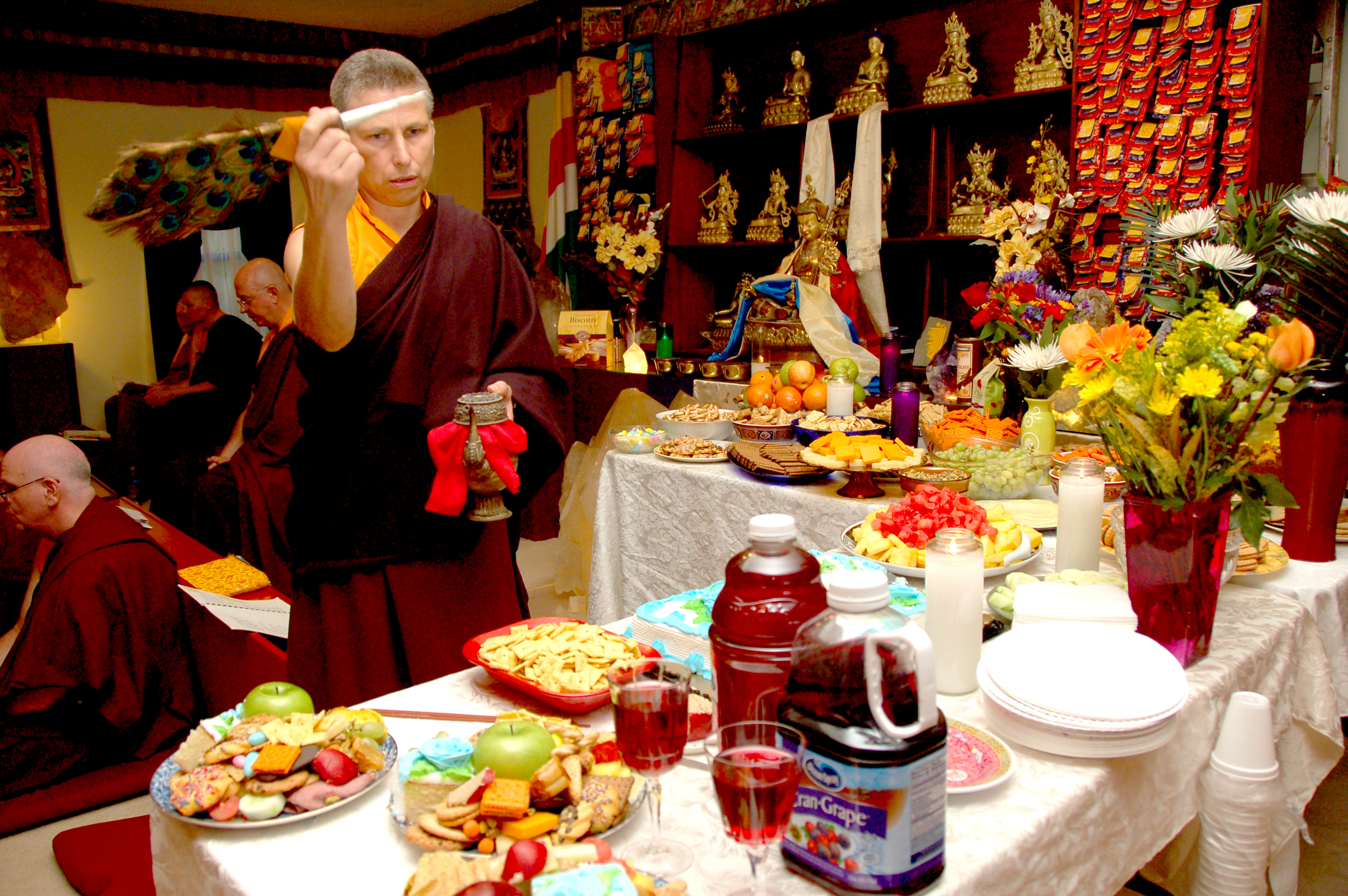
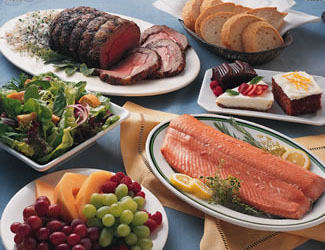
Here are some of the ways that I can think of just off the top of my head. Let’s say, for instance, that we’re eating some food. Well, you know, you might eat something that is very rich and meaty; and then after that you have to have something that’s very light and sparkly to cleanse your mouth. After eating something rich and spicy, then you have to have something sweet and mellow. And then you think that if you’ve had something salty, you must have something very liquidy and smooth to drink. And it goes back and forth and back and forth; and you must constantly build on what you have given yourself to complete the experience. Have you ever noticed that that’s true? Have you ever noticed that if you were to eat, for instance, some meat at a meal, then after that you would have to have something sweet? Or if you ate something salty, then after that you would have to have something cool and refreshing? And that if you ate something cool and refreshing, then you would have to have something salty? And it’s an endless cycle of things that you have to do that is based one on top of the other. It’s almost like a reactive phenomena that is circular and cycled, almost, in its shape.
Then let’s say that we go to the store and we see a dress that we absolutely musthave. It’s a ‘must have.’ It’s a beautiful dress. It’s a beautiful dress. We try it on, and it fits us perfectly. Or if we’re a man, it’s a beautiful suit, and it fits us perfectly. I can relate more to the women’s dressing aspect. But anyway, if it’s a dress, well, you have to have the perfect shoes. And of course, if you have to have the perfect shoes, then you must have the perfect hose. And of course, if you have the perfect hose, then you must have nice underwear to go under it. And of course, if that’s the case, you must figure out exactly how to do your hair properly to make it just right for that dress. And then, what are the accessories that you are going to use? Well, the only earrings that you’ve found that are just perfect are going to cost you about $150.00. Ahhhh… So in order to make that practical, you have to buy another dress that they go with. Two dresses for a $150.00 pair of earrings? Nope. That skirt and that blouse would make it practical. They would make it worthwhile. But then, for each one of them, you have to have shoes and hose. Pretty soon it gets awfully darn complicated, doesn’t it? And you find that it never ends. Because every time you put a piece together, there has to be another piece.
Or with relationships. You always think, ‘Well if I could just find that perfect relationship, I could be happy.’ Then you find a relationship, and you talk yourself into believing that it’s perfect. Maybe it seems perfect at first. And then suddenly there comes that first, horrible day when you notice there’s a flaw.. You try not to think about it, but it’s really there. You try not to think about it, but it’s creeping up on you; and pretty soon you notice that it’s not perfect. And the moment that it’s not perfect, you fall through the cracks again, don’t you? Because little by little, that lack of perfection is going to build up. And if your mind is not stable, pretty soon it won’t be the one. And if it’s not the one, pretty soon you’re on the track again, looking, looking, looking.
It’s always like that. It’s always like that. It can happen with material objects. It can happen with relationships. It can happen with ways that you spend your day. It can happen with jobs. It can happen with ideas. And the thing that we always come out understanding is that nothing is perfect. We’re never completely content. There is no perfect relationship. None. There is no perfect object. None. There is no perfect circumstance. None. There is no perfect idea. None. Because each idea, each object, each relationship, can only be perceived by us according to the karmic patterns and habitual tendencies of our mind. We will create the kinds of relationships in our mind that are our habit to create according to our karma. And we will not even be able to register those that are inconsistent with the karmic cause and effect relationships within our minds, with the habitual tendencies that are within our minds. We will not even be able to cook up a relationship that isn’t part of the habitual tendency of your mind. Of our minds. That’s why they’re all alike. That’s why, even though some relationships seem different, and some people seem different, our friends and our experiences within the context of relationships eventually all have a certain common denominator. They have a common denominator in some regard. They are the same. They leave us in the same way; they affect us in the same way. And it’s due to the fact that we cannot even perceive a relationship that is not part of the habitual tendency of our mind. That is what we are doing. We are looking in the mirror and seeing the habitual tendency of our mind. And it’s the same way with any object that we have ever owned. They all have a certain common denominator. They all excite us for a period of time, and then they leave us. They either get old, or they break down, or they’re no longer in fashion, or whatever it is that happens.
There is a famous Scottish saying “It is darkest before the dawn.” Or as Dad’s friend said, “It’s always darkest when its getting darker than it has ever been before.” A challenge today is variation on a theme this week which is about working productively within limitations and dealing with frustration. Are you able to harness the feeling of having no room to move by moving something you can.? As the Serenity Prayer goes, Grant me the serenity to accept the things I cannot change, the courage to change the things I can and the wisdom to know the difference.
How to understand that your faith is alive? Try being alive in your faith. The ball’s in your court, and you’re not going to get away from that. You cannot change the religion and think that it’s going to suit your needs, because then you’re doing something else entirely. You’ve already decided what it’s going to look like and how you’re going to act. You’re on a track, that is unbendable, unmovable, unadaptable, and you’re going to bend things around you to fit. You cannot do that to the world any more than you can do that to yourself. Bash-to-fit and paint-to-match doesn’t work.
So our job then is to get in, to make this faith more than a formalized external thing just like an exoskeleton. The only way to get in it is by really understanding it, by really going through the process that empowers you, to see what the truth actually is. For instance, we’re told that cause and effect is for real. Cause and effect should be blatantly obvious to us by this time because most of us here are above five years old. But we don’t get it. Lord Buddha tells us that cause and effect really matter. If you engage in virtuous, loving, generous, kind acts, the results will be love, happiness, fulfillment, higher rebirth, all of these kinds of things. That seems pretty reasonable to me.
But if we don’t go through what it takes to truly understand this on a deep level, if we end up approaching even this very visible piece of truth by saying, “Oh this is another thing I have to learn.” I’ve seen my students do this – from my very oldest to the brand new ones. “From now on I’m going to do good things, because good things will get good results and I’m going to be happy. Okay. Let’s see now. It’s 7 o’clock in the morning. I will be out of bed by 7:15. Can I get a good thing done by 7:20? This is the way that we think, you know. It’s by rote. A chicken can do this! A parrot that can be taught to talk can learn these rules, but where is the heart of the parrot?
What if we could hear the Buddha’s teaching and say, “This is amazing wisdom that has come into the world. The Buddha organizes this wisdom and says to us, ‘Virtuous actions produce excellent results.’” What if we went through the process of really looking at this? What if we really tried to connect the dots? What if we looked at our own life experience? Yes, its’ hard to do. We know that. The reason it’s hard to do is that in order for you to examine what virtuous conduct looks like and how it relates to result, you have to determine what is nonvirtuous conduct. In order to do that you have to face some terrible truths about yourself, for example, that you don’t always engage in virtuous conduct. The minute we get near that sucker we back off fast, because isn’t religion supposed to make us feel better? Well, yes, if it’s an opiate. Well, yes, if it’s a drug – one of your many drugs.
Religion can be compared more to exercise. When we first start to exercise, especially nowadays, we join a club and get an outfit. (I have some killer workout outfits, I want you to know.) We get an outfit and everything matches, the socks, the headband. Or else we jock out about it. Maybe everything doesn’t match, but it’s all cool. And then we get in there, and we don’t work out or exercise because it feels good to lift vast amounts of weight over and over again. Not at first. In fact at first there’s a lot of pain. You get on those machines, and the next thing you know you can’t move. So starting never feels good but afterwards – when you’re in shape and your body is tuned up and you’re strong – you feel great! It’s an organic thing. It benefits all your systems. It comes up from inside of you. It changes everything about your life. It feels great. But initially no. Most people stop with that initial stuff, don’t they? The minute it doesn’t feel good, that’s when they stop.
We do the same thing with religion. Can you see that? We go into it with an outfit, and we do it until it’s a little uncomfortable, such as changing something about our lives or seeing something. Then we’re out of there, because we have the don’t wannas. We don’t wanna; it doesn’t feel god. We think, “I thought this was going to make me happy, and it really doesn’t. It’s kind of depressing to think about reality. I don’t want to.”
Now let’s look at a person who moves into making exercise part of their lives. You do it in a more directly related way. You learn something about it. You learn about the physiology of exercise. You learn that there are certain problems your body has that it doesn’t have when you exercise. Well, that’s one thing that will empower you to keep on going: You go for that goal of producing a certain result. Have you ever thought of that in your practice? Producing a certain result, instead of just putting in your time? There is a difference. With exercise we get to a certain point where we just begin to see because we’re looking inside of ourselves and we’re looking in the mirror. Suddenly, we notice that there is some result. The first time you see a result, it can be a life-changing experience, if you work to integrate it into your life.
It’s just exactly like that with religion. Initially, you have to change. Change is not comfortable. We already know this. So initially you change and then after that you begin to connect the dots. You begin to see some cause and effect relationships. You begin to see that virtuous behavior actually does make you feel pretty good, and you explore that. You don’t take it for granted like a big dope. You work it out in your mind – work the numbers, work the equations. What feels good? Does it feel good to be in charge of your own internal progress? I think so. It doesn’t feel good to walk through life and just let life hit you like a truck. It feels good to walk through life in my practice, knowing in my heart that I am deeply empowered by this direct intimate relationship to spirituality. I know what kindness tastes like. I can see direct results from certain kinds of behavior patterns, behavior changes. I can see them directly in my mind. I feel comfortable with that. How is it that Tibetan monks have the same restrictions as our ordained and they are so much more comfortable with them? How is it that Tibetan lay people feel so much more comfortable with their lives? It’s because they have some kind of direct experience that makes it sensible and realistic and reasonable to conduct themselves in a certain way.
We have not developed that sense. I don’t know how many times I can present this same teaching. It’s about understanding that the ball is in our court. It’s about having a direct hands-on experience, not about being a good boy or girl. Aren’t you sick of that? This moralizing stuff has got to go! Instead, have a direct understanding, a natural wisdom – your wisdom – that dry times cannot take away from you, that broken hearts cannot take away from you, that no one else can take away from you? Your wisdom. You don’t look to anyone else to get your wisdom. You’ve got it inside. You understand the path in a deep way. You are empowered.
I’m not talking about ritual empowerment. I’m talking about a deeper, truer kind of empowerment. How wonderful if we can know that spiritual empowerment deeply within ourselves, to then go through the process of ritual empowerment according to the teaching and know what it’s about. It’s not just a vase (or a bhumpa) being knocked on your head. You could do that from now until your head and the bhumpa are both flat, and there would be no direct relationship. If it’s all academic and intellectual then it’s the same as getting a Ph.D. Anywhere in technical sciences or whatever. It’s not really a path. A path is a way to go. A path is not an object that you consume or collect or put in your crock-pot and boil all day until it makes a gravy at night. A path is where you are. Where are you then?
What I’m talking about is carefully considering how to overcome the limitations of confinement of our kind of society, of our kind of culture; how to go more deeply to have a more direct relationship with our spiritual nature – a real mystical relationship with that nature. And I don’t mean just meditating on some sort of internal cartoon circus where you think you’re getting messages from the Pleiades or some baloney like that.
Happy Birthday Scorpios – the Sun has entered your sign – now is your time to shine! Welcome to a new year and an opportunity to leave the past behind you and step into the empowering present. Although Scorpio Marie Antoinette did say There is nothing new except what has been forgotten. Today emotional sensitivity is heightened. It’s easier today to cast yourself as a victim – but there is much more reward in taking responsibility to transform the energy. There is an opportunity for a beneficial connection today.
An excerpt from a teaching by Jetsunma Ahkön Lhamo from The Spiritual Path
Sometimes the ordained have problems with desire. When you take on robes, it doesn’t mean that desire ceases. Why not make that desire meaningful? You can offer desire to the Three Precious Jewels. It’s not a big secret that you’re feeling it. Use it as an offering! It is the most profound and auspicious offering. Of course, this is true for lay people as well. All the ego-clinging that you participate in can be offered. But what do you do instead? How many precious minutes do you waste? You sit there and think about how profound your understanding of the Dharma is, and you juggle your insights in the air. Aren’t you just continuing the habitual tendency of perceiving phenomenal reality according to you? You use your insights to increase your ego-clinging. Maybe you’re doing it right now, contriving your own version of the insight you think I want you to have. What you are not doing is offering your perception to the Three Precious Jewels. You aren’t, are you? You forgot. With this practice, you can break through the seduction of phenomenal existence. It is a way to break the cycle of desire and ego inflation. It is a way to awaken to the Nature. If you did that and nothing else, you would be an excellent practitioner, and you would achieve the auspicious result.
How can you break the cycle? If you remember just three times during the course of one day, three minutes of generosity, that’s a start. If you lose it after a minute, don’t give up. Keep climbing back on. When you fall off the horse, climb back on. That’s how you establish generosity in your mind. Write yourself a note. Put it on all your favorite places: your mirror, refrigerator, CD player. Whenever you turn on your CD player, you’ll remember to offer the experience of sound. A little at a time, day by day, you can have that experience. I have had the experience of going for a walk and doing that for an extended period of time. Each time I sensed the experience of perception, I would turn it over immediately, turn it over.
Your habit is to take a perception, hold on to it, and make something. Have you noticed that? But you can come between that moment of perceptual experience and making something. It’s tricky, and you have to practice it, but you can learn to put a little space in there. And you can use that space to turn it over, to dedicate it, to offer it. You can develop a repeatable experience. It can even become automatic. Just remember: the moment you experience your own perception, avoid forming it into a superstructure that enhances your ego. Turn it over, turn it over, offer it. What will happen? Your whole personality will change. Your behavior will change. It will have to change—because your behavior has been based on desire and on inflating your ego. Not only that, but if you engage in this kind of practice for an extended period, you can have something like a blissful experience. I say this with dread in my heart because I know what’s going to happen. You’ll go for a walk. You’ll put some minimal effort into this practice, and you’ll contrive for yourself an amazing, blissful experience. And then you’ll seize upon that experience and have a more meaningful self because of it. Don’t do that! Just engage in the practice and continually make that offering. You’ll find there’s a happiness that comes with it. There’s a joy, a spontaneous feeling of joy. But don’t cling to it. The minute you see yourself sensing the feeling, you’ve got to turn that over too. You simply make an offering. That experience of joy is an offering. See all your connections with the world through the five senses as a kapala filled with precious jewels. But don’t contrive something out of it. Instead, find the subtle moment right before the experience. Then, once you find it, simply use that moment to make the offering.
I hope all this is helpful to you. I hope you will use it. This is the kind of teaching that can change your life. It can change everything about your practice. I don’t think it is arrogant to say that. It is my personal experience. This practice, I think, has contributed more to my well-being than anything, even though, if I tried, I could find reasons to be unhappy. But for me, this practice has been like a happiness machine. I feel it has deepened my mind. I feel it has made my mind more spacious, more relaxed, more peaceful. I feel it has created a lot of merit. I visualize an altar in my mind at which I can constantly make offerings. You should think of your consciousness as an altar—and all phenomenal experience as the offering. The instant you decide that you must have the best apples, make those apples count for something. Offer them and everything that is delicious and beautiful and satisfying. Offer as well all experience, in its purest form. Dedicate the value of that offering to the end of suffering for all sentient beings. You have entered the path of ultimate happiness.
With the moon entering Sagittarius it’s a great time to get out doors during the change of seasons. You can dress up or dress down depending on the hemisphere you live in. Exercise could help you exorcise any challenging emotions. What’s your preferred outdoor exercise? Watching butterflies, yoga, martial arts or frisbee? The sky’s the limit. As Tuck Burnam says, make sure the wind behind you is your own.
The following is an excerpt from a teaching by Jetsunma Ahkon Lhamo called “Why We Suffer”
The next piece of information that you really have to take in is that not only are you responsible for being where you are now, and not only are you responsible for what’s going to happen next, but you don’t have much time. This precious human rebirth goes by as quickly as a waterfall falling down rocks. Depending on how old you are, you’ll know that. You partially know that already. I’m forty-one and I think to myself constantly how it was only yesterday that I was eighteen, nineteen, twenty. Only yesterday. In my mind I feel like a child; I’m not fully grown yet. I feel like I’m not grown up, not mature yet. And I’m halfway through this bugger. Now that’s true of all of us; and some of us are further along than others. We don’t have much time. It’s going by very quickly. If you don’t take a hold of this opportunity now, you will not be able to utilize it.
Please understand that you are deeply involved in a habitual reactive process. The mind is tight, and it is tightly ingrained in its compulsive habitual tendencies. That you will be able to take advantage of one small moment of spaciousness, that you will be able to really absorb the nectar and really able to use it, according to the teachings, is really as unlikely as a sea turtle surfacing in a great ocean and coming up through a round circle that is afloat on the ocean. How rare is that? So please do what you can to make this opportunity as auspicious as possible. Please accept the fact that even though you’re hearing the teachings, and you’re hearing them as well as you can, you’re only hearing a little bit of them. The mind is hard. Soften the mind. Go for the nectar of the teaching that leads to enlightenment as though you were a starving and thirsty being on a desert where there is no other water to be found. Generate that thirst. Generate that thirst as though your throat were parched, as though there were nothing else. And then aim truly. Try not to make up your own religion. Actually, we’ve been doing that for eons and eons in cyclic existence. We have been making up the religion of self. This is the religion of ego. We have a religion, it’s true. Time to convert. Now we need to follow the method that leads to enlightenment, not the one that leads to further self-absorption and more suffering. Remember that all the experiences that you’ve had are phenomena; that they are direct displays of your own habitual tendency, and, therefore, as meaningless, really; that the meaningful truth about you is the most glorious truth and the one that you keep forgetting. In your nature, you are the Buddha; and it is possible to awaken, and therefore to be free from cyclic death and rebirth and from samsaric suffering. It is possible. But it will not happen without great effort. And it will not happen if you don’t begin now.
So please do utilize the opportunity. Do utilize the teaching. If you go away from this and you change in some way… And, of course, the idea is to change. If you didn’t want to change, you probably wouldn’t be here. If you go away from this and change in some way, change sufficiently to where the mind becomes more relaxed, the heart becomes more receptive… If these things begin to happen and you actually begin to practice, begin to make wishing prayers, begin to make kindness the cornerstone, the backbone, of your incarnation, of your life, then this day has been worth something. But if you just wanted to sample the wares here, your mind probably is like a bowl turned over and the nectar, once again, has escaped you. Please take a hold of yourself. Please utilize this precious human rebirth. Please understand the nature of cyclic existence and its faults. And please understand the beautiful and bountiful feast that awaits you upon awakening.
A new intensity and energy is around today enabling access to a deeper perspective of the world. Sometimes diving deep is needed for the changes you wish to make. You never know if you don’t go there. It’s not a half-way day to day. Passion can be gainfully employed in deeper conversations about the meaning of life and what matters. As Maya Angelou said: My mission in life is not merely to survive, but to thrive; and to do so with some passion, come compassion, some humor, and some style.
How do you cultivate compassion? The first step is to open your eyes and look at the nature of suffering. In our culture, we keep ourselves removed from this. The deformed, severely handicapped, or terminally ill are often hidden from view.
There are countries where this is not so. During my trip to India, I was shocked by the poverty, the leprosy, the filth. Every time my cab stopped, someone with stubs where arms had been would stick one in the window. I started to give out all the money I had with me. Soon the driver pulled over and said, “Lady, please stop that. My cab will be mobbed. Besides, you’ll lose all your money, and they’ll still be sick and poor. Even if you buy each of them a meal, they’ll be just as hungry tomorrow.”
His words were a vivid reminder that this type of compassion, though well-meaning, is not the ultimate answer. Hunger and sickness are only two kinds of suffering. Philanthropic compassion may temporarily relieve hunger pangs, but it does not begin to address the causes.
What did the Buddha think when he saw the poor, the decrepit, and the sick? Not merely that they were suffering from poverty, old age, or sickness. With His great wisdom and compassion, He understood that all this suffering results from karma created by desire.
Where does desire come from? From the belief that self-nature is inherently real. From the compulsive tendency of the self to perpetuate itself and to see others as separate and real. This begins a process of attraction and repulsion, action and reaction. A sentient being’s every thought is built around attraction and repulsion. Desire becomes stronger and stronger, reinforcing the belief in “self” and “other” as separate—and in all phenomena as inherently real. From this, karma arises. The process continues for eons and eons of cyclic existence.
Have you ever suffered from loneliness or depression? Have you experienced violence or poverty? A pro-longed illness? The heartbreak of divorce? Have you seen deliberately deformed children? Lepers? Have you visited a slaughterhouse? According to the Buddha, there are states, or realms, in which beings suffer much more horribly.
The forms we take in these realms result from the qualities of our minds. If we are filled with hatred or anger, we are born in a hell realm. How can this happen? It is not difficult to understand. When you are filled with hate, are you not in your own private hell? We have all gone through periods of intense anger or hatred in which we found excuses to get more angry. Each of us has had moments in such private hells. If your mind is capable of producing a nightmare, rebirth in a hell realm is a possibility.
There also exists a state or realm populated by what the Buddha called “hungry ghosts.” Have you ever gone through a period of feeling terribly needy? You needed love, approval, or nourishment so badly that you were in a state of constant, restless despair. Yet when people reached out to you, they were unable to get through. It is the hungry ghost realm in which similar needy states of mind congregate.
According to the Buddha, when beings die, they experience the intermediate state between incarnations and are then reborn in a form appropriate to the qualities or the karma of their minds. If they had a great deal of hatred, that hatred will clearly manifest itself and influence their next rebirth. If they were greedy, that greed will influence their rebirth. If they had the karma of ignorance, that ignorance will determine their rebirth.
Even if you had every good intention and all the material means by which to support beings throughout their lives, you could not do anything about the process of rebirth. You cannot change what is inevitable. You cannot influence future lives because you cannot permanently change minds and hearts. Thus continues the cycle of suffering. And that is why we embrace, with all our hearts, a pure path to bring about the ultimate end of suffering.