The Nature of Stupas

The following is an excerpt from a teaching by Jetsunma Ahkon Lhamo called “The Lama Never Leaves”

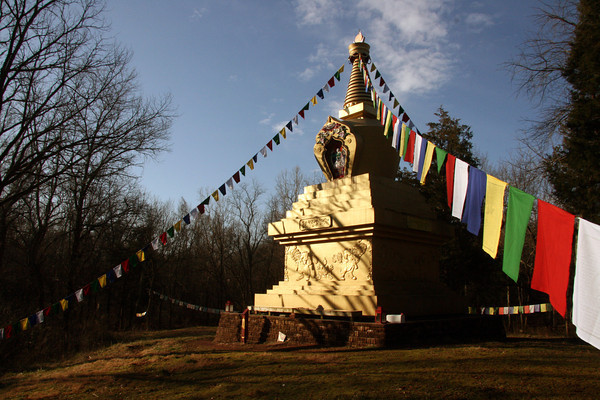
Today, I would like to talk about what we have here.  Not only the objects of support that I’ve talked about, but we have the stupas.  I would like to explain to you the nature of the stupas.  I would like to explain to you a little bit about the treasures that we have here. To say that there is nothing like this in America sounds prideful.  Yet, I am not the one saying it, really.  I’m telling you what other teachers who have come here and who have been around America have said—that there’s nothing else like this, that this is quite remarkable.  And I say, “Well, we’re just getting started.  I hope it’s good.” We have here these extraordinary stupas that have been built according to the ancient Palyul tradition by a number of lamas—His Holiness, and then Tulka Rigzin Pema Rinpoche who is a renowned stupa builder.  The stupas have  been blessed by every lama that has come here; but they have been properly consecrated, about that there is no doubt.

The stupas have different levels and ultimately when they are born, that is to say, after they are completely built and the lama actually generates the entire mandala of the deities and all the objects of refuge, , and descends that entire mandala into the stupa, the stupa becomes then a living presence.  The stupa becomes like the Buddha in Nirmanakaya form, that is to say in the physical form.

On the bottom of the Stupa, there are many objects there that indicate the things of the world to be overcome, such as objects of violence like knives and guns and weapons, and they are buried underneath.  There are prayers and objects and images of suppression, including symbols of death, that go on top of that and they suppress the things of the world that are harmful.,  At the time of the filling of the Enlightenment Stupa, His Holiness said, “Well, it would be good if we had the skull of a wolf to put down underneath there.”  I went, “The skull of a wolf?  In Maryland???”  So we were rushing around thinking, “How in the world does one get the skull of a wolf?”  trying to figure it out.  And then we had the great good fortune, I guess… A fox up the road got run over and we had an intact fox skull.  So we brought the poor little fox skull to His Holiness and said, “Would this do?”  And he went, “This is pathetic.  Look how small it is.  Well, if that’s what you call wolf in America, this will have to do!”  So it turns out, the fox gets in there   asthe symbol of death.  We have symbols of old age, of sickness, of death, of all kinds of suffering, and the suppression of that.

Above that, there are different layers.  There are the practices: beginning stage practice, generation stage practice, completion stage practice, accomplishment. Then there are the objects and prayers and mantras that are associated with all these different levels wrapped in a very succinct way, arranged perfectly like the mandala of the deities.  It has to be arranged very perfectly, and it’s all very secret and careful.  Nobody can look in there unless they’ve been on the stupa diet, which is no animal flesh, no alcohol, no sexual activity and no ordinary stuff of any kind while you’re building the stupa.   And the many many gizillions—I don’t even know how many—of mantras , with saffron water sprayed on them that are rolled so tight, some done by machine, because we could get them rolled tighter, and some of them done by students who themselves were reciting mantra at the same time they were rolling them very tightly and sticking to the stupa diet.  So everything very carefully arranged, everything very perfect.  You can’t leave a drop of sweat or a bit of DNA in the stupa unless you have achieved enlightenment.  So nobody gets to really climb in there without being clothed up and very very careful.

When the lama then brings the stupa to fruition, there is of course the vestibule in which the deity sits, and the deity itself is completely consecrated like the deities on the altar, and they themselves have all the accomplishment figures in them. And then the relics are at the top.  Some of them are wrapped up to the spine, that is a very large piece of wood with mantra written all over it going down the middle.  Some of them are wrapped body, speech, and mind mantras of enlightenment.  So then when the lama descends the deities into the stupa, the stupa is completely able to receive every blessing that the lama is capable of conferring.  All the materials are blessed, purified and perfect.  All the needs have been met.

The lama that actually empowers the stupa is always a lama of accomplishment.  That is to say, Tulku Rigzin Pema Rinpoche is known as a stupa lama and maintains the stupa diet always. He maintains retreat a lot of the time in order to keep the stupa-related accomplishments fresh in his mind as though they were like fresh bread, just right there at the tip of his tongue or the tip of his mind—however you would put it—able to be conferred.  Then of course His Holiness Penor Rinpoche who empowered the Enlightenment Stupa is a living Buddha and is known worldwide as a living Buddha.  In Tibet, people gather the dirt that he walks on and save it and put it on their altars.  His foot-print even.   He never is not practicing.  I’ve seen the way his mind works.  He is like…   Well, he is a living Buddha.  There is no other thing to say about it.

Copyright © Jetsunma Ahkon Norbu Lhamo All rights reserved
Astrology for 3/4/2017

3/4/2017 Saturday by Norma

Venus, recalling the past, turns around today to heal an old wound, bringing remembrances of other times for review. You have an opportunity to say what you neglected to say, to heal a grievance or cheer people who need your attention to feel better. Compassionate speech has never been more powerful so choose your words carefully. Symbolic gestures are effective now: send flowers, cards, candy or a check, and your message will be well received. You must also be prepared to accept those who come to you for forgiveness. Charles Williams said, “Many promising reconciliations have broke down because, while both parties came prepared to forgive, neither party came prepared to be forgiven.” Avoid feelings of victimization and stay home if you’re under the weather. An attitude of humility and gratitude solves every problem today.

Right in Front of You

The following is an excerpt from a teaching by Jetsunma Ahkon Lhamo called “The Lama Never Leaves”

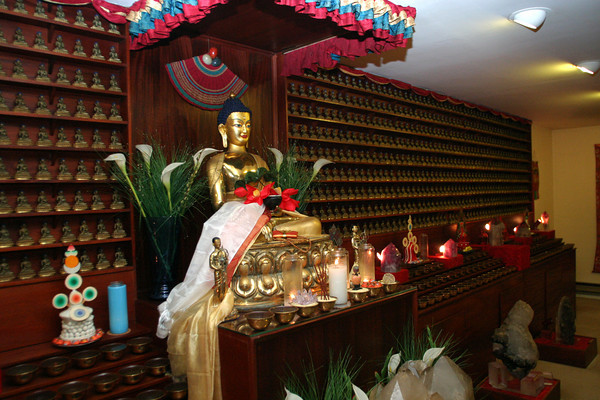
What I would like to talk about today is our opportunity right here.  We have a tremendous opportunity.  Whenever lamas come to this temple, they say, “This is a living jewel in America.”  That’s what they say.  They say that this temple is a living jewel; that it’s the real thing. They use phrases like that.  This is really Dharma; this is the right stuff. They also say that we have all the objects of support here.  We don’t really know what that means, but we’re glad we have it.  So I’ll tell you.

We have these visible objects of support, meaning that, for instance, right in front of us, we have the cosmological display of the mind of enlightenment.  That is the sand mandala that remains there.  His Holiness [Penor Rinpoche] allowed it to remain so that we can have with us that display and take refuge and meditate and be mindful of that and to learn.  It is the very display of the mind of enlightenment.  Each object in the mandala has specific meaning and so we are delighted to have this.

Then we also have beautiful statues.  The statues are not specifically the objects of refuge, but they are physical supports for the objects of refuge.  In other words, our eyes are allowed to rest on these objects. Our eyes are allowed to, for instance, study the hand positions, the objects that are being held and to learn from them the meaning of the objects, because each of the objects that any of the statues hold has to do with a quality of the Enlightened Buddha.  So each and every object that is held has to do with quality or maybe in some cases activity, like in the case of, statue of Mahakala that may hold a great lasso. He lassoes the negativity and pacifies itSo it has to do with the qualities and the activities of the enlightened mind.  We ourselves use the same images in our practice so that we can practice these very qualities and these very activities.  For instance, if we generate ourselves as Manjushri, we then are holding the sword that cuts the darkness of ignorance.

Then we have an altar where we can make many offerings.  We try to make the offerings as extensive and as beautiful and as exceptional as possible.  Maybe we wouldn’t think to have so many flowers in our own home.  Maybe we wouldn’t think to offer so many bowls of rice. Why would you want to have so much rice or so much water or so many candles? Why would you put so many sweets and delicacies and things on the cabinets like that?  You wouldn’t do that in your own home.  And that reminds you that here we are in this amazing temple with these objects of refuge and we are making many offerings.  It reminds us that these are offerings; and we again, in some subtle way, offer them when we see them being offered that way.  So that is a condition by which we can practice virtue and gather merit.  Anytime we make an offering to an altar, there is a great deal of merit in that, and our minds become more purified and more virtuous.  And so that is a cause for happiness.

Here are the statues. They’re not just ordinary statues, that is to say, lumps that are formed to look like the Buddha.  Each of them has been empowered, and there are specific mantras that are within each one of them. Usually there are mantras that are general and there are mantras that are specific to the deity.  Inside there is a central channel, as though it were a living deity where the central channel is the beginning emanation of the deity’s form.  Inside each and every one of them is a  a copper tube, or maybe it can be wood, like the spine of the deity.  And so in every single one, there are profound prayers and many offerings.  Some of them have relics in them.  Some of them have jewels, no really fabulous diamonds, so there’s no sense stealing any of them.  We actually had somebody in Poolesville steal a ring from the stupa once and he lost his finger—the finger with the ring on it— so he returned the ring.  You don’t want to do thatYou want to think of whatever offerings are in there as being the very jewel of enlightenment and that that is something precious.

By the lama’s power, each and every statue is empowered; that is to say, the lama generates the deity and invites the deity to remain.  And so the deity actually remains as this statue.  That doesn’t mean Guru Rinpoche is here and not there, or there and not here.  It doesn’t mean that, but it does mean that these statues should be treated like living Buddhas.  And that is the cause for great merit.  There are many practices that are done, particularly during Losar [Tibetan new year], where we take a statue of the Buddha and we carefully wash it and say many prayers. We say, “Although the Buddha does not need washing, by this washing may all sentient beings be cleansed of the suffering of non-virtue.” And so the cleansing of the Buddha is a tremendous virtuous offering to make, you know, to cleanse the Buddha with saffron water and to offer the Buddha a cloak.  Although the Buddha is never cold, one would offer that cloak in the hopes that, “By this offering may all sentient beings be free of the suffering of want, of nakedness or of cold, or of not having any clothing, and may they be clothed eventually with the gorgeous array of Dharma.”  So we make these kinds of wishing prayers.

When we make these wishing prayers for others, we are making them for ourselves, as well.  In fact, there’s almost no need to include ourselves in those prayers, although we certainly may, and many of the prayers have words like that, “May I and all beings…,” or “May all beings and myself included…,” like that.  But whenever we make prayers for the liberation and salvation of all sentient beings, for the end of their suffering, for their continued advance upon the path, then surely you must know that by the merit of that, we also are accumulating a great deal of merit to do that very same thing. So that merit is ours as well.   In fact, when you accomplish something meritorious, by dedicating that merit, the minute you dedicate it, you can no longer burn it up in an adverse way.  It’s like you put it in the bank.  You can’t spend it anymore.  And even though it goes to benefit all sentient beings, it’s still in your bank.  It’s awful we have to explain it that way, but ours is a materialistic society, and that’s how we understand things.

So whenever we commit some kind of virtuous act, we should immediately think, “This I dedicate to the liberation and salvation of all sentient beings.”  Whenever we go round and round the stupas—even trying to relieve our own suffering, which many of us do and should really, because we have had cures around the Stupas—we have had amazing turn-arounds in people’s mental states, their habitual tendencies, even mental illness.  We’ve had amazing events come about through circumambulating the stupas and making many prayers.  The minute we do that, we should absolutely dedicate that to the liberation and salvation of all sentient beings.

When we pray for our own health, we should not do so without praying for the health of others as well.  When we pray for our own happiness, we should think, “Oh, here I am in this land of great fortune; and here I am securely, hopefully, upon the path, and here I am in front of the objects of refuge and yet I can be so miserable. If this is possible, then how much more miserable than I am must other sentient beings be—those who have no food, who have no home, who are in war, who experience earth changes or tsunami or terrible events.  Here I am in comfort and I am suffering, then therefore I pray that their suffering will cease also.

Copyright © Jetsunma Ahkon Norbu Lhamo All rights reserved

 

Astrology for 3/3/2017

This is the best possible day to execute your plan! Strength combines with wisdom to give the ability to start something that is long lasting, and fire signs generate an exciting flash of enthusiasm. But if you’re chasing love be careful, something you’ve set your heart on is about to change. Wait three days before proposing marriage or otherwise committing yourself on the love front. Business prospers and love is strange. What’s good today? Throwing yourself into the activities of life, thinking about what you’re doing and gauging your efforts by what you learn. Ben Franklin said, “Tell me and I forget. Teach me and I remember. Involve me and I learn.”

Cause and Effect and the Antidote to Unhappiness

The following is an excerpt from a teaching by Jetsunma Ahkon Lhamo called “The Lama Never Leaves”

Lord Buddha’s teachings are always reasonable and logical.  He teaches us that, for instance, if we are lonely and unhappy, we should look to find the causes of that.  He teaches us that causes are never outside.  They seem to be, but they are never outside because actually we are living with our own karmic habitual tendencies and propensities.  So if we are lonely and unhappy, we should look to the deeper causes.  The deeper causes may be that in the past, whether in this lifetime or in some previous lifetime, we allowed the others around us to be unsupported and lonely and unhappy.  Or perhaps we committed some profound non-virtue with our minds and so now, in our mind, we have the habit or the result of loneliness and unhappiness.  Perhaps in the past, we caused someone mental suffering or mental affliction, and so now in the present, we find ourselves feeling that same mental affliction. But we can only remember since the time of our birth, or somewhat after that, and we don’t know what the cause was really.  It’s hard to see.  We have to go by the Buddha’s teachings because Lord Buddha is that state of enlightenment which has the wisdom to see causes and results.  So we are taught if we have certain results within our life, such as unhappiness and loneliness, we should look for deep causes If we can’t find some reason in this lifetime for our loneliness and unhappiness, that is to say, that we ourselves have not brought about similar loneliness and unhappiness to others, then we should think that probably the cause has been in the deep past.  So we must assume that in the past, we have caused some unhappiness to others.

Now, here we are on the path, and we are told to apply the antidote. I shouldn’t leave that part out.  And the antidote, of course, would be to do one’s best to uphold the Bodhisattva Vow and to benefit others as strongly and as purposefully as we possibly can.  Of course, as monks and nuns, we will do that within the context of Dharma activities. As lay people, hopefully, we will do that within the context of Dharma activities as well. Yet we also have many opportunities in our lives to be of benefit to others in ordinary but very special ways. Some of us are doctors or nurses or counselors or those who help others.  So there are human ways to help others and there are extraordinary Dharma ways to help others, and we should apply that antidote.

One thing that not only I have noticed but practically every pop-psychologist that has arms to write a book with nowadays will tell you is that in doing for others, one becomes happy.  Self-absorption and ego cherishing, only thinking about what you want and what you don’t have, leads to further unhappiness and selfishness.  So it’s doing for others that actually brings up the spirit, and I personally know that this is true.  I know that this is true.

Copyright © Jetsunma Ahkon Norbu Lhamo All rights reserved
 

Astrology for 3/2/2017

3/2/2017 Thursday by Norma

This is a great day to go shopping, to make purchases that seem right. It’s an investor’s dream day, provided you listen to yourself and not your partner, who continues to come up with endless suggestions that postpone actual activity: propose something and the opposite will be offered! The solution is to stop asking for input for the time being. John Steinbeck said, “Ideas are like rabbits. You get a couple and learn how to handle them, and pretty soon you have a dozen of them.” What’s good today? Business deals, purchases, love, artistry, visions and dreams.

Mind Creates Form: Khenpo Tenzin Norgay

The following is an excerpt from a teaching by Khenpo Tenzin Norgay given at Kunzang Palyul Choling called “The Six Paramitas”

We are always concerned about our mind.  We have the body, speech and mind, and according to our Buddhist teachings, we say that our mind is more powerful than our body and speech.  It is the main controller.  Once we have our mind controlled, then our body becomes naturally controlled, and then our speech is also perfected.  So that’s why, instead of making our body perfect, what we are doing is making our mind perfect.

The mind is given more importance in our teachings.  According to our teachings, our mind can create a physical object, not the other way around—a physical object creating our mind.  So this is one of the main teachings. If we are able to understand that, then the law of karma, or incarnation, can be better understood.

So here, when we say our mind can create physical objects or all these projections—it is in the Abhidharma teachings—we are talking about how we have three realms of existence: the formless realm, the form realm and the desire realm.  Even in the Sutrayana teachings, when talking about, the formation of these three realms or cyclic existence, like when earth or some physical formation is there, it’s saying that it starts from below and then goes upward—having this sphere and space and the sphere of water and all gradually stacking upward.  Then when talking about the formation of the beings abiding there, the inhabitants, it’s talking about stepping downward.  First we can say we have this formless realm where there is only consciousness.  The person born in the formless realm is, in one way of saying,  less distracted and has a great degree of meditation but without Vipassana or Right View.  If we don’t have Right View, then when our meditational power becomes exhausted, we can be born in the form realm.  In the form realm, our teachings say, there is no physical body of flesh and bones, but not exactly the rainbow-like body. So there is sort of like a physical body there which is not really made of flesh and bones. But it’s saying because of our attachment to the physical form, there is some solid form of physical appearances in the form realm.  When this becomes stronger, we call it the desire realm.  So that’s where we are, in this desire realm.  And here, our desire to objects is stronger, so we have this flesh and bones and this brain.

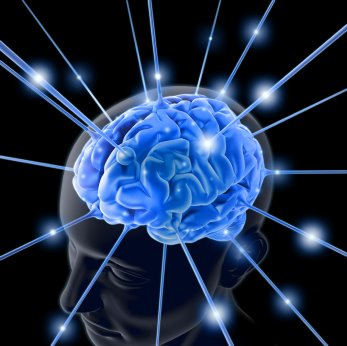
What I’m trying to say is our mind can exist freely without relying upon the chemicals in our brain.  If it were just a chemical process, then once the brain died, everything would be dead.  So it seems this is not our teaching.  Our teaching is that our mind creates the brain, not the brain creates our mind.


Astrology for 3/1/2017

3/1/2017 Wednesday by Norma

Act promptly on premonitions today and wonder about their veracity later. If you’re wrong, oh well, but if you’re right an opportunity is at hand! Intuition lines up with power to take you places beyond your wildest dreams provided, of course, that you take action. Ben Franklin said, “Nothing ventured, nothing gained.” A friendly force can slow you down by suggesting a different route after you’ve already decided. Listen but follow your own plan, the one that seems right to you. Water plays a major role in the day, as does medicine, intuition and fantasy. Look at the sky, the clouds and water for signs, and keep a close eye on a person who is under the weather. Love is great today, relaxation is wonderful and rest is well earned.

Non-Duality

The following is an excerpt from a teaching by Jetsunma Ahkon Lhamo called “Tools to Deepen in Your Practice”

We think that bodhichitta is something that we must practice, and yes, in order to build proper habitual tendency, that’s what we should do.  That is the basis and foundation for the next level of practice.  But this level of practice requires going beyond simple human kindness, or even extraordinary kindness where we practice from life to death, you know, in order to practice medicine or give out food, or make some phenomenal contribution.

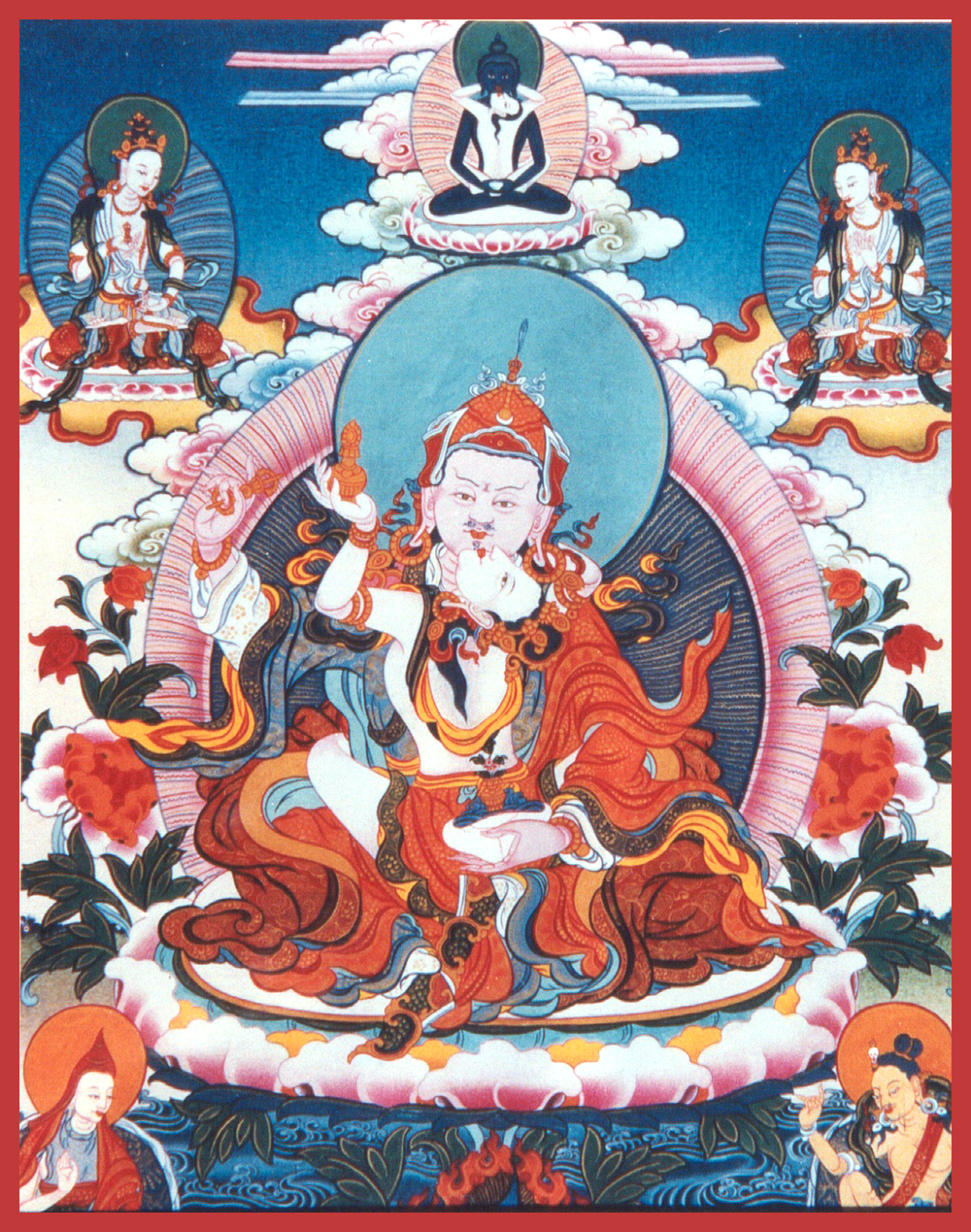
But here in the Vajrayana path, we must understand that you cannot create the bodhichitta.  You cannot establish it, nor can you tear it down or destroy it.  All you can do is deny that you are that; and you can do that from now ‘til kingdom come, whenever that is.  But you cannot deny the understanding that when we seethe fundamental picture we see again and again and again in Vajrayana of the Lama and Consort in union, this is emptiness and method, emptiness and compassioninseparable, functional as one.  We can take them apart to discuss or to understand them, but in truth the bodhichitta cannot be separated from emptiness.  And the true awakening to the bodhichitta comes from the fundamental view of understanding the emptiness of all nature.

In Vajrayana, we are asked to accomplish many things.  One thing we are asked to accomplish is, of course, the realization of emptiness, the understanding of emptiness.  We are asked to understand the arising of compassion as being consistent with the understanding of emptiness.  What we can’t do is change that or build it or control it, or anything.  By simply letting go of the idea of duality, the display of truth must surely arise, and that display is the bodhichitta.

 Copyright © Jetsunma Ahkon Norbu Lhamo All rights reserved
WP2Social Auto Publish Powered By : XYZScripts.com