Go Back to Bodhicitta

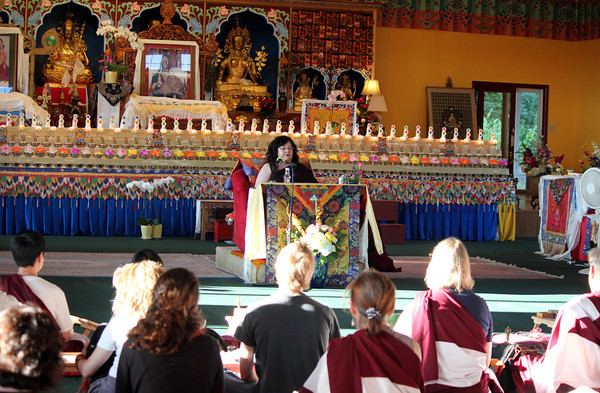
The following is an excerpt from a teaching given by Jetsunma Ahkon Lhamo at Palyul Ling Retreat in New York 2012:

In the beginning, all the lamas, including His Holiness Penor Rinpoche, ever taught us about was the bodhicitta. All we ever got was the bodhicitta. People would ask for Dzogchen. Give us Dzogchen. And the lamas would say, “No, you’re not ready. You’re not ready. Let’s start with the bodhicitta.”  After awhile, Americans got really sick of the bodhicitta. It’s really sad, but they did. I never did. In fact, I never stopped teaching bodhicitta. I know that now the bodhicitta is kind of reduced to a small bit of speech or teaching that comes right at the beginning of a practice or a wang or teaching. It is very condensed compared to what it used to be. When the lamas first came to America, it was just bodhicitta, and really nothing else. But the American students were insistent that they were ready for the Dzogchen. Eventually the lamas gave in. And I am sorry that happened, because I think we missed something.

I notice that when some practitioners practice, they’re calm and that’s good, but they are also solemn. They are not so happy looking, not so joyous. Dharma is joyous. To be able to practice Dharma is a feast.  There’s nothing in the world more joyous than that, because you have something—. \you have Buddha in the palm of your hand. You have something that nobody else has here in America. Other people have other teachers. And they have other lineages and that’s great, but we have this. And we should be thrilled and happy, and try to maintain the understanding of how precious this is.

The day we decide that we are too advanced for bodhicitta is the day that we’ve lost our way. Because if all we ever studied from this point on was the bodhicitta, it would be enough. Sometimes when we go into the higher teachings, we forget what the root is. Bodhicitta is the root. Bodhicitta is the root of everything that comes after. If you cannot develop the bodhicitta, it will be very difficult to stay on the path. As they say, the bodhicitta is like the dakini’s warm breath. It is what we consider to be the activity of the Buddhas, the nature of the Buddhas, like the sun’s rays—part of the sun and yet coming out to bless all. So when we think about the bodhicitta and we think that maybe it’s an early practice, and maybe we are being insulted by being taught this practice or maybe we should be allowed to go on, don’t hurry.

If I had my choice, I would teach nothing but bodhicitta. I used to do that, almost like Baskin Robbins’s 51 flavors of ice cream. I used to think about 51 different ways, as many ways as I could, to teach bodhicitta. I would get really creative so that it wouldn’t be boring. And what I found is that most people didn’t notice that they were only being taught the bodhicitta, because I would teach it in such a way that it would seem different and interesting. And I would make people laugh, and that always helped. You can’t be stiff when you are laughing. I made it joyful. All of us felt great joy to be together, as I see you do too. I think it is the most beautiful part of the Dharma. If we say that it is the smallest part, or the least of the parts, it is a mistake. Do all of you understand that?  It is a mistake if we put bodhicitta lower than anything else, because in order to practice we need the bodhicitta desperately. It is what keeps us going. It is nourishment.

My philosophy is that if we are on the path and every year we practice really hard and really purely here and then go home, but then forget about it, as so many of us do, then in my experience we need to go back to the bodhicitta and study the suffering of sentient beings again, again and again. Study the suffering of sentient beings so that you can understand why it is that you are practicing. You’ll have strength to practice because you will see them, and they are suffering terribly.

Seeing that woman and her husband on the roof was for me a great motivator. It was a great strengthener. It gave me spiritual muscle so that whatever I did, bodhicitta was always the crown on the head of my practice. And then above that, of course, is Tsawai Lama—above the crown of my head, and in my heart, as I know he is in yours.

Copyright © Jetsunma Ahkon Lhamo.  All rights reserved

Astrology for 2/14/2017

2/14/2017 Tuesday by Norma

Groups are fun and information is coming in fast! The news is invigorating and a message from a partner sets the agenda for the immediate future. A solid group is forming that has the potential to outlive the current issues and become an important player in the future. Older, more experienced members step forward to offer help and it’s important to defer to them. Avoid un-vetted information and definitely avoid broad, inaccurate assertions that undercut your cause. (Carrying a sign saying “The moon is made of green cheese!!!” permanently invalidates your wish to be taken seriously.) Indecision is a factor today. Wait out anything that generates confusion. Hard charging people are magnetic, love is on the table, and technology makes an important leap forward today.

Protecting And Maintaining Bodhicitta: from “The Way of the Bodhisattva”

The following is respectfully quoted from “The Way of the Bodhisattva” by Shantideva as translated by the Padmakara Translation Group and published by Shambhala:

Protecting And Maintaining Bodhichitta:

That the original resolve of bodhichitta needs consolidation becomes evident from the very first stanzas of chapter 4, where Shāntideva takes stock of what he has just done and begins to count the cost. The undertaking to which he has committed himself in a moment of optimistic zeal is devastating. Hesitation is understandable. However, in view of the alternatives, and in order to stiffen his resolve, Shāntideva embarks on a graphic description of the dreadful consequences of retraction. As alway, the aim is pedagogical. Shāntideva is no tub-thumping preacher content merely to terrorize his listeners. The situation as he describes it is certainly grim, but he shows the way out and in so doing plots out a scheme of mental training that, for its spiritual profundity and psychological acuity, has rarely been equaled and surely never surpassed anywhere or at any time in the history of the world’s religions.

The first message is that, however immense the goal may seem, it is possible–provided that we want it and make the necessary effort. We can learn to be free and to become buddhas. Moreover, Shāntideva points out that having attained a human existence, we are at a crossroads; we have reached a critical point. According to Buddhism, human life, at once so precious and so fragile, is the existential opportunity par excellence. Of all forms of existence, it is the only one in which development along a spiritual trajectory is truly possible. And yet the occasion is easily, in fact habitually, squandered in trivial pursuits. Time passes and we “measure our lives in coffee spoons.” Perceiving the nature of the opportunity, and realizing how it is slipping through his fingers, Shāntideva responds with almost a note of panic.

For it’s as if by chance that I have gained
This state so hard to find, wherein to help myself.
And now, when freedom–power of choice–is mine,
If once again I’m led away to hell,

I am as if benumbed by sorcery,
My mind reduced to total impotence
With no perception of the madness overwhelming me.
O what it is that has me in its grip? (4.26-27)

This situation is certainly perilous, but what is it that constitutes the danger? It is the kleshas, defiled emotions: “Anger, lust–these enemies of mine.” These are the roots of sorrow, to which every suffering be it on a personal or cosmic scale, can ultimately be traced. And yet the kleshas, however terrible they may be in their effects, are nothing more than thoughts: intangible, fleeting mental states. To become aware of this fact, and to see therefore that our destiny lies in the way we are able to order the workings of our minds, is the theme of the fourth chapter. How is it, Shāntideva asks, that mere thoughts can cause so much havoc? The answer is simply that we allow them to do so. “I it is who welcome them within my heart.” With these words, the battle lines are drawn. The enemy is the afflictions, the thoughts of pride, anger, lust, jealousy, and the rest. The arena is the mind itself. Shāntideva steels himself for the fray, giving himself confidence by stimulating his own very characteristic of Shāntideva’s pragmatic approach–a sort of psychological homeopathy, in which an attitude normally considered a defilement is consciously and strenuously adopted as an antidote to the defilement itself. The theme is developed at greater length later on in the book, but for the time being, chapter 4 concludes on a ringing note of aggression. Emotional defilements are the enemy; they must be destroyed. “This shall be may all-consuming passion; filled with rancor I will wage my war!” Paradoxically, the conflict need not been an arduous one. Thoughts after all are merely thoughts. Through analysis and skill, they can be easily eliminated. Once scattered by the eye of wisdom and driven from the mind, they are by definition totally destroyed. And yet Shāntideva reflects, with sentiments that must go to the heart of every would-be disciple: “But oh–my mind is feeble. I am indolent!”

Once it is clear, however, that the problem lies in the mind itself, or rather in the emotions that arise there, the simple but difficult task is to become aware of how thoughts emerge and develop. This is the theme of the fifth chapter, on vigilance. Again, we find the same note of practical optimism. Just as the mind is the source of every suffering, likewise it is the wellspring of every joy. And once again, the good news is that the mind can be controlled and trained.

If, with mindfulness’ rope,
The elephant of the mind is tethered all around,
Our fears will come to nothing,
Every virtue drop into our hands.

Astrology for 2/13/2017

2/13/2017 Monday by Norma

A difficult moment comes early in the day, let yourself get through it. Any illness is related to overwork or exposure to a new strain of something going around. Respect your body wisdom- if
it’s tired, give it a rest; if it’s hungry, give it a snack. A solid path appears tomorrow so don’t fret if you don’t see the way today, and try not to give in to worry. Zachary T. Bercovitz, M.D. said,
“Some patients I see are actually draining into their bodies the diseased thoughts of their mind.” Vigorous activity is advised-if you’re able- the more robust, the better! If you can’t be active,
put your attention on things that generate happiness in your mind. Anything that makes you laugh is great and anyone who brings a smile is a friend. Do your best to bring cheer to those around you.

What Are Your Hopes?

The following is an excerpt from a teaching by Jetsunma Ahkon Lhamo called “Mindfulness of Cyclic Existence”

Buddhist philosophy speaks of the emptiness, or the illusory quality, of all phenomena.  If self does not exist in the way that we think it does and the only true reality is the primordial wisdom state, then phenomena cannot exist in the way we think it does either because all phenomena seem to us to be something external. That perception is born of the belief of self-nature as being separate. All phenomena are perceived as external, as inherently real. The only way that phenomena can be understood is by understanding that they are separate from self. Self ends here; other begins there. And really, that is how perception comes about if you look at the perception of your own mind. That is what your perception consists of. This is universally true. It doesn’t indicate that you are a good person or a bad person; it’s simply universally true.

Buddhist philosophy speaks of a natural awakened state, a state in which perception does not depend on division, but instead is a pure experience that is free of conceptualization, free of focus in the way that we have focus. It is a pristine and luminous state. And in that state, which, of course, is the goal in this philosophy, hope and fear have no place. Again, hope and fear are dependent upon the perception of phenomena as being separate. They are dependent on the belief of self-nature as being inherently real. In this system at least, the idea of hope and fear revolves by necessity around the idea that separation exists in such a form that self – you, I – can either have something or not have something, that happiness can be controlled by having or not having, that all the experiences that are uniquely human actually revolve around having or not having. If you think about all of the goals that we’ve had in our lives, all the things that we were taught by our parents and by our schools, they are all based on that dualistic perception. They are all wrapped around hope and fear.

This is a tremendous difficulty when one sets out to understand Buddhist philosophy. If you say to a Westerner, hope and fear are not so great, they only serve to make the mind unstable, the first thing that any red-blooded American will do is completely freak out. We do that because we were brought up with hope being a noble thing. I was born in 1949, and I remember some of the leftover consciousness that my parents had from the war—something inbred into the society or the culture at that time. Even though they were no longer directly involved in war, it was very noble to be very patriotic, to have a great deal of hope in the American way, to have a great deal of fear that the American way would be taken away. There was something from that time that I think has since been more firmly planted in our society than ever it was before, even though we were founded on revolution. Of course, there is hope and fear involved in that concept as well. At any rate, it becomes so important to us that even now in this New Age, this Aquarian Age, or whatever it is that we are in the middle of, even now a person is considered to be right-minded or to have the right attitude if no matter what life deals us, no matter what happens to us, no matter how we suffer or how sick we are or how miserable we are or how awful we feel, we rise anew every day refreshed and face the day, like a good American person. This kind of attitude is considered really, really admirable, really the way to go.  In fact, it is considered that if one has this attitude that things will somehow work out.  It’s not for me to judge whether that’s good or bad; I am only trying to isolate the idea so that we can look at it.

We also have the idea that we should have almost a priority list of things that we are hopeful about.  Actually, in our society, if you were to walk up to an ordinary, mainstream moral majority person – now, perhaps meditators are a little bit different – but, if you walk up to any one of them and say, “What are your hopes? Come on, what are your hopes? This is America. What are your hopes?” they would give you a list of what their hopes are. If there is a person that you walk up to and say, “What are your hopes?” and they say, “Well, I’m okay. I am living from day to day. I try to remain in the moment, I try to experience each moment in its fullness, and I find that that’s enough for me. I find that if I remain mindful of the fullness of each moment and live right there and don’t really think too much about hope and fear, don’t really plan too much, but remain spontaneous…” In our culture, that person is a failure. That person is considered to be inappropriate. That person’s parents would probably not be too proud of them, and I find that in myself. When my children say I am doing just fine today and that’s all I want to think about, my American motherhood just goes “sssss.” Everything inside of me tenses up and wonders what is going to happen to my poor child.  It’s so much a part of us. I am saying that we don’t even realize that.

Copyright © Jetsunma Ahkon Lhamo.  All rights reserved

Astrology for 2/12/2017

2/12/2017 Sunday by Norma

Puttering around is satisfying and productive but don’t forget to notice that a larger project is gaining recognition. (“I was so busy digging out the driveway that I forgot to pick up my Nobel Prize.”). Large and small accomplishments are possible today, keeping you busy smiling and nodding in agreement. A worker bee can land a big fish by doing the right thing at the right time, so don’t slack off. It’s a disorienting time where multiple issues demand attention and everything is happening at once, but do your best to remain stable. Catherine the Great said, “A great wind is blowing and that gives you either imagination or a headache.” Love is fun, communication with friends and groups is excellent and a wonderful partnership is here.

Pulling the Threads: Hope, Fear and Stabilizing the Mind

The following is an excerpt from a teaching by Jetsunma Ahkon Lhamo called “Mindfulness of Cyclic Existence”

The subject of this teaching is the difficulty that Westerners have in coming to grips with some of the concepts that are foundational to Buddhism. They are so foundational as to be almost invisible at times. Yet the concepts are difficult for us because we have our own concepts and philosophies that argue against these that are also so foundational that they are practically invisible. They are so much a part of the fabric of our perception and our thinking that we often don’t realize these thoughts are affecting us deeply.

What happens is that when we try to get a grip on Buddhist philosophy, or when we try to become mindful in a constant way, we find that there is difficulty. We may not understand what that difficulty is, or we may find that even without our knowing we have a very superficial understanding of Buddhist concepts, or we may find that we feel there is some superficiality about our approach to the path. Yet we can’t seem to get a grip on it.  We can’t seem to understand what it is that is bothering us.

I think that this particular subject is not only of importance to Buddhists, or to those that are even thinking about becoming Buddhists, or even to those that are peripherally Buddhists, but I also think it’s a subject that bears recognition by anyone who does any meditation of any kind.

In Buddhist philosophy, a tremendous amount of thought and energy goes into making one understand how to stabilize the mind. In fact, if you could boil down Buddhist philosophy, and even Buddhist practice, the underlying goal would be how to stabilize the mind. It’s a difficult concept to understand because we as Westerners and Americans have our particular idea of what stabilizing the mind must be like. In one way, we could understand stabilizing the mind by understanding the opposite. We think of a person who is unstable as being mentally deranged or something like that. We don’t realize that most ordinary people, according to Buddhist thought, have unstable minds. We don’t realize that this is actually one of the symptoms or conditions that is prevalent in what Buddhists call samsara, or cyclic existence. But in fact this is true, and we must learn to recognize the lack of stability in our own minds.

One of the first ways in which that lack of stability is addressed is by addressing the attachment or the attraction that we have, or even the grasping that we have, toward hope and fear. This is something that you hear about again and again and again in the Buddha’s teaching: how attached we are to hope and fear, how difficult hope and fear are, and how these things lead to an unstable mind. It’s very hard for Westerners to understand. I would like to describe some of the Buddhist thought on the attachment to hope and fear, but more I would like to concentrate on why it is that Westerners have such a difficult time with this concept. If we can understand why we have such a difficult time with it, we may understand that in one way we have never really isolated the ideas of hope and fear, put them out in front of us so that we can really examine how much a part of the fabric of our minds these concepts are.

As a Westerner, there is actually an underlying – and even, I think, overt attitude – that is considered to be admirable or noble. We certainly have our particular norms, our own particular standards, our own particular attitudes that are unique to the Western world and specifically unique to Americans. Without going to the trouble of isolating all of them, I’d like to say that we have a certain picture or image that we’ve grown up with. Of course, it changes from generation to generation, but until very recently not that much. Still, there are some threads that continue generation to generation. We have our own particular image, our own particular ideal. What usually happens is if we grow up with an image or an ideal, it becomes so much a part of us, so ingrained, so woven into our particular emotional and mental and philosophical tapestry, that we don’t notice it, in the same way that you might look at a woven blanket and see a certain array of colors within the blanket. You really wouldn’t pick out the pink in there or the blue, or really isolate them in that way. In the same way, we have attitudes that are woven in. They are part of our structure. Therefore, they are never pulled out. The thread is never pulled out, never really isolated. Hope and fear certainly are in there, and our particular attitude toward hope and fear, as a Westerner, should be examined. When looked at next to the Buddhist ideas about hope and fear, we might come to some shocking awareness.

Copyright © Jetsunma Ahkon Lhamo.  All rights reserved

Astrology for 2/11/2017

2/11/2017 Saturday by Norma

Scientific thinking is highlighted and an unusual discovery is possible today. A project is coming to fruition: your invention works, your opus magnum of a book is wrapping up, and something dear to your heart is nearing completion. Take a satisfied breath and get back to work as the moon enters Virgo and you remember everything you forgot to do: feed the dog, do the laundry, rake the lawn! A small task performed opens a door that offers multiple possibilities for advancement. Swami Sivananda said, “Put your heart, mind, intellect and soul even to your smallest acts. This is the secret of success.” Feeling sick? A special remedy sets you straight!

Astrology for 2/10/2017

2/10/2017 Friday by Norma

An outstanding opportunity appears late in the day where opposing factions make peace. If you’re in the mood to party, this is your night. Diplomatic skills are at their best and people are impressing each other everywhere. Planets in opposition highlight the importance of friendly listening to and acceptance of every viewpoint. Say, “It’s hot in here,” and someone will say, “I’m freezing!” Smile and agree, why not? Mark Twain said, “The proper office of a friend is to side with you when you are in the wrong. Nearly anybody will side with you when you are right.” Look for a favorable outcome to a long term project in the next day or so. Dress up, have fun and spend special time with your partner.

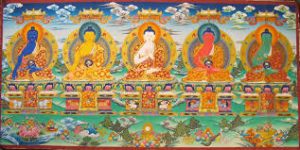
Introduction to the Five Wisdoms

Respectfully quoted from “Palyul Times” published by the Ngagyur Nyingma Institiute

According to Mahayana Buddhism, the ultimate fruition is explained in two states: the body (Skt. kaya)–the self-perfected state that manifests through the body and represents the dimension of the primordial state–and wisdom (Skt. jana)–consciousness that represents the energy of original wisdom. Naturally, they are empty and luminous respectively.

The later one, wisdom, is further categorized into five jnana in accordance with the way of perceiving uncontaminated phenomena. The fundamental nature with twofold purity–the purity of emotional and cognitive obscurations–is called Sphere of Reality Wisdom, which is also the universal substrate of the other wisdoms. Knowing the entirety of phenomena with a single mind is Mirror-Like Wisdom. Perceiving all things as equal in the absence of self-nature is Equality Wisdom. Seeing the non-inherent existence of phenomena vividly and distinctly without any discrimination is Discriminating Wisdom. And knowing the way of performing enlightened activities in order to tame sentient beings is known as Accomplishing Wisdom. These five wisdoms may be elaborated further with the following explanations:

  1. Sphere of Reality Wisdom (Skt. Dharmadhatu jnana): This wisdom is pure in it’s ultimate nature, from which noble qualities such as power and fearlessness are generated, emerged and are constituted. One would realize it be cleansing the two superficial, cloud-like defilements — the one that obscures omniscience; it is similar to the nature of space. The Sphere of Reality Wisdom was never born in the beginning, neither does it exist in the middle, nor does it cease at the end.
  2. Mirror-Like Wisdom (Skt. Adarsha Jnana): By cleaning the defiled concept of apprehending object and subject, this is the transformed state of the all-ground consciousness. Here, all existence appears clearly just like the objects appear on the surface of a cleanly-wiped mirror. Mirror-Like Wisdom sees all phenomena in its true form, like an object reflected in the mirror which is devoid of grasping.
  3. Equality Wisdom (Skt. Samata jnana): When the meditation of the essential nature is clearly realized at the first bhumi, a clear comprehension of self and others is realized, illuminating their equality. Also, when all the bhumis are purified and progressively realized, the afflicted mental consciousness will transform into wisdom. Thus, Equality Wisdom is the imprint of practicing evenness on the learning path, and attains non-abiding nirvana.
  4. Discriminating Wisdom (Skt. Pratyavekshana jnana): Discriminating Wisdom is the foundation of the concentrative strength, meditative stabilization and meditative absorption. As it closely examines the subtle nature of phenomena, it brings about the essence of dharma, thereby clearing the ignorant mind. Discriminating Wisdom distinctly investigates the specific and general characteristics of phenomena and is applied effortlessly with single-pointed concentration.
  5. Accomplishing Wisdom (Skt. Krtyanushthana jnana): When the consciousness of the fivefold sense faculties are transmuted they perform boundless and various skillful methods in teh universe and become a common basis to accomplish the welfare of infinite beings. Accomplishing Wisdom knows to perform with myriad skillful means the maturation of disciples in boundless worldly realms.

These Five Wisdoms can be condensed into the Three Kayas. Out of these, the first two wisdoms are subsumed into the Dharmakaya, the third and fourth wisdoms are in Sambhogakaya, and the last wisdom is defined by Nirmanakaya.

The way these wisdoms perceive ultimate reality is in the form of seeing the unseen, whereas the relative perceptions are the mere appearance of interdependent origination. The superimposed images appearing to deluded beings due to their own afflictions are also perceived in teh way a clairvoyant knows the various appearances that dreaming people sees in their dreams. Hence, this is how the wisdoms perceive the world which is beyond the mind of ordinary beings.

Ngawang Lhundrub 

7th Year, NNI

WP2Social Auto Publish Powered By : XYZScripts.com