
Bodhicitta and Generating the Deity

The following is from a series of tweets by Jetsunma Ahkon Lhamo in response to some comments from one of her students:

Gonpo: To say one “generates” this or that — deity or Bodhichitta – is a type of that materialism. Kind of like, “wow, look at me!” Our great Vajrayana teachers like Jetsunma Ahkon Lhamo help is cut through such materialism. Help us cut ego, relax mind, do nothing maybe! I don’t know, but my understanding from Jetsunma is that the Bodhichitta, our Buddhanature isn’t where the work needs to happen. Our habits are.

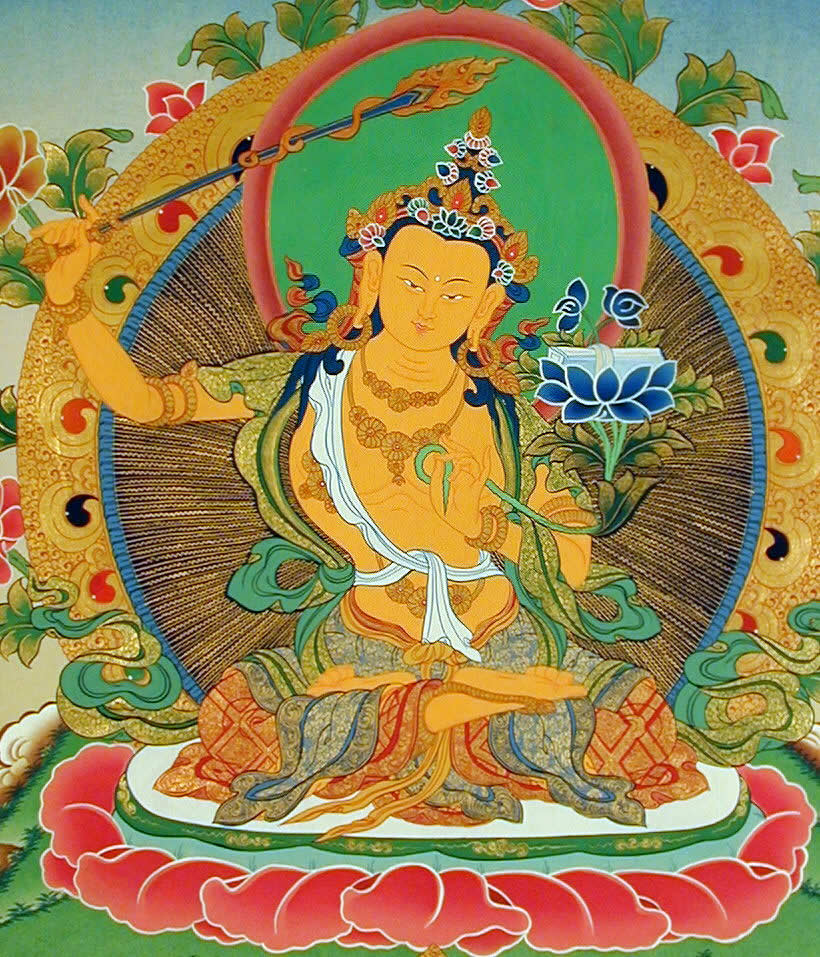
Jetsunma: Your statement Gonpo, bears a little comment. “Yidam generation stage” is indeed Vajrayana. In the generation stage one generates the qualities of the yidam, mixing one’s mind so as to gain the mind aspect. One generates the handheld implements and their meaning to gain the qualities and activities of the Deity. Say your generation stage is Bodhisattva Manjushri. The implements are meant to be generated with a deep understanding of their meaning. Like Manjushri’s sword of wisdom is seen to cut through ignorance. The text he holds is a symbol of wisdom, purity of mind. All yidams are practiced like that. Now say you are practicing a yidam in yab/yum posture. What are you practicing there? The union of compassion and method! Or also called “wisdom and display” which also means one must accomplish the meaning and the concerned activities as your own very display in samsara.

All yidams, deities are the very door to liberation, and that is the great blessing power they offer. They are not ordinary, they emanate from primordial awareness, the profound Buddha Nature. Why is this? In their great compassion their sole concern is to liberate beings from the cycle of suffering and rebirth. Therefore, if one generates any yidam their first and primary concern should be the same. To benefit and liberate all motherly beings from suffering.

OM MANI PEDME HUNG!

OM AH RAPATSANA DHI!

Copyright © Jetsunma Ahkon Lhamo.  All rights reserved

Moods, Bodhicitta and Mental Discipline

The following is an excerpt from a teaching called “Your Treasure is Heart”

In order to understand how mental discipline will help you feel more compassionate, you need to understand that compassion is not an emotion.  Bodhichitta is not an emotion.  It doesn’t exist on that dense a level.  It’s not as dense as an emotion.  Emotions are actually reactions.  If you take perception, delusion, duality, confusion, hatred, greed and ignorance, all of those things that are characteristic of samsara, and you shake them up in a jar, the bubbles that you would get, like the bubbles from soap, are roughly the equivalent of emotions.  Emotions are the result of conceptual proliferation, whipped up into a very exaggerated state.  They are reactive. Bodhichitta really has nothing to do with that.

When we begin to give rise to the Bodhichitta, we do so, first of all, through mental discipline.  As we begin to practice, we have some understanding of the suffering of sentient beings and why we should engage in loving concern for them.  When we examine the thoughts that turn the mind, we really tune into the sufferings of samsara.  We tune in, as well, to the fact that we have lived so many lifetimes that literally anyone that we can see, or see a picture of, or hear or think of has been our own kind parent in some previous life.  Yet these beings are wandering in samsara just like a bee that’s caught in a jar, absolutely clueless as to how to create the causes by which their terrible suffering might end.

Once you learn that, you discipline your mind not to ignore it.  We like to surf on the sensual pleasure of the moment.  We like to enjoy, and try to get as high in our daily routine as possible, so we can just surf on the moment of experience.  We don’t want to think about the condition of sentient beings.  So this mental discipline is required in order to be a serious practitioner. You can’t cut corners here. If you don’t put in the time, your practice will never be up to snuff.

Many students come to me saying “Well, I just don’t feel this compassion.”  My answer is, so what!  Compassion is not an emotion.  Nobody is going to benefit by how you feel.  They’re going to benefit by what you do.  So do the practice.  Discipline yourself to contemplate the causes and conditions of both happiness and suffering; and particularly contemplate the suffering of sentient beings,  These contemplations cannot be short-circuited. They must be delved into with everything you have. Once you do that you begin to feel a certain kind of determination and motivation, and it begins to make sense.

When I was 20, I had not met with the path of Dharma yet, but I was actually given these contemplations directly in my own meditation and in the dream state. So I began to practice them.  What happened to me was I realized that compassion is the only thing that makes sense.  Think about the logic of it. Here you are, one sentient being on our planet where in the human realm alone, there are roughly six billion of us.  On our planet there are also uncountable animal forms.  You can’t even count the number of ants in an ant hill.  Each one of them is a sentient being with the Buddha nature within them, just as surely as you are, yet they appear in this form due to their own habitual tendency and the way that their consciousness is functioning. How many uncountable sentient beings can be seen with the eye on this planet alone!

If this absolute Buddha nature, this ground of being, is my nature, and you are that also, and yet we appear in these multitudinous forms, wandering and suffering in samsara, it made perfect sense to me to dedicate my life to the liberation and salvation of all sentient beings.  Nothing else seemed logical or reasonable.  And from that, gradually, this determination grew.  For about ten months,  I went through the mental discipline. I practiced for eight to ten hours a day only on those contemplations until I could see clearly for myself that this is the only game in town that made sense.  With that knowledge, living any other kind of life seemed like whoring or prostitution to me, and it didn’t seem reasonable.  So my discrimination was born.

In the Buddha’s teachings we are told that there are three thousand myriads of universes, three thousand myriads of universes.  That’s just one number that gives us some understanding that we’re talking big!  The Buddha also teaches us that there are formless realms, and there are uncountable sentient beings in these formless realms.  So logically, if my nature is this Buddha nature, completely inseparable from the very Lord that I call Buddha, completely inseparable and indistinguishable from all these sentient beings, it is logical and reasonable that I would do everything that I can to bring benefit to others instead of spending my entire life in ego-gratification and self-cherishing.  It is logical and reasonable also to me, that I will never be happy until every sentient being is free.  That’s what seems reasonable to me.

Once you have that kind of understanding, you have to go through the process of reminding yourself, keeping it alive every step of the way.  If any of you have been married, you know that taking the vow is not the end of the issue.  If you want to remain in that situation, you really have to work at it.  Giving rise to the Bodhichitta is like that .  The effort doesn’t stop once you come to the great conclusion.  You have to remind yourself every day.  It’s part of the discipline of practice so that you remain mindful.  On the path of Dharma these contemplations are crucial.

So this is how it starts.  It starts in mental discipline which gives rise to determination.  Where’s the emotion in all that?  Emotions become inconsequential.  Once you realize that there are six billion humans, that you know of, wandering in samsara, not understanding how to create the causes of happiness, whether you have gas at that moment or are in a good or a bad mood, those kinds of things become a moot point.  You learn that it’s OK to be a Bodhisattva in a bad mood.  But you don’t get to stop, you see, because you’ve learned something.

Copyright © Jetsunma Ahkon Lhamo.  All rights reserved
Use Your Heart

The following is from a series of tweets by Jetsunma Ahkon Lhamo:

I hope and pray all people will come to see that kindness is the way. Most trouble can be avoided if we are simply good hearted. Bitterness and meanness poison just about every situation. If people would communicate skillfully and with respect nearly all arguments can be solved without war or hate. Only when one’s very life and livelihood are threatened, then legal council should be sought for advice.

In general, no resolution is ever possible with insults, snarky talk, or childish cruel jokes or rants. It is possible to grow up and grow in the capacity for compassion with practice. If we care about any sentient beings, we must care about all, as we are all of the same nature. So the obsession with harming others is a strong indication that this is not well understood. From the view of say, Lord Buddha’s extraordinary awakened state, there is no “place” where one life “ends” and another life “begins.” There is only the empty and complete display of the primordial ground of being. Beyond that, we are not separate- not in being, not in distance, and not in time, as these are all relative, where the absolute nature is unchanging, and fulfilled at once.

Relative view can be a real mess, and discord results when one has no healthy boundaries or indulges the ignorant, ordinary monkey-mind to do as it pleases. We are not here for that. We are all, in ultimate view, Buddha in physical form. How well the “light” shines through one’s “window” depends entirely on how well we clean and keep the “glass”, and this is our true job. We must see all as it is. Not as our habits dictate. You can change, you can do better. You are Buddha! Never forget that. Use your heart, and stand tall for the sake of all!

OM MANI PEDME HUNG!

Copyright © Jetsunma Ahkon Lhamo.  All rights reserved

For the Benefit of All

The following is from a series of tweets by Jetsunma Ahkon Lhamo:

I haven’t been on twitter so much in a teaching or connecting capacity, as I am required to testify in this upcoming case between the US Government and William Cassidy, with others involved. I would prefer not to testify but there is no choice. I am the main victim, and my Ordained Sangha. It is sad it has come to this. But this is a criminal case, and laws have been broken. As well as hearts and even spirits. Many of us have suffered greatly. And grieved for Buddhism here in the west. We have done our part, screen shots, every bit of cruelty, every single threat. All these three horrible years. Now the FBI has taken this as criminal and due process is underway.

My motivation is not punitive, but a hope that hate-filled people will think before harassing women or anyone for whatever reason. I hope Buddhist Sanghas everywhere see they need not accept such abuse. Nor will I, nor should any other woman. Cyber stalking and threats, all forms of it should be eradicated from Buddhism, Dharma, and any true spiritual path.

OM MANI PEDME HUNG

OM TARE TUTTARE TURE SOHA

May virtue and compassion prevail!

Copyright © Jetsunma Ahkon Lhamo.  All rights reserved

What Will You Give?

The following is from a series of tweets by Jetsunma Ahkon Lhamo:

Hammering on sentient beings for their “faults” or for their thoughts and opinions is unacceptable. The first reason is, the hurt it causes, and then because the persons judging and pointing are themselves flawed. Gossip and threats, puffed up judgments are a downfall. We should try to see the situation and indeed the world from other’s eyes. Chances are if we just strike out blindly, before walking in that person’s shoes for a mile or so we will likely be dead wrong on all accounts.

To avoid judging, gossip, hate etc requires a generosity of spirit. We must learn that generosity for ourselves, once we have been taught. We are rarely raised with such pristine ethics. And when we gain this kindness it is through the effort of changing our habitual tendencies. It takes work, work that few attempt, or stick to. We are afraid to be honest, afraid to open up, to care, we would rather step on others. Many think if they open, soften the heart,  they  will be duped, endangered and a total chump for being “vulnerable.” His Holiness the Dalai Lama says that warm heartedness, compassion, kindness are the basis for all spiritual paths.

Further we are encouraged to note and study the condition of samsara, and the actual suffering of beings. This too, takes courage! “Good grief!” we think. It will spoil my mood! Upset me! However if we do not follow this pith instruction we will have entirely missed the boat on the treasure, result and nectar of the Buddha Dharma. Not to mention the joy of a kinder, gentler world. And we all have that responsibility, not just the chosen few, not just His Holiness the Dalai Lama, but all of us.

I wish we could develop the view of being caretakers of the Planet, like the Native Americans and other indigenous tribal people do. They stay in touch with the natural world and in their own mystical way support and hold it. There is no excuse, no reason behind sitting on one’s duff and being of no help, only “tisk tisking” at everything. What will you give? We must all do what we can. Love and respect all equally and totally. Open the heart and mind so compassion truly pours forth, glorious to see. That will not make you weak or vulnerable or soft. It will make you love, and you will be greatly loved and respected as well. Try it!

OM TARE TUTARE TURE SOHA

OM MANI PEDME HUNG

OM AH MI DEWA HRI

OM AH HUNG BENZAR GURU PEDMA SIDDHI HUNG

Copyright © Jetsunma Ahkon Lhamo.  All rights reserved

Letting Go of Concepts

The following is an excerpt from a teaching by Jetsunma Ahkon Lhamo called “Your Treasure is Heart”

How are you going to practice Bodhichitta?  That’s the question.  What’s it going to look like for you?  Do not make the mistake that so many people make by trying to adapt a saintly demeanor where everything is love and light and there are no real feelings, only fabricated ones.  As if all of those neurotic little ulcers in our personality are neatly covered with bandaids and we’re not seething underneath them at all!  That’s not the mistake that you want to make.  That’s not even what compassion looks like.  Why should it?  What difference could it possibly make to any other person, really and truly, that you look saintly?  How is that going to help someone else, unless that’s exactly what that person needs to see? Then, as a Bodhisattva, that’s what will happen.

I have to say, for the most part, my experience has been that love is not neatly tied up in little bundles or appearances.  It doesn’t necessarily fit in a box.  Love, we should all know by now (unless we’re just stupid) is not convenient.  It is just not convenient.  Love is messy.. It doesn’t have any particular appearance, because it appears exactly as it needs to appear.  So don’t make that terrible mistake of doing something that’s the equivalent of playing dress-up, putting on your mommy and dad’s clothing and walking around like “Oh I’m a Bodhisattva now.”  That’s not it.  Adapting a certain demeanor that you feel is some sort of compassionate ideal has nothing to do with love.  It brings no real benefit.  All it does is stroke your ego. In one way, the most self-absorbed thing that you can do is to selfishly use Bodhichitta as a costume for yourself. Instead toss all those images out the window.

Do you think that Bodhichitta should always appear as sweet words and sugary kindness?  No. No, if sweet words and sugary kindness always worked, if that’s all that it took, you could go to Dale Carnegie or something like that modified to fit this particular need. You could learn how to speak words of love and light, and how to be so sweet that everybody loved you.  If that’s all it took, how easy it would be.  I mean, really, it would be a no-brainer.  Somebody could write a list of statements and responses that you could have all typed up on a laptop computer. Whenever you got hit with a situation and didn’t know how to practice Bodhichitta, you could just key it in and come up with a response—see the blue aura, give the blue speech.  It could work, but that’s not how love is.  Love is messy.  Love has to reinvent itself every single moment, because it’s constantly looking to see what is needed.  The moment love becomes a concept, it is not love.  The moment you have a concept about what love should look like, you are not loving.  Love is not the way you think.

Copyright © Jetsunma Ahkon Lhamo.  All rights reserved
Compassion in Real Life

The following is an excerpt from a teaching by Jetsunma Ahkon Lhamo called “Your Treasure is Heart”

When we begin to practice the Bodhichitta, we become more in tune with the idea that the great Bodhisattvas are willing to do whatever it takes regarding the suffering of sentient beings,. We, in our practice, should follow accordingly, and use them as our example.  When we look at the world today, and when we study in the texts, we see that sentient beings, as numberless as grains of sand on the earth, are revolving in the six realms of cyclic existence. And we are suffering horribly— horribly and needlessly.  Needlessly because, other than our own habitual tendency, our desire and our own distorted perception, there are no chains that bind us here.  And so the Bodhisattva is moved to tears watching the suffering of sentient beings and seeing that even here in the human realm where things are pretty terrific and we have the capacity to practice, we are still suffering from old age, sickness and death. And there is nothing we can do about it.

When the Bodhisattvas see that, they consider that enough is enough and they feel a heartfelt courage or concern come up within them. Therefore, their determination to be of benefit to sentient beings and to do, literally, whatever it takes is born.  So now we are on the path of the Bodhisattva. How should we engage on that path?  We really don’t know how the mechanical appearance of it should look in our lives,.  This is a big dilemma for westerners.  I’ve noticed this myself.  Once we vibe with the idea of compassion, we seem to understand it.  When so many of the ideas of Dharma seem foreign, why is it that the idea of compassion is somehow more palatable and more understandable?  Well, probably because we’ve seen the idea before, in other religious systems in our culture with which we are better acquainted.  So we have the idea in our minds already.  I think also, for those of us who are American, we have this national identity of being a great country, or a prosperous country, and therefore we feel that we are in a position to minister to others.  It’s almost like a subtle national identity that we all seem to have.  We know we’ve got more food , more clothes , and better conditions than a lot of the other guys. So, in a national or group way, we are aware of our capacity to be an elder brother or sister in the world. I really think that that’s part of us.  Our national identity is definitely a factor here..

Where the terrible confusion comes in is that we don’t know what Bodhichitta should look like.  When we actually get down to the nuts and bolts of our practice, something is missing.  Something just flies the coop.  It really doesn’t quite connect in our mind.  So we try to draw on these archetypal pictures that we have in our culture. One of the pictures that we have is a saintly archetype.  Does it come from medieval time?  Probably, I would think so.  I would say that we are very slow to change some of our ideas.  We’re pretty quick to change our fashion sense, our idea of how to get educated and how to remain current in certain things in the world, but subtle archetypal ideas take a long time to change.  We have the idea that that we would look saintly practicing compassion, the idea that a Bodhisattva has to be something that… Well I don’t know. What did medieval saints look like?  Maybe a little anemic, you know? Like if you were too robust, or maybe had a pint too much blood, you wouldn’t look very saintly. I don’t think I’d pass for a saint either.  You know I think I look like a make-up expert or something else, a beautician.

So we have these pictures and our saintly image is somewhat anemic.  We have this idea that saintly people should never really let out a good guffaw, and have absolutely zero capacity to find anything truly amusing, most especially not themselves.  Lord knows that saintly types have no capacity to laugh at themselves.  In fact, all they are able to do for the most part is to roll those eyes ever skyward and look pure.  So we have some kind of ridiculous idea of what sainthood or compassion actually ought to look like.

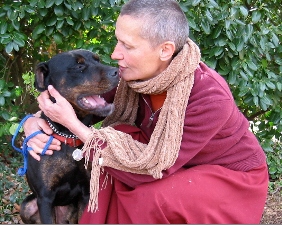
Well, I don’t think compassion looks like that at all.  I think compassion can look like a banana, if that’s what sentient beings need.  I think compassion can look like a puppy if it brings comfort to sentient beings.  I think compassion can look exactly like whatever it takes.  Actually all the teachings about the great Bodhisattvas say that they literally appear in any form in order to bring benefit to sentient beings.  In The Guide to the Bodhisattva’s Way of Life, which I hope each and every one of you will buy a copy of at some point, there are many beautiful and heart-wrenching prayers, like, “Let me return as a bridge so that sentient beings may cross over.  Let me return as food so that sentient beings will be nourished.  Let me return as shelter so that sentient beings will be protected,”  this heartfelt cry to return in whatever form necessary in order to be of benefit to sentient beings.

I don’t think that a bridge or a banana or whatever it takes will necessarily look like some anemic saintly thing.  Instead, I think compassion can be pretty exotic and meaty stuff.  I think it can look like meat and potatoes.  I think it can look like whatever it damn well pleases, so long as it gets the job done.

Copyright © Jetsunma Ahkon Lhamo.  All rights reserved

Overcoming Hope and Fear

The following is from a series of tweets between Jetsunma Ahkon Lhamo and one of her followers on twitter:

Questioner: the problem is reality and society keep proving and backing a cynical outlook.

Jetsunma: There will always be people with poor qualities, but you can choose like-minded friends who are kind and worthy. I’ve met both kinds, believe me. And, did you know – cynicism is a habit, just like compassion, happiness, good heart, etc. You can learn to run different “tapes” in your mind. I get stalkers, haters, sarcasm, hostility but I don’t take it personally. It speaks to their character, not yours. If the shoe doesn’t fit you don’t have to wear it.

You should see the hate I get thrown at me. But it is gossip and lies, and I pay no attention. On the other hand, so much love, kindness, friendship, and I hang with people who want to leave the world a better place. So the choice of how to be affected is truly yours and mine.

I too have to work on my own perception. Try to see it for what it is. Just empty reaction, hope and fear. We all do. Being honest here. It takes work and willingness to look within. And I try to see through circumstance as though it is a dream. Insubstantial, born and gone at the same time.

Questioner: then your in control sister! And the environment is tamed.

Jetsunma: How sweet! But no. I was cruelly stalked for three years. Three horrible, miserable years. And I block a circle of gossips that continually insult and make fun of me. When I think of them they are a “muse” to write and teach. And to explain poor qualities and the hurt and harm that comes from that crud. So in a way their cruelty is a blessing, and motivation to teach. These people go after others too. They seem to need victims. How can you take people like that seriously?

Questioner: then your so irresistible your stalk-able.

Jetsunma: You are very kind. Actually he is off the streets now, (violent felon) no longer able to harm others. He is not a loving man, I don’t think it was my “charms” that interested him so much as my position and Lineage.

Copyright © Jetsunma Ahkon Lhamo.  All rights reserved

Wrathful Compassion and Dispelling Obstacles

The following is an excerpt from a teaching by Jetsunma Ahkon Lhamo called “Your Treasure is Heart”

For Americans, the activity of the lamas can be confusing because sometimes the lamas will engage in wrathful compassion.  This has happened to me and I know it has happened to my students as well.  Sometimes because of the karma and the love and concern between the student and the teacher, the lama will see in their meditation that some terrible obstacle has arisen in the mind of the student, or in the path of the student, or in the life of the student in some way.  Maybe it’s an obstacle to the student’s life.  Maybe it’s an obstacle to the student’s path.  Maybe it’s simply something like a brick wall where the student will meet up with their habitual tendency and not be able to make much progress.  If there is the right kind of karmic relationship, if the causes have been given rise to and the devotion is there and all of the different catalytic necessities are in place, then the lama will often engage in wrathful activity in order to cut this obstacle.

Let’s say, for instance (and this often occurs), that the lama sees that within the student’s mind some negative, nonvirtuous karma has been catalyzed or drawn to the surface, or has begun to ripen.  Then the lama will see that this could be dangerous and the lama will be very wrathful.  How does that work?  Well, first of all, the lama, knowing what the student’s capacity is, will do that skillfully in such a way that eventually, even if not at first, the student will fully understand the lama’s gracious activity; and even though wrathful activity has occurred, the student will remain fully devoted, fully respectful, fully loving and confident in the lama’s kindness.

That pure inner posture is a posture of true devotion, purity, spirituality in every sense of the word.  When the lama takes all of your habitual tendencies and all of your issues and smacks you in the head with them, it takes a tremendous amount of vajra courage to continue with love and confidence.  If the student is lacking in a certain kind of virtuous karma, or virtuous ripening at that particular time and is also, perhaps,  having the ripening of some nonvirtuous karma, that interaction between the lama and student may turn it around, and can turn it around just like that, because of the student’s capacity, even in the face of such a difficult situation, to remain fully devoted, fully confident and fully vulnerable.  Vulnerable means opened up and not protected.  In order to continue on this path of compassion and wisdom, that determination, that vajra courage, is such a tremendously virtuous inner posture in which to remain, that often this negative tendency or negative event will be cut.

This has definitely happened to me as I described once or twice before, where my own teacher, out of the clear blue sky with no seeming cause, began to be very angry at me and accused me of something that I would never do.  It would be the equivalent of my accusing you of murdering babies with chain saws.  It was just so far from reality it could never be true.  So my teacher began to be really angry at me and scolded me and raged at me to the point where I was shaking in my shoes.  I was unbelievably terrified. Then when he felt the obstacle had been cut he just stopped and he said, “O.K., we’re done now.  Try not to get mad.  See you later.”  Sort of like that.  Try not to get mad!  I was trying not to make my own gravy if you’ll excuse the expression.  I was terrified.  I’ve never been so terrified in my life. I barely shuffled myself out of the room. And then I realized that physically I felt completely different and that something had changed radically. I went to my other teacher who was also here (two of my main teachers were here) and he said “Oh yeah.  His Holiness saw an obstacle to your health and he cut it.”  Interestingly, from that time forward I felt about 10 years younger, the ultimate face lift.  My love and respect and regard for my teacher, and also the courage to really make myself spiritually vulnerable to his care, grew by that situation because I knew in my heart that he had brought me great benefit.  That’s the kind of thing that one sees on the path of Vajrayana.

Copyright © Jetsunma Ahkon Lhamo.  All rights reserved

WP2Social Auto Publish Powered By : XYZScripts.com