Compassion – Antidote to Suffering

248175515_ekELp-S

A Teaching by Jetsunma Ahkön Lhamo

In Vajrayana Buddhism (literally the Diamond Vehicle), which is the form of Buddhism preserved in Tibet and Mongolia and the one followed in my temple, one of the foundational teachings is the understanding and practice of compassion.  I personally find that a religious philosophy based on selfless compassion is deeply satisfying, and I believe that it strikes a chord with many Americans.

However, although there are many people who embrace the idea of compassion as love and a deep caring for others, they do not realize that to actualize the mind of Great Awakening requires a deliberate and disciplined path.  Human beings are not born with great compassion automatically realized.  Thus, the Diamond Path can be described as a technology for spiritual development.

From the Buddhist point of view, there are primarily two ways to approach compassion: aspirational compassion and practical compassion.  When one begins to practice on the Diamond Path, one begins straightaway to make wishing prayers, cultivating the idea of being of benefit to beings who are revolving helplessly through cycles of existence.   This is aspirational compassion.

Every practice in which we engage, every teaching we hear, every empowerment we receive, every prayer we chant, can all be dedicated to the liberation of all beings from all forms of suffering.

Thus, aspirational compassion is practiced in the beginning by many repetitions of wishing prayers.  These prayers are meant to benefit beings through developing the sincere desire to utilize all one’s activities — from the mundane to the sublime — as a means of eliminating the causes of suffering in all its forms.  One prays for the cessation of war, poverty, sickness, death and rebirth, loneliness, hatred, greed and ignorance.  One adopts a posture of pure intention based on the idea that every portion of this life, as well as future incarnations yet to come, might somehow be useful to sentient beings.

As an example of this type of wishing prayer, I will paraphrase a famous practice:

If there is a need for nourishment, let me return as food.  If there is a need for shade, let me be a tree.  If there is a need for shelter, let me be a house.  If there is a need to cross over, let me be a bridge.  If there is sickness, may I manifest as the doctor, the medicine and the nurse who restore health.  May I be land for those requiring it, a lamp for those in darkness, a home for the homeless, and a servant to the world.

While this may sound very kind and loving, the intention here goes far deeper than the apparent words because one must strive to be of benefit not only to fulfill the immediate needs of beings, but also to bring future benefit.  Providing things such as food, housing, and medicine bring about benefit, of course, and this type of kindness is profoundly virtuous.  We should all strive to meet the needs of others in just these ways.  Yet, from a Buddhist perspective, being able to practice only this type of compassion does not bring ultimate benefit.  For instance, if it were possible to feed an entire nation or perhaps even the world and completely eliminate hunger and hopelessness, we still would not be solving the root of the problem.

According to the Buddha, there is no condition or circumstance without a cause.  Just as the fruit does not manifest without first appearing on a tree, which came from a seed, neither does any circumstance, good or bad, in which we find ourselves manifest without a cause.  These causes may not be found in this life only, but may come from previous lifetimes.

It is not possible for people to be born randomly into difficult circumstance or to suddenly experience the onset of tremendous suffering and upheaval.  These events are always the result of a tapestry of cause-and-effect relationships (karma) woven around the delusion involving the definition and maintenance of an ego.  Thus, to solve the immediate needs of beings may bring some relief, but it does not guarantee that they will not experience great difficulty in the future, because it does not break the continuum of cause and effect that ripens unexpectedly and constantly.  This continuum originates from the belief in an ego self and the desire that results from that belief.  It is through the pacification of desire that one can begin to transform one’s karma.  When the delusion of ego begins to dissolve, karma also begins to dissolve.  But if the mindstream is not purified of the karma of suffering, the potential for suffering remains.

We were raised to believe that reality can be manipulated.  Our libraries are filled with books of great American success stories.  These tend to be about material successes.  But the spiritual aspirant must ask: Will this success last?  Even if it lasts for an entire life, will it survive death?  If we had the power to bring peace to the world, to disarm nations and maintain order and harmony, would that peace last beyond our lifetime?  Many leaders have exhausted their lives forging great nations and empires only to have them destroyed shortly after their deaths.

To provide beings with the ultimate benefit of freedom from all suffering, one must apply the ultimate technology.  The aspiration to be of benefit to beings, the cultivation of pure intention, the continued observance of human kindness, the making of wishing prayers, and constantly hoping from the core of one’s mind and heart to be of lasting benefit to others, are practices to develop compassion.  Yet at some point the ultimate step must be taken.  This begins with the realization that temporary happiness is not enough, that feeding and clothing people, along with other acts of kindness, are not enough.  These things cannot undo the certainty of death, which puts people beyond our reach.  How can we follow them into future incarnations to ensure their safety?

There is only one way to cease the ripening of the seeds of suffering: enlightenment, which dissolves the belief in ego, pacifies all cause-and-effect relationships or karma, and reveals one’s true primordial nature.  The Diamond Path utilizes many techniques to purify the five senses and the mindstream itself.  When these practices are engaged in, not only for one’s own benefit but also to purify the karma and suffering of others, the practical aspect of the Awakening Mind — practical compassion — is engaged.  This is “practical” because it is the technology to completely rid oneself and others of the causes for suffering.  Buddhists view this type of compassion as the act of ultimate kindness.

While ordinary kindness is a valid undertaking and should be part of the activity of every spiritual aspirant, one must address the question of ultimate benefit, of eliminating suffering at its roots.

We should take to heart what the great Indian Buddhist Shantideva wrote a thousand years ago.  “May I act as the mighty earth or like the free and open skies to support and provide the space whereby I and all others may grow.  Until every being afflicted by pain has reached to nirvana’s shores, may I serve only as a condition that encourages progress and joy.”

© Jetsunma Ahkön Lhamo
Create the Causes of Happiness: Full Length Video Teaching

The following is a full length video teaching offered by Jetsunma Ahkon Lhamo at Kunzang Palyul Choling:


Jetsunma gives an overview of the Buddha’s path emphasizing your power to actualize the mind of enlightenment, which is not separate from you.

Copyright © Jetsunma Ahkon Norbu Lhamo.  All rights reserved

Karmic Consequences

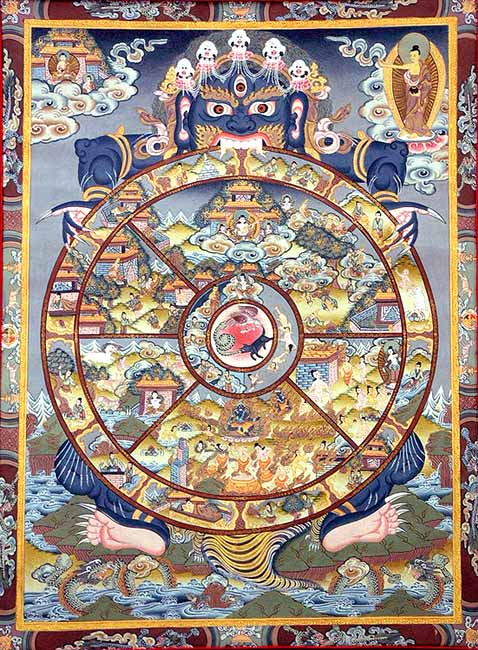
Wheel of Life

From The Spiritual Path:  A Compilation of Teachings by Jetsunma Ahkon Lhamo

Wouldn’t you think it impossible—in a country so permeated with eternalism, with the traditional western teaching that the self exists after death—for many people to act as if they believed that it doesn’t really matter what they do? Yet these opposing beliefs coexist in our culture. It is somehow possible for us to believe in eternalism and at the same time to be full-fledged, card-carrying materialists. Let us examine how this has come about.

Very early in life, we learn about rules. Getting caught with your hand in the cookie jar means trouble. Also, our parents hide their feelings and teach us to repress ours. We see them break laws sometimes, clear-cut ones. If we ask our parents why they just ran a red light, they may jokingly say, “It was only pink.” We also see them do things they told us not to do. (“Do as I say, not as I do,” they seem to be teaching us.) We soon realize that there are some things we can sweep under the carpet of our conscience.

We also learn about cause and effect. We know that if we cross a busy street without looking both ways, we may get hit by a car. Fire burns. Immediate, obvious consequences we understand. What we neglect, what we do not really comprehend, is that results can take a long time to unfold. Early in childhood, we were told not to feel anger, yet we could sense it in adults. How do you feel a certain way and yet not feel that way? We learned the real message: if you can see it, it counts; if you can’t, it somehow doesn’t. It’s okay to get mad and to hate if you don’t do it too obviously. Taking an ax to people or beating them up is wrong; but somehow you can get away with being angry at them. We learn that it’s okay to do subtle or secret things.

Being subtle is not a problem. And there may be nothing wrong with hiding feelings. The real problem is that we fail to understand that hatred and anger will produce results simply because they exist in our mindstreams. Even though hidden or subtle, these feelings create an undeniable cause-and-effect relationship. People in Buddhist or Hindu countries deeply believe in karma. Whether or not you get caught makes no difference. They know there is absolutely no way a person can get away with anything. They are taught from birth that if you don’t pay in this life, some day you will. This is so profoundly ingrained that they have a totally different perspective: health, appearance, prosperity, surroundings, family, the ability to be successful in our lives—all these are seen as results of previous actions.

We, however, are convinced that our experiences happen to us. If someone is angry at us, we can find the causes, can’t we? The person was in a bad mood. Well, if we’re honest, we might remember that we said something to him last week, and now he’s getting back at us. Anyway, we can always find something. But what we are experiencing is not what it seems. It is a picture, a display, an emanation of our own mind-stream continuum. And if we are experiencing it, we had something to do with sowing the seed, which is now ripening. That is what the Buddha teaches.

This is true of every event, such as people treating you badly, or even an experience like hunger. My stomach is empty. I need food. But this experience and all the circumstances surrounding it are the ripening of previously created karma. We can’t see at that subtle level because we have no sense of our true nature. We cannot see the continuum. We can see pieces of it, glimpses maybe; but the continuum is invisible. So we persist in our habit of inventing explanations.

© Jetsunma Ahkön Lhamo

Keep Your Practice Alive: Full Length Video Teaching

The following is a full length video teaching offered by Jetsunma Ahkon Lhamo at Kunzang Palyul Choling:


For us in the west the most important part of Dharma practice is within your heart. Practicing the foundational thoughts that turn the mind will help you keep that alive.

Copyright © Jetsunma Ahkon Norbu Lhamo.  All rights reserved

Letting Go of Hate

From The Spiritual Path:  A Compilation of Teachings by Jetsunma Ahkon Lhamo

You have heard that hatred is a primary cause for suffering, so you may say: “First, I want to be free of hatred.” Don’t you often say that? But hatred remains. Why? Because you will willingly let go only of the things that obviously cause suffering. For instance, you will not be involved in wars. Yet this is no great credit to you. Oh, it is some indication that you are progressing on your path, but butterflies don’t wish to go to war either—and they don’t even have the potential to know the Nature of Mind.

Where is this hatred that you wish to be rid of? It resides deep within some subconscious levels of your mind. It also hides. Though you decide to rid yourself of hatred, you compulsively want to hold something back for your own. Hatred you want to be rid of, but you also want to hold on to a particular prejudice against someone or something. You want to maintain an active set of opinions about the qualities and personalities of others. You want to be the one who is right. You want to be the favorite—but this, of course, can only happen if others are not. On the conscious level you pledge your life to be without hatred, but still you have not overcome your dependency on the data given to you by the five senses. You give with one hand and hold back with the other.

The five perceptions are born of desire; this results in all karmic suffering. Your job is to renounce your participation in this process to the very depth of your capacity and then take refuge in the five celestial perceptions, the components of the Buddha in the world, the five pathways to liberation. If you run from the facts of your existence, you will miss your opportunity. You must decide from the depth of your being that you truly wish to be free of hatred in all its forms. Make every conscious effort, realizing that that will not be enough. For instance, it is not enough to think positively: that only makes your hatred more subliminal. Instead, take absolute refuge in the Buddha’s teaching. Make fervent wishing prayers to be free of hatred. Make many different offerings that this might be accomplished, wishing sincerely to be free of pride and the demons of the five senses. Then practice and live the Buddha’s teaching.

There is no suffering you cannot be free of. You hold in your hands a precious wish-fulfilling jewel, a magic carpet, celestial food. You need not be imprisoned within the demonic confines of your five senses when at last you have dedicated yourself to realizing the nature of the five goddesses. The degree to which you have devotion will determine the speed of your victory.

© Jetsunma Ahkön Lhamo

Equanimity

242305246_yHAhy-S

From The Spiritual Path:  A Compilation of Teachings by Jetsunma Ahkon Lhamo

The Buddha taught us to treasure those we do not know—even our worst enemies—as much as our most beloved relatives and friends. We should value them equally. “Is that really possible?” you may wonder. Not only is it possible; it is necessary. Boundless equanimity is the basis of compassion and of a truly deepened, stable practice.

If you carefully examine why you value a loved one more than someone you have never met, or more than your enemy, you will uncover a whole mother lode of information and awareness required to understand the Buddha’s teaching. You will realize the extent to which you are motivated by desire. This can make you uncomfortable: sincere self-examination requires tremendous courage. I believe that the Buddha’s teaching is best understood and practiced if you are fearless in examining your motivation. This alone can be a great guru. You can learn much about your desire for approval, for recognition.

If you look closely at how you have felt about yourself throughout your life, you will see that you have played a kind of mirror game since birth. Children develop their sense of self by seeing its reflection in the eyes and minds of others. Through our perception of them, children learn about their appearance, qualities, and tendencies. This process continues even now: you modify your self-image as you watch your reflection in others.

Your belief in the reality of self-nature seeks its own continuation. That, of course, is the bottom line of survival instinct. Once we have developed the view that self-nature is inherently real, we see “other” as inherently real—all phenomena as inherently real. This perception seems essential to prevent chaos, to maintain stability.

But the Buddha teaches that we are empty of self nature. Our true reality is the primordial-wisdom state. The experience of self and other is merely a series of conceptualizations. Watch your mind as you meet a person for the first time. The determinations you make in order to distinguish that person from yourself or someone else are all tainted by attraction and repulsion. This is true even of the thought processes that occur when you are not looking at anything, when your eyes are closed, and when you are resting or in a relaxed state.

With attraction and repulsion, there is always wanting or not wanting; there is always grasping or pushing away. When attraction arises in the mindstream, repulsion will also occur to the same degree. Though you may not be aware of the repulsion at that moment, the seed is there which will cause it to be experienced at some future time. Once a cause-and-effect relationship is begun, it always fulfills itself—unless it is purified. That is why equanimity is essential to your meditation or practice. In order to attain equanimity, one must realize the emptiness or sameness or suchness which is the underlying reality of all perceived phenomena. The way to stabilize the mind is not through suppression. The goal is not to train your EKG to become a straight line. Realization is not a “flat-line” mentality. You are not supposed to act out your idea of peacefulness. You know how it’s done: not too blissful, just un-focus the eyes a little, a pseudo-Mona Lisa routine. We tend to think that the way to attain stability is to adopt a pose or posture, like a child putting on his daddy’s clothes.

The Buddha teaches that the primordial-wisdom state is the ground from which phenomena spontaneously arise. We experience them either purely, as spontaneous, natural movements of that Nature, or impurely, as delusions of self and other. The primordial wisdom state is clear; it has the quality of innate wakefulness; it is neither dead nor cold. Yet the moment you try to describe it, saying: “Well, it’s like this” or “It looks like this” or “It’s light” or “It’s love” or even “It’s innate wakefulness,” whatever words you use, the moment you describe it, you lose it. You lose it because you wrap concepts and terminology around it, making it a contrived, unnatural experience. But by gradually eliminating desire from the mindstream, you begin to practice equanimity. You begin to experience the natural state in meditation.

© Jetsunma Ahkön Lhamo

Here is a teaching you did not ask for

242307604_BfVDE-S

A teaching by Jetsunma Ahkon Lhamo


Try to believe in the Love….that the Love that exists is

Absolute.  It never varies, it is unchanging.  You did nothing

to deserve it and you cannot destroy it.  It is your belief in the

Love, your acceptance of it, this changes from moment to

moment, circumstance to circumstance, tossed about on the

waves of your emotions.

Let your heart fall deeper under the surface to where the

waves seem very far away.  There you will find it, and me.

Make a samaya now to go deeper every day, to diligently

travel to that calm place where the sands do not shift at all.

You never asked for this!  Only for what is temporary,

turbulent, based on a self that you have only imagined.  Learn

to ask for what is true.  That you will be answered is certain

because the answer is already accomplished.

Beneath the waves it is already there.

I am with you again, still, always.

I do love you.

Written as a birthday gift for a student September 20, 1986 in Poolesville MD
Copyright Alyce Zeoli-Jones

Prayer to Be Reborn in Dewachen

Download the Prayer to Be Reborn in Dewachen

Prayer to Be Reborn in Dewachen

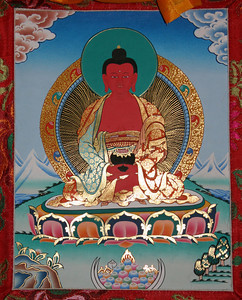
With a longing to benefit beings who are sick and dying, Jetsunma created a song called “Prayer to Be Reborn in Dewachen.” This is a traditional prayer to Amitabha, the Buddha of Limitless Light, from the P’howa practice of the Longchen Nyigthig tradition. P’howa is the meditation practice for the time of death, and Amitabha is the deity to be visualized in that meditation.  “Dewachen” refers to the state of consciousness in which one experiences a pure land and the opportunity to accomplish liberation.

Jetsunma said,  “When I listened to this tune, I realized that it was like a mother singing her child to sleep, which really was my motivation when I sang that song.  I know that everyone that I love, I will be parted from someday.  Everyone that I meet will die some day.  I wish there was some way that they could be guided through the bardo individually.  And the best response that I know of is this prayer.”

Any being who listens to this prayer receives a blessing, whether Buddhist or non Buddhist, human or animal.  It is especially soothing for those who are chronically or acutely ill, or who are on the precipice of dying.  You can help beings by making this prayer heard by as many people and as many animals close to their death as possible.  It is available here:  Prayer to Be Reborn in Dewachen

WP2Social Auto Publish Powered By : XYZScripts.com