
When the Law Won’t Help

The following is from a series of tweets by Jetsunma Ahkon Lhamo:

I’m pretty much at a low point in recovery from PTSD. It’s not just feeling safe; it’s what it does to you. Like it’s hard to think and remember what is important. And I wish I could sleep all the time. I want to go home but it’s not safe. Am having difficulty concentrating, learning new things and studying. I have no ambition. In short, I have every symptom of a stalked person. Without exception.

I was doing well with the self defense, but the flu knocked me out. Now to start over seems like too much.

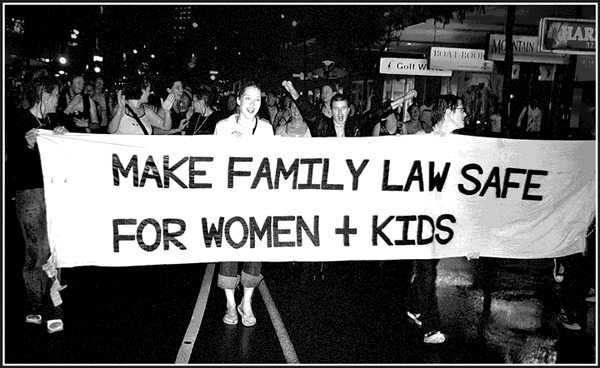
But I must get over this. I can’t find any stalker laws to protect us. There is no interest in providing safety for women. We have better luck with animal rights. Shameful.

Why would a judge or any man want to legislate safety for women? After all, they want to own us. Tell us how to be. Many women choose these days to be alone. It is better to take no chances. What a shame! Especially financially independent women choose lonely over bullying.

So how many women choose to make their own way financially? Not enough. How many men rule by keeping money from women? Many.

So why can’t we women wake up?

Well, no law protects us. And most is written by men. (Or not written) And we need their help. But they have no desire to help, as they might lose the opportunity to abuse and control. And that would be inconvenient.

Copyright © Jetsunma Ahkon Lhamo.  All rights reserved

Mirror that Illustrates the Crucial Points: From “Drops of Nectar”

The following is respectfully quoted from “Drops of Nectar” by Ngagyur Nyingma Institute:

The Ultimate and Meaningful Instruction: Longchen Rabjam

Supreme glorious master, all-pervasive lord of the hundred Buddha-families.
Who combines into one, the power of compassion and enlightened activity.
Of the limitless mandala of the infinite Victorious Ones,
I constantly pay homage at your feet.

Ema, fortunate yogins listen to me. We have all now obtained this perfect human body with the freedoms and endowments. We have been introduced to the precious teachings of the higher vehicle. We have the freedom to behave in accordance with the sublime dharma. At this time, we should make sure that our human life does not go to waste and pass without meaning. We must establish our ultimate goal correctly. The categories of teachings are innumerable, the doors to the teachings are countless, and the commentaries to the teachings are vast.

If you cannot practice the essential points of the teachings, then although one knows a hundred thousand volumes of scriptures by heart, certain benefit at the time of death is difficult to achieve. Although you may have acquired boundless qualities of knowledge through study and contemplation, if your mindstream does not accord with genuine dharma you will not be able to tame the enemy of delusions. Moreover, if you don’t commit to an attitude of not needing anything, even with control over the one billion world systems, contentment won’t arise.

Without preparing soon for the uncertain time of death, you will not accomplish the great essential objective when death occurs. If you don’t correct your own mistakes and train in unbiased pure perception, being motivated by attachment and aversion, you won’t fully enter t dharma of the greater vehicle.

Among the six realms of the three worlds, there is not even a single sentient being who has not been your parent. If you do not regularly and continually aspire and pray for their well-being and happiness with the compassionate mind of enlightenment, the treasure of benefiting others will not be revealed. If you do not cultivate the devotion to your root guru that regards him as even more kind than the actual Buddha, the power of blessings will not be great.

If genuine blessings do not enter into you, the sprout of experience and realization will not emerge. Without realization dawning from within, the fruit of enlightenment will not be obtained through mere intellectual understanding or empty talk. In short, if you do not mingle your mind with dharma, merely appearing like a practitioner will not bring about your purpose. Consider that you do not need more than is merely sufficient to support your life force and vital energy.

Pray single-pointedly to your guru and practice Guru Yoga. Whatever virtuous activities you do, always focus on the benefit for sentient beings, your parents. No matter what happiness or sorrow, good or bad might occur, always meditate on the compassion of your guru. Within the expanse of self manifesting non-grasping self-cognizing awareness, abide in non-fabricated and unforced naturalness. Whatever thought arises; know its nature and liberate everything as the play of the true nature of reality.

Without so much as a hair tip of something solid to meditate on, and without falling for even a moment under the power of perpetual ordinary delusion, maintain undistracted mindfulness in all your daily activities. By training in recognizing all sights and sounds — whatever arises of the six consciousnesses — as magical play lacking true existence, you will gain mastery over the experiences of the bardo.

In short, at all times and on all occasions ensure that whatever you do accords with the sacred dharma and dedicate all virtue for the attainment of enlightenment. Acting in that way, you will not only fulfill the intentions of your root guru but also be of service to the teachings. You will repay the kindness of your parents and spontaneously accomplish the two benefits, of self and others.

I request that you retain this in your hearts. Even if you meet me in person, other than these instructions, I have nothing more to say. Therefore, at all times and on all occasions, practice!

The powerful conqueror, the excellent Longchen Rabjam wrote this when he lived on the slope of Gangri Thodkar. May it be virtuous!


‘Til Death Do Us Part: From “To Have or To Harm” by Linden Gross

The following is respectfully quoted from “To Have or To Harm” by Linden Gross:

Unrelenting harassment consumes your life. Knowing you were once intimate with the person responsible for your misery makes it worse. You ask yourself again and again: How could I have married such a monster?

No matter what you do, the threats and abuse escalate. “The tell me [these obsessions] usually end in death for one or both parties,” said a victim in rural Tazewell County, Virginia. “I don’t like the solution. I think there should be another one.”

Since October 13, 1986, that notion of death has become all too real for Rebecca Watson. on Columbus Day, the thirty-one-year-old divorcée called her boyfriend and colleague–an ex-cop named Andrew Hill–to confirm plans to go in to work that afternoon after meeting for lunch and a video at her place. By 2:00 P.M., the idea of relaxing for the rest of the rainy afternoon sounded more appealing than catching up on paperwork. So she dropped Andrew off at his car, which, as usual, he’d parked in the nearby country-club lot in order to avoid antagonizing Rebecca’s jealous ex-husband. She watched him jump into his green 1979 Chrysler and turn over the ignition. Suddenly, a ball of flame exploded from under his seat, swept over his head with a deafening roar and blew out the rear window. Andrew dived out the door. “That son of a bitch tried to blow me up!” he yelled.

Rebecca, a former Boise, Idaho, probation and parole officer who still works in the criminal justice field, met Damian Crowell in 1976. The local boxing announcer left a definite impression on Rebecca that day. She thought he was obnoxious, “You will go out with me,” he told her after she declined his overtures. In the end, he was right.

Born overseas to Southern Baptist missionary parents, Rebecca spent her first thirteen years in Asia. By the time she returned to the United States, the overweight adolescent felt like an outcast. “I was a big nerd in high school. I knew four people maybe.” Her low self-esteem hung on long after the baby fat had dropped and her popularity had grown. Even at twenty-two, attention from an attractive older man–who could be quite charming once he put his ego aside–was hard to resist.

Within two days, Rebecca had capitulated. Within six months, the couple was discussing marriage. Although Rebecca didn’t admit it to herself at the time, she had been primed to rebel against–and to escape–her strict religious upbringing. Damian offered her a way out.

On January 15, 1977, eight months after their first meeting, she married him. But the relationship didn’t provide the companionship she’d hoped for. She worked during the day, then came home to domestic duties. Damian made little effort to include her in his life or to help her. “I was the little woman, and I sat at home feeling very much alone,” said Rebecca.

She tried to talk to him, but he didn’t want to hear that she was unhappy. “You’re the one who’s fucked up,” he told her when she suggested they try marriage counseling. “You get help.”

Feeling abandoned and miserable, with only her golden retriever to turn to at home, Rebecca fell into an affair during the summer of 1979. Suspicious, her husband borrowed her keys on the pretext of changing the oil in her car, entered her office in the state building, and found letters from Timothy Scott, her lover.

Returning home, he confronted his wife, then called Timothy and demanded that he come to their home to discuss Rebecca’s involvement with him. “Don’t come over!” He has a gun! He wants to kill you!” Rebecca screamed in the background.

Timothy came anyway. Damian greeted him at the door, then moved to stand by Rebecca. “Take this person,” he told him. “I don’t want her anymore.” He then accused Rebecca of sleeping around with colleagues in the probation and parole department. Timothy left after twenty minutes. Rebecca left after Damian belted her across the jaw.

She stayed away for several days, returning only when her husband agreed to counseling. Therapy didn’t help. Although he didn’t hit her again, Rebecca always knew he wouldn’t hesitate. In the meantime, he kept an eye on her twenty-four hours a day. He would call the office and grill Rebecca’s secretary if she wasn’t there. With whom had she left? When was she coming back? He didn’t hesitate to follow up with other parole officers if the answers didn’t satisfy him. His inquisitions raised questions and eyebrows at work.

In a turnabout, the former recluse now refused to leave her alone. If his work required him to leave town, he would force her to accompany him. He cut her down constantly. Whenever she complained about his actions, he flung her affair back in her face. In his eyes, her indiscretion had expunged his responsibility for the failure of their relationship. It was all her fault.

Evidence of her one affair proved that she obviously had had–and was currently having–others, according to Damian. During one of his rages, he accused her of having gotten pregnant by someone and aborting the fetus. When she denied the charges, he forced her to call her gynecologist while he listened on the other phone. Their lack of intimacy was her fault too, he railed. It seemed that no humiliation he could heap on her would suffice.

Rebecca had been unhappy and lonely before. Now she was miserable, and too scared to leave. Damian had a temper, and he had a gun collection. “I didn’t know what he’d do. And I was so insecure, I didn’t know if I could survive on my own. I was terrified that I wouldn’t know how to handle myself.” So she stayed, even though the relationship had deteriorated to the point where she hated coming home and being in the house with him.

When Damian lost his job in 1980, she supported both of them. That year he underwent three major surgeries. She’d been tempted to leave before, but she couldn’t justify abandoning him when he was critically ill. “Every time I got close to leaving, something would come up,” she recalled.

For the next five years, Damian made sure that Rebecca’s life revolved around him. Part of the strategy included isolating her from her friends and family. The latter wasn’t hard to do since Rebecca was too embarrassed to admit her close-knit family that her marriage hadn’t worked out. His goal? To make sure she was totally dependent on him and increasingly unable to function alone.

Finally, on July 10, 1985, after he’d called during the lunch hour with his routine questions concerning her whereabouts, Rebecca decided that she wasn’t going to put up with it anymore. After work, in the company of another woman parole officer with whom she’d become friends, she returned home, packed two suitcases, grabbed her golden retriever, and left. Her colleague let her stay rent-free in her apartment.

Taken by surprise, Damian reacted calmly. “We’ll talk soon,” he said. “I want to go to counseling and work this out.” But Rebecca knew she would never return.

Not that he didn’t try to make her, even after he’d started living with another woman three and a half months into the separation. Despite a barrage of flowers, cards, letters, obscene phone calls, and the charge in federal court that she was responsible for a recent burglary of his house, she held firm. In the meantime, Rebecca’s friendship with Andrew Hill turned to romance.

That October, she moved from the parole officer’s apartment to a house owned by some other friends. On moving day, the phone rang at 9:45 P.M., but the caller hung up as soon as she answered. “Bet you your bottom dollar it’s Damian,” she told Andrew. Fifteen minutes later, someone stood pounding on the front door. Rebecca tried to look through the peephole, but it was covered with a thumb.

“Police! There’s been a report of trouble at this address that we’re here to check out.”

Rebecca recognized Damian’s voice. “You’re not the police,” she countered, “I want you to leave.”

“I just want to give you an insurance check from the burglary,” Damian said.

Rebecca knew that she was still due her share of the insurance settlement. So, when he refused to slip it through the mail slot, she agreed to open the door but left the security chain attached. In a flash, Damian kicked the door in, knocking Rebecca against the wall.  He pulled a small automatic as his forced his way through the door and pointed it in the air.

“Where is he?” Damian demanded.

“Give me the gun, Damian,” she said loudly enough to alert Andrew that he estranged husband was armed. She tried to wrest the weapon from him, but he pushed her against the wall and ran into the bedroom, looking for Andrew. Instead he found the bed neatly made. He returned to the living room and knocked Rebecca to the ground. Andrew had just come out of the kitchen. Damian pointed the gun at his chest.

“Get out of my house!” Rebecca demanded. “This is my house. Get out!”

Amazingly, he did. But he didn’t go quietly. He screamed accusations from the porch. “How can you do this to me? We’re still married. You’re not suppose to be seeing anybody.” In an effort to calm him down, Rebecca offered to discuss the situation with him in the house as long as he was unarmed. Damian released the chamber and a bullet fell out. Then he handed Rebecca the gun and walked inside.

They talked for ten minutes. When Rebecca reasserted that she wasn’t coming back and it was time for him to go, he left. On the way out, she returned his gun to him. “I didn’t want him to come back,” she said.

Unwilling to let Damian get away with what he’d done, Rebecca filed a warrant against him for breaking and entering and for assault. Andrew filed a warrant for assault and brandishing a gun. Then, afraid that Damian would come after her once the warrants were served, Rebecca packed some clothes, put her dog in the car, and abandoned her new home in favor of a friend’s house.

The police didn’t take matters as seriously as Rebecca had. Because they knew that Andrew was an ex-cop, they found the incident hilarious. One detective, realizing that Rebecca really felt threatened, offered to have Damian “taken care of” for a hundred dollars. She refused.

In December, Damian attacked in a new way. Rebecca had been living in her new home for approximately three weeks, when tapes of conversations she’d had on her phone were circulated to various men she was dating. While the wording of the attached notes varied, the theme remained the same: “So you think you’re the only one.”

Rebecca called the phone company. An investigation revealed a tape recorder had been spliced into her phone lines under the house. The phone company advised her that wiretapping was a federal violation and recommended that she take action.

When she contacted the police about the wiretapping, they referred her to the FBI. The FBI, however, didn’t want anything to do with the case. “It’s a domestic,” they said, rolling their eyes. Apparently, that rendered it unworthy of attention.

That same month, Damian went to court on the breaking and entering and the assault charges. The judge gave him six months for one, twelve for the other, and suspended the sentence. As long as Damian didn’t contact Rebecca or go near her, he would do no time.

But Damian couldn’t–or would’t–stop. He traced obscene messages LUV269 in the dust on her car’s rear window. The deluge of letters, cards, and hang-ups and obscene phone calls to her unlisted phone number re-commenced. She’d see his car pass her house at least twice a night. “He’s out there. He’s watching me,” she realized.

Terrified of what his next move might be, Rebecca learned to look into her rearview mirror ten times a minute as she drove. Every time she walked out the door, she looked over her shoulder. She never knew what to expect when she checked mail or answered the phone. Fear made functioning normally at work and at home increasingly difficult. Yet no one, including the police, seemed concerned for her. Instead, people seemed to consider her a tramp.

Damian had been forbidden to contact Rebecca by the court. But shortly before their divorce became final in March 1986, he called her. “Well, would you like to go out to dinner to celebrate our anniversary, or would you like to go out to dinner to celebrate the divorce?” he asked. To a bystander, the words would have sounded downright friendly. But they, along with his tone of voice, chilled Rebecca more than his threats had. “It was like he was saying, ‘I’m letting you know that I’m aware that this is our anniversary, and I’m also aware that the divorce is almost final, bitch!” Rebecca recalled.

She packed her bags and that night got out of the house she’d lived in for less than four months. “You can identify a threat from the intonation as well as what’s said,” Rebecca asserted. “It doesn’t need to be I’m gonna kill you or I’m gonna hurt you to be scary.”

Two months later, another recording device materialized under her house. She’d gone out to pick up a prescription she’d phoned in. “A guy called to ask if it was ready,” the pharmacist told her. “Not again!” she thought as she raced back home. The only way anyone could have known that she’d ordered a refill was if he’d listened in to her conversation with the pharmacy. The tape recorder was right back where she’d expected it to be, just inside the crawl space beneath the house.

No fingerprints were found in the crawl space or on the tape recorder, wires, or the fence, so police couldn’t tie Damian to the wiretap. But they could nail him for violating the terms of his suspended sentence. Instead of being sent to jail, however, Damian was put on twelve months’ probation and told to report to the office where Rebecca and her boyfriend worked as probation and parole officers. “Stay away from her and get on with your life,” the judge told him.

Damian, however, had decided to go on the judicial offensive. He sued Rebecca for not paying the mortgage on the house they had shared. The judge dismissed the suit when she explained she no longer lived there. Damian also tried, unsuccessfully, to sue Andrew for making harassing phone calls.

The summer brought anonymous flowers, clipped articles about female sexual problems ranging from frigidity to nymphomania, letters slipped under the door delineating what an awful person Rebecca was, and a cassette recording of the song “Private Eyes are Watching You” taped to the door. Unknown to Rebecca, Damian had hired a private investigator to spy on her.

In addition, he began to harass those close to Rebecca: the men she dated, even her religious, seventy-one-year-old mother. She began to fear not for herself but for the lives of everyone who cared about her. “That’s how he’ll get to me,” she told herself. The guilt she felt–and the migraines that resulted–almost incapacitated her.

She’d already blamed herself for her own misery. Her self-esteem had plummeted. But this was too much. “I’m fair game because I was stupid enough to marry you. So come after me,” Rebecca wanted to say. “My mother didn’t marry you. The guys I’m dating didn’t marry you. None of these people had anything to do with you. Leave them alone.”

Rebecca developed new daily routines. Most evenings when she came home from work, she checked under the house to see if another tape recorder had been planted. She watched everything she said on the phone and in her house.

One day, Andrew needed to make a confidential call from her home in reference to a presentence report he had to file for work. As a procedural precaution, he double-checked the crawl space under the house before picking up the phone. There was yet another recording device. “Look what’s here,” he announced to Rebecca, who had walked outside with him. They checked the tape that evening, in the presence of a lieutenant from the police department. A conversation they’d shared about the case the night before had been recorded. Although the police dusted for finger prints, both tape and machine cape up clean.

Damian continued to send correspondence to a number of Rebecca’s friends and occasionally to their mates. He tampered with her car, affixing obscene fake tags to her license plate. But the number of episodes diminished.

If Rebecca took any comfort in the five weeks of relative calm, the events of October 13–Columbus Day–shattered that forever. She watched the fireball that Damian’s first bomb triggered with a sense of disbelief. “I felt like I was watching Miami Vice,” she said. Even after all the months of telling herself that she was just paranoid and then having her suspicions confirmed, she couldn’t believe what happened. If she had followed through with her original plan, she would have been in the car too.

The blast–which resulted in permanent hearing loss for Andrew–brought the police and the FBI to the scene. That’s when Rebecca found out that a second bomb filled with gunpowder, BBs, shot, finishing nails, and tacks had failed to detonate because it was wired to a painted surface. The lack of a ground, a prerequisite for current to flow, had prevented the bomb from exploding.

The mistake saved Andrew’s life.

During the investigation, Damian argued that Rebecca and Andrew had rigged the bomb themselves in order to set him up. Within two weeks, however, the list of suspects had narrowed to one. One year after Damian had broken in to her house, law enforcement had finally begun to take Rebecca seriously. The problem now was to put together a case that would stick.

At least that’s how law enforcement saw it. Things weren’t that clear-cut for Rebecca. She’d lived in fear of Damian, but she hadn’t reckoned with the sudden notoriety the fire-bombing brought her. The reactions of those around her just made matters worse. “If I sit here, will the seat blow up?” one prominent attorney joked. “If we’re lucky, it will,” she snapped.

After the bombing, Rebecca stayed with friends. Eventually, she returned to her place. Whenever the police thought they were ready to arrest Damian, they’d call to warn her, and she’d move out. Then they’d reconsider, wanting to gather more evidence before indicting him. And she’d return home, only to be uprooted the next time. Finally, after months of jumping back and forth, Rebecca just got tired. “I’m taking my house back. I’m taking my life back,” she announced. “If he’s going to get me, he’s going to get me no matter where I am.” So she moved back to her house, prepared to stay.

Despite her resolve, the bombing incident devastated her. Coping with the everyday occurrences of her life became increasingly difficult. Anxious, profoundly depressed, and feeling thoroughly guilty about the bruises and permanent hearing loss that Andrew had sustained, she tortured herself with questions about what Damian would do next, and with the knowledge that pure dumb luck had saved her and Andrew. She couldn’t escape the realization that she’d married the man who had tried to kill them. If she’d made such a radical mistake, how could she trust herself to make a reasonable decision about anything else?

People didn’t understand the depth of her pain. She couldn’t explain. Instead, she erected a wall to protect herself and withdrew even more. Finally, she began seeing a therapist. A psychological test rated her anxiety level at 100 percent.

Revealing the intimate details of her married life–and of her affair–to the police and prosecutors made her feel like a city tramp. Anticipating the exposure of her private life that Damian’s trial would bring added to her agony. She dreaded facing Damian in court.

Her therapist understood. He helped her turn the guilt she harbored into anger, and reminded her that the disclosures would strip away Damian’s power to blackmail her. “He doesn’t expect you to through with this because he thinks you don’t  have the courage,” the therapist said. As she walked out, he added a final note of encouragement: “Go in there and nail the son of a bitch!”

Damian’s prosecution taught Rebecca about her personal strength in a way that nothing else could have. “I knew when I walked into that courtroom, he was going to stare me down. That was part of the power he had over me. And I determined that no matter how hard it was, I was going to establish eye contact first thing, get it over with. And I was going to make him look away first. That was one of the hardest things I’ve ever done in my life. But I did it. And it worked.”

In an effort to discredit her, Damian’s lawyer brought up her affair at every turn, even though the prosecutor objected and the judge denied its relevance each time. Damian had illegally taped a conversation in which Rebecca and Andrew joked about enticing her former husband to violate his probation so they could have him arrested. That was used against her. “You tried to set him up, didn’t you?” railed the defense attorney. “Just like you set up the bomb. You did that yourself.”

Press accounts labeling Rebecca as Damian’s wife (instead of former wife) and Andrew as her lover added to the horror. Rebecca chose not to dignify the implications with a response. But she suffered, not just for herself but for her missionary parents and the reactions of their friends.

In the end, the prosecution prevailed. Damian was found guilty on nine counts, including the manufacturing and possession of a bomb and several counts of wiretapping. He was sentenced to fifteen years in a federal penitentiary, with another fifteen years suspended. Which means that he’ll be out by 1996 at the latest. Rebecca’s one hope is that the threat of going back to jail to serve out the suspended sentence will deter him from antagonizing her. Deterrents, however, never worked with him in the past.

Although Damian remarried while in jail, he has not forgotten. Notes to Rebecca’s sister, brother-in-law, and mother–the last after Rebecca’s brother died of a heart attack–are his way of saying that he’s continued to track her family and that he remains in jail because of her.

The reminders are superfluous. “People say, ‘Why worry? He’s married now,'” said Rebecca. “But it’s not love. It’s obsession. It’s: How dare you walk away from me? If you walk away from me, I’m going to ruin you, get yo to the lowest point of your life so that no one else will want you.”

He came close. Two years after Damian was taken off the streets, Rebecca still couldn’t concentrate enough to read a book, watch a television show, or carry on an extended conversation. She would sit and stare at the walls, even on the job. No matter how hard she tried, she couldn’t do her work. Finally, unable to function, she quit.

The insurance money she received upon her brother’s death allowed her to take an eight-month vacation. The time off helped. But when interviewed for a new position in the criminal justice system, her prospective employers insisted on speaking with Rebecca’s therapist to make sure she had put the incidents behind her.


The assurances must have convinced them, for Rebecca has been working as an investigator since 1991. But the emotional scars remain. Although currently she doesn’t have to wonder if Damian is going to drive by her house or place of employment when she leaves, she remains distrustful of people. She still checks over her shoulder and screens all her calls before picking up. She still can’t believe that all this ever happened to her.

But, after eight years, she’s coming around ever so slowly. When strangers ask about her ex-husband, she tells them what happened. “I’m past the shame of it,” she says. “It’s not my fault.”

 

The Ten Negative Actions: From “Treasury of Precious Qualities”

The following is respectfully quoted from “Treasury of Precious Qualities” by Jigme Lingpa:

There are ten ways of behaving, related to body, speech and mind, that are to be abandoned.

To begin with, there are three physical acts: killing, taking what is not given, and sexual misconduct. These are followed by four negative actions of speech: lying, divisive speech, worthless chatter, and harsh words. Finally, there are three negative actions of mind: covetousness, evil intent, and wrong views.

1. Killing

A complete act of killing takes place according to five criteria.

a)    A living being must be the object of the action.

b)    There must be no mistaking the intended victim.

c)    There must be the specific intention to kill.

d)    The act must be performed knowingly.

e)    The death of the being must ensue.

Similar to this are all acts of aggression when death occurs, through beating and so forth, even when death is not actually intended.

2. Theft

The act of taking what is not freely given is fully accomplished when four elements are present.

a)    The object concerned must be the possession of another.

b)    The agent knows that this is the case.

c)    The agent knowingly appropriates it.

d)    The object moves its location and becomes the agent’s property.

Related to theft are acts whereby things are acquired by deceit, for instance, in commercial transactions, or by extortion, or through the imposition of unjust fines, confiscation, and so on.

3. Sexual Misconduct

Sexual misconduct takes place when three elements are present.

a)    It is known that the object of desire is the partner of another, or else a person engaged by someone else. One is aware that one is in the presence of a representation of the Buddha, or of persons with pratimoksha ordination (clerical or lay). One has intercourse with someone judged inappropriate in terms of custom, time, or any other criteria.

b)    Actual physical union.

c)    Satisfaction.

Included in sexual misconduct are improper sexual acts.

4. Lying

Lying occurs when four elements are present.

a)    The speaker must not be mistaken about what he or she wants to say.

b)    The speaker must have the intention to deceive.

c)    The lie must be consciously pronounced.

d)    The hearer must be deceived.

Associated with lying are all attempts to twist the truth by deceptive means and the concealment of the facts in order to cheat people.

5. Divisive Speech

Here, three factors are necessary.

a)    The people affected must be living in harmony or at least in a relationship of neutrality.

b)    The agent speaks in order to divide the parties.

c)    Discord arises between them, or at least the meaning of the speaker’s words comes home to them.

Allied to divisive speech is the repetition of criticism or abuse spoken by others in order to nurture resentment.

6. Worthless chatter

This comprises three elements.

a)    The conversation is motivated by the defilements.

b)    The mind strays to what is unwholesome.

c)    Futile chatter occurs: in other words, conversation productive of attachment or aversion. This covers, for instance, discussions about the sacrifices described in the Vedas, poetry, historical discourses about the rise and fall of empires, singing, recounting of legends, erotic literature, and tales of adventure and crime.

Related to worthless chatter are all unnecessary conversations about wars, crime, and so forth, even if this does not provoke attachment or hatred.

7. Harsh words

This depends on three factors.

a)    A specific person must be addressed.

b)    This person is spoken to harshly and hidden faults are exposed.

c)    The words pierce the person’s heart, causing trauma and sorrow.

Allied to verbal abuse are all kinds of talk that, though superficially sweet, bring about the unhappiness of others.

8. Covetousness

Covetousness has two factors.

a)    The object in mind must be the wealth or reputation of another.

b)    One must be obsessed with the other person’s qualities and belongings and want to take them for oneself.

Related to covetousness are all reflections on the wealth and advantages of others, with the wish to have them for oneself.

9. Evil Intent

Two factors are required for evil intent.

a)    The object must be a living being.

b)    The agent hates and deeply wishes harm to the other, desiring his or her misery, whether physical or mental. Wishing harm on others may be connected with anyone of nine objects: those who cause trouble to oneself, those who attack one’s friends, and those who aid one’s enemies. These three categories, multiplied by three according to past, present and future, come to nine objects all together. In addition, there are five factors that accompany evil intent. These are: hatred, rancor, injured pride, vengefulness, and ignorance.

Related to evil intent is discomfort at the advantages of others, such as riches and long life, and the wish that they did not have them but rather their opposites.

10. Wrong Views

There are two kinds of false views.

a)    Disbelief in the ineluctable principle of karma.

b)    Belief in a permanent self and phenomena, or the opposite, namely, nihilism, the belief that nothing survives death.

Related to wrong views are claims, born of animosity, that a sublime being has faults when this is not the case, and conversely the denial of the qualities that such a being possesses—thus creating doubts in the minds of others.


An Attitude of Gratitude Opens All Doors

The following is a full length video teaching offered by Jetsunma Ahkon Lhamo at Kunzang Palyul Choling:

Using the attitude of gratitude we can make the best use of our precious human rebirth – which goes by faster than we could ever imagine. OM AH HUNG BENZAR GURU PEDMA SIDDHI HUNG.

© copyright Jetsunma Ahkon Norbu Lhamo All rights reserved.

Emptiness and Compassion for Westerners: Full Length Video Teaching

The following is a full length video teaching by Jetsunma Ahkon Lhamo offered at Kunzang Palyul Choling:

Jetsunma examines the various ways that the Judeo-Christian thought field in which we were raied has affected our thinking. We think we understand the concepts but often miss the point through our confusion.

© copyright Jetsunma Ahkon Norbu Lhamo All rights reserved.

To Have or To Harm: Joseph Blackstone

The following is respectfully quoted from “To Have or To Harm” by Linden Gross:

Joseph Blackstone, a fifty-three-year-old lab technician, describes himself as a hereditary obsessive-compulsive and his thirty-year marriage as a business partnership rather than a relationship. For two years he had an affair with a waitress from the local country club. Then she broke off their relationship. “I went insane over it. Literally and irrationally insane over a period of five or six years, ” he recalled. “I felt this need to drive by her home in the daytime and sit outside her house for hours at night. I’m not sure why, even now. I phoned her incessantly. I sent letters saying, ‘You did me wrong. Why? Why?’ For those years, I couldn’t eat or sleep. My life was a black hole.

Work had always been sacred to Joseph. He’d always held two or three jobs at once. The stalking of his former lover put an end to that practice. He didn’t have time for both. Gaining power over his ex-lover took precedence. In the meantime, his work, his relationship with his wife and family, and his physical health suffered.

His obsession ultimately ended him in a sanatorium, where he underwent extensive therapy. The cloud he’d been operating under began to lift. “I thought I wanted her back. In retrospect, I guess I couldn’t let go. In the process, I ruined two lives,” he said. “I saw her as my emotional fulfillment. I’d invested all my eggs in that little basket. When she left, my basket was empty. I felt a void within myself.”

Some mental health authorities hypothesize that the need to possess someone who is unavailable stems from childhood feelings of rejection and abandonment. The idealized or fantasy relationship is subconsciously perceived as a way to rewrite history, to fill all of life’s deficits. “There is that magical quality that feeds the fantasy of the stalker and makes him feel that this person can fulfill his emotional needs…and make him feel lovable,” says Orange County psychiatrist Bruce Danto. Denial of the opportunity to make up for the damage suffered during the early years can lead to feelings of desperation and panic as well as a sense that the imagined connection must be preserved at all cost.

To Have or To Harm: Why?

The following is respectfully quoted from “To Have or To Harm” by Linden Gross:

What compels some people to become obsessed with others, to hound, threaten, injure, and sometimes kill them in the name of love?

As with most research into criminal behavior, explanations range from the biological to the environmental. Physiological studies, for example, reveal that sexual attraction and the onset of feelings of love often trigger a surge of natural amphetamine like substances in our bodies. Some professionals in the field theorize that higher than usual levels of these chemicals may lead to the aberrant behavior of love-obsessed individuals.

That’s a tantalizing notion. It would explain the incomprehensible and even offer the possibility of a biochemical solution. Other behavioral scientists, however, postulate that some event or series of events during the formative years provoked the deviant behavior, especially in view of similarities between repeat stalkers and serial rapists and killers.

The fact is that the stalking phenomenon is too new and the studies are too few to determine what causes these obsessive behaviors. There aren’t enough physical and social scientists exploring the issue. So, all they’ve been able to ascertain are the traits that these people share.

Here’s what we know:

Stalkers are above average in intelligence. They usually read a lot and will engage in considerable research — as well as expenditures that reach into the thousands of dollars — in pursuit of their objectives. They know just how far they can go without breaking the law. And they refuse to take no for an answer.

Lack of a core identity also ranks high on the list of stalker characteristics. In an effort to make up for this inherent deficiency, love-obsessed individuals psychologically latch on to another person to validate their own worth. “If I could just be with her, I would have accomplished something,” reasons the stalker, whose identity almost immediately becomes submerged in the other person’s.

Should the obsessed individual fail to make a connection–whether from the outset or after a relationship has been attempted–he or she has no well-developed sense of self upon which to fall back. Without the coveted liaison, they have nothing. Since that emotional void is intolerable, the obsessed person can’t afford to accept the rejection, whether overt or implicit. As long as the stalker continues the pursuit, he can convince himself that he hasn’t been conclusively rejected.

When rejection can no longer be denied, the emptiness and humiliation cause obsessed individuals to act out in ways that destroy them as well as their victims.


From “To Have or to Harm” by Linden Gross

The following is respectfully quoted from “To Have or To Harm” by Linden Gross:

Chicago, Illinois, August 5, 1989
After violating a protective order three times, Sheila Gallo’s former husband kills her. Their divorce had been final for just two days.

Richmond, Virginia, February 9, 1989
Deborah Frost’s old high-school boyfriend kills her while out on bond. The young man, who came from a “nice family” according to the victim’s mother, had never gotten over her. Eleven encounters with the law over a ten-month period did nothing to change his intentions or the outcome.

Milwaukee, Wisconsin, March 9, 1992
Shirley Lowery waits in the hall outside a courtroom where she’s applied for a restraining order against the man with whom she’d once lived. Before she makes it inside, Benjamin Franklin stabs her nineteen times, fulfilling his promise to make Shirley pay for leaving him.

Boston, Massachusetts, May 30, 1992
Eleven days after Kristin Lardner gets a permanent injunction to keep Michael Cartier away from her, the twenty-two-year-old bouncer walks up to her in the middle of a busy street during daylight hours and shoots her repeatedly in the head. He was on probation at the time, for the beating of a previous girlfriend. “If the courts had checked his record or spoken to police when she sought help, he would have been locked up rather than set loose to kill her,” Kristin’s sister Helen Lardner, a Washington lawyer, testified before the U.S. Senate Judiciary Committee.

Statistics on stalking are limited, principally because the cases wind up being classified as the crimes into which they usually escalate, such as assault or homicide. But most authorities agree that the overwhelming number of stalking victims are women. In fact, 90 percent of the fifteen hundred women killed by their current or former mates each year in this country were stalked before being murdered. However, that doesn’t mean that most stalking victims are killed. But “there’s a far greater chance that an ordinary -citizen case is going to result in a tragic conclusion than the celebrity,” says Lieutenant John Lane, who heads the Los Angeles Police Department’s Threat Management Unit, created especially to deal with stalking cases.

Stalkers don’t prey just on their individual targets. In cases involving family units, children frequently wind up as the victims. In October 1992, for example, Andrew Taylor made good on a prior threat. After his attempts at reconciliation — and his intimidation campaign — failed, he kidnapped his one-month-old daughter from her mother, a respiratory therapist. Authorities found the bodies of the unemployed actor and baby, whom he’d strangled, on a nearby bench. Eight months later, a South Dakota man shot his estranged wife and their two children just before their divorce was to become final.

Obsessed pursuers will frequently harass a third party to whom the actual target is attached in order to gain the intense impact and reaction they seek. “The easiest way to get me is to get to the people I love,” says Sarah Jane Williams, whose grandmother wound up in a nursing home after being knocked over by a prowler — presumably Sarah Jane’s stalker — when he broke into her home.

How did he know where to find the ninety-eight-year-old woman? or for that matter Sarah Jane, whom he continues to harass by phone even though she changes her number so often it takes her a few seconds to remember her current one?

Today’s easy access to informaiton has made us all potential victims. In his book Privacy for Sale, Jeffery Rothfeder explains how the proliferation of computerized records containing information about personal, private lives (5 billion records to date in the United States alone) means that a person with the right skills or contacts can find out virtually everything about us, from our whereabouts to our finances to our purchasing habits and family ties.

Why would one person obsess about another to the point of craving this sort of intimate information?

Anyone who has ever fallen in love or been infatuated knows how close the experience can be to a spiritual or drug induced high. Suddenly, our thoughts are consumed with one single being. Everything we see or do seems to bring him or her to mind. We find ourselves doing things we wouldn’t under any other circumstances. Like calling and then hanging up or using a fake voice just to see if anyone is home. Or driving by the house or apartment again and again for a glimpse.

The truth is that, for most of us, we’re in love not just with the person but with our projection of what kind of couple we’ll make, the needs that he or she will fulfill, and the idealized notion of love in general. Before we’ve even gotten to know what we’re really dealing with, we’ve fallen in love with what this person could represent to our future.

The individual whose life is a void waiting to be filled, however, takes those feelings and amplifies them. The person with whom he’s infatuated becomes his reason to exist. Any contact is better than no contact, any information a way to feel more intimately involved even if no relationship exists. That emptiness also helps explain the explosions that take place during the separations or divorces of many couples, when those who have used their relationships to define their identities simply can’t afford to let go.

In a culture where male violence is highlighted daily in the press and glorified nightly on television, the inability to accept rejection can easily mutate into dominance — particularly if it’s the man who’s been cast aside. “It has been sanctioned in society for a thousand years that a man has control over his woman,” says Michael Faymar, training coordinator for the Domestic Abuse Intervention Project in Duluth, Minnesota.

The social conditioning that most American men receive feeds this distorted view of relationships as ownership and love as a predestined occurrence. Even when they have targeted women who don’t return their affections, the socially accepted notion that men choose women, rather than the other way around, feeds their sense of righteousness. “She’s the only one for me,” says the ardent suitor, as if that should be the determining factor in her decisions.


WP2Social Auto Publish Powered By : XYZScripts.com